Types of Storks: All 20 Species (With Pictures)
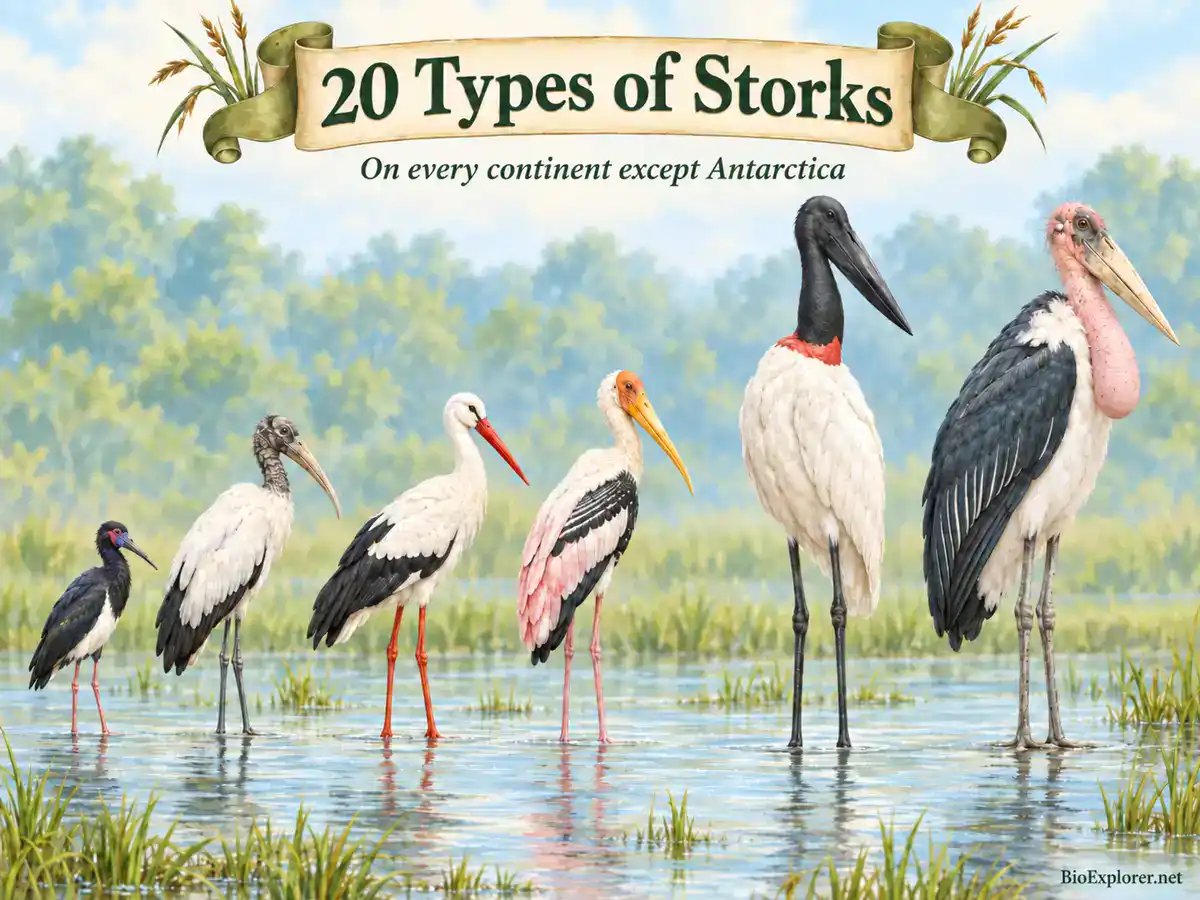
Storks are big, long-legged birds that most people know from one story: the bird that brings babies. There are 20 living species, and they live on every continent except Antarctica. The smallest could perch on your forearm. The largest has a wingspan wider than a grown man is tall.
This guide covers all 20 types of storks. For each one you will find a picture, where it lives, how big it gets and one fact worth remembering. You will also learn why the count changed from 19 to 20, and why the only stork that nests in the United States came off the endangered species list in 2026.
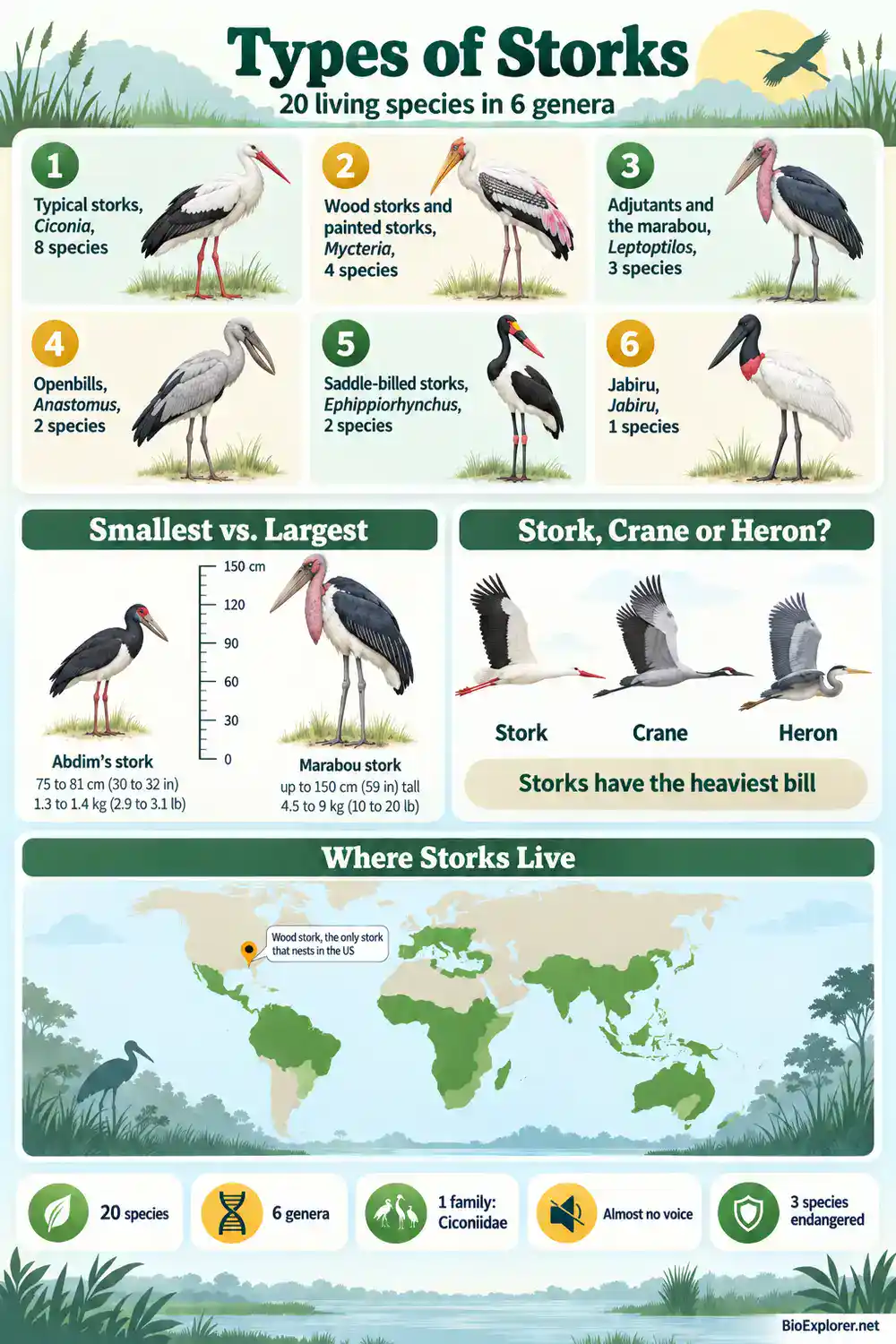
There are 20 living species of storks, all in the family Ciconiidae. They fall into 6 genera. The largest group is Ciconia, with 8 species. Many older sources still say 19, because they were written before the woolly-necked stork was split into an African and an Asian species.
Stork Types:
- How Many Types of Storks Are There?
- The Woolly-Necked Stork Became Two Species
- What Is a Stork?
- Storks vs Cranes vs Herons
- Typical Storks (Genus Ciconia)
- Wood Storks and Painted Storks (Genus Mycteria)
- Openbills (Genus Anastomus)
- Adjutants and the Marabou (Genus Leptoptilos)
- Saddle-Billed Storks (Genus Ephippiorhynchus)
- The Jabiru (Genus Jabiru)
- Storks in the United States
- Storks From Smallest to Largest
- Do Storks Really Deliver Babies?
- What Do Storks Eat?
- Where Do Storks Live?
- Storks by Year of Classification
- Are Storks Endangered?
- Frequently Asked Questions
How Many Types of Storks Are There?
Scientists recognize 20 living species of storks. The major global checklists agree on that number: the IOC World Bird List, the Clements and eBird checklist, BirdLife International and AviList.
You will still see 19 in a lot of places. That older count comes from treating the woolly-necked stork as a single species. Even the IUCN’s own stork specialist group still lists 19 on its species page, with a note that the page will be updated.
| Genus | Common name of the group | Species |
|---|---|---|
| Ciconia | Typical storks | 8 |
| Mycteria | Wood storks and painted storks | 4 |
| Leptoptilos | Adjutants and the marabou | 3 |
| Anastomus | Openbills | 2 |
| Ephippiorhynchus | Saddle-billed storks | 2 |
| Jabiru | Jabiru | 1 |
| Total | 6 genera | 20 |
The Woolly-Necked Stork Became Two Species
For most of the last century, one stork carried the name woolly-necked stork across both Africa and Asia. The two populations never meet, and they do not look the same: the African bird has a feathered black face and dark legs, while the Asian bird has bare bluish skin on its face, a neat black cap and orange-red legs.
BirdLife International treated them as separate species in 2014. The eBird and Clements checklist followed in 2022, and the IOC World Bird List in 2023. A 2025 study that sequenced DNA from museum specimens found the two are genetically distinct sister groups, which supports the split.
That is why the count moved from 19 to 20. It also matters for conservation, because the two birds are doing very different things. The African woolly-necked stork is listed as Least Concern and increasing. The Asian woolly-necked stork is Near Threatened.
What Is a Stork?
A stork is a large wading bird in the family Ciconiidae, the only living family in the order Ciconiiformes, with long legs, a long neck and a heavy, straight or slightly curved bill. Storks fly with the neck stretched out and the legs trailing behind, and they ride thermals like birds of prey, which is how the migratory species cross continents without flapping much.
Storks Have Almost No Voice
Most storks have little or no voice. The syrinx, the organ birds use to make sound, is poorly developed in the family, so adults rarely call. Instead they clatter their bills, rattling the two halves together in a sound that carries across a colony.
Built to Cool Down
Storks stand in open sun for hours. Several species aim their wings at the sun or hold them out from the body, and a classic 1971 study described these spread-wing postures across the family and linked them to temperature control and to shading the nest. Some storks, including the marabou, also squirt liquid droppings onto their own legs to cool off, a habit they share with New World vultures.
Storks vs Cranes vs Herons
Three families of tall wading birds get mixed up constantly, and they sit in three different orders among the types of birds. The easiest way to tell them apart is to watch them fly.
| Feature | Storks | Cranes | Herons and egrets |
|---|---|---|---|
| Neck in flight | Stretched out straight | Stretched out straight | Folded back in an S |
| Bill | Heavy, thick at the base | Straight and more slender | Long, thin and dagger-like |
| Voice | Almost none, they clatter their bills | Loud bugling calls | Harsh croaks and squawks |
| Nest | Usually stick platforms in trees or on buildings; a few species use reeds or the ground | On the ground | Sticks in trees or reeds |
| Family | Ciconiidae | Gruidae | Ardeidae |
So a big bird flying with its neck folded into an S is a heron. If the neck is straight out, it is a stork or a crane, and the bill settles it: storks carry a much heavier bill. Cranes sit in a different order altogether, the order Gruiformes, alongside rails and sungrebes.
No. The shoebill is often called the shoebill stork, but it sits in its own family, Balaenicipitidae, and is closer to pelicans. Some stork lists on the web include it, which is one way they reach 20 species while leaving a real stork out.
Typical Storks (Genus Ciconia)
Ciconia is the largest group of storks, with 8 species. It includes the white stork of European rooftops and the black stork of quiet forests. These are the birds most people picture when they hear the word stork.
The group spans 4 continents. One species, the maguari stork, lives in South America, and the rest are spread across Europe, Africa and Asia.
White Stork
| Kingdom | Order | Family | Genus | Species |
|---|---|---|---|---|
| Animalia | Ciconiiformes | Ciconiidae | Ciconia | Ciconia ciconia |
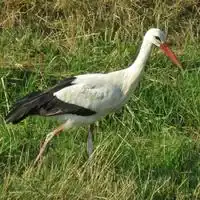
The white stork breeds across Europe, North Africa and western Asia. Most eastern European birds winter in eastern and southern Africa, while the smaller Central Asian population winters from Iran and Pakistan into India.
A growing share of the western population now stops in Iberia or North Africa, and some stay near the breeding grounds all year. It is a soaring migrant, so it avoids long sea crossings: western birds funnel over the Strait of Gibraltar and eastern birds over the Bosphorus. Storks leaving Poland can cover about 12,000 km (7,500 mi) in 30 to 40 days.[20]
Adults measure 95 to 110 cm (37 to 43 in) long, span 180 to 218 cm (71 to 86 in) and weigh 2.5 to 4.4 kg (5.5 to 9.7 lb). They feed in wet meadows and pasture on insects, earthworms, frogs, lizards, small mammals and fish. Pairs build huge stick nests on roofs, chimneys and church towers, and since the 1970s more and more on electricity poles.
This is the bird behind the story that storks deliver babies. It is also the bird that proved where storks go in winter. In May 1822, a white stork was shot near Klutz in Germany with an 80 cm (31 in) African arrow through its neck. The Pfeilstorch, or arrow stork, is still on display at the University of Rostock.
Carl Linnaeus, the Swedish naturalist behind modern scientific naming, described white stork in 1758.
Black Stork
| Kingdom | Order | Family | Genus | Species |
|---|---|---|---|---|
| Animalia | Ciconiiformes | Ciconiidae | Ciconia | Ciconia nigra |
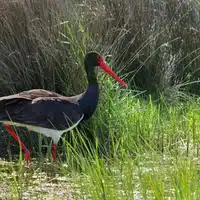
The black stork breeds in a broad band from Spain across central and eastern Europe to China, with a separate resident population in southern Africa. Most birds winter in tropical Africa or from Pakistan across northern India into China. It relies less on thermals than the white stork, so it crosses the Alps and large lakes more readily.[22]
Adults measure 95 to 100 cm (37 to 39 in) long, span 185 to 200 cm (73 to 79 in) and weigh about 3 kg (6.6 lb). The plumage is black with green and purple sheen, set against a white belly and a bright red bill, legs and eye ring. It hunts fish by stalking shaded forest streams and pools.
It is the shy opposite of the white stork. Where the white stork nests on rooftops, the black stork nests deep inside quiet old forest and abandons a nest if people come too close. That sensitivity has made it a flagship for forest protection in Europe.
Carl Linnaeus described black stork in 1758.
Abdim’s Stork
| Kingdom | Order | Family | Genus | Species |
|---|---|---|---|---|
| Animalia | Ciconiiformes | Ciconiidae | Ciconia | Ciconia abdimii |
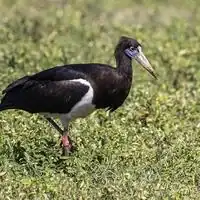
Abdim’s stork breeds across the Sahel and the Horn of Africa during the northern rains, then crosses the equator to spend the southern rainy season in Zimbabwe, Botswana, Namibia and South Africa. It arrives in the south between October and December and leaves by early April, wandering wherever storms bring insects out.[24]
At 75 to 81 cm (30 to 32 in) long, about 140 cm (55 in) across the wings and 1.3 to 1.4 kg (2.9 to 3.1 lb), it is the smallest stork. It is glossy blackish with a clean white belly, red and blue bare skin on the face and pink knees and feet. Flocks feed on pasture and cropland, taking grasshoppers, locusts, caterpillars and termites.
It is the smallest of all storks, and it follows rain for a living. Flocks appear wherever a storm triggers a hatch of grasshoppers or locusts, which is why farmers across Africa often see them arrive with the weather.
Martin Lichtenstein, a German zoologist who ran the Berlin Zoological Museum, described Abdim’s stork in 1823.
African Woolly-Necked Stork
| Kingdom | Order | Family | Genus | Species |
|---|---|---|---|---|
| Animalia | Ciconiiformes | Ciconiidae | Ciconia | Ciconia microscelis |
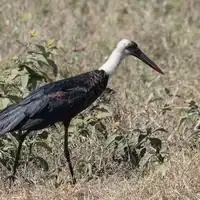
This stork lives in 38 countries across sub-Saharan Africa, from Senegal and Ethiopia south to South Africa. It is mostly resident, though it makes local north and south movements and sometimes gathers in flocks of several hundred. It uses rivers, floodplains, marshes and dams, and also rice fields, flooded pasture and golf courses.[25]
Adults measure 86 to 95 cm (34 to 37 in) long. The body is glossy black with blue, green and purple sheen, offset by a woolly white neck and white undertail. Its face is feathered black and its legs are dark, which separates it from the bare-faced, red-legged Asian bird. It eats fish, frogs, snakes, crabs and large insects.
It is quietly becoming a suburban bird. In a KwaZulu-Natal study in South Africa, 71 percent of households surveyed fed woolly-necked storks in their gardens every day of the year, and researchers found 30 active nests in suburban gardens.
George Robert Gray, an English zoologist at the British Museum, described it in 1848. The woolly-necked stork was split into 2 species, and this is the African one.
Asian Woolly-Necked Stork
| Kingdom | Order | Family | Genus | Species |
|---|---|---|---|---|
| Animalia | Ciconiiformes | Ciconiidae | Ciconia | Ciconia episcopus |
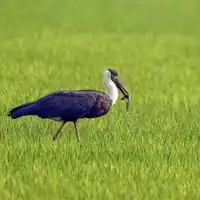
The Asian woolly-necked stork ranges patchily from Pakistan across India, Nepal and Sri Lanka into Myanmar, Thailand, Cambodia, Malaysia, Sumatra and Java. South Asia holds most of the world population and looks stable, while numbers in Southeast Asia have collapsed since the mid 1900s. It is now near extinction in Thailand and appears to be gone from Luzon in the Philippines.[26]
Adults measure 86 to 95 cm (34 to 37 in) long and weigh about 2 kg (4.4 lb). The bird is glossy black with a bright white neck, a bald bluish grey face, a neat black cap and orange-red legs. It hunts fish, frogs, snakes, lizards, crabs and large insects in rivers, marshes and rice paddies.
Where big trees are scarce, this stork has started nesting on mobile phone towers. The habit is now recorded from both India and Bangladesh.
Pieter Boddaert, a Dutch physician and naturalist, described Asian Woolly-Necked Stork in 1783. The African population was split off as a separate species, leaving this one as the Asian bird.
Storm’s Stork
| Kingdom | Order | Family | Genus | Species |
|---|---|---|---|---|
| Animalia | Ciconiiformes | Ciconiidae | Ciconia | Ciconia stormi |
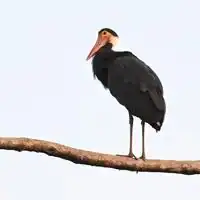
Storm’s stork lives only in the lowland rainforests of southern Thailand, Peninsular Malaysia, Sumatra and Borneo. It keeps to riverside and swamp forest, feeding in wet clearings and on muddy banks, and turns up alone or in small groups rather than in flocks. In Sabah, the Kinabatangan floodplain may hold the last viable population.[46]
It is a small, dark stork, 75 to 91 cm (30 to 36 in) long and about 2.4 kg (5.3 lb), with a white neck, a bright red bill and bare yellow skin around the eye. It hunts fish and other small animals in shallow water. Logging, dams and the spread of oil palm have broken its forest into isolated pockets.
It is one of the world’s rarest storks. Estimates run from a few hundred to under 2,000 mature birds, and it is so hard to find that no reliable global count exists.
Wilhelm Blasius, a German zoologist, described Storm’s stork in 1896.
Maguari Stork
| Kingdom | Order | Family | Genus | Species |
|---|---|---|---|---|
| Animalia | Ciconiiformes | Ciconiidae | Ciconia | Ciconia maguari |
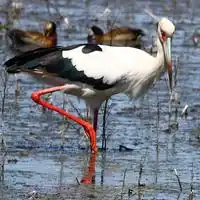
The maguari stork lives in open country across South America east of the Andes, from Venezuela and the Guianas south to central Argentina, and it is commonest in the south. It is not a true migrant, but it disperses widely after breeding, sometimes in flocks of more than 50 birds.[29]
Adults measure 97 to 102 cm (38 to 40 in) long, span 150 to 180 cm (59 to 71 in) and weigh about 3.8 to 4.2 kg (8.4 to 9.3 lb). The plumage is white with black flight feathers, and the bird has pale yellow eyes, red facial skin and a straight bill that is blue-grey at the base and red at the tip. It nests in reedbeds and eats frogs, fish, eels, snakes and insects.
It is the only member of the genus Ciconia in the Americas, and its short, white, forked tail is unlike that of any other stork.
Johann Friedrich Gmelin, a German naturalist, described maguari stork in 1789.
Oriental Stork
| Kingdom | Order | Family | Genus | Species |
|---|---|---|---|---|
| Animalia | Ciconiiformes | Ciconiidae | Ciconia | Ciconia boyciana |
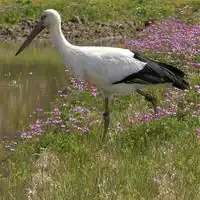
The oriental stork breeds in the Russian Far East and northeastern China and winters mainly in southern China, with small numbers reaching Korea, Japan and Taiwan. The IUCN estimate has been 1,000 to 2,499 mature individuals, though recent winter counts in China have run higher. It feeds in rice paddies and shallow river wetlands and nests in tall trees nearby.[30]
It is about 110 cm (43 in) long with a wingspan near 195 to 220 cm (77 to 87 in) and weighs 4 to 5 kg (8.8 to 11 lb), so it is larger and heavier billed than the white stork. It eats loaches, catfish, frogs, snakes, shellfish and insects, and an adult needs roughly 500 g (18 oz) of food a day.
Japan’s last wild oriental stork died in 1971. Captive breeding finally worked in 1989, releases began in 2005, and by 2017 the country again had 189 birds. Farmers near Toyooka now flood their paddies in winter and sell premium stork-friendly rice, so the market pays for the birds’ food.
Robert Swinhoe, a British naturalist and consul in China, described oriental stork in 1873.
Wood Storks and Painted Storks (Genus Mycteria)
The 4 Mycteria storks all hunt the same way. They wade with the bill held open in the water and snap it shut when prey touches it, so they can fish in water too muddy to see through.
One species lives in the Americas, one in Africa and two in Asia.
Wood Stork
| Kingdom | Order | Family | Genus | Species |
|---|---|---|---|---|
| Animalia | Ciconiiformes | Ciconiidae | Mycteria | Mycteria americana |
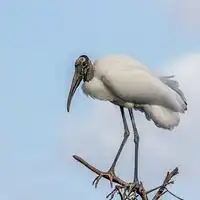
The wood stork is the only stork that breeds in the United States. It nests from Florida north to North Carolina and ranges south through Mexico, Central America and the Caribbean into South America. Colonies sit in cypress and black gum trees standing in water, which keeps raccoons away from the nests.[13]
Adults measure 85 to 115 cm (33 to 45 in) long, span 150 to 165 cm (59 to 65 in) and weigh 1.8 to 2.7 kg (4 to 6 lb). The plumage is white with black flight feathers, and the bare head and thick curved bill give it an unmistakable outline. A breeding pair needs roughly 200 kg (440 lb) of small fish to raise a brood.
It hunts blind. The stork sweeps its open bill through muddy water, and when a fish touches it the bill snaps shut in 25 milliseconds, one of the fastest reflexes known in any vertebrate.
Carl Linnaeus described wood stork in 1758.
Milky Stork
| Kingdom | Order | Family | Genus | Species |
|---|---|---|---|---|
| Animalia | Ciconiiformes | Ciconiidae | Mycteria | Mycteria cinerea |
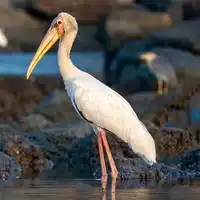
The milky stork is a coastal specialist of Southeast Asia, living in the mangroves and brackish swamps of Indonesia and Peninsular Malaysia, with an inland population around Cambodia’s Tonle Sap. It feeds on tidal mudflats, in fishponds and in rice fields, and needs tall mature trees for nesting.[32]
Adults are 95 to 100 cm (37 to 39 in) long and weigh about 2.4 kg (5.3 lb). The plumage is creamy white with black flight feathers, and the bare face is dark red. Like other Mycteria storks it fishes by feel, wading with its bill open in the water. About 1,500 mature birds remain.
In Malaysia’s Matang mangroves, counts fell from more than 100 birds in 1984 to a single wild bird in 2010. In Thailand it is extinct as a breeding bird, and one captive flock is being managed for a possible reintroduction.
Stamford Raffles, the British colonial administrator and naturalist who founded Singapore, described milky stork in 1822.
Yellow-Billed Stork
| Kingdom | Order | Family | Genus | Species |
|---|---|---|---|---|
| Animalia | Ciconiiformes | Ciconiidae | Mycteria | Mycteria ibis |
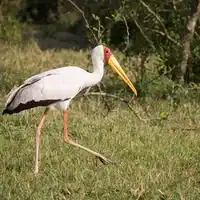
The yellow-billed stork is the African member of the Mycteria group and lives across most of sub-Saharan Africa on lakes, rivers and estuaries. In one survey of 35 reservoirs in northern Ethiopia, it turned up on the deeper water bodies rather than the shallow ones.[47]
Adults measure 95 to 105 cm (37 to 41 in) long, span 150 to 165 cm (59 to 65 in) and weigh about 1.9 to 2.3 kg (4.2 to 5.1 lb). It is white with black flight feathers and a pink wash in the breeding season, a bare red face and a long yellow bill that curves slightly down. It fishes by feel in shallow water.
It is the wood stork’s African twin. Same genus, same touch hunting, same bare face, but with a banana-yellow bill and a scarlet face instead of the wood stork’s all-dark head.
Carl Linnaeus described yellow-billed stork in 1766.
Painted Stork
| Kingdom | Order | Family | Genus | Species |
|---|---|---|---|---|
| Animalia | Ciconiiformes | Ciconiidae | Mycteria | Mycteria leucocephala |
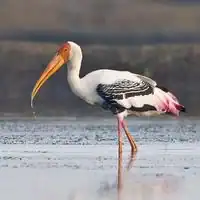
The painted stork is the most numerous stork in South Asia, common across India and Sri Lanka and thinning out eastwards, where it is now rare in Thailand, Laos, Vietnam and southern China. India’s Keoladeo National Park, a man-made wetland managed with dykes and sluices, is one of its key breeding sites and can hold more than 20,000 nesting waterbirds.
Adults measure 93 to 102 cm (37 to 40 in) long, span 145 to 160 cm (57 to 63 in) and weigh 3.2 to 3.5 kg (7 to 7.7 lb). The bird is white with a black breast band, a yellow bill and bare orange facial skin. South Asia holds an estimated 15,000 to 25,000 birds, with fewer than 10,000 in Southeast Asia.
Its name comes from the rosy pink feathers that drape over the folded wing like a sash, the most colorful plumage in the stork family.
Thomas Pennant, a Welsh naturalist, described painted stork in 1769.
Openbills (Genus Anastomus)
The 2 openbills are named for a gap that stays open even when the bill is closed. Both species specialize heavily on freshwater molluscs, especially snails.
Asian Openbill
| Kingdom | Order | Family | Genus | Species |
|---|---|---|---|---|
| Animalia | Ciconiiformes | Ciconiidae | Anastomus | Anastomus oscitans |
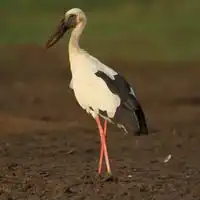
The Asian openbill is a colonial waterbird of South and Southeast Asia, from India and Sri Lanka east to Cambodia. It has spread fast since a population boom on Thailand’s Chao Phraya River in 1997, reaching China in 2006 and the Malay Peninsula in 2008. One satellite-tracked bird flew from Mengzi in China to Thailand in 18 days.[36]
It is about 81 cm (32 in) long, spans roughly 148 cm (58 in) and weighs about 1.4 kg (3 lb). Apple snails make up most of its diet, with crabs, frogs, fish and large insects to fill out the menu. Colonies sit close to villages, farmland and water, and in Nepal larger nest trees produce more fledglings.
Its bill does not close. Even when shut, the two halves leave a visible gap. Despite the look of it, the bird does not crack shells with that gap: it holds the snail, works a mandible tip into the shell and pulls the animal out.
Pieter Boddaert described Asian openbill in 1783.
African Openbill
| Kingdom | Order | Family | Genus | Species |
|---|---|---|---|---|
| Animalia | Ciconiiformes | Ciconiidae | Anastomus | Anastomus lamelligerus |
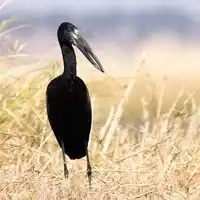
The African openbill lives on lakes, reservoirs and marshes across sub-Saharan Africa, with a second subspecies on Madagascar. It moves around within Africa rather than migrating out of it, following seasonal flooding and the snail beds that come with it.[34]
It is a small stork, 80 to 94 cm (31 to 37 in) long, spanning about 140 cm (55 in) and weighing 1 to 1.3 kg (2.2 to 2.9 lb). The plumage is glossy blackish with a sheen that shifts in the light, and the bill is pale horn colored. Freshwater snails and mussels make up the bulk of the diet.
Two storks on two continents ended up with the same broken-looking bill for the same reason. Both openbills use it to grip a snail and extract the animal from its shell.
Coenraad Jacob Temminck, a Dutch zoologist and the first director of the natural history museum in Leiden, described African openbill in 1823.
Adjutants and the Marabou (Genus Leptoptilos)
The 3 Leptoptilos storks are the giants of the family. All have bare heads and necks, all scavenge, and all have learned to feed at rubbish dumps. The marabou lives in Africa, the 2 adjutants in Asia.
Marabou Stork
| Kingdom | Order | Family | Genus | Species |
|---|---|---|---|---|
| Animalia | Ciconiiformes | Ciconiidae | Leptoptilos | Leptoptilos crumenifer |
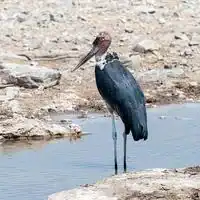
The marabou stork is the giant of the family, found across sub-Saharan Africa from Senegal east to Kenya and south to Zimbabwe. It prefers dry savanna and grassland near water, but it has also moved into cities. In Kampala, Uganda, urban marabous live largely on human refuse, and studies of their gut bacteria show they have adjusted to that diet.[7]
It stands up to about 150 cm (59 in) tall with a wingspan of 225 to 285 cm (89 to 112 in) and weighs 4.5 to 9 kg (10 to 20 lb). The bare head and neck are scavenging equipment. It eats carrion, but also fish, frogs, snakes, rats, crocodile eggs, flamingos, termites and locusts.
The pink sac hanging from its throat is not a food pouch. It is an inflatable air sac up to 35 cm (14 in) long, used in courtship and dominance displays, for cooling off and for making sound. Its wingspan, measured to about 3.2 m (10.5 ft) in the largest birds, is among the widest of any land bird.
Rene-Primevere Lesson, a French naval surgeon and naturalist, described marabou stork in 1831. Its name is often spelled crumeniferus, but crumenifer is the correct form.
Lesser Adjutant
| Kingdom | Order | Family | Genus | Species |
|---|---|---|---|---|
| Animalia | Ciconiiformes | Ciconiidae | Leptoptilos | Leptoptilos javanicus |
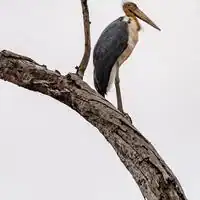
The lesser adjutant stork has the widest range of the three adjutants, from India, Nepal and Sri Lanka east through Myanmar and Thailand to Malaysia and Indonesia. It uses big rivers and lakes inside wooded country, wetlands in farmland, and coastal mudflats and mangroves.[17]
Adults measure 110 to 120 cm (43 to 47 in) long, span 200 to 210 cm (79 to 83 in) and weigh about 5 kg (11 lb). Like the other adjutants it has a bare head and a heavy bill, and it eats fish, frogs, reptiles and invertebrates and will scavenge. The world population is estimated at roughly 5,000 to 15,000 birds, with about 1,500 pairs in Cambodia.
It sat on the Vulnerable list for nearly 30 years before being downlisted in 2023. The change came from better survey coverage, not from the bird recovering.
Thomas Horsfield, an American physician and naturalist working in Java, described lesser adjutant stork in 1821.
Greater Adjutant
| Kingdom | Order | Family | Genus | Species |
|---|---|---|---|---|
| Animalia | Ciconiiformes | Ciconiidae | Leptoptilos | Leptoptilos dubius |
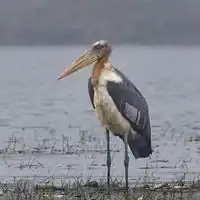
The greater adjutant stork once ranged from northern India to Vietnam. Today it breeds in Assam and Bihar in India and in Cambodia, a fraction of the population of the late 1800s, though numbers in Assam have risen sharply in the last 20 years and Bihar now holds a growing colony along the Kosi floodplain. It nests in tall trees with dense canopies, often on private land in villages, and feeds at wetlands and rubbish dumps.[8]
It is a huge, bare-headed scavenging stork, 120 to 152 cm (47 to 60 in) long with a wingspan of about 250 cm (98 in), and the Asian counterpart of the marabou. It takes carrion, fish, frogs, reptiles and refuse. Wetland drainage, felling of nest trees and pollution drove the collapse.
Its comeback in Assam is the work of Dr. Purnima Devi Barman and her all-women Hargila Army, who turned villagers with nest trees into protectors. Assam’s population has quadrupled, the bird moved from Endangered to Near Threatened in December 2023, and Barman won the Whitley Gold Award in 2024.
Johann Friedrich Gmelin described greater adjutant stork in 1789.
Saddle-Billed Storks (Genus Ephippiorhynchus)
These 2 storks carry huge red and black bills and are among the tallest birds in their range. One lives in Africa and one from India to Australia. In both species, females have yellow eyes and males have dark brown eyes, so you can tell them apart in the field.
Saddle-Billed Stork
| Kingdom | Order | Family | Genus | Species |
|---|---|---|---|---|
| Animalia | Ciconiiformes | Ciconiidae | Ephippiorhynchus | Ephippiorhynchus senegalensis |
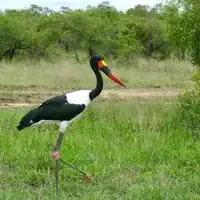
The saddle-billed stork is scattered across sub-Saharan Africa but is tied to large permanent rivers, lakes and floodplains, and adults usually stay put year round. It has disappeared from parts of West Africa and is now sparse and patchy there, and East African numbers are falling. South Africa holds only about 160 mature birds, roughly 100 of them in Kruger National Park.[40]
It is one of Africa’s largest storks at 145 to 150 cm (57 to 59 in) long, with a wingspan of 240 to 270 cm (94 to 106 in) and a weight of 6.3 to 7.5 kg (14 to 17 lb). It hunts fish, frogs and insects in shallow water and soars on flat wings. Pairs stay together across seasons and build large treetop nests.
You can sex this stork at a glance: females have a yellow eye, males a dark brown one. Nesting is almost always high in a tree, so a 2024 record of a pair nesting on the ground in Zambia was a first for the species.
George Shaw, an English zoologist at the British Museum, described saddle-billed stork in 1800.
Black-Necked Stork
| Kingdom | Order | Family | Genus | Species |
|---|---|---|---|---|
| Animalia | Ciconiiformes | Ciconiidae | Ephippiorhynchus | Ephippiorhynchus asiaticus |
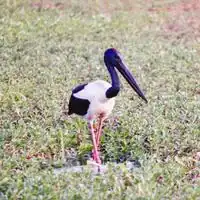
Black-necked stork is the only stork native to Australia. It ranges from India east through Southeast Asia to New Guinea and northern and eastern Australia, in 2 subspecies. It lives on floodplain wetlands, swamps, billabongs and farm dams, and pairs hold enormous territories. In New South Wales, where about 75 breeding pairs remain, a good territory covers thousands of hectares.[42]
Adults measure 110 to 137 cm (43 to 54 in) long and span about 230 cm (91 in), and weigh roughly 4.1 kg (9 lb). The body is white with a black tail and a massive black bill, and the head and neck shine iridescent green and purple above coral red legs. Birds wade in water 5 to 30 cm (2 to 12 in) deep, and eels often supply most of their food.
As in its African cousin, the eye gives the sex away: females are yellow eyed and males dark brown eyed. In Australia the bird is widely, and wrongly, called a jabiru, a name that belongs to the South American stork.
John Latham, an English physician and ornithologist, described black-necked stork in 1790.
The Jabiru (Genus Jabiru)
The jabiru is the only member of its genus and the tallest flying bird in South America.
Jabiru
| Kingdom | Order | Family | Genus | Species |
|---|---|---|---|---|
| Animalia | Ciconiiformes | Ciconiidae | Jabiru | Jabiru mycteria |
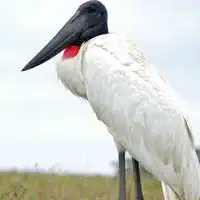
The jabiru is the tallest flying bird in South America. It ranges from southern Mexico to northern Argentina and is most numerous in the Brazilian Pantanal, where it is the regional symbol. It uses seasonally flooded savanna, marshes and coastal lagoons, and gathers at shrinking pools in the dry season.[44]
It reaches about 140 cm (55 in) long with a wingspan of roughly 260 cm (102 in) and a weight near 8 kg (18 lb), and the heavy black bill can be 30 cm (12 in) long. The body is white, the head and neck are bare and black, and a band of scarlet skin circles the base of the neck. Pairs are strongly monogamous and reuse the same huge stick nest for years.
Its wingspan reaches about 2.6 m (8.5 ft), among the widest of any land bird in the Americas and second only to the Andean condor. Pairs greet each other by rattling those enormous bills together while swaying their necks.
Martin Lichtenstein described jabiru in 1819. The name jabiru comes from the Tupi-Guarani languages of South America.
Storks in the United States
Only one stork nests in the United States: the wood stork. It breeds in Florida, Georgia, South Carolina and North Carolina, and the birds that nest there make up what the government calls the Southeast US distinct population segment.It is one of the most distinctive native birds of Florida, and the bird behind one of the country’s quieter conservation wins.
The Wood Stork Came Off the Endangered Species List in 2026
US wood storks fell from thousands of nesting pairs in the 1930s to fewer than 500 by the mid 1990s, and the bird was listed as endangered in 1984. It was downlisted to threatened in 2014. The Fish and Wildlife Service proposed removing the Southeast US population from the list in 2023, and the final rule took effect on March 12, 2026.
At delisting, surveys counted 10,000 to 14,000 nesting pairs at roughly 100 colony sites, more than twice the pairs and more than three times the colonies recorded when the bird was first listed. A 10-year monitoring plan now tracks the population.
Many websites, including some large ones, still describe the wood stork as threatened or endangered in the US. The removal is recent, so older pages have not caught up. The Federal Register rule is the document to check.
The Jabiru Visits Texas
A second stork turns up in the United States now and then. The jabiru, a South American giant, is a rare but repeat visitor and one of the scarcest Texas birds on record: the state had 15 accepted records as of June 2026, with a few more from Oklahoma, Louisiana and Mississippi. Nearly all arrive in late summer, and they are wandering birds from southeastern Mexico, not a US population.
Storks From Smallest to Largest
Storks range from a bird the size of a large chicken to one of the widest-winged land birds alive. Lengths below are from bill tip to tail tip.
| Stork | Length | Wingspan | Weight |
|---|---|---|---|
| Abdim’s Stork | 75 to 81 cm (30 to 32 in) | About 140 cm (55 in) | 1.3 to 1.4 kg (2.9 to 3.1 lb) |
| Storm’s Stork | 75 to 91 cm (30 to 36 in) | Not reported | About 2.4 kg (5.3 lb) |
| African Openbill | 80 to 94 cm (31 to 37 in) | About 140 cm (55 in) | 1 to 1.3 kg (2.2 to 2.9 lb) |
| Asian Openbill | About 81 cm (32 in) | 147 to 149 cm (58 to 59 in) | About 1.4 kg (3.1 lb) |
| Wood Stork | 85 to 115 cm (33 to 45 in) | 150 to 165 cm (59 to 65 in) | 1.8 to 2.7 kg (4 to 6 lb) |
| African Woolly-Necked Stork | 86 to 95 cm (34 to 37 in) | Not reported | Not reported |
| Asian Woolly-Necked Stork | 86 to 95 cm (34 to 37 in) | Not reported | About 2.1 kg (4.6 lb) |
| Painted Stork | 93 to 102 cm (37 to 40 in) | 145 to 160 cm (57 to 63 in) | 3.2 to 3.5 kg (7.1 to 7.7 lb) |
| Black Stork | 95 to 100 cm (37 to 39 in) | 185 to 200 cm (73 to 79 in) | 3 to 3.2 kg (6.6 to 7.1 lb) |
| Milky Stork | 95 to 100 cm (37 to 39 in) | Not reported | About 2.4 kg (5.3 lb) |
| Yellow-Billed Stork | 95 to 105 cm (37 to 41 in) | 150 to 165 cm (59 to 65 in) | 1.9 to 2.3 kg (4.2 to 5.1 lb) |
| White Stork | 95 to 110 cm (37 to 43 in) | 180 to 218 cm (71 to 86 in) | 2.5 to 4.4 kg (5.5 to 9.7 lb) |
| Maguari Stork | 97 to 102 cm (38 to 40 in) | 150 to 180 cm (59 to 71 in) | 3.8 to 4.2 kg (8.4 to 9.3 lb) |
| Oriental Stork | About 110 cm (43 in) | 195 to 220 cm (77 to 87 in) | 4 to 5 kg (8.8 to 11 lb) |
| Lesser Adjutant | 110 to 120 cm (43 to 47 in) | 200 to 210 cm (79 to 83 in) | About 5 kg (11 lb) |
| Black-Necked Stork | 110 to 137 cm (43 to 54 in) | About 230 cm (91 in) | About 4.1 kg (9 lb) |
| Marabou Stork | 120 to 150 cm (47 to 59 in) | 225 to 285 cm (89 to 112 in) | 4.5 to 9 kg (9.9 to 19.8 lb) |
| Greater Adjutant | 120 to 152 cm (47 to 60 in) | About 250 cm (98 in) | Not reported |
| Jabiru | 122 to 140 cm (48 to 55 in) | About 260 cm (102 in) | About 8 kg (17.6 lb) |
| Saddle-Billed Stork | 145 to 150 cm (57 to 59 in) | 240 to 270 cm (94 to 106 in) | 6.3 to 7.5 kg (13.9 to 16.5 lb) |
The smallest stork is Abdim’s stork of Africa, at 75 to 81 cm (30 to 32 in) and about 1.3 kg (2.9 lb). The largest is the marabou stork, which stands up to 150 cm (59 in) tall, weighs up to 9 kg (20 lb) and has been measured with a wingspan of about 3.2 m (10.5 ft), among the widest of any land bird.
Do Storks Really Deliver Babies?
No, but the story has deep roots in European folklore. Several things fed it. The white stork nests on chimneys and rooftops, returns to the same nest every spring and raises its young in full view of the household below. A bird that comes back each year to a family home, at the season when human babies were most often born, made an easy symbol for new life, and the belief spread widely in the 1800s.
The same bird also settled a much older question. Before the 1800s, nobody knew where European storks went in winter. Some naturalists thought they hibernated underwater. In May 1822, a white stork was shot near Klutz in northern Germany with an African hunting arrow, about 80 cm (31 in) long, driven through its neck.
The bird had flown all the way back to Europe with it. That specimen, known as the Pfeilstorch or arrow stork, is still kept at the University of Rostock, and it was the first physical proof that storks migrate to Africa.
What Do Storks Eat?
Storks are carnivores that take whatever their bill is built for. Fish, frogs, snakes, lizards, crabs, snails, large insects and small mammals all appear on the menu. The openbills live mainly on freshwater snails. The adjutants and the marabou scavenge carrion and feed at rubbish dumps.
The wood stork and its Mycteria relatives fish by touch in muddy water, and the white stork works dry meadows for insects and earthworms.
Where Do Storks Live?
Storks live on every continent except Antarctica. Africa and Asia have the most species, Europe has 2 breeding species, and the Americas have 3. Australia has 1.
| Stork | Scientific name | Where it lives | Habitat |
|---|---|---|---|
| Abdim’s Stork | Ciconia abdimii | Sub-Saharan Africa and southwestern Arabia | Savanna, grassland, pasture and cropland |
| African Openbill | Anastomus lamelligerus | Sub-Saharan Africa and Madagascar | Freshwater lakes, reservoirs and marshes |
| African Woolly-Necked Stork | Ciconia microscelis | Sub-Saharan Africa, from Senegal and Ethiopia to South Africa | Rivers, floodplains and marshes in savanna |
| Asian Openbill | Anastomus oscitans | India and Sri Lanka east to Cambodia, spreading into southern China | Lowland marshes, rice paddies and farm ponds |
| Asian Woolly-Necked Stork | Ciconia episcopus | Pakistan and India east to Indonesia | Rivers, marshes, floodplains and rice paddies |
| Black Stork | Ciconia nigra | Europe and Asia, plus a resident population in southern Africa | Old, undisturbed forest with streams and pools |
| Black-Necked Stork | Ephippiorhynchus asiaticus | India and Southeast Asia to New Guinea and Australia | Floodplain wetlands, swamps and farm dams |
| Greater Adjutant | Leptoptilos dubius | Assam and Bihar in India, and Cambodia | Wetlands with tall nest trees, and rubbish dumps |
| Jabiru | Jabiru mycteria | Southern Mexico to northern Argentina | Seasonally flooded savanna, marshes and lagoons |
| Lesser Adjutant | Leptoptilos javanicus | India and Nepal east to Indonesia | Wooded wetlands, big rivers and coastal mangroves |
| Maguari Stork | Ciconia maguari | South America east of the Andes, from Venezuela to central Argentina | Freshwater marshes, flooded pasture and rice fields |
| Marabou Stork | Leptoptilos crumenifer | Sub-Saharan Africa | Dry savanna and grassland near water, plus towns and dumps |
| Milky Stork | Mycteria cinerea | Indonesia, Peninsular Malaysia and Cambodia | Coastal mangrove and brackish swamp |
| Oriental Stork | Ciconia boyciana | Russian Far East and northeastern China; winters in southern China | Rice paddies, river wetlands and nearby tall trees |
| Painted Stork | Mycteria leucocephala | India and Sri Lanka east to Cambodia and southern China | Freshwater marshes, reservoirs and managed wetlands |
| Saddle-Billed Stork | Ephippiorhynchus senegalensis | Sub-Saharan Africa | Large rivers, lakes, floodplains and swamps |
| Storm’s Stork | Ciconia stormi | Southern Thailand, Peninsular Malaysia, Sumatra and Borneo | Lowland rainforest and peat swamp forest |
| White Stork | Ciconia ciconia | Europe, North Africa and western Asia; winters in Africa and India | Wet meadows, grassland and farmland |
| Wood Stork | Mycteria americana | Southeastern United States to South America | Freshwater wetlands that dry down seasonally |
| Yellow-Billed Stork | Mycteria ibis | Most of sub-Saharan Africa | Lakes, rivers and estuaries |
Storks by Year of Classification
The table below shows when each stork was first described and by whom. Carl Linnaeus named 4 of them himself.
| Stork | Scientific name | Year | Described by | Profession |
|---|---|---|---|---|
| Black Stork | Ciconia nigra | 1758 | Carl Linnaeus | Swedish naturalist |
| White Stork | Ciconia ciconia | 1758 | Carl Linnaeus | Swedish naturalist |
| Wood Stork | Mycteria americana | 1758 | Carl Linnaeus | Swedish naturalist |
| Yellow-Billed Stork | Mycteria ibis | 1766 | Carl Linnaeus | Swedish naturalist |
| Painted Stork | Mycteria leucocephala | 1769 | Thomas Pennant | Welsh naturalist |
| Asian Openbill | Anastomus oscitans | 1783 | Pieter Boddaert | Dutch physician and naturalist |
| Asian Woolly-Necked Stork | Ciconia episcopus | 1783 | Pieter Boddaert | Dutch physician and naturalist |
| Greater Adjutant | Leptoptilos dubius | 1789 | Johann Friedrich Gmelin | German naturalist |
| Maguari Stork | Ciconia maguari | 1789 | Johann Friedrich Gmelin | German naturalist |
| Black-Necked Stork | Ephippiorhynchus asiaticus | 1790 | John Latham | English physician and ornithologist |
| Saddle-Billed Stork | Ephippiorhynchus senegalensis | 1800 | George Shaw | English zoologist |
| Jabiru | Jabiru mycteria | 1819 | Martin Lichtenstein | German zoologist |
| Lesser Adjutant | Leptoptilos javanicus | 1821 | Thomas Horsfield | American physician and naturalist |
| Milky Stork | Mycteria cinerea | 1822 | Stamford Raffles | British naturalist |
| Abdim’s Stork | Ciconia abdimii | 1823 | Martin Lichtenstein | German zoologist |
| African Openbill | Anastomus lamelligerus | 1823 | Coenraad Jacob Temminck | Dutch zoologist |
| Marabou Stork | Leptoptilos crumenifer | 1831 | Rene-Primevere Lesson | French naval surgeon and naturalist |
| African Woolly-Necked Stork | Ciconia microscelis | 1848 | George Robert Gray | English zoologist |
| Oriental Stork | Ciconia boyciana | 1873 | Robert Swinhoe | British naturalist |
| Storm’s Stork | Ciconia stormi | 1896 | Wilhelm Blasius | German zoologist |
Are Storks Endangered?
Most storks are not endangered, but 3 species are. Storm’s stork, the milky stork and the oriental stork are all listed as Endangered, and all 3 are Asian birds losing wetland and forest habitat. Four more are Near Threatened.
There is good news too. The greater adjutant and the lesser adjutant were both downlisted in 2023, and the painted stork moved to Least Concern in the same update. In 2025 the black-necked stork improved to Least Concern, while the saddle-billed stork slipped to Near Threatened.
| IUCN status | Species | Storks |
|---|---|---|
| Endangered | 3 | Milky Stork, Oriental Stork, Storm’s Stork |
| Near Threatened | 4 | Asian Woolly-Necked Stork, Greater Adjutant, Lesser Adjutant, Saddle-Billed Stork |
| Least Concern | 13 | Abdim’s Stork, African Openbill, African Woolly-Necked Stork, Asian Openbill, Black Stork, Black-Necked Stork, Jabiru, Maguari Stork, Marabou Stork, Painted Stork, White Stork, Wood Stork, Yellow-Billed Stork |
Frequently Asked Questions
There are 20 living species of storks in 6 genera. Older sources say 19, because the woolly-necked stork was counted as one species before it was split into an African and an Asian species.
The marabou stork of Africa. It stands up to 150 cm (59 in) tall, weighs up to 9 kg (20 lb), and the largest birds have a wingspan of about 3.2 m (10.5 ft).
Abdim’s stork of Africa, at 75 to 81 cm (30 to 32 in) long and about 1.3 kg (2.9 lb).
Yes. The wood stork nests in Florida, Georgia, South Carolina and North Carolina. The jabiru also turns up in Texas every few years as a rare visitor.
No. It was removed from the US endangered species list in a rule that took effect on March 12, 2026, after the population grew to 10,000 to 14,000 nesting pairs.
No. The story comes from the white stork, which nests on rooftops in Europe and returns to the same nest every spring, so it became a symbol of new life.
Both fly with the neck stretched out, but storks have much heavier bills and usually nest on raised stick platforms, while cranes have slender bills, loud bugling calls and usually nest on the ground.
Watch the neck in flight. Herons fold the neck back into an S shape. Storks fly with the neck straight out.
No. The shoebill has a family of its own and is more closely related to pelicans, even though it is often called the shoebill stork.
Storm’s stork of Southeast Asia. Estimates run from a few hundred to under 2,000 mature birds, spread across the rainforests of Sumatra, Borneo and the Malay Peninsula.
Very little. The sound organ is poorly developed in storks, so instead of calling they clatter the two halves of the bill together.
The 2 openbills. Freshwater molluscs, especially snails, make up most of their diet, and their specialized bill tips help them grip a snail and pull the animal out of its shell.
A stork needs somewhere to feed and somewhere safe to nest. Protect one without the other, and the birds still disappear.
Cite this page
BioExplorer. (2026, September 22). Types of Storks: All 20 Species (With Pictures). https://www.bioexplorer.net/animals/birds/storks/
About the author