Why Don’t Poisonous Birds Poison Themselves? One Theory Just Failed a Test
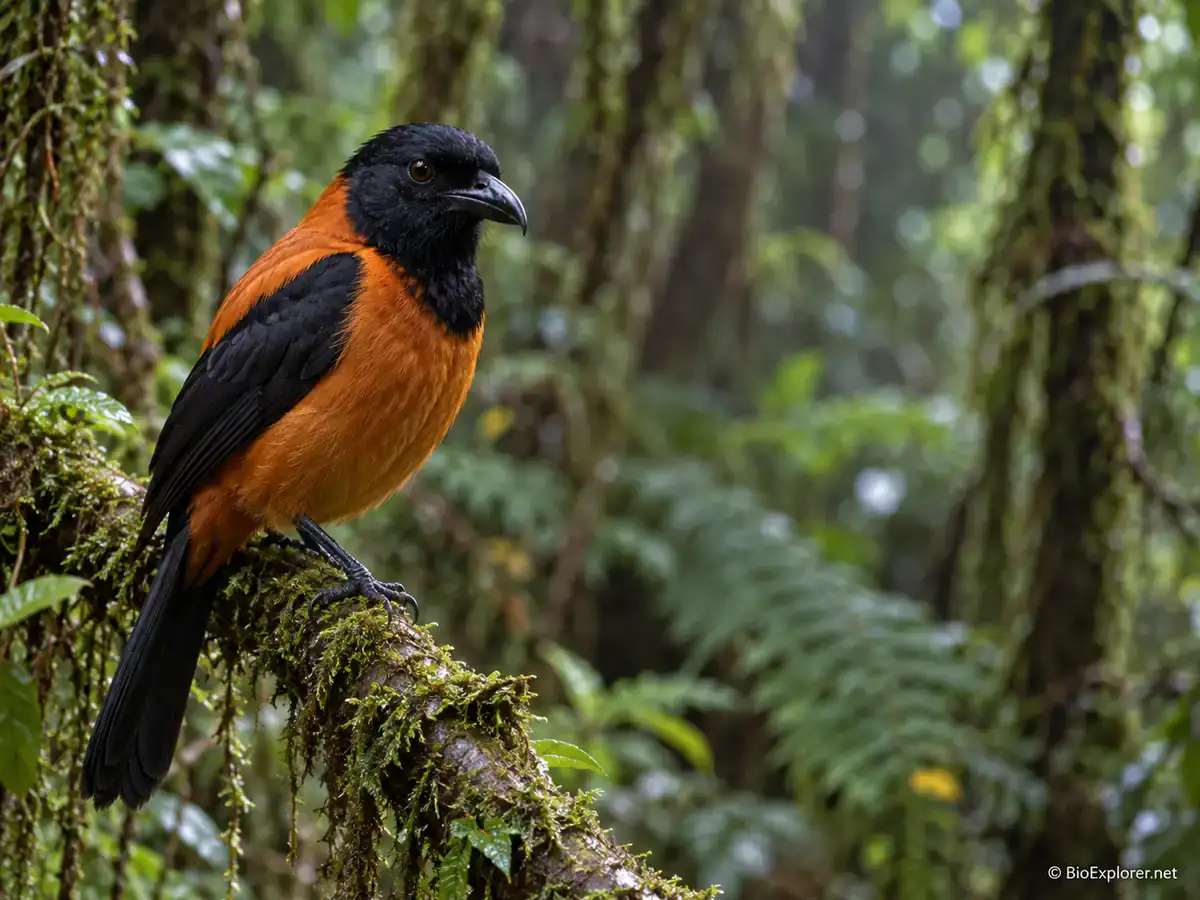
In the forests of New Guinea, a few small songbirds carry some of the most potent toxins known. Researchers who handle pitohuis have ended up sneezing, with numb lips and a burning mouth. People in New Guinea say the meat of some toxic birds burns in the mouth like chili.
These birds carry batrachotoxins, the same family of toxins found in South America’s Phyllobates poison dart frogs. Scientists have long wondered how the birds carry these toxins without poisoning themselves. A 2026 study from the University of California, Los Angeles, has cast serious doubt on one leading explanation.
Fayal Abderemane-Ali, who led the UCLA study, and Kasun Bodawatta, lead author of the earlier study it tested, both spoke with BioExplorer.
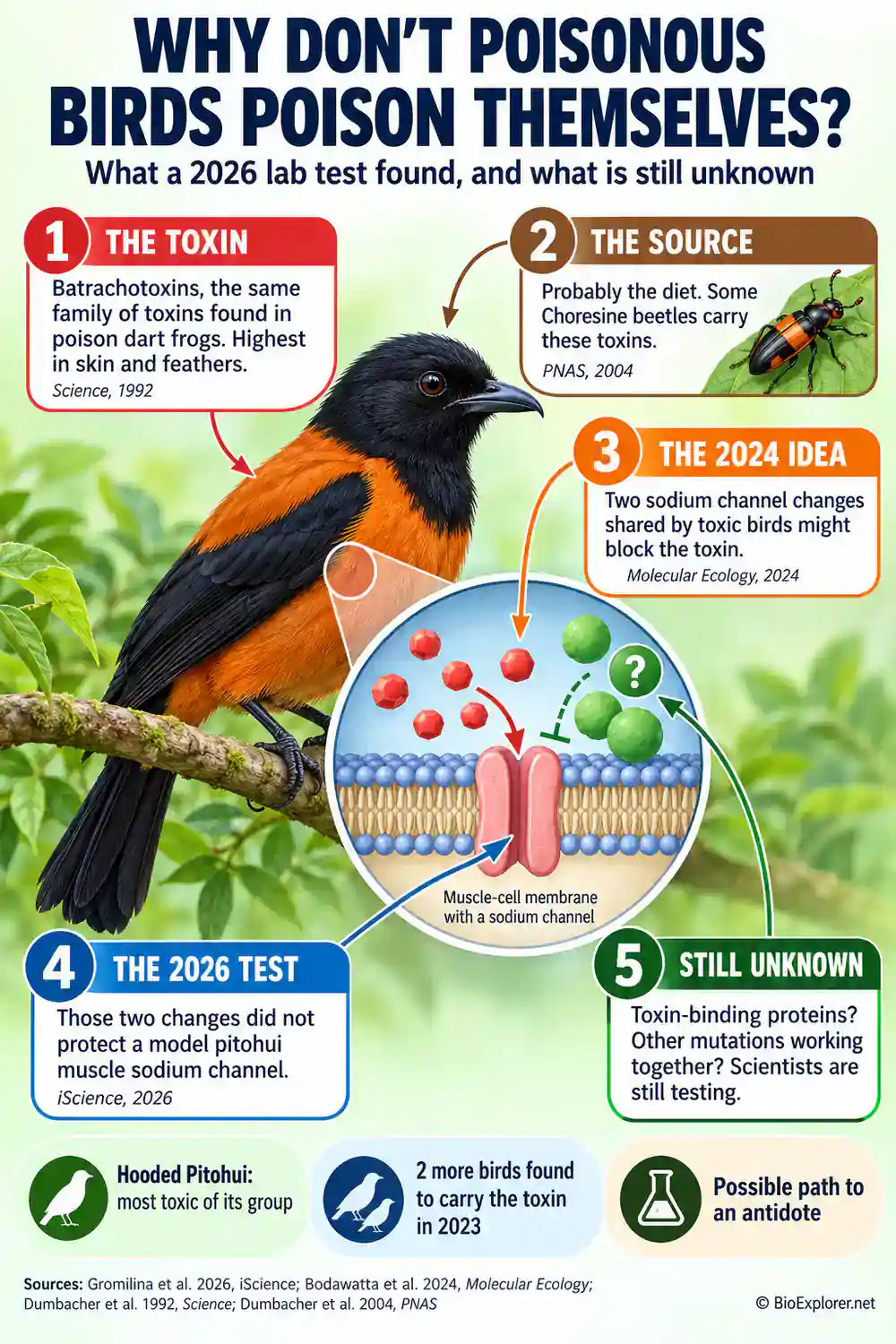
No one knows for sure yet. A 2026 UCLA study found that two proposed protective mutations did not make a pitohui muscle sodium channel resistant to batrachotoxin. That result weakens one specific idea and fits, but does not prove, another: that the birds keep the toxin away from their nerves and muscles.
Jump to:
The Pitohui’s Poison
The story began in 1992, when Jack Dumbacher and colleagues reported in Science that three pitohui species carry homobatrachotoxin. Toxin levels were highest in the birds’ skin and feathers. Until then, batrachotoxins were thought to exist only in Phyllobates poison dart frogs.
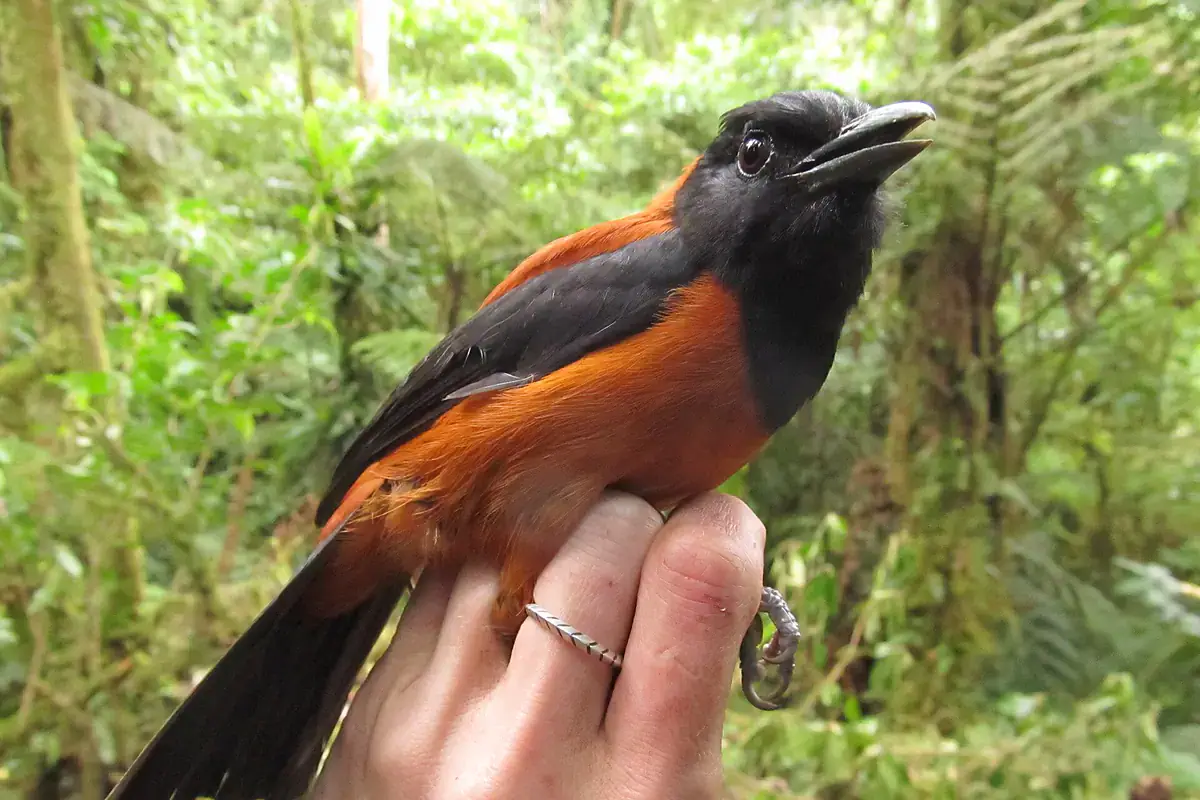
Several other poisonous birds have been found since, but pitohuis remain the classic example. A 2022 review in the Journal of Medical Toxicology names the Hooded Pitohui as the most toxic of its group. The same review says researchers who handle these birds have reported sneezing, numbness and a burning feeling in the mouth.
Batrachotoxin attacks sodium channels, the tiny gates that let nerve cells and muscles fire. The toxin slips inside a channel and holds it open, so sodium keeps flooding into the cell. The University of Copenhagen describes batrachotoxin as 250 times more toxic than strychnine.
Where the Toxin Comes From
Pitohuis do not appear to make batrachotoxin themselves. In a 2004 PNAS study, Dumbacher’s team found high levels of batrachotoxins in small melyrid beetles of the genus Choresine. The researchers also found a Choresine beetle in one pitohui stomach, although it belonged to a different species whose toxin content was not tested.
The beetles remain the leading suspect, but the University of Copenhagen notes that the toxin’s true source has not been confirmed. Borrowing toxins from food is one of many tropical rainforest animal adaptations. Poison dart frogs are also thought to get their toxins from their diet. So what do frogs eat that makes them so toxic?
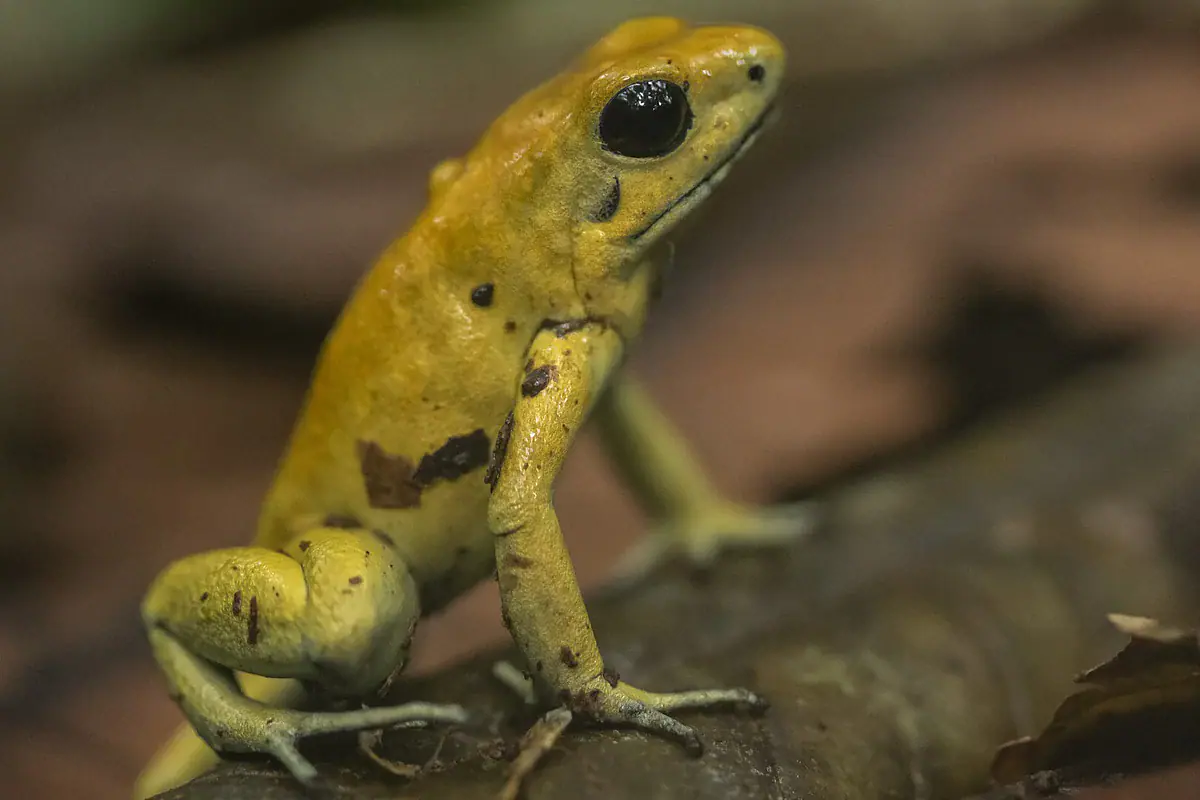
Eating toxic beetles creates a problem, though. A bird that stores a nerve poison in its skin must somehow move or lock away that poison between its gut and its skin. Yet its own nerves and muscles stay safe along the way.
The 2024 Idea
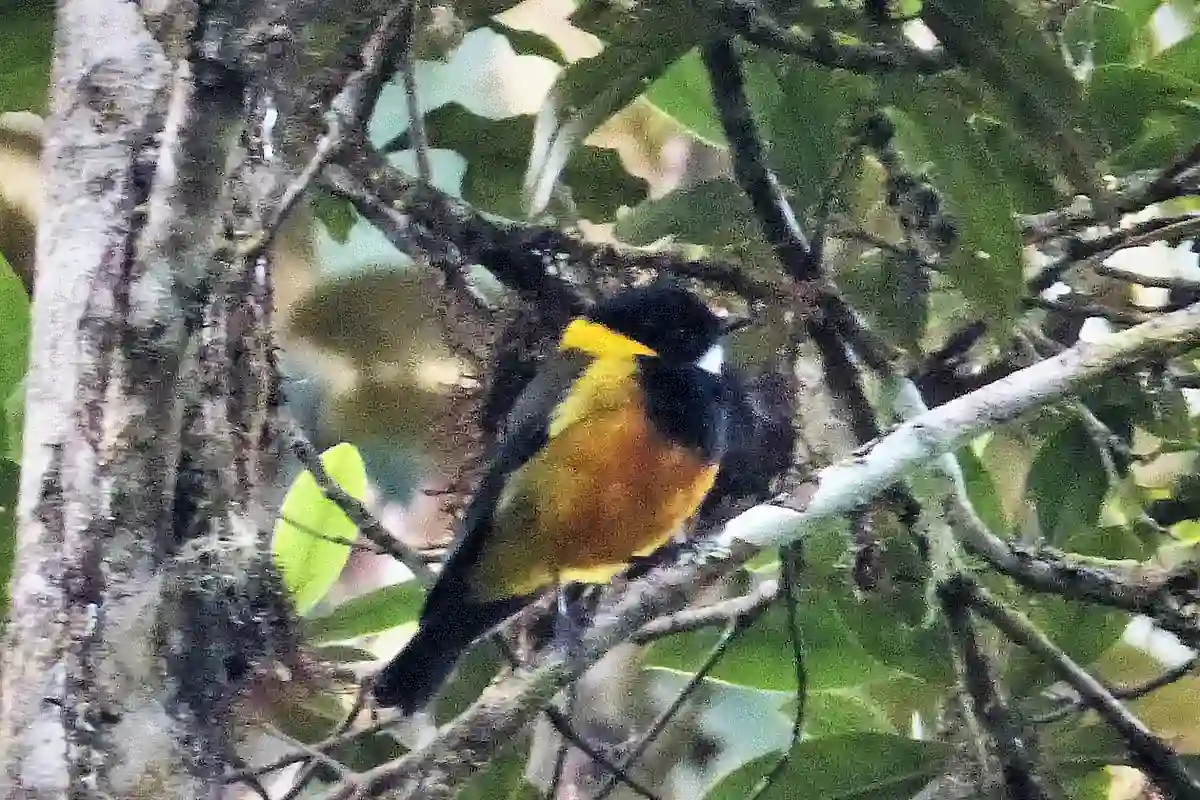
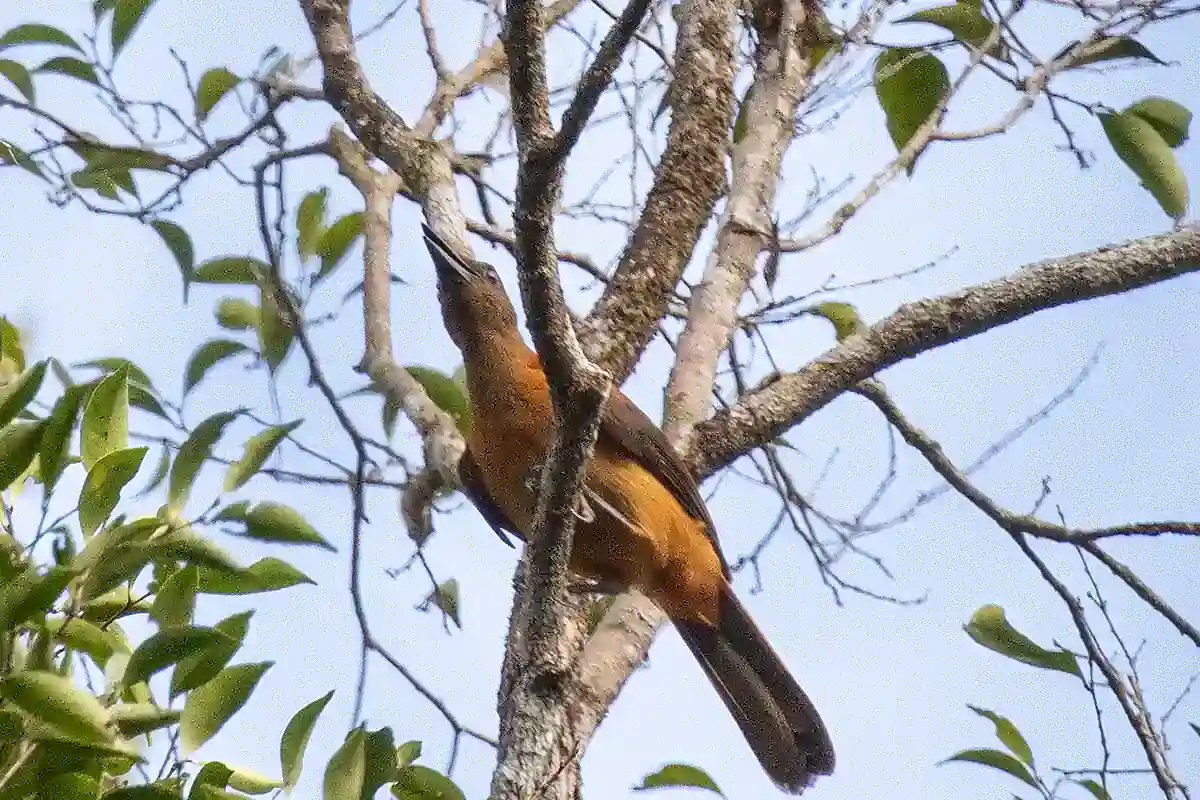
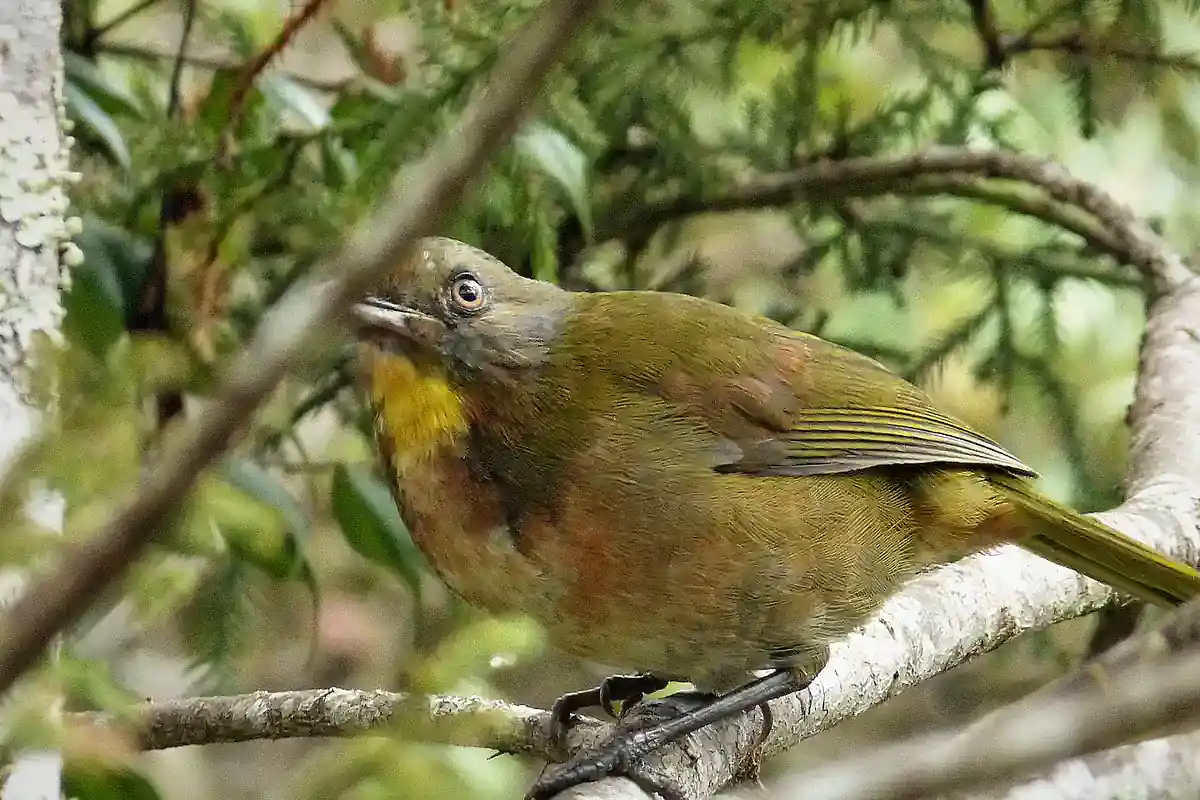
In 2023, a team led by Kasun Bodawatta and Knud Jønsson of the University of Copenhagen detected batrachotoxins in two known species not previously recognized as toxic. The Regent Whistler and the Rufous-naped Bellbird were sampled in Papua New Guinea’s Saruwaged Range. The study appeared in Molecular Ecology in 2024.
According to the paper, only some of the sampled birds of these two species tested positive. Their feather toxin levels were also low compared with those of better-known toxic birds.
The Copenhagen team also sequenced SCN4A, the gene that builds the main muscle sodium channel, called NaV1.4. Two substitutions shared by several toxic birds appeared to be favored by natural selection, alongside other changes found in single species. Computer models suggested some of these changes might weaken the toxin’s grip.
The picture was not clear-cut. The two shared substitutions also turned up in some birds thought to be nontoxic or not fully tested. Only one of them, called D1050N, was statistically linked to toxicity.
The team proposed that the birds protect themselves by changing the toxin’s target. Some candidate changes sat in pore-forming regions where frog resistance mutations had also been proposed, though at different positions. As Bodawatta put it in the university’s announcement, the bird changes were “not in the exact same places as the frogs“.
The 2026 Test
The UCLA team, led by physiologist Fayal Abderemane-Ali, decided to test that idea directly. Evelina Gromilina and Zhiying Jia are the paper’s co-first authors.
“For half a century, the ‘target mutation’ strategy has been the dominant view for toxin resistance in poisonous animals“, Abderemane-Ali told BioExplorer. “What was striking is that nobody had put these two substitutions into a working channel and measured them. So we tested them“.
The researchers took the muscle sodium channel gene of a Southern Variable Pitohui and added the two shared substitutions from the 2024 study. They then made the channels in frog egg cells and recorded how the channels behaved.
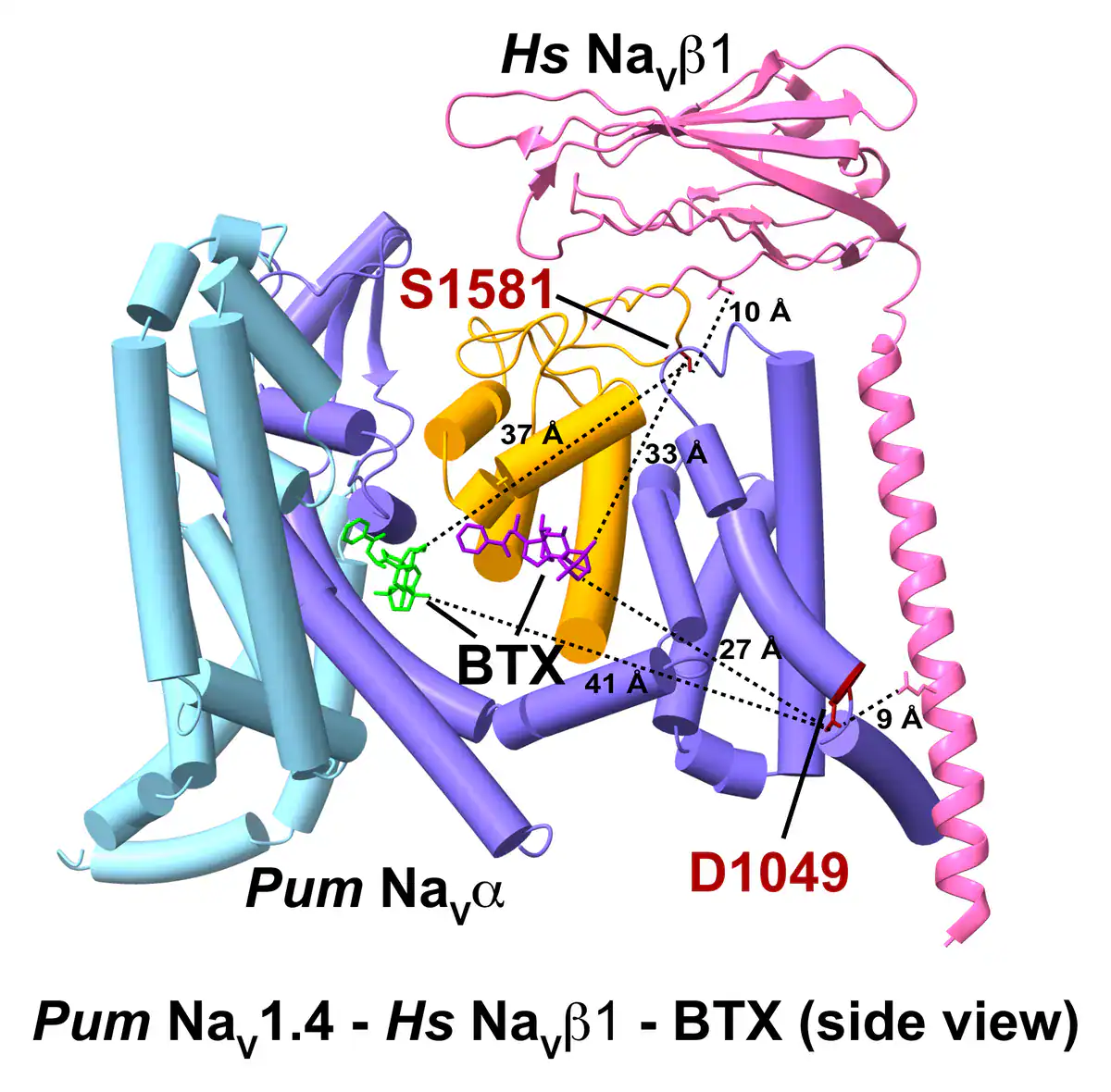
The two papers number these changes differently. They are D1050N and S1568P in the 2024 study, and D1049N and S1581P in the UCLA study, which used a pitohui channel. They are the same two substitutions.
The mutant channels worked just like normal ones. More important, they reacted to batrachotoxin exactly as unprotected channels do.
With or without the mutations, the toxin shifted the channels’ opening point by roughly 30 to 35 millivolts. It also stopped many of the channels from closing properly.
A computer model of the channel offered a reason. Both mutations sit on exposed surfaces of the channel, far from the inner pocket where batrachotoxin binds. In the model, they are roughly 27 to 41 angstroms away from the toxin. That is a long way at the scale of a single protein. The team concluded in iScience that “these NaV1.4 point mutations are not responsible for BTX resistance“.
The result did not surprise the researchers. “We weren’t surprised they failed to protect against batrachotoxin, because the two residues sit far away from where the toxin binds“, Abderemane-Ali said.
The Original Team Responds
Kasun Bodawatta was lead author of the 2024 study and is now a Marie Curie postdoctoral fellow at Lund University in Sweden. He told BioExplorer that the UCLA study “took a step forward” in testing the mutations identified by his team, led by Knud Jønsson.
Bodawatta also stressed how much is still unclear. “Currently there are many unknowns related to evolution of toxicity in New Guinean toxic birds“, he said.
Like the UCLA study’s authors, Bodawatta suggested the birds may have other ways to keep the toxin inactive as it travels from the gut to the skin. This could involve binding proteins that have not yet been identified in birds, he said.
His team is assembling more complete bird genomes to search for selected changes on the inner side of the channel, where batrachotoxin binds. Early results, he said, suggest the team may not be able to identify such mutations. He also noted that “there can be multiple mutations throughout the Nav channel that act in harmony to provide autoresistance“.
Bodawatta cautioned that “lab tests done using non-toxic bird cells (particularly human) may not translate to what is happening in wild birds.” He would like to see cell lines grown from toxic birds, so scientists can test batrachotoxin on the birds’ own channels.
Toxin Sponges
If these substitutions do not protect the channel, something else may keep the poison away from it. One prominent hypothesis, favored by the UCLA team, is toxin sequestration. The birds might lock the toxin away with binding proteins, keep it in certain tissues, or use several methods at once.
The idea is that rather than armoring the lock, you intercept the key.
Fayal Abderemane-Ali, UCLA
“We hypothesize that toxic birds have proteins that grab the toxin in the bloodstream and transport it away safely from the sodium channels and to the skin and feathers“, Abderemane-Ali said. His team calls them “toxin sponges“.
Several such proteins are already known in other animals, he noted. They include saxiphilin in bullfrogs, a toxin-binding plasma protein in pufferfish and an alkaloid-binding globulin in poison frogs. But no batrachotoxin-binding protein has been identified in any animal yet.
Finding one could take years. Toxic bird samples are difficult to obtain, Abderemane-Ali explained, and batrachotoxin itself is “scarce and dangerous to work with“.
Abderemane-Ali and colleagues found related evidence in poison frogs in 2021, in work led from Daniel Minor’s lab at the University of California, San Francisco. In the Journal of General Physiology, they showed that captive-raised poison frogs resisted batrachotoxin and saxitoxin, even though their sodium channels were sensitive to both.
The same 2021 study showed that saxiphilin can protect sodium channels from saxitoxin. Saxitoxin is a different toxin, so this result shows how a sponge could work rather than proving that one exists for batrachotoxin.
A sponge strategy would have an advantage over changing the channel itself. Sodium channels are finely tuned, so mutations that block a toxin often make the channel work less well. A binding protein could let an animal store its poison safely while its nerves and muscles keep working normally.
Toward Antidotes
The UCLA team sees a possible practical payoff. “If these toxic birds have a batrachotoxin-binding protein, that means nature has already developed an antidote for this toxin,” Abderemane-Ali said.
Scientists could isolate such a protein and engineer it to bind even more tightly. They could then produce it in bulk, as they do other recombinant proteins, and use it as a decoy that soaks up the toxin before it reaches nerves and muscles.
Batrachotoxin itself rarely poisons people, he pointed out. The bigger prize is that “the same principle should extend to tetrodotoxin, saxitoxin, and ciguatoxin“. These toxins poison people through contaminated seafood every year, he said, and none has an approved antidote.
That goal is still some way off. The UCLA result narrows the search, because it suggests the protection acts before the toxin reaches these channels.
Open Questions
The UCLA study has limits, and the authors list them. Full-length sodium channel genes are not yet available for the Regent Whistler or the Rufous-naped Bellbird, so the mutations were tested in a pitohui channel instead. The tests also used frog egg cells rather than bird muscle, and they did not cover other sodium channel types or whole birds.
The study also does not identify a toxin-binding protein in birds. Its results fit the sequestration idea, but they are not direct proof of it.
The debate between the two labs is a friendly one. The UCLA paper thanks Jønsson for his comments on the manuscript.
For now, the pitohui’s protection remains a mystery. The bird carries a poison that should shut down its own muscles, and scientists are still searching for the shield that stops it.
At a Glance
| Study | Year | Key finding |
|---|---|---|
| Dumbacher and colleagues, Science | 1992 | Pitohuis carry homobatrachotoxin, highest in skin and feathers |
| Dumbacher and colleagues, PNAS | 2004 | Some Choresine beetles carry batrachotoxins; one Choresine found in a pitohui stomach |
| Abderemane-Ali and colleagues, J. Gen. Physiol. | 2021 | Poison frogs resist toxins despite sensitive sodium channels |
| Bodawatta and colleagues, Molecular Ecology | 2024 | Toxins found in two known species; channel mutations proposed as protection |
| Gromilina and colleagues, iScience | 2026 | Two proposed mutations did not protect a pitohui muscle channel |
FAQs
Scientists are still working it out. A 2026 UCLA study found that two suspected protective mutations did not make a pitohui muscle sodium channel resistant to batrachotoxin. One prominent hypothesis is that the birds lock the toxin away, possibly with binding proteins.
The Hooded Pitohui of New Guinea is among the most poisonous birds known. A 2022 review in the *Journal of Medical Toxicology* lists the Hooded Pitohui as the most toxic of the pitohuis.
Touching a pitohui can be unpleasant. Researchers who handled these birds reported sneezing, numbness and burning in the mouth. A 2022 review in the *Journal of Medical Toxicology* notes that these exposures are milder than poisonings from poison dart frogs.
Pitohuis most likely get batrachotoxins from their diet. Some small *Choresine* beetles carry high levels of these toxins. A *Choresine* beetle of a species not tested for toxins has also turned up in a pitohui stomach.
Yes, both carry the same family of toxins, called batrachotoxins. Birds and frogs are only distantly related, so the 1992 *Science* study concluded that each group likely evolved this defense on its own.
Possibly. If poisonous birds carry a protein that binds batrachotoxin, scientists could engineer it into a decoy that soaks up the toxin. The UCLA study’s senior author says the same idea might also help with seafood toxins such as tetrodotoxin and saxitoxin, which have no approved antidote.
Cite this page
BioExplorer. (2026, October 6). Why Don’t Poisonous Birds Poison Themselves? One Theory Just Failed a Test. https://www.bioexplorer.net/how-poisonous-birds-survive-their-own-poison.html/