
Branches of Biochemistry
With science and technology reaching new heights, are you curious about the causes behind diseases like cancer and liver cirrhosis? Are you interested to formulate new drugs and vaccinations promoting better disease-free health? If yes, then taking up a course on Biochemistry can give you that much-needed edge to carry on.
Jump to:
- What is Biochemistry?
- Branches of Biochemistry
- A) Structural Biology: The Architecture of Life
- B) Enzymology: The Machinery of Life
- C) Metabolism: The Energy of Life
- Biochemistry Articles
- Building Blocks of Carbohydrates
- Explore Building Blocks of Lipids, Structure, Functions & Examples of Lipids
- Introduction To Fermentation Biology
- Nucleotides: Building Blocks of Nucleic Acids
- Recombinant Proteins
- The Science Behind Dehydration Synthesis and Hydrolysis
- Top 10 BEST Colleges For Biochemistry
- Top 10 Biochemistry News of 2020 – A Round-Up
- Top 15 Biochemistry Discoveries in 2018
- Top 15 Biochemistry Discoveries of 2019
- What Are The Building Blocks of Proteins?
- Resources
What is Biochemistry?
Some say Biochemistry or Biological Chemistry is the study of the ongoing chemical actions within the body of a living organism. However, it is worth understanding here that the concept of Biochemistry is quite vivid. This subject is a branch of science that focuses on every activity happening at the molecular level. Why just molecules? Biochemistry delves into deeper subjects like cells, lipids, proteins and organelles.
When sickness strikes in a living organism, a biochemist keeps close eyes on the interaction and functions of cells. It sees how a molecule responds to this distorted type of interaction and figure's out the type of disease a person is afflicted with. This observation is extremely resourceful to create drugs cutting down the malefic effects of such dreadful diseases.
Biochemistry is the study of chemical processes. A biochemist tracks down the flow of chemical energy through metabolism tries to figure out the ways by which biological molecules facilitate the working of chemical processes inside the body of the being. Since this subject is closely related to molecular biology, you are required to gain lessons on molecular mechanism as well. In a nutshell, Biochemistry is a core subject in the field of Science and Technology.
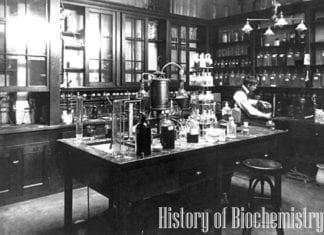
History of Biochemistry
Branches of Biochemistry
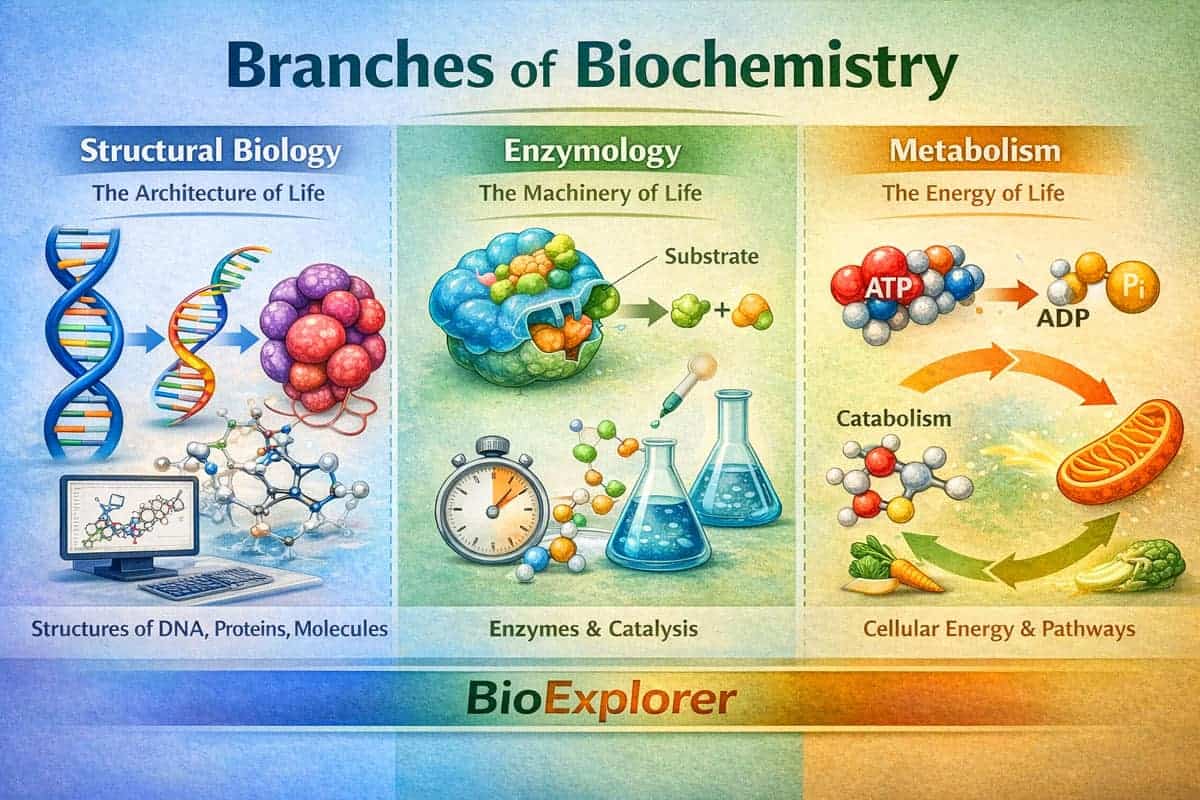
Biochemistry is the study of life at the molecular level. To make this vast subject easier to understand, scientists generally divide it into three fundamental branches. Together, these 3 pillars explain how the invisible molecules inside us determine our health, growth, and survival.
A) Structural Biology: The Architecture of Life
Structural biology focuses on the three-dimensional shapes of biological molecules, such as proteins and DNA. In biochemistry, “shape is function“. If a molecule's shape changes—even slightly—it may no longer be able to do its job, which is often how diseases start.
- What it studies: How atoms are arranged in a molecule to create a specific structure.
- Why it matters: By understanding the structure of a virus protein, for example, scientists can design “puzzle-piece” medicines to block it.
B) Enzymology: The Machinery of Life
Enzymology is the study of enzymes, which are specialized proteins that act as biological catalysts. Almost every chemical reaction in your body—from digesting food to copying DNA—would happen too slowly to sustain life without enzymes to speed them up. (NIH)
- What it studies: How enzymes bind to specific targets (substrates) and the speed (kinetics) at which these reactions occur.
- Why it matters: Most modern medicines work by either helping or “turning off” specific enzymes in the body.
Top 25 Fun Facts About The Digestive System
C) Metabolism: The Energy of Life
Metabolism is the sum of all chemical reactions that happen within a living cell. It is the process by which your body converts what you eat and drink into energy and building blocks for your muscles, bones, and organs. (NIH)
- What it studies: The pathways of catabolism (i.e., breaking down molecules for energy) and anabolism (i.e., using energy to build new cell components).
- Why it matters: Studying metabolism helps us understand conditions like diabetes, obesity, and how our bodies respond to exercise.

Overview Of Cellular Respiration Equation, Types, Stages & Products
Biochemistry Articles
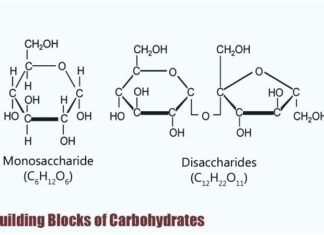
Building Blocks of Carbohydrates
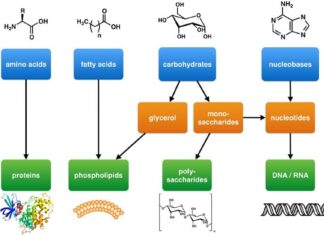
Explore Building Blocks of Lipids, Structure, Functions & Examples of Lipids
Introduction To Fermentation Biology
Nucleotides: Building Blocks of Nucleic Acids
Recombinant Proteins
The Science Behind Dehydration Synthesis and Hydrolysis

Top 10 BEST Colleges For Biochemistry
Top 10 Biochemistry News of 2020 – A Round-Up
Top 15 Biochemistry Discoveries in 2018
Top 15 Biochemistry Discoveries of 2019
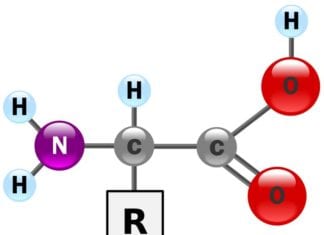
What Are The Building Blocks of Proteins?
Resources
Biochemistry shares close relevance with Biomolecular science. As a student, you will first gain lessons on the basic concept of the course of Biochemistry and Biomolecular Science. Following this, lessons on cell biology, genetics, pharmalogy, physiology, immunology and microbiology will be provided.
Theories regarding cell and molecular biosciences, protein analysis, duplication, recombination and repair of DNA will be encouraged along with ideas of enzymes and protein trafficking. Having said this, the most interesting subjects in Biochemistry are Biochemistry of chronic diseases, molecular biology in biotechnology, healthcare organization and genetics.
As a successful graduate in Biochemistry, you can easily find yourself a place in hospitals, food institutes, forensic crime research departments, education sector and in the drug research and development center. Remember, Biochemistry has proven results of scientific developments and breakthroughs in the field of medicine and Biotechnology.
Biochemistry Encyclopedia
Encyclopedia resource provides articles on topics covered under biochemistry. Link
Amino Acids
Name and linear structure formula for twenty Amino Acids.
Biochem Basics
A simple beginners’ guide to biochemistry, written by a high school student (AP Chem and AP Bio veteran). Includes clear explanations, original diagrams, and fun animations. Link
biochem.ualberta.ca | Biochemistry Home Page
University of Alberta, Department of Biochemistry Home Page. Link
Biochemist On-Line
Biochemist On-Line serves several purposes: To serve as a site where visitors can learn and ask questions about Biochemistry. To provide biochemists with links to reference material found on the Internet. It will provide an online message board where individuals can post questions or comments about ongoing research There will also be an online chat board where individuals from around the world can chat live. Link
BioMolecular Networks Initiative
The Biomolecular Networks Initiative (BNI) is a multidisciplinary research program that integrates molecular biology, biochemistry, physics, mathematics, and computer science to understand complex biological systems. The site contains information on our latest breakthroughs as well as an extensive publications list, our workshop and seminar announcements, job opportunities, collaboration opportunities, and a links list, on which your site is included.Link
Biopolymers Homepage
Biopolymers – Welcome to the number 1 source for biopolymers !The first publication covering all classes and aspects of biopolymers in 10 volumes. Link
Brussels Red Cell
Site dedicated to genetic diseases of the red cell: sickle cell disease, thalassemia, spherocytosis, enzyme defects, porphyrias. Link
Canterbury Health Laboratories
Canterbury Health Laboratories is New Zealand’s Premier Medical Testing Laboratory and offers over 1000 different Pathology Tests. The laboratory is keen use our wide area of specialist expertise to network with other providers and help develop their products. Link
Chemical Solution Calculator
A useful calculator for making up chemical solutions in the biological laboratory. Link
ChemWeb.com
ChemWeb features searchable chemistry journals and databases, jobs, chemical books, software and products, details of conferences. Link
Cholinesterases
This web site provides a review of the cholinesterase enzymes. Link
Cyberlipid Center
All aspects of lipid structure, distribution, discovery and analysis. Link
Department of Chemistry and Chemical Biology
Welcome to the Harvard Department of Chemistry and Chemical Biology. Link
Enzymes
Read an introduction to enzymes and learn about their classifications, activities and chemical reactions. Link
Fermentas
Molecular Biology Products, including Restriction Endonucleases, DNA/RNA Modifying Enzymes, Taq DNA Polymerase, PCR Kits, Molecular Weight Markers and other associated products available from MBI Fermentas. The Catalog also includes an extensive reference section with many useful protocols. Link
G-proteins and their role in disease
A brief description on what G-proteins are, how they function, and their role in a few diseases. Link
Metabolic Pathways of Biochemistry
Welcome to Metabolic Pathways of Biochemistry, the online reference of metabolism for students, scientists, and the world. This site is designed to graphically represent all major metabolic pathways, primarily those important to human biochemistry. Link
NetBiochem
NetBiochem has made full use of multimedia hypertext to provide students and the merely curious with a stimulating and accessible primer in biochemistry. Complete treatments of the basics in metabolism, macromolecules, membrane actions, and nucleic acids. Link
Peptide Resource Page
A guide for researchers and educators listing educational websites and providers of custom peptides, peptide synthesis reagents, peptide synthesizers, and software. Link
Custom DNA Synthesis, primers
PrimeSyn lab provides custom DNA synthesis services ranging from custom oligos and simple primers to labeled probes (FRET,Scorpion, probes for RTPCR). Other services include protein analysis, protein purification, and analytical method development. Link
Protein Analysis Center (PAC)
PAC provides amino acid sequence services with a program focused on Edman degradation, C-terminal degradation, amino acid compositions and mass spectrometry, the latter both for sequences and total masses. Sample preparation techniques necessary to ensure good performance in the sequence analysis is also included. Link
The Glycoscience Network Page
The Glycoscience Network (TGN) is an informal world-wide grouping of scientists who share a common interest in carbohydrates. Link
The Nuclear Receptor Resource
The Nuclear Receptor Resource (NRR) Project is a collection of individual databases on members of the steroid and thyroid hormone receptor superfamily. Although the databases are located on different servers and are managed individually, they each form a node of the NRR. The NRR itself integrates the separate databases and allows an interactive forum for the dissemination of information about the superfamily. Link
The Principles of Protein Structure Using the Internet
A Birkbeck College (University of London) presents an on-line course in protein structure. Link
Cite this page
Bio Explorer. (2026, January 10). Branches of Biochemistry. https://www.bioexplorer.net/divisions_of_biology/biochemistry/