
Top 15 Pros and Cons of Cloning
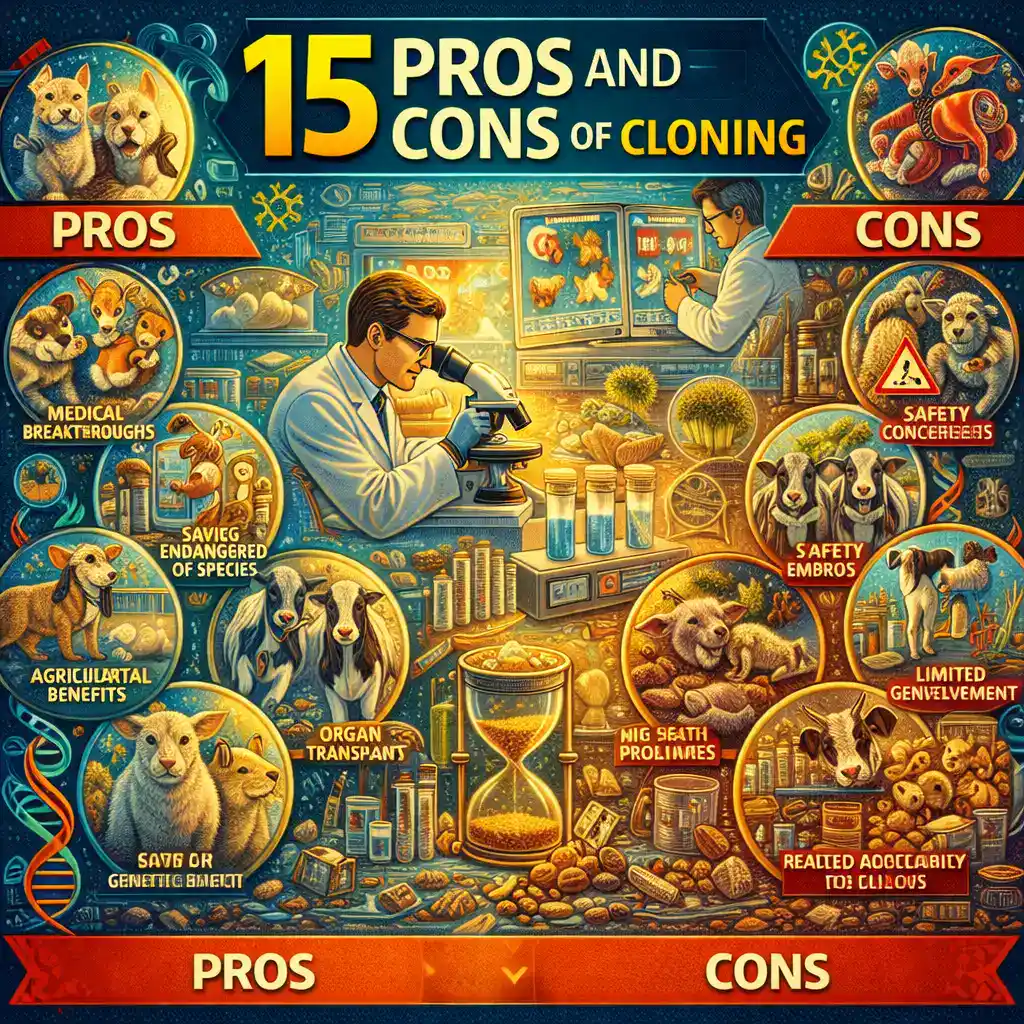
Cloning creates a copy of a single cell or an entire living organism. Each clone carries the same set of genetic material in the nucleus of every cell, making cloning one of the most studied branches of genetics. An individual produced through this process is known as a clone of the original organism.
Jump to:
- 7 Pros of Cloning
- 1. Species Preservation
- 2. Boosted Food Production
- 3. Reproductive Support
- 4. Medical Research Advancement
- 5. Regenerative Medicine Potential
- 6. Preservation of Valuable Genetics
- 7. Faster Scientific Testing
- 8 Cons of Cloning
- 1. Safetly Concerns
- 2. Ethical Risks
- 3. Reduced Genetic Diversity
- 4. Limited Development
- 5. High Failure Rates
- 6. Health Problems in Clones
- 7. Reduced Adaptability
- 8. High Cost and Resource Use
- Jump to comments
Naturally, the term is also used for identical or monozygotic twins, as they are natural clones of each other. In the history of genetics, cloning emerged into public awareness as a major scientific breakthrough when researchers successfully cloned Dolly the sheep in 1997, demonstrating that the technique could be achieved with relative ease and success.
The successful cloning of rhesus macaque monkeys in the late 20th century provided strong support for the hypothesis that humans could, in theory, be cloned. However, cloning techniques themselves have existed far longer than modern laboratory experiments. In fact, cloning occurs naturally and continuously in the living world, with some scientists suggesting it has been happening since life first arose on Earth.
With a rapidly changing environment and accelerating advances in scientific research and medical development, cloning may soon become more widespread. However, does it offer a realistic way to revive declining species populations, create so-called immortal animals, or is it simply another ambitious attempt to achieve immortality?
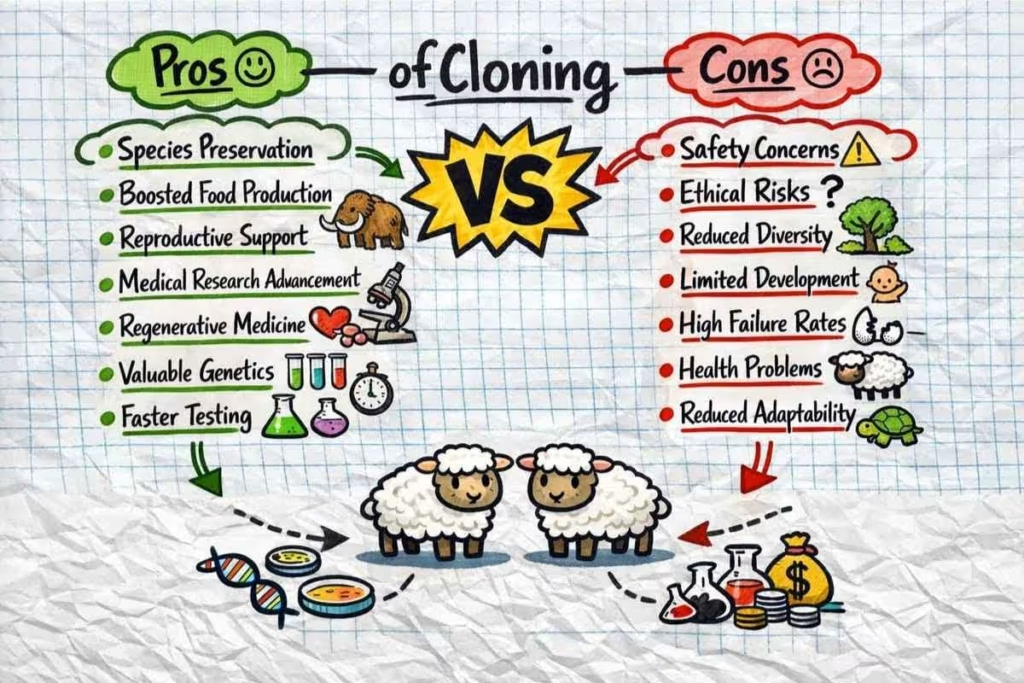
7 Pros of Cloning
Since its first successful execution in 1996, cloning has become one of the important branches of biotechnology. Through cloning, transgenic organisms—those with specific genes inserted into their genome—can be replicated, allowing scientists to produce identical copies across different types of plants and types of animals. The following are some of the key advantages of cloning.
1. Species Preservation
As many organisms in the planet approach endangerment and extinction, cloning appears to be a possible solution to restore populations. By utilizing the genetic material of already dead organisms, cloning can even expand gene pool diversity.
- Beyond revival itself, the cloning of extinct animals would allow scientists to study them as living organisms rather than relying solely on remains such as dinosaur fossils or limited evidence from extinct birds.
- Although considered an artificial reproduction mode, cloning is widespread in a natural setting. The oldest form of cloning, asexual reproduction, is exhibited by various organisms like insects, and microorganisms.
Cloning Helps Save Endangered Species

Scientists have successfully cloned endangered animals using preserved genetic material to support conservation efforts. For example, the black-footed ferret — once thought extinct — has been cloned from frozen tissue samples of a ferret that died in 1988, producing healthy kits.
Adding these clones to breeding programs can increase genetic variation in small populations where every unique genome helps strengthen long-term survival prospects.
2. Boosted Food Production
Another major advantage of cloning is its potential to increase agricultural production, particularly in livestock and fresh produce. By controlling biological processes and preserving desirable traits, cloning reduces the genetic "lottery" that occurs during meiosis—an outcome often discussed alongside the broader genetic engineering pros and cons surrounding predictability, diversity, and long-term impact.
During cloning, both the gene of interest and the organism carrying it can be replicated far more rapidly than through natural reproduction. As a result, a larger number of identical organisms can be produced within a shorter period of time.
Cloning Used to Improve Livestock Breeding Stock
While cloned animals themselves are seldom used directly for meat or milk, cloning has been used to expand superior genetics quickly in livestock. For example, in the United States there were an estimated about 600 cloned animals in the country as of 2008, most of which were used to produce high-quality breeding stock that can then be mated conventionally.
By cloning elite animals with desirable traits such as growth rate, milk yield, or disease resistance, breeders can more rapidly introduce those traits into herds, helping increase overall food-producing efficiency.
3. Reproductive Support
Last but not the least is the use of cloning as a means to produce children for infertile and same-sex couples. Normally, couples would want to have children that are biologically theirs. Interestingly, the genetic manipulations could now be targeted at giving the children the genetic traits of both parents.
- Children could, in theory, be produced without donor eggs or donor sperm, as cloning bypasses the traditional processes of fertilization and spermatogenesis. In such scenarios, same-sex couples would only require a surrogate parent to carry the clone until birth.
- Scientists who support this method believe that it would become justifiable for these couples to reproduce in this method, assuming the procedures could be done safely.
Cloning Technology Advances Toward Reproductive Support
Researchers have recently taken a notable step toward using cloning-related technology to help people with infertility. Scientists at Oregon Health & Science University used a cloning-like method to create human eggs from adult skin cells by transferring nuclei into donor eggs.
Although only about 9 % of these lab-created eggs developed to the blastocyst stage — far below natural rates — this proof of concept shows that cloning-based approaches could one day help women without viable eggs, and possibly same-sex couples, have genetically related children if carried to full reproductive use in the future.
Source: FT News – Scientists use cloning technology to swap DNA in human eggs
4. Medical Research Advancement
Cloning plays an important role in medical research by enabling scientists to work with genetically identical cells, tissues, or organisms. This genetic uniformity is especially valuable when studying inherited conditions, including disorders caused by Autosomal Recessive Inheritance, where eliminating genetic variation helps isolate disease mechanisms.
By reducing experimental noise, cloning improves the accuracy of research on cancer, genetic diseases, and neurological disorders, while also informing broader ethical discussions often framed around the designer babies pros and cons debate.
Cloned Monkeys Improve Medical Research Accuracy
In 2018, Chinese researchers successfully cloned two identical macaque monkeys, named Zhong Zhong and Hua Hua, for use in biomedical research. These genetically identical primates allow scientists to study neurological and genetic diseases with far greater accuracy than previously possible, because differences in experimental outcomes are not caused by genetic variation.
Researchers noted that cloned monkeys could significantly improve studies on brain disorders, immune diseases, and drug testing, where genetic consistency is critical for reliable results.
Source: Cloning of Macaque Monkeys
5. Regenerative Medicine Potential
Cloning has the potential to transform regenerative medicine by providing patient-specific cells, tissues, or organs for therapeutic use. Because these cloned materials are genetically identical to the recipient, they significantly reduce the risk of immune rejection that often limits transplants.
This approach could support tissue repair and organ replacement, overlapping with advances discussed in gene therapy pros and cons, where genetic precision plays a central role in modern medical treatments.
Cloned Skin Cells Used for Burn Treatment
In regenerative medicine, scientists can grow sheets of skin cells in the laboratory that are genetically identical and use them to repair large wounds or burns. For decades researchers have used cultured epithelial sheets — cells expanded from a patient's own skin biopsy — to treat severe burns.
These cultured cells act as autologous (self-derived) grafts, improving wound closure and reducing rejection because the cells match the patient's own genetics. The technique — a form of cell cloning and expansion — shows how replicated cells can play a real role in repairing damaged tissue and supporting regenerative healing.
6. Preservation of Valuable Genetics
Cloning provides a practical way to preserve rare or desirable genetic traits that may be lost due to environmental change, disease, or declining populations. From the perspective of the biological species concept, which defines species based on reproductive continuity, cloning offers a controlled method to maintain genetic lineages when natural breeding becomes limited or impossible.
This approach helps ensure that valuable genetic traits remain available for conservation efforts, agriculture, and future scientific study.
Cloning Restores Lost Founder Genetics in Przewalski's Horse
Scientists have used cloning to help preserve valuable genetic diversity in the endangered Przewalski's horse, a species that once vanished from the wild and today exists with limited genetic variation. In 2020, a foal named Kurt was born by cloning cells that had been cryopreserved since 1980, capturing genetic material that was otherwise no longer present in the current population.
A second clone followed in 2023, giving conservationists two animals that carry historic genetic variants and may be able to pass those genes into future generations, helping broaden the gene pool for this endangered species.
7. Faster Scientific Testing
Cloning allows scientists to create many genetically identical organisms in a short time. This makes experiments faster and easier to control. Because the organisms are genetically the same, test results are more consistent and reliable.
This consistency is important in toxicology, environmental studies, and DNA testing service development, where accuracy and repeatability matter. As a result, cloning helps speed up testing and supports dependable scientific conclusions.
Standardized DNA "clones" speed up repeatable testing
For faster and more reliable testing, scientists often use cloned DNA as a standard reference. In one real example, a reference DNA sample created by NIST contains known copy amounts ranging from about 5 to 500,000 identical DNA copies. Because every lab tests the same DNA with the same targets, results can be compared easily and repeated accurately.
This saves time, reduces errors, and helps scientists reach dependable conclusions much faster.
Source: NIST Publication
8 Cons of Cloning
Although cloning offers significant benefits for research and industry, its outcomes are not always predictable due to high failure rates and health complications during development. In addition, many aspects of the cloning process are still not fully understood. The following are some of the most commonly cited disadvantages of cloning.
1. Safetly Concerns
Despite being genetically identical with each other, clones will not be the same regarding behavioral attributes. Aside from that, their similarities regarding physical appearance are not guaranteed.
- It should be important to note that genetic material is not the sole determinant of these characteristics.
- Of course, chances that a pair of clones will be subjected to different habitats and have varying nutritional loads are very high, thus imprinting different changes and contributions to each one.
- Aside from that, most clones produced have had reduced longevity and developed health problems. For instance, Dolly the sheep had abnormalities in her DNA (i.e., shortened telomeres), suggesting that some of her own cells bear the “age” of the source organisms.
Premature Aging in Dolly the Sheep
Dolly the sheep raised safety concerns because researchers found evidence that her cells may have carried signs of biological aging from the adult donor. A peer-reviewed Nature paper reported shortened telomeres in cloned sheep, which fueled worries about premature aging and health issues in clones.
Dolly later developed arthritis and was euthanized at 6.5 years old, which is noticeably shorter than the typical ~11–12 year life expectancy for a Finn Dorset sheep.
Source: National Museum of Scotland
2. Ethical Risks
One of the strongest arguments against cloning centers on its ethical concerns and broader bioethical issues. Beyond the manipulation of living organisms, critics argue that the cloning process itself involves the exploitation of life, raising serious moral and ethical questions.
Dolly's High Failure and Human Cloning Concerns
The creation of Dolly the sheep in 1996 required 277 embryo attempts before producing a single viable adult clone, and most early embryos failed to develop beyond a few days. This extremely low success rate illustrated how many failures must occur before one success, raising serious ethical concerns about cloning living beings.
Critics argue that if the same methods were applied to humans, scientists would face countless failed embryo attempts, miscarriages, and developmental losses, which many consider ethically unacceptable until the risks are fully understood and mitigated.
Source: NCBI Bookshelf: Embryos, Cloning, Stem Cells, and the Promise of Reprogramming
3. Reduced Genetic Diversity
Cloning produces genetically identical individuals, which can narrow the genetic pool of a population over time. When many animals share the same genome, there are fewer unique genetic variations to support survival traits seen in contexts such as tropical rainforest animal adaptations, where species rely on specialized genetics to cope with disease, climate, and environmental pressures.
This loss of diversity can make entire populations more vulnerable, especially in endangered species where every unique gene matters.
Cloning and Genetic Uniformity in Farm Animals
In commercial livestock cloning, critics warn that widespread use could narrow genetic diversity within breeds. A 2003 review of cloning in cattle found that fewer than 5 % of cloned embryos implanted in cows survived to term, meaning that only a very small number of individuals contribute genetically when cloning is used heavily.
Over time, cloning many genetically identical animals can reduce the variety of alleles in a population—making herds more vulnerable to infectious diseases and environmental stress because fewer unique genotypes are available to resist new threats.
Source: Welfare Issues with Genetic Engineering and Cloning of Farm Animals (pdf)
4. Limited Development
To date, many scientists will agree that the process of cloning is not yet fully developed to be used as a way to promote the conservation of species. Some researchers need to acknowledge cloning as it fails to recognize the main drivers of extinction in the first place: the destruction of habitats and hunting.
- Critics also argue that even if cloning could help in desperate times, present techniques to execute these goals are deemed ineffective in making a difference.
- As compared with cloning domestic organisms (e.g., cattle), the process of cloning endangered species is more difficult and would likely take years (and even decades) to complete.
- While there are many reasons why countless attempts to revive endangered and extinct species have failed, they all exhibited one major trouble: they were not exact copies of their supposed-to-be counterparts.
Cloning the Pyrenean Ibex: A Limited Success
In an effort to revive the extinct Pyrenean ibex, researchers produced 208 cloned embryos, implanting them into surrogate goats. Of these, only 7 pregnancies occurred, and just one clone was born alive, only to die minutes after birth due to lung defects—a direct result of imperfect development during cloning.
This case highlights how current cloning techniques often fail to produce healthy, viable animals, even when abundant tissue samples are available.
Source: First Extinct-Animal Clone Created (National Geographic)
5. High Failure Rates
One of the most significant drawbacks of cloning is its extremely high failure rate. A large number of cloning attempts fail during early development, with many embryos unable to survive to birth. Even among clones that are born alive, health complications and early mortality are common.
These repeated failures make cloning inefficient, costly, and ethically controversial, as they involve the loss of many developing organisms for a single successful outcome.
Low Success Rates in Mammalian Cloning
Research on somatic cell nuclear transfer (SCNT) shows that cloning has very low success rates. In mammals, only about 1–3% of cloned embryos survive to become live offspring, meaning dozens or even hundreds of embryos are often required to produce a single viable clone.
Most failures occur during early development or shortly after birth, underscoring the inefficiency and ethical concerns associated with cloning.
Source: National Academies of Sciences – Scientific and Medical Aspects of Human Reproductive Cloning
6. Health Problems in Clones
Cloned organisms often face a higher risk of health problems compared to those born through natural reproduction. Many clones develop physical abnormalities, organ malfunctions, or weakened immune systems that make them more vulnerable to disease.
In some cases, clones show signs of premature aging or shortened lifespans. These ongoing health concerns raise ethical questions about cloning and highlight the risks involved in producing organisms with compromised well-being.
Cloned Calf Dies from Health Defects
In one documented case, a calf cloned from an adult cow developed serious health issues and died at just two months old. French researchers reported that the calf suffered blood and heart problems believed to result from the cloning process, suggesting that gene reprogramming errors can interfere with normal development.
Cloned livestock and other mammals have also shown organ defects and abnormal growth in various studies, highlighting real health risks tied to cloning.
Source: J. Jones et al., Cloning may cause health defects, PubMed Central
7. Reduced Adaptability
Cloning produces organisms that are genetically identical, which can limit their ability to adapt to changing environments. When populations lack genetic variation, they become more vulnerable to diseases, climate shifts, and broader environmental issues such as habitat loss and pollution.
A single illness or environmental stress can affect all clones in the same way, increasing the risk of widespread failure. This reduced adaptability makes cloning a risky option for long-term survival, especially in natural ecosystems.
Livestock Genetic Homogeneity
Regulatory reviews of animal cloning have warned that widespread use of cloning in livestock could reduce genetic diversity within herds. The U.S. Food and Drug Administration noted concerns that genetically uniform populations created through cloning may become more vulnerable to disease outbreaks and environmental stress, as a single threat could affect all animals in the same way. This reduced adaptability highlights a major risk of relying too heavily on cloning for long-term population sustainability.
8. High Cost and Resource Use
Cloning requires advanced technology, specialized laboratory facilities, and highly trained experts to carry out the process. Many cloning attempts fail, which means experiments must be repeated multiple times, increasing the use of time, energy, and biological materials.
These high financial and technical demands make cloning accessible mainly to large research institutions. As a result, cloning remains costly and impractical for widespread or routine use.
Somatic Cell Nuclear Transfer in Mammals
Scientific studies show that animal cloning by somatic cell nuclear transfer remains highly inefficient. In many mammalian species, only 1–4 % of reconstructed embryos develop to adulthood, and failures occur at multiple stages of development, meaning many embryos are lost before birth and significant resources are consumed for just a few successful outcomes.
Overall, scientific research developments go faster than the actual and real needs of humans, who are the ultimate recipients of such progress. Because of that, there is a pressing need to determine whether such practical applications are timely or are indeed necessary for human survival.
To date, many people still believe that the process of cloning itself is not ethical. Many countries have prohibited all research and actual cloning processes, making it. Nevertheless, the process of cloning is still up for further studies.
Cite this page
BioExplorer. (2026, August 26). Top 15 Pros and Cons of Cloning. https://www.bioexplorer.net/pros-and-cons-of-cloning.html/


The artificial creation of life; sounds like “Frankenstein” at the genetic level. We will.never have another “Picasso” or “Einstein” (not that way), that’s nuture not nature. Just because we “can” doesn’t mean that we “should”. What about when clones reproduce. Doesn’t that bring forward recessive genes, making a species more vulnerable. Will that create a domino effect that will take out that species? It worries me. It reminds me of Kurt Vonnegut’s ” ice nine”; a beautiful but deadly thing. Cloning human beings; no. Just let God and nature take care of that. Other things, well……..please be careful!