
20 Types of Magpies: Every Magpie in the Crow Family
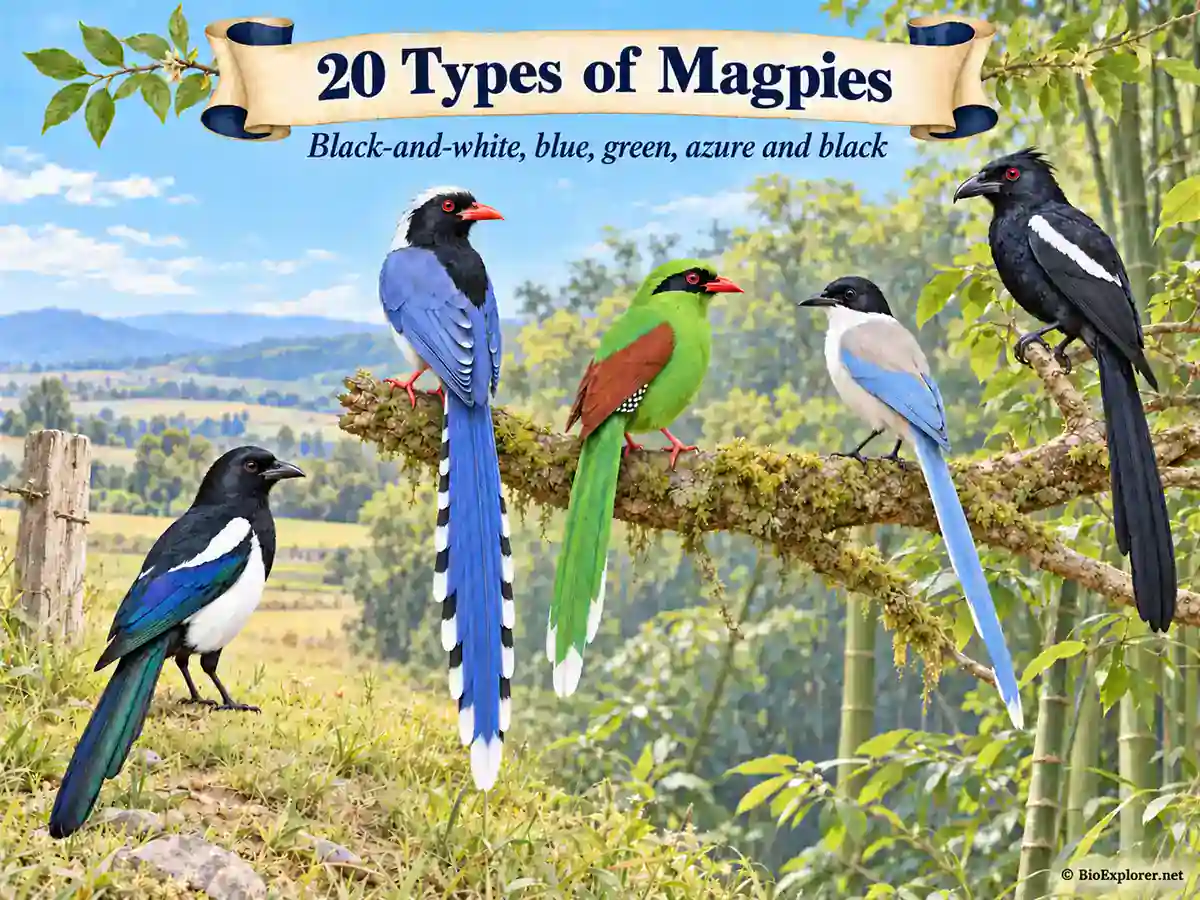
Magpies are long-tailed members of the crow family, and the major global bird checklists list 20 species under that name. The best known are the black-and-white magpies of Europe and western North America. Other magpies are bright blue, emerald green or glossy black, and most of those live in the forests of southern and eastern Asia.
This guide covers all 20 corvid species that the IOC World Bird List and the AviList global checklist call magpies. Each species entry describes the bird’s looks, range, diet and conservation status. The Australian Magpie and several other birds share the name without belonging to the crow family, and they get their own section near the end.
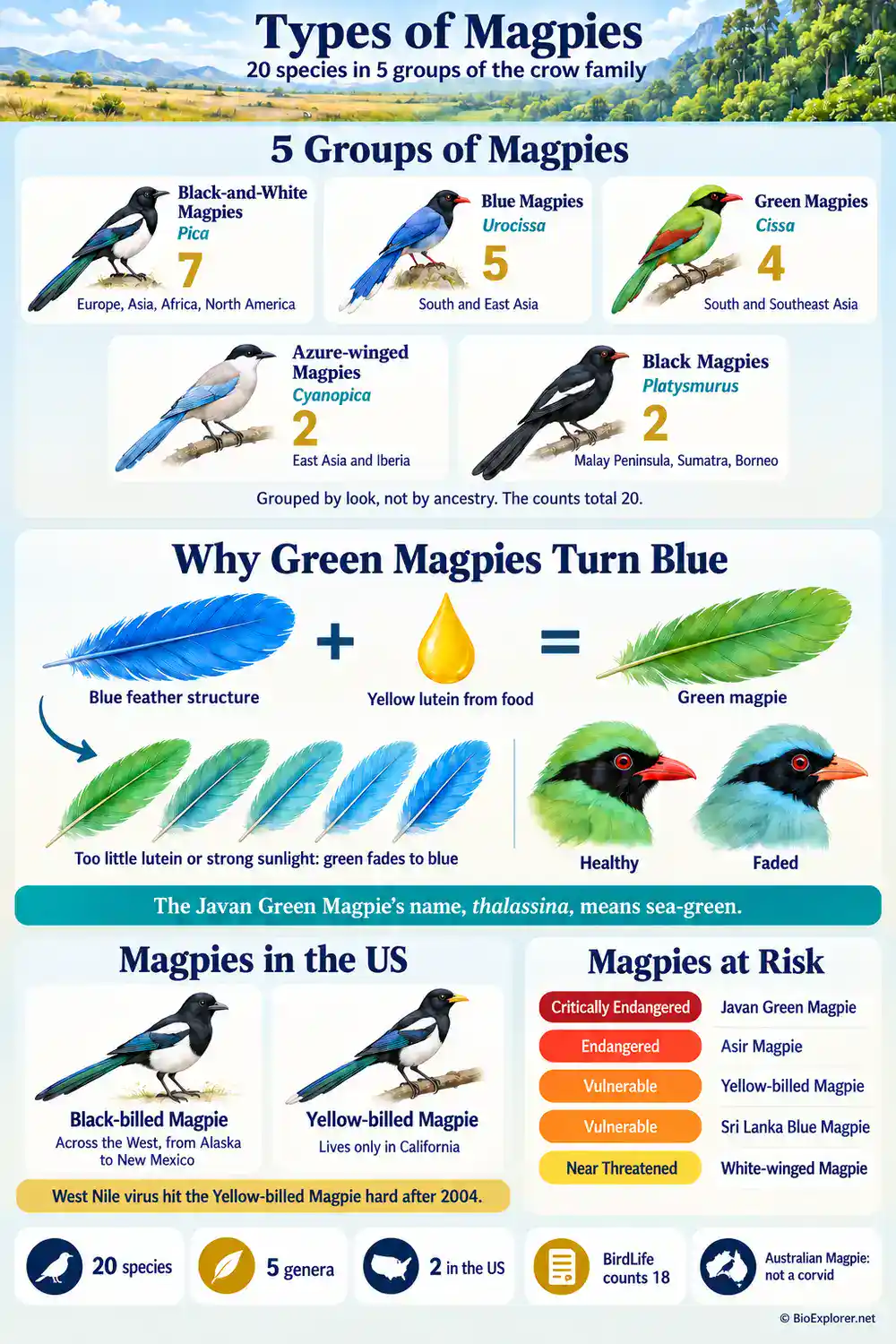
The IOC World Bird List and AviList recognize 20 corvid species called magpies, in five genera: Pica (7), Urocissa (5), Cissa (4), Cyanopica (2) and Platysmurus (2). BirdLife International counts 18, because it still treats the Oriental and Black-rumped Magpies as part of the Eurasian Magpie. The Australian Magpie is not a corvid at all.
Types of Magpies Guide:
What Is a Magpie?
In this guide, a magpie is a member of one of five genera in the bird family Corvidae, which also includes crows, ravens and jays. These magpies tend to have longer tails and bolder colors than their crow relatives. Our guide to the types of crows covers the mostly black genus Corvus.
The word magpie describes a look, not a single branch of the crow family tree. Genetic studies place the five magpie genera in different corvid lineages, according to a 2023 study by McCullough and colleagues in Ornithology. Alexey Kryukov’s 2025 review lists ground jays and nutcrackers among the proposed closest relatives of the Pica magpies.
This article sorts the magpies by appearance and range, not by ancestry. The Pica magpies are black and white, and they live mainly in open country across the Northern Hemisphere. The blue, green, azure-winged and black magpies live mostly in forest and woodland, and all but one of them live in Asia.
Magpie counts have changed in recent years as checklists split older species based on DNA studies. The IOC World Bird List, the AviList checklist and the Clements Checklist used by eBird now agree on 20 species.
Explore the key differences between ravens and crows here.
All 20 Magpie Species
| # | Common name | Scientific name | Where it lives | IUCN status |
|---|---|---|---|---|
| 1 | Eurasian Magpie | Pica pica | Europe to Siberia and Kamchatka | Least Concern* |
| 2 | Oriental Magpie | Pica serica | SE Russia, Korea, E China to N Myanmar and N Indochina; introduced in Japan and Taiwan | Not Evaluated |
| 3 | Black-rumped Magpie | Pica bottanensis | Tibetan Plateau, Bhutan, W China | Not Evaluated |
| 4 | Maghreb Magpie | Pica mauritanica | Morocco, Algeria, Tunisia | Least Concern |
| 5 | Asir Magpie | Pica asirensis | SW Saudi Arabia | Endangered |
| 6 | Black-billed Magpie | Pica hudsonia | Alaska, W Canada, W United States | Least Concern |
| 7 | Yellow-billed Magpie | Pica nuttallii | Central California | Vulnerable |
| 8 | Sri Lanka Blue Magpie | Urocissa ornata | Sri Lanka | Vulnerable |
| 9 | Taiwan Blue Magpie | Urocissa caerulea | Taiwan | Least Concern |
| 10 | Yellow-billed Blue Magpie | Urocissa flavirostris | Himalayas to N Vietnam | Least Concern |
| 11 | Red-billed Blue Magpie | Urocissa erythroryncha | Himalayas, China, Indochina | Least Concern |
| 12 | White-winged Magpie | Urocissa whiteheadi | Hainan, S China, Laos, Vietnam | Near Threatened |
| 13 | Common Green Magpie | Cissa chinensis | Himalayas to Sumatra and Borneo | Least Concern |
| 14 | Indochinese Green Magpie | Cissa hypoleuca | Indochina, S China | Least Concern |
| 15 | Javan Green Magpie | Cissa thalassina | Western Java | Critically Endangered |
| 16 | Bornean Green Magpie | Cissa jefferyi | Mountains of N and C Borneo | Least Concern |
| 17 | Azure-winged Magpie | Cyanopica cyanus | East Asia | Least Concern |
| 18 | Iberian Magpie | Cyanopica cooki | Spain and Portugal | Least Concern |
| 19 | Malayan Black Magpie | Platysmurus leucopterus | Malay Peninsula, Sumatra | Least Concern |
| 20 | Bornean Black Magpie | Platysmurus aterrimus | Borneo | Least Concern |
*BirdLife’s Least Concern rating for the Eurasian Magpie covers the older, broader species that still includes the Oriental and Black-rumped Magpies. Neither of those two has been assessed on its own yet.
Black-and-White Magpies
The seven Pica magpies share the classic black-and-white pattern, with black heads, white bellies and long, glossy tails. Older checklists counted only three of them, and the IOC list later recognized four more species once treated as forms of the Eurasian Magpie. AviList adopted the change in 2025 after reviewing DNA studies published in 2017 and 2018.
Eurasian Magpie
| Kingdom | Order | Family | Genus | Species |
|---|---|---|---|---|
| Animalia | Passeriformes | Corvidae | Pica | Pica pica |
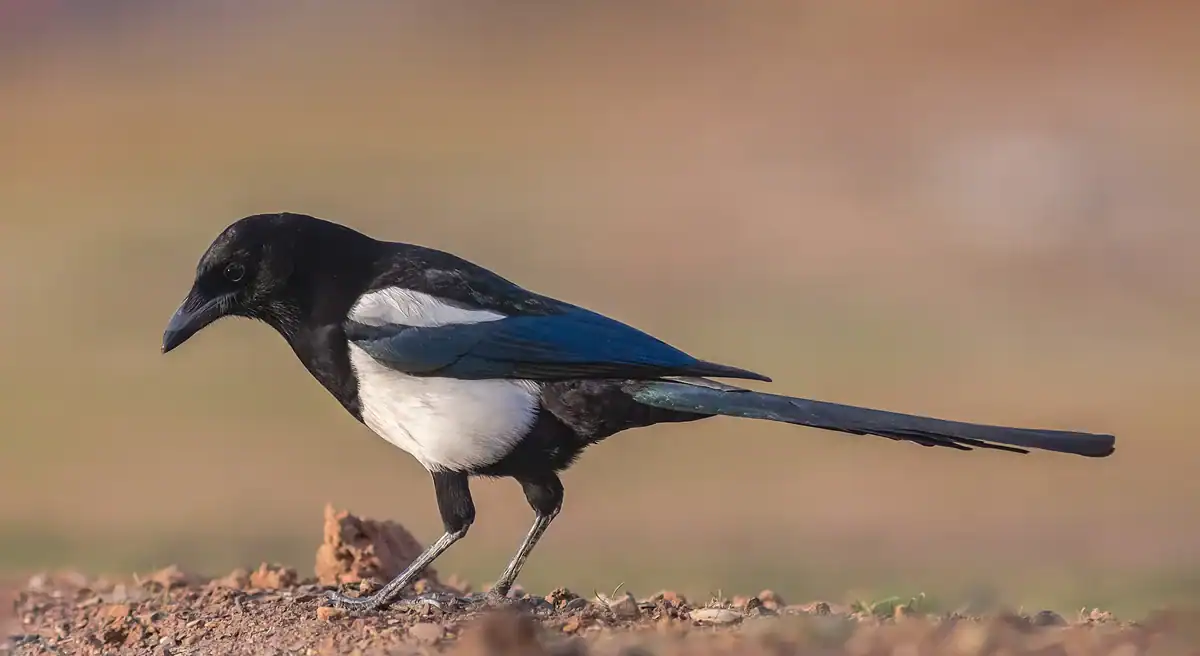
The Eurasian Magpie is the bird most people in Europe picture when they hear the word magpie. Its range runs from the British Isles and Spain across Europe and Siberia to Kamchatka. Farmland, parks, open woods and city gardens all suit it, as long as there are trees for nesting.
- The RSPB gives the Eurasian Magpie a length of 17 to 18 inches (44 to 46 cm). The RSPB also lists a weight of 7 to 9 ounces (200 to 250 g), and the British Trust for Ornithology notes that at least a third of the bird’s length is tail. In good light, the black wings shine purplish blue and the tail glints green.
- Eurasian Magpies are omnivores and scavengers that eat insects, seeds, fruit and carrion. Birds of the World notes that they often raid the nests of other birds for eggs and chicks.
- A breeding pair of Eurasian Magpies builds a large stick nest in a tall tree. According to the BTO, the female usually lays five or six eggs and incubates them for about 20 days.
- Britain’s Eurasian Magpie population rose 104 percent between 1967 and 2024, by the BTO’s count. The BTO’s oldest banded Eurasian Magpie lived 21 years and 8 months, though a typical life expectancy is about five years.
- BirdLife International rates the Eurasian Magpie as Least Concern. That rating applies to the older, broader species, which still includes the Oriental and Black-rumped Magpies.
- Carl Linnaeus described the Eurasian Magpie in 1758.
Oriental Magpie
| Kingdom | Order | Family | Genus | Species |
|---|---|---|---|---|
| Animalia | Passeriformes | Corvidae | Pica | Pica serica |
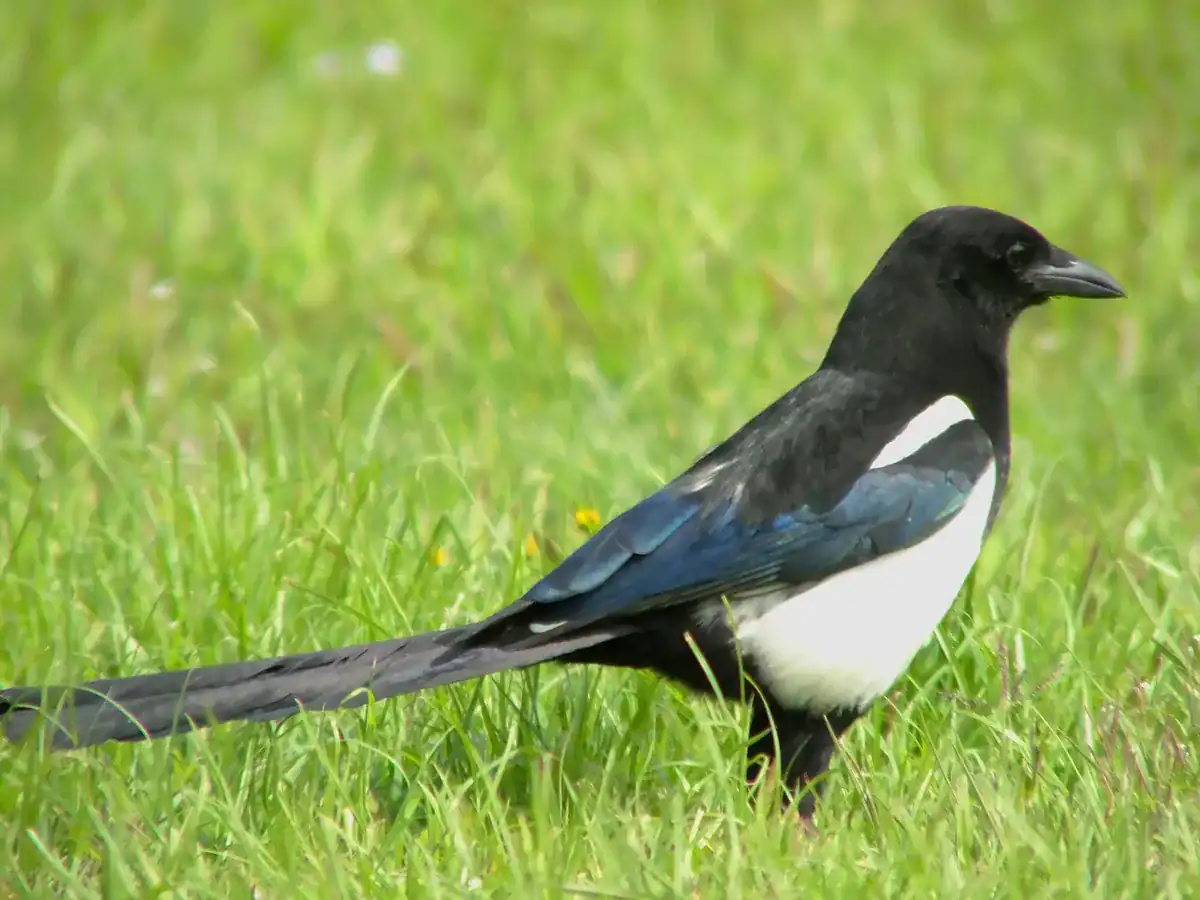
The Oriental Magpie is the black-and-white magpie of East Asia. Its native range runs from southeastern Russia and Korea south through eastern China to northern Myanmar and northern Indochina. People also introduced Oriental Magpies to Japan and Taiwan.
- The Hong Kong Bird Watching Society lists the Oriental Magpie at 18 to 20 inches (46 to 50 cm). Its wing feathers carry a greenish-blue gloss, and its tail flashes green and reddish purple. No weight for this species turned up in the sources used.
- In Hong Kong, Oriental Magpies live around villages, farmland and open wetlands. They often nest on pylons, cranes, lighting towers and billboards, and they eat a range of foods that includes wild figs.
- Oriental Magpies on Japan’s Saga Plain descend from birds brought over from Korea, probably by the early 1600s. A 2025 study in Ecology and Evolution reports that this population is now declining, even though its habitat is a national natural monument.
- The Wild Bird Federation Taiwan says Oriental Magpies were brought to Taiwan as ornamental birds during the Qing dynasty, with the first wild record in 1863. By 2012, Oriental Magpies had spread across most of Taiwan except the east.
- A 2025 review of Pica genetics by Alexey Kryukov finds that the Oriental Magpie forms its own deeply divergent lineage. The branching order among the main Pica lineages remains unresolved. Where it meets the Eurasian Magpie in eastern Mongolia, the two species interbreed, and the mixed population shows lower breeding success.
- An Audubon article describes the Oriental Magpie as a symbol of Korean identity. The bird also appears in traditional Korean paintings that pair a magpie with a tiger.
- The Oriental Magpie has not yet been assessed on its own for the IUCN Red List, so its status is Not Evaluated. BirdLife still includes it in the Eurasian Magpie. The Hong Kong Bird Watching Society found breeding Oriental Magpies in 40 percent of its survey squares in the 1990s, but in only 12 percent by 2019.
- John Gould described the Oriental Magpie in 1845.
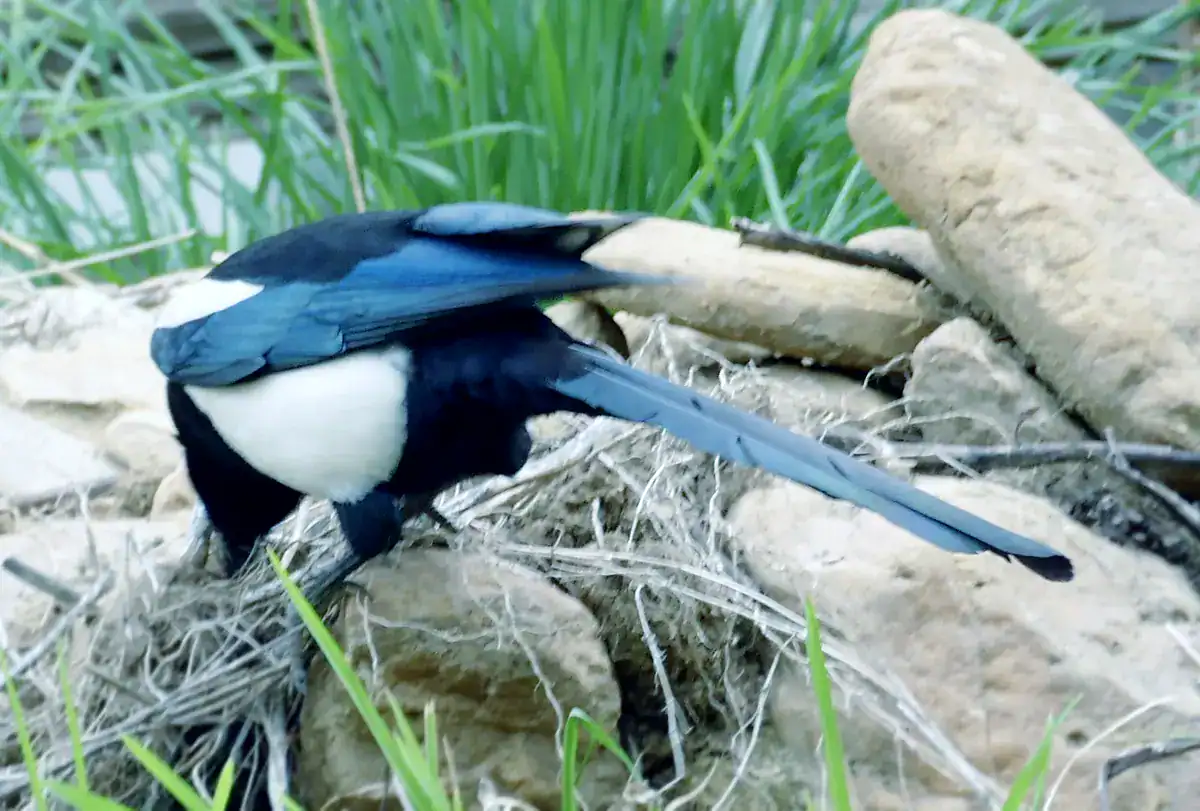
Black-rumped Magpie
| Kingdom | Order | Family | Genus | Species |
|---|---|---|---|---|
| Animalia | Passeriformes | Corvidae | Pica | Pica bottanensis |
The Black-rumped Magpie is a high-mountain magpie of the Tibetan Plateau. It ranges from Qinghai and western Sichuan in China south through Tibet to central Bhutan.
- Birds of the World describes the Black-rumped Magpie as larger but shorter-tailed than the Eurasian Magpie. As its name says, the rump is black instead of white, and the white wing patches are smaller.
- A 1922 volume of The Fauna of British India by E. C. Stuart Baker gives the Black-rumped Magpie a length of about 21 inches (525 mm). That old figure was the only measurement found in the sources used.
- Stuart Baker recorded Black-rumped Magpies breeding above 10,000 feet (3,050 m), often with nests set low in thorn bushes. In Tibet, these magpies also build large communal roost nests, sometimes on telephone poles, according to Birds of the World.
- The species name bottanensis comes from the old French name for Bhutan. Mitochondrial DNA suggests that the Black-rumped Magpie’s closest relative is the Asir Magpie of Saudi Arabia.
- The Black-rumped Magpie has not yet been assessed on its own for the IUCN Red List, so its status is Not Evaluated. BirdLife still counts it as part of the Eurasian Magpie.
- Adolphe Delessert described the Black-rumped Magpie in 1840.
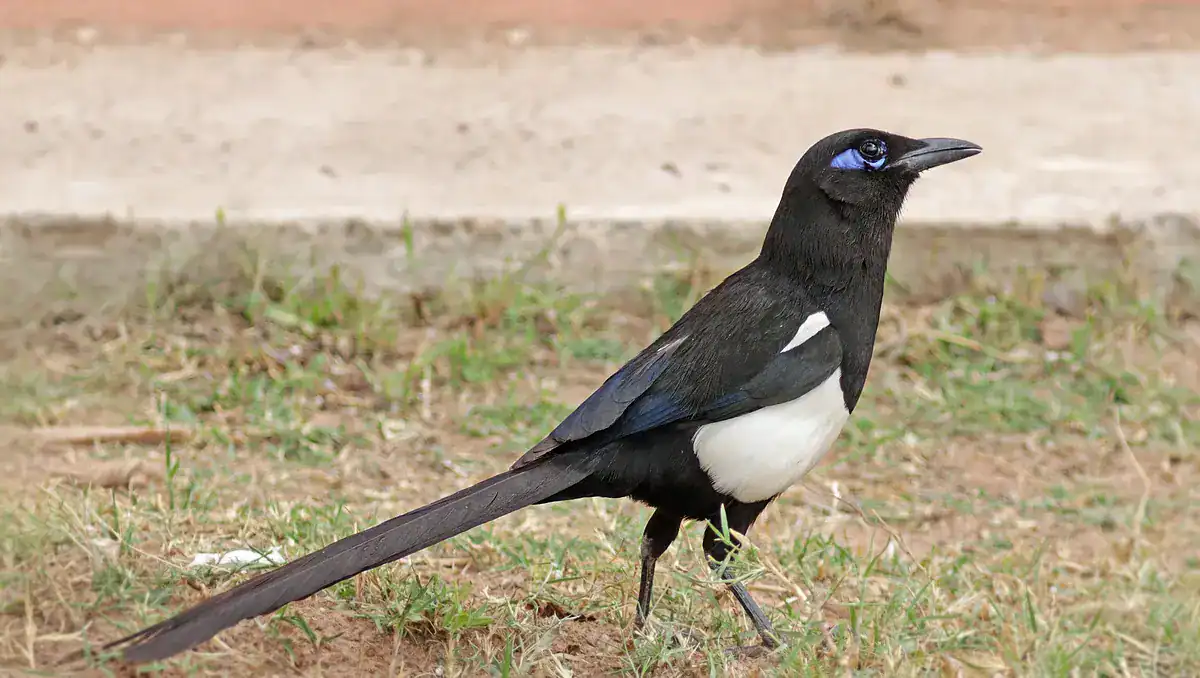
Maghreb Magpie
| Kingdom | Order | Family | Genus | Species |
|---|---|---|---|---|
| Animalia | Passeriformes | Corvidae | Pica | Pica mauritanica |
The Maghreb Magpie lives in northwest Africa, in Morocco, Algeria and Tunisia. GREPOM notes a patch of bright blue bare skin around the eye as its main field mark.
- GREPOM, BirdLife’s partner group in Morocco, gives the Maghreb Magpie an average length of about 18 inches (46 cm). Compared with a Eurasian Magpie, it has slightly shorter wings and a longer tail with little gloss. No weight for this species turned up in the sources used.
- Maghreb Magpies prefer farmland and grassland mixed with groves of trees. BirdLife also records them in thorny scrub and urban parks, at elevations up to 8,200 feet (2,500 m).
- The Maghreb Magpie feeds mainly on ground insects such as beetles, according to GREPOM. Its wider diet includes lizards, small mammals, nestlings, seeds, fruit and roadkill.
- Morocco long listed the Maghreb Magpie as a nuisance species in its yearly hunting orders, so the birds could be killed freely. In Tunisia, BirdLife reports that the species now survives only around Sbikha, possibly with fewer than 100 pairs.
- BirdLife rates the Maghreb Magpie as Least Concern, while suspecting a slow decline.
- Alfred Malherbe described the Maghreb Magpie in 1845.
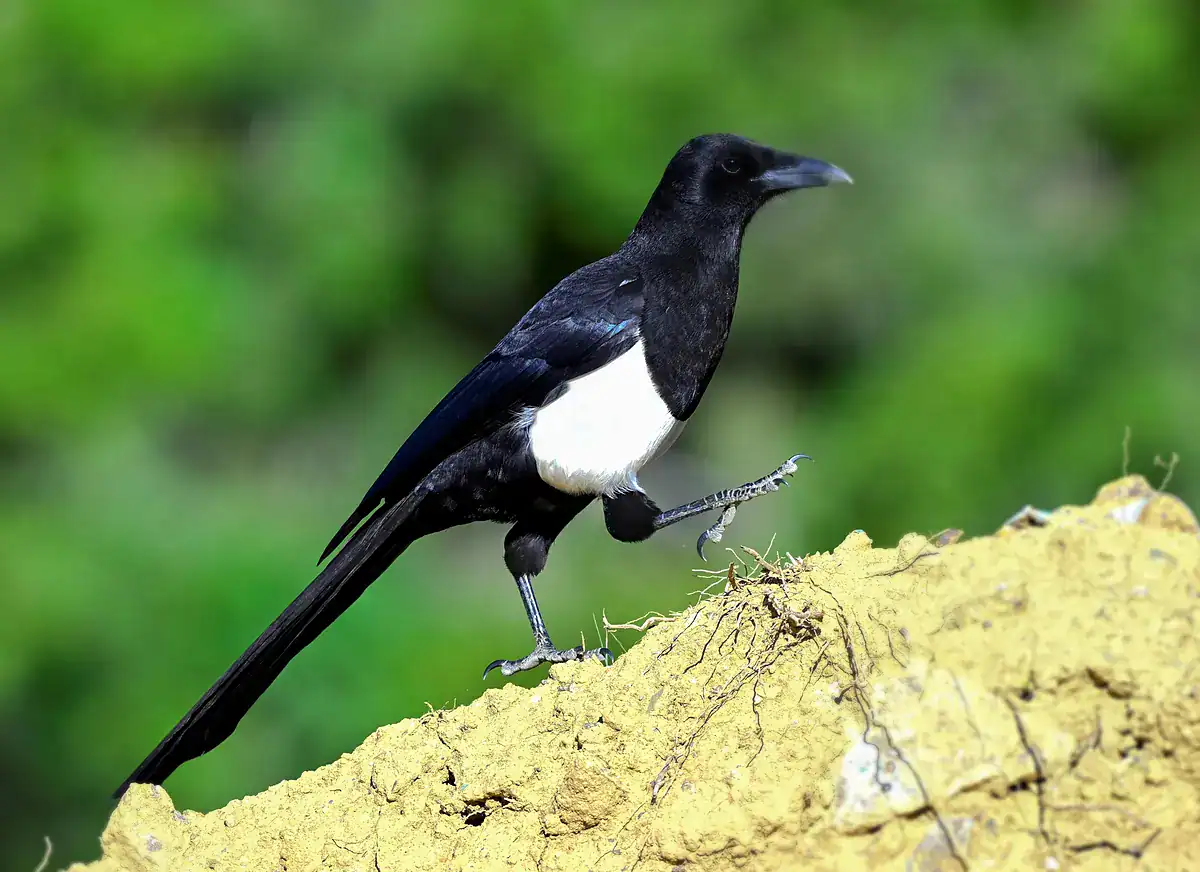
Asir Magpie
| Kingdom | Order | Family | Genus | Species |
|---|---|---|---|---|
| Animalia | Passeriformes | Corvidae | Pica | Pica asirensis |
The Smithsonian describes the Asir Magpie as Saudi Arabia’s only endemic bird. It lives in the juniper woodlands of the Asir Mountains, between about 6,000 and 9,800 feet (1,850 to 3,000 m).
- Saudi Arabia’s National Center for Wildlife puts the Asir Magpie at about 18 inches (46 cm) and 8.5 ounces (240 g). A 2016 report in the journal Sandgrouse describes duller plumage than a Eurasian Magpie’s, with an all-black rump, a much shorter tail and a larger bill.
- Ants, bees and locusts make up much of the Asir Magpie’s diet, the Saudi Press Agency reports. The birds also eat seeds, fruit, fallen berries and leftover rice from picnic areas.
- Asir Magpies build an oval dome of twigs with a side entrance. The National Center for Wildlife says these nests sit 10 to 26 feet (3 to 8 m) up in a juniper or acacia.
- The National Center for Wildlife says Asir Magpie numbers fell by more than 90 percent over 80 years. The center now runs a rescue plan with 29 separate actions.
- The 2016 Sandgrouse report links the Asir Magpie’s decline to tourism development, habitat destruction and warmer, drier weather in the Asir Mountains.
- BirdLife rates the Asir Magpie as Endangered and estimates that about 100 breeding pairs remain.
- George Latimer Bates described the Asir Magpie in 1936. For decades it was treated as a subspecies of the Eurasian Magpie.
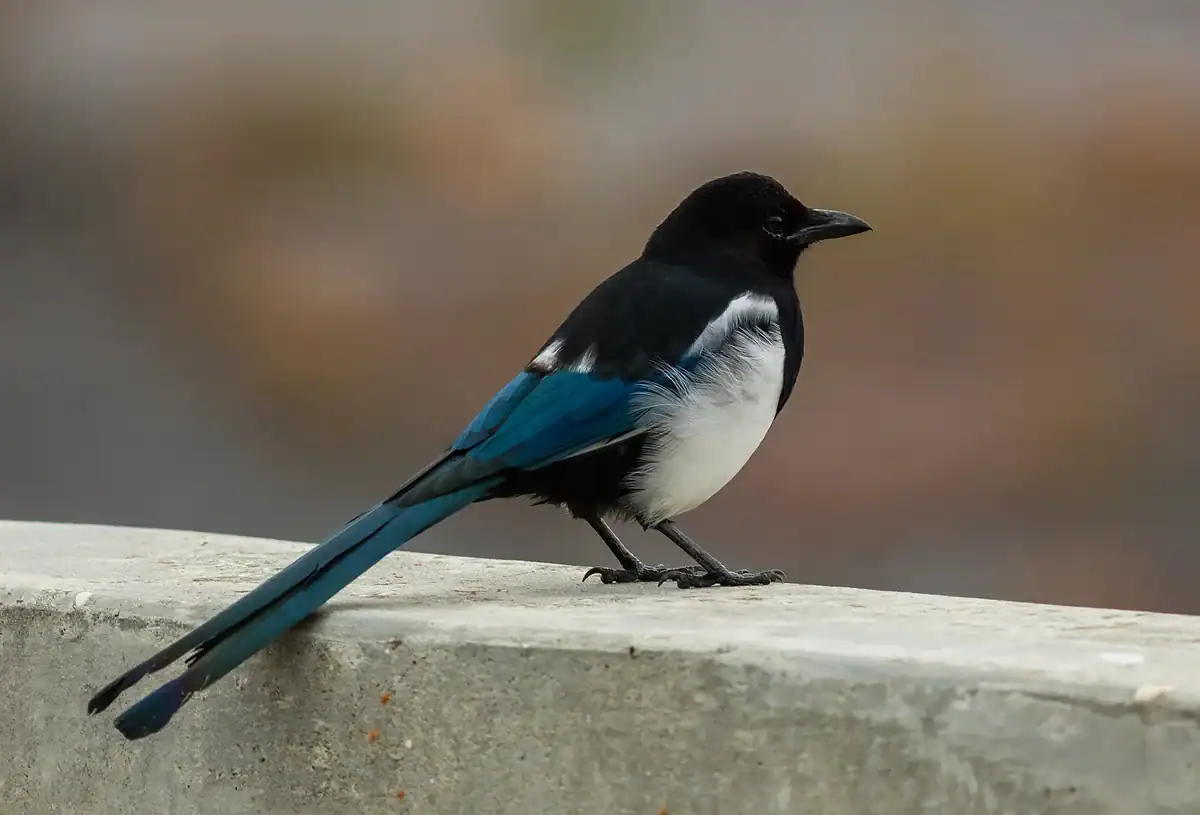
Black-billed Magpie
| Kingdom | Order | Family | Genus | Species |
|---|---|---|---|---|
| Animalia | Passeriformes | Corvidae | Pica | Pica hudsonia |
The Black-billed Magpie is the common magpie of western North America. It ranges from Alaska and western Canada south to northern Arizona and New Mexico.
- The Cornell Lab of Ornithology lists the Black-billed Magpie at 17.7 to 23.6 inches (45 to 60 cm) long and 5.1 to 7.4 ounces (145 to 210 g). Much of that length is a long, diamond-shaped tail, and both wings and tail flash blue-green in sunlight.
- Black-billed Magpies favor meadows, sagebrush plains and ranchland, usually near water. They eat grain, fruit, insects, small mammals and carrion, and they pick ticks off deer, moose and cattle.
- A Black-billed Magpie nest is a bulky dome of sticks around a mud cup. Cornell notes that one nest can take up to 40 days to build.
- Lewis and Clark recorded the Black-billed Magpie in their journals on September 17, 1804, on the Great Plains. The University of Nebraska edition of the journals notes that magpies were not previously known in the New World. The expedition later shipped four live magpies to Thomas Jefferson, and only one survived the trip.
- When a Black-billed Magpie finds a dead magpie, it calls loudly, and other magpies gather around the body for a few minutes. Animal Diversity Web notes that scientists still do not understand the purpose of these gatherings.
- BirdLife rates the Black-billed Magpie as Least Concern. Cornell reports a decline of about 38 percent between 1966 and 2019, based on the North American Breeding Bird Survey.
- The oldest Black-billed Magpie on record with the USGS Bird Banding Laboratory was 9 years and 5 months old.
- Joseph Sabine described the Black-billed Magpie in 1823.
Yellow-billed Magpie
| Kingdom | Order | Family | Genus | Species |
|---|---|---|---|---|
| Animalia | Passeriformes | Corvidae | Pica | Pica nuttallii |
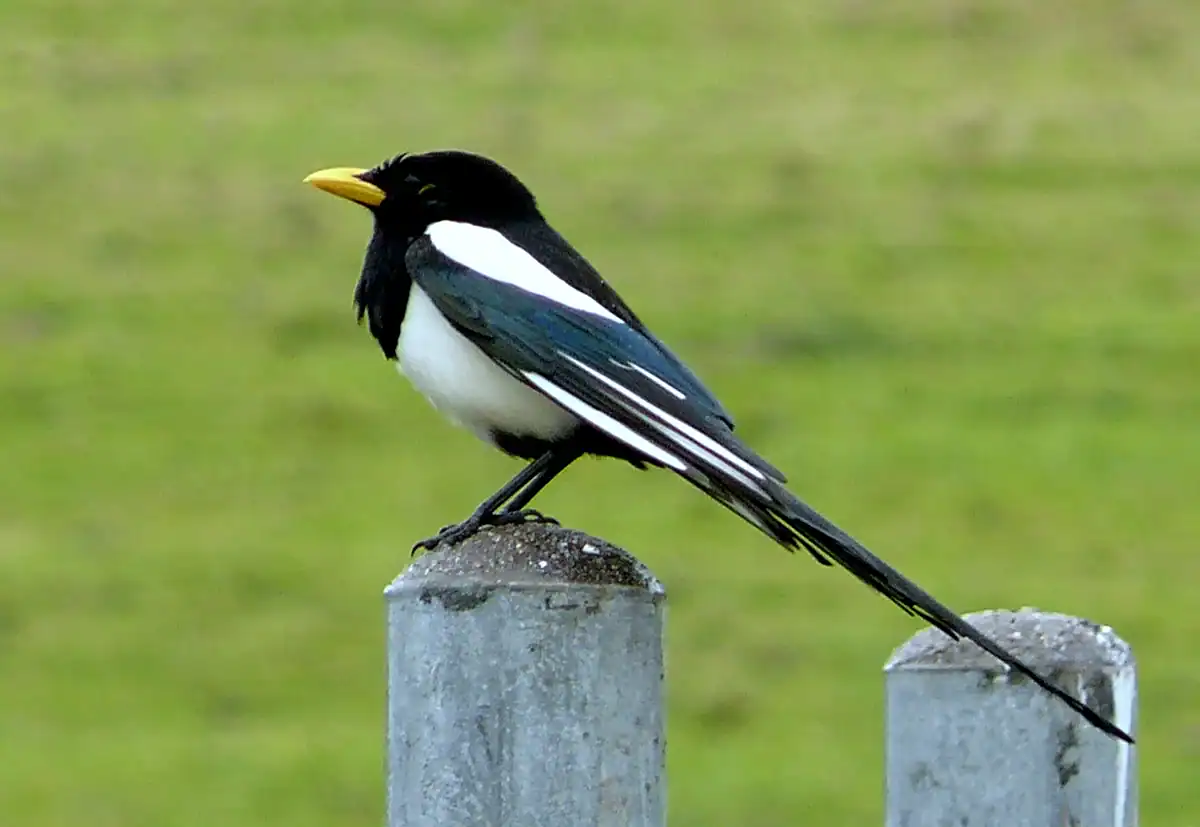
The Yellow-billed Magpie lives in California and nowhere else. Cornell places it in the oak woodlands of the Central Valley, the Coast Ranges and the Sierra Nevada foothills, from Redding south to Santa Barbara.
- Cornell lists the Yellow-billed Magpie at 16.9 to 21.3 inches (43 to 54 cm) and 5.3 to 6.0 ounces (150 to 170 g). That makes it a little smaller than the Black-billed Magpie, and its bright yellow bill is the quickest way to tell the two apart.
- Yellow-billed Magpies live in oak savanna, open oak woodland, orchards and pasture with tall trees. The California Department of Fish and Wildlife reports that about 70 percent of their yearly diet is animal food, from insects to carrion. Acorns, grain and fruit make up the rest.
- Yellow-billed Magpies nest high, usually 30 to 80 feet (9 to 24 m) up, according to the California Department of Fish and Wildlife. Dozens of pairs sometimes nest close together.
- West Nile virus spread through the Yellow-billed Magpie’s range in 2004 and hit the species hard. Crosbie and colleagues wrote in The Auk that people reported 12,211 dead Yellow-billed Magpies from 2004 to 2006. Of the 1,007 dead magpies tested, 78 percent carried the virus.
- Cornell reports that the Yellow-billed Magpie has declined 83 percent since 1968. The 2025 State of the Birds report puts the Yellow-billed Magpie on its Red Alert list of species at risk of steep further losses. BirdLife rates it as Vulnerable.
- John James Audubon described the Yellow-billed Magpie in 1837 and named it for the naturalist Thomas Nuttall. The AviList checklist now spells the species name nuttallii, replacing the older spelling nuttalli.
Blue Magpies
The five Urocissa magpies are large, colorful birds with very long tails, in which the outer feathers are much shorter than the central ones. Four of them have bright blue bodies, red or yellow bills and white tips on their tail feathers. The fifth, the White-winged Magpie, is darker and far less known.
Sri Lanka Blue Magpie
| Kingdom | Order | Family | Genus | Species |
|---|---|---|---|---|
| Animalia | Passeriformes | Corvidae | Urocissa | Urocissa ornata |
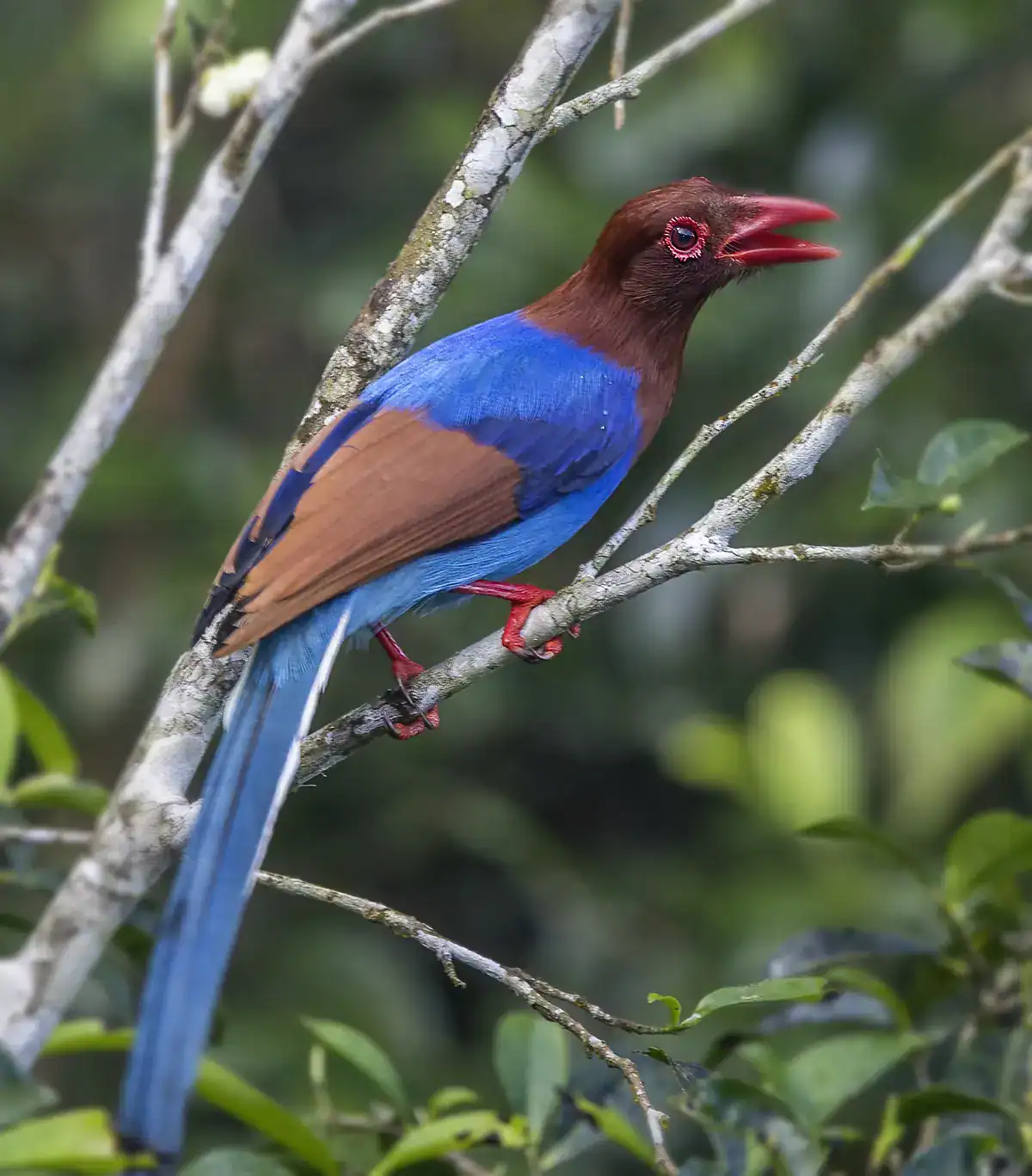
The Sri Lanka Blue Magpie lives only in Sri Lanka, in the tall forests of the island’s wet zone.
- BirdLife describes the Sri Lanka Blue Magpie as a blue bird with a chestnut head, chestnut wings and a red bill, eye-ring and legs. It measures 16.5 to 18.5 inches (42 to 47 cm), and much of that is its long, white-tipped tail.
- The EltonTraits database, which draws on the CRC Handbook of Avian Body Masses, gives the Sri Lanka Blue Magpie a weight of about 7 ounces (196 g).
- Sri Lanka Blue Magpies live in undisturbed hill and lowland forest from about 500 to 7,000 feet (150 to 2,135 m). The Ceylon Bird Club lists geckos, lizards, frogs, insects, larvae and fruit in their diet.
- A University of Colombo study of marked birds found that Sri Lanka Blue Magpies breed cooperatively, with helpers feeding the young. Larger groups raised more fledglings, but pairs without helpers also bred successfully.
- BirdLife rates the Sri Lanka Blue Magpie as Vulnerable and estimates 6,000 to 14,000 mature birds, with numbers slowly declining.
- Johann Georg Wagler described the Sri Lanka Blue Magpie in 1829.
Taiwan Blue Magpie
| Kingdom | Order | Family | Genus | Species |
|---|---|---|---|---|
| Animalia | Passeriformes | Corvidae | Urocissa | Urocissa caerulea |
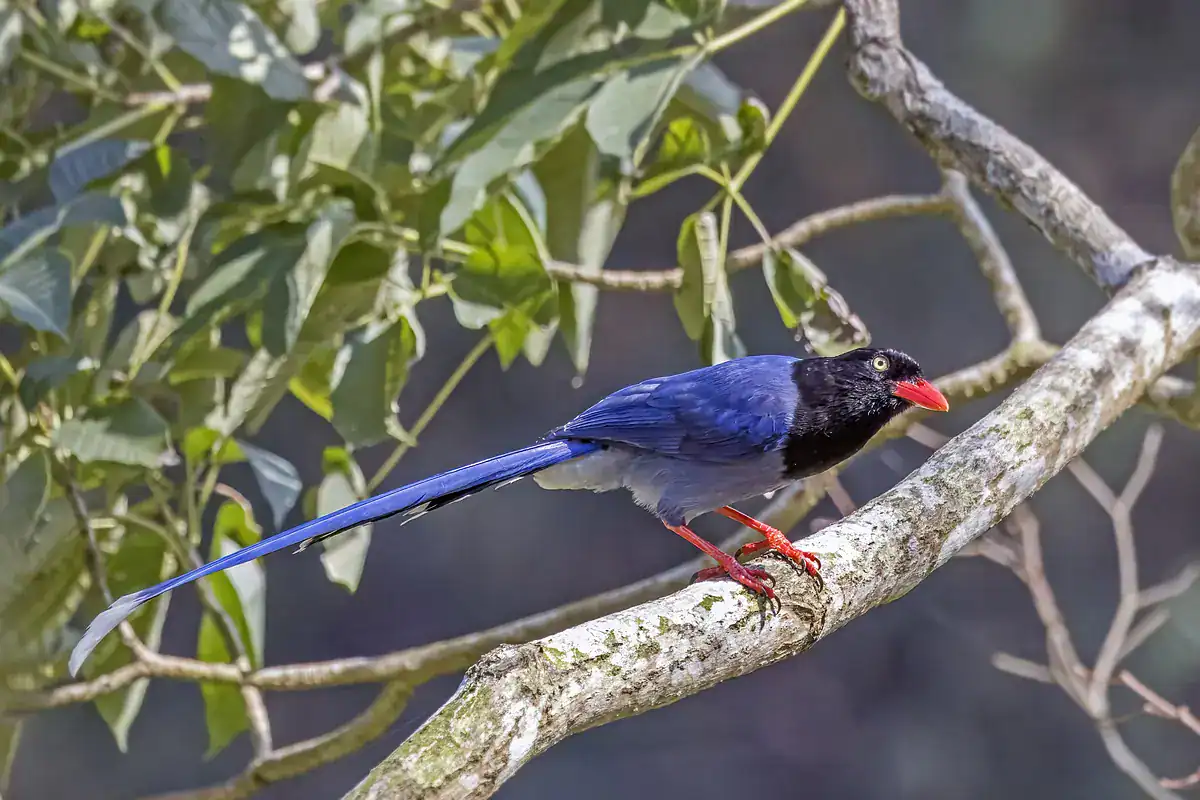
The Taiwan Blue Magpie is found only on Taiwan, mostly in lowland and foothill broadleaf forest and nearby farmland. Taipei has adopted it as the city’s official bird.
- A Taiwan Blue Magpie has a black head and breast, a red bill and feet, yellow eyes and a long blue tail with white tips. A Taipei City fact sheet lists it at up to about 27 inches (68 cm), and EltonTraits gives a weight of about 9 ounces (257 g).
- Taiwan Blue Magpies eat berries, papaya, insects, lizards, snakes and small mammals. Taiwan’s Ministry of Agriculture notes that they also prey on the chicks of other birds.
- A 1987 study published by Academia Sinica found that the Taiwan Blue Magpie was the only species known on Taiwan to breed with helpers at the nest. Helpers were present at 70 percent of the nests early in the study. All members of a flock helped build nests and feed the young.
- Taiwan Blue Magpies defend their nests fiercely and will swoop at people who come too close. The Taipei City fact sheet adds that they almost never injure anyone.
- BirdLife lists the Taiwan Blue Magpie as Least Concern, with numbers thought to be slowly falling because of habitat loss.
- John Gould described the Taiwan Blue Magpie in 1863.
Yellow-billed Blue Magpie
| Kingdom | Order | Family | Genus | Species |
|---|---|---|---|---|
| Animalia | Passeriformes | Corvidae | Urocissa | Urocissa flavirostris |
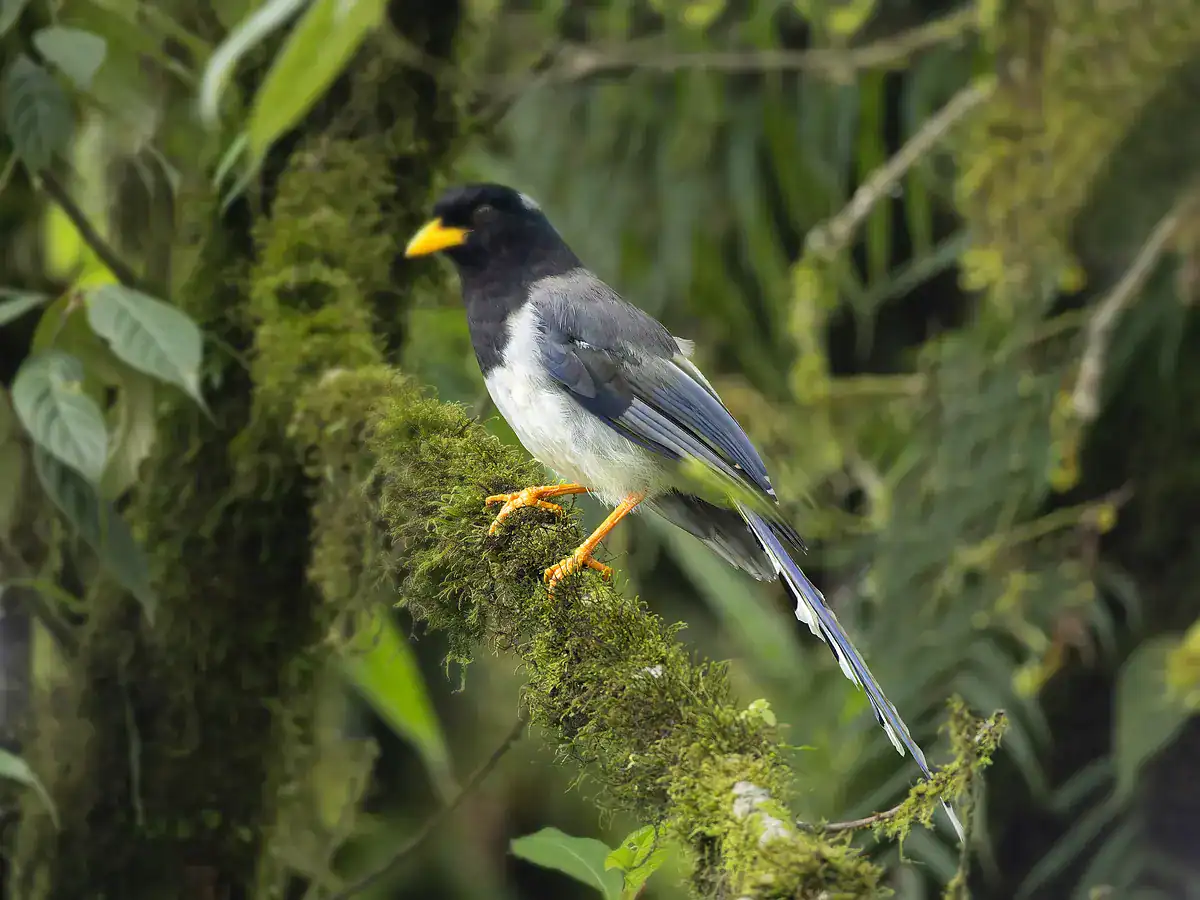
The Yellow-billed Blue Magpie lives in Himalayan forests from northern Pakistan and India through Nepal and Bhutan to northern Myanmar and northern Vietnam. BirdLife’s current factsheet lists an elevation range of about 1,300 to 12,100 feet (390 to 3,700 m). It separately gives occasional elevation limits of 3,300 to 12,100 feet (1,000 to 3,700 m).
- In 1922, E. C. Stuart Baker described the Yellow-billed Blue Magpie with a black head and breast, a white nape, a waxy yellow bill and orange-yellow legs. Stuart Baker measured a total length of about 25 inches (630 to 650 mm), with a tail of up to 18.5 inches (47 cm).
- EltonTraits gives the Yellow-billed Blue Magpie a weight of about 5.3 ounces (149 g). The yellow bill separates it from the Red-billed Blue Magpie, which lives in some of the same areas.
- Stuart Baker called the Yellow-billed Blue Magpie omnivorous and noted that it hunts small mammals, nestlings and insects of all kinds.
- BirdLife rates the Yellow-billed Blue Magpie as Least Concern but suspects a small decline linked to tree cover loss.
- Edward Blyth described the Yellow-billed Blue Magpie in 1846.
Red-billed Blue Magpie
| Kingdom | Order | Family | Genus | Species |
|---|---|---|---|---|
| Animalia | Passeriformes | Corvidae | Urocissa | Urocissa erythroryncha |
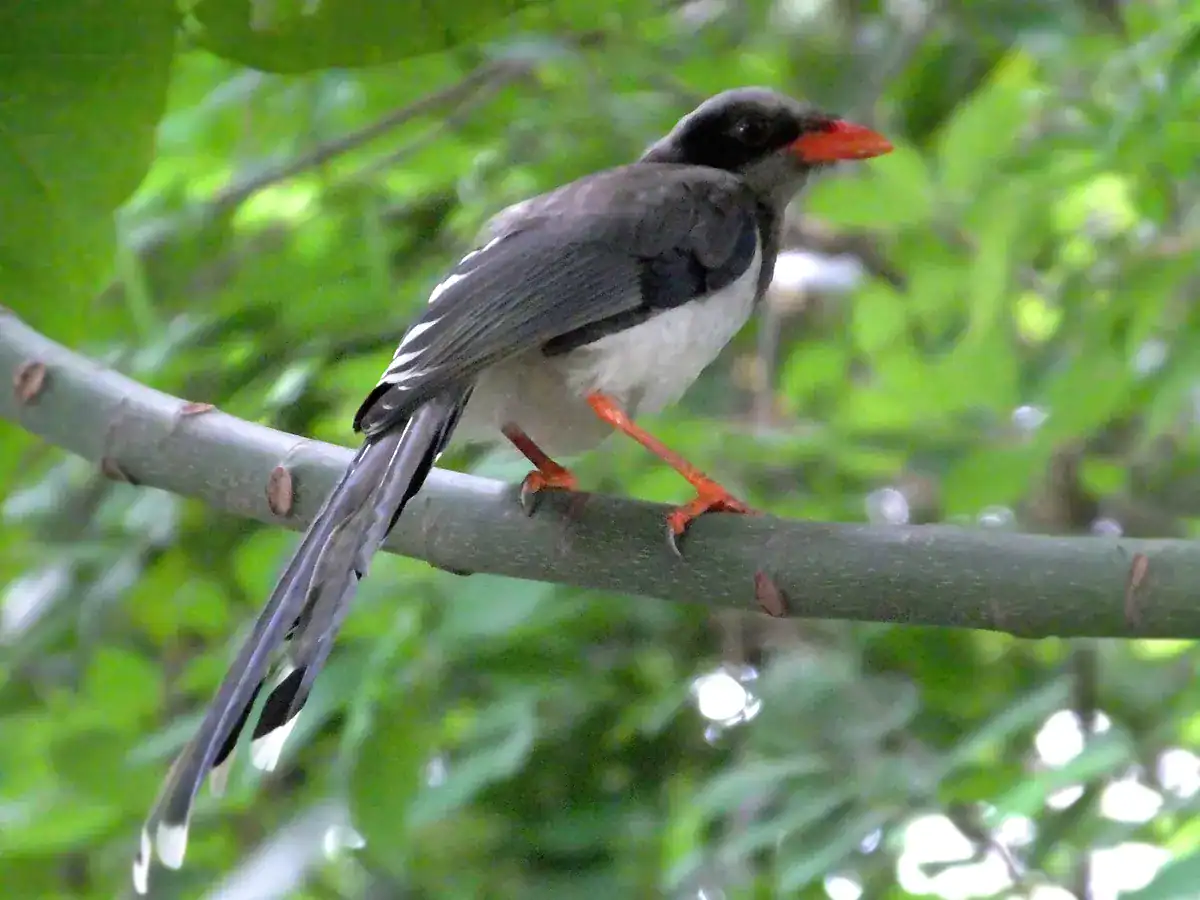
The Red-billed Blue Magpie ranges from the western Himalayas east through China and Indochina, including the island of Hainan. In Hong Kong, it favors woodland edges, large gardens and shrubland.
- The Hong Kong Bird Watching Society lists the Red-billed Blue Magpie at 21 to 27 inches (53 to 68 cm), with an exceptionally long tail. The Saint Louis Zoo notes that the tail feathers alone can grow up to 17 inches (43 cm) long.
- A Red-billed Blue Magpie has a black head and breast, white-tipped crown feathers and a red bill. EltonTraits gives an average weight of about 5.4 ounces (152 g).
- Red-billed Blue Magpies prey on insects, eggs and nestlings. In Hong Kong, observers have seen them destroy magpie nests, catch a young tailorbird in flight and attack snakes, including cobras.
- Red-billed Blue Magpies introduced to Taiwan have bred with the native Taiwan Blue Magpie. Taiwan’s Forestry Bureau has removed introduced birds, including a mixed family found in 2007.
- BirdLife rates the Red-billed Blue Magpie as Least Concern, with a stable population.
- Pieter Boddaert described the Red-billed Blue Magpie in 1783.
White-winged Magpie
| Kingdom | Order | Family | Genus | Species |
|---|---|---|---|---|
| Animalia | Passeriformes | Corvidae | Urocissa | Urocissa whiteheadi |
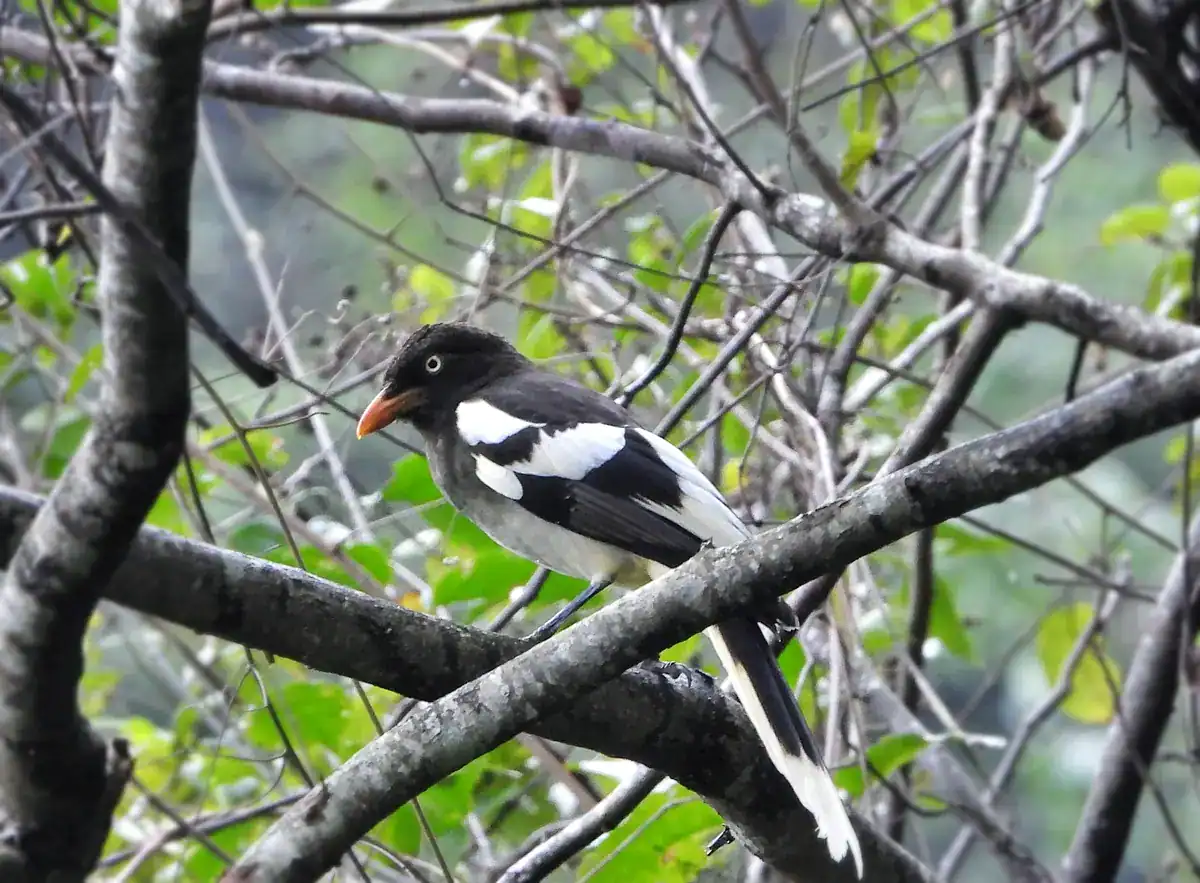
The White-winged Magpie lives in the forests of Hainan, southern China, Laos and Vietnam. It looks quite unlike the other blue magpies, with dark plumage and pale bands on the wings and tail.
- Birds of the World describes the White-winged Magpie as heavily built, with a thick bill and a long, tapering tail. Adults have yellow eyes and yellowish-white bands on the wings and tail. No length or weight for this species turned up in the sources used.
- White-winged Magpies live in evergreen, pine and mixed forest from the lowlands to about 4,600 feet (1,400 m), and they rarely enter farmland, according to BirdLife.
- Birds of the World notes that almost nothing has been published on the White-winged Magpie’s diet. Its nest and eggs were described only briefly, from Hainan, more than a century ago.
- On the Nakai Plateau in Laos, White-winged Magpies were locally common in the 1990s but turned up far less often by the early 2000s. BirdLife rates the species Near Threatened because of continuing forest loss across its range.
- Ornithologists once placed the White-winged Magpie in its own genus, Cissopica. Some now suggest that its two subspecies may be separate species.
- William Robert Ogilvie-Grant described the White-winged Magpie in 1899.
Green Magpies
The four Cissa magpies are bright green forest birds with a black mask, a red bill and chestnut wings. Their green comes from blue feathers tinted by yellow pigment from their food.
According to the Javan Green Magpie Conservation Action Plan, the green feathers of Cissa magpies are blue feathers tinted by lutein, a yellow pigment the birds absorb from their food. Without enough lutein, or under strong sunlight, the green fades to blue and the red bill turns pale orange. Museum skins fade the same way, which is how the Javan Green Magpie got the name thalassina, meaning sea-green or bluish green.
Common Green Magpie
| Kingdom | Order | Family | Genus | Species |
|---|---|---|---|---|
| Animalia | Passeriformes | Corvidae | Cissa | Cissa chinensis |
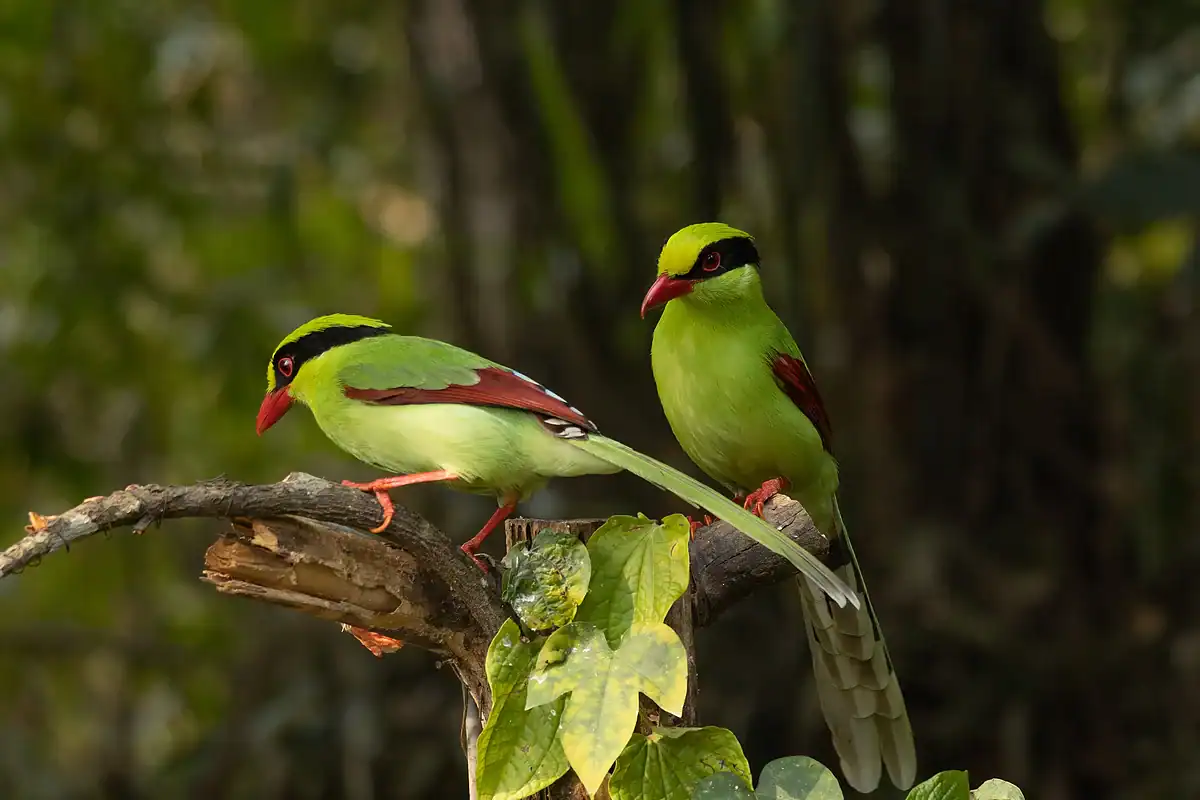
The Common Green Magpie ranges from the eastern Himalayas through southern China and Indochina to the Malay Peninsula, Sumatra and Borneo. Its range is far larger than that of any other green magpie.
- A 2013 review by van Balen and colleagues in Bird Conservation International lists the Common Green Magpie at 14.6 to 15.4 inches (37 to 39 cm). The same review gives a weight of 4.2 to 4.7 ounces (120 to 133 g).
- Malaysia’s biodiversity database, MyBIS, describes the Common Green Magpie as emerald green with a black mask, reddish-brown wings and a red bill, legs and eye rims. eBird adds that a black-and-white lattice pattern on the rear wing feathers separates it from the Indochinese Green Magpie.
- Common Green Magpies live in lowland and hill forest, bamboo and scrub. MyBIS describes them as mainly carnivorous, eating beetles, grasshoppers, small reptiles and mammals, nestlings and eggs.
- In 1988, the Houston Zoo became the first in North America to breed Common Green Magpies, according to a 1989 report in AFA Watchbird. The chicks, fed mostly on mice, left the nest bluish and turned green only after a diet rich in carotenoids, the pigment family that includes lutein.
- BirdLife rates the Common Green Magpie as Least Concern, with a declining population.
- Pieter Boddaert described the Common Green Magpie in 1783.
Indochinese Green Magpie
| Kingdom | Order | Family | Genus | Species |
|---|---|---|---|---|
| Animalia | Passeriformes | Corvidae | Cissa | Cissa hypoleuca |
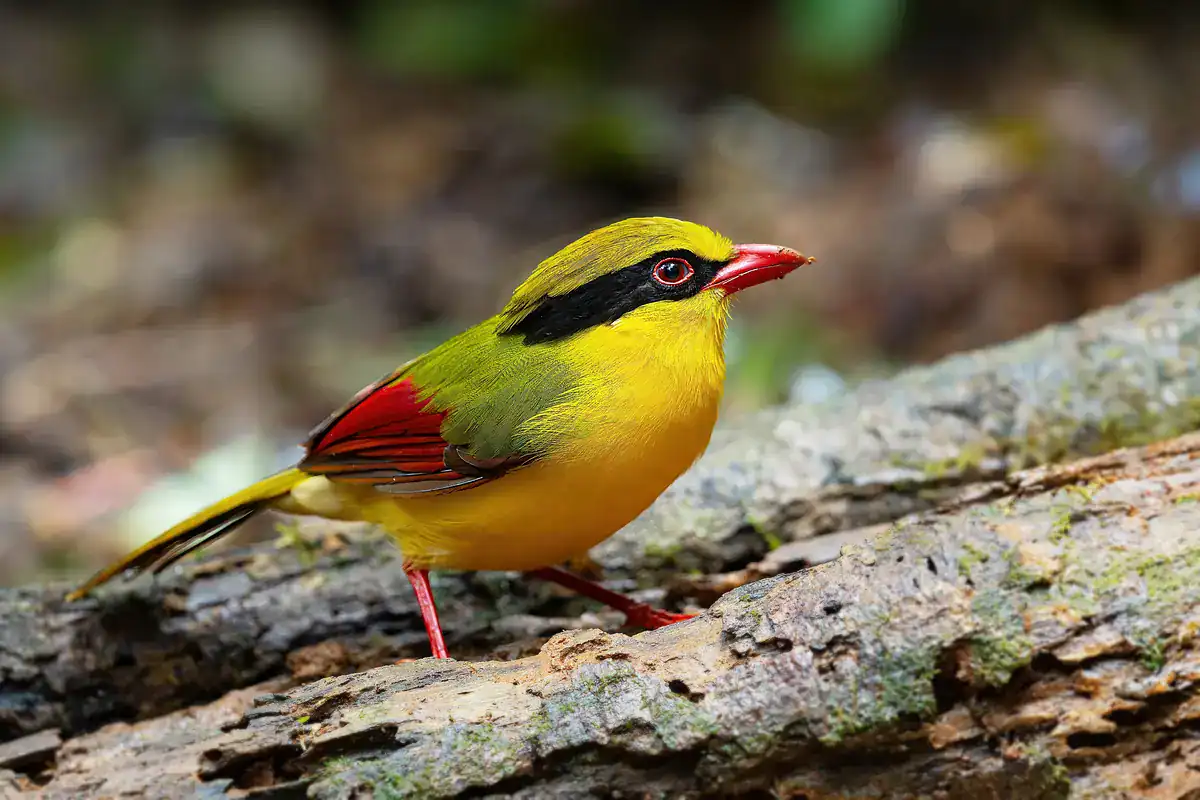
The Indochinese Green Magpie lives in the evergreen forests of Thailand, Laos, Cambodia, Vietnam, southern China and Hainan. It usually travels in small to medium flocks.
- Van Balen and colleagues list the Indochinese Green Magpie at 13.4 to 13.8 inches (34 to 35 cm) and about 4.4 ounces (125 g). That makes the Indochinese Green Magpie slightly smaller than the Common Green Magpie.
- eBird describes the Indochinese Green Magpie as vivid green with a black mask, cinnamon flight feathers and a cherry-red bill. Birds in Southeast Asia have a yellow breast and belly, while Chinese birds are green below.
- The Indochinese Green Magpie’s inner wing feathers are plain green with no black-and-white pattern, which helps separate it from the Common Green Magpie.
- A 1999 AFA Watchbird report on captive Indochinese Green Magpies describes a pair stalking mice “like a brace of dogs.” Their young left the nest blue-gray and did not turn green until their first adult molt.
- BirdLife rates the Indochinese Green Magpie as Least Concern, with a declining population.
- Tommaso Salvadori and Enrico Hillyer Giglioli described the Indochinese Green Magpie in 1885.
Javan Green Magpie
| Kingdom | Order | Family | Genus | Species |
|---|---|---|---|---|
| Animalia | Passeriformes | Corvidae | Cissa | Cissa thalassina |
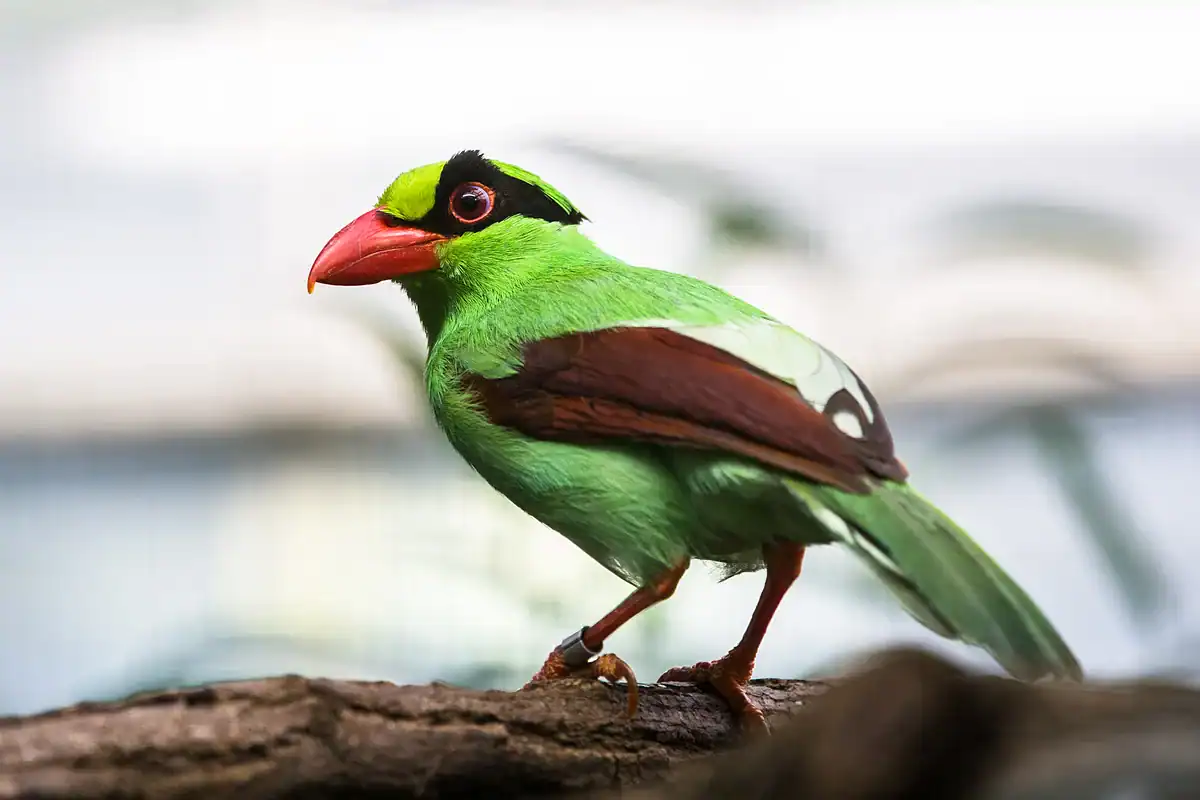
The Javan Green Magpie lives only in the mountain forests of western Java, in Indonesia. It is Critically Endangered, and its wild population may now be smaller than the 130 birds that its conservation action plan counts in zoos and breeding centers.
- BirdLife lists the Javan Green Magpie at 12.2 to 13 inches (31 to 33 cm). The species’ conservation action plan gives a weight of 4.4 to 4.8 ounces (124 to 135 g). It has a shorter tail than other green magpies, a black mask, a red bill and chestnut wings.
- Museum stomach contents show that Javan Green Magpies eat snails, crayfish, beetles, caterpillars, large ants, lizards, frogs and the eggs and chicks of other birds.
- Trapping for Java’s songbird trade drove the Javan Green Magpie’s decline. Chester Zoo explains that the birds were kept as “master birds” to train other songbirds for singing contests.
- The Javan Green Magpie Conservation Action Plan for 2026 to 2035 estimates 50 to 250 Javan Green Magpies left in the wild. Recent surveys of 12 mountains found no Javan Green Magpies.
- By October 2025, 130 Javan Green Magpies lived at 11 institutions, the action plan reports. Cikananga Wildlife Center in Java held 68 of them.
- Cikananga began gathering Javan Green Magpies rescued from West Java’s bird markets in the early 2010s. The action plan reports that the first substantiated breeding of Javan Green Magpies there took place in 2013.
- BirdLife rates the Javan Green Magpie as Critically Endangered, and Indonesian law protects it.
- Coenraad Jacob Temminck described the Javan Green Magpie in 1826.
Bornean Green Magpie
| Kingdom | Order | Family | Genus | Species |
|---|---|---|---|---|
| Animalia | Passeriformes | Corvidae | Cissa | Cissa jefferyi |
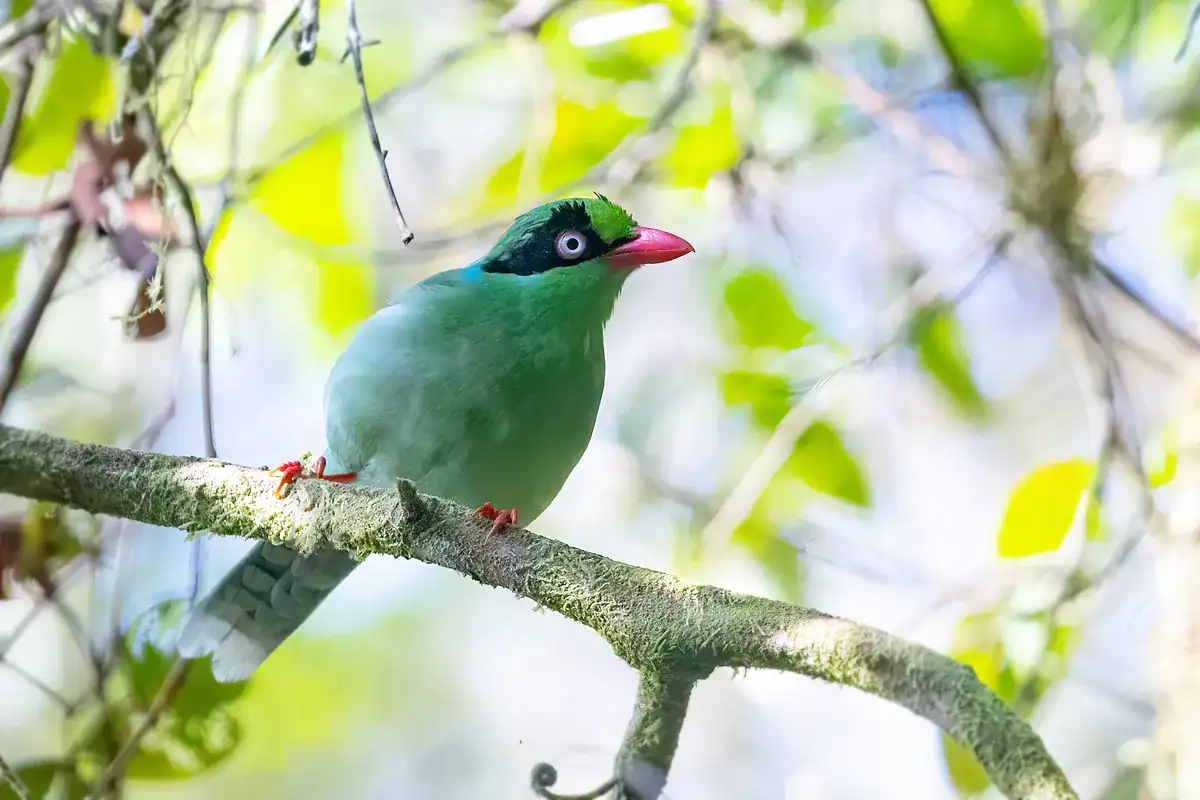
The Bornean Green Magpie lives only in the mountains of northern and central Borneo, in mountain forest up to the tree line. Its pale eye helps separate it from the Common Green Magpie, which also lives on Borneo.
- eBird describes the Bornean Green Magpie as grass green with a black mask, wine-red wings and pale inner wing feathers. MyBIS notes its whitish eyes ringed with red skin.
- Museum skins of the Bornean Green Magpie measured by van Balen and colleagues average about 10.8 inches (27.4 cm), and skins usually run shorter than live birds. The same review gives a typical weight of about 4.4 ounces (125 g).
- Bornean Green Magpies range up to about 9,000 feet (2,735 m) and rarely come below 4,600 feet (1,400 m). Their diet is mostly invertebrates and small vertebrates, according to MyBIS.
- In his 1893 book on Mount Kinabalu, the explorer John Whitehead wrote that he collected the first Bornean Green Magpie there on February 1, 1888. He noticed the bird first by its white eye and asked that it be named after his father, which gave the species the name jefferyi.
- BirdLife rates the Bornean Green Magpie as Least Concern, with a declining population.
- Richard Bowdler Sharpe described the Bornean Green Magpie in 1888.
Azure-winged Magpies
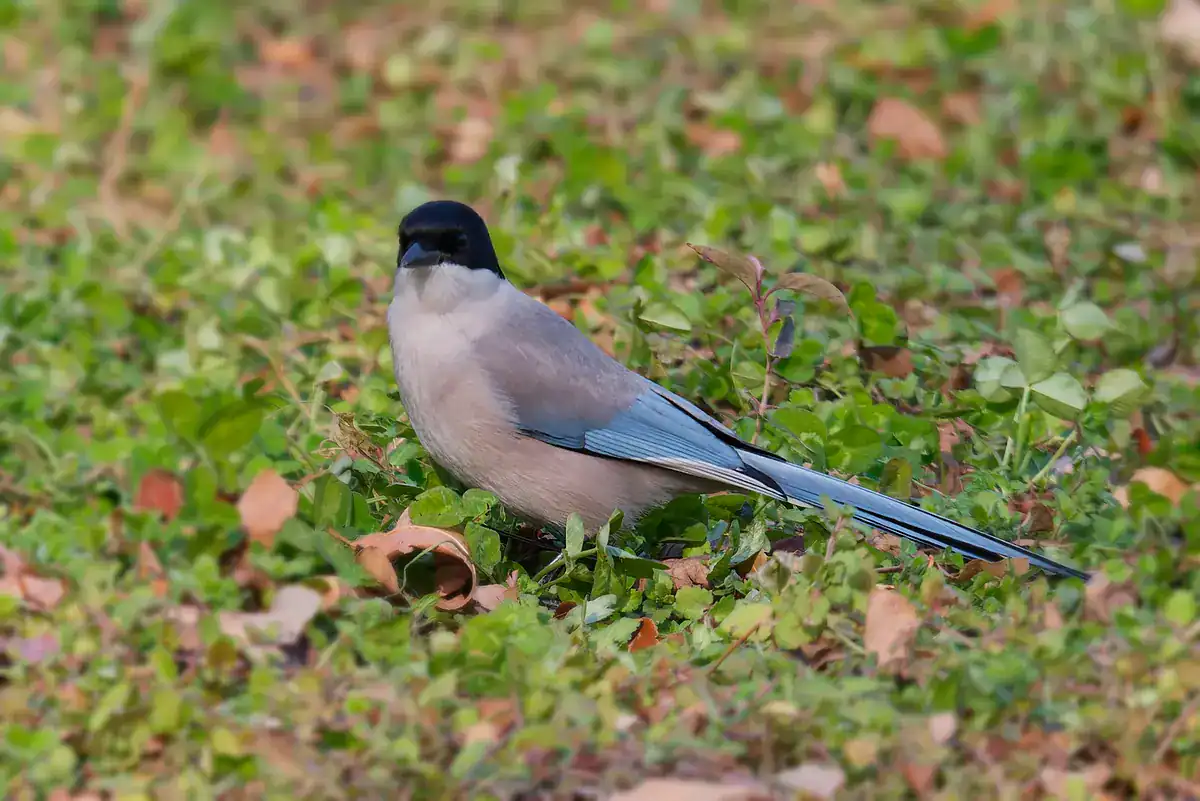
The two Cyanopica magpies are small, slim corvids with black caps, soft gray-brown bodies and pale blue wings and tails. One lives in East Asia and the other lives on the Iberian Peninsula. Spain’s breeding bird atlas gives a gap of about 5,000 miles (8,000 km) between the two populations.
Azure-winged Magpie
| Kingdom | Order | Family | Genus | Species |
|---|---|---|---|---|
| Animalia | Passeriformes | Corvidae | Cyanopica | Cyanopica cyanus |
The Azure-winged Magpie lives in East Asia, from northern Mongolia and the Amur River basin to Korea, China and Japan. It is a common resident bird across much of China.
- The Azure-winged Magpie measures about 13.8 inches (35 cm) and weighs around 2.8 ounces (80 g), according to a 2026 study in BMC Genomics by Zhang and colleagues.
- Azure-winged Magpies eat mostly insects and other small invertebrates, but they also take fruits, berries and seeds.
- Azure-winged Magpies live in groups and breed cooperatively. A 2016 study in Biology Letters found that captive birds often brought food to group mates. They were the first birds shown by experiment to share food before anyone begged for it.
- Wild Azure-winged Magpies behaved differently in a field study by Du and colleagues in Integrative Zoology. Birds on a Lanzhou University campus let others take food from them rather than offering it, and only when food was scarce.
- On the Tibetan Plateau, Azure-winged Magpie nests can cluster at 20 to 180 nests per hectare (about 8 to 73 per acre) in shrubs. A 2022 study in Current Zoology found that neighbors often raid each other’s nests.
- BirdLife rates the Azure-winged Magpie as Least Concern, with a slow decline.
- Peter Simon Pallas described the Azure-winged Magpie in 1776.
Iberian Magpie
| Kingdom | Order | Family | Genus | Species |
|---|---|---|---|---|
| Animalia | Passeriformes | Corvidae | Cyanopica | Cyanopica cooki |
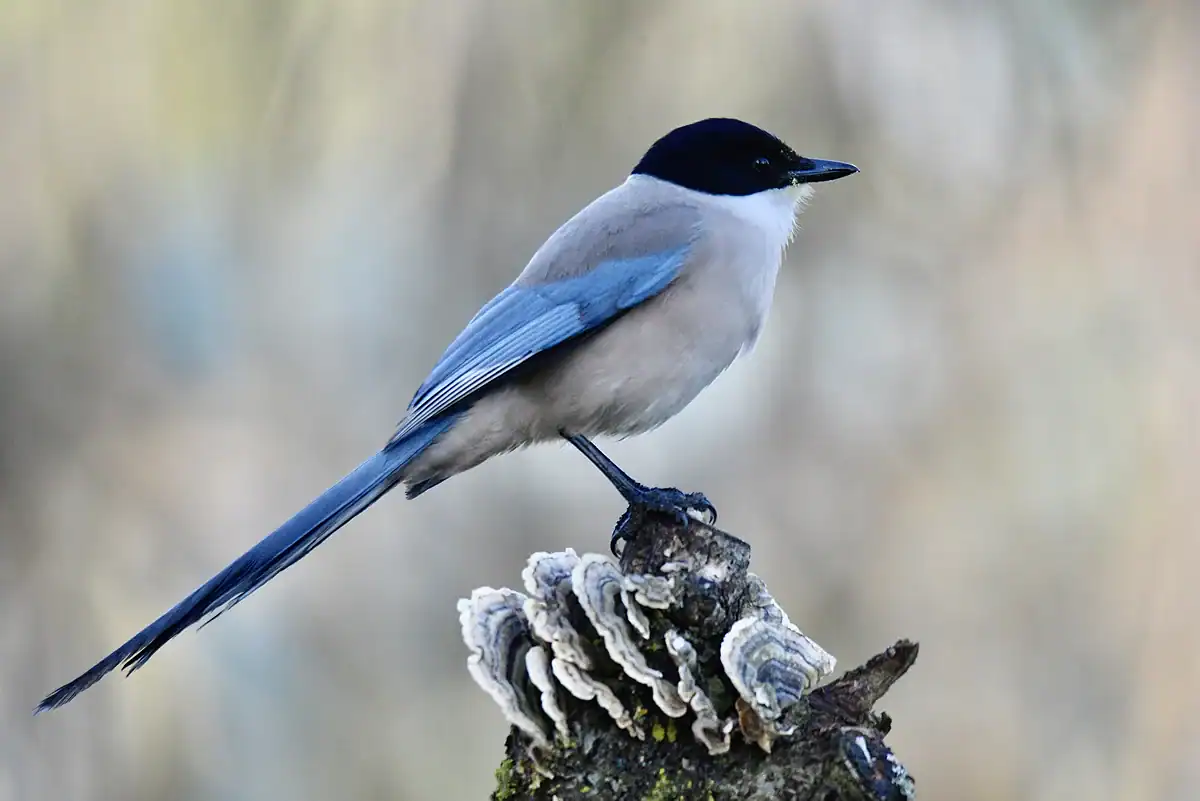
The Iberian Magpie lives only in Spain and Portugal, mostly in the southwest of the peninsula. SEO/BirdLife calls it the lightest corvid in Spain.
- SEO/BirdLife lists the Iberian Magpie at 13.4 to 13.8 inches (34 to 35 cm), with a wingspan of 15 to 15.7 inches (38 to 40 cm). Spain’s National Museum of Natural Sciences gives an average weight of about 2.5 ounces (70 g).
- The Iberian Magpie has a black cap, a white throat, sky-blue wings and tail and a gray-brown back and belly. Males and females look alike, though males are larger.
- Iberian Magpies live in open oak woodland, olive groves, pine forest, orchards and riverside woods, from sea level to about 5,600 feet (1,700 m). They eat mostly insects and add more fruit, such as grapes and figs, in fall and winter.
- According to Spain’s National Museum of Natural Sciences, Iberian Magpies nest in loose colonies of 30 to 40 pairs. In some colonies, about half of the breeding pairs have helpers.
- Some scientists once suggested that Spanish or Portuguese sailors brought the Iberian Magpie’s ancestors from Asia. Spain’s breeding bird atlas notes possible fossils from Gibraltar, dated to about 44,100 years ago, that argue against that idea.
- A 2002 DNA study by Fok, Wade and Parkin found that the Iberian Magpie is genetically distinct from the Asian birds. The Iberian population is native and did not arrive recently from Asia.
- BirdLife rates the Iberian Magpie as Least Concern, with 713,000 to 1.8 million mature birds and a growing population.
- Charles Lucien Bonaparte described the Iberian Magpie in 1850.
Black Magpies
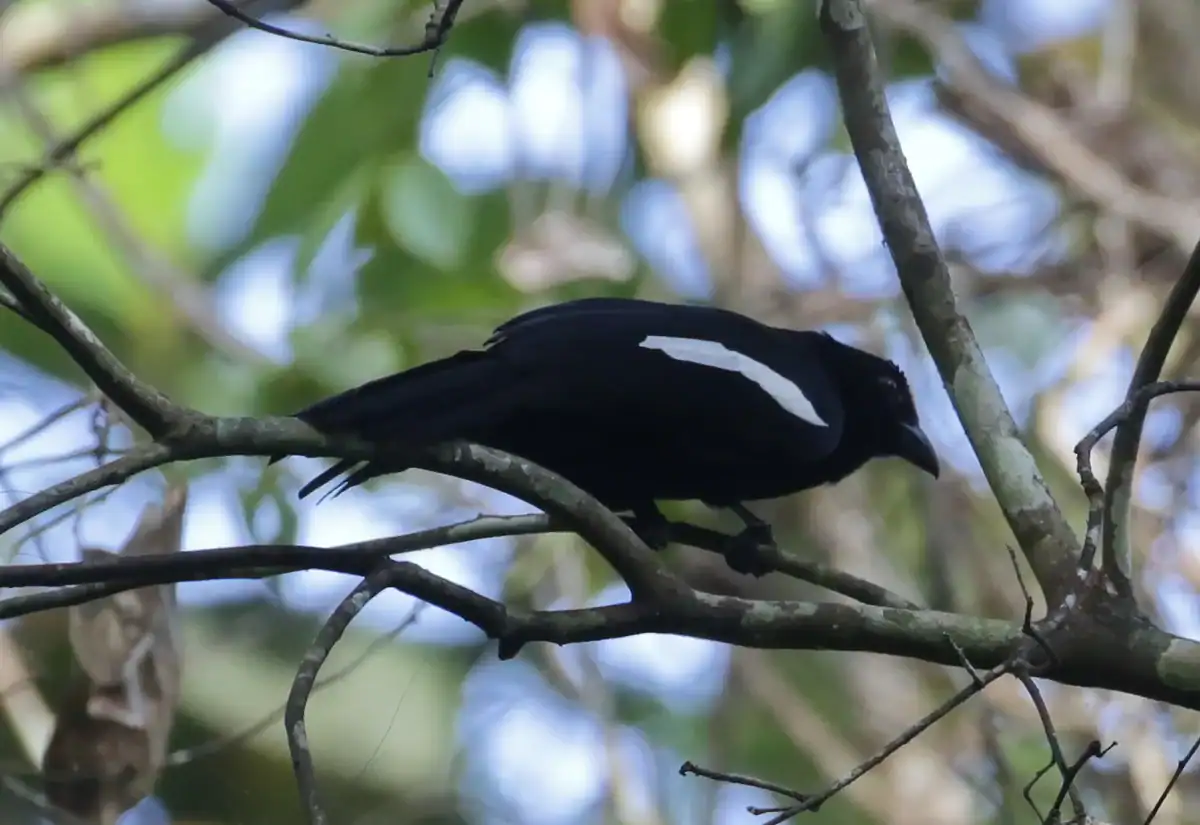
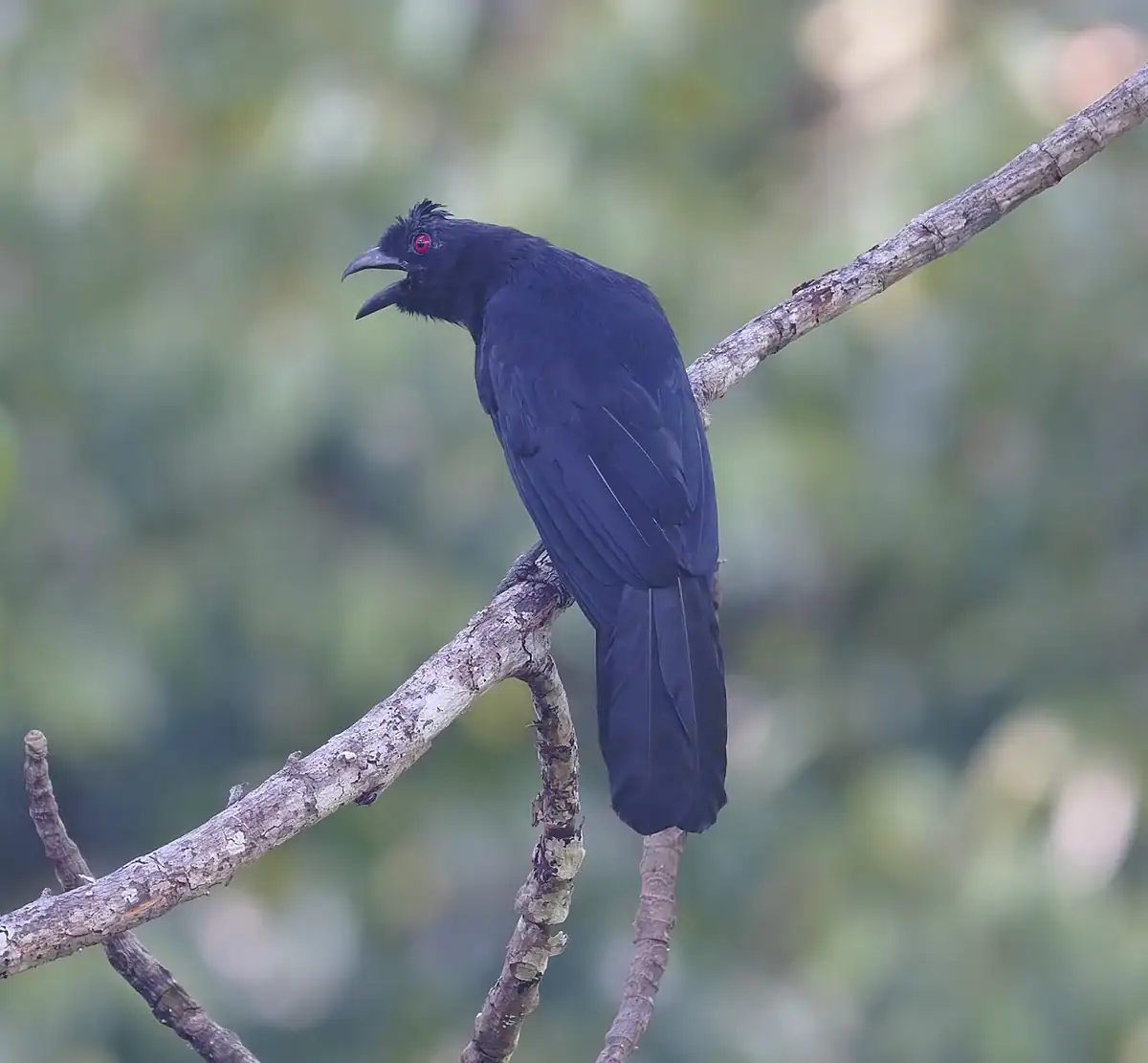
The two Platysmurus magpies are glossy black birds of Southeast Asian rainforests. Both have red eyes and a small crest, and until recently most checklists treated them as one species.
Malayan Black Magpie
| Kingdom | Order | Family | Genus | Species |
|---|---|---|---|---|
| Animalia | Passeriformes | Corvidae | Platysmurus | Platysmurus leucopterus |
The Malayan Black Magpie lives in southern Myanmar, peninsular Thailand and Malaysia, and Sumatra. BirdLife lists it as a rare bird in Singapore.
- eBird describes the Malayan Black Magpie as glossy black with a long tail, a heavy hooked bill, a weak crest and a bright white stripe on the wing. Birds of the World notes its piercing red eyes.
- Stuart Baker’s 1922 measurements give the Malayan Black Magpie a length of about 16 inches (400 to 410 mm). No weight for this species turned up in the sources used.
- Malayan Black Magpies live in dense lowland evergreen forest, swamp forest, tall secondary forest, forest edges and mangroves, up to about 2,600 feet (800 m). An early observer quoted by Stuart Baker found that they eat insects and sometimes fruit.
- Birds of the World warns that forest loss across the Malayan Black Magpie’s range has been among the most extensive in the world. BirdLife rates the species as Least Concern but declining.
- Coenraad Jacob Temminck described the Malayan Black Magpie in 1824.
Bornean Black Magpie
| Kingdom | Order | Family | Genus | Species |
|---|---|---|---|---|
| Animalia | Passeriformes | Corvidae | Platysmurus | Platysmurus aterrimus |
The Bornean Black Magpie lives only on Borneo. It looks much like the Malayan Black Magpie but lacks the white stripe on the wing.
- Birds of the World describes the Bornean Black Magpie as glossy black with a slight green sheen and red eyes. Richard Bowdler Sharpe wrote in 1877 that it was entirely black, with no white on the wing at all.
- AviList now treats the Bornean Black Magpie as a separate species, based on differences in plumage, shape and voice. The checklist notes that genetic data would help confirm the split.
- In Sabah, Bornean Black Magpies use untouched and logged forest, peat-swamp and heath forest, and even cocoa plantations. Birds of the World records them up to about 4,300 feet (1,300 m).
- Birds of the World describes knowledge of the Bornean Black Magpie’s diet and breeding as still very poor. No reliable length or weight turned up in the sources used.
- BirdLife rates the Bornean Black Magpie as Least Concern but declining.
- Coenraad Jacob Temminck described the Bornean Black Magpie in 1825.
Magpies in the US
Two magpies live in the United States, and both belong to the genus Pica. The Black-billed Magpie is widespread across the West, from Alaska to New Mexico, while the Yellow-billed Magpie lives only in California. Magpies are absent from most of the eastern states.
The Black-billed Magpie is a familiar sight on ranches and roadsides in states such as Colorado, Montana and Wyoming. It appears in our list of birds of Colorado, and our Black-billed Magpie profile covers the species in more depth.
The Yellow-billed Magpie is a California specialty and a growing conservation concern. Our Yellow-billed Magpie profile covers its range and identification in detail.
Other Birds Called Magpies
Several birds carry the magpie name without belonging to the crow family. Among them is the Australian Magpie, which belongs to a different family altogether.
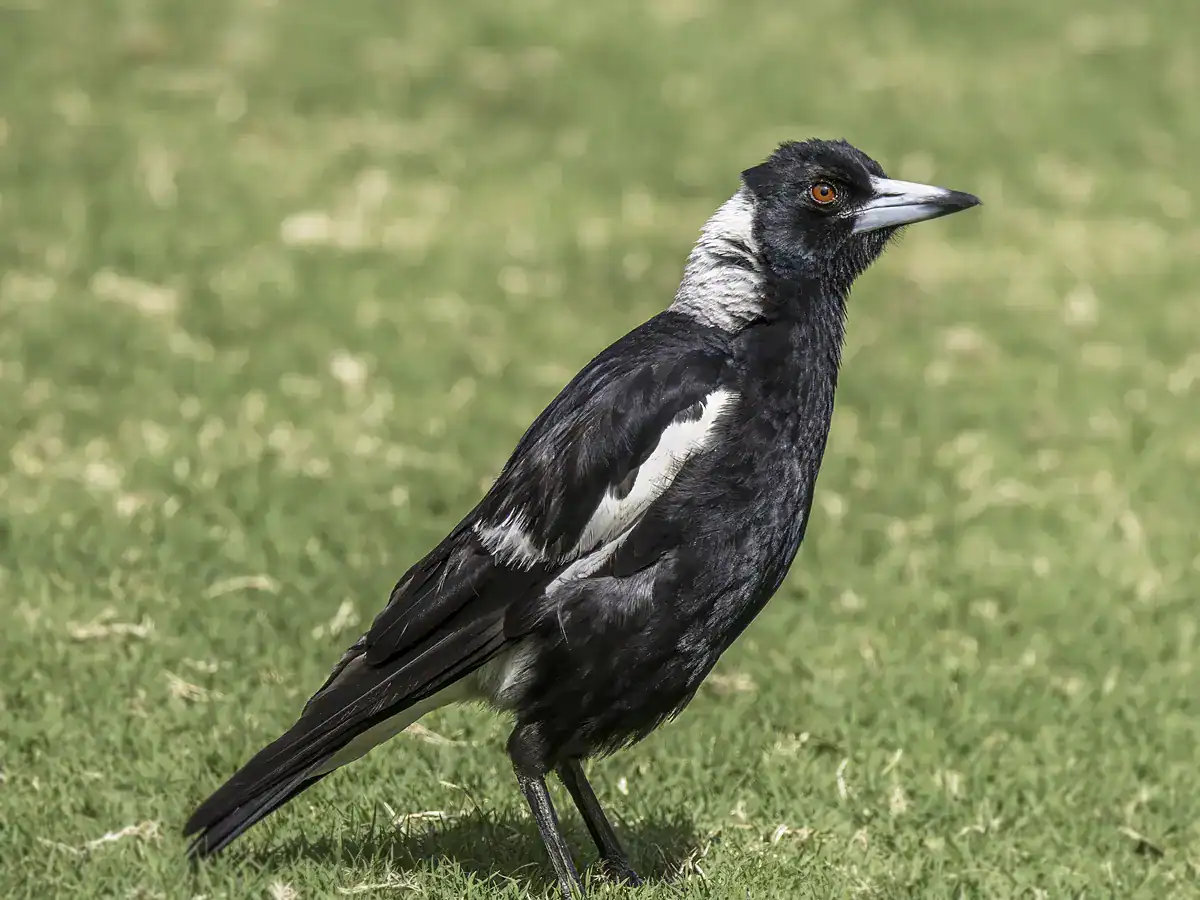
Australian Magpie
| Kingdom | Order | Family | Genus | Species |
|---|---|---|---|---|
| Animalia | Passeriformes | Artamidae | Gymnorhina | Gymnorhina tibicen |
The Australian Magpie is common across most of Australia, but it is not a corvid. The Australian Museum places it in the family Artamidae, the same family as the butcherbirds and currawongs.
- The Australian Museum lists the Australian Magpie at 14 to 17 inches (36 to 44 cm). Males have a white nape and females a grayish one, and adults have chestnut-brown eyes.
- Australian Magpies live in groups of up to 24 birds that defend their territory all year. The Australian Museum notes that an Australian Magpie can mimic more than 35 bird species, along with dogs, horses and human speech.
- Australian Magpie breeding peaks from August to November, according to the Australian Museum. In New South Wales the main swooping season runs from August to October, and the state’s National Parks service notes that males guard the nest closely for only 4 to 6 weeks. The Australian Museum adds that only a small minority of magpies swoop at people.
- In a 2022 University of the Sunshine Coast study, five Australian Magpies were fitted with GPS trackers. An adult female pecked a juvenile’s harness free within the hour, and a few days later none of the five birds still wore a tracker.
- BirdLife rates the Australian Magpie as Least Concern, with a growing population. New Zealand Birds Online notes that people introduced Australian Magpies to New Zealand between 1864 and 1874 to control insect pests.
- John Latham described the Australian Magpie in 1801.
Other birds with magpie in their name include the magpie-jays of Mexico and Central America. They are true corvids but belong with the jays. The Black-throated Magpie-Jay appears in our list of Mexican birds.
The Magpie-lark of Australia, the magpie-robins of southern Asia and the Indian Ocean islands, the Magpie Goose and the Magpie Shrike are not corvids at all.
How Smart Are Magpies?
Magpies have a reputation as clever birds, though two famous claims about them are weaker than they sound. In 2008, Helmut Prior and colleagues reported in PLOS Biology that Eurasian Magpies appeared to recognize themselves in a mirror. The mirror test checks whether an animal notices a mark on its own body in a mirror, and few animals pass it.
The mirror result has not held up well. A 2020 replication led by Manuel Soler, published in the Journal of Comparative Psychology, found no evidence of self-recognition in Eurasian Magpies. For now, the mirror test result is best treated as unconfirmed.
The idea that magpies steal shiny things has even less support. In a 2014 University of Exeter study, wild magpies touched shiny objects only twice in 64 trials and quickly dropped them. The birds were wary of any new object, shiny or not.
Magpies at Risk
Most magpies are still common, but under BirdLife’s 18-species treatment, four magpies are threatened and one is Near Threatened. The Javan Green Magpie is Critically Endangered and the Asir Magpie is Endangered. The Yellow-billed and Sri Lanka Blue Magpies are Vulnerable, and the White-winged Magpie is Near Threatened.
The threats differ from place to place. Trapping for the songbird trade drove the Javan Green Magpie’s collapse, and West Nile virus hit the Yellow-billed Magpie in California. In Saudi Arabia, tourism development, habitat loss and a warmer, drier climate threaten the Asir Magpie.
FAQs
The IOC World Bird List, the AviList checklist and the Clements Checklist all list 20 corvid species called magpies. BirdLife International counts 18, because it groups the Oriental and Black-rumped Magpies with the Eurasian Magpie.
The seven Pica magpies are the Eurasian, Oriental, Black-rumped, Maghreb, Asir, Black-billed and Yellow-billed Magpies. All seven share the black-and-white pattern most people link to the word magpie.
Yes, two species live in the United States. The Black-billed Magpie lives across much of the West, and the Yellow-billed Magpie lives only in central California.
No. The Australian Magpie belongs to the family Artamidae with the butcherbirds and currawongs, not to the crow family. Its black-and-white plumage looks like a Eurasian Magpie’s, but the two birds are not closely related.
Magpies and crows both belong to the family Corvidae. Most magpies have long tails and black-and-white or brightly colored plumage, while crows in the genus Corvus are mostly black with shorter tails.
A typical Eurasian Magpie lives about five years, according to the British Trust for Ornithology, and the BTO’s oldest banded bird lived 21 years and 8 months. In the US, the oldest Black-billed Magpie on record with the USGS Bird Banding Laboratory reached 9 years and 5 months.
No good evidence supports the idea. A 2014 University of Exeter study found that magpies avoided shiny objects and were wary of anything new.
The smallest published estimates are for the Javan Green Magpie and the Asir Magpie. The Javan Green Magpie’s conservation action plan estimates 50 to 250 birds in the wild, and BirdLife estimates about 100 breeding pairs of Asir Magpies. Both figures are uncertain and are measured differently, so neither species can be named the rarest with confidence.
Cite this page
BioExplorer. (2026, October 3). 20 Types of Magpies: Every Magpie in the Crow Family. https://www.bioexplorer.net/animals/birds/magpies/
About the author