
Bioinformatics and Computational Biology: Data Meets Life Science
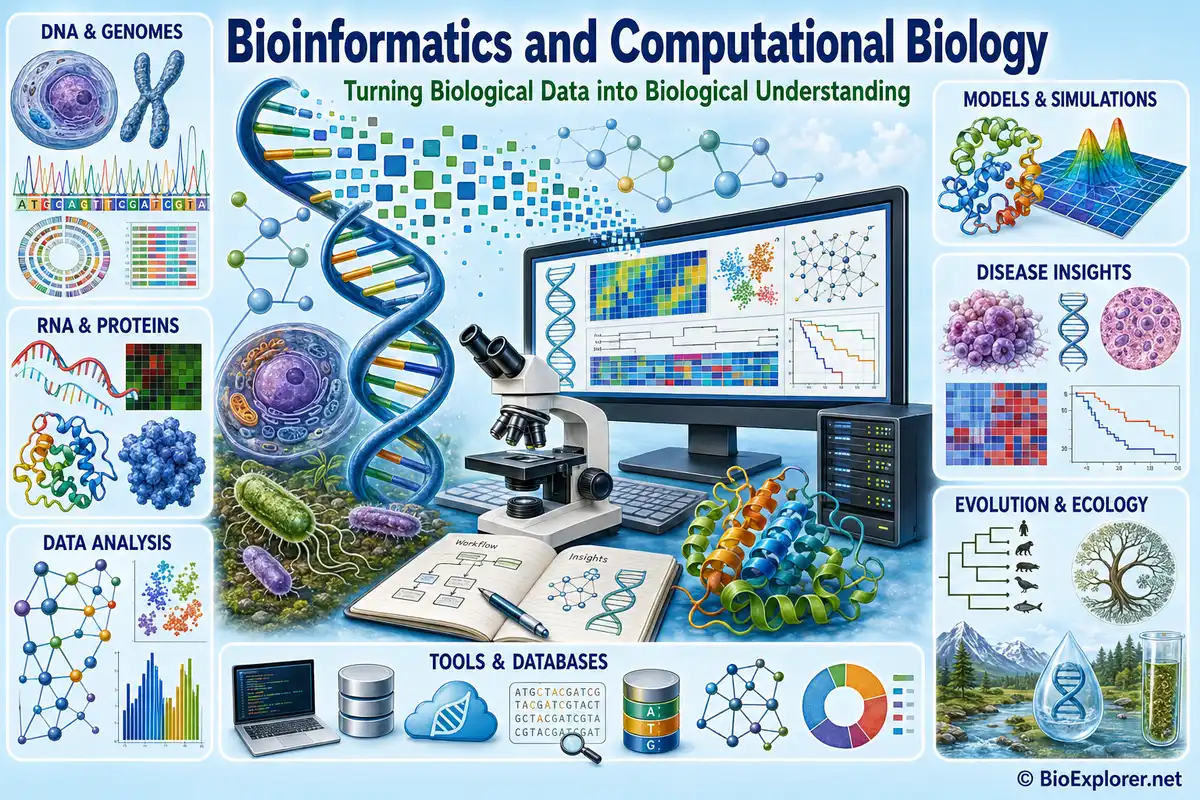
Bioinformatics turns biological data into biological understanding. It is the field that helps scientists store, search, compare, analyze, visualize, and interpret data from DNA, RNA, proteins, genomes, cells, microbes, populations, diseases, and ecosystems.
The field exists because modern biology now produces more data than a person can inspect by eye. A single genome, RNA sequencing experiment, protein database, cancer study, or environmental DNA survey can contain millions to billions of data points. Bioinformatics gives researchers the computational tools to find the biological signal inside that data.
Computational biology is closely related. It often goes one step further by building models, simulations, and mathematical explanations of biological systems. Together, bioinformatics and computational biology help connect genes, proteins, evolution, medicine, ecology, and life science data.
Bioinformatics Guide:
- What Is Bioinformatics?
- Where Computational Biology Fits
- Why Bioinformatics Matters in Modern Biology
- Major Areas of Bioinformatics
- Bioinformatics vs Computational Biology
- Common Tools and Databases Used in Bioinformatics
- How Bioinformatics Is Used in Medicine
- How Bioinformatics Helps Evolution and Ecology
- AI and Machine Learning in Bioinformatics
- Skills Used in Bioinformatics
- History of Bioinformatics: Key Turning Points
- Careers in Bioinformatics and Computational Biology
- Related Fields
- Recommended Bioinformatics Resources
- Bioinformatics FAQs
What Is Bioinformatics?
Bioinformatics is the use of computers, statistics, databases, algorithms, and data science to study biological information. It is especially important for analyzing DNA sequences, RNA expression, protein sequences, genome variation, biological pathways, and large research datasets.
A bioinformatics workflow may start with raw sequencing reads from a laboratory instrument. Those reads are checked for quality, aligned to a reference genome or assembled into longer sequences, compared with known genes, annotated with biological meaning, and analyzed for patterns such as mutations, gene activity, ancestry, disease risk, or evolutionary relationships.
The important point is that bioinformatics is not just "biology on a computer." It is interpretation. A file of DNA letters becomes useful only when scientists can ask: Where did this sequence come from? What gene is it part of? Has it changed? Is it expressed? Does it affect a protein? Does it matter for health, ecology, or evolution?
Where Computational Biology Fits
Bioinformatics and computational biology overlap, but they are not identical in emphasis. Bioinformatics often focuses on biological data: storing it, retrieving it, comparing it, annotating it, and analyzing it. Computational biology often focuses on building models that explain or predict biological behavior.
For example, a bioinformatician may compare thousands of gene sequences to identify disease-linked variants. A computational biologist may build a model showing how those variants change a pathway, affect cell behavior, or alter disease progression. In real research teams, the same person may do both.
A practical way to separate them is this: bioinformatics is usually data-first, while computational biology is often model-first. Both depend on biology, statistics, programming, and careful scientific judgment.
Why Bioinformatics Matters in Modern Biology
Bioinformatics matters because biology has become a data-rich science. DNA sequencing, RNA sequencing, mass spectrometry, microscopy, public health surveillance, genome-wide association studies, protein structure prediction, and environmental sampling all produce datasets that need computational analysis.
In medicine, bioinformatics helps identify disease genes, classify tumors, detect pathogens, track outbreaks, study antibiotic resistance, find drug targets, and support precision medicine. In agriculture, it helps analyze crop genomes, disease resistance, breeding lines, soil microbes, and livestock genetics.
In evolution and ecology, bioinformatics helps build phylogenetic trees, compare genomes across species, study population structure, analyze environmental DNA, identify microbial communities, and monitor biodiversity. Without bioinformatics, many modern biology datasets would remain unreadable.
Major Areas of Bioinformatics
Bioinformatics is not one technique. It is a group of approaches used across many areas of biology. The table below shows the major areas and the kinds of questions each one helps answer.
| Area | What It Studies | Typical Questions |
|---|---|---|
| Genomics | Whole genomes, genes, chromosomes, and sequence variation. | What genes are present? Which variants differ between individuals, populations, or species? |
| Transcriptomics | RNA molecules produced by cells, tissues, or organisms. | Which genes are active, and how does gene expression change across conditions? |
| Proteomics | Large-scale protein data, often from mass spectrometry. | Which proteins are present, abundant, modified, or interacting? |
| Sequence Analysis | DNA, RNA, or protein sequences and their similarity to known sequences. | What does this sequence match? Is it a gene, marker, mutation, or conserved region? |
| Structural Bioinformatics | Three-dimensional structures of proteins, nucleic acids, and molecular complexes. | How might a molecule fold, bind, change shape, or interact with another molecule? |
| Systems Biology | Networks of genes, proteins, pathways, and cellular processes. | How do parts of a biological system interact to create a larger response? |
| Phylogenetics | Evolutionary relationships inferred from molecular data. | How are organisms, genes, or viruses related through evolutionary history? |
| Metagenomics | Genetic material collected from mixed communities, often environmental or microbial samples. | Which organisms or genes are present in soil, water, gut, ocean, or clinical samples? |
| Biomedical Informatics | Biological and clinical data connected to health and disease. | How can genomic, molecular, and health data improve diagnosis, treatment, or research? |
| Database Biology | Curated biological databases and knowledge systems. | How can biological data be stored, linked, searched, standardized, and reused? |
Bioinformatics vs Computational Biology
The difference between bioinformatics and computational biology is often blurred because both fields use computation to study life. The distinction is most useful when thinking about the main goal of the work.
| Point of Difference | Bioinformatics | Computational Biology |
|---|---|---|
| Main Emphasis | Biological data storage, retrieval, analysis, annotation, and interpretation. | Mathematical, statistical, and computational models of biological systems. |
| Typical Starting Point | A dataset such as genome sequences, RNA-seq reads, protein records, or database entries. | A biological question that may need a model, simulation, or theoretical framework. |
| Common Output | Aligned sequences, annotated genes, variant calls, expression tables, database records, or biological classifications. | Models, simulations, predictions, network behavior, system dynamics, or mechanistic explanations. |
| Example Question | Which genes are differentially expressed in this tumor sample? | How might changes in this pathway alter tumor growth over time? |
| Common Tools | BLAST, sequence aligners, genome browsers, GenBank, UniProt, PDB, R, Python, workflow systems. | Mathematical modeling, machine learning, simulations, network models, dynamical systems, statistical inference. |
| Best Way to Remember | Bioinformatics makes biological data searchable, comparable, and interpretable. | Computational biology uses computation to explain, model, or predict biological behavior. |
| In Practice | Often overlaps with computational biology in genomics, medicine, evolution, and systems biology. | Often overlaps with bioinformatics when models depend on large biological datasets. |
Common Tools and Databases Used in Bioinformatics
Bioinformatics depends on shared databases and tools because biological data becomes more useful when it can be compared with trusted references. A new DNA sequence, protein sequence, or gene expression pattern usually needs context from known genes, genomes, proteins, structures, pathways, or publications.
| Tool or Database | What It Is Used For | Why It Matters |
|---|---|---|
| BLAST | Searching for similarity between biological sequences. | Helps identify unknown DNA, RNA, or protein sequences by comparing them with known records. |
| GenBank | Public archive of nucleotide sequences. | Provides a major reference source for DNA and RNA sequence data. |
| UniProt | Protein sequence and functional information. | Connects protein sequences with names, functions, domains, organisms, and literature. |
| Protein Data Bank | Three-dimensional structures of proteins, nucleic acids, and complexes. | Supports structural biology, drug discovery, and protein function research. |
| Genome Browsers | Visual exploration of genomes and annotations. | Lets users inspect genes, variants, regulatory regions, and comparative genome tracks. |
| Sequence Alignment Tools | Comparison of DNA, RNA, or protein sequences. | Finds conserved regions, mutations, evolutionary relationships, and sequence differences. |
| RNA-seq Analysis Tools | Analysis of gene expression from sequencing data. | Measures which genes are active and how expression changes between samples. |
| Programming Languages | R, Python, SQL, Bash, and related tools. | Enable custom analysis, statistics, visualization, automation, and reproducible workflows. |
| Workflow Systems | Tools that organize multi-step analyses. | Help make bioinformatics pipelines repeatable, traceable, and easier to share. |
How Bioinformatics Is Used in Medicine
Medicine uses bioinformatics because disease often leaves molecular evidence. A tumor may carry driver mutations. A virus may show genetic changes as it spreads. A patient may have a rare variant that affects a protein. A drug may work only in people whose disease has a certain molecular profile.
In cancer genomics, bioinformatics helps compare tumor DNA with normal DNA, identify mutations, detect copy number changes, classify tumor types, and connect molecular findings with treatment options. In infectious disease, it helps identify pathogens, monitor viral variants, compare bacterial genomes, and track antimicrobial resistance genes.
Bioinformatics also supports vaccine research, pharmacogenomics, newborn sequencing studies, rare disease diagnosis, drug target discovery, and clinical decision support. The strongest medical use is not simply finding data. It is combining laboratory evidence, biological knowledge, and clinical context without overinterpreting uncertain results.
How Bioinformatics Helps Evolution and Ecology
Bioinformatics gives evolution and ecology a molecular record. DNA and protein sequences can reveal relationships that are difficult to see from anatomy alone. They can show how lineages diverged, how populations mixed, how genes spread, and how organisms adapted.
Phylogenetic analysis uses molecular data to infer evolutionary relationships. Population genomics studies variation within and between populations. Metagenomics reads genetic material from mixed samples, such as soil, ocean water, human gut contents, or wastewater, to identify organisms and functional genes.
Environmental DNA, often called eDNA, is especially useful for biodiversity monitoring. Instead of capturing an organism directly, researchers can analyze DNA shed into water, soil, or air. This can help detect rare species, invasive species, pathogens, and community changes, although sampling design and contamination control are critical.
AI and Machine Learning in Bioinformatics
Artificial intelligence and machine learning are increasingly used in bioinformatics, but they do not replace biological reasoning. They are tools for finding patterns in complex data, predicting molecular features, classifying samples, prioritizing variants, modeling protein structures, and integrating many kinds of biological information.
Useful applications include protein structure prediction, image-based cell analysis, gene expression classification, drug response prediction, variant effect prediction, and literature mining. These methods can be powerful, but they depend heavily on training data quality, careful validation, and awareness of bias.
A machine learning model can rank likely answers, but a scientist still has to ask whether the result makes biological sense. In bioinformatics, a technically impressive prediction is not enough. It must survive comparison with experiments, known biology, independent data, and uncertainty.
Skills Used in Bioinformatics
Bioinformatics requires more than coding. The strongest work combines biological literacy, statistical reasoning, data handling, and the ability to notice when an analysis is technically correct but biologically misleading.
- Biology: Understanding genes, genomes, proteins, cells, evolution, disease, and experimental design.
- Statistics: Measuring uncertainty, comparing groups, controlling false discoveries, and avoiding overinterpretation.
- Programming: Using languages such as Python, R, SQL, and shell scripting to process and analyze data.
- Databases: Searching, joining, curating, and interpreting biological records from public and private data sources.
- Algorithms: Understanding alignment, clustering, classification, graph methods, and optimization.
- Data visualization: Turning complex results into figures that reveal patterns without distorting evidence.
- Reproducibility: Recording inputs, software versions, parameters, workflows, and quality checks.
- Scientific interpretation: Connecting results back to experiments, organisms, disease mechanisms, or ecological questions.
History of Bioinformatics: Key Turning Points
Bioinformatics did not begin with the internet or modern genome sequencing. It grew from protein sequence comparison, molecular databases, sequence alignment algorithms, and the need to organize rapidly expanding biological data.
| Year | Milestone | Why It Matters |
|---|---|---|
| 1965 | Margaret Dayhoff and colleagues published the Atlas of Protein Sequence and Structure. | Helped establish protein sequence comparison as a data-driven approach to molecular evolution. |
| 1970 | Saul Needleman and Christian Wunsch published a dynamic programming method for global sequence alignment. | Provided a rigorous algorithm for comparing biological sequences across their full length. |
| 1971 | The Protein Data Bank was established. | Created a public archive for three-dimensional biological macromolecular structures. |
| 1981 | Temple Smith and Michael Waterman published a method for local sequence alignment. | Made it possible to identify the best matching regions between biological sequences. |
| 1982 | GenBank began as a public nucleotide sequence database. | Helped centralize DNA sequence data for search, comparison, and reuse. |
| 1988 | The National Center for Biotechnology Information was established in the United States. | Became a major hub for biomedical literature, sequence databases, and bioinformatics tools. |
| 1990 | BLAST was published. | Made fast sequence similarity searching widely accessible and became one of the most important tools in bioinformatics. |
| 1995 | The genome of Haemophilus influenzae became the first complete genome sequence of a free-living organism. | Showed how whole-genome sequencing could transform microbiology and comparative genomics. |
| 2003 | The Human Genome Project was declared complete. | Accelerated human genomics, genome annotation, variation studies, and biomedical data analysis. |
| 2021 | DeepMind and EMBL-EBI launched the AlphaFold Protein Structure Database. | Expanded access to predicted protein structures and changed how many researchers approach structural questions. |
Careers in Bioinformatics and Computational Biology
Bioinformatics careers exist in universities, hospitals, biotechnology companies, pharmaceutical research, public health agencies, agriculture, conservation, forensic science, and data science groups that work with biological information.
| Career | What the Role Often Does | Where It May Be Used |
|---|---|---|
| Bioinformatics Scientist | Builds and applies workflows for sequence, genome, transcriptome, or protein data. | Research institutes, biotech companies, pharmaceutical labs, genomics companies. |
| Computational Biologist | Develops models and computational analyses to explain biological systems. | Systems biology, cancer biology, neuroscience, evolution, drug discovery. |
| Genomics Analyst | Analyzes genome sequencing data, variants, annotations, and reports. | Clinical genomics, rare disease research, cancer genomics, population studies. |
| Biomedical Data Scientist | Works with molecular, clinical, imaging, or health-related datasets. | Hospitals, research centers, medical AI, precision medicine. |
| Microbial Genomics Specialist | Studies bacterial, viral, fungal, or community genome data. | Public health, outbreak tracking, antibiotic resistance, microbiome research. |
| Structural Bioinformatics Analyst | Uses sequence and structure data to study proteins and molecular interactions. | Drug discovery, protein engineering, enzyme research, structural biology. |
| Bioinformatics Software Developer | Builds tools, pipelines, databases, visualizations, and web resources. | Research software, database teams, biotech platforms, public repositories. |
| Research Scientist | Uses computational and experimental evidence to answer biological questions. | Academic labs, industry research, government agencies, nonprofit research groups. |
Related Fields
Bioinformatics connects strongly with several areas of biology because biological data comes from genes, cells, proteins, organisms, populations, and ecosystems.
- Genetics supplies many of the core questions about inheritance, variants, genes, and traits.
- Molecular Biology explains DNA, RNA, gene expression, replication, transcription, translation, and molecular mechanisms.
- Biotechnology uses bioinformatics in genome editing, recombinant DNA work, synthetic biology, and biological product development.
- Biochemistry connects sequence data with enzymes, proteins, pathways, and molecular function.
- Evolutionary Biology uses molecular data to study ancestry, selection, divergence, and adaptation.
- Microbiology uses genome and metagenome analysis to study microbes, pathogens, resistance, and microbial communities.
- Structural Biology uses protein and nucleic acid structures to understand molecular shape, binding, and function.
- Theoretical Biology overlaps with computational modeling, simulation, and mathematical approaches to living systems.
- Pharmacology uses bioinformatics in drug target discovery, pharmacogenomics, and drug response prediction.
- Conservation Biology uses genomic data to study population health, biodiversity, inbreeding, and species recovery.
For broader vocabulary support, use the Biology Glossary. For genetics practice, the Punnett Square Calculator can help readers understand basic inheritance before moving into large-scale genomic data.
Recommended Bioinformatics Resources
These external resources are useful for learning bioinformatics, searching biological databases, exploring genomes and proteins, and understanding modern computational life science.
- NCBI A major U.S. biomedical information resource with sequence databases, literature tools, genome resources, and bioinformatics utilities.
- NCBI BLAST A widely used tool for comparing DNA, RNA, and protein sequences against known sequence databases.
- GenBank A public nucleotide sequence database used for DNA and RNA sequence records.
- EMBL-EBI Training Training materials for bioinformatics tools, databases, genomics, proteins, pathways, and data analysis.
- European Nucleotide Archive A major archive for nucleotide sequencing information.
- UniProt A central resource for protein sequence and functional information.
- RCSB Protein Data Bank A major resource for three-dimensional structures of biological macromolecules.
- AlphaFold Protein Structure Database A database of predicted protein structures developed by DeepMind and EMBL-EBI.
- UCSC Genome Browser A genome browser for visualizing genes, annotations, comparative genomics, regulatory data, and variation.
- Ensembl Genome Browser A genome browser and annotation resource for vertebrate genomes and comparative genomics.
- Galaxy A web-based platform for reproducible bioinformatics analysis workflows.
- Bioconductor An open-source project for analyzing and understanding high-throughput genomic data using R.
- International Society for Computational Biology A professional society for bioinformatics and computational biology.
Bioinformatics FAQs
Bioinformatics is the use of computers, statistics, databases, algorithms, and data science to analyze and interpret biological data such as DNA, RNA, proteins, genomes, and gene expression.
Computational biology uses mathematical models, algorithms, simulations, statistics, and computer science to study and predict biological systems and processes.
Bioinformatics usually focuses on biological data storage, search, analysis, and interpretation. Computational biology often focuses on modeling, simulation, and prediction of biological systems.
Bioinformatics is important because modern biology produces massive datasets from genomes, RNA, proteins, disease studies, microbes, and ecosystems. Computational analysis helps scientists find meaningful biological patterns.
Common bioinformatics tools and resources include BLAST, GenBank, UniProt, Protein Data Bank, genome browsers, sequence alignment tools, RNA-seq tools, R, Python, and workflow systems.
Bioinformatics is used in medicine to study disease genes, cancer mutations, rare variants, pathogen genomes, drug targets, vaccine research, pharmacogenomics, and precision medicine.
Bioinformatics uses biology, statistics, programming, databases, algorithms, data visualization, reproducible workflows, and careful scientific interpretation.
Bioinformatics careers include bioinformatics scientist, computational biologist, genomics analyst, biomedical data scientist, microbial genomics specialist, structural bioinformatics analyst, and bioinformatics software developer.
Cite this page
BioExplorer. (2026, September 30). Bioinformatics and Computational Biology: Data Meets Life Science. https://www.bioexplorer.net/divisions_of_biology/bioinformatics/