
Thollon’s Red Colobus
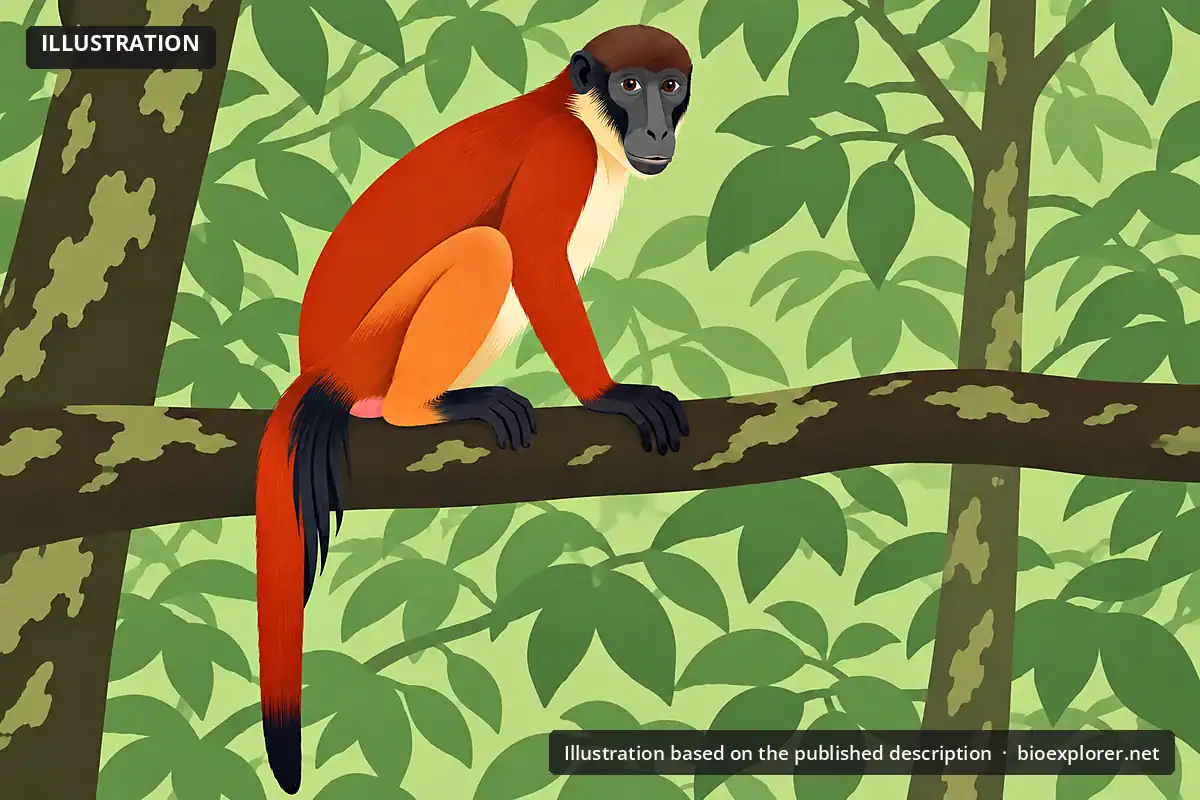
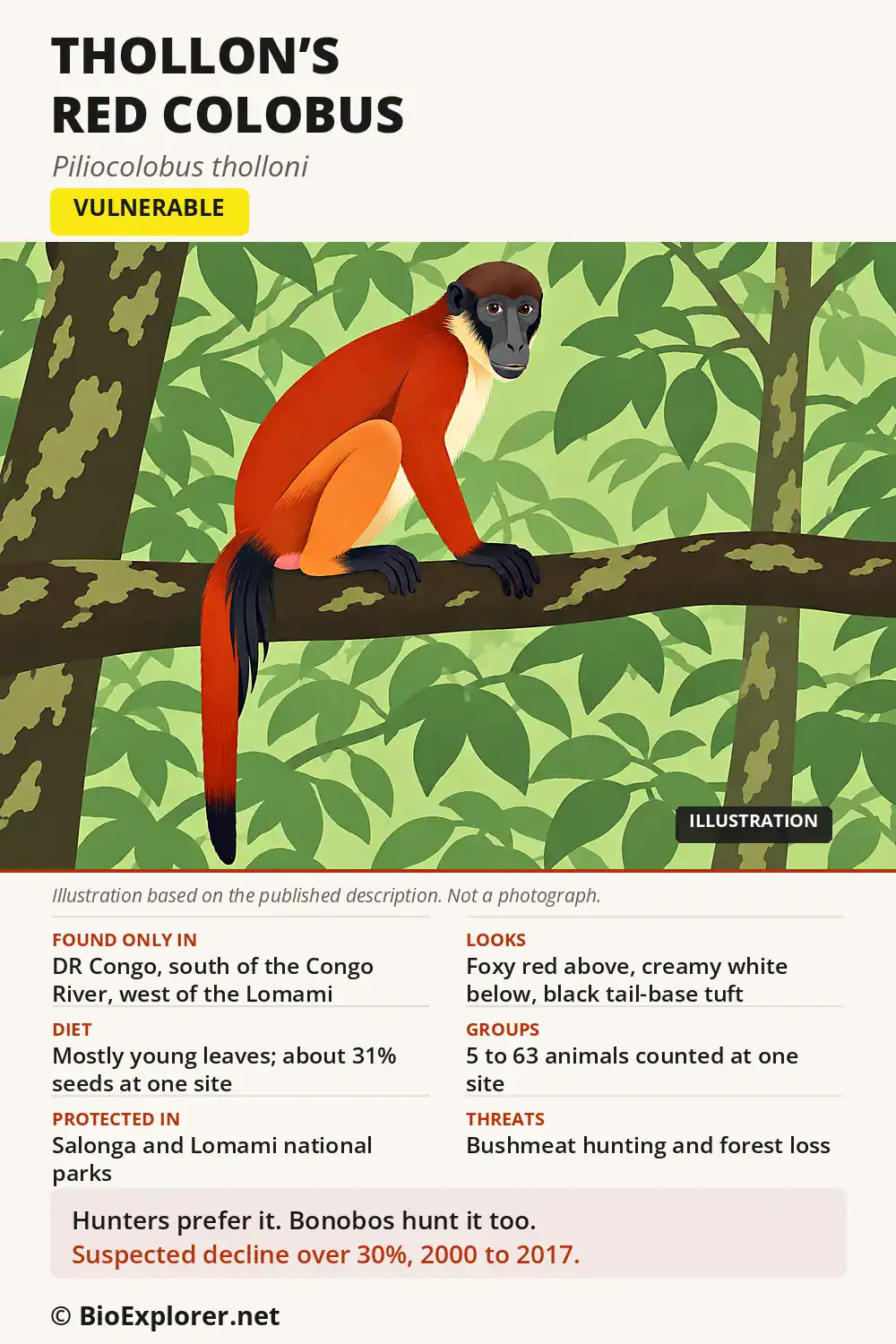
The Thollon's red colobus is a leaf-eating monkey of central Africa. Its scientific name is Piliocolobus tholloni.[1] It is also called the Tshuapa red colobus. It lives only in the Democratic Republic of the Congo.[2] Its coat is foxy red above and creamy white below.[3] It is one of the Old World monkeys. Many hunters prefer it as bushmeat. The IUCN lists it as Vulnerable.
This Vulnerable red colobus lives only in DR Congo's central forests.
- Common NamesThollon's red colobus, Tshuapa red colobus, Colobe de Thollon (French)
- Taxonomy Classification Year1886
- Monkey SizeHead and body about 64 cm (25 in) in males, 58 to 60 cm (23 to 24 in) in females
- Skin Color(s)Foxy red above, creamy white below, dark hands, feet and tail tip, slaty gray face
- HabitatClosed-canopy lowland rainforest, including swamp and dry-ground forest
- DietMostly young leaves, plus seeds, ripe fruit and flowers
- Native CountriesDemocratic Republic of the Congo
- It lives south of the Congo River and west of the Lomami.
- Its coat is foxy red above and creamy white below.
- A long black tuft grows at the base of its tail.
- Seeds made up almost a third of its diet at one site.
- A 2021 plan reported large populations in parts of Salonga and Lomami.
Thollon's Red Colobus Distribution
 )
Thollon's Red Colobus Guide:
Name and Classification
Alphonse Milne-Edwards described this monkey in 1886. He named it Colobus tholloni. The holotype came from the Brazza mission. It is kept in Paris. Its recorded type locality is simply "Lower Congo."
In 1913, Paul Matschie named another red colobus, lovizettii. It came from Kutu, on Lac Léopold II, now Lake Mai-Ndombe. Today that name counts as a synonym of this species.
It belongs to the genus Piliocolobus, the red colobus. They form part of the wider group of colobus monkeys.
Its rank has shifted over the years. A 1999 scheme placed it under Pennant's red colobus. Later authors placed it under the Tana River red colobus. Colin Groves treated it as a full species. So did Groves and Nelson Ting in 2013. Jonathan Kingdon agreed in 2015. The IUCN follows that view.
The handbook notes unexpected variety in its mitochondrial DNA. Animals from one locality can carry very different lineages. That pattern is shared with other east-central African red colobus.
Physical Description
Its fur is a uniform foxy red above. The shoulders and tail are a little darker. The underparts are creamy white.
The crown is light bay to mahogany. Short black hair frames the face. Only the rear of the cheeks is pale, like the belly.
The arms are foxy red. The legs are a paler orange-rufous. The hands, feet and tail tip are dark to black.
Long black tufts grow at the base of the tail. Hairs at its sides form a long tuft, called a panache.
The face is slaty gray. A trace of pale marks the eyelids and lips. The bare sitting pads are pink or slaty.
The skull is long, narrow and very prognathous. It bears a large sagittal crest. The crest is more extensive than in other red colobus.
During her fertile period, the female shows a large pink sexual swelling.
That foxy coat places it among the red monkeys.
Size and Weight
Few specimens have ever been measured. The handbook bases its size remarks on only three.
Males measure about 64 cm (25 in) in head and body. Their tails run about 63 cm (25 in). Females measure 58 to 60 cm (23 to 24 in). Their tails run 41 to 69 cm (16 to 27 in).
The handbook calls it a rather large red colobus. It also calls the tail very short. Yet its own figures give a tail near body length.
The handbook gives no body weights for this species.
Similar Species Compared
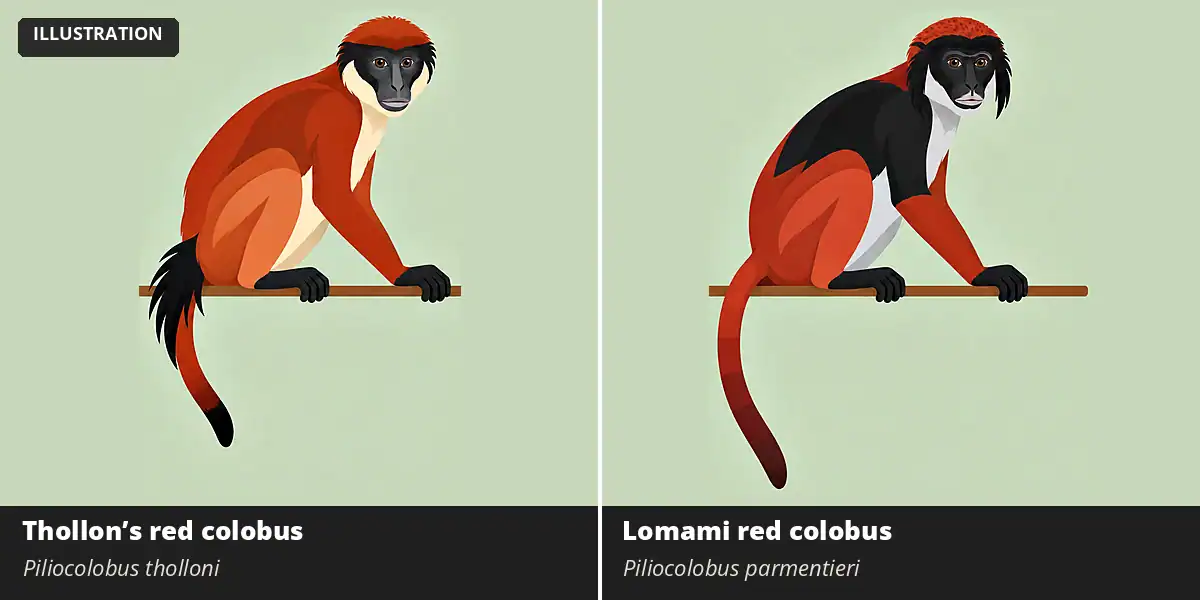
The Lomami River divides two red colobus. Thollon's lives on the west bank. The Lomami red colobus lives on the east bank.[4] These are the only red colobus in the Congo's central basin.[5] The Lomami red colobus has black on its mid-back and shoulders.[6] Its belly is grayish white, not cream.
North of the Congo River lives Oustalet's red colobus.[7] It is dark, speckled smoky brown above.[8] Its coat varies a great deal from place to place.
Across the Congo River lives Bouvier's red colobus.[9] It lives on the right bank. It is found only in the Republic of the Congo. It is glossy red, with a narrow blackish mantle.[10] Its pale face has large pink eye rings.
| Trait | Thollon's red colobus | Lomami red colobus | Oustalet's red colobus | Bouvier's red colobus |
|---|---|---|---|---|
| Scientific name | Piliocolobus tholloni | Piliocolobus parmentieri | Piliocolobus oustaleti | Piliocolobus bouvieri |
| Range | DR Congo, south of the Congo River and west of the Lomami River | DR Congo, between the Lomami and Lualaba rivers | DR Congo, Republic of the Congo, Central African Republic; possibly extinct in South Sudan | Republic of the Congo only |
| Habitat | Closed-canopy lowland rainforest, swamp to dry ground | Primary lowland rainforest on dry ground | Lowland moist, swamp and gallery forest | Swamp forest and riverside forest |
| Coat and key marks | Foxy red above, creamy white below, long black tuft at the tail base | Red, with black mid-back, shoulders and upper arms; grayish-white belly | Dark speckled smoky brown above; very variable | Glossy red, narrow blackish mantle, pale face with pink eye rings |
| Head and body (females) | 58 to 60 cm | Not known | 52 to 64 cm | About 58 cm, from two specimens |
| Tail (females) | 41 to 69 cm | Not known | 68 to 73 cm | About 76 cm |
| Weight (females) | Not known | Not known | 8.2 kg | Not known |
| Diet | Mostly young leaves; about 31 percent seeds at one site | Leaves, fruit, flowers, buds, possibly seeds | Leaves, fruit, flowers and buds | Leaves, fruit, flowers, buds, possibly seeds |
| Group size | 5 to 63 at one site, in John Hart's 2008 data | About 20, in John Hart's 2016 observations | 3 to 18 at one site | Not known |
| IUCN status | Vulnerable (assessed 2019, published 2020) | Endangered (assessed 2017, published 2020) | Vulnerable (assessed 2018, published 2020) | Endangered (assessed 2019, published 2022) |
Range and Distribution
It is endemic to the Democratic Republic of the Congo. It is one of the Democratic Republic of the Congo monkeys.
Its range lies south of the great bend of the Congo River. The Lomami River marks its eastern edge. The Kasai and Sankuru rivers mark its southern edge.
Within that area, it occurs in patches. Surveys have missed it at many sites where it was expected. Forest age, plant mix, disturbance and hunting may explain the gaps.
Rivers shape its range too. It lives south of the Lomela River. Yet it is absent between the Lomela and the Tshuapa.
Its range largely matches that of the bonobo. That ape also lives only in DR Congo. Thollon's red colobus may live south of the Sankuru and Kasai. That remains unconfirmed.
Habitat Needs
It lives in closed-canopy lowland rainforest. South of the main forest block, it is unknown in gallery forest.
At Botsima, in Salonga National Park, it used swamp forest. It also used seasonally flooded and dry-ground forest there.
In Lomami National Park, it favors dry-ground forest on clay soils. Small rivers cut narrow valleys through that forest. Yet it avoids seasonally flooded forest there.
At Lukuru, near the southern limit, it lives in upland dry forest. There it uses the middle canopy.
Its forest home places it among the types of rainforest monkeys.
Diet and Behavior
Only one detailed field study exists. It took place at Botsima, in Salonga National Park.[11] The site was protected from hunting.
Researchers followed a group of over 60 animals for 12 months. Leaves made up 60.7 percent of the diet. Most were young leaves. Seeds made up 30.8 percent. Ripe fruit made up 7.1 percent, and flowers 1.4 percent.
Most food came from legumes. The leaves and seeds came mainly from one legume subfamily, the Caesalpinioideae. The forest there grows on very acidic, sandy, nutrient-poor soils.
The Angolan colobus shares the Botsima forest. That black-and-white colobus ate mostly seeds. The authors link heavy seed-eating to poor soils and abundant legumes.
That plant diet places it among the herbivorous monkeys.
The study group ranged across the whole 250 hectare (620 acre) site. Groups can be large. Losekola lies in Lomami National Park. Group counts there ran from 5 to 63. Two groups there were estimated at over 90. Those counts come from John Hart's 2008 survey data.
Salonga's Etate zone has anti-poaching patrols. Gay Reinartz reported group averages of 13 and 14 there in 2014. The largest count she reported was 45.
It often travels in mixed groups with other primates. That has been reported at Lukuru and in Lomami National Park.
Bonobos hunt it. At LuiKotale, near Salonga, bonobo hunting was tracked for 10 years.[12] Red colobus made up 77 percent of their primate prey. Thollon's is the only red colobus listed at that site.[13]
Population and Status
No overall population count exists. The 2021 action plan offers a rough guess. It suggests the total could exceed 30,000 animals. No systematic survey backs that figure.
It can be locally common where it is not hunted. Salonga National Park holds an important population. Surveys there found it widespread but rare.
In 2016, field teams in Salonga's Watsi Kengo sector made chance sightings. They estimated about 600 animals over two thirds of it. That figure reached the assessors as a personal communication.
Line-transect surveys covered southern Salonga from 2016 to 2018.[14] The corrected density was about 99 animals per square km. That equals about 256 per square mile. The 95 percent confidence interval ran from 61 to 161. Estimated groups averaged 31 animals, ranging from 1 to 100.
In Lomami National Park, it is widespread west of the Lomami. It is common in the Obenge and Losekola sectors.
The 2020 assessment reported no recent sightings in three reserves. They are Iyondji, Kokolopori and Luo. In 2009, it was very rare in western Sankuru Nature Reserve.
The IUCN lists it as Vulnerable under criteria A2cd+3cd. It suspects a decline of over 30 percent from 2000 to 2017. It predicted continued decline from 2018 through 2026. One generation lasts 9 to 10 years. The assessment dates from 2019 and was amended in 2020.
It was ranked Near Threatened in 2008 and 2016.
Major Threats
Hunting for bushmeat is the main threat. It rose sharply after the Congo wars of 1996 to 2003. Many hunters still prefer this species.
Surveyors in the upper Tshuapa basin call it large. They say it is slow to flee. So it may be among the first primates hunted out.
At Lukuru, hunters favor its meat. Some say church teachings credit its flavor to divine intervention.
Hunting pressure is not the same everywhere. In 2009, John Hart watched hunters in the Obenge sector. Six shotgun hunters killed it on only two of 17 trips. Five bow hunters killed only this monkey on their nine hunts.
Markets show its toll. A 1999 Basankusu study recorded 229 carcasses in one month. This species made up 36 percent. Lukuru Foundation workers surveyed Lusambo's market in 2011. They found it made up 5 percent of carcasses.
Kindu, near Lomami National Park, sells it smoked.[15] A smoked carcass fetched about US$11. Half the vendors selling it reported declining availability.
Forest loss is a growing threat too. Logging and farm clearing are the main causes. Sankuru Reserve and the Lusambo region became hot spots of forest loss.
The action plan raises another risk. Oil exploration in parts of Salonga could harm large populations.
Conservation Efforts
It lives in three protected areas. They are Lomami and Salonga national parks and Sankuru Nature Reserve.
Colonial law fully protected it in 1937. That protection was repealed in 1985. Since 2006, DR Congo's protected species list has covered it again. Yet enforcement remains weak, and hunting continues.
Enforcement can work. At Kindu's markets, it was once over 3 percent of 4,382 animals. Then hunting laws were enforced. In 2015, none appeared among 6,155 animals recorded.
The species is listed on CITES Appendix II. The African Convention lists it in Class B.
The 2021 action plan names both national parks as priority sites. It sets a budget of US$140,000 for this species. It calls for surveys, monitoring, anti-hunting education and ecological studies.
Explore more monkeys starting with T. Or browse all types of monkeys.
Common Questions
It lives only in DR Congo. Its range lies south of the Congo River, west of the Lomami.
It is foxy red above and creamy white below. A long black tuft grows at its tail base.
At one site, it ate mostly young leaves. Seeds made up almost a third of its diet.
The IUCN lists it as Vulnerable. Hunting for bushmeat is the main threat.
No count exists. A 2021 action plan suggests there could be over 30,000.
It is also called the Tshuapa red colobus. The Tshuapa River flows through its range.
Cite this page
BioExplorer. (2026, November 11). Thollon’s Red Colobus. https://www.bioexplorer.net/animals/mammals/monkeys/thollons-red-colobus/
About the author

Wildlife Writer and Photographer, BioExplorer.net
Arjun is a science writer and wildlife photographer at BioExplorer.net. He turns new research on animals into clear, accurate reads for curious readers. His work covers animal behavior, ecology, and newly described species. He holds a Cornell Lab of Ornithology certificate in bird biology. He is pursuing an HBSc at the University of Toronto Mississauga.