
Tana River Red Colobus
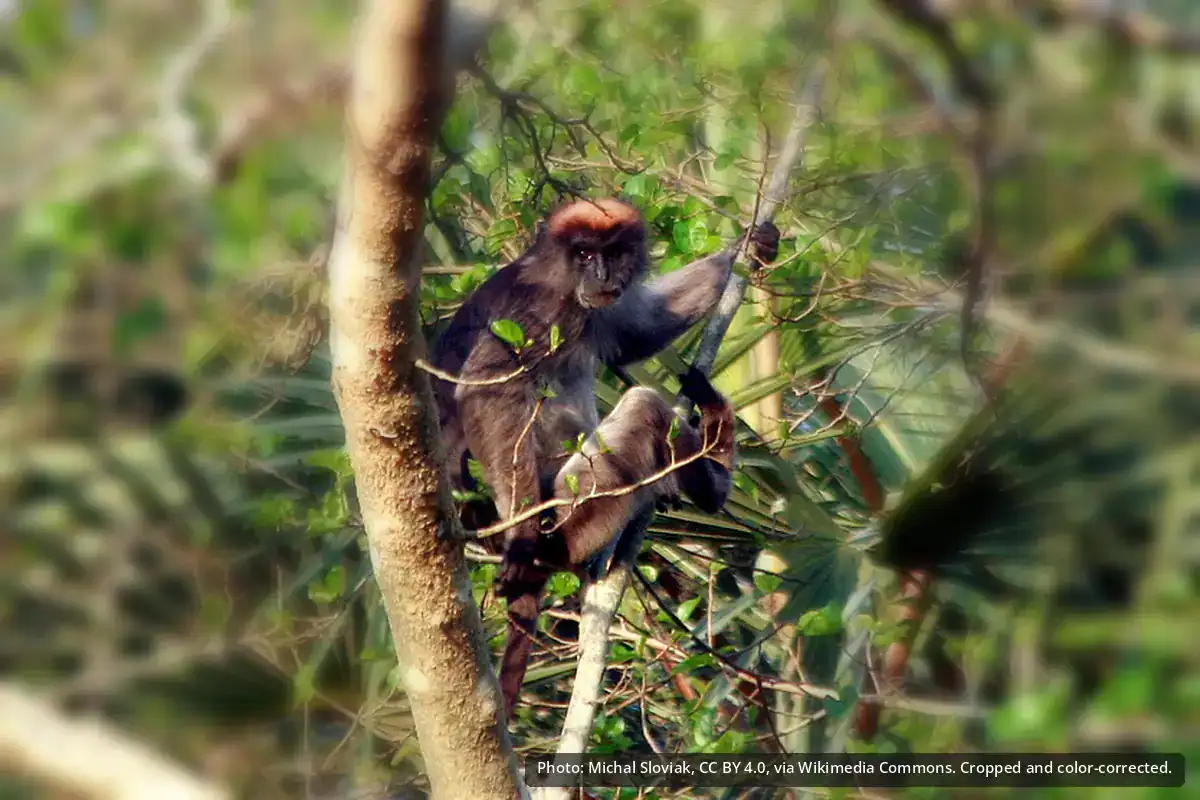
The Tana River red colobus is a leaf-eating monkey from coastal Kenya. Its scientific name is Piliocolobus rufomitratus.[1] It lives only in forest patches along the lower Tana River. A few may survive in the Tana Delta. It is one of the Old World monkeys. The IUCN lists it as Critically Endangered.[2]
This Critically Endangered colobus lives only in Kenya's Tana River forests.
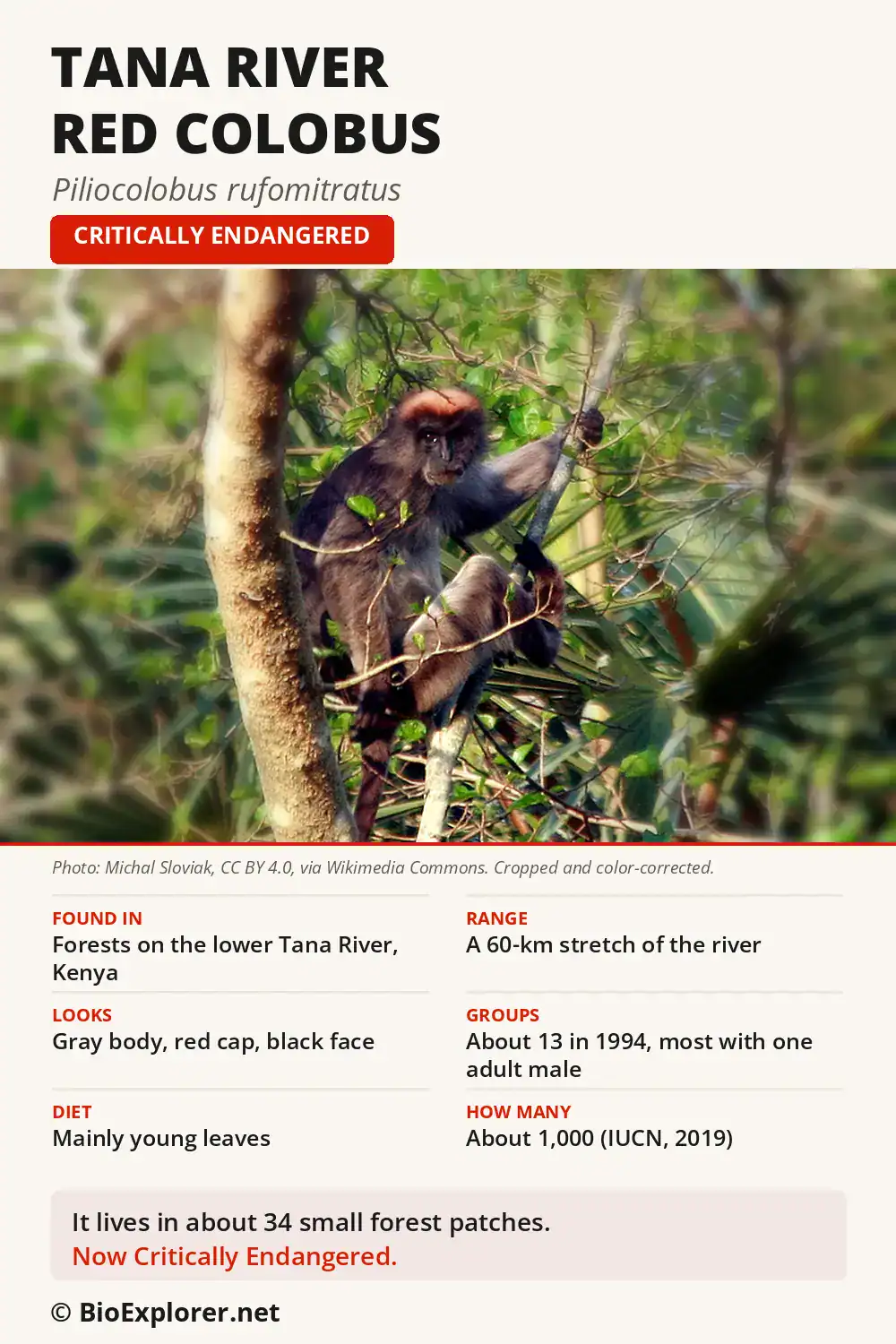
- Common NamesTana River red colobus, eastern red colobus, Mbalawasi (Kipokomo)
- Taxonomy Classification Year1879
- Monkey SizeMedium-sized; few published measurements for this population
- Skin Color(s)Gray body, red crown, darker tail, black face
- HabitatRiverine and flood-plain forest on the lower Tana River
- DietMainly young leaves, plus mature leaves and fruit
- Native CountriesKenya
- It mainly lives along a 60-km stretch of the lower Tana River.
- Its gray body contrasts with a red cap and a black face.
- Young leaves are the most important part of its diet.
- A 1994 census found groups averaged about 13 animals.
- The 2019 Red List assessment estimated about 1,000 animals.
Tana River Red Colobus Distribution
 )
Tana River Red Colobus Guide:
Name and Classification
Wilhelm Peters described this monkey in 1879 as Colobus rufomitratus. His type specimen came from Muniuni, on the Tana River. Today it sits in the genus Piliocolobus, with the other red colobus. It belongs to the leaf-eating colobus monkeys.
The local Pokomo people call it Mbalawasi.[3]
Its rank has long been debated. Some experts treated it as a subspecies. The 2008 Red List grouped it with three other red colobus.[4] One was the ashy red colobus. The others were Oustalet's red colobus and Thollon's red colobus. The Mammal Diversity Database and IUCN treat it as a full species.
A 1974 study found its skull differed from inland red colobus. It suggested it might be a distinct species.
Physical Description
A 1974 field report describes a gray monkey with a darker tail. Its head is red, and its face is black and scowling. That red cap places it among the red monkeys. Its gray body also fits the gray monkeys.
The type skin adds finer detail.[5] A black band crosses the forehead. Black tufts sit above the ears. The crown and the back of the neck are rusty red. The underparts and inner arms are yellowish white. The tail turns blackish at the tip.
Infant coloring and sex differences are not well described.
Size and Weight
The IUCN calls it a medium-sized monkey. Published measurements for the Tana population are scarce. One study says it matches the Tana River mangabey in size.[6]
Similar Species Compared
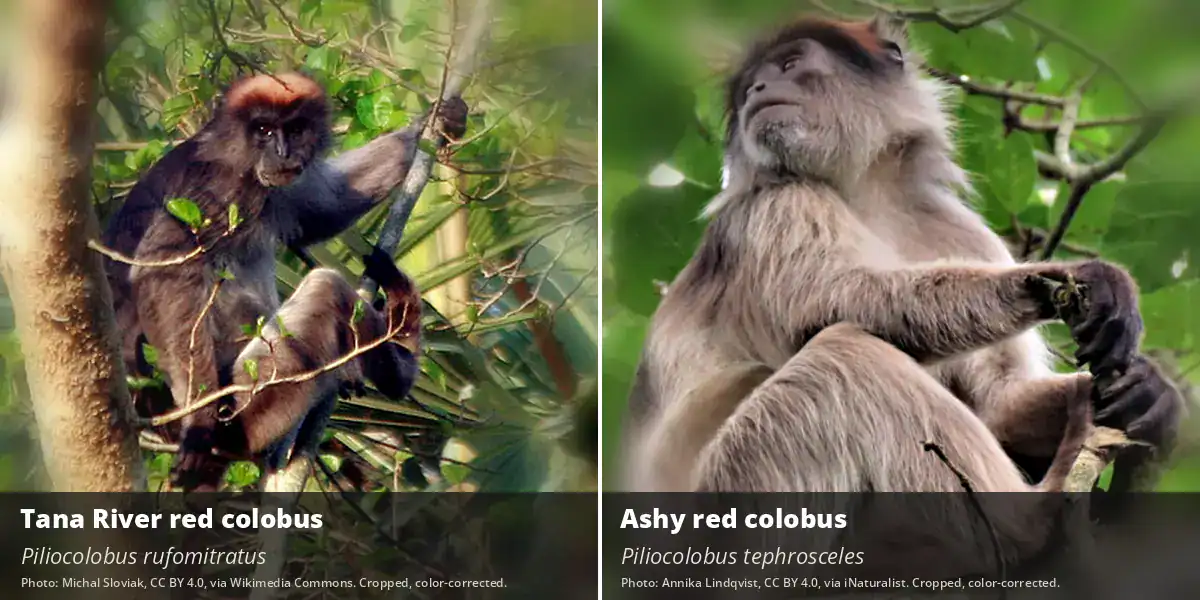
The ashy red colobus lives far inland, in Uganda and Tanzania.[7] It shares a similar color pattern. Old descriptions separate them by small details. The ashy red colobus has no black between its ear tufts. Its arms and legs are paler. Museum males average about 9.4 kg (21 lb).[8] It feeds mainly on young leaves, buds and flowers.[9] Its groups are also much larger. The IUCN lists it as Endangered.
The Zanzibar red colobus is native only to Unguja Island, off Tanzania.[10] Its crown and back are reddish brown. Its shoulders and outer arms are black. It is also listed as Endangered.
The Tana River mangabey shares the same river forests.[11] It is a yellowish monkey with a black face. It eats mostly fruit and seeds and forages on the ground. Its groups average about 27 animals. Like the colobus, it is Critically Endangered.
| Trait | Tana River red colobus | Ashy red colobus | Zanzibar red colobus | Tana River mangabey |
|---|---|---|---|---|
| Scientific name | Piliocolobus rufomitratus | Piliocolobus tephrosceles | Piliocolobus kirkii | Cercocebus galeritus |
| Range | Lower Tana River, possibly Tana Delta, Kenya | Western Uganda and western Tanzania | Native to Unguja Island, Zanzibar, Tanzania | Lower Tana River, Kenya |
| Habitat | Riverine and flood-plain forest patches | Many forest types, 1,100 to 2,200 m | Ground-water forest, coral rag scrub and mangrove | Flood-plain and gallery forest, nearby bushland |
| Coat and key marks | Gray body, red crown, darker tail, black face | Rusty brown crown, dark back, pale arms and legs | Reddish brown crown and back, black shoulders and arms | Yellowish coat, pale underside, black face |
| Head and body | Not known | Not known | About 66 cm, computed from one skin, sex unknown | About 62 cm, computed from one mounted type, sex unknown |
| Tail | Not known | Not known | About 61 cm, one skin, sex unknown | About 73 cm, one mounted type, sex unknown |
| Weight | Not known | Six museum males averaged about 9.4 kg; one female weighed 6.7 kg | Four museum females averaged about 5.4 kg; one male weighed 5.8 kg | Not known |
| Diet | Mainly young leaves, plus fruit | Mainly young leaves, buds and flowers | Young leaves and leaf buds, plus unripe fruit | Mainly fruit and seeds, taken on the ground |
| Group size | About 13 on average (1994 census) | 45 to 50 on average at Kibale | 17.1 on average | About 27 on average, 6 to 62 |
| IUCN status | Critically Endangered (2019 assessment) | Endangered (2019 assessment) | Endangered (2018 assessment) | Critically Endangered (2019 assessment) |
Range and Distribution
It is found only in Kenya. It lives along a 60-km stretch of the lower Tana River. It runs from Kipende in the north to Mitipani in the south. A few may survive farther south in the Tana Delta.
The animals live in about 34 small forests.[12] These range from 1 to 500 ha (2.5 to 1,240 acres). Some are isolated from the rest. Its area of occupancy is under 13 square km (5 sq mi).
The floodplain sits no higher than 40 m (130 ft).[13] Rainfall there averages only about 400 mm (16 in) a year.
Habitat Needs
It lives in riverine and flood-plain forest. These forests grow in a dry region. They depend on groundwater and floods from the river.
A 1972 survey found colobus in several forest types. They were abundant in mixed evergreen forest. They seemed commonest in small patches of mango and fig trees. These grew on old farmland. Colobus avoided dark forest with an even canopy. They seemed to need a fairly open canopy for sunlight.
Diet and Feeding
It is a folivore, or leaf eater. One group was studied from 1973 to 1974.[14] Twenty-two plant species made up its diet that year. Young leaves were the most important food. It ate more fruit than rainforest red colobus. It also ate less mature leaf. Thirteen tree species supply at least 80% of its diet.
That plant-based diet makes it one of the herbivorous monkeys.
Colobus sit still to feed. They pull branches close and pluck leaves with their lips. They do not raid crops.
Behavior and Groups
Researchers observed one group from 1973 to 1974.[15] It spent about a third of daytime feeding. It rested about half the day. The shares varied with age, sex, time of day and month. The group fed less and rested more than one Ugandan group.
It is almost fully arboreal. It rarely comes to the ground. It does so to cross between forest patches. Observers in 1972 said it seemed never to walk. It always bounded, landing with heavy crashes. It rarely calls.
A 1994 census found groups averaged about 13 animals. Most had one adult male. One group used a home range of 9 ha (22 acres).[16] It traveled about 603 m (1,980 ft) a day.
In the 1970s, groups usually held 12 to 30 animals.[17] One group ranged from 16 to 33 over 28 months. Adult females appeared to outnumber adult males at least six to one.
One group showed high membership turnover by both sexes.[18] This was the first such evidence in primates. The author suggested mate choice and infanticide avoidance as possible reasons.
It often seems to associate with Sykes's monkeys. It responds to their alarm calls. On forest edges, it also meets the yellow baboon and vervet monkey.
Population and Status
A 1972 survey estimated about 1,860 animals. A 1994 census estimated 1,100 to 1,300. The 2019 Red List assessment estimated about 1,000 animals. The trend was downward.
A 1999 to 2001 survey of 31 forests counted 613 colobus. They lived in 50 groups across 20 forest patches. Mean group size had fallen by nearly 50% since 1978.
Despite its small numbers, it keeps high genetic diversity.[19] Its mitochondrial DNA shows high haplotype diversity.
The IUCN listed it as Endangered in 2008 and 2016. It was moved to Critically Endangered in 2019. Assessors warn numbers could fall 80% or more by 2048. That could happen if forest loss returns to past peak rates.
Major Threats
Its forests keep shrinking. One study tracked 21 years of forest loss.[20] Forest area fell by 34.5% in that time. Loss was higher outside the reserve.
People clear forest for farms. Fires and livestock damage the patches. Large fig trees are felled to make canoes. Insecurity and inter-ethnic violence make protection harder.
Dams change the river itself. Five hydroelectric dams upriver have altered flows and floods. That affects the water table the forests need. The Red List described a sixth dam as under construction. It is the High Grand Falls Dam. Large irrigation schemes would come with it.
Irrigation projects have already destroyed key forests. Invasive mesquite is also spreading into native forest.
Conservation Efforts
Kenya created the Tana River Primate National Reserve in 1976. It covers about 169 square km (65 sq mi). About 35% of these colobus live inside it.
A World Bank project ran from 1996 to 2001.[21] It planned to relocate people from the reserve. Forest clearing increased instead.
In January 2007, the High Court of Kenya ordered the reserve annulled. Kenya's Wildlife Act requires approval by Parliament for that step. As of 2021, it had not happened.[22]
The Ndera Community Conservancy was set up in 2010. It aims to protect forests along the lower Tana. The Tana Delta became a Ramsar Site in 2012.
It is listed on CITES Appendix I. It has made the list of the 25 most endangered primates.
Explore more monkeys starting with T. Or browse all types of monkeys.
Common Questions
It lives only in Kenya, in forests along the lower Tana River. A few may survive in the Tana Delta.
It eats mainly young leaves. It also eats mature leaves and fruit.
The 2019 Red List assessment estimated about 1,000. Their numbers were falling.
Yes. The IUCN lists it as Critically Endangered. Forest loss is the main threat.
A 1994 census found groups averaged about 13. Most had one adult male.
The colobus is gray with a red cap and eats leaves. The mangabey is yellowish and eats mostly fruit and seeds.
Cite this page
BioExplorer. (2026, November 2). Tana River Red Colobus. https://www.bioexplorer.net/animals/mammals/monkeys/tana-river-red-colobus/
About the author

Wildlife Writer and Photographer, BioExplorer.net
Arjun is a science writer and wildlife photographer at BioExplorer.net. He turns new research on animals into clear, accurate reads for curious readers. His work covers animal behavior, ecology, and newly described species. He holds a Cornell Lab of Ornithology certificate in bird biology. He is pursuing an HBSc at the University of Toronto Mississauga.