Top 11 Animals With Super Sensors
In general, plants, animals, and other organisms obtain information about the world through their senses.
This is because their survival is highly dependent on their ability to perceive and sense any stimulus or changes in the environment.
However, as humans, our senses are limited to what we can see, smell, hear, taste, and feel and by the capacity of information they provide. While these senses work entirely well for us, some animals have different perceptions. While they also possess some senses that humans have, they tend to have this at far higher intensity and sensitivity.
Often being preyed upon, some animals have developed their sense organs to sense any harm and survive it. Other animals developed their senses to compensate for their weak or lack of some senses. Others have developed them to improve their hunting process.
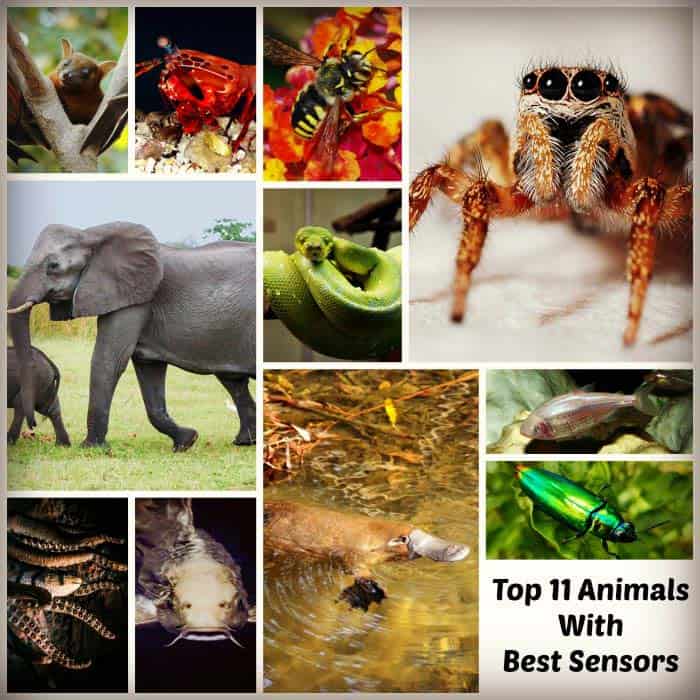
The following are the 11 animals with the best sensors in the animal kingdom, and the corresponding anatomical and morphological structures that allow them to have so.
Jump to:
- Top 11 Animals With Excellent Sensors
- 1. Platypus (Electroreception)
- 2. Bats (Echolocation)
- 3. Snakes (Infrared Radiation Detection)
- 4. Octopus (Polarized Vision)
- 5. Catfish (Sense of Taste)
- 6. African Bush Elephant (Sense of Smell)
- 7. Jewel Beetles (Detect Presence of Fire)
- 8. Cavefish (Sense of Hearing)
- 9. Bees (Sense of Earth's Magnetic Field)
- 10. Spiders (Sensitive To Touch)
- 11. Mantis Shrimp (Complex Visual System)
- References
Top 11 Animals With Excellent Sensors
1. Platypus (Electroreception)

In the entire animal kingdom, the duck-billed platypus, along with echidnas (ant-eaters), is the only mammal that can lay eggs. In addition to this unique ability, this animal has a highly developed sensor that can locate its prey (i.e., small invertebrates) through electroreception. Using their bill filled with sensors, the platypus can accurately detect the electrical impulses of their prey even in the deepest of waters.

2. Bats (Echolocation)

Known to be creatures of the night, bats are great sound navigators: an ability called echolocation. Bats use their mouths to produce sounds that will bounce off objects. Since they are typically active at night, they use echolocation to search for food, locate any changes in their flight, and find their way in the dark.
3. Snakes (Infrared Radiation Detection)

Aside from the distinct five senses, did you know that snakes have this so-called sixth sense? According to the international science journal Nature, hunter snakes like pit vipers, pythons, and boas can still accurately find their way through the dark. This is because snakes can detect the infrared (thermal) radiation emitted by the bodies of the animals they prey in. Hence, even blinded snakes can still accurately prey on other animals, thanks to infrared radiation!
4. Octopus (Polarized Vision)

Aside from its flexible physique with eight powerful tentacles, the octopus is one of the unique animals because of its incredible sense of sight. For instance, they have “polarization vision“. They can detect the direction in which light waves vibrate. This makes see-through prey and silvery fish stand out in the water.
5. Catfish (Sense of Taste)

Have you ever wondered what animal has the highest sense of taste? Well, the award goes to the catfish! Large catfish can have up to 175,000 taste buds. A person has about 10,000. The catfish’s taste buds cover its whole body, so it tastes the water it swims through. Along with its four pairs of whiskers, these taste buds help the fish find food and locate prey nearby.
6. African Bush Elephant (Sense of Smell)
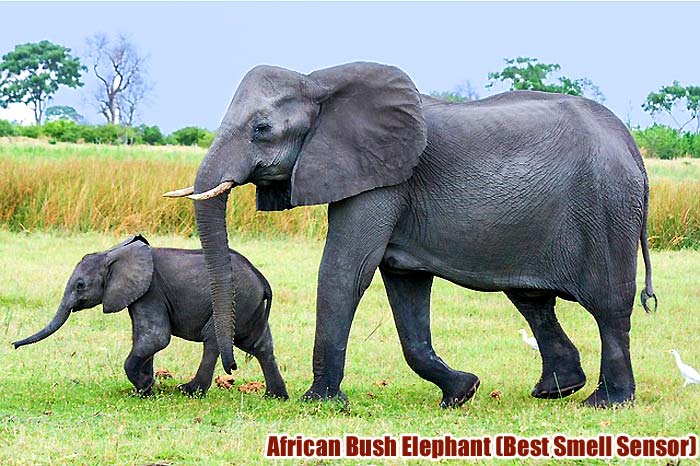
The African bush elephant may have the best nose of any mammal. It has about 2,000 working smell receptor genes. Each gene lets the nose detect a different set of odors. Dogs have about 800, and humans have about 400. A 2014 study found this is the highest count of 13 mammals tested.
To be exact, interestingly, elephants top the charts based on the number of smell genes with 1948, while cows and dogs take the second and third spots with 1186 and 811 genes, respectively!
7. Jewel Beetles (Detect Presence of Fire)

Pictured: a tropical jewel beetle. Fire beetles are plain black.
Fire beetles (Melanophila), a type of jewel beetle, can sense a forest fire from more than 12 miles (20 km) away. A person can only smell the smoke from a few hundred feet away. There are three apparent reasons why fire beetles evolved to develop this character-first is mainly for food gathering, secondly is for ensuring the mating process, and third is securing the health of their eggs laid in pine trees.
8. Cavefish (Sense of Hearing)

This animal proves the saying “when one sense is weak, the other senses are further strengthened. ” to be true. Cavefish live in a relatively pitch-black environment, so their sense of sight is nearly functionless. However, its sense of hearing is substantially sensitive as it can detect even the slightest noise at 1 kHz (or even lower!). This ability helps the cavefish to efficiently locate its prey and filter out unnecessary noise in the surroundings.
Suggested Reading:
Top 16 Animals with the Best Hearing
9. Bees (Sense of Earth’s Magnetic Field)

Aside from making honey from flower nectar, did you know that bees are incredibly hypersensitive that they can also sense the Earth’s magnetic field? Aside from that, they can also detect atmospheric electromagnetic waves that indicate thunderstorms. These abilities help bees in navigating flowers and determining whether a storm is approaching.
Many birds are thought to sense the magnetic field too, although a recent seabird study has complicated the picture of how birds navigate.
10. Spiders (Sensitive To Touch)

Spiders are one of the very few animals with a hypersensitivity to touch. By having massive numbers of hairs (known as trichobothria) on their legs, they can detect and trace the origin of a vibration created by an object or another animal. As a result, hunting their prey becomes as easy as merely standing on their self-made web.
11. Mantis Shrimp (Complex Visual System)

Are you already fascinated by the octopus’ sense of sight? Wait until you hear about the astounding ability of the mantis shrimp. Known to have the most complex visual system in the animal kingdom, mantis shrimps have 16 types of photoreceptors (light detectors) that can detect visible and ultraviolet (UV) light and are the only known animals to see the circularly polarized light! Aside from that, they can sense light depth in one eye while independently moving the other.

What Do Shrimp Eat?
The animals mentioned above only prove that what humans can perceive is very limited by a very narrow band of what is possible. Humans might have highly developed intellectual abilities, but these creatures with such “super sensors” are not less either.
As a result, scientists and inventors continually seek to discover and construct various devices and gadgets that can help increase the range of what we can sense.
Because of them, we can already discover beyond the limitation of human senses and glimpse things previously exclusive to animals. Wouldn’t that be exciting?
Cite this page
BioExplorer. (2026, October 28). Top 11 Animals With Super Sensors. https://www.bioexplorer.net/animals-with-best-sensors.html/
References
- “Platypus Electroreception”. Accessed November 23, 2017. Link.
- “How do bats echolocate, and how are they adapted to this activity? – Scientific American”. Accessed November 23, 2017. Link.
- “Snake infrared detection unravelled : Nature News”. Accessed November 23, 2017. Link.
- “Octopus Senses – Octopus Facts and Information”. Accessed November 23, 2017. Link.
- “What Animal Has the Best Sense of Taste?”. Accessed November 23, 2017. Link.
- “Studying Elephants – EDITED BY KADZO KANGWANA AWF TECHNICAL HANDBOOK SERIES”. Accessed November 23, 2017. PDF.
- “7 Superpowered Animal Senses You Won’t Believe Are Possible”. Accessed November 23, 2017. Link.
- “Sensory Adaptation for a Cavefish | Animals – mom.me”. Accessed November 23, 2017. Link.
- “The 6 Most Mind-Blowing Superpowers of Bees”. Accessed November 23, 2017. Link.
- “The spider sensory organs and legs”. Accessed November 23, 2017. Link.
- “Mantis shrimp have the world’s best eyes but why?”. Accessed November 23, 2017. Link.
- “Elephants Can Outsniff Rats and Dogs”. Live Science (on Niimura et al. 2014, Genome Research). Accessed October 28, 2026. Link.
- “Thresholds of polarization vision in octopuses”. Journal of Experimental Biology (2021), via PubMed Central. Accessed October 28, 2026. Link.
- “Fire beetles sense and seek out wildfire”. AskNature, Biomimicry Institute. Accessed October 28, 2026. Link.