
Highland Mangabey
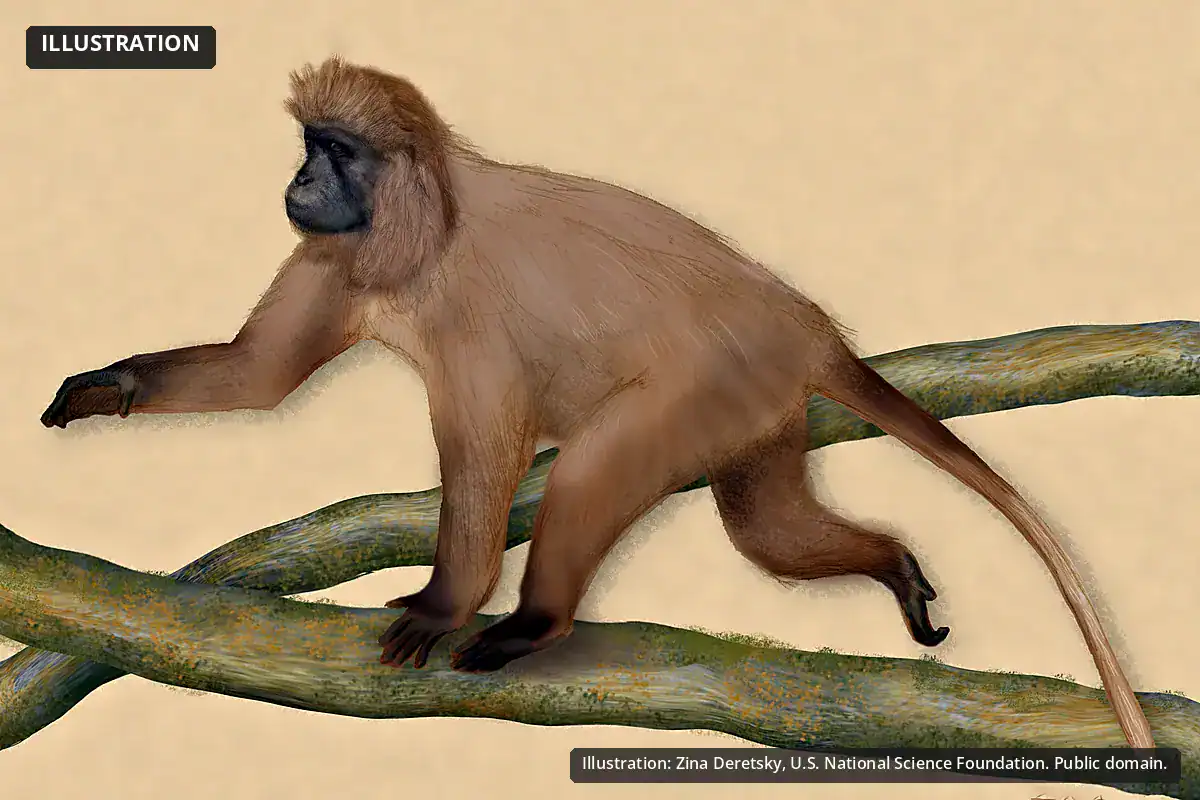
The highland mangabey is better known today as the kipunji. Its scientific name is Rungwecebus kipunji.[1] It lives only in mountain forests of southern Tanzania. It is one of the Old World monkeys. The IUCN lists it as Endangered.[2]
This Endangered monkey lives in two isolated regions of southern Tanzania.
- Common NamesKipunji, highland mangabey
- Taxonomy Classification Year2005
- Monkey SizeAdult males an estimated 85 to 90 cm (33 to 35 in), head and body
- Skin Color(s)Brown fur, off-white belly and tail, black face and eyelids
- HabitatMontane and submontane forest, 1,300 to 2,450 m
- DietOmnivorous: leaves, fruit, bark, flowers, pith and invertebrates
- Native CountriesTanzania
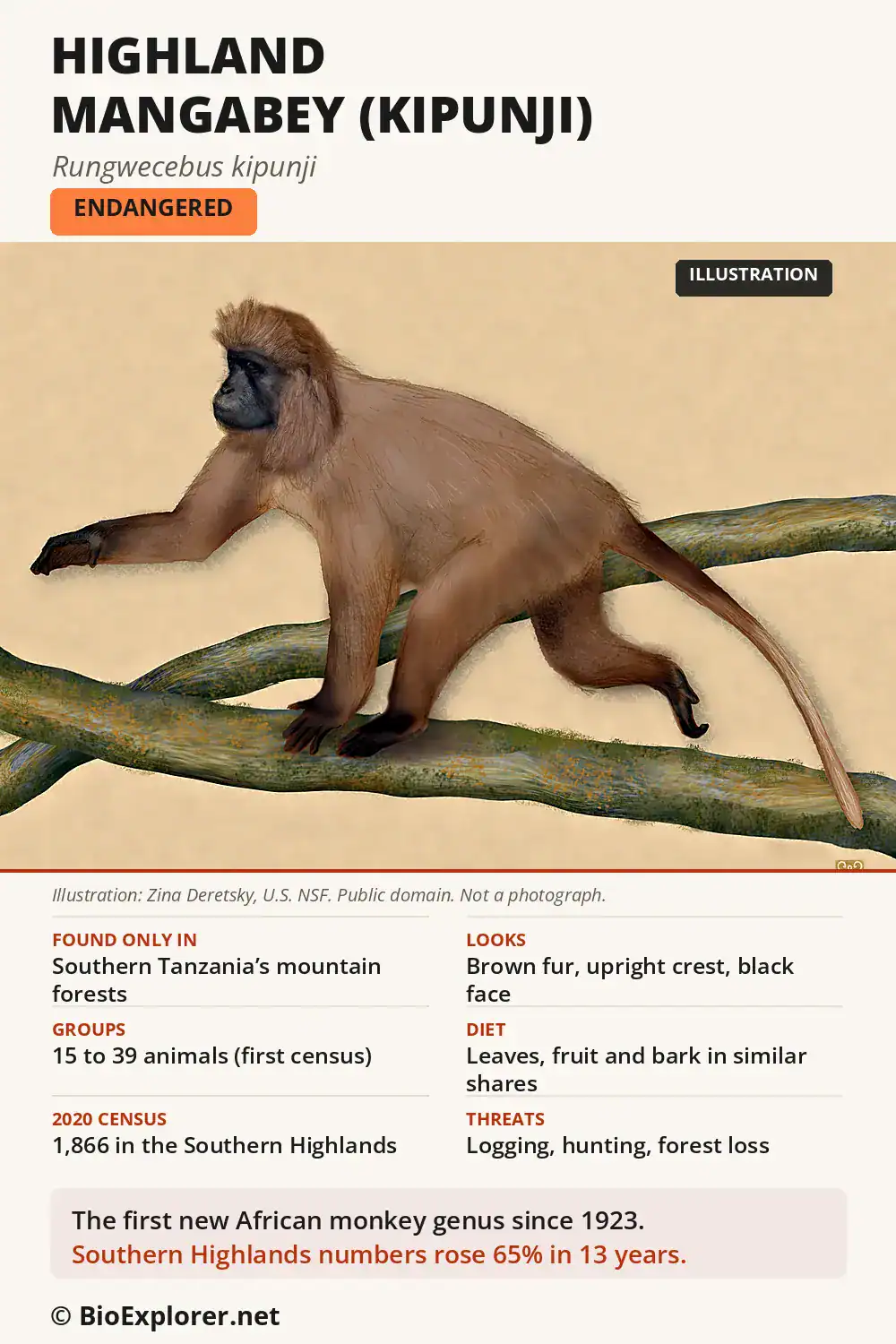
- It was named in 2005 and given its own genus in 2006.
- A long, upright crest of brown hair tops its head.
- Southern Highlands kipunji eat leaves, fruit and bark in similar shares.
- The first census estimated about 1,117 animals in 38 groups.
- A 2020 census counted 1,866 in the Southern Highlands.
Highland Mangabey Distribution
 )
Highland Mangabey Guide:
Name and Classification
Scientists described it in 2005 as Lophocebus kipunji.[3] That genus holds the tree-dwelling mangabeys. Two of them are the gray-cheeked mangabey and black-crested mangabey. They chose it for its black eyelids and life in trees.
Two teams found it on their own. One worked in the Southern Highlands in 2003. The other worked in the Udzungwa Mountains in 2004. The name kipunji comes from a local name in the Southern Highlands.[4]
Then a farmer killed one on Mount Rungwe.[5] It became the only preserved specimen at the time. Its DNA showed that Lophocebus was not one natural group. So in 2006 the team named a new genus, Rungwecebus. It was the first new genus of African monkey since 1923.[6]
Later studies tied it closely to baboons.[7] Nuclear DNA groups it with the baboon genus Papio. Its mitochondrial DNA tells a messier story. It clusters with southeastern lines of the yellow baboon and chacma baboon.
One team proposed that the kipunji arose as a hybrid.[8] Its parents would have been baboon females and mangabey males. Another team saw a separate sister line to baboons instead. In that view, it later mixed with baboons through hybridization.
Kipunji in Ndundulu carry an older mitochondrial type.[9] So baboon DNA seems to have entered the Rungwe population only. A 2018 study found the reverse as well.[10] Some yellow baboons near the Udzungwa Mountains carry kipunji-like mitochondrial DNA.
A 2011 skull study still found no simple answer.[11] It ranked Rungwecebus as a distinct genus. It sits close to Papio, Lophocebus and Theropithecus. Its closest living relatives are the various types of baboons.
Physical Description
The 2005 description lists its key traits. They are its coat color and a long, upright crest. Its tail and belly are off-white. Its eyelids are black, the same as its face. Its loud call also set it apart from other mangabeys.
A university news report added more detail. It described long, brown fur and black skin. Brown hair tufts grow from the top and sides of its head. That coat places it among the brown monkeys.
Size and Weight
Few body measurements have been published. A 2026 paper quotes estimates from the 2006 genus description.[12] Adult males have an estimated head-body length of 85 to 90 cm. That is about 33 to 35 in. They weigh roughly 10 to 16 kg (22 to 35 lb). No figures for females or tail length appear in open sources.
The first two specimens were both subadult males. So these adult figures remain estimates.
Similar Species Compared
The yellow baboon ranges from southern Ethiopia to the Zambezi valley.[13] It lives in savanna, thorn scrub and open woodland.[14] It also uses gallery forest. It has yellow-brown fur with white cheeks and underparts. Its muzzle juts out like a dog's. Wild males average 25.8 kg (57 lb), far heavier than a kipunji. It eats grasses, roots, fruit, insects and small animals. The IUCN lists it as Least Concern.
The gray-cheeked mangabey lives in West Central African forests.[15] Its range covers southern Cameroon, Gabon, Congo and nearby countries. It spends most of its time high in the canopy. It eats mainly fruit and seeds. Groups studied in Gabon and Congo held 12 to 24 animals. The IUCN lists it as Vulnerable.
The Sanje mangabey also lives in the Udzungwa Mountains.[16] Yet it is absent from the kipunji's Ndundulu Forest. It uses submontane and montane forest. It lives at 290 to 2,000 m (950 to 6,560 ft). It spends about half its time foraging on the forest floor. Its face is beige, not black.[17] Like the kipunji, it is Endangered.
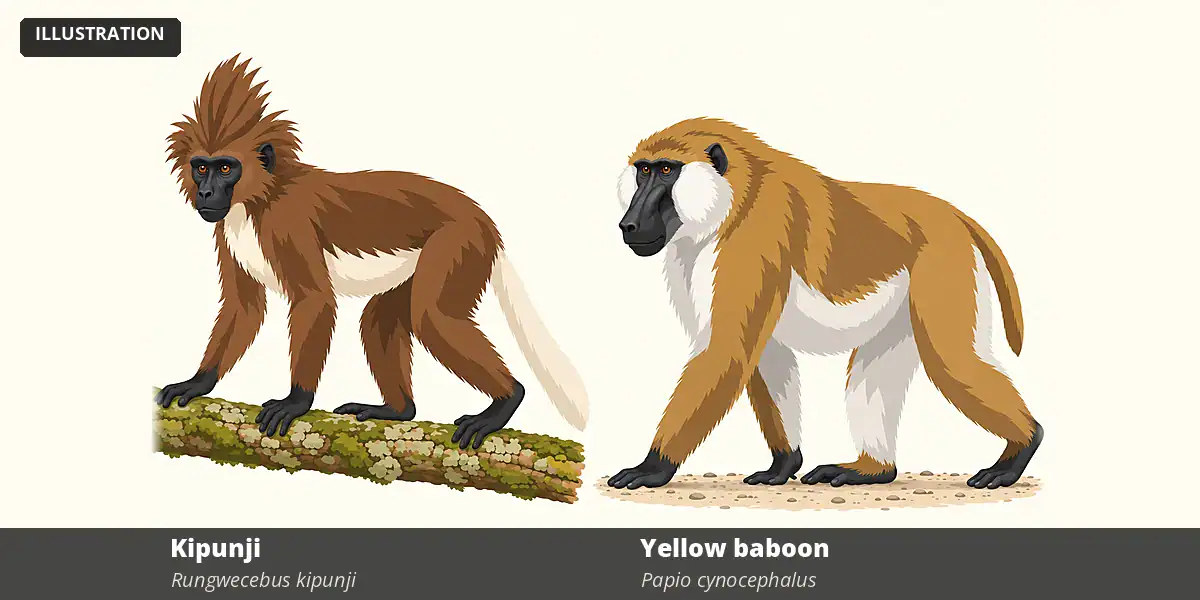
| Trait | Kipunji | Yellow baboon | Gray-cheeked mangabey | Sanje mangabey |
|---|---|---|---|---|
| Scientific name | Rungwecebus kipunji | Papio cynocephalus | Lophocebus albigena | Cercocebus sanjei |
| Range | Southern Highlands and Udzungwa Mountains, Tanzania | Southern Ethiopia and Somalia south to Malawi, Mozambique and Zambia | Cameroon, Central African Republic, Equatorial Guinea, Gabon and Republic of the Congo | Udzungwa Mountains, Tanzania |
| Habitat | Montane and submontane forest, 1,300 to 2,450 m | Thorn scrub, savanna, open woodland and gallery forest | Primary and secondary forest, up to 1,100 m | Submontane and montane forest, 290 to 2,000 m |
| Coat and key marks | Brown fur, long upright crest, off-white belly and tail, black face and eyelids | Yellow-brown fur, white cheeks and underparts, black face, long muzzle | Not known | Coat between Tana River and agile mangabeys, beige face |
| Head and body | Adult males about 85 to 90 cm (estimate) | Not known | Not known | Not known |
| Weight | Adult males about 10 to 16 kg (estimate) | Males 25.8 kg, females 11.0 kg (wild averages) | Not known | Not known |
| Diet | Southern Highlands: leaves, fruit and bark in similar shares; 122 food plants | Grasses, corms, tubers, fruit, invertebrates and small vertebrates | Mainly fruit and seeds | Mostly fruit, nuts and seeds |
| Group size | 15 to 39 (2005 to 2006 census) | 17 to 77, average 39 at Amboseli | 12 to 24 (Congo), 18 to 23 (Gabon) | Group means from 15 to over 70 |
| IUCN status | Endangered (assessed 2018) | Least Concern (assessed 2020) | Vulnerable (assessed 2016) | Endangered (assessed 2016) |
Range and Distribution
It is found only in Tanzania. Its two populations live about 350 km (220 mi) apart. Farmland with little forest lies between them.
The larger population lives on Mount Rungwe and in Livingstone Forest. Both are in the Southern Highlands of southwestern Tanzania. Livingstone Forest lies inside Kitulo National Park. A degraded strip of forest, the Bujingijila Corridor, joins the two. It is about 2 km (1.2 mi) wide.
The smaller population lives in Ndundulu Forest, in the Udzungwa Mountains. It sits in the Kilombero Nature Reserve. Kipunji seem to be absent from the next-door Udzungwa Mountains National Park.
The 2018 assessment put its occupied area at 67.5 square km. That is about 26 sq mi. It lives at 1,300 to 2,450 m (4,270 to 8,040 ft).
Habitat Needs
On Mount Rungwe and in Kitulo, it uses degraded montane forest. Its broken canopy reaches 10 to 30 m (33 to 98 ft). Logging cut these forests back from the 1960s to the 1980s. Tree ferns, wild bananas and bamboo grow thick underneath.
It favors steep gullies and valley edges, near streams. It avoids ridges, open ground and bamboo stands. Yearly rain on south Mount Rungwe is about 185 to 280 cm. That is about 73 to 110 in. These wet mountain forests make it one of the rainforest monkeys.
Ndundulu is different. Its submontane forest is undisturbed, with an unbroken canopy. The trees there reach 40 to 50 m (130 to 165 ft).
One model tied kipunji to closed canopy at mid to low elevations.[18] It tolerated broken forest, as long as food remained. The best spots near Rungwe and Livingstone were already occupied.
Habitat alone may not explain its tiny Udzungwa range.[19] Nearby forest of similar quality has no kipunji at all.
Diet and Feeding
One study followed 34 groups over 45 months.[20] It logged 9,498 hours of direct observation. The team recorded 122 food plants from 60 families.
In the Southern Highlands, the kipunji is a dietary generalist. It eats mature and young leaves, ripe and unripe fruit, and bark. These make up similar shares of its diet. It also eats flowers, pith, seed pods, shoots, rhizomes and tubers. Invertebrates, fungi, moss, lichen and soil appear too.
Its most eaten tree is Macaranga capensis. This fast-growing tree springs up early in forest regrowth. The kipunji eats its leaves, leaf stalks, pith, flowers and bark.
It eats more leaves in dry seasons, more fruit in wet ones. Bark eating rises with rainfall. This broad diet makes it one of the omnivorous monkeys.
It sometimes leaves the forest to raid crops, especially maize. Diet data from Ndundulu are still sparse.
Behavior and Groups
The kipunji is active by day and lives mainly in trees. It lives in groups with several adult males. In the Southern Highlands, groups held 25 to 39 animals. Ndundulu groups were smaller, at 15 to 25.
Four Mount Rungwe groups were followed for 70 days straight.[21] They traveled about 1,293 m (0.8 mi) a day on average. Home ranges averaged an estimated 205 to 306 ha. That is about 510 to 760 acres. The figure depends on the method used. Ranges overlapped widely, yet groups rarely came close. The authors concluded that kipunji are not territorial.
In Ndundulu, kipunji joined other monkeys in 43.8% of encounters. Pairs with Sykes' monkeys made up 42.9% of those associations. Pairs with the Udzungwa red colobus made up 14.3%.
In the Southern Highlands, they often slept near the Angolan colobus. Sykes' monkeys slept in neighboring trees as well.
Researchers describe its loud call as a honk-bark. Little is published on its breeding.
Population and Status
The first census ran from 2005 to 2006. Teams walked 3,456 km (2,150 mi) of survey routes. They then followed groups for 772 hours to count them.
They estimated about 1,117 kipunji in 38 groups. About 1,042 lived in Rungwe and Kitulo, in 34 groups. Only about 75 lived in Ndundulu, in four groups. The authors warned that the Ndundulu population may no longer be viable.
A 2020 census repeated the work in the Southern Highlands.[22] It counted 1,866 kipunji in 59 groups. Numbers had risen 65% in 13 years. Group numbers rose 59%, and occupied area rose 19%. Groups averaged about 32 animals, but 24 in Madehani. That village forest is not protected. Signs of human activity fell by 81%. WCS later put the global total at 1,966 animals.[23]
Ndundulu remains small, with no clear trend detected. Counts from 2013 to 2024 found three to six groups. The 2026 study put it at fewer than 100 animals.
In 2006, a review called the kipunji Critically Endangered.[24] It joined the world's 25 most endangered primates for 2006 to 2008.[25] The latest Red List assessment, from 2018, lists it as Endangered. It described a tiny, fragmented and shrinking range. It listed the population trend as decreasing. The 2020 census came later and found an increase.
Major Threats
The forests of Rungwe and Kitulo are degraded. Logging, charcoal making and illegal hunting have long been common. Farmers have encroached on the Bujingijila Corridor. So groups are cut off, even within the same protected area.
People hunt kipunji with log traps and dogs. Most of this is revenge for raids on maize. It peaks from January to April. Some kipunji are also hunted for food. Hunting them is illegal.
The Red List also lists climate change as a threat. Ndundulu is in good shape, yet kipunji there stay few. The reasons remain unclear.
Conservation Efforts
It is listed on CITES Appendix II. The 2018 assessment placed all known kipunji in protected areas. The first census put 48.4% in Kitulo National Park. It put 44.9% in Mount Rungwe Nature Reserve. The last 6.7% lived in Kilombero Nature Reserve. Madehani Village Forest, surveyed later, has no formal protection. Only the national park has its own management and staff.
Restoring the Bujingijila Corridor is a top priority. It covers 2.1 square km (0.8 sq mi). It could hold about 88 more kipunji. It would also reconnect the Rungwe and Kitulo groups.
The Wildlife Conservation Society uses the kipunji as a flagship species. Its long-term program works in and around Rungwe and Kitulo. One habituated group is watched daily for research. Another is being habituated for tourism.
Researchers advise against moving kipunji between the two populations. The two are genetically distinct.
Explore more monkeys starting with H. Or browse all types of monkeys.
Common Questions
Yes. The highland mangabey and the kipunji are the same species. Its scientific name is Rungwecebus kipunji.
The highland mangabey lives only in southern Tanzania. It lives on Mount Rungwe and in Kitulo, Madehani and Ndundulu forests.
In the Southern Highlands, the highland mangabey eats leaves, fruit and bark. They make up similar shares of its diet. Diet data from Ndundulu are sparse.
The first census estimated about 1,117 highland mangabeys. A 2020 census counted 1,866 in the Southern Highlands. Ndundulu likely holds fewer than 100.
No. The highland mangabey has its own genus, Rungwecebus. Its closest living relatives are the baboons.
Two teams found the highland mangabey in 2003 and 2004. It was named in 2005.
Cite this page
BioExplorer. (2026, October 27). Highland Mangabey. https://www.bioexplorer.net/animals/mammals/monkeys/highland-mangabey/
About the author