
Types of Penguins: 19 Species Plus the New Gentoos (With Pictures)
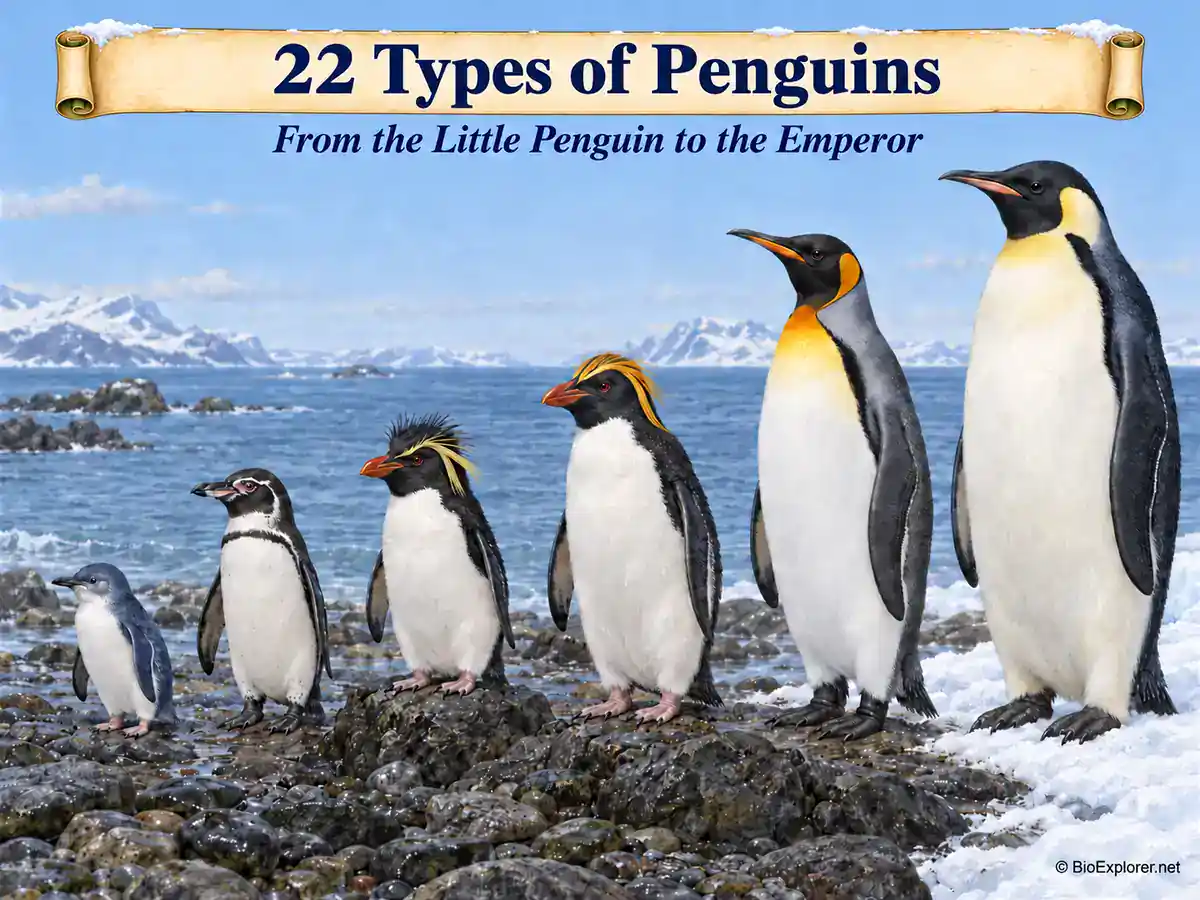
Penguins are flightless seabirds built for life in the ocean. Their wings are stiff flippers. The flipper bones are flattened and dense.[1]
All but one penguin species live only in the Southern Hemisphere. The Galapagos Penguin is the exception. Its breeding grounds straddle the equator.[2]
The main world bird checklists list 19 living penguin species. In 2026, a genetic study proposed splitting the gentoo into four species.[3] This guide covers all 22 types, including the proposed gentoos.
Each entry gives the range, size, diet and conservation status. It also adds one notable fact. Penguins are one branch of the types of birds.
AviList, the global bird checklist, recognizes 19 living penguin species. The Clements checklist from Cornell uses the same count. BirdLife International and the IUCN count 18 species.
A 2026 study proposed splitting the gentoo into four species. If checklists accept it, the total becomes 22. By our count, 10 of the 18 IUCN-assessed species are threatened.
The African Penguin is Critically Endangered.
Types of Penguins Guide:
- Penguin Species List
- How Many Penguins?
- The New Gentoos
- What Is a Penguin?
- Breeds or Species?
- The Six Penguin Groups
- Great Penguins
- Brush-tailed Penguins
- Crested Penguins
- Banded Penguins
- Yellow-eyed and Little Penguins
- Largest and Smallest
- Where Penguins Live
- Extinct Penguins
- Threats to Penguins
- Protected in the US
- Who Named Them
- Frequently Asked Questions
Penguin Species List
This table lists all 22 types of penguins in this guide. The last column gives each IUCN Red List category.[4][5]
| # | Penguin | Scientific Name | Where It Breeds | IUCN Status |
|---|---|---|---|---|
| 1 | Emperor Penguin | Aptenodytes forsteri | Antarctic coast, on sea ice | Endangered |
| 2 | King Penguin | Aptenodytes patagonicus | Sub-Antarctic islands | Least Concern |
| 3 | Adelie Penguin | Pygoscelis adeliae | Antarctic coast | Least Concern |
| 4 | Chinstrap Penguin | Pygoscelis antarcticus | Antarctic Peninsula and South Atlantic islands | Least Concern |
| 5 | Northern Gentoo Penguin (proposed) | Pygoscelis papua | Falkland Islands and Martillo Island | Not Evaluated |
| 6 | Southern Gentoo Penguin (proposed) | Pygoscelis ellsworthi | Antarctic Peninsula and South Georgia | Not Evaluated |
| 7 | Eastern Gentoo Penguin (proposed) | Pygoscelis taeniata | Crozet, Marion and Macquarie Islands | Not Evaluated |
| 8 | Southeastern Gentoo Penguin (proposed) | Pygoscelis kerguelensis | Kerguelen Islands, likely Heard Island | Not Evaluated |
| 9 | Macaroni Penguin | Eudyptes chrysolophus | Sub-Antarctic islands and the Antarctic Peninsula | Vulnerable |
| 10 | Royal Penguin | Eudyptes schlegeli | Macquarie Island and nearby Bishop and Clerk Islets | Least Concern |
| 11 | Western Rockhopper Penguin | Eudyptes chrysocome | Southern Chile and the Falkland Islands | Not Evaluated Separately |
| 12 | Eastern Rockhopper Penguin | Eudyptes filholi | Southern Indian Ocean, Macquarie Island and New Zealand’s sub-Antarctic islands | Not Evaluated Separately |
| 13 | Northern Rockhopper Penguin | Eudyptes moseleyi | Tristan da Cunha, Gough, Amsterdam and St Paul Islands | Endangered |
| 14 | Fiordland Penguin | Eudyptes pachyrhynchus | Southwestern New Zealand | Near Threatened |
| 15 | Snares Penguin | Eudyptes robustus | Snares Islands, New Zealand | Vulnerable |
| 16 | Erect-crested Penguin | Eudyptes sclateri | Bounty and Antipodes Islands, New Zealand | Endangered |
| 17 | African Penguin | Spheniscus demersus | Namibia and South Africa | Critically Endangered |
| 18 | Humboldt Penguin | Spheniscus humboldti | Peru and Chile | Vulnerable |
| 19 | Magellanic Penguin | Spheniscus magellanicus | Argentina, Chile and the Falkland Islands | Least Concern |
| 20 | Galapagos Penguin | Spheniscus mendiculus | Galapagos Islands | Endangered |
| 21 | Yellow-eyed Penguin | Megadyptes antipodes | Southeastern New Zealand and its sub-Antarctic islands | Endangered |
| 22 | Little Penguin | Eudyptula minor | Southern Australia and New Zealand | Least Concern |
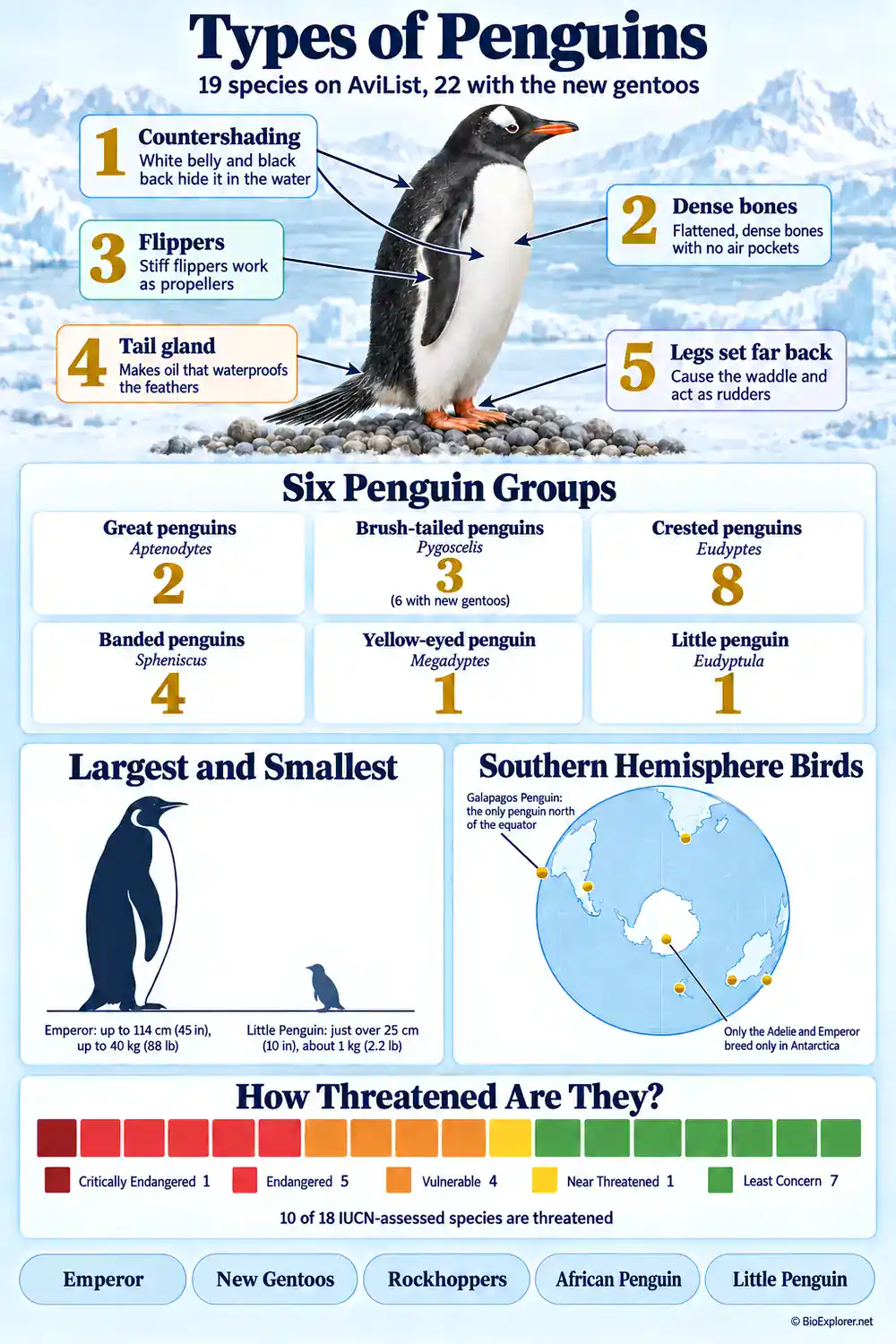
The IUCN still assesses the gentoo as one species. That species is rated Least Concern. The four proposed gentoos have no separate ratings yet.
The IUCN has not assessed Western and Eastern Rockhoppers separately. It still uses the older, unsplit Southern Rockhopper. That combined species is rated Vulnerable.
How Many Penguins?
Scientists agree on most penguin species, but not all. AviList was first released in June 2025. It lists 19 penguin species in six genera.
The Clements checklist adopted the AviList count in October 2025.[6] ITIS, the US government taxonomy database, also lists 19.[7]
BirdLife International and the IUCN recognize 18 species.[8] The difference is the rockhoppers. AviList and Clements split the Southern Rockhopper in two.[9]
The two rockhoppers differ in DNA. They also differ in skin color around the bill. The checklists now call them Western and Eastern Rockhoppers.
An older version of this page listed 27 penguin species. That count mixed 18 species with nine subspecies. A subspecies is a local form within one species.
In April 2026, Daly Noll and colleagues proposed four gentoo species. No checklist has adopted the proposal yet. If one does, the count rises to 22.
The New Gentoos
Scientists have argued about gentoo classification for over a century. Rauri Bowie of UC Berkeley was a senior author of the study. He said the gentoo is probably the most debated penguin.[10]
The team sequenced whole genomes from 64 gentoos. The birds came from 10 breeding colonies. Those colonies covered nearly the entire gentoo range.
The four gentoo lines split from one ancestor long ago. That ancestor lived about 800,000 years ago. Island groups and ocean fronts now keep them apart. An ocean front is where cold Antarctic water meets warmer water.
The study proposed these four species:
- Northern Gentoo (Pygoscelis papua) breeds on the Falklands and Martillo Island.
- Southern Gentoo (Pygoscelis ellsworthi) breeds on the Antarctic Peninsula and South Georgia.
- Eastern Gentoo (Pygoscelis taeniata) breeds on Crozet, Marion and Macquarie Islands.
- Southeastern Gentoo (Pygoscelis kerguelensis) breeds on Kerguelen and probably Heard Island.
The Southeastern Gentoo is the newly described species. Its name is anchored to an 1897 museum specimen, the holotype. The description also used genomes, body measurements and habitat models.
UC Berkeley called it the first new penguin in over 100 years. The Snares Penguin, named in 1953, is a more recent example.
A 2020 study proposed a separate South Georgia gentoo species.[11] Major checklists did not adopt it. The 2026 study treats those birds as a subspecies.
Plumage alone does not reliably separate the four gentoos. Body measurements can help tell several of them apart. In museum specimens, Antarctic Peninsula birds were smallest.
The study also modeled suitable habitat for 2050. It used a moderate warming scenario called RCP4.5. Three proposed gentoos may lose much of their modeled habitat.
The Southern Gentoo’s modeled habitat may grow by about 9 percent. The model used ocean temperature, salinity, acidity and productivity. It did not include behavior, diet shifts or movement between islands.
What Is a Penguin?
A penguin is a flightless seabird in the family Spheniscidae. That family sits in the order Sphenisciformes. Every living penguin belongs to this one family.
Penguins are birds in every sense. Among living animals, only birds have feathers.[12] Penguins also lay eggs and are warm-blooded, like other birds.
Penguin flippers are short, stiff and work as propellers. Flipper bones are flattened, fused and dense. They lack the air spaces found in many flying birds’ wings.
These features are classic ocean animal adaptations. Most other flightless birds, like ostriches, live on land.
The black-and-white coat works as camouflage. From below, a white belly blends with bright surface water. From above, a black back blends with the dark depths.
A gland near the tail makes waterproofing oil for the feathers. Another gland removes extra salt from swallowed seawater.
Penguin legs sit far back on the body. This causes the waddle on land. In water, the legs and feet steer like rudders.
Most penguins replace all their feathers at once each year. Scientists call this a catastrophic molt. Molting penguins fast and can lose 45 percent of their mass.[13]
Breeds or Species?
Many people search for penguin breeds. Penguins do not have breeds. A breed is a group of domestic animals shaped by people.[14]
Penguins are wild species. The biological species concept defines species by natural interbreeding.[15] So the right term is penguin species, or types of penguins.
The Six Penguin Groups
Living penguins fall into six genera. A genus is a group of closely related species. Each penguin genus has its own look.
| Group | Genus | Species | What to Look For |
|---|---|---|---|
| Great penguins | Aptenodytes | 2 | The two largest penguins |
| Brush-tailed penguins | Pygoscelis | 3 (6 with the proposed gentoos) | Long, stiff tails that sweep behind them |
| Crested penguins | Eudyptes | 8 | Yellow or orange plumes on the head |
| Banded penguins | Spheniscus | 4 | Black chest bands and bare facial skin |
| Yellow-eyed penguin | Megadyptes | 1 | Pale yellow eyes |
| Little penguin | Eudyptula | 1 | The smallest penguin, with blue and white feathers |
Great Penguins
The two great penguins are the largest living penguins. Their genus name, Aptenodytes, means featherless diver in Greek.[16]
Emperor Penguin
| Kingdom | Order | Family | Genus | Species |
|---|---|---|---|---|
| Animalia | Sphenisciformes | Spheniscidae | Aptenodytes | Aptenodytes forsteri |
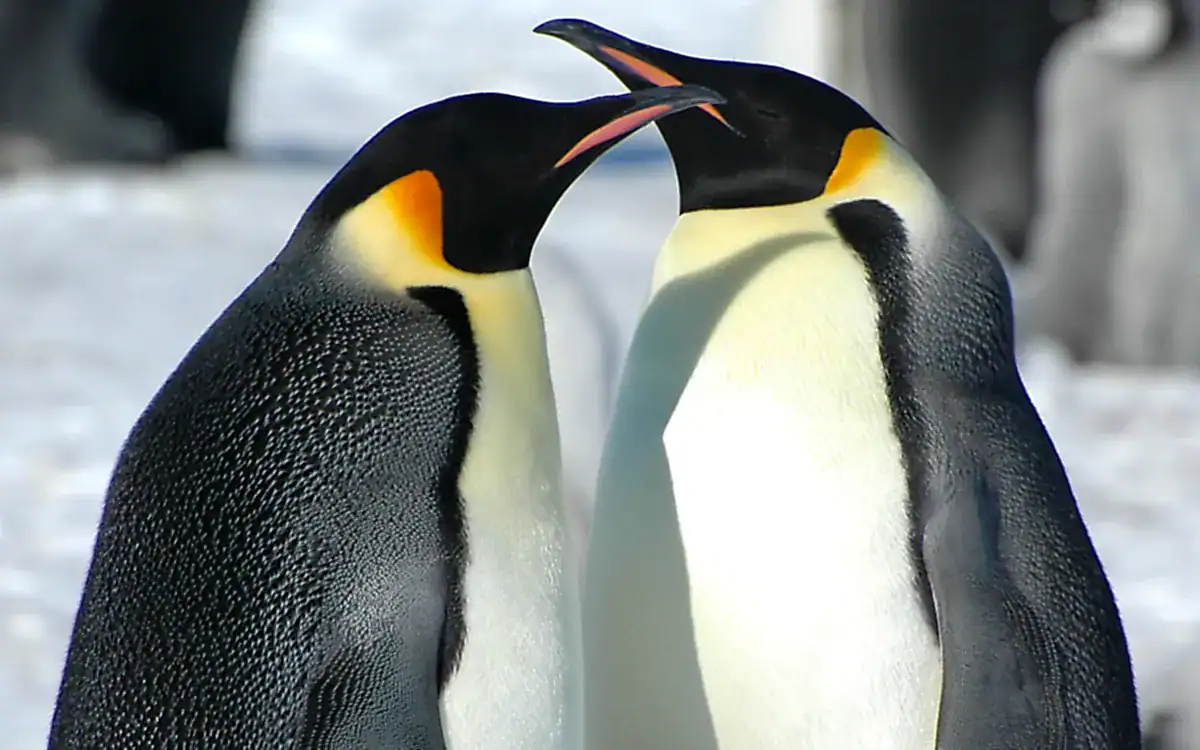
The Emperor Penguin is the tallest and heaviest living penguin.[17] It is the only known penguin that breeds through the Antarctic winter.[18] Its chicks are raised on sea ice attached to the coast.
- An adult Emperor Penguin stands up to 45 inches (114 cm) tall. Adults weigh up to 88 pounds (40 kg).
- Scientists know of 66 Emperor Penguin breeding colonies.[19] A 2022 US estimate put pairs at 270,000 to 280,000.
- The female Emperor lays one egg in May. She passes it to the male.[20]
- The male Emperor then fasts for about nine weeks. He balances the egg on his feet. He loses about 45 percent of his body weight.
- Emperor Penguins survive winter by huddling. Up to 10 birds can share each square meter.[21] Huddling cuts heat loss by up to half.
- One study found Emperor huddles can reach 37.5°C (99.5°F) inside.[22] That is close to the birds’ own body temperature.
- The Emperor Penguin dives deeper than any other bird.[23] Its deepest recorded dive reached 565 meters (1,854 feet).
- A 2018 study recorded one Emperor dive lasting over 32 minutes. It is the longest bird dive on record.
- The IUCN listed the Emperor Penguin as Endangered on April 9, 2026. Emperor numbers fell about 10 percent between 2009 and 2018.
- Early sea ice breakup is the main threat to Emperor Penguins. In 2022, four of five colonies in one region lost every chick.[24] That region was the central and eastern Bellingshausen Sea.
King Penguin
| Kingdom | Order | Family | Genus | Species |
|---|---|---|---|---|
| Animalia | Sphenisciformes | Spheniscidae | Aptenodytes | Aptenodytes patagonicus |
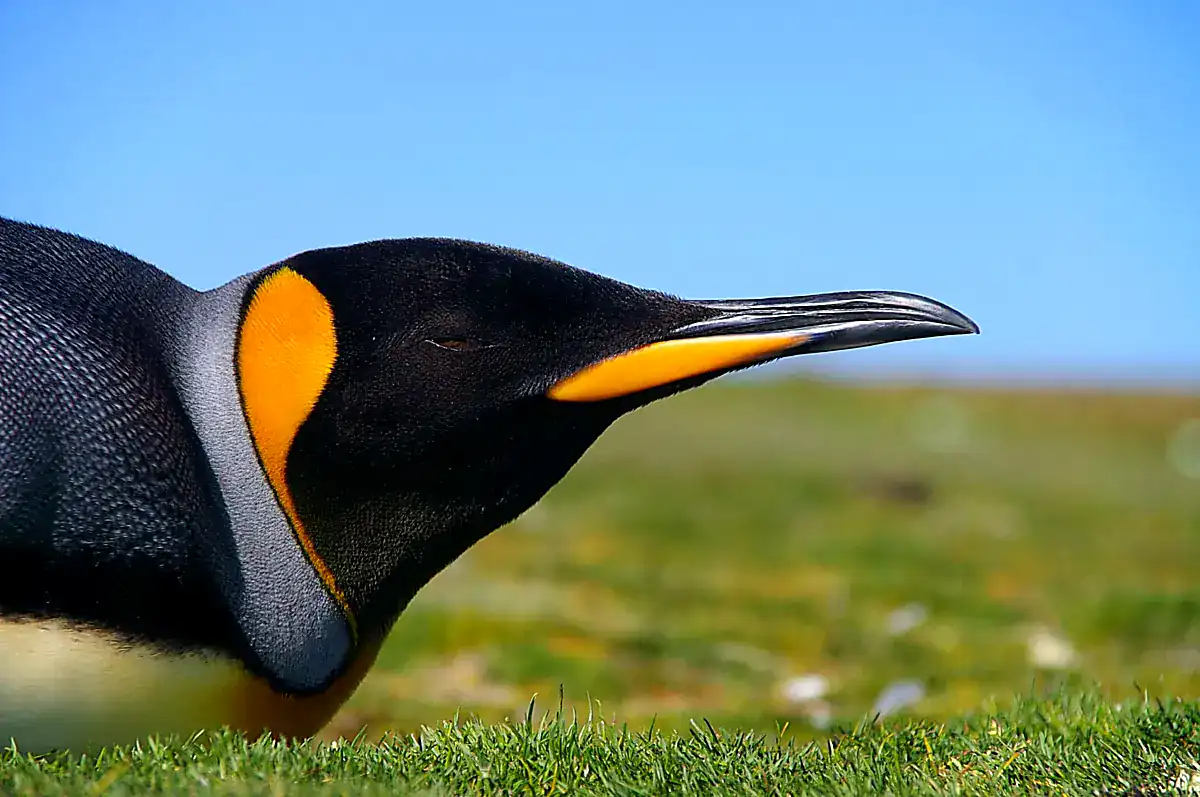
The King Penguin is the second-largest penguin. It stands 85 to 95 cm (34 to 37 in) tall.[25] King Penguins breed on sub-Antarctic islands. These lie between about 45° and 55° south.
- Adult King Penguins weigh 9.3 to 17.3 kg. That is 21 to 38 pounds.
- The King Penguin builds no nest. It holds its single egg on its feet. Incubation takes about 54 days.
- Raising one King Penguin chick takes 10 to 13 months. A pair raises only two chicks every three years.
- King Penguin chicks wear woolly brown down. Nineteenth-century books even listed them as a separate bird. Those books called it the woolly penguin.
- King Penguins mainly eat lanternfish. They eat more squid in winter.
- One Crozet Islands King Penguin dived 424.5 meters.[26] That is 1,393 feet, the species record.
- Sealers once boiled King Penguins for oil. Many colonies nearly vanished. The world population now seems stable at about 1.6 million pairs.
Brush-tailed Penguins
Brush-tailed penguins are named for their long, stiff tails. The gentoo has the most prominent tail of any penguin. It sweeps from side to side as the bird walks.
This genus, Pygoscelis, has held three species for decades. It would hold six if checklists accept the gentoo proposal.
Adelie Penguin
| Kingdom | Order | Family | Genus | Species |
|---|---|---|---|---|
| Animalia | Sphenisciformes | Spheniscidae | Pygoscelis | Pygoscelis adeliae |
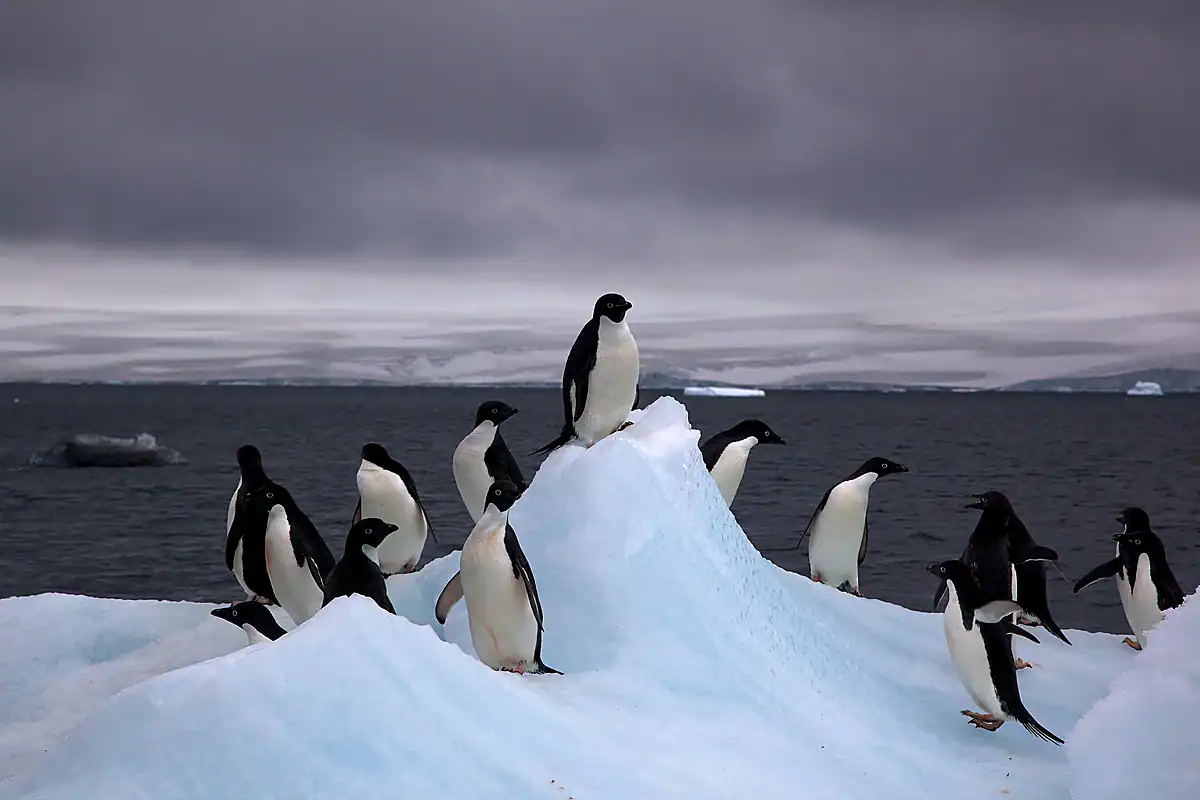
The Adelie Penguin breeds around the entire Antarctic coast. It nests wherever bare rock shows through the ice.[27] Only Adelie and Emperor Penguins nest exclusively on Antarctic shores.
- Adult Adelie Penguins weigh 3 to 6 kg (7 to 13 lb). They stand about 70 cm (28 in) tall. Males and females are similar in size.
- Adelie Penguins build nests from pebbles on sloping ground. The slope lets meltwater drain away. Neighbors often steal each other’s stones.
- By mid-November, an Adelie nest usually holds two eggs. Both parents share incubation. Chicks head to sea at 7 to 9 weeks.
- Adelie Penguins eat mainly Antarctic krill offshore. Near the colony, they eat more fish and crystal krill.
- Some Adelie Penguins dive to 175 meters (574 feet). Most feed in the top 70 meters.
- Adelie Penguin numbers can change greatly over time. Near Australia’s Casey Station, 1950s counts found 30,000 pairs. Today there are nearly 200,000.
- The Adelie Penguin honors Adele, wife of explorer Jules Dumont d’Urville. His French expedition found the bird in 1840.
- Our Adelie penguin facts page covers the species in more depth.
Chinstrap Penguin

| Kingdom | Order | Family | Genus | Species |
|---|---|---|---|---|
| Animalia | Sphenisciformes | Spheniscidae | Pygoscelis | Pygoscelis antarcticus |
The Chinstrap Penguin has a thin black band under its chin. That band runs from ear to ear. Chinstraps breed mainly on the Antarctic Peninsula and nearby islands.
- An adult Chinstrap Penguin stands about 72 cm (28 in) tall. It weighs 3.5 to 5 kg (8 to 11 lb).[28]
- Chinstrap Penguins nest on ice-free slopes. The highest slopes fill first because ice melts there first. Some Chinstrap colonies exceed 100,000 pairs.
- Krill makes up about 95 percent of the Chinstrap Penguin’s prey. Chinstraps can dive to 70 meters. Most feeding dives stay within 10 meters.
- A 2020 global census counted 3.42 million Chinstrap breeding pairs.[29] It found them in 375 colonies.
- The same census compared some colonies with older counts. About 45 percent had probably or certainly declined.
- Our chinstrap penguin facts page has more on this species.
Northern Gentoo Penguin
| Kingdom | Order | Family | Genus | Species |
|---|---|---|---|---|
| Animalia | Sphenisciformes | Spheniscidae | Pygoscelis | Pygoscelis papua |
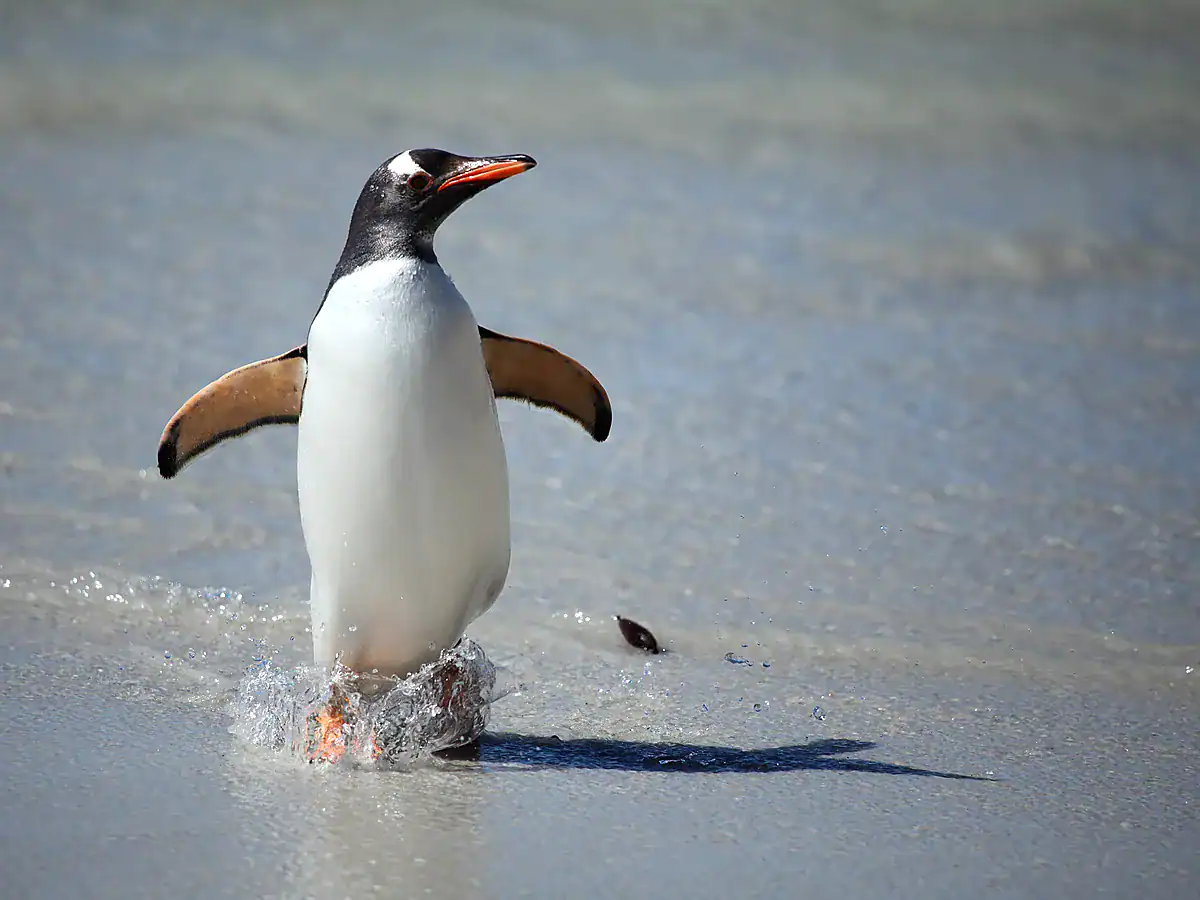
The Northern Gentoo Penguin is one of the four proposed gentoo species. It keeps the original name, Pygoscelis papua. It breeds only on the Falklands and Martillo Island.
- Both Northern Gentoo breeding areas lie north of the Antarctic Polar Front. That front is where cold Antarctic water meets warmer water.
- In museum measurements, Northern Gentoos were the largest gentoos. Adult gentoos weigh 4.5 to 8.5 kg. That equals 10 to 19 pounds. They stand about 75 cm (30 in) tall.[30]
- Like every gentoo, the Northern Gentoo has an orange-red bill. The color comes from carotenoids, pigments found in krill.
- Northern Gentoos, like all gentoos, eat fish, krill, squid and cuttlefish. They take almost anything they can catch.
- Northern Gentoos make up about 24 percent of all gentoos.
- The Northern Gentoo may lose much modeled habitat by 2050. That projection assumes moderate warming.
Southern Gentoo Penguin
| Kingdom | Order | Family | Genus | Species |
|---|---|---|---|---|
| Animalia | Sphenisciformes | Spheniscidae | Pygoscelis | Pygoscelis ellsworthi |
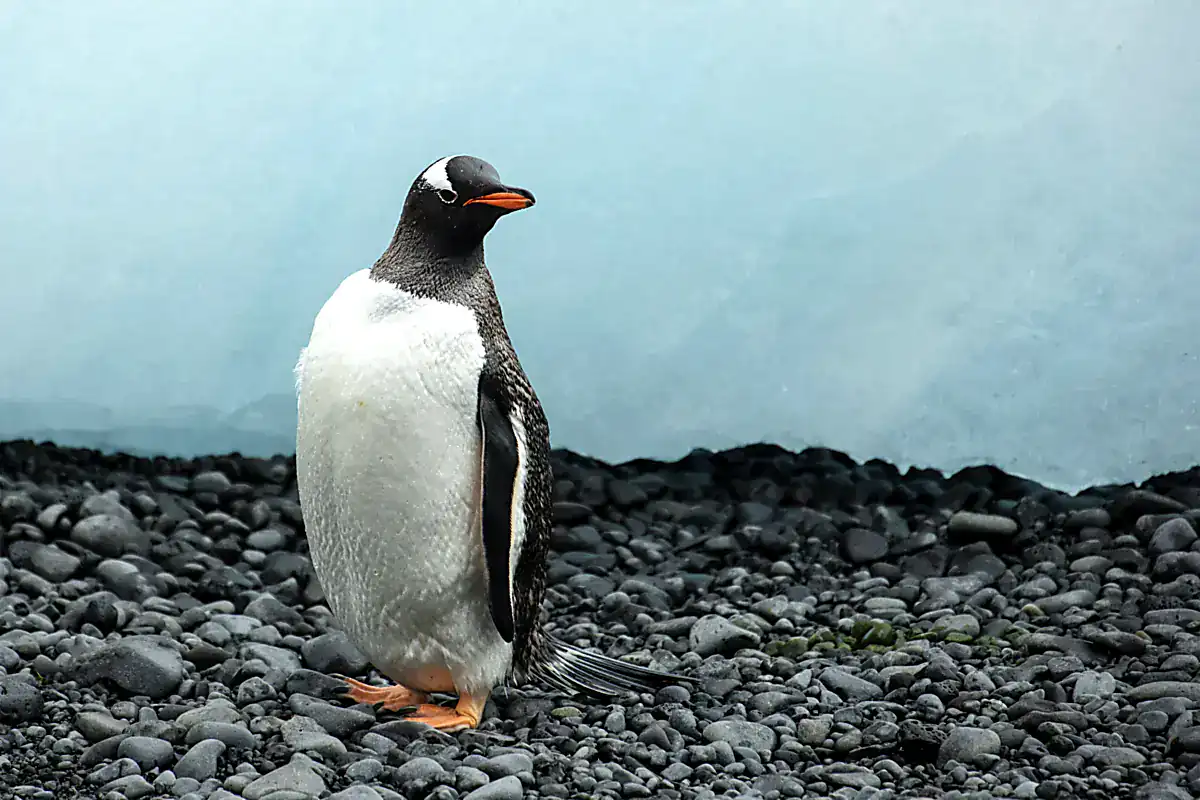
The Southern Gentoo Penguin is the only proposed gentoo living in Antarctica. It breeds on the Antarctic Peninsula and nearby island groups. It also breeds on South Georgia.
- Southern Gentoos from the Antarctic Peninsula were the smallest gentoos measured. Colder southern gentoos were smaller than northern ones. Many warm-blooded animals show the opposite pattern.
- Southern Gentoos make up about 65 percent of all gentoos. Their colonies drove an 11 percent gentoo rise since 2013.
- Southern Gentoos showed selection signals in candidate genes. These genes are linked to heat production, fat storage and vision.
- The Southern Gentoo has two proposed subspecies. One lives on South Georgia. The other lives across the rest of its range.
- A 2020 study proposed full species status for South Georgia’s gentoos.
- The Southern Gentoo’s modeled habitat may grow about 9 percent by 2050.
Eastern Gentoo Penguin
| Kingdom | Order | Family | Genus | Species |
|---|---|---|---|---|
| Animalia | Sphenisciformes | Spheniscidae | Pygoscelis | Pygoscelis taeniata |
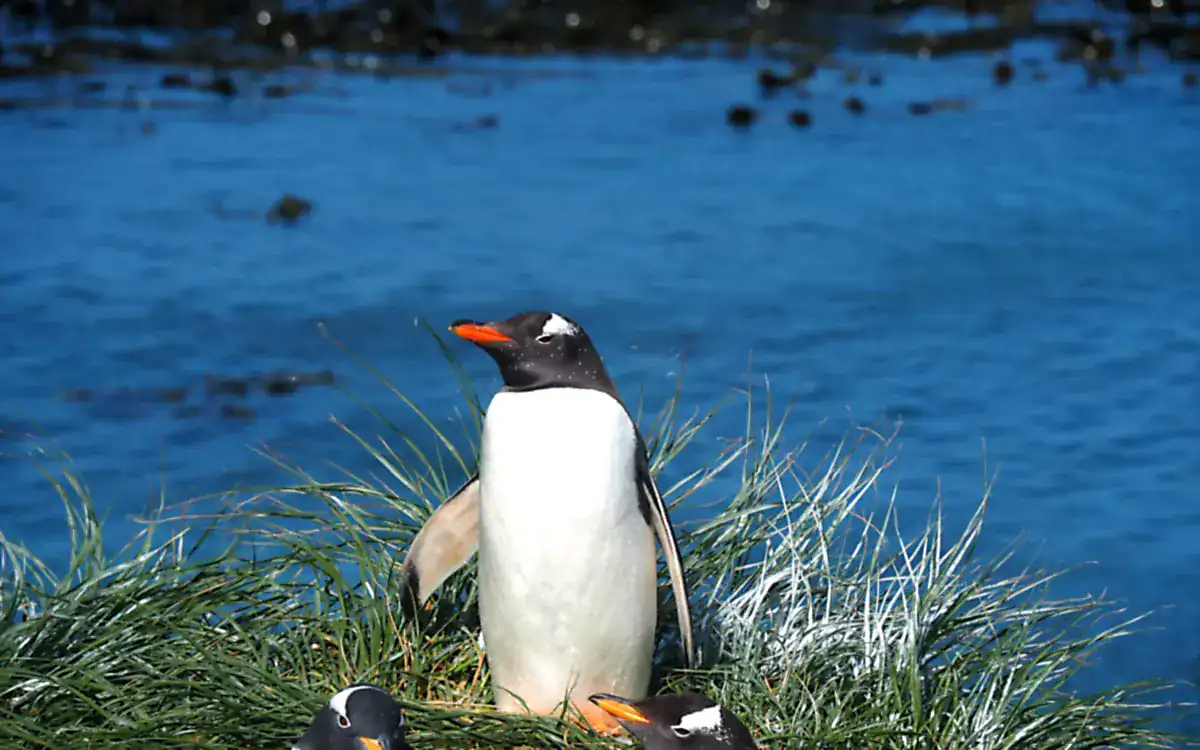
The Eastern Gentoo Penguin is another proposed gentoo species. It breeds on the Crozet, Marion and Macquarie Islands. It is the rarest proposed gentoo, about 2 percent of all gentoos.
- In museum measurements, Eastern Gentoos matched Southeastern Gentoos in size. Earlier work found Crozet gentoos to be larger. The authors say more sampling is needed.
- Eastern Gentoos showed selection signals in candidate genes. Those genes relate to carbohydrate use, oxygen transport and lungs. The study suggests these may aid diving.
- Some Eastern Gentoo colonies are shrinking. Macquarie pairs fell 50 percent over three generations.
- One Eastern Gentoo colony on Possession Island, Crozet, also declined. It fell 32.6 percent from 1992 to 2018.
- Co-author Juliana Vianna said sub-Antarctic gentoos are of most concern. The Eastern Gentoo is one of three proposed gentoos facing habitat loss.
Southeastern Gentoo Penguin
| Kingdom | Order | Family | Genus | Species |
|---|---|---|---|---|
| Animalia | Sphenisciformes | Spheniscidae | Pygoscelis | Pygoscelis kerguelensis |
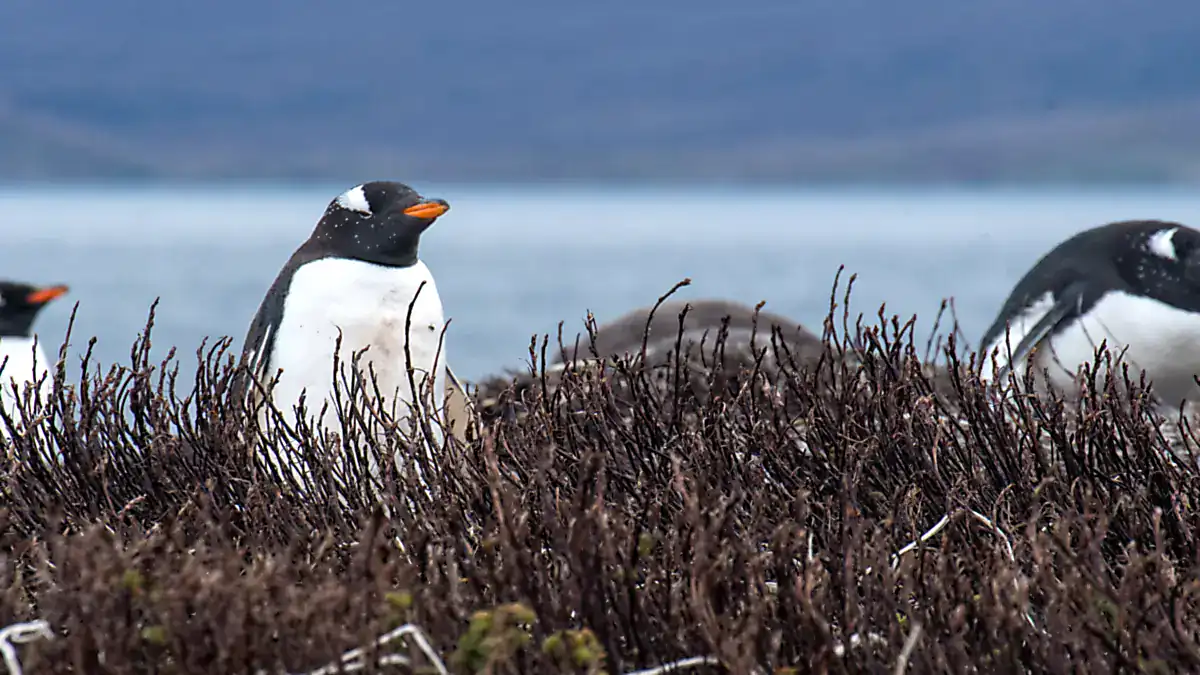
The Southeastern Gentoo Penguin is the newly described gentoo. Scientists named it in April 2026. It breeds on the Kerguelen Islands in the Indian Ocean. It probably also breeds on nearby Heard Island.
- The Southeastern Gentoo looks like other gentoos. It differs slightly in size and voice. Scientists call such look-alike species cryptic.
- The designated Southeastern Gentoo holotype is an adult male from Kerguelen. It was collected on December 31, 1897. Other specimens and genetic data also supported the description.
- Southeastern Gentoos showed selection signals in four candidate genes. Studies of other birds link these genes to vocal learning.
- Southeastern Gentoo colonies sit right on the Antarctic Polar Front. They make up about 9 percent of all gentoos.
- The last full Southeastern Gentoo count on Kerguelen dates to 1985.
- Young Southeastern Gentoos tracked from Kerguelen traveled to Heard Island. They were likely feeding there.
- The Southeastern Gentoo may lose much modeled habitat by 2050. Some suitable habitat may remain around Heard Island.
Crested Penguins
Crested penguins wear yellow or orange plumes on their heads. Their genus name, Eudyptes, means good diver.[31]
Crested penguins lay two eggs of different sizes. The smaller first egg rarely produces a surviving chick.[32]
Macaroni Penguin
| Kingdom | Order | Family | Genus | Species |
|---|---|---|---|---|
| Animalia | Sphenisciformes | Spheniscidae | Eudyptes | Eudyptes chrysolophus |
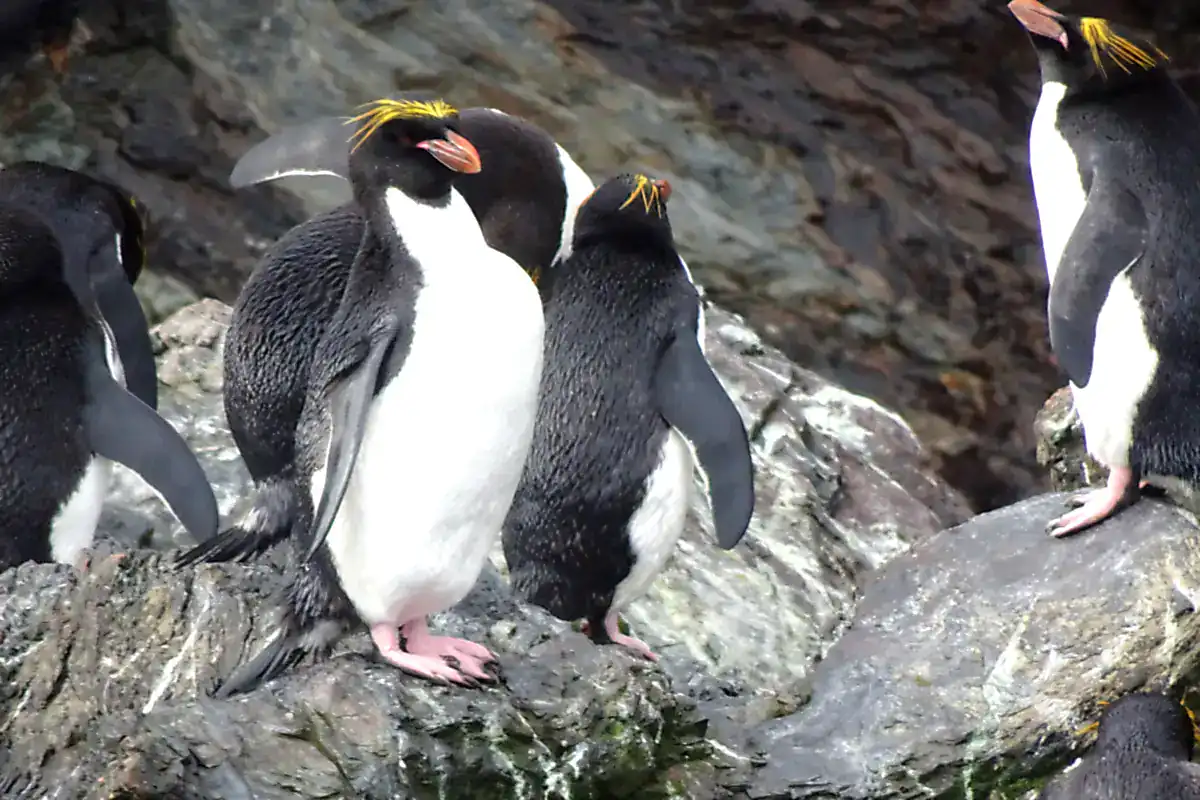
The Macaroni Penguin is the most numerous penguin species. It breeds on sub-Antarctic islands around the Southern Ocean. Some also breed on the northern Antarctic Peninsula.[33]
- Adult Macaroni Penguins weigh 4 to 7 kg (9 to 15 lb). They stand about 70 cm (28 in) tall.
- The Macaroni Penguin has long orange plumes above its eyes. Its name comes from showy 18th-century English hairstyles called macaronis.
- Macaroni Penguins eat mostly Antarctic krill and some fish. They can dive deeper than 220 meters (722 feet).
- The Macaroni Penguin lays two eggs each season. The second egg is bigger. It is usually the only one that hatches.
- The Macaroni Penguin population was 6.3 million breeding pairs in 2013. That figure reflects a rapid decline from earlier decades.
- On Heard Island, some Macaroni colonies sit on very steep slopes.
Royal Penguin
| Kingdom | Order | Family | Genus | Species |
|---|---|---|---|---|
| Animalia | Sphenisciformes | Spheniscidae | Eudyptes | Eudyptes schlegeli |
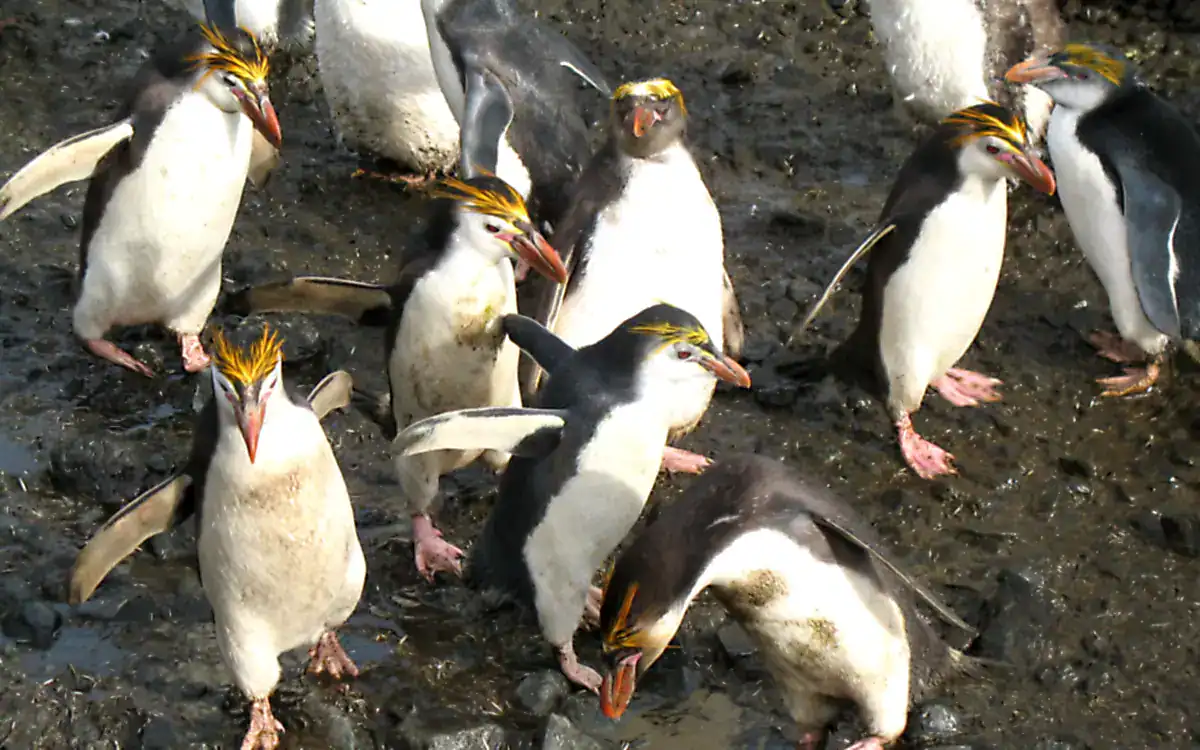
The Royal Penguin breeds only on Macquarie Island and nearby islets.[34] Macquarie lies far southeast of mainland Australia. The Royal looks like a Macaroni with a white or pale face.
- Adult Royal Penguins stand 65 to 75 cm (26 to 30 in). They weigh 4 to 8 kg (9 to 18 lb).
- The Royal Penguin has a massive orange bill. Its crest is scruffy and orange-yellow.
- Royal and Macaroni Penguins are very close relatives. A 2019 study suggested they may be one species.[35] Face color is the main difference.
- About 850,000 Royal Penguin pairs breed in 57 colonies.
- From 1889 to 1919, workers on Macquarie boiled penguins for oil. They took King Penguins first, then mostly Royal Penguins.[36]
- About 150,000 penguins died each summer on Macquarie. The total reached roughly 3.6 million. Explorer Douglas Mawson helped lead the campaign to end it.
- Royal Penguins breed only around Macquarie Island. One large oil spill could harm much of the population.
Western Rockhopper Penguin
| Kingdom | Order | Family | Genus | Species |
|---|---|---|---|---|
| Animalia | Sphenisciformes | Spheniscidae | Eudyptes | Eudyptes chrysocome |
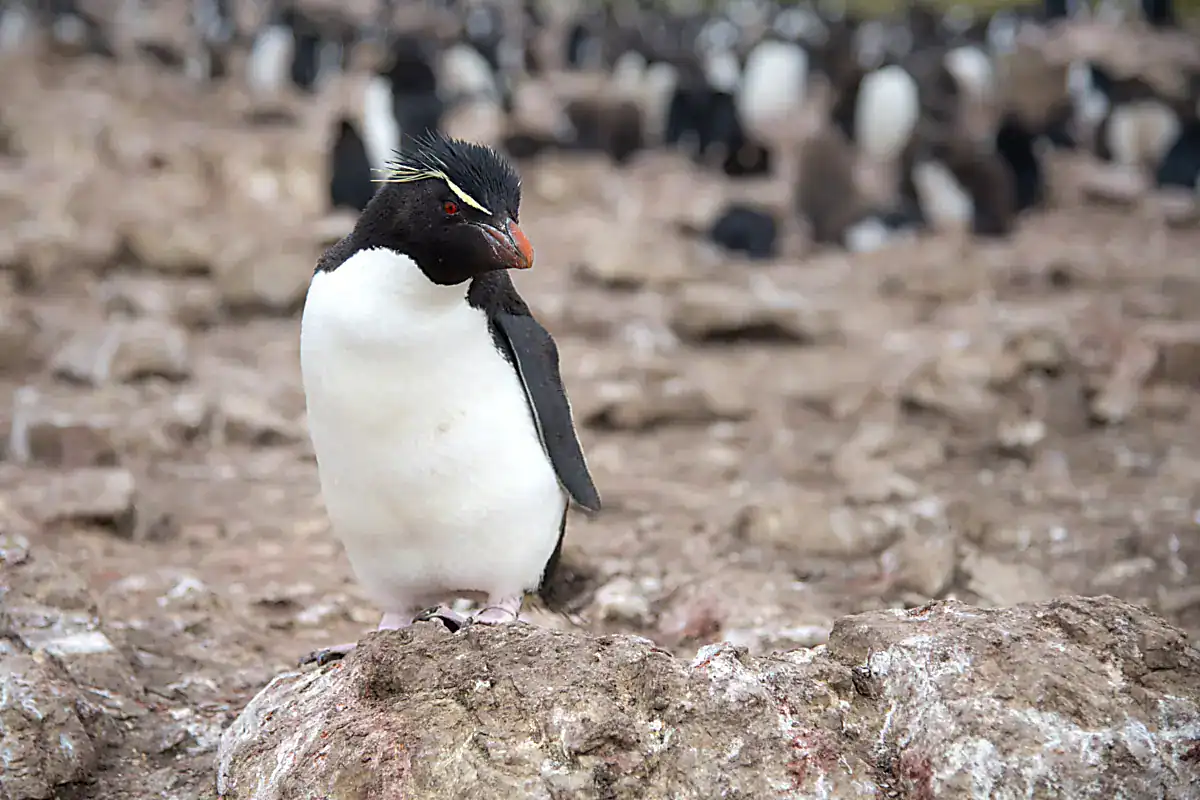
The Western Rockhopper Penguin breeds on islands off far southern Chile. It also breeds on the Falkland Islands. It was once part of the Southern Rockhopper.
- An adult Western Rockhopper measures about 61 cm (24 in). It weighs about 2.7 kg (6 lb).[37]
- The Western Rockhopper has black skin at its bill base. Its yellow brow widens in front of the eye. The brow then trails into long, drooping plumes.
- Western Rockhoppers hop nimbly across steep, rocky islands.[38] Their hopping gives rockhoppers their name.
- About 775,000 Western Rockhopper pairs may remain. An ongoing decline is suspected.
- The Western Rockhopper has not been evaluated separately. The combined Southern Rockhopper is rated Vulnerable.
Eastern Rockhopper Penguin
| Kingdom | Order | Family | Genus | Species |
|---|---|---|---|---|
| Animalia | Sphenisciformes | Spheniscidae | Eudyptes | Eudyptes filholi |
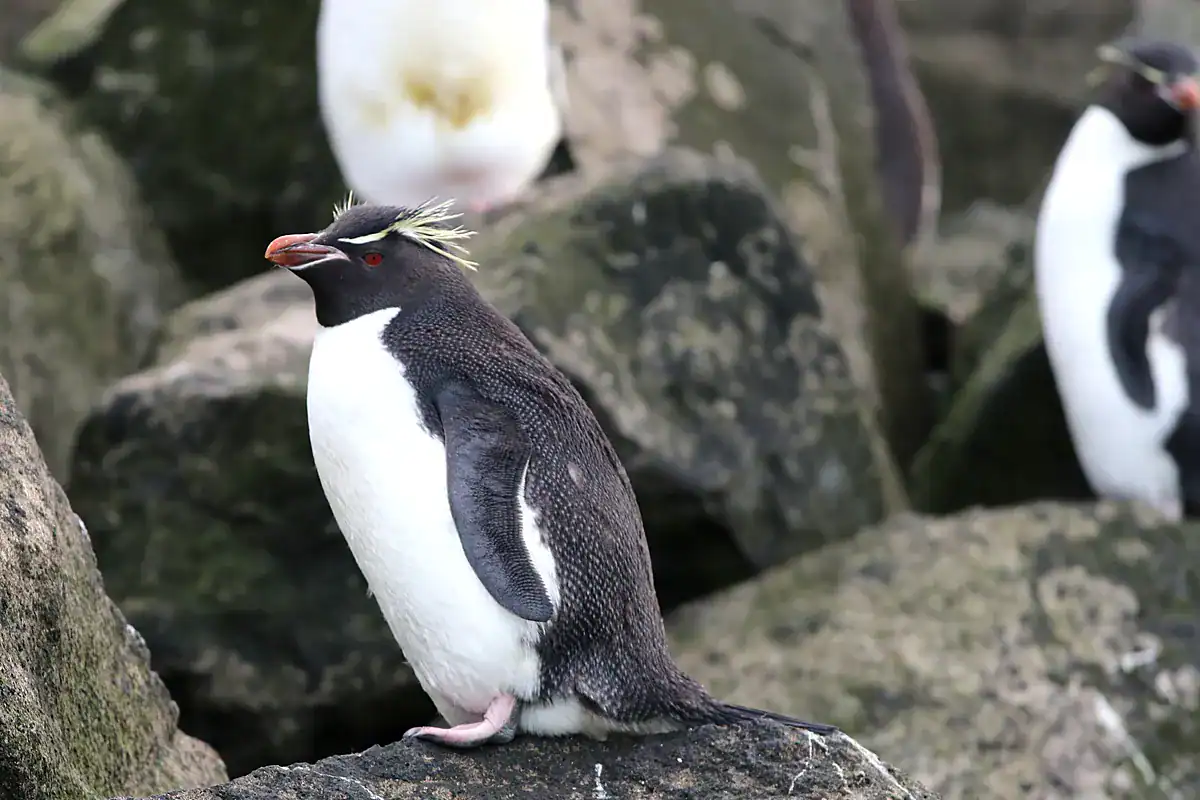
The Eastern Rockhopper Penguin breeds on southern Indian Ocean islands. It also breeds on Campbell, Auckland, Antipodes and Macquarie Islands.[39] AviList split it from the Southern Rockhopper in 2025.
- Eastern Rockhoppers measure 45 to 55 cm (18 to 22 in). They weigh 2 to 4 kg (4 to 9 lb).
- The Eastern Rockhopper has red eyes. Pinkish-white skin edges its bill. Its thin yellow brow flares out behind the eye.
- Eastern Rockhoppers eat small fish, squid, octopus and krill-like crustaceans.
- On Campbell Island, Eastern Rockhoppers crashed by 95 percent. About 800,000 pairs bred there in 1942. Only 33,200 remained by 2012.
- Food shortages tied to climate change probably drove the Eastern Rockhopper decline.
- Scientists still debate the Eastern Rockhopper’s status. A 2019 study found interbreeding with western birds.[40] It recommended keeping them as one species.
Northern Rockhopper Penguin
| Kingdom | Order | Family | Genus | Species |
|---|---|---|---|---|
| Animalia | Sphenisciformes | Spheniscidae | Eudyptes | Eudyptes moseleyi |
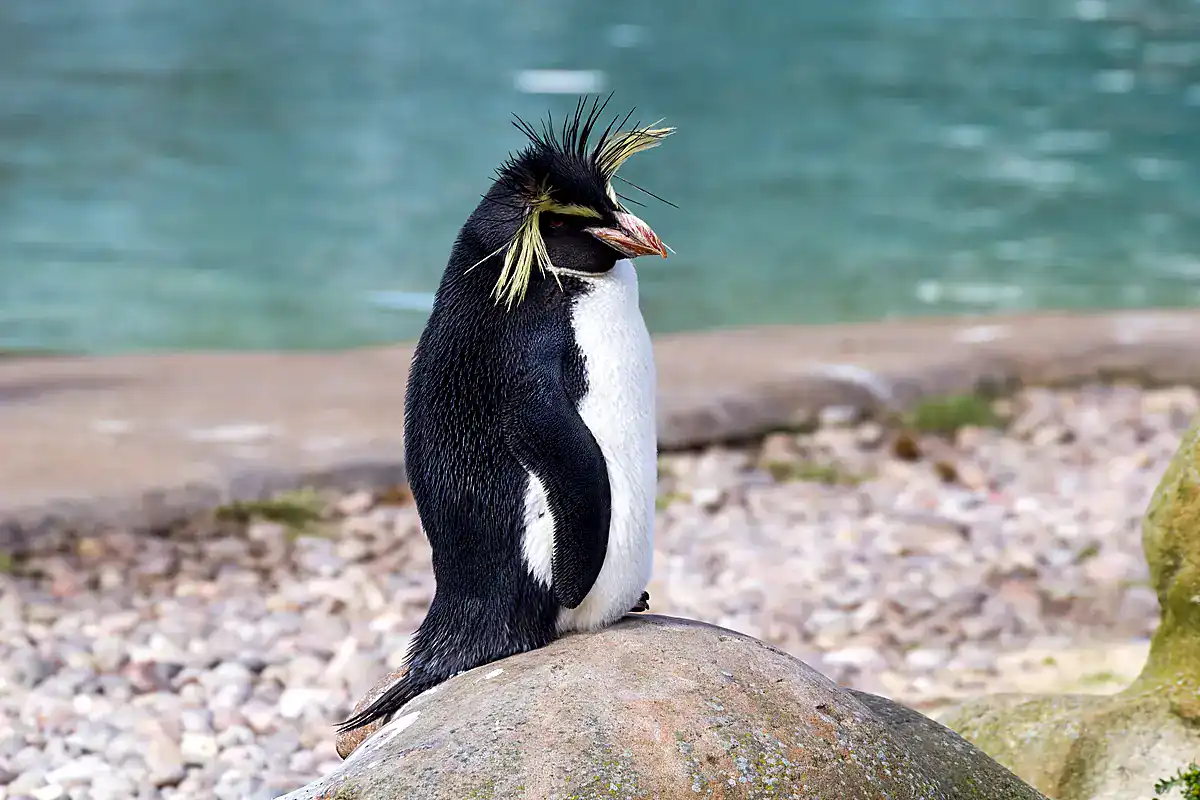
The Northern Rockhopper Penguin breeds on Tristan da Cunha and Gough Island.[41] These islands lie in the South Atlantic. It also breeds on Amsterdam and St Paul Islands. These lie in the Indian Ocean.
- The Northern Rockhopper has a wider yellow brow than other rockhoppers. Its head plumes are also longer.
- An adult Northern Rockhopper Penguin measures about 55 cm (22 in).
- Northern Rockhoppers eat mostly crustaceans, especially subtropical krill. They also eat some fish and squid.
- About 206,850 Northern Rockhopper pairs remain. About 90 percent breed in the Atlantic.
- Northern Rockhopper numbers fell 57 percent over 30 years. Amsterdam Island lost 90 to 99 percent since the 1800s.
- Oil spills threaten Northern Rockhoppers. In March 2011, the ship MS Oliva wrecked at Nightingale Island.[42]
- The Oliva spilled about 1,400 metric tons of heavy fuel oil. Roughly 3,700 Northern Rockhoppers were coated in oil.
Fiordland Penguin
| Kingdom | Order | Family | Genus | Species |
|---|---|---|---|---|
| Animalia | Sphenisciformes | Spheniscidae | Eudyptes | Eudyptes pachyrhynchus |
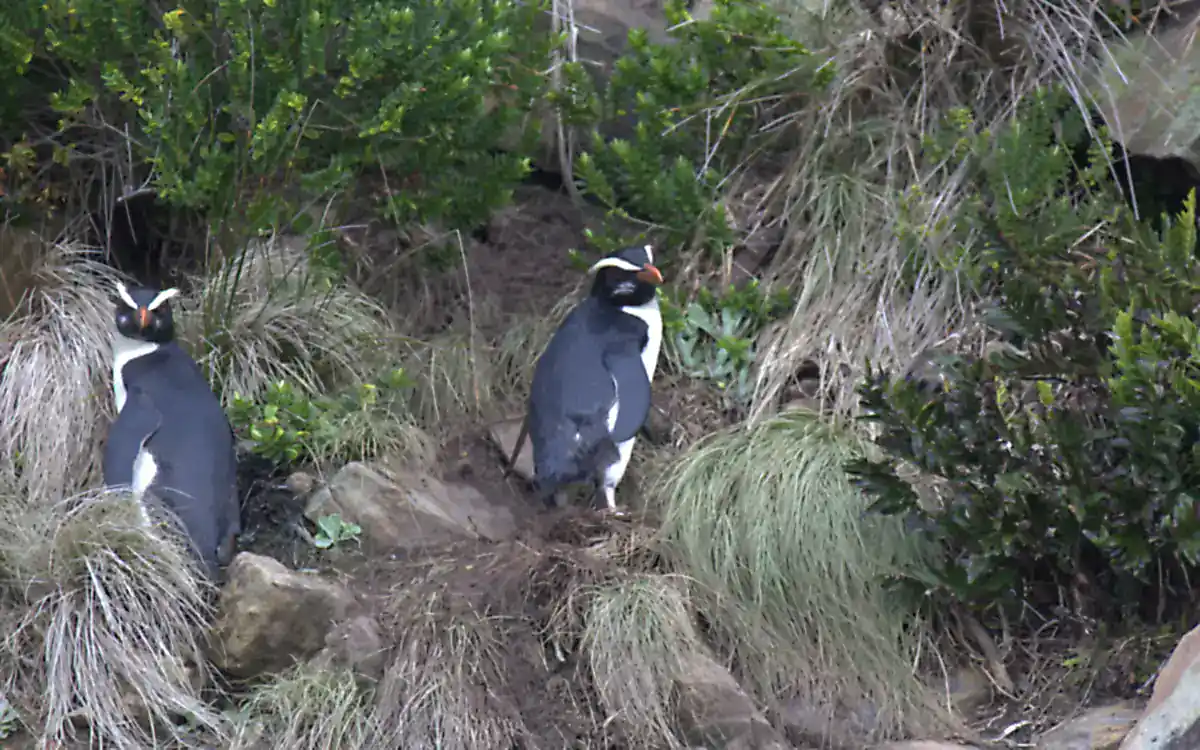
The Fiordland Penguin, or tawaki, nests in coastal rainforest and sea caves. It also nests under boulders.[43] It breeds on New Zealand’s southwest coast and Stewart Island.
- An adult Fiordland Penguin stands about 60 cm (24 in) tall. It weighs about 4 kg (9 lb).[44]
- The Fiordland Penguin has a broad yellow brow above each eye. Its orange bill has a thin strip of black skin.
- Fiordland Penguins travel far before their yearly molt. Tracked birds swam 3,500 to 6,800 km. Their trips lasted 8 to 10 weeks.
- New Zealand’s conservation department estimates 2,500 to 3,000 Fiordland pairs.[45] Numbers have declined since the 1950s. Newer surveys suggest more birds than that.
- Stoats kill Fiordland Penguin chicks and weak adults. A single dog could destroy a whole colony.
Snares Penguin
| Kingdom | Order | Family | Genus | Species |
|---|---|---|---|---|
| Animalia | Sphenisciformes | Spheniscidae | Eudyptes | Eudyptes robustus |
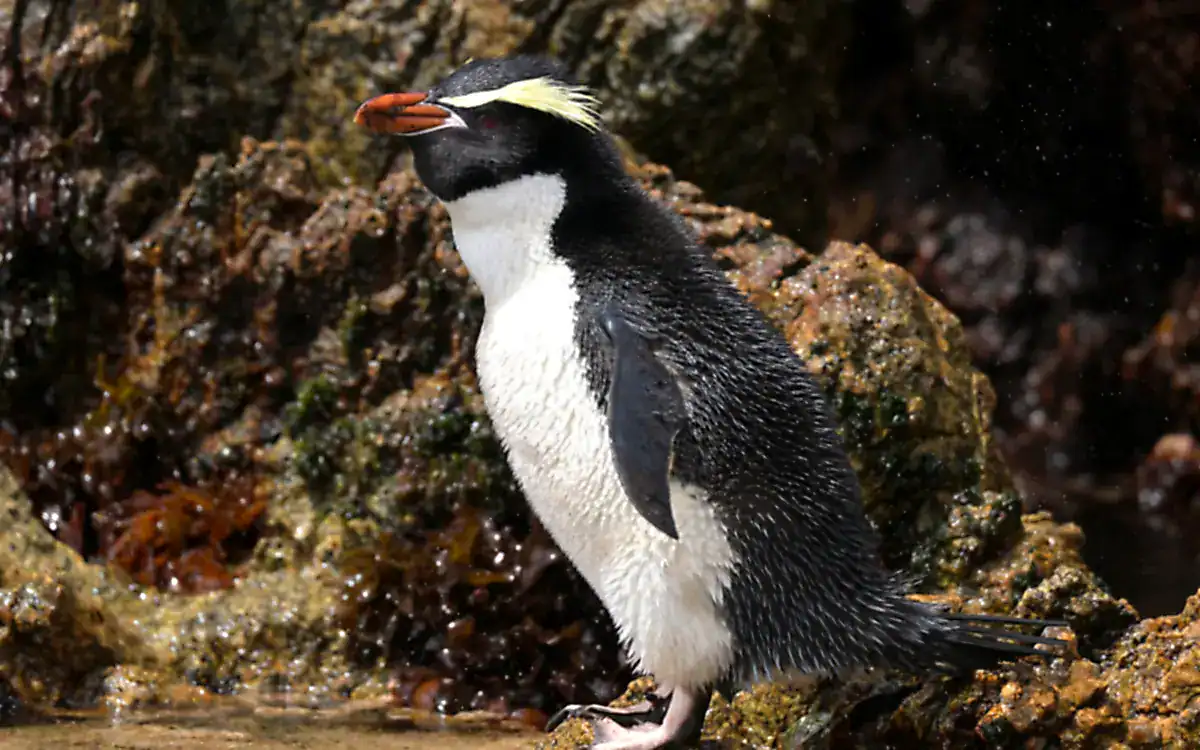
The Snares Penguin breeds only on the Snares Islands. These islands lie south of New Zealand’s South Island.[46] Most colonies sit under tree daisies or among Hebe shrubs.
- An adult Snares Penguin stands about 60 cm (24 in) tall. It weighs about 3 kg (7 lb).[47]
- The Snares Penguin has a large, robust orange bill. Prominent bare pink skin surrounds its base.
- Snares and Erect-crested Penguins look alike.[48] From the front, Snares crests form a V. Erect-crested crests run parallel.
- Four full Snares Penguin counts took place from 2000 to 2013. They found between 24,666 and 30,672 nests.
- Both Snares Penguin eggs hatch in about 60 percent of nests. The chick from the smaller egg usually dies within a week.
- The Snares Penguin is rated Vulnerable. The whole species breeds in one small island group.
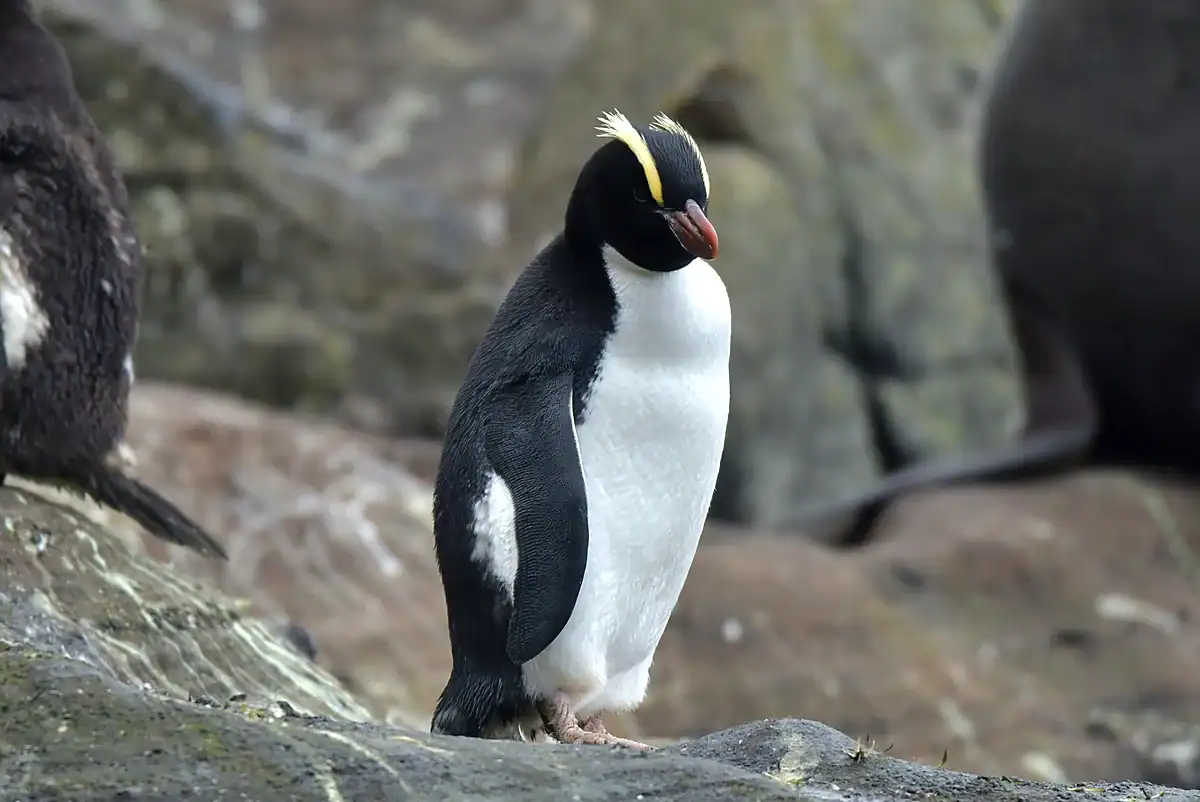
Erect-crested Penguin
| Kingdom | Order | Family | Genus | Species |
|---|---|---|---|---|
| Animalia | Sphenisciformes | Spheniscidae | Eudyptes | Eudyptes sclateri |
The Erect-crested Penguin breeds mainly on the Antipodes and Bounty Islands. These lie far southeast of New Zealand. Its yellow crests stand upright and run roughly parallel.
- An adult Erect-crested Penguin stands about 65 cm (26 in) tall. It weighs about 4 kg (9 lb).
- The Erect-crested Penguin has pale skin at its bill base. Its bray is deeper than other crested penguins’ calls.
- The Erect-crested Penguin’s second egg is about 85 percent heavier. Most first eggs are lost by the day it is laid.
- The world Erect-crested population is about 68,500 pairs. A partial 2014 survey found another 19 percent decline on the Antipodes.
- Erect-crested Penguins face shifting food supplies and storm landslides. Growing fur seal numbers also crowd them on the Bounty Islands.
- By 2019, no one had tracked Erect-crested Penguins at sea yet.
Banded Penguins
Banded penguins have black chest bands and bare skin on the face. Their genus is Spheniscus. They breed in Africa, South America and the Galapagos Islands.
African Penguin
| Kingdom | Order | Family | Genus | Species |
|---|---|---|---|---|
| Animalia | Sphenisciformes | Spheniscidae | Spheniscus | Spheniscus demersus |
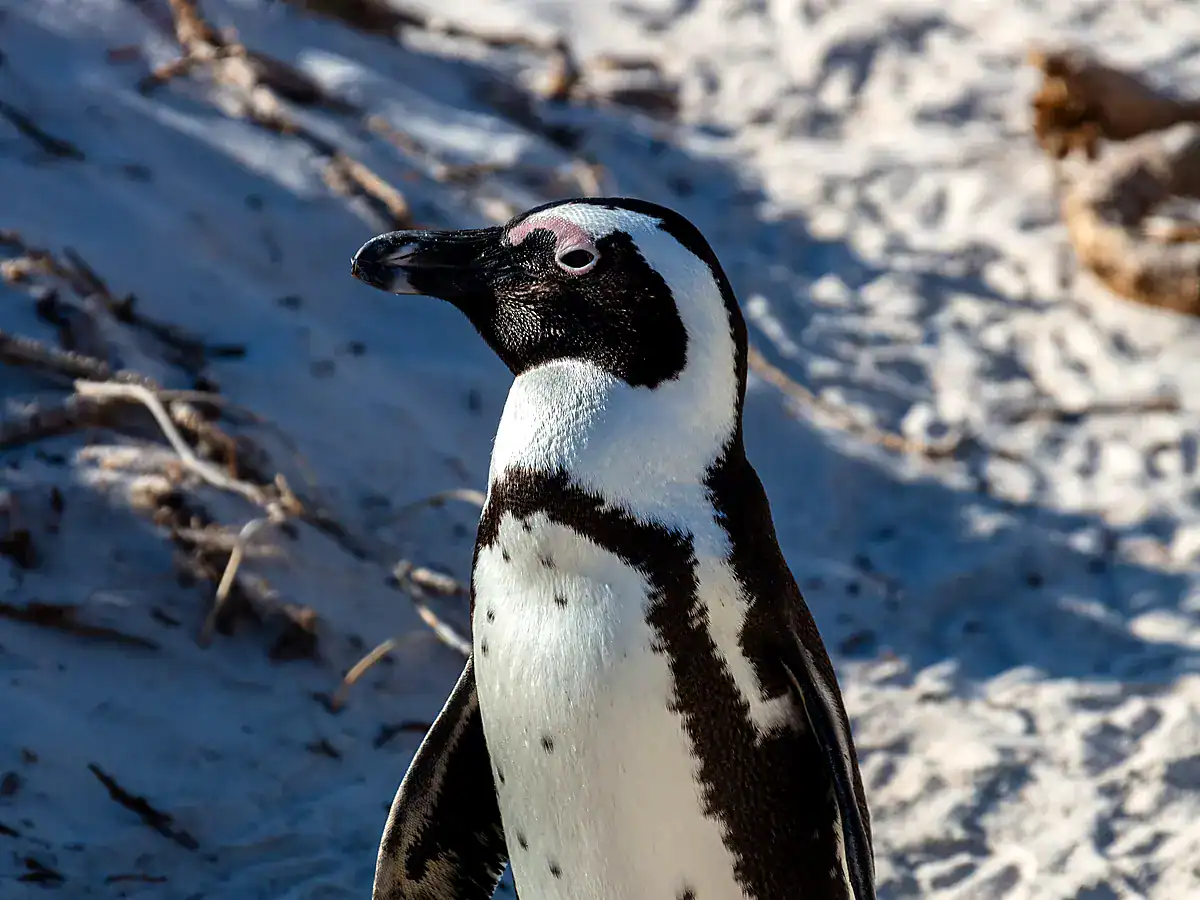
The African Penguin is the only penguin on the African continent. It breeds along the coasts of Namibia and South Africa.[49] Our African penguin facts page covers it in more depth.
- Adult African Penguins stand 24 to 27 inches (61 to 69 cm). They weigh 4.4 to 11 pounds (2 to 5 kg).[50]
- The African Penguin has a patch of bare skin above each eye. More blood flows there when the bird is hot. The air then cools that blood.
- African Penguins are also called jackass penguins. Their loud call sounds like a donkey’s bray.
- The African Penguin nests in burrows dug into sand or guano. Guano is dried seabird droppings. Some pairs nest under bushes instead.
- Both African Penguin parents incubate two eggs. Incubation takes about 38 to 41 days.
- On October 28, 2024, the African Penguin became Critically Endangered.[51] Breeding pairs had fallen below 10,000.
- About 9,900 African Penguin pairs remained in 2024.[52] Numbers have fallen over 97 percent in 100 years.
- Overfishing seems to be the African Penguin’s biggest threat. The birds depend on anchovies and sardines.
- Oil spills also harm African Penguins. The 2000 Treasure spill oiled 19,000 of them.[53]
Humboldt Penguin
| Kingdom | Order | Family | Genus | Species |
|---|---|---|---|---|
| Animalia | Sphenisciformes | Spheniscidae | Spheniscus | Spheniscus humboldti |
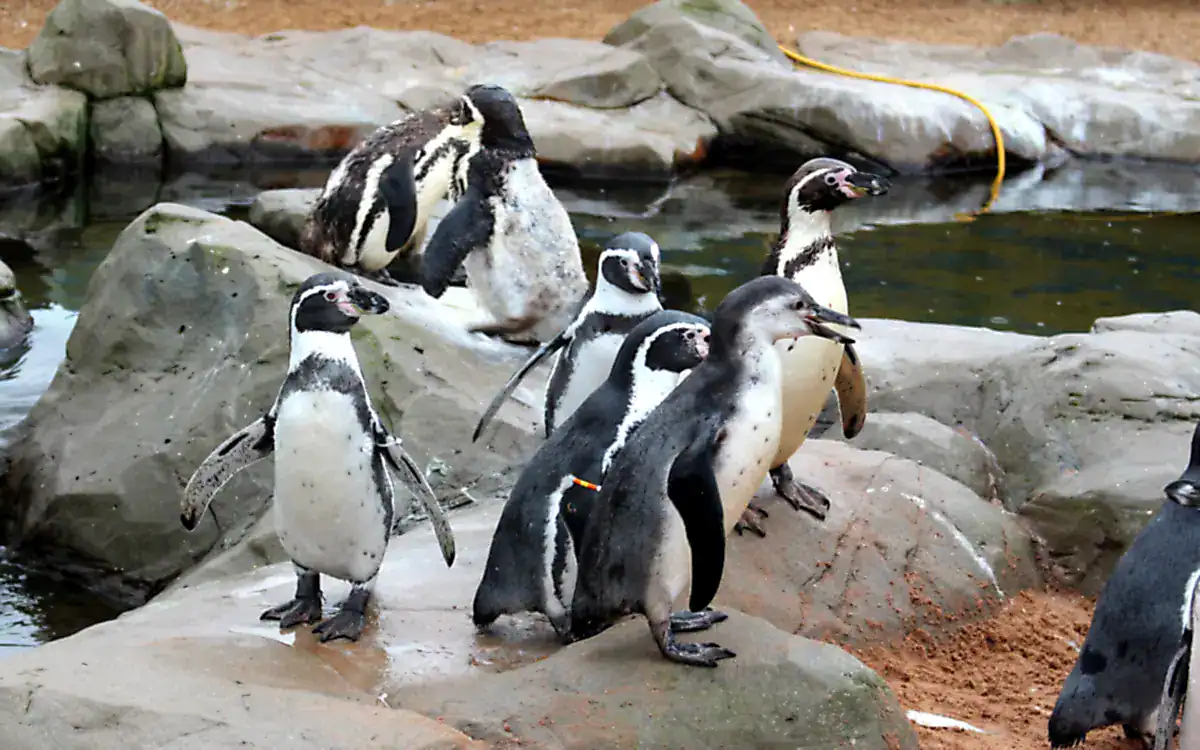
The Humboldt Penguin lives along the Pacific coasts of Peru and Chile.[54] It is named for the cold Humboldt Current beside its range.[55]
- Adult Humboldt Penguins measure 66 to 70 cm (26 to 28 in). They weigh 4 to 5 kg (9 to 11 lb). Males are larger.
- Humboldt Penguins dig burrows into thick layers of shoreline guano. Females lay two eggs.
- At Punta San Juan, Peru, guano mining stopped and guano deepened.[56] Humboldt Penguins could then dig more burrows. Burrow nesters there raised more chicks than open nesters.
- Large bare patches around its eyes help the Humboldt Penguin stay cool.
- The Humboldt Penguin feeds on schooling fish. In central Chile, it prefers anchovy, pilchard and squid.
- The 1982 to 1983 El Niño cut Peru’s Humboldts by 65 percent. El Niño is a periodic warming of the Pacific.
- The 2010 US listing cited about 5,000 Humboldt Penguins in Peru. It cited 30,000 to 35,000 in Chile.
Magellanic Penguin
| Kingdom | Order | Family | Genus | Species |
|---|---|---|---|---|
| Animalia | Sphenisciformes | Spheniscidae | Spheniscus | Spheniscus magellanicus |
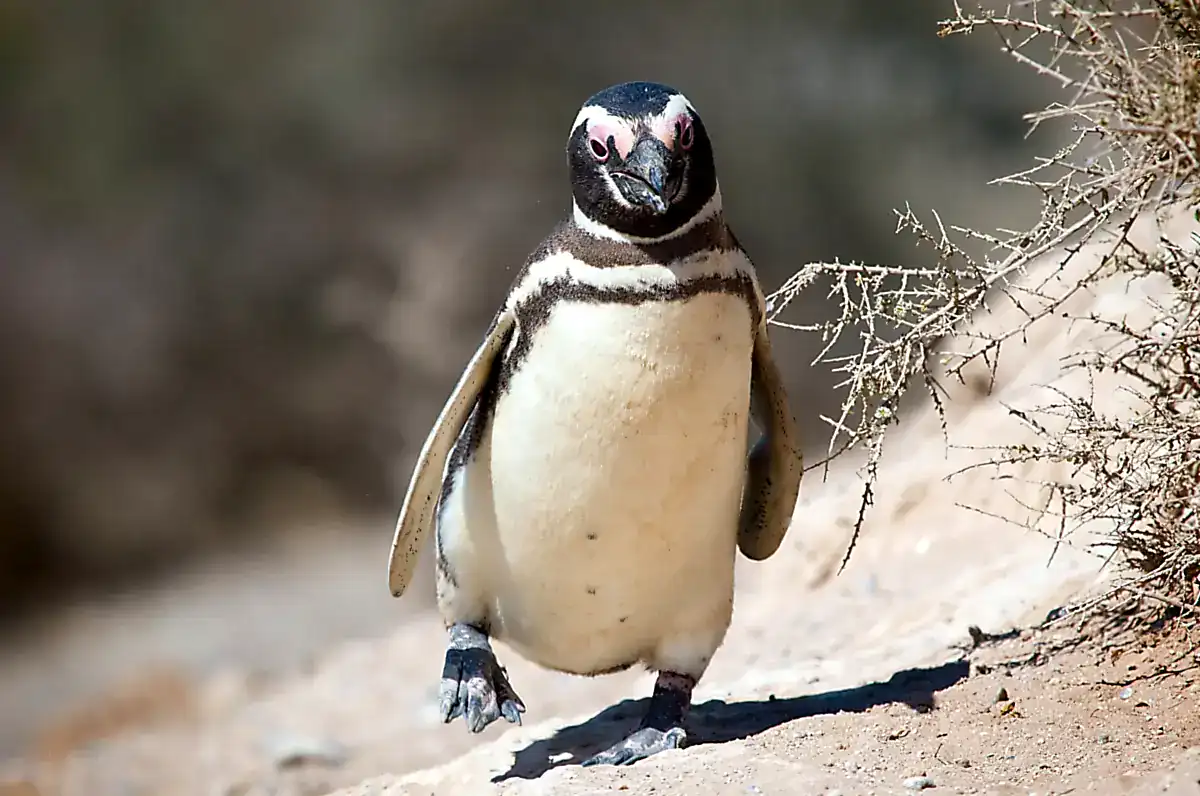
The Magellanic Penguin breeds along the coasts of Argentina and Chile.[57] It also breeds on the Falkland Islands. Its northernmost Atlantic colonies sit at about 40° south.
- Adult Magellanic Penguins weigh 2.5 to 7.5 kg. That is 6 to 17 pounds.[58] Males can weigh up to 20 percent more.
- The Magellanic Penguin nests in dug burrows, under bushes or in scrapes. Females lay two eggs in October. Chicks hatch after 39 to 42 days.
- After breeding, Magellanic Penguins swim north for winter. Some reach the Tropic of Capricorn off Brazil.
- The Magellanic Penguin Project at Punta Tombo began in 1982.[59] A company had planned to turn the penguins into golf gloves.
- Magellanic Penguins seem stable in Argentina overall. A 2026 study projected about 1.28 million pairs there for 2024.[60] It found no overall decline.
Galapagos Penguin
| Kingdom | Order | Family | Genus | Species |
|---|---|---|---|---|
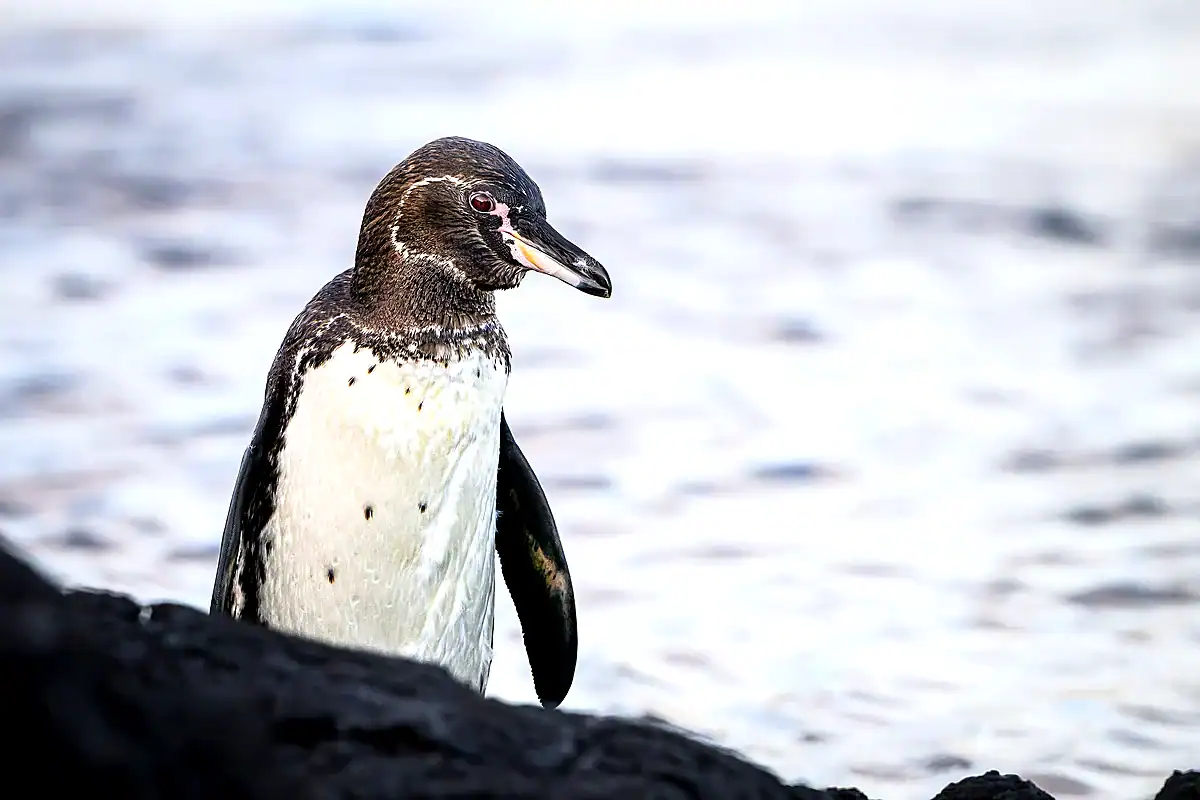
| Animalia | Sphenisciformes | Spheniscidae | Spheniscus | Spheniscus mendiculus |
The Galapagos Penguin is the most northerly penguin. It is the only penguin found north of the equator. Its breeding grounds straddle the equator on Isabela Island.
- An adult Galapagos Penguin measures about 53 cm (21 in). It weighs 1.7 to 2.6 kg (4 to 6 lb).[61]
- The Galapagos Penguin’s small body helps it stay cool.[62]
- The cold Cromwell Current brings food to Galapagos Penguin waters. The penguins catch small schooling fish, often within 5 meters of shore.
- Galapagos Penguins have no set breeding season. They nest in lava tubes, caves and crevices. A pair can raise two chicks in three months.
- The Galapagos Penguin normally molts twice a year. Every other penguin molts once a year.
- A 2020 Galapagos Penguin census estimated 1,940 birds.[63] That estimate is among the highest on record.
- Strong El Niño events hit Galapagos Penguins hard. The 1982 to 1983 event killed 77 percent of them.
Yellow-eyed and Little Penguins
The last two genera each hold one species. Both breed in New Zealand. The Little Penguin also breeds across southern Australia.
Yellow-eyed Penguin
| Kingdom | Order | Family | Genus | Species |
|---|---|---|---|---|
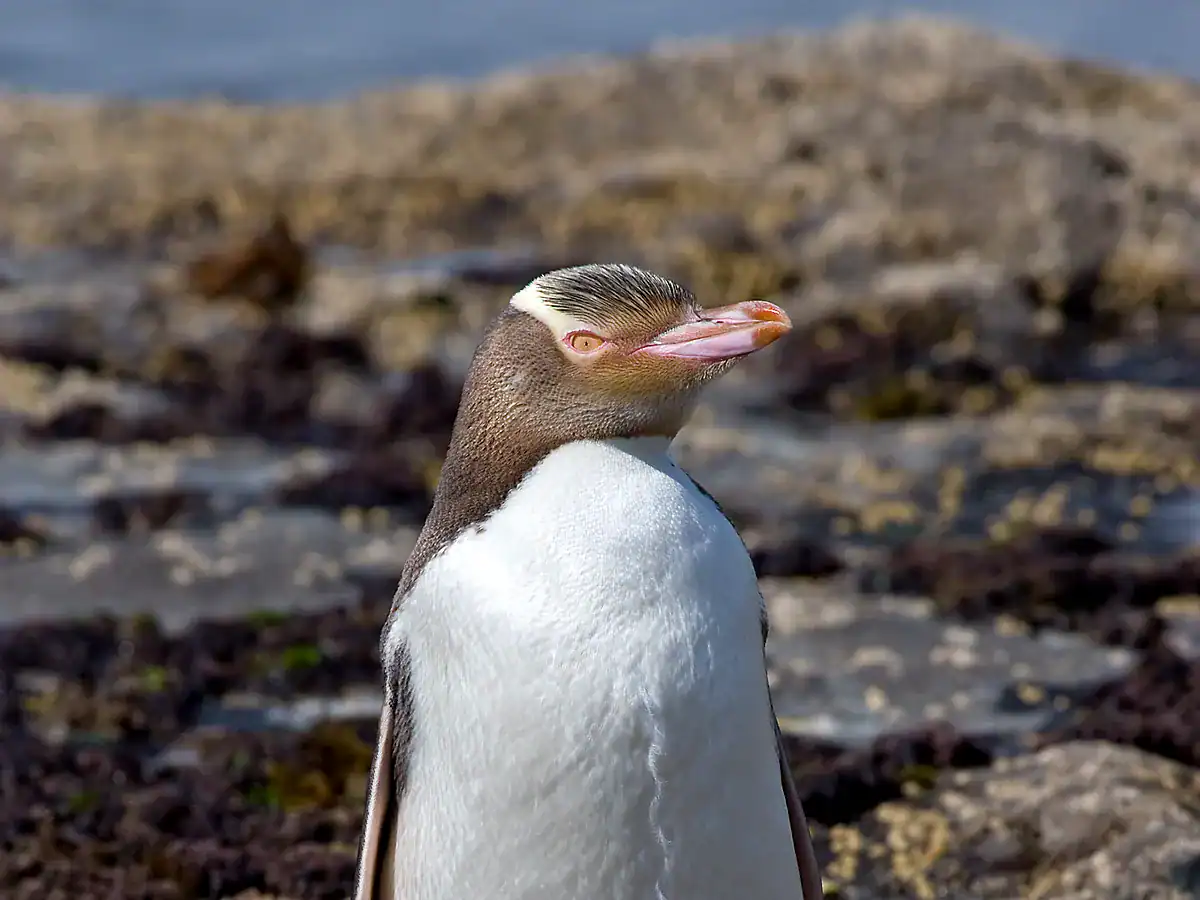
| Animalia | Sphenisciformes | Spheniscidae | Megadyptes | Megadyptes antipodes |
The Yellow-eyed Penguin, or hoiho, lives only in New Zealand.[64] It breeds on the southeastern South Island and Stewart Island. It also breeds on the Auckland and Campbell Islands.
- An adult Yellow-eyed Penguin stands about 65 cm (26 in) tall. It weighs about 5 kg (11 lb).[65]
- The Māori name hoiho means noise shouter. The Yellow-eyed Penguin gives a shrill call at breeding sites.
- The Yellow-eyed Penguin feeds mostly on the sea floor. It can dive to 160 meters (525 feet).
- Red cod was once a key Yellow-eyed Penguin food. The birds now eat more blue cod, which is less nutritious.
- Northern-range Yellow-eyed Penguins are in steep decline. This range covers South Island and Stewart Island. Only 143 nests were counted there in 2024 to 2025.[66] That is 80 percent fewer than in 2008 to 2009.
- Since 2019, a respiratory disease has struck Northern-range hoiho chicks.[67] A 2026 study reported fewer than 115 Northern-range breeding pairs.
- A 2026 genetic study found three distinct Yellow-eyed Penguin lineages. It recommended recognizing three subspecies.
- The Northern lineage split off 5,000 to 16,000 years ago. Yellow-eyed Penguins have likely lived on South Island for millennia.
Little Penguin
| Kingdom | Order | Family | Genus | Species |
|---|---|---|---|---|
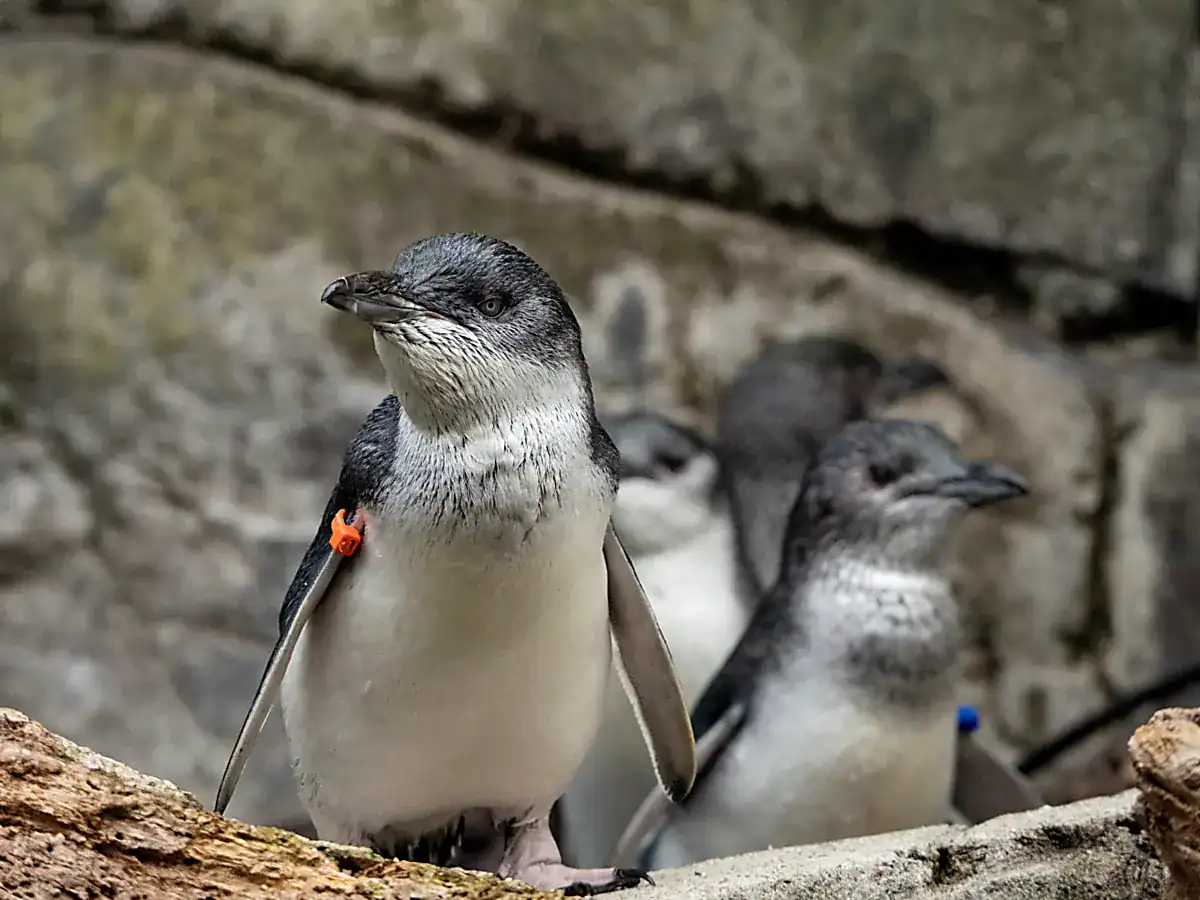
| Animalia | Sphenisciformes | Spheniscidae | Eudyptula | Eudyptula minor |
The Little Penguin is the smallest penguin in the world. It measures just over 25 cm (10 in) long. It weighs about 1 kg (2.2 lb).[68]
- The Little Penguin breeds on southern Australian and New Zealand coasts. It is the only penguin breeding on mainland Australia.[69]
- The Little Penguin is the only penguin with blue and white feathers.[70] The colors hide it from predators above and below.
- Little Penguins nest in burrows, under plants, in crevices and in caves. Some walk 1.5 km inland and climb 300 meters.
- Little Penguins come ashore at dusk to avoid predators. In October 2022, 5,440 crossed Phillip Island’s beach in one night.[71]
- Ancient DNA suggests the Australian Little Penguin form reached New Zealand recently.[72] It probably arrived between AD 1500 and 1900.
- Some scientists treat Australian Little Penguins as a separate species. They call it Eudyptula novaehollandiae.
- New Zealand rates the Little Penguin as At Risk, Declining. Dogs are probably its greatest threat there.
Largest and Smallest
Penguins range from about 25 cm to over a meter tall. An Emperor can outweigh a Little Penguin about 40 times.
| Penguin | Height or Length | Weight |
|---|---|---|
| Emperor Penguin | Up to 114 cm (45 in) | Up to 40 kg (88 lb) |
| King Penguin | 85 to 95 cm (34 to 37 in) | 9.3 to 17.3 kg (21 to 38 lb) |
| Gentoo penguins | About 75 cm (30 in) | 4.5 to 8.5 kg (10 to 19 lb) |
| Royal Penguin | 65 to 75 cm (26 to 30 in) | 4 to 8 kg (9 to 18 lb) |
| Chinstrap Penguin | About 72 cm (28 in) | 3.5 to 5 kg (8 to 11 lb) |
| Macaroni Penguin | About 70 cm (28 in) | 4 to 7 kg (9 to 15 lb) |
| Adelie Penguin | About 70 cm (28 in) | 3 to 6 kg (7 to 13 lb) |
| Magellanic Penguin | About 70 cm (28 in) | 2.5 to 7.5 kg (6 to 17 lb) |
| Humboldt Penguin | 66 to 70 cm (26 to 28 in) | 4 to 5 kg (9 to 11 lb) |
| African Penguin | 61 to 69 cm (24 to 27 in) | 2 to 5 kg (4.4 to 11 lb) |
| Yellow-eyed Penguin | About 65 cm (26 in) | About 5 kg (11 lb) |
| Erect-crested Penguin | About 65 cm (26 in) | About 4 kg (9 lb) |
| Western Rockhopper Penguin | About 61 cm (24 in) | About 2.7 kg (6 lb) |
| Fiordland Penguin | About 60 cm (24 in) | About 4 kg (9 lb) |
| Snares Penguin | About 60 cm (24 in) | About 3 kg (7 lb) |
| Northern Rockhopper Penguin | About 55 cm (22 in) | Not available |
| Eastern Rockhopper Penguin | 45 to 55 cm (18 to 22 in) | 2 to 4 kg (4 to 9 lb) |
| Galapagos Penguin | About 53 cm (21 in) | 1.7 to 2.6 kg (4 to 6 lb) |
| Little Penguin | Just over 25 cm (10 in) | About 1 kg (2.2 lb) |
Some sources give standing height. Others give bill-to-tail length. Treat close values as rough. The Magellanic height comes from MarineBio.[73]
Where Penguins Live
Penguins are Southern Hemisphere birds. The largest numbers live on Antarctic coasts and sub-Antarctic islands.[74]
Antarctica
Five penguin species breed in Antarctica. Emperor and Adelie Penguins breed only in Antarctica. Chinstrap, Gentoo and Macaroni Penguins breed on the northern Antarctic Peninsula.
King Penguins do not breed in Antarctica. They breed only on warmer sub-Antarctic islands.
Sub-Antarctic Islands
Many penguins breed on the cold islands ringing Antarctica. These include King, Macaroni, Royal and rockhopper penguins. Three of the four proposed gentoos breed there too.
New Zealand and Australia
New Zealand’s Department of Conservation counts 18 penguin species worldwide.[75] Thirteen have been recorded in the New Zealand region. Nine species breed there.
New Zealand has more penguin species than any other country. Australia has the Little Penguin on its southern coasts. Its sub-Antarctic Macquarie Island hosts the Royal Penguin.
Africa and South America
The African Penguin breeds in Namibia and South Africa. The Humboldt Penguin breeds on South America’s Pacific coast. The Magellanic Penguin breeds along southern South America.
The Northern Gentoo and Western Rockhopper breed on the Falkland Islands.
The Equator
The Galapagos Penguin lives on the equator. Cold currents bring it food. It is the only penguin in the Northern Hemisphere.
No Penguins Up North
There are no penguins in the Arctic. The great auk was once known as a penguin. It was a flightless seabird of the North Atlantic.
The last known great auk pair was killed in 1844.[76] The great auk was not closely related to true penguins.
Penguins live in the south. Polar bears live in the far north. The two never meet in the wild. Read more in our guide to what polar bears eat.
Extinct Penguins
At least two penguins died out after people reached New Zealand. The Waitaha Penguin was described from ancient bones in 2009.[77] Its describers called it the first known human-caused penguin extinction.
The Waitaha Penguin lived on mainland New Zealand. It died out after people arrived. It is now often treated as a Yellow-eyed Penguin subspecies.
Older studies said Yellow-eyed Penguins replaced it about 500 years ago. A 2026 genomic study challenges that timeline. Its results suggest hoiho lived on South Island for thousands of years.
The Chatham Island Crested Penguin was named in 2019 from bones.[78] It survived until a few centuries ago. It died out only after humans arrived.
Human arrival has driven many other extinct birds to the same fate.
The penguin family is very old. Some of the oldest known penguins belong to the genus Waimanu.[79] They lived in New Zealand 60 to 62 million years ago.
Waimanu had compressed, dense wing bones. It most likely could not fly.
Some ancient penguins were giants. Kumimanu fordycei was described in 2023 from North Otago fossils.[80] It may have weighed about 154 kg (340 lb). That is nearly four times the weight of a 40 kg Emperor.
Threats to Penguins
In 2022, BirdLife reported climate change affects 88 percent of penguin species.[81] It also cited a 2019 study on marine threats. Overfishing affects 70 percent of species. Bycatch in fishing gear affects 65 percent.
Climate change, overfishing and bycatch are major threats to biodiversity worldwide.
Climate and Sea Ice
Emperor Penguins breed, raise chicks and molt on fast ice. Fast ice is sea ice attached to the coast. Early breakup can plunge chicks into the sea before they can swim.
Changing ocean conditions can push food out of reach. In 2009, Magellanic Penguins at Punta Tombo foraged 25 miles farther.[82] Ten years earlier, they had not needed to travel so far.
Strong El Niño years cause heavy losses for Galapagos and Humboldt Penguins. During these events, the ocean warms and food becomes scarce.
Food and Fishing
Krill feeds much of the Southern Ocean. Whales, seals, penguins, squid and fish eat over half of it yearly.[83]
CCAMLR is the treaty body that manages Antarctic fishing. It caps the southwest Atlantic krill catch each year. The limit is 620,000 metric tons.
African Penguins compete with fishing fleets for sardines and anchovies.
Predators
Fur seals and leopard seals kill adult Macaroni Penguins. Skuas and giant petrels take their eggs and chicks. Learn more in our guide to what seals eat.
On land, introduced predators pose a major danger. In New Zealand, stoats, ferrets, rats, dogs and cats kill penguins.
Bird Flu
H5N1 bird flu reached the sub-Antarctic in 2023.[84] It was first detected on South Georgia on October 23, 2023.
By March 2024, King Penguins and gentoos on South Georgia tested positive.[85] Gentoo deaths there were localized and brief.
H5N1 killed Kings and gentoos on Crozet’s Possession Island from October 2024.[86] A 2025 to 2026 survey checked sites in East Antarctica.[87] It found no H5N1 at the sampled sites.
Protected in the US
No penguin lives wild in the United States. Still, the US Endangered Species Act can protect foreign animals. It lists nine penguin species or populations.[88]
| Penguin | US Status | Listing Date |
|---|---|---|
| Galapagos Penguin | Endangered | June 2, 1970 |
| African Penguin | Endangered | September 28, 2010 |
| Humboldt Penguin | Threatened | August 3, 2010 |
| Yellow-eyed Penguin | Threatened | August 3, 2010 |
| White-flippered form of the Little Penguin | Threatened | August 3, 2010 |
| Fiordland Penguin | Threatened | August 3, 2010 |
| Erect-crested Penguin | Threatened | August 3, 2010 |
| Southern Rockhopper Penguin, New Zealand and Australia population | Threatened | February 22, 2011 |
| Emperor Penguin | Threatened | October 26, 2022 |
The listed rockhopper birds live on Macquarie, Campbell, Auckland and Antipodes Islands. AviList now classes all of them as Eastern Rockhoppers.
To see penguins in the US, visit a zoo or aquarium. Start with our list of the best zoos in the USA.
Who Named Them
Every penguin species has a scientific name and an author. The author is the person who first described it.
Johann Reinhold Forster named five penguins in 1781. That is more than anyone else. Forster sailed with Captain James Cook.
| Penguin | Scientific Name | Named By | Year |
|---|---|---|---|
| African Penguin | Spheniscus demersus | Carl Linnaeus | 1758 |
| King Penguin | Aptenodytes patagonicus | John Frederick Miller | 1778 |
| Northern Gentoo Penguin | Pygoscelis papua | Johann Reinhold Forster | 1781 |
| Chinstrap Penguin | Pygoscelis antarcticus | Johann Reinhold Forster | 1781 |
| Magellanic Penguin | Spheniscus magellanicus | Johann Reinhold Forster | 1781 |
| Western Rockhopper Penguin | Eudyptes chrysocome | Johann Reinhold Forster | 1781 |
| Little Penguin | Eudyptula minor | Johann Reinhold Forster | 1781 |
| Humboldt Penguin | Spheniscus humboldti | Franz Meyen | 1834 |
| Macaroni Penguin | Eudyptes chrysolophus | Johann Friedrich von Brandt | 1837 |
| Adelie Penguin | Pygoscelis adeliae | Jacques Bernard Hombron and Honore Jacquinot | 1841 |
| Yellow-eyed Penguin | Megadyptes antipodes | Jacques Bernard Hombron and Honore Jacquinot | 1841 |
| Emperor Penguin | Aptenodytes forsteri | George Robert Gray | 1844 |
| Fiordland Penguin | Eudyptes pachyrhynchus | George Robert Gray | 1845 |
| Eastern Gentoo Penguin | Pygoscelis taeniata | Titian Ramsay Peale | 1849 |
| Galapagos Penguin | Spheniscus mendiculus | Carl Jakob Sundevall | 1871 |
| Royal Penguin | Eudyptes schlegeli | Otto Finsch | 1876 |
| Eastern Rockhopper Penguin | Eudyptes filholi | Frederick Wollaston Hutton | 1879 |
| Erect-crested Penguin | Eudyptes sclateri | Walter Buller | 1888 |
| Northern Rockhopper Penguin | Eudyptes moseleyi | Gregory Mathews and Tom Iredale | 1921 |
| Southern Gentoo Penguin | Pygoscelis ellsworthi | Robert Cushman Murphy | 1947 |
| Snares Penguin | Eudyptes robustus | Walter Oliver | 1953 |
| Southeastern Gentoo Penguin | Pygoscelis kerguelensis | Daly Noll and colleagues | 2026 |
Murphy first named his gentoo as a subspecies. Peale’s name was later treated as a subspecies too. The 2026 study proposes both as full species.
Frequently Asked Questions
AviList and the Clements checklist recognize 19 living penguin species. The IUCN and BirdLife International count 18. A 2026 proposal would raise the total to 22.
The list starts with the Emperor, King, Adelie, Chinstrap and Gentoo. Next come the Macaroni and Royal Penguins. Then come the Western, Eastern and Northern Rockhoppers. The Fiordland, Snares and Erect-crested Penguins follow. Next are the African, Humboldt, Magellanic and Galapagos Penguins. The Yellow-eyed and Little Penguins complete the list. Lists of 18 combine the Western and Eastern Rockhoppers.
It is the proposed Southeastern Gentoo Penguin, Pygoscelis kerguelensis. Scientists described it in April 2026. It breeds on the Kerguelen Islands.
The Emperor Penguin is the largest. Adults stand up to 45 inches (114 cm) tall. They weigh up to 88 pounds (40 kg).
The Little Penguin is the smallest. It measures just over 25 cm (10 in) long. It weighs about 1 kg (2.2 lb).
By total numbers, the Galapagos Penguin is among the rarest. A 2020 estimate counted about 1,940 birds. The Yellow-eyed Penguin totals fewer than 3,000 individuals.
No. Breeds are domestic animals shaped by people. Penguins are wild species.
Yes. Penguins have feathers, lay eggs and are warm-blooded. They use their wings as flippers.
Five species breed in Antarctica. They are the Emperor, Adelie, Chinstrap, Gentoo and Macaroni. Only Emperors and Adelies nest exclusively on Antarctic shores.
No. Wild penguins live in the Southern Hemisphere. The Galapagos Penguin, on the equator, is the most northerly species.
Most penguins eat krill, small fish and squid. The mix depends on the species. King Penguins favor lanternfish.
The African Penguin is Critically Endangered. Five species are Endangered. They are the Emperor, Galapagos, Yellow-eyed, Erect-crested and Northern Rockhopper.
Penguins belong to the class Aves, the birds. Their order is Sphenisciformes. Their family, Spheniscidae, holds six genera.
Yes. The Waitaha and Chatham Island Crested Penguins died out after people arrived. Fossils also show giants like Kumimanu fordycei.
Cite this page
BioExplorer. (2026, September 30). Types of Penguins: 19 Species Plus the New Gentoos (With Pictures). https://www.bioexplorer.net/animals/birds/penguins/
About the author