
Pig-tailed Langur
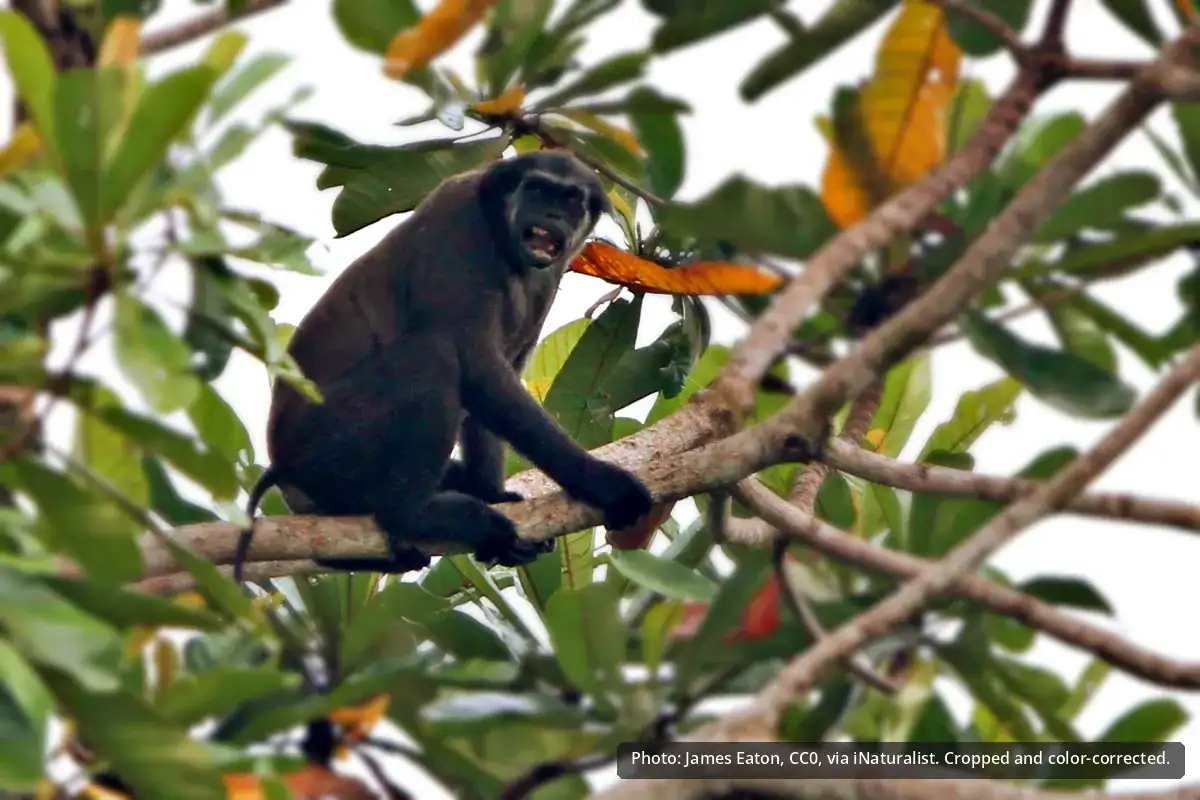
The pig-tailed langur is a short-tailed monkey from Indonesia. It lives only on the Mentawai Islands, off western Sumatra.[1] The IUCN lists it as Critically Endangered. The 2015 assessment estimated an 80% to 90% decline over 36 years. Field researchers often call it the simakobu.[2]
It belongs to the Old World monkeys. It is also one of the Indonesian monkeys found nowhere else. Browse its relatives among all the types of monkeys.
This Critically Endangered monkey lives only on Indonesia's Mentawai Islands.
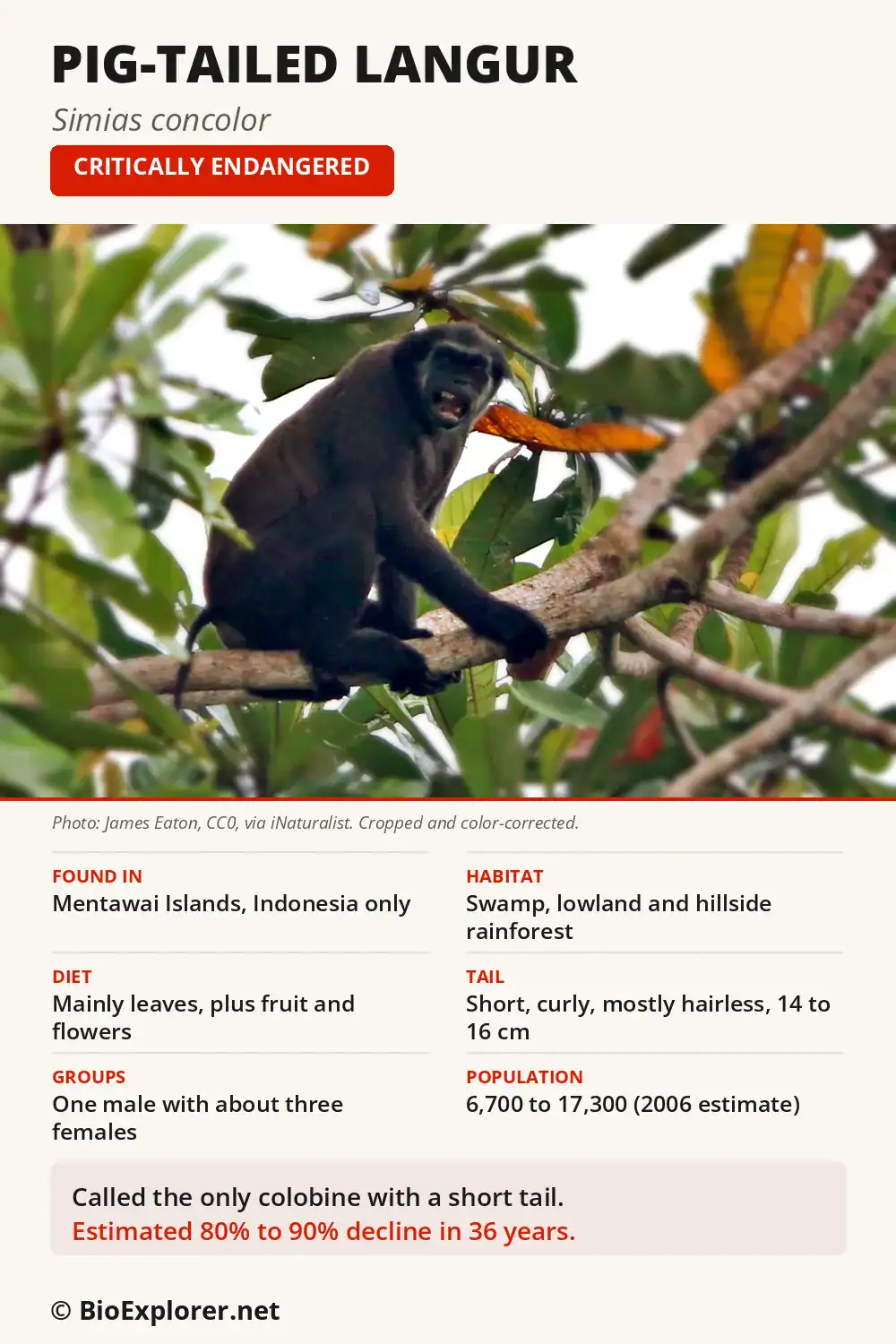
- Common NamesPig-tailed langur; pig-tailed snub-nosed langur; simakobu; masepsep
- Taxonomy Classification Year1903
- Monkey SizeHead and body 46 to 55 cm; tail about 14 to 16 cm
- Skin Color(s)Black face, hands and feet; coat dark grayish-black or pale buff
- HabitatSwamp, lowland and hillside rainforest, below about 500 meters
- DietHerbivorous, mainly leaves
- Native CountriesIndonesia
- One handbook calls it the only colobine with a short tail.
- Its tail is short, upturned, curly and mostly hairless.
- Females show sexual swellings, unlike any other Asian colobine.
- In a 2012 Siberut survey, 77% of active hunters targeted it.
- Its closest living relative is the proboscis monkey of Borneo.
Pig-tailed Langur Distribution
 )
Pig-tailed Langur Guide:
Classification and Naming
Gerrit Miller described the species in 1903 as Simias concolor.[3] His type specimen came from South Pagai Island. Simias holds just this one species. Some later authors moved it into the genus Nasalis. Current checklists keep it in its own genus.
Its closest living relative is the proboscis monkey of Borneo.[4] Mitochondrial DNA dates their split to about 1.9 million years ago. Nuclear DNA gives about 1.1 million years. The authors called that split surprisingly recent, given how different they look. The pair belongs to the odd-nosed monkeys. Other members are the golden snub-nosed monkey and the red-shanked douc langur.
The 2013 handbook recognizes two subspecies.[5] S. c. siberu lives on Siberut, the northern island. S. c. concolor lives on Sipora, North Pagai and South Pagai. Local names differ too.[6] The southern form is called masepsep, the Siberut form simakobu. Its name puts it among the monkeys starting with P. It also counts among the Asian types of langurs.
Despite the shared name, it is not a macaque. Do not confuse it with the Sunda pig-tailed macaque.
Appearance and Size
It has a long nasal bone but a snubbed, upturned nose. Adults come in two color forms. The common form is dark grayish-black. That places it among the black monkeys. The rarer form is a pale buff color. Both forms have black faces, hands and feet, with white cheek patches.
The Pagai form is less dark and more brownish. So it also counts among the brown monkeys. The pale form is about a third in central and southern Siberut. In northern Siberut it is only about 5%. It is extremely rare on the Pagai Islands.
The tail is short, upturned, curly and mostly hairless. It measures only about 14 to 16 cm. The handbook calls it the only colobine with a short tail. Its front and hind limbs are roughly equal in length.
Males measure 49 to 55 cm in head and body. Females measure 46 to 52 cm. The handbook gives males a weight of 8.5 to 8.8 kg. Wild adults weighed on Siberut ranged from 5.2 to 7.85 kg.[7] There, males were about 23% heavier than females.
Range and Habitat
The species is endemic to the four main Mentawai Islands. These are Siberut, Sipora, North Pagai and South Pagai. It also lives on the islets of Simalegu, Simatapi and Sinakak. The Red List puts its upper elevation limit at 500 meters.
It lives in swamp forest and lowland rainforest. It also uses primary forest on hillsides in the island interiors. That makes it one of the rainforest monkeys. Mentawai forests get up to 4,000 mm of rain a year.
The islands hold other endemic primates. On Siberut it shares forest with the Siberut langur. The Siberut macaque lives there too. On the southern islands it meets the Mentawai langur. There it also lives with the Pagai Island macaque. Kloss's gibbon shares the four main Mentawai Islands.
Diet and Feeding
The pig-tailed langur eats mainly leaves. It adds fruit, seeds and flowers. That diet puts it among the herbivorous monkeys.
Leaves took up 57.2% of feeding time on Siberut.[8] Fruit took up 22.8%, and flowers 17.8%. It rested for 55.4% of the day and fed for 30.8%. Groups traveled about 572 meters a day on average.
A Siberut study compared it with the local langur.[9] That langur was then called Presbytis potenziani. The langur ate more fruit, and their diets overlapped little. The pig-tailed langur used the lower canopy more, below 20 meters.
Social Life and Behavior
The species is active by day. It moves mostly through the trees but also comes to the ground. When alarmed by people, it freezes silently in dense foliage. If pressed further, it drops to the ground and flees.
Early studies described small family groups of a male and female.[10] Later work on Siberut found larger one-male groups instead. These held one adult male and about three adult females. All-male groups also roamed the forest. The researchers saw no adult male and female pairs in undisturbed forest. They suggested such pairs may result from hunting shrinking the groups.
One-male groups average about eight animals.[11] Their home ranges are small, often under 10 hectares. Across the islands, home ranges run from 3 to 30 hectares.
Adult males give loud calls of repeated nasal barks. A call lasts about 15 seconds. Each male's call is individually distinct. Dawn calls usually form choruses of two or more males. On the Mentawai Islands, no mammal hunts it except people.
Breeding and Young
Female pig-tailed langurs show sexual swellings.[12] No other Asian colobine is known to do this. Their swellings are prominent during the receptive phase.
An early study reported births only in June and July. A later study found breeding is not strictly seasonal. Focal groups at Peleonan averaged 0.64 births per female per year. Single births are the norm.
Population and Rarity
The Red List assessment dates from November 2015. It was published in 2020 and flagged as needing an update. It cites a 2006 action plan estimate of 6,700 to 17,300 animals. That was down from about 26,000 in 1980.
Siberut holds most of them. A 2011 park survey estimated 8.5 animals per square kilometer.[13] The 95% confidence interval was 5.0 to 14.5. Researchers extrapolated about 14,112 animals in Siberut National Park. That estimate ranged from 8,252 to 24,133. The authors noted it may be a slight overestimate. Densities in north Siberut's Peleonan Forest are much higher.[14] A 2005 survey there estimated 53.1 animals per square kilometer. Its 95% confidence interval was 38.8 to 72.5.
The southern islands hold far fewer. The same action plan gave only 700 to 1,800 animals there. Researchers estimated five animals per square kilometer in unlogged Pagai forest. Forest logged 20 years earlier held an estimated 2.5. It has probably vanished from two islets off South Pagai.
Main Threats
Hunting is the biggest threat. It is the preferred game of most Mentawai hunters. A 2012 survey interviewed 390 adult men across Siberut.[15] Of them, 93 men, or 24%, still hunted. Among those active hunters, 77% targeted this species. The study estimated 1,620 to 3,240 taken on Siberut each year.
Hunting has become easier over recent decades. Logging roads opened remote forest. Air rifles became widespread. On Siberut, bows and poison arrows remain the main hunting tool. Old taboos that limited hunting have faded. Tenaza estimated Pagai hunters killed twice as many as were born.
Hunting also reshapes groups. It skews adult sex ratios and leaves fewer young. Commercial logging and oil palm plantations destroy its forest. Some animals are also taken as pets.
Conservation Status
The pig-tailed langur is Critically Endangered under criteria A2acd. The 2015 assessment estimated an 80% to 90% three-generation decline. One generation is about 10 to 12 years. It was first listed as Critically Endangered in 2008.
It is listed on CITES Appendix I. The 2015 assessment reported protection under Indonesian law. The United States lists it as endangered, as the Pagi Island langur.[16] The assessment named Siberut National Park as its only official protected area. A personal communication cited there says it is never seen in captivity.
Siberut National Park covers about 47% of the island. UNESCO lists Siberut as a biosphere reserve.[17] Primates in Peril named it in nine straight editions, 2002 to 2018.[18]
Shamans in four southern Siberut regions may never eat the white morph.[19] It is one of five animals tabooed in all four regions.
Common Questions
The pig-tailed langur has a short, curly, mostly hairless tail. The tail is only about 14 to 16 cm long.
The pig-tailed langur lives only on Indonesia's Mentawai Islands. These are Siberut, Sipora, North Pagai and South Pagai.
The pig-tailed langur eats mainly leaves. It also eats fruit, seeds and flowers.
No current total exists. A 2006 action plan estimated 6,700 to 17,300 pig-tailed langurs. The 2015 assessment estimated further declines afterward.
Yes. DNA shows the proboscis monkey is the pig-tailed langur's closest relative.
Hunting is the main threat to the pig-tailed langur. Logging and oil palm plantations also destroy its forest.
Cite this page
BioExplorer. (2026, November 2). Pig-tailed Langur. https://www.bioexplorer.net/animals/mammals/monkeys/pig-tailed-langur/
About the author

Wildlife Writer and Photographer, BioExplorer.net
Arjun is a science writer and wildlife photographer at BioExplorer.net. He turns new research on animals into clear, accurate reads for curious readers. His work covers animal behavior, ecology, and newly described species. He holds a Cornell Lab of Ornithology certificate in bird biology. He is pursuing an HBSc at the University of Toronto Mississauga.