
Olalla Brothers’ Titi
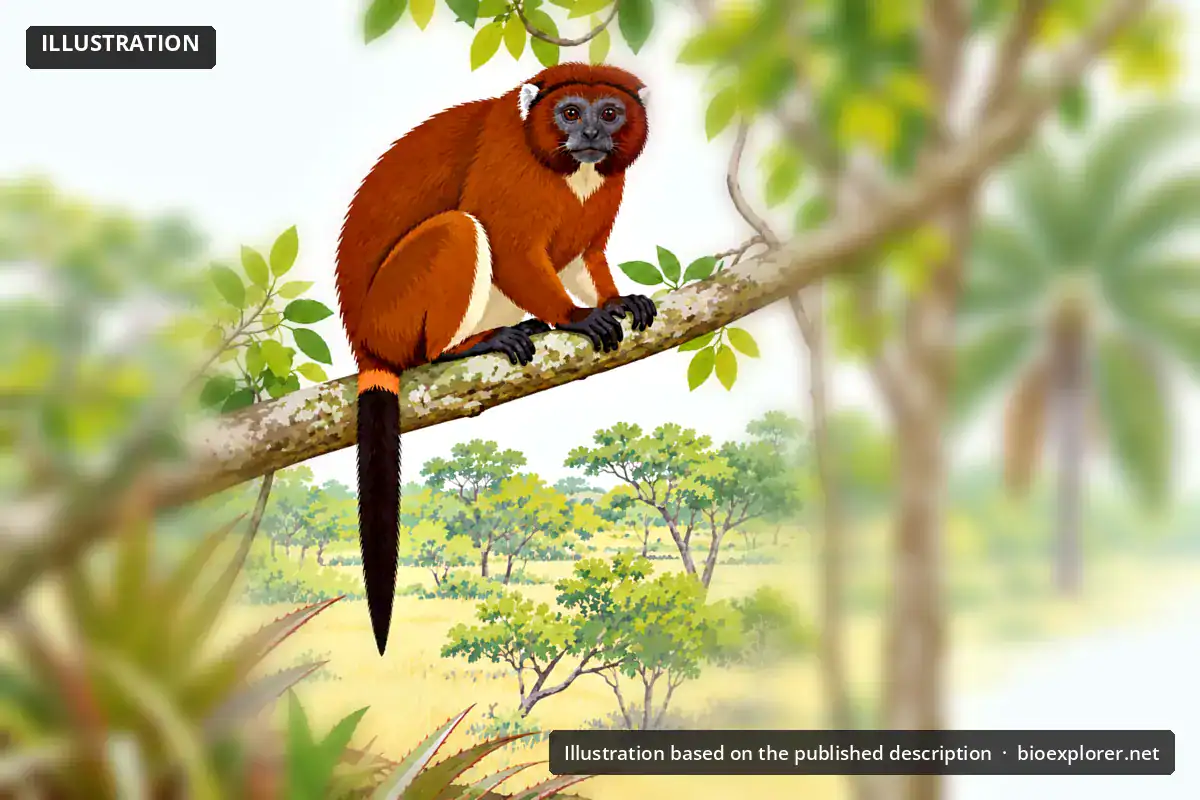
The Olalla brothers' titi is a small monkey found only in Bolivia.[1] Its scientific name is Plecturocebus olallae. It lives in a tiny corner of the Beni savannas. The IUCN lists it as Critically Endangered.[2] For decades after 1939, no one studied it in the wild.
This Critically Endangered titi lives only in Bolivia's Beni lowlands.

- Common NamesOlalla brothers' titi, Olalla's titi, reddish lucachi
- Taxonomy Classification Year1939
- Monkey SizeBody 41 cm (16 in), tail 34 cm (13.4 in), about 1 kg (2.2 lb)
- Skin Color(s)Reddish brown, with creamy underparts and a blackish tail
- HabitatForest islands and riverside forest in flooded savanna
- DietMostly fruit and leaves; also flowers and insects
- Native CountriesBolivia
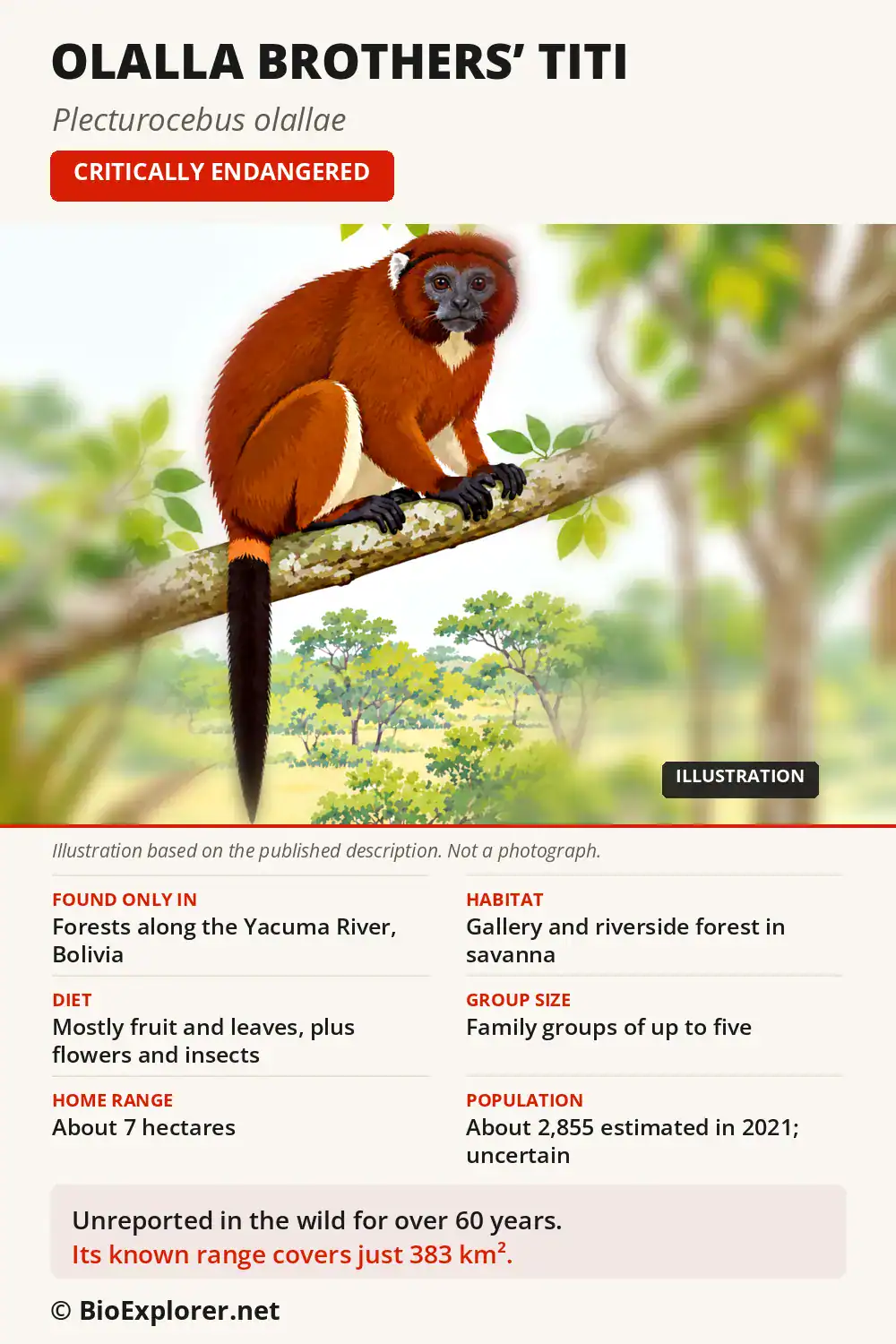
- It lives only in forest patches near the Yacuma River.
- Its reddish coat contrasts with a blackish, orange-based tail.
- It eats mostly fruit and leaves, plus flowers and insects.
- Adult pairs live in small family groups of up to five.
- A 2021 study estimated about 2,855, but the total is uncertain.
Olalla Brothers' Titi Distribution
 )
Olalla Brothers' Titi Guide:
Name and Classification
Lönnberg named it Callicebus olallae in 1939. The type specimen is an adult male. It sits in the Swedish Museum of Natural History in Stockholm. It came from La Laguna, 5 km (3.1 mi) from Santa Rosa. That site lies in Beni Department, Bolivia.
Alfonso M. Olalla collected it on February 12, 1938.[3] The Olallas were a famous family of Ecuadorian collectors.[4] Carlos and his sons worked for the American Museum of Natural History.
In 1937, the Stockholm museum funded Alfonso's expedition to Bolivia.[5] His wife, Dr. Nair V. Olalla, worked beside him with trained assistants. The trip brought back about 400 mammals and 9,000 birds. Later field workers credit the titi specimens to the Olalla brothers.[6] The common name nods to that collecting family.
A 2016 genetic study split the titis into three genera.[7] This titi moved to Plecturocebus. The name means plaited-tail monkey. It refers to titis twining their tails as they sit together. The Mammal Diversity Database calls the placement tentative.
It belongs to the donacophilus species group. That group is named for the white-eared titi, P. donacophilus. The Rio Beni titi and Chacoan titi monkey belong to it too. All four sing the same style of duet.[8]
The 2016 study also placed two Peruvian titis in this group. They are the Rio Mayo titi and the Urubamba brown titi. Their duets sound strikingly different, which questions that placement.
Its closest neighbor is P. modestus. Lönnberg named both species in the same 1939 paper. Their type sites lie only about 65 km (40 mi) apart. A 2019 genetic study sampled 54 animals of both species.[9] It found two related but distinct genetic groups. The two may still be diverging from one ancestral population.
Like all titis, it is one of the New World monkeys. It also appears among monkeys starting with O. Meet its relatives in our guide to all types of monkeys.
Found Again in 2002
For over 60 years, nobody reported this titi in the wild.[10] Science knew it from a single specimen. In late September 2002, four biologists set out to find it. Jesús Martinez led the field trip.
They found three groups near Puerto Santa Cruz on the Yacuma River. The site lay 22 km (14 mi) from the type locality. The team matched their photos to the Stockholm specimens. These were the first documented wild records since 1938.
No titis remained at La Laguna itself. Residents said hunting had apparently wiped them out around 1998. Wildlife Conservation Society (WCS) researchers have studied it ever since.
Physical Description
The Olalla brothers' titi is a reddish monkey. In the wild, its back, limbs and chest look rufous. That rufous coat places it among the red monkeys. The forehead, sideburns and beard are dark brownish red. Small white tufts mark the ears. The throat is pale and the underparts creamy. The hands are blackish.
The tail is blackish and tapers to a point. Its pale orange base contrasts sharply with the rest.
A later study describes rather long, reddish-brown fur. Each hair carries a wide orange band and a brown tip. It counts among the orange monkeys for that reason. Its warm coat also places it among the brown monkeys. In that account, the tail looks grayer and contrasts less.
Adult males have a tall, narrow head and an oval muzzle area. Male Rio Beni titis have wider heads and five-sided muzzles. P. modestus also has banded agouti fur and no pale tail base. Sources disagree on how prominent the ear tufts are. Unlike the white-eared titi, it has no cheek stripe.[11]
Size and Weight
Few measurements exist. The type specimen is a prepared museum skin. It measured 750 mm (29.5 in) in total. Its tail made up 340 mm (13.4 in) of that. WCS gives a length of up to 75 cm, tail included.[12]
Bolivia's 2026 Red Book reports a 41 cm (16 in) body.[13] It gives a 34 cm (13.4 in) tail. It puts body mass at around 1 kg (2.2 lb).
Range and Distribution
This titi lives only in Bolivia. It is one of two primates found nowhere else in the country. The other is the Rio Beni titi.
Its range follows forests along the Yacuma River in southwestern Beni Department. The area belongs to the Llanos de Moxos.[14] This vast wetland mixes flooded grassland with islands of forest. It ranks among the most restricted Bolivian monkeys. Its range touches Reyes, Santa Rosa and San Borja municipalities. Local people call it the reddish lucachi.
The Beni River seems to mark its western edge. The San Borja area bounds it to the east. Its northern limit is still unknown.
Its known range covers just 383.4 km² (148 sq mi). That is the smallest range of any Bolivian endemic primate. Forest covers only about half of it. No national protected area overlaps its range.
Habitat Needs
This titi lives in gallery and riverside forest within savanna. It favors low forest that locals call chaparrales. These stands hold dense lianas, motacú palms and garabatá bromeliads. Groups stay low, at an average height of 6.8 m (22 ft). Low shrub forest, only 2 to 3 m tall, is unsuitable.
In 2019, researchers located 90 groups. They compared the sites with a preliminary satellite vegetation map. By that map, 41% sat in mature forest. Another 21% sat in successional forest and 20% in flooded forest.
Across the wider Llanos de Moxos, pre-Hispanic earthworks helped forest expand.[15]
Other primates share these forest islands. They include the black-capped squirrel monkey and the Bolivian red howler. Capuchins live there too. Along the Yacuma, observers also saw the black howler monkey.
Diet and Feeding
In studied groups, fruit made up about 48.5% of the diet. Leaves added another 38.9%. Flowers and insects make up much smaller shares. Because fruit comes first, it ranks among the frugivorous monkeys. With insects on the menu, it also counts among the omnivorous monkeys.
One titi was seen eating seeds of the mapajo tree, Ceiba pentandra. Locals report it feeding on motacú palms. Seeds like those of garabatá turned up in its droppings. In two studied groups, fruit-feeding time fell during the dry season.[16]
Behavior and Groups
This titi is socially monogamous. It lives in family groups of up to five. In 2004 to 2006 surveys, groups held one to five animals. They averaged 2.7, and every group had an adult pair. Later studies give averages of 2 to 2.4.
A group's home range covers about 7 ha (17 acres). It travels roughly 500 m (1,640 ft) a day.
Titis usually stay in the trees. In one fragmented study area, 7% of moves were on the ground. One group fled its patch when nearby grassland burned. A group also lost territory to squirrel monkeys and night monkeys.
Disturbed adults may stand, bob their bodies and wave their arms.
Calls and Duets
Mated pairs sing duets to defend their territory. Groups start calling around 7:00 a.m. A bout lasts about 30 minutes. Calling sometimes resumes around 8:30 a.m.
Groups called on 33% of study days.[17] They called more in the rainy season. Groups in unbroken forest called more often.
Its duet sits at the high-pitched end of the titi duets studied.
Breeding and Young
Pregnancy lasts about four months. Recent observations suggest two breeding seasons each year. They begin with the dry and wet seasons. Still, a female has only one infant a year. Young mature at about two years old. They then look for chances to leave their family group. As in other titis, the father carries the infant. The IUCN uses a generation length of nine years.
Population and Status
An early survey found 5.9 groups per km² (15 per sq mi). A 2021 study estimated 7.5 groups per km² instead. From that, it estimated about 2,855 individuals. The true total remains uncertain. Later surveys found groups in only part of the available forest.
The IUCN lists it as Critically Endangered under criterion A3cd. Its assessment dates from November 2020 and appeared in 2021. It suspects a decline above 80% over the next 27 years. That span equals three titi generations.
Its listing has grown more serious over time. It was Endangered in 2008.[18] It was Vulnerable in 2003 and Data Deficient in 2000. Bolivia's 2026 Red Book lists it as Critically Endangered. That is an upgrade from Endangered in 2009. It is also on CITES Appendix II. It joined the World's 25 Most Endangered Primates in 2018. It has appeared in later editions of that list too.
Major Threats
Cattle ranching drives most habitat loss. Ranchers burn the grasslands every year. Those fires often escape into forest patches.
The Northern Corridor highway passes about 10 km (6 mi) away. Its upgrade could bring new settlements, ranches and farms. Beni's land-use plan also promotes large-scale mechanized farming.
Hunting reports are sporadic, and hunting is not considered a major threat. Its small size makes it unattractive prey. At least one titi was apparently killed for fishing bait.
The 2019 survey found lower occupancy nearer human settlements. Researchers did not establish the cause of that pattern.
Conservation Efforts
Two municipal protected areas cover more than 90% of its range. Pampas del Yacuma lies in Santa Rosa del Yacuma. Rhukanrhuka lies in Reyes. Both name this titi as a conservation priority.
Pampas del Yacuma covers 616,453 ha (1.52 million acres). Rhukanrhuka covers 859,451 ha (2.12 million acres). Pampas del Yacuma gained a management plan in 2017.
Outreach has run for about two decades.[19] School talks, contests and fairs reached Reyes and Santa Rosa. Local knowledge of both endemic titis improved. In 2022, WCS biologist Jesús Martinez won a conservation education award. The International Primatological Society presented it.
A 2019 survey set a baseline for future monitoring. It covered 582 grid cells at two sites. Its design had 81% power to detect a 30% occupancy change. The calculation used a significance level of 0.2.
Common Questions
The Olalla brothers' titi lives only in Bolivia. It occupies forest patches along the Yacuma River in Beni Department.
Yes. The IUCN lists the Olalla brothers' titi as Critically Endangered. It suspects a decline above 80% over 27 years.
A 2021 study estimated about 2,855 Olalla brothers' titis. The total is uncertain, as groups occupy only part of the forest.
The Olalla brothers' titi eats mostly fruit and leaves. It also eats flowers and insects.
The Olalla brothers' titi has reddish fur and creamy underparts. Its blackish tail has a pale orange base.
The Olalla brothers' titi takes its English name from the Olalla brothers. They were Ecuadorian specimen collectors. Alfonso M. Olalla collected its type specimen in 1938.
Cite this page
BioExplorer. (2026, October 27). Olalla Brothers’ Titi. https://www.bioexplorer.net/animals/mammals/monkeys/olalla-brothers-titi/
About the author