
Caquetá Titi
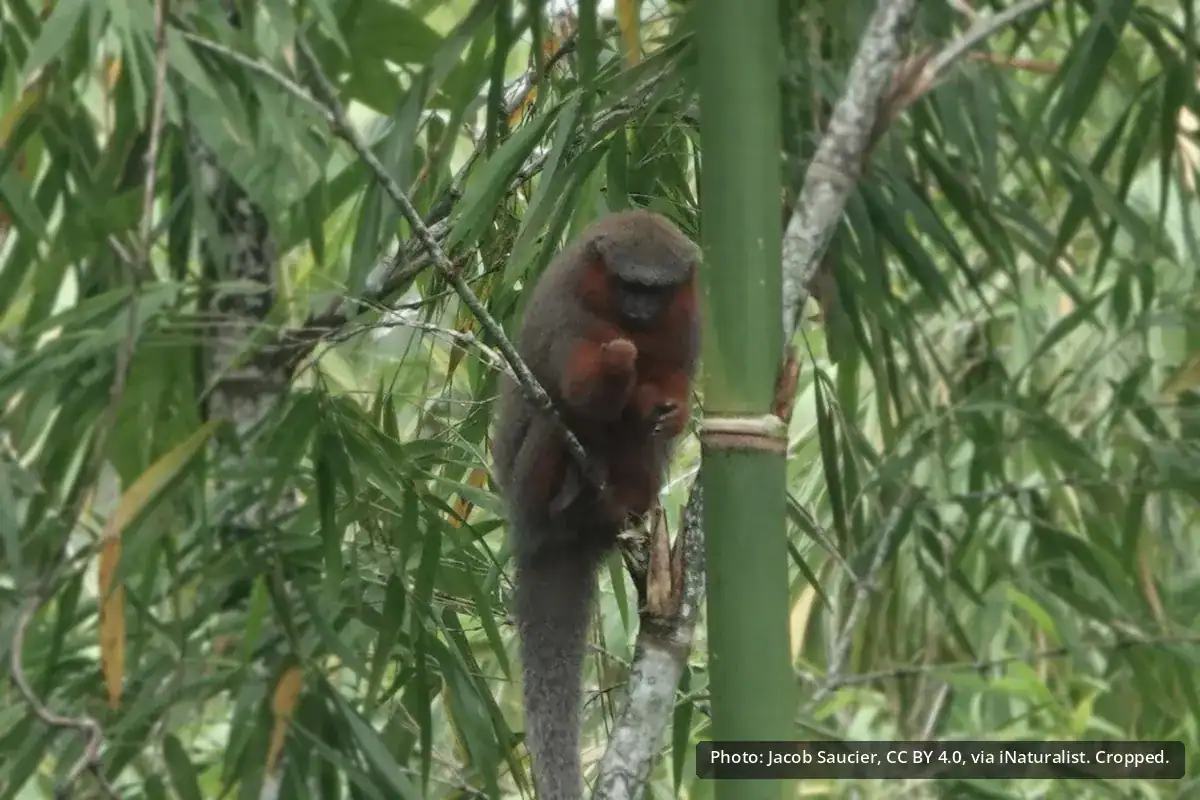
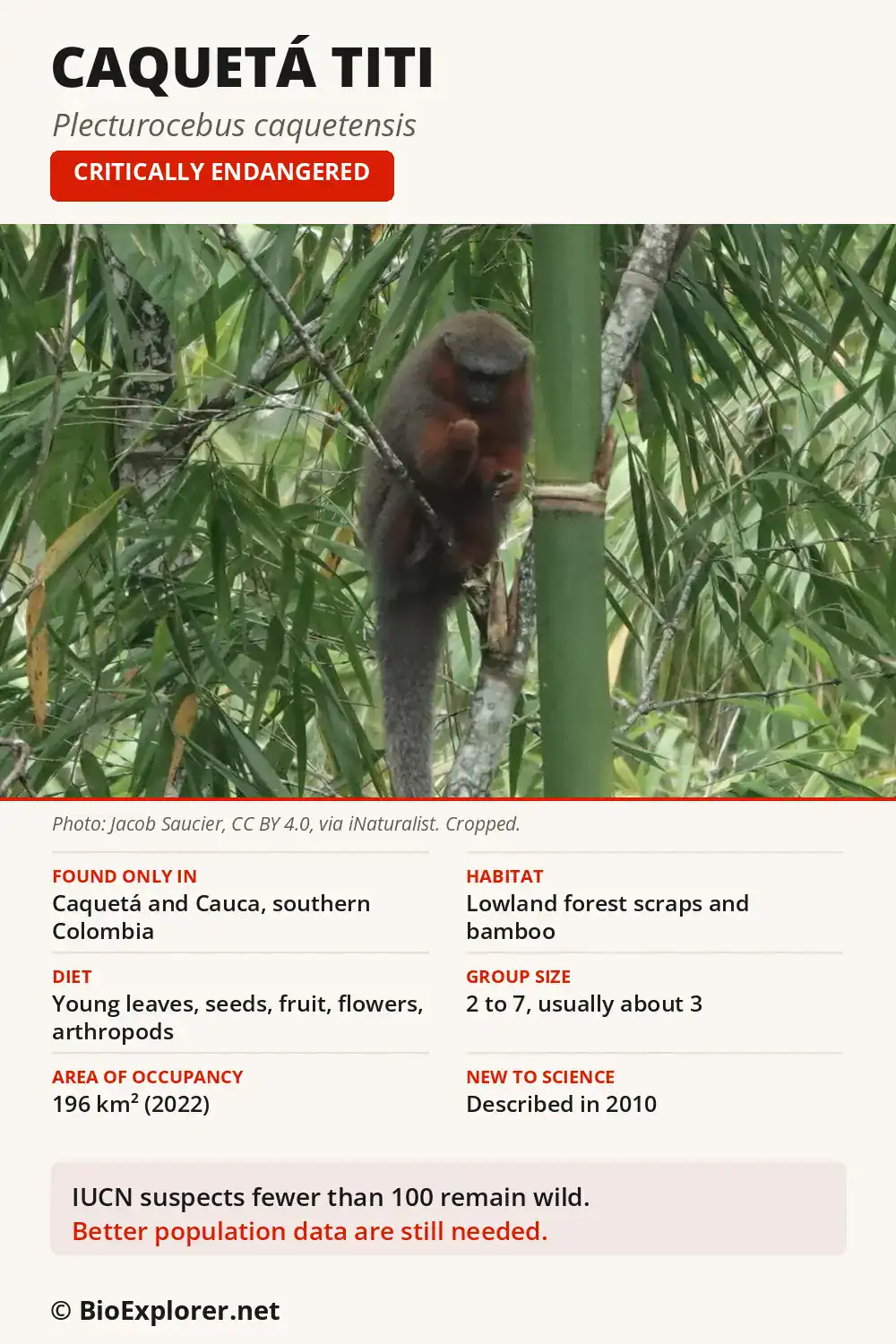
The Caquetá titi is a small monkey found only in Colombia.[1] Its scientific name is Plecturocebus caquetensis. Scientists described it as a new species in 2010.
The IUCN lists it as Critically Endangered. Its 2010 describers called it "probably the most endangered of Colombia's primates".[2]
The Caquetá titi is a small monkey found only in Colombia. It is Critically Endangered.
- Common NamesCaquetá Titi
- Taxonomy Classification Year2010
- Monkey SizeHead and body 35 cm (13.8 in), tail 61 cm (24 in), one juvenile female
- Skin Color(s)Grayish brown, chestnut red, dark face
- HabitatLowland Amazon forest fragments and bamboo
- DietOmnivorous: leaves, seeds, fruit, arthropods
- Native CountriesColombia
- Scientific name: Plecturocebus caquetensis (Defler, Bueno & García, 2010)
- Family: Pitheciidae
- Status: Critically Endangered (IUCN)
- Range: Caquetá and Cauca departments, Colombia
- Head and body: 35 cm (13.8 in), one juvenile female
- Tail: 61 cm (24 in), same juvenile female
- Weight: not yet published
- Diet: young leaves, seeds, fruit, flowers and arthropods
- Group size: 2 to 7, usually about 3
- Population: never fully counted
Caquetá Titi Distribution
 )
Caquetá Titi Guide:
Name and Classification
The species was first named Callicebus caquetensis. Its type specimen came from Vereda El Jardín, near Puerto Milán. That site lies in Caquetá Department, southern Colombia. A 2016 genetic study split the titis into three genera.[3] The Caquetá titi moved to Plecturocebus. The Mammal Diversity Database calls that placement tentative.
Older works place it in the cupreus species group.[4] That group includes the coppery titi, P. cupreus. The 2016 study folded that group into the moloch group. It is named for the red-bellied titi, P. moloch.
Its nearest relatives live on either side of its range. The ornate titi lives to the north. To the south lives P. leucometopus, long called P. discolor. Older sources call it the white-tailed titi.
Chromosome studies add to the case for a separate species.[5] It has 46 chromosomes, like many close relatives. It shares 21 of 22 chromosome pairs with its southern neighbor. Like all titis, it is one of the New World monkeys. It also appears among monkeys starting with C. Meet its relatives in our guide to all types of monkeys.
A Long-Delayed Discovery
Biologist Martin Moynihan first saw these titis near Valparaíso in 1969. He described the encounter in a 1976 book. He suspected they were something new.[6] Decades of political violence then kept scientists away. The area became an insurgent stronghold.
In August 2008, a team finally confirmed the monkeys in the field. Javier García led the surveys for the National University of Colombia. He found groups by listening for their morning calls. Local contacts helped keep the team safe. One promising forest patch still could not be surveyed.
The formal description appeared online on August 12, 2010. Its authors were Thomas Defler, Marta Bueno and García. "It's important that people know we're still finding new monkeys," Defler said.
Physical Description
The Caquetá titi is about the size of a house cat. Males and females look alike. The back, arms and legs are grayish brown. Each hair carries bands of color, called agouti. That coat puts it among the brown monkeys.
The underside is sparsely haired and chestnut red. The red runs onto the neck and cheeks. There it forms a distinct, bushy red beard. That beard places it among the red monkeys too.
The forehead mixes white, gray, buffy orange and black hairs. Unlike its two neighbors, it has no white forehead bar.[7] It also lacks the off-white hands and feet of the ornate titi. Its facial skin is fairly dark.
The tail is grayish agouti. The last third is grizzled white and black.
Size and Weight
Published measurements are scarce. All come from the holotype, a juvenile female. Her head and body measured 35 cm (13.8 in).[8] Her tail measured 61 cm (24 in). No adult weight has been published.
Range and Distribution
This titi lives only in Colombia. Early surveys found it between the Caquetá and Orteguaza rivers. Those rivers seem to bound its range on three sides. The Andean foothills form the western edge. Groups were found at 190 to 270 m (623 to 886 ft).
Later work extended the known range into Cauca Department.[9] There it lives in the Andean-Amazon foothills of Piamonte. Cauca records sit at 246 to 335 m (807 to 1,099 ft).
A 2016 estimate put the range at 4,029 km² (1,556 sq mi). That is one of the smallest ranges of any primate. Only about 36% of it was still habitat. In 2022, its extent of occurrence was 3,741 km² (1,444 sq mi). Its area of occupancy was 196 km² (76 sq mi). That second figure is an IUCN grid measure. The authors call it the most restricted primate range in Colombia.
Habitat Needs
The Caquetá titi lives in lowland Amazon rainforest. It uses disturbed terra firme forest and low, swampy areas. Riverside and seasonally flooded forests suit it well. It may also use Mauritia flexuosa palm swamps. Like many titis, it counts among the rainforest monkeys of the Amazon.
Today most groups live in forest scraps. Surveys found them in gallery forest and along tree-lined streams. Others cling to patches inside farmland. Of the Cauca records with habitat data, 84% came from secondary forest. Groups used Guadua bamboo stands at 42% of sites. Bamboo had never been recorded as its habitat before.
Other primates share this forest. They include Miller's saki and black-mantled tamarins. Humboldt's woolly monkeys live nearby too.
Diet and Feeding
A study published in 2024 followed one group through 2013.[10] It studied a 23 ha (57 acre) fragment called Playa Rica. Cattle pasture and rubber trees surrounded the patch.
The titis ate young leaves, seeds, fleshy fruit and flowers. They also ate arthropods. Seeds were an important part of the group's diet. In Cauca they ate Cecropia, Inga and peach palm fruit. They also chewed Guadua bamboo petioles, a new food record.
With arthropods on the menu, it is among the omnivorous monkeys.
Behavior and Groups
Caquetá titis live in small family groups. Each group centers on a pair-living adult male and female. Their offspring make up the rest. The male carries the single infant. Mates sing coordinated duets to defend their territory.
Groups hold 2 to 7 animals, with about 3 on average. One Cauca site held 12.5 animals per km² (32 per sq mi). That figure is local, not range-wide.
The Playa Rica group used a small home range. Researchers mapped it with 95% minimum convex polygons. It covered 2.74 ha (6.8 acres) in the dry season. In the rainy season, it grew to 5.58 ha (13.8 acres). The group spent most of its day resting and feeding. Rest peaked at dawn, noon and dusk.
One group slept in a Vochysia tree 15.3 m (50 ft) tall. A boa once attacked an adult and failed. A group also reacted in alarm to two tayras. A violaceous jay once attacked a juvenile. Domestic dogs sometimes attack titis crossing open pasture.
Breeding and Young
Births have been recorded in October and January. A newborn was recorded at Playa Rica in early October 2013. In Cauca, an adult carried a newborn on January 2, 2017.
A 2021 Cauca study recorded no infants at all. The ratio of adult females to young was low. The authors say this may signal poor recruitment. It could also reflect short-term variation.
Population Status
The Caquetá titi has never been fully counted. The 2008 to 2010 surveys detected 82 animals. Early estimates suggested about 250 individuals. Defler did not expect more than 500. Early work also suggested fewer than 250 mature adults. The current IUCN assessment suspects fewer than 100 animals remain wild. It suspects fewer than 50 mature individuals. It says population data are needed to confirm those estimates. The assessment dates from 2015 and needs updating.
The IUCN Red List assessment uses criterion A4cde.[11] That reflects a past and projected population decline. The 2010 authors cited a drop above 80% over three generations. A 2022 update found range figures nearer Endangered. Its authors still back Critically Endangered until trends are known.
Major Threats
Cattle ranching drives most forest loss here. Ranchers clear, burn and degrade the soil. Near Valparaíso, 68% of land had become pasture. In Albania municipality, pasture covered 98% by 2001.
Caquetá lost 29,800 ha (73,600 acres) of forest in 2019. From 2000 to 2016, it lost about 0.77% of its forest yearly. That rate is roughly twice that of similar South American regions. Coca crops, logging, mining, oil and new roads add pressure. Hunting, roadkill and domestic dogs take a further toll.
Small fragments trap groups in place. Titis rarely cross open pasture. That isolation blocks young animals from finding new territory.
Conservation Efforts
The Caquetá titi is listed on CITES Appendix II. It joined the 2016 to 2018 World's 25 Most Endangered Primates list.[12]
No unit of Colombia's national protected-area system covers its range. The Cauca study site borders a national park. It is Serranía de los Churumbelos Auka Wasi National Park. In 2010 its describers urged one or two new reserves. They also proposed a corridor to the eastern Andes.
Private and community lands now protect some habitat. Reserva Murciélagos in Piamonte covers 120 ha (297 acres).[13] Its backers call it the first protected area for this titi.
Local people now lead much of the work. In 2022, a grant backed Johana Villota's project in Piamonte.[14] The work included 17.85 ha (44 acres) at Reserva Natural Kataleya. Fifteen peasant and Indigenous landholders signed a voluntary conservation agreement. The project also trains locals in primate monitoring and ecotourism guiding.
Caquetá Titi FAQs
The Caquetá titi lives only in southern Colombia. It occurs in Caquetá and Cauca departments, in Amazon foothill forest.
Yes. The IUCN lists the Caquetá titi as Critically Endangered. Its area of occupancy is only about 196 km².
No reliable current total exists for the Caquetá titi. The IUCN suspects fewer than 100 remain in the wild. Better population data are still needed.
The Caquetá titi eats young leaves, seeds, fruit and flowers. It also eats arthropods.
The Caquetá titi has a grayish-brown back and chestnut-red underparts. A bushy red beard covers its cheeks. It lacks a white forehead bar.
Scientists confirmed the Caquetá titi in the field in 2008. They described it as a new species in 2010.
Cite this page
BioExplorer. (2026, November 2). Caquetá Titi. https://www.bioexplorer.net/animals/mammals/monkeys/caqueta-titi/
About the author

Wildlife Writer and Photographer, BioExplorer.net
Arjun is a science writer and wildlife photographer at BioExplorer.net. He turns new research on animals into clear, accurate reads for curious readers. His work covers animal behavior, ecology, and newly described species. He holds a Cornell Lab of Ornithology certificate in bird biology. He is pursuing an HBSc at the University of Toronto Mississauga.