
Lomami Red Colobus
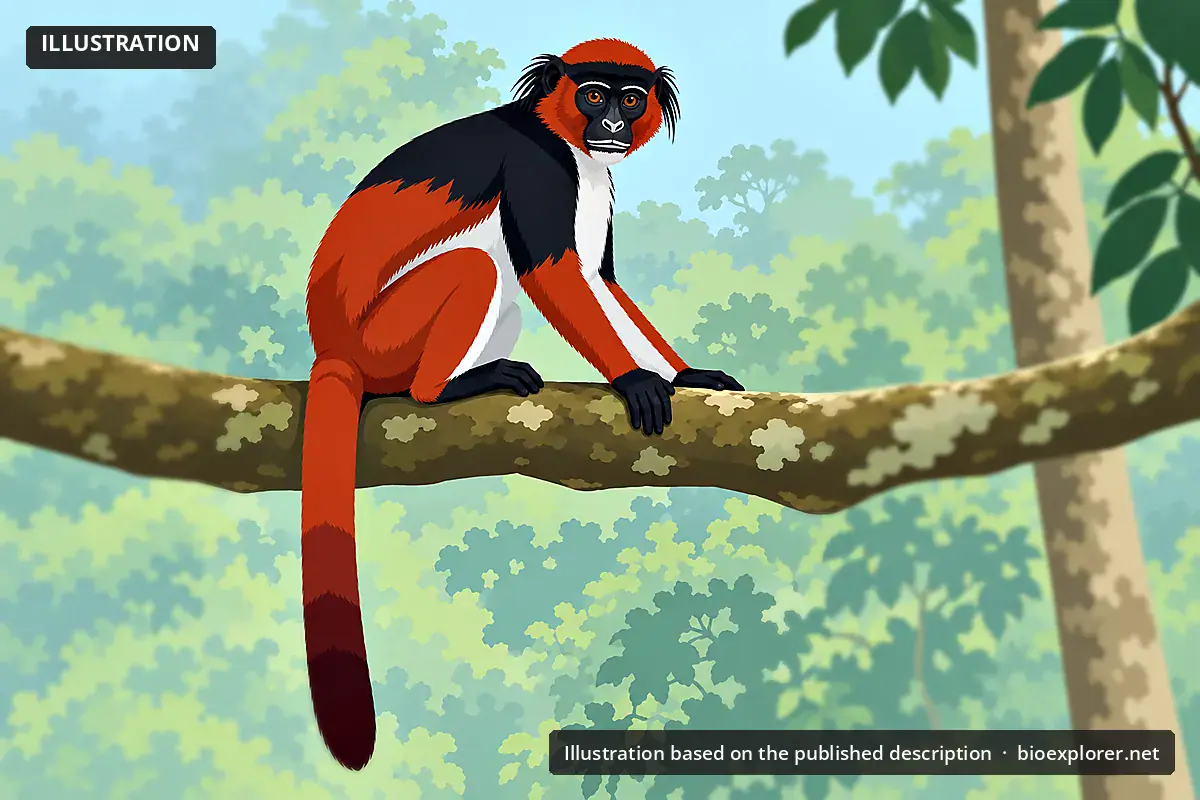
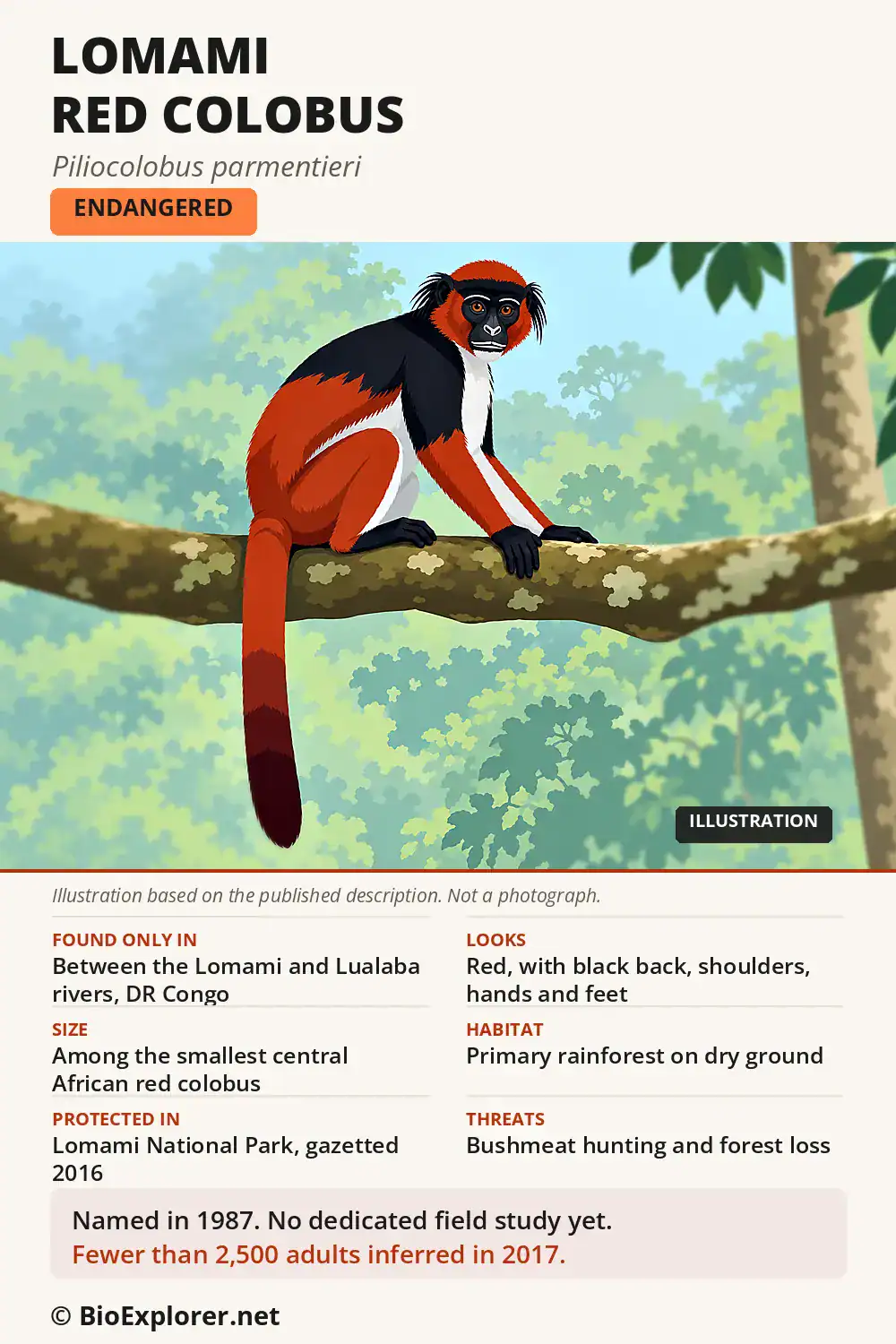
The Lomami red colobus is a little-known monkey of central Africa. Its scientific name is Piliocolobus parmentieri.[1] It lives only in the Democratic Republic of the Congo.[2] Its red coat carries black on the back, shoulders and upper arms.[3] It is one of the Old World monkeys. Scientists named it only in 1987. No dedicated field study has examined it. The IUCN lists it as Endangered.
This Endangered colobus lives only in central DR Congo.
- Common NamesLomami red colobus, Lomami River red colobus, Colobe de la Lomami (French)
- Taxonomy Classification Year1987
- Monkey SizeNo body measurements are available
- Skin Color(s)Red coat, black mid-back, shoulders and upper arms, grayish-white underside, black face
- HabitatPrimary lowland rainforest on dry ground
- DietLeaves, fruit, flowers and buds; possibly seeds
- Native CountriesDemocratic Republic of the Congo
- Scientists described this monkey in 1987.
- It lives between the Lomami and Lualaba rivers.
- No dedicated field study of its ecology exists.
- Its black hands and feet contrast with its red arms.
- It is now known from Lomami National Park, created in 2016.
Lomami Red Colobus Distribution
 )
Lomami Red Colobus Guide:
Name and Classification
Marc Colyn and Walter Verheyen described this monkey in 1987. They named it Colobus rufomitratus parmentieri. That made it a subspecies of a wider red colobus. The type specimen came from Mabobi village. Mabobi lies on the road from Kisangani to Ubundu. It sits on the left bank of the Lualaba River.
It belongs to the genus Piliocolobus, the red colobus. They are part of the wider group of colobus monkeys.
Experts have moved it between species many times. One 1999 scheme placed it under Pennant's red colobus. Colin Groves made it a subspecies of Foa's red colobus. Groves and Nelson Ting raised it to a full species in 2013. In 2015, Jonathan Kingdon placed it under Oustalet's red colobus.
Some authors spell its name parmentierorum. The IUCN treats that plural as a spelling error.
The 2021 action plan calls it a stable, distinct taxon.[4] Its coat varies little from one animal to the next. Its mitochondrial DNA links it with other east-central red colobus. Yet it is not especially close to its eastern neighbors.
Physical Description
Its fur is red. Black covers the mid-back, the shoulders and the upper arms. The underside and the inner limbs are grayish white.
The hands and feet are black. They stand out sharply against the red limbs.
The tail is reddish at the base. It darkens toward the tip but never turns fully black.
The crown is speckled reddish. A black band crosses its front edge, out to the temples. A long black tuft grows at the base of each ear.
The facial skin is black. Narrow pale zones edge the lips, chin and nose. The upper eyelids are pale too.
The handbook notes one odd trait. It lacks a prominent head tuft, or panache. That is unusual among central African red colobus.
Its red fur places it among the red monkeys. Its black shoulders and hands also link it with black monkeys.
Size and Weight
It ranks among the smallest of the central African red colobus. Its tail is longer than that of its western neighbor.
The handbook says no specific body measurements are available. It does print weights for males and females. But the figures in its online text are garbled. So no trustworthy weight can be given here.
Similar Species Compared
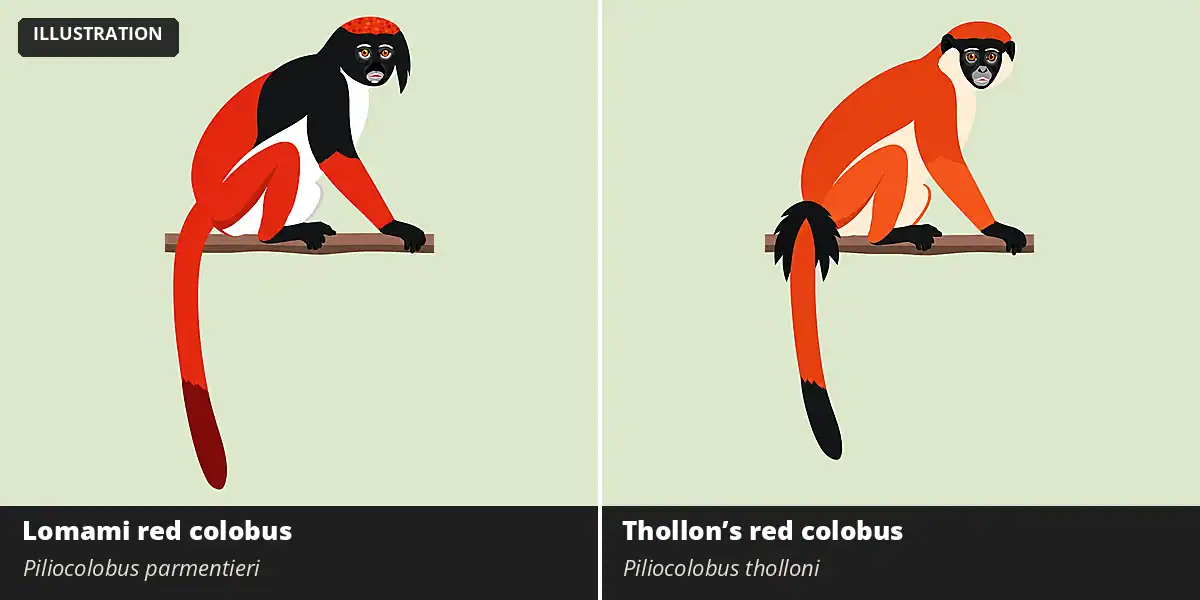
The Lomami River divides two red colobus. Thollon's red colobus lives on the west bank.[5] The Lomami red colobus lives on the east bank.[6] Neither crosses the river. Thollon's is foxy red above and creamy white below.[7] It carries a long tuft at the tail base. The Lomami red colobus has black on its back and shoulders.
These two are the only red colobus in the Congo's central basin. Both live in Lomami National Park, on opposite banks.
North of the Congo River lives Lang's red colobus.[8] Its front half is brick red. Its rear half is gray, sharply set off. No other red colobus shares that pattern. A handbook gives males a head and body of about 50 cm.[9] The handbook gives males a weight near 9 kg (20 lb).
East of the Lualaba lives the Ulindi River red colobus.[10] The IUCN ranks it as a species. The MDD includes it in Foa's red colobus. Its coat varies across its range. Red forms dominate south of the Elila River. Forms with red and black prevail to the north.
| Trait | Lomami red colobus | Thollon's red colobus | Lang's red colobus | Ulindi River red colobus |
|---|---|---|---|---|
| Scientific name | Piliocolobus parmentieri | Piliocolobus tholloni | Piliocolobus langi | Piliocolobus lulindicus (IUCN); within P. foai in the MDD |
| Range | Central DR Congo, between the Lomami and Lualaba rivers | DR Congo, south of the Congo River bend, east to the Lomami River | Northeastern DR Congo, around Kisangani | Eastern DR Congo, east of the Lualaba River |
| Habitat | Primary lowland rainforest on dry ground | Lowland flooded and dry primary rainforest | Primary lowland rainforest | Lowland moist forest, 450 to 1,800 m |
| Coat and key marks | Red, black mid-back, shoulders and upper arms, grayish-white underside | Foxy red above, creamy white below, dark hands and feet, long tail-base tuft | Brick red front half, gray rear half | Varies: red south of the Elila River, red and black to the north |
| Head and body (males) | Not known | About 64 cm | About 50 cm | Not known |
| Tail (males) | Not known; longer than in Thollon's | About 63 cm | About 66.5 cm | Not known |
| Weight (males) | Not reliably known | Not known | About 9 kg | Not known |
| Diet | Leaves, fruit, flowers, buds, possibly seeds | Mostly young leaves; seeds can be substantial | Leaves, fruit, flowers, buds, possibly seeds | Assumed mainly leaves |
| Group size | About 20, in John Hart's 2016 observations | 5 to 63 at one site, in John Hart's 2008 data | Not known | Not known |
| IUCN status | Endangered (assessed 2017, published 2020) | Vulnerable (assessed 2019, published 2020) | Endangered (assessed 2018, published 2020) | Endangered (assessed 2020) |
Range and Distribution
It is endemic to the Democratic Republic of the Congo. It is one of the Democratic Republic of the Congo monkeys.
Its range lies in the interfluve between two great rivers. The Congo, or Lualaba, River bounds it to the north and east. The lower Lomami River bounds it to the west.
The southern limit was long uncertain. Early workers thought flooded forest on white sand stopped it. Later authors put the limit near the Ruiki and Lutanga rivers. In 2016, John Hart found new groups much farther south. They lived near the villages of Lokobekobe and Mokau. That pushed the known range to about 1.4 degrees south.
The known historic range covers about 19,000 square km (7,300 sq mi). By 2006, under 10,000 square km (3,900 sq mi) remained suitable.
Habitat Needs
It lives in primary forest on dry ground, called terra firma forest. It may use older secondary forest too. It has not been seen in young regrowth after farming.
Good upland forest is patchy in its range. Swamp forest and farms break it up. So the monkey has a localized, scattered occurrence. A 2026 study found the same patchy pattern in Lomami National Park.[11] It appears tied to islands of suitable forest.
Its lowland forest home places it among the types of rainforest monkeys.
Diet and Behavior
No dedicated field study has examined this monkey. Its ecology and behavior remain little known.
The handbook lists young and mature leaves in its diet. Fruit, flowers and buds are listed too, and possibly seeds. That plant diet places it among the herbivorous monkeys.
The handbook calls it active by day and tree-dwelling. Its home range, social life and breeding are unknown.
In 2016, John Hart saw groups of about 20 animals. In Lomami National Park, it was once seen in a mixed group. It traveled with the newly described Likweli monkey.
Population and Status
No population estimate exists. The 2017 assessment inferred fewer than 2,500 adults.
It is now rare or absent in the north of its range. It is depleted in most of the Lobaye basin. That basin was once thought to be its stronghold. Surveys in 2007 between Kisangani and Ubundu found no sign of it. The type specimen came from that area. No villagers there could report it.
The IUCN lists it as Endangered under criterion A4cd. It suspects a decline of at least 50% over three generations. That window runs from 2009 to 2038. One generation lasts about 10 years. The assessment dates from 2017. An amended version was published in 2020.
As a subspecies, it was listed Data Deficient in 1996 and 2000.
Major Threats
Hunting for bushmeat and habitat loss are the main threats. Kisangani, a large city, sits at the edge of its range. It is a hub for the commercial bushmeat trade.
In the 1980s, it was common in a Kisangani bushmeat market. A 2014 survey found just 3 colobine carcasses out of 353. Data through 2016 showed hunters still favored red colobus.
In 2008, two hunters in Opala killed this species. They said they had to travel almost 40 km to find it. Red colobus typically watch hunters rather than flee.
Farm clearing has degraded over half its historic range. Upland rice grown for city markets drives much of this. In 2013, active logging concessions covered about a quarter of the range. Logging roads open new forest to hunters.
Forest loss in Tshopo Province accelerated through 2018. Yearly loss rose from 36,000 to 130,000 hectares, 2001 to 2018.
Conservation Efforts
It is now known from Lomami National Park. The park was gazetted on 19 July 2016.[12] It covers about 8,900 square km (3,400 sq mi). The park protects other rare monkeys too, including the lesula.
The 2021 action plan names two priority sites. They are Lomami National Park and the Lobaye basin. It sets a budget of US$85,000 for this species.
The plan asks for surveys in the south of the range. It also calls for a red colobus monitoring program in the park. Better law enforcement and local awareness campaigns are on the list.
All red colobus are protected by law in the DR Congo. Yet unregulated hunting continues across its range. The species is listed on CITES Appendix II. The African Convention lists red colobus in Class B.
Explore more monkeys starting with L. Or browse all types of monkeys.
Common Questions
It lives only in central DR Congo. Its range lies between the Lomami and Lualaba rivers.
Its coat is red, with black on the back and shoulders. Its hands and feet are black.
Yes. The IUCN lists it as Endangered. Hunting and forest loss are the main threats.
No population estimate exists. The 2017 assessment inferred fewer than 2,500 adults.
A handbook lists leaves, fruit, flowers and buds. It may also eat seeds.
Yes. It lives in Lomami National Park, gazetted in 2016.
Cite this page
BioExplorer. (2026, November 2). Lomami Red Colobus. https://www.bioexplorer.net/animals/mammals/monkeys/lomami-red-colobus/
About the author

Wildlife Writer and Photographer, BioExplorer.net
Arjun is a science writer and wildlife photographer at BioExplorer.net. He turns new research on animals into clear, accurate reads for curious readers. His work covers animal behavior, ecology, and newly described species. He holds a Cornell Lab of Ornithology certificate in bird biology. He is pursuing an HBSc at the University of Toronto Mississauga.