
Indochinese Grey Langur
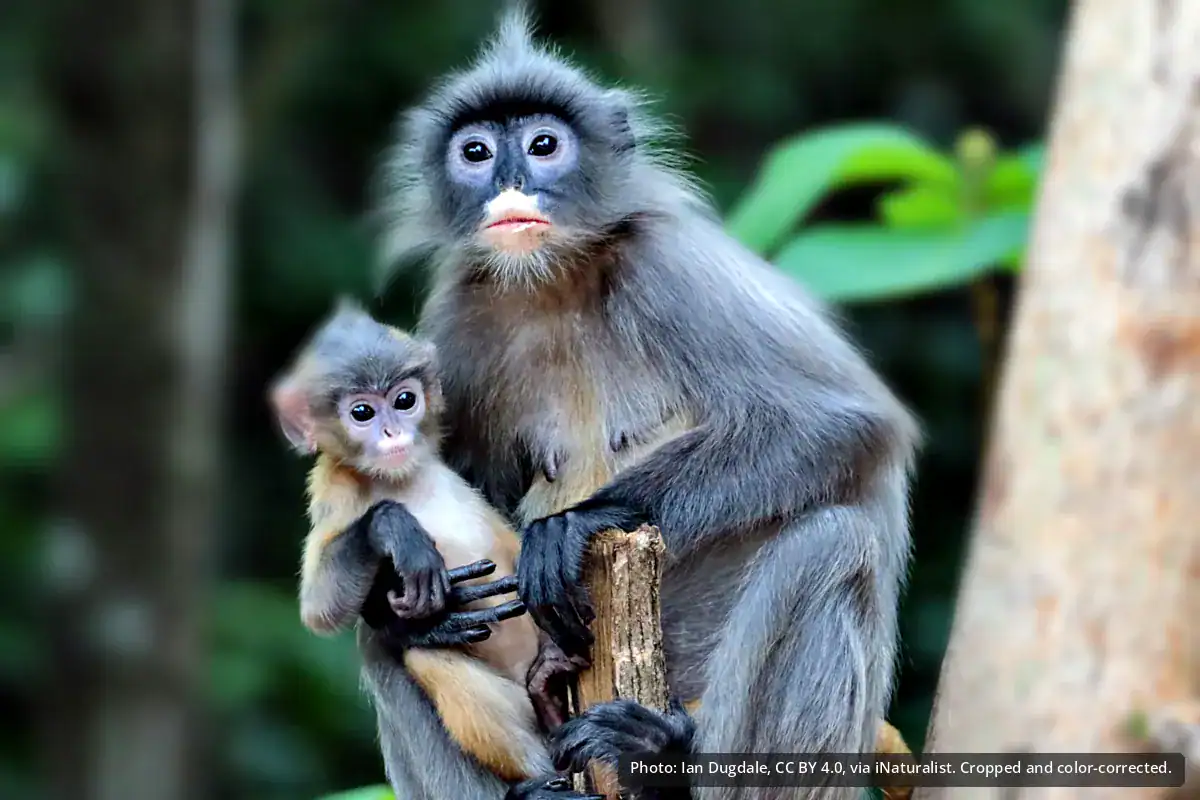
The Indochinese gray langur is a pale gray leaf monkey of Asia. Its scientific name is Trachypithecus crepusculus.[1] It ranges from southern China to Thailand and northern Vietnam. It is one of the Old World monkeys. The IUCN lists it as Endangered.[2]
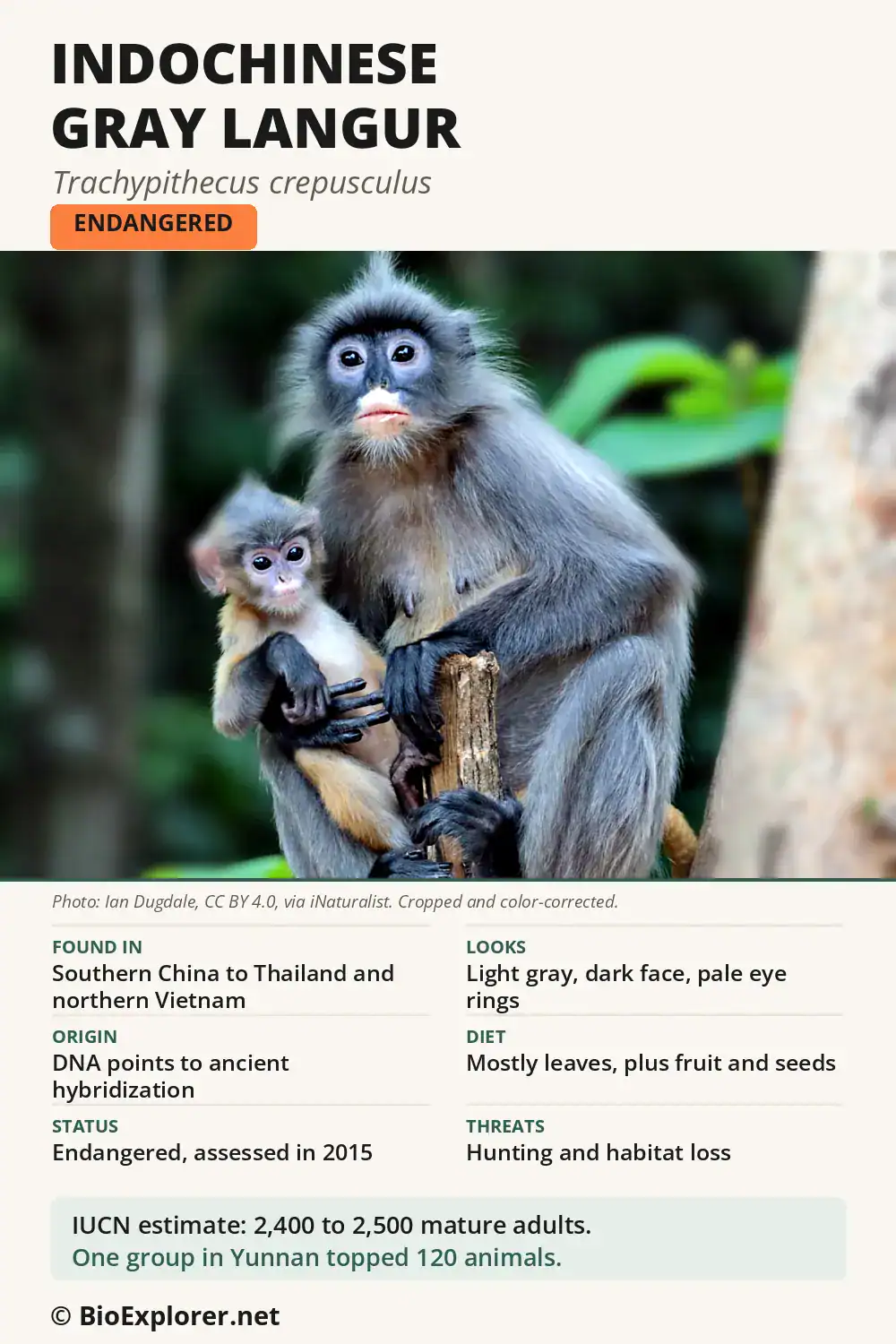
This Endangered langur lives in forests from southern China to Vietnam.
- Common NamesIndochinese gray langur, Phayre's leaf monkey (older studies), Voọc xám (Vietnamese)
- Taxonomy Classification Year1909
- Monkey SizeAbout 51 cm (20 in) head and body in males, tail about 83 cm (33 in)
- Skin Color(s)Light gray coat, dark gray face, pale eye rings, pale lip patches
- HabitatEvergreen, semi-evergreen, mixed deciduous and limestone forest, lowlands to 2,900 m
- DietMostly leaves, plus fruit, seeds, figs, bamboo shoots, flowers and gums
- Native CountriesChina, Laos, Myanmar, Thailand, Vietnam, Cambodia (unconfirmed)
- Its light gray coat contrasts with a dark face.
- Its DNA records an ancient mix of two langur lineages.
- Leaves make up most of its diet.
- One group in Yunnan grew to more than 120 animals.
- Hunting and habitat loss are driving its decline.
Indochinese Gray Langur Distribution
 )
 )
 )
 )
 )
 )
Indochinese Gray Langur Guide:
Name and Classification
American zoologist Daniel Giraud Elliot described this langur in 1909. He named it Presbytis crepuscula. Its type locality is Mount Muleiyit in Myanmar, at 1,500 m. The holotype is kept at the Natural History Museum, London.
For decades it was treated as part of Phayre's langur. Older studies in Thailand still call it Phayre's leaf monkey. Genetic work later raised it to a full species.
Its origin is unusual. A 2019 study compared its mitochondrial and nuclear DNA.[3] Its mitochondria make it a distant relative of the francoisi group. Its nuclear genes place it in the obscurus group instead. There, its closest relative is the Tenasserim langur.
The authors propose ancient hybridization. Males from a barbei-like lineage bred into an older population. Over time, their nuclear genes swamped the original ones. The old mitochondria survived as a relic of a lost lineage.
A 2020 mitogenome study dated that deep mitochondrial split.[4] It put the split at about 3.06 million years ago. The 2019 study had estimated about 2.45 million years.
The 2020 study also split Phayre's langur into three species. The others are the Shan State langur and the new Popa langur. Browse more types of langurs on our hub.
Physical Description
Its body and tail are light gray.[5] The belly is a little brighter, a silvery gray. Brown hair covers the forehead and cheeks and frames the face. Its hands and feet are dark gray. That coat makes it one of the gray monkeys of Asia.
The bare face is dark gray. Full pale rings circle the eyes. Pale, unpigmented patches mark the middle of both lips.
The head has no crest, but long hairs form a whorl. A thin tassel tips the tail.
Animals in the northeast of the range tend to be darker. It shows most on their limbs and tails. Yet DNA shows no large differences across the range.
At Phu Khieo, infants gained adult color at 20 to 26 weeks.[6]
Size and Weight
The Handbook of the Mammals of the World gives its size. Males measure about 51 cm (20 in) in head and body. Females measure about 49 cm (19 in).
Male tails run about 83 cm (33 in). Female tails run about 82 cm (32 in). The tail is far longer than the head and body.
Males weigh about 6.9 kg (15 lb). Females weigh about 6.4 kg (14 lb). Females are slightly smaller than males. The handbook gives no sample sizes.
Similar Species Compared
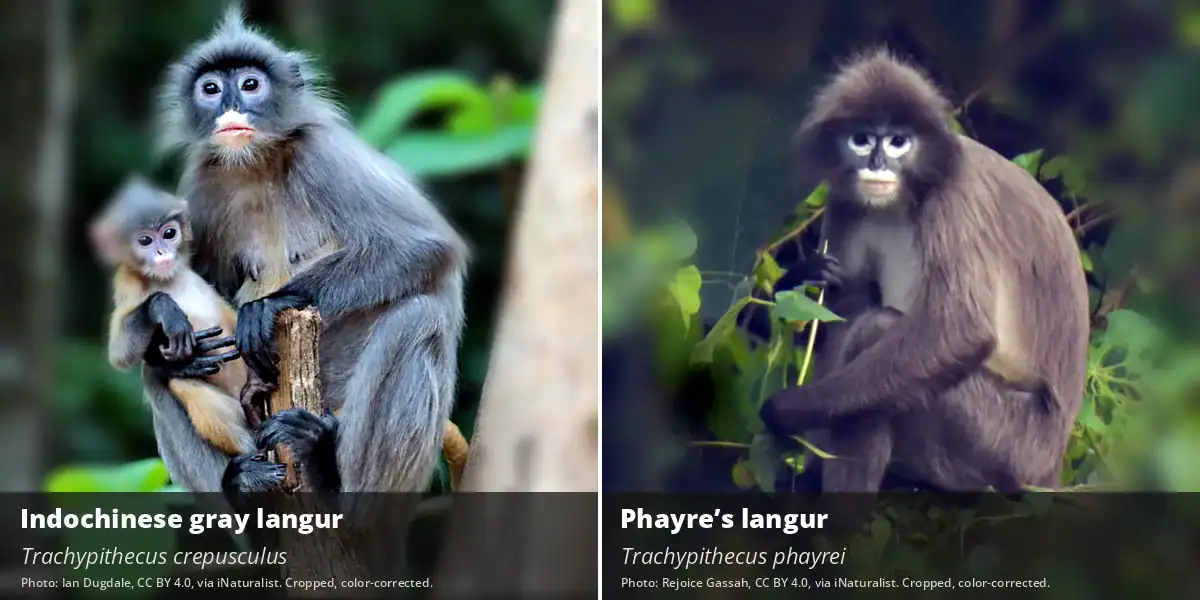
Phayre's langur lives farther west, in Bangladesh, India and western Myanmar.[7] It has a fleshy-white muzzle and white eye rings. Its coat is brownish to gray, with a sharply paler belly. Its males have shorter tails than Shan State or Popa langurs. In Tripura, India, young leaves made up about 48% of feeding time.[8]
The Shan State langur lives between the Ayeyarwaddy and Thanlwin rivers. Its coat is more fawn. White shows only on the inner side of its eyes.
The Tenasserim langur is its closest nuclear relative. It is grayish black, with a distinct crest of upright hairs.[9] Almost nothing is known about it in the wild. The IUCN lists it as Vulnerable.[10]
| Trait | Indochinese gray langur | Phayre's langur | Shan State langur | Tenasserim langur |
|---|---|---|---|---|
| Scientific name | Trachypithecus crepusculus | Trachypithecus phayrei | Trachypithecus melamera | Trachypithecus barbei |
| Range | Southern China, Myanmar, Laos, Thailand, northern Vietnam | Bangladesh, northeast India, western Myanmar | Eastern Myanmar and western Yunnan, China | Eastern Myanmar and western Thailand |
| Habitat | Evergreen, deciduous and limestone forest, lowlands to 2,900 m | Region of tropical rainforest and dry deciduous forest | Region of Shan State tropical mixed forest | Mixed deciduous and moist evergreen forest |
| Coat and key marks | Light gray, dark gray face, full pale eye rings | Brownish to gray, sharply pale belly, white muzzle, white eye rings | Fawn, white only inside the eyes, wide white muzzle | Grayish black, distinct crest, gray face, white eye rings |
| Head and body | Males about 51 cm | Males median 57.5 cm (5 measured) | Males median 56 cm (5 measured) | Not known |
| Tail | Males about 83 cm | Males median 70 cm (5 measured) | Males median 75 cm (5 measured) | Not known |
| Weight | Males about 6.9 kg | Males median 7.9 kg (3 weighed) | Males median 8.6 kg (3 weighed) | Not known |
| Diet | All leaves 54.2% of feeding time in Yunnan | Young leaves alone about 48% of feeding time in Tripura | Not known | Not known |
| Group size | Averages 11 to 26 in Thailand, one group over 120 | 7 to 18 in two Tripura groups | Not known | Not known |
| IUCN status | Endangered (assessed 2015) | Endangered (assessed 2021) | Not evaluated as a species | Vulnerable (assessed 2020) |
Indochinese figures are handbook averages; the others are museum specimen medians.
Range and Distribution
It lives east of the Salween River, also called the Thanlwin. That river most likely marks its western limit. In China, it lives in southern Yunnan Province. The Wuliang Mountains hold its northernmost population.[11]
In Myanmar, its type locality is Mount Muleiyit. Its exact Myanmar range is poorly known.
In Thailand, it lives in the north, south to Raheng. Most studies come from Phu Khieo Wildlife Sanctuary. It also occurs in Nam Nao National Park and Huai Kha Khaeng. That makes it one of the Thailand monkeys.
Lao records come from Nam Kading and areas north and west.[12] Nam Kading National Protected Area lies in central Laos. It had fewer confirmed 1990s records than any other Lao monkey.
In Vietnam, it lives in the north and north-center. It is recorded in 11 provinces, Dien Bien to former Quang Binh.[13]
The IUCN also lists Cambodia. Its own range text does not mention Cambodia. The MDD leaves Cambodia out too.
Habitat Needs
It uses evergreen, semi-evergreen and mixed deciduous forest. It also lives in light woodland and bamboo stands. It even uses limestone hills. Those forests make it one of the rainforest monkeys of Indochina. It shares some forests with François' langur and the red-shanked douc langur.
In Laos, most records come from broken forest with tall bamboo. None came from deep, closed-canopy forest.
Its elevation range is wide. The IUCN gives 50 to 1,000 m (165 to 3,280 ft). Yet Wuliang Mountains langurs live at 1,700 to 2,900 m. That is 5,580 to 9,510 ft. In Laos, only one record lies above 800 m.
Diet and Feeding
It is largely a leaf eater. It also eats figs, bamboo shoots, seeds, flowers and gums. That diet puts it among the herbivorous monkeys.
A three-year study followed a huge group in Wuliangshan.[14] Observers logged 1,738 hours over 213 days. Leaves made up 54.2% of feeding time. Fruit and seeds made up 32.1%.
The group ate 148 plant species in all. Each month it used 15 to 51 species.
A Phu Khieo study found leaves made up 39% of the diet. In some months, leaves reached 81%.
In Wuliangshan, langurs mostly destroy the seeds they eat.[15] They killed the seeds of 48 plant species. Gibbons in the same forest spread seeds instead.
Langurs also eat soil. At Phu Khieo, salt lick trips enlarged one group's home range.[16] It grew from 73.7 to 93.4 ha (182 to 231 acres).
Behavior and Groups
It is strongly arboreal. At Wuliangshan, it spent only 2.9% of its time on the ground.[17] It rested 40.4% of the time and traveled 33%. Feeding took 22.5%.
Group size varies widely. Three Phu Khieo groups averaged 11, 18 and 26 animals. Xuan Lien groups in Vietnam hold up to 30 to 35. The Wuliangshan group grew from 70 to 80 to over 120. In 2014 it split into two groups.
Females leave their birth groups.[18] Males usually stay or form groups nearby. More females than males are born at Phu Khieo. A newly arrived female can soon become the top female.
Langurs at Phu Khieo have been seen mobbing a clouded leopard.[19]
Breeding and Young
Studies at Phu Khieo tracked hormones in wild females.[20] Their cycle averaged 28.4 days. Pregnancy lasted about 205 days.
Births happen all year, but most fall from November to April. If an infant survives, the next birth comes about two years later. Infants nurse for about 19 months.[21]
Females mate with adult males around ovulation. When pregnant, they also mate with adolescent males. This may confuse paternity.
Population and Status
The IUCN estimates 2,400 to 2,500 mature individuals. Xuelong Jiang, in unpublished data, reports more than 2,000 at Wuliangshan. He puts China's total at 5,000.
A 2015 survey found 43 groups in the Wuliang Mountains. It estimated about 1,960 langurs there. Twenty-one of those groups lived partly or fully outside the reserve.
Vietnam's populations are small. A 2017 national action plan estimated about 500 in Vietnam.[22] Xuan Lien Nature Reserve holds an estimated 100 to 200. Mu Cang Chai holds an estimated 50 to 80.
In Laos, surveys found its status far from secure.
The IUCN assessed it as Endangered in 2015, under criterion C1. It suspects a decline of more than half over 36 years. The assessment is marked as needing an update.
Major Threats
Hunting is the main threat in Vietnam and Laos. In Vietnam, people hunt it for meat.
The handbook notes another danger. These langurs often grow large gallstones. The stones are used in traditional Asian medicine.
Habitat loss is the other major threat. Small farms and plantations replace its forest. At Wuliangshan, gibbon protection keeps hunting pressure minimal. Outside the reserve, forest is cleared for walnut and tea plantations. Livestock grazing degrades the forest that remains.
In Vietnam, hunting and forest loss have erased many former populations. There it is also hunted for traditional medicine. Farm expansion, construction and dams add pressure.
Conservation Efforts
It is listed on CITES Appendix II. China protects it as a National Class I species. Vietnam lists it in Group IB under Decree 06/2019. It is also on the priority species list of Decree 64/2019. Older decrees listed it under the name Trachypithecus barbei.
It lives in many protected areas. They include Pu Mat and Ben En National Parks in Vietnam. Others are Nam Et-Phou Louey in Laos and Phu Khieo in Thailand. In China, they include Wuliangshan, Ailaoshan and Xishuangbanna.
The IUCN calls for research on its numbers, ecology and threats. It also calls for a species action plan.
Explore more monkeys starting with I. Or browse all types of monkeys.
Common Questions
The Indochinese gray langur ranges from southern China to Thailand and Vietnam.
The Indochinese gray langur has light gray fur and a dark face. Pale rings circle its eyes.
The Indochinese gray langur eats mostly leaves. It also eats fruit, seeds, figs and flowers.
Genetic studies suggest the Indochinese gray langur arose through ancient hybridization. Its mitochondria and nuclear genes point to different langur groups.
Yes. The IUCN assessed the Indochinese gray langur as Endangered in 2015.
Indochinese gray langur groups studied in Thailand averaged 11 to 26 animals. One Yunnan group topped 120.
Cite this page
BioExplorer. (2026, October 29). Indochinese Grey Langur. https://www.bioexplorer.net/animals/mammals/monkeys/indochinese-grey-langur/
About the author