
Gray Snub-Nosed Monkey
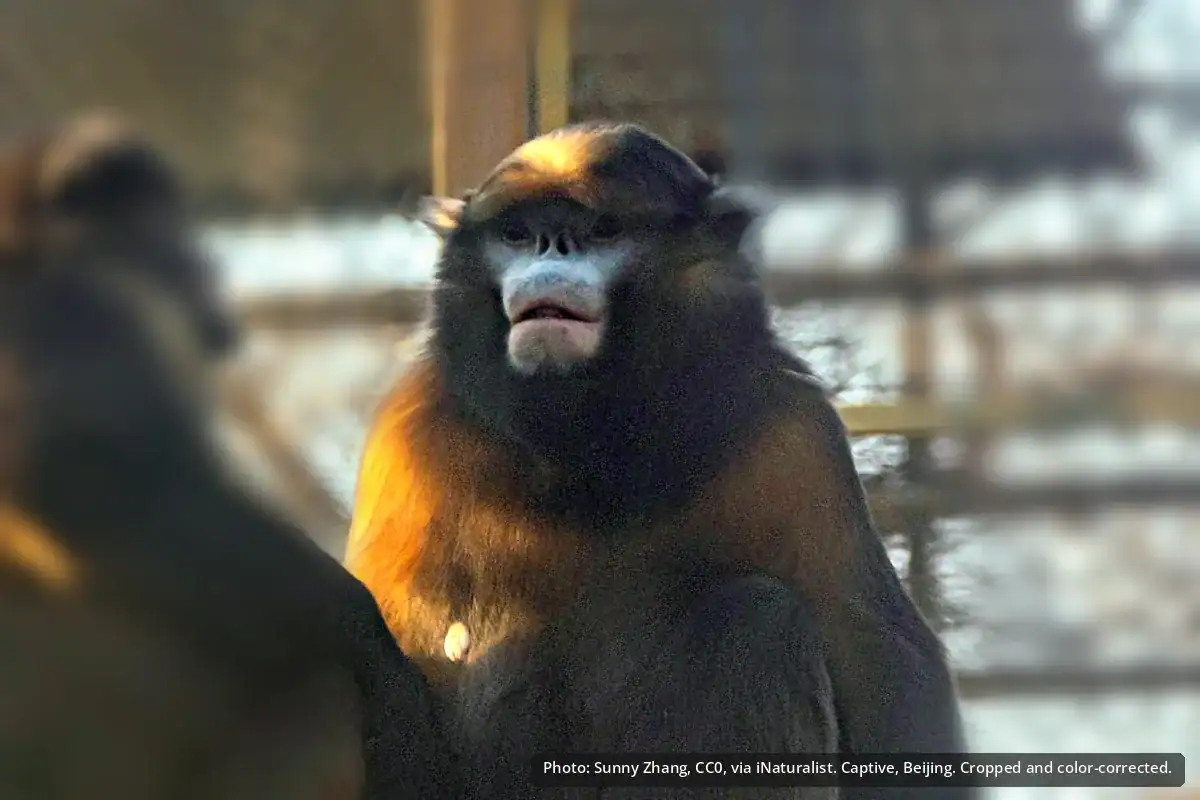
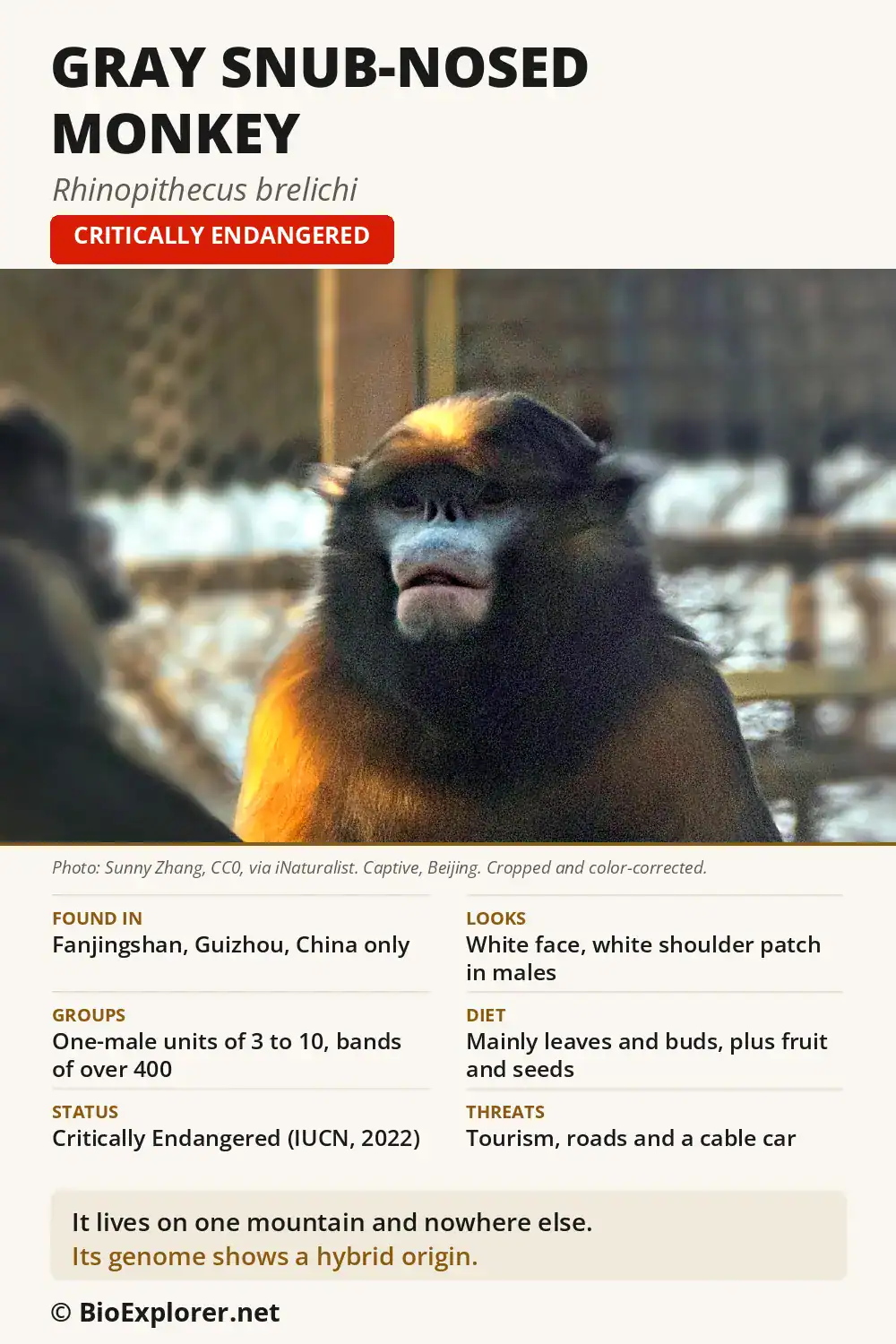
The gray snub-nosed monkey lives on a single mountain in China. Its scientific name is Rhinopithecus brelichi.[1] It is also called the Guizhou snub-nosed monkey. The IUCN lists it as Critically Endangered.[2] It is one of the rarest Old World monkeys.
This Critically Endangered monkey lives only on Fanjingshan, China.
- Common NamesGray snub-nosed monkey, Guizhou snub-nosed monkey, Brelich's snub-nosed monkey
- Taxonomy Classification Year1903
- Monkey Size66 to 72 cm (26 to 28 in), head and body
- Skin Color(s)Dark brown back fading to gray, white face, white shoulder patch in males, black hands and feet
- HabitatMixed broadleaf and conifer mountain forest, about 1,400 to 2,100 m
- DietMainly leaves and buds, plus fruit, seeds, flowers and some insects
- Native CountriesChina
- Adult males carry a white patch of fur between the shoulders.
- Its tail is nearly half again as long as its body.
- Its bare white face has dark bluish skin around the eyes.
- A genome study traced its origin to ancient hybridization.
- Fanjingshan became a UNESCO World Heritage Site in 2018.
Gray Snub-nosed Monkey Distribution
 )
Gray Snub-nosed Monkey Guide:
Name and Classification
Oldfield Thomas named this monkey in 1903.[3] Henry Brelich obtained the skin from a hunter. He presented it to the National Museum. The type was a female with a glossy slaty gray back. It already showed the white patch between the shoulders. For decades the species was known from only two specimens.[4]
It belongs to the genus Rhinopithecus, the snub-nosed monkeys. The genus has five living species. Its relatives include the Tonkin snub-nosed monkey of Vietnam. The Myanmar snub-nosed monkey is another. The gray species was formerly a golden snub-nosed monkey subspecies. It is now recognized as a full species.
In 2023, a genome study revealed its unusual origin.[5] It has mixed ancestry from two lineages. One is the golden snub-nosed monkey. The other is the ancestor of the black and Myanmar snub-nosed monkeys. It is a rare primate species born from hybrids. Its mosaic coat may have helped keep it apart from both parents.
Mitochondrial trees place it closest to the golden species.[6] Whole-genome estimates date their split near 1.07 million years ago.
Physical Description
Its back is dark brown above, blending to grayish lower down. Those tones make it one of the gray monkeys. It also counts among the brown monkeys of China.
Adult males have a white patch of fur between the shoulders. They also have red hair on the back of the head. In adult males, the underside and inner limbs are bright gingery red. On the chest and belly, black hairs overlie the red.
Its hands and feet are blackish. Its tail is black and rather curly at the base. That dark fur places it among the black monkeys as well. The tail ends in a white tip.
The face is bare and white, with black cheeks. Dark bluish skin surrounds the eyes. Its brow is gingery red, and its ears are tipped with white. Unlike its relatives, it lacks furred wedges on the cheeks.
Adult males have a white scrotum and white nipples. Infants are grayish white. They turn darker gray as juveniles.
Size and Weight
Head-body length is 66 to 72 cm (26 to 28 in). The handbook does not split this by sex. The tail measures about 97 cm (38 in). That is nearly 150% of head-body length.
Males weigh 14 to 15 kg (31 to 33 lb). Females weigh about 8 kg (18 lb). So males are nearly twice as heavy.
Similar Species Compared
The golden snub-nosed monkey is its closest mitochondrial relative. Its long coat is yellowish red to bright golden orange.[7] Furred wedges run across its cheeks, unlike the gray snub-nosed monkey. Adult males grow fleshy flaps at the corners of the mouth. It lives in central China, far north of Guizhou. The IUCN lists it as Endangered.[8]
The black snub-nosed monkey lives far to the west.[9] It is blackish gray above, with white underparts. White fur rings its face, and its muzzle is bright pink. It lives at 3,000 to 4,700 m. No other nonhuman primate lives higher. The IUCN also lists it as Endangered.[10]
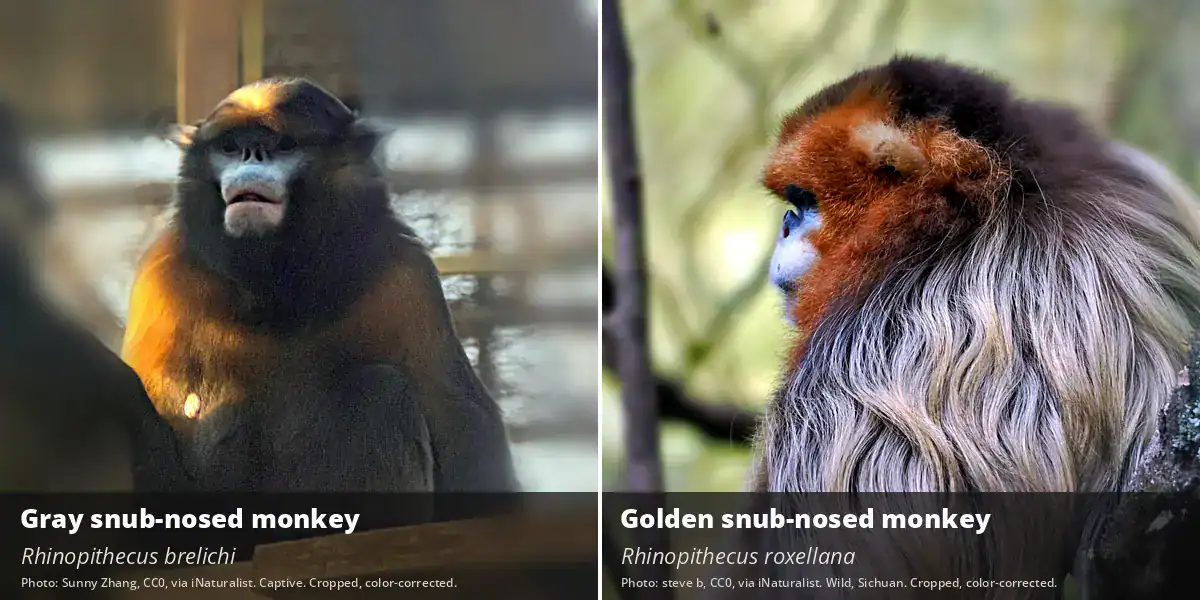
| Trait | Gray snub-nosed monkey | Golden snub-nosed monkey | Black snub-nosed monkey |
|---|---|---|---|
| Scientific name | Rhinopithecus brelichi | Rhinopithecus roxellana | Rhinopithecus bieti |
| Range | Fanjingshan, Guizhou, China only | Gansu, Shaanxi, Sichuan and Hubei, China | Southeastern Tibet and northwestern Yunnan, China |
| Habitat | Mixed broadleaf and conifer forest, about 1,400 to 2,100 m | Conifer, deciduous and rhododendron forest, 1,800 to over 3,000 m | Conifer, evergreen and deciduous forest, 3,000 to 4,700 m |
| Coat and key marks | Dark brown and gray, white face, white shoulder patch in males | Golden to red-orange coat, whitish muzzle, violet skin around eyes | Blackish gray above, white underparts and face ring, pink muzzle |
| Head and body | 66 to 72 cm, sexes pooled | Males 56 to 83 cm | Males about 83 cm |
| Tail | About 97 cm, sexes pooled | Males 61 to 104 cm | 52 to 75 cm, sexes pooled |
| Weight | Males 14 to 15 kg | Males 15 to 19 kg | Males 15 to 17 kg |
| Diet | Mainly leaves and buds, plus fruit, seeds and flowers | Lichens, fruit, seeds and leaves, plus bark | Mainly lichens, plus leaves |
| Group size | One-male units of 3 to 10, bands of over 400 | Groups of 20 to 30, troops of up to 600 | Bands of about 24 to 370 |
| IUCN status | Critically Endangered (assessed 2022) | Endangered (assessed 2015) | Endangered (assessed 2015) |
Range and Distribution
The gray snub-nosed monkey is endemic to southwestern China. It lives only in Fanjingshan National Nature Reserve. The reserve lies in the Wuling Mountains of Guizhou Province. The Red List gives its area as 419 km² (162 sq mi). UNESCO says the monkey lives nowhere else on Earth.[11]
Within the reserve, it uses only a small area. A 2020 study estimated its occupied area at 27.8 km².[12] That is just 6.6% of the reserve. The monkeys live in the reserve's northern part. Another 28.5 km² of suitable habitat lies to the south. An aerial tram now cuts the monkeys off from it.
The Red List rates its extent of occurrence below 100 km². It counts only one location. A nearby provincial reserve, Yangxi, is largely unexplored. The monkey has never been confirmed there.
Habitat and Elevation
It lives in steep, rugged mountain forest. The forest is mixed deciduous, broadleaf evergreen or coniferous. Twenty years of records place it between 1,432 and 2,100 m. Fanjingshan is foggy for most of the year. Snow is common in winter.
In harsh cold, the Red List says, they descend to rivers. They go as low as 1,200 m. One study band showed no such winter move.[13] It stayed between 1,350 and 1,870 m all year. Each morning the band climbed uphill. Each afternoon it moved back down.
It shares the reserve with the Tibetan macaque. The Red List also lists the rhesus macaque as sympatric.
Camera traps caught a surprise in 2011.[14] A quarter of the 24 recorded events came at night. One group was moving around 3 a.m. Researchers had thought the species was active only by day.
Diet and Feeding
A field study at Yangaoping recorded 107 food plant species.[15] These came from 58 genera and 28 families. Young leaves made up 25.5% of feeding records. Mature leaves made up 21.8%, and fruits and seeds 21.6%. Buds made up 15.3%, and flowers 9.4%. That mostly plant diet places it among the herbivorous monkeys.
Its diet shifts with the seasons. In spring, it eats young leaves and flowers. In summer, it adds unripe fruits and seeds. Ripe fruits and seeds dominate in autumn. In winter, it turns to mature leaves and buds. Buds of a magnolia, Magnolia sprengeri, are a key winter food.
It also digs out food. It eats seeds, young bamboo and invertebrates from decayed wood. This extractive foraging averaged about 26% of feeding records.[16] That is unusual for a leaf-eating colobine.
Behavior and Groups
It is active by day and lives mostly in trees. It climbs, leaps and walks on all fours.[17] It sometimes swings by its arms. Groups often cross open ground on foot.
Family groups hold one adult male and several females. They number about 5 to 10 animals. All-male groups of 2 to 5 stay at band edges. Many family groups travel together as loose bands. These can merge into gatherings of more than 400. On cold days, the monkeys huddle in dense evergreen trees.
Breeding and Young
Mating runs from summer into autumn, peaking in September. Births are strictly seasonal, from late March to late April.[18] Captive and wild records both show this pattern.
Each female bears a single infant. In captivity, females first gave birth at about 8.6 years. The mean interbirth interval was 38.2 months. That is longer than in golden or black snub-nosed monkeys.
Population and Status
The IUCN reassessed it as Critically Endangered in March 2022. It had been listed as Endangered since 1988. The assessment estimates about 200 mature individuals. It puts the total at no more than 650, likely nearer 400. It also estimated a decline of about 10% in four years.
Counts have varied widely over time. A 2007 to 2008 survey reported about 750 monkeys in four subpopulations.[19] A 2020 habitat model estimated only 125 to 336. That model multiplied habitat area by density; it was not a count.
The IUCN Green List reports a 2023 census by local agencies.[20] That census found about 800 monkeys. Its report has not been published in a journal.
Low Genetic Diversity
Its mitochondrial DNA diversity is the lowest in its genus.[21] One study found only five haplotypes in 141 monkeys. Nuclear DNA tells a different story.[22] There, diversity is high and similar to other snub-nosed monkeys. The mtDNA indicates declining female effective population size. The decline began about 3,500 to 4,000 years ago. That timing matches the spread of farming nearby.
Major Threats
Tourism and its infrastructure threaten its habitat. Roads and cable cars were built for visitors. The 2022 assessment reported 1.4 million visitors since 2018. After a tram opened in 2009, monkeys left parts of the park.
Some monkeys are hunted for meat and traditional medicine. Others are caught in snares set for other animals. Wood cutting, building and illegal mining also harm its forest. Its small, isolated population faces an inbreeding risk.
Conservation Efforts
It is listed on CITES Appendix I. China protects it as a Category I species. Its whole known range lies inside one protected area.
UNESCO inscribed Fanjingshan as a World Heritage Site in 2018. The listing covers the monkey's entire known home range. In 2024 the reserve joined the IUCN Green List.
The reserve keeps a small captive colony at Beijing Zoo. Captive breeding has been slow. The Red List calls for new surveys and published counts.
Explore more monkeys starting with G. Or browse all types of monkeys.
Common Questions
The gray snub-nosed monkey lives only on Fanjingshan, in Guizhou, China.
Yes. The IUCN listed the gray snub-nosed monkey as Critically Endangered in 2022.
A 2020 model estimated 125 to 336 gray snub-nosed monkeys. A 2023 agency census reported about 800.
The gray snub-nosed monkey eats mostly leaves, buds, fruits, seeds and flowers.
A male gray snub-nosed monkey weighs 14 to 15 kg. Females weigh about 8 kg.
Yes. The gray snub-nosed monkey has mixed ancestry from two lineages.
Cite this page
BioExplorer. (2026, November 2). Gray Snub-Nosed Monkey. https://www.bioexplorer.net/animals/mammals/monkeys/gray-snub-nosed-monkey/
About the author

Wildlife Writer and Photographer, BioExplorer.net
Arjun is a science writer and wildlife photographer at BioExplorer.net. He turns new research on animals into clear, accurate reads for curious readers. His work covers animal behavior, ecology, and newly described species. He holds a Cornell Lab of Ornithology certificate in bird biology. He is pursuing an HBSc at the University of Toronto Mississauga.