
Bouvier’s Red Colobus
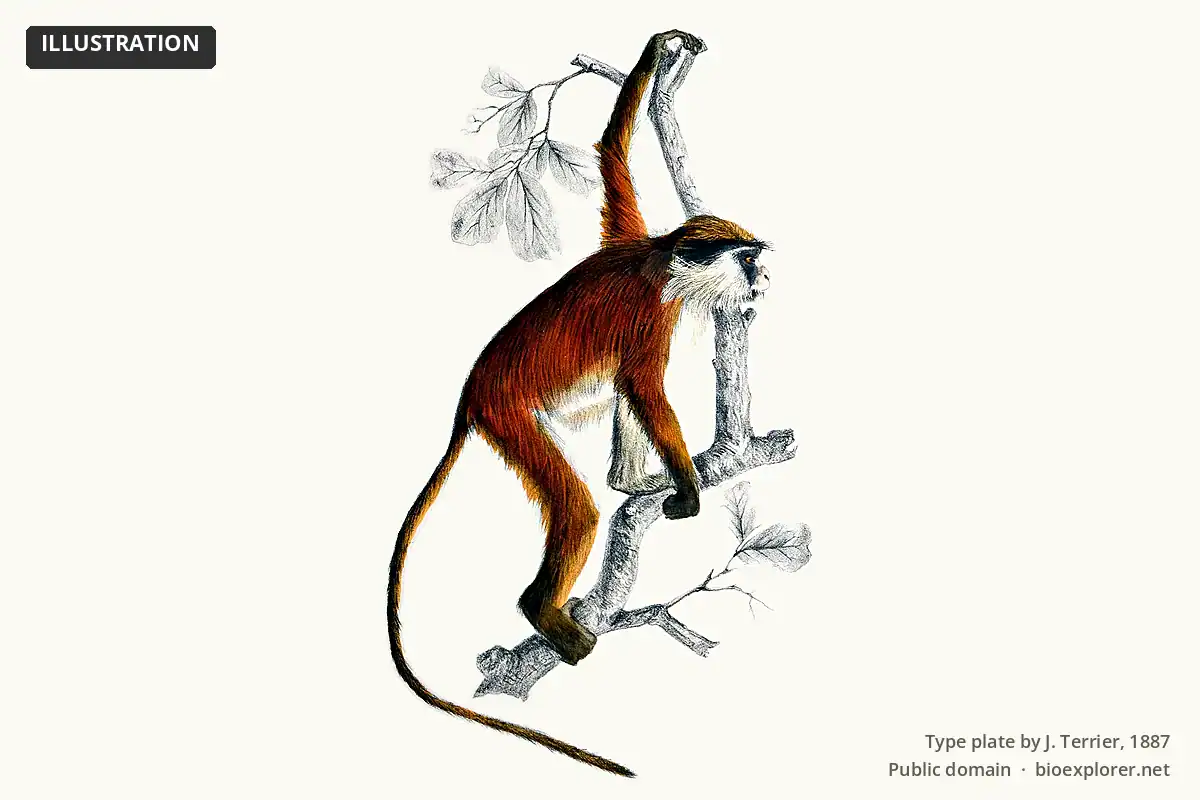
The Bouvier's red colobus is a rare monkey of the Congo Basin. Its scientific name is Piliocolobus bouvieri.[1] It lives only in the Republic of the Congo.[2] Its glossy red coat frames a strikingly pale, pinkish face.[3] It is one of the Old World monkeys. As recently as 2007, it was feared extinct. Photos taken in 2015 proved it still survives. The IUCN lists it as Endangered.
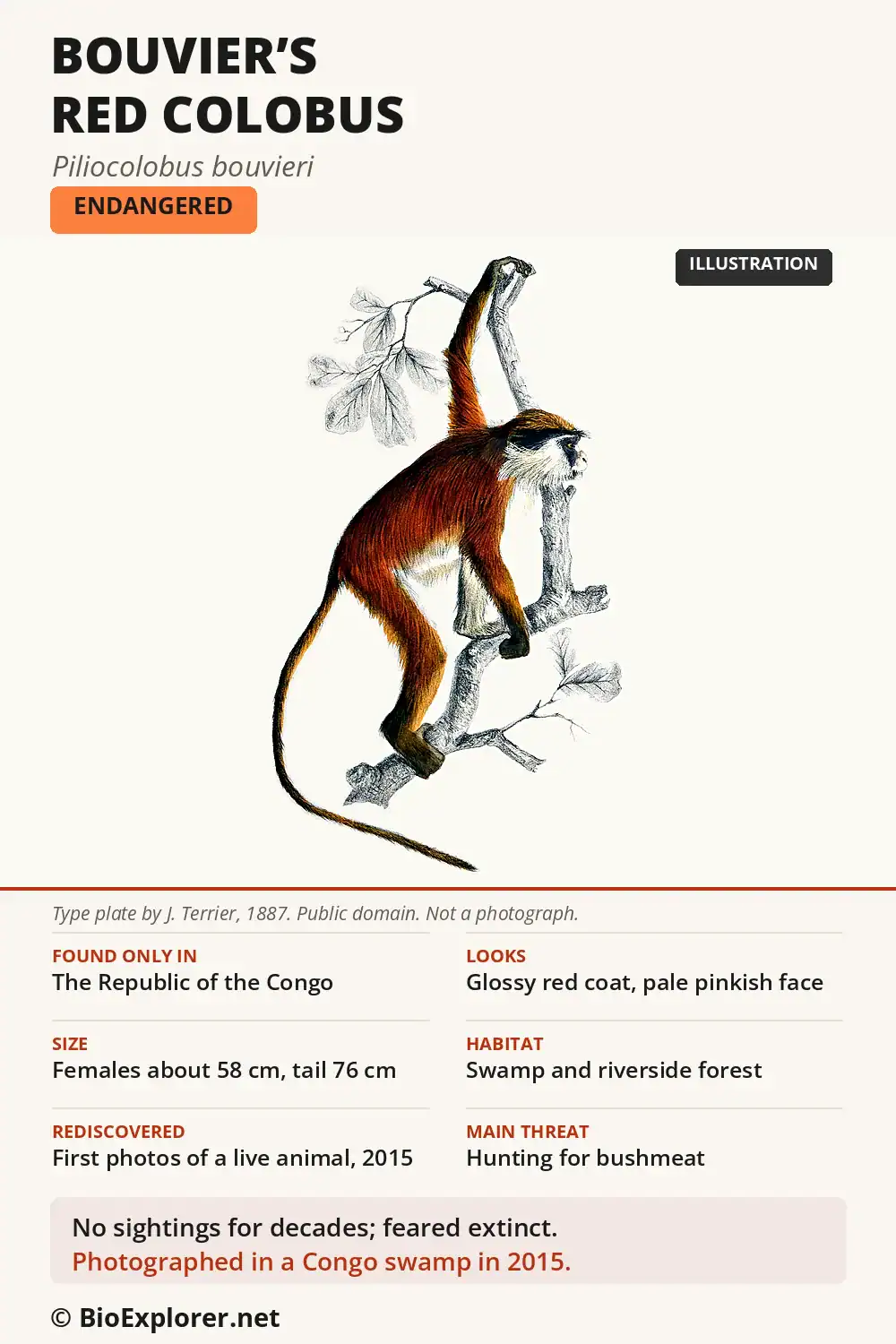
This Endangered colobus lives only in the Republic of the Congo.
- Common NamesBouvier's red colobus, Colobe de Bouvier (French)
- Taxonomy Classification Year1887
- Monkey SizeFemales: head and body about 58 cm, tail about 76 cm
- Skin Color(s)Glossy red coat, narrow blackish mantle, pale pinkish face
- HabitatSwamp forest and riverside gallery forest
- DietLeaves, fruit, flowers and buds; possibly seeds
- Native CountriesRepublic of the Congo
- The first photos of a living animal were taken in 2015.
- Its pale, pinkish face sets it apart from other red colobus.
- Its known measurements come from two female specimens.
- A group was found in Lesio-Louna Reserve in 2016.
- No population estimate exists for this species.
Bouvier's Red Colobus Distribution
 )
Bouvier's Red Colobus Guide:
Name and Classification
A. T. de Rochebrune named this monkey Piliocolobus bouvieri in 1887. He described it in a Paris book on the fauna of Senegambia. His notes on where it lived were vague. They even listed Gambia and Casamance, far to the west.
In 1939, Allen picked Gambia as the type locality. Moreau and colleagues disagreed in 1946. They named Mongo, on the right bank of the Congo River. Mongo lies above the mouth of the Alima River.
In 1914, Matschie described a red colobus from the Sangha River. He called it Colobus likualae.[4] Its type was an adult female, collected in 1913. That name is now a synonym of Bouvier's red colobus.
It belongs to the genus Piliocolobus, the red colobus. They are part of the wider group of colobus monkeys.
Many experts once ranked it as a subspecies of Pennant's red colobus. The Niger Delta red colobus shared that rank. A 2003 scheme also placed Preuss's red colobus there. A wider 1999 grouping took in Foa's red colobus too. It also included Lang's red colobus.
Colin Groves raised Bouvier's red colobus to a full species in 2007. The IUCN still assessed it as a Pennant's subspecies in 2016.
The 2013 handbook knew of no DNA studies of this monkey. Pennant's red colobus looks similar in many ways, but darker.[5]
Physical Description
Its fur is glossy red above. A narrow, blackish mantle runs down to mid-back. The underparts are paler, partly brown and rufous. The thighs and flanks are a yellower rufous.
The tail is dark at the root. Toward the tip, it turns golden brown to brownish rufous.
The crown is red, with no whorls of hair. A stiff black band runs above the eyes. A black brow band reaches back onto the temples. A small tuft grows behind each ear.
The face is its best field mark. It is light slate, with large pink eye rings. Some faces are flesh colored, with blackish cheekbones and brows. Others are darker, with only the nose and lips pale. Rochebrune called the face "rosy flesh." He noted pale, rosy ears too.
White hairs cover the chin. The bare sitting pads are pink.
That glossy coat places it among the red monkeys.
Size and Weight
The handbook's figures come from just two female specimens. Their head and body length was about 58 cm (22.8 in). Their tails were about 76 cm (29.9 in).
That makes it a fairly small red colobus, with a long tail. The handbook gives no measurements for males. No weight is known for either sex.
Similar Species Compared
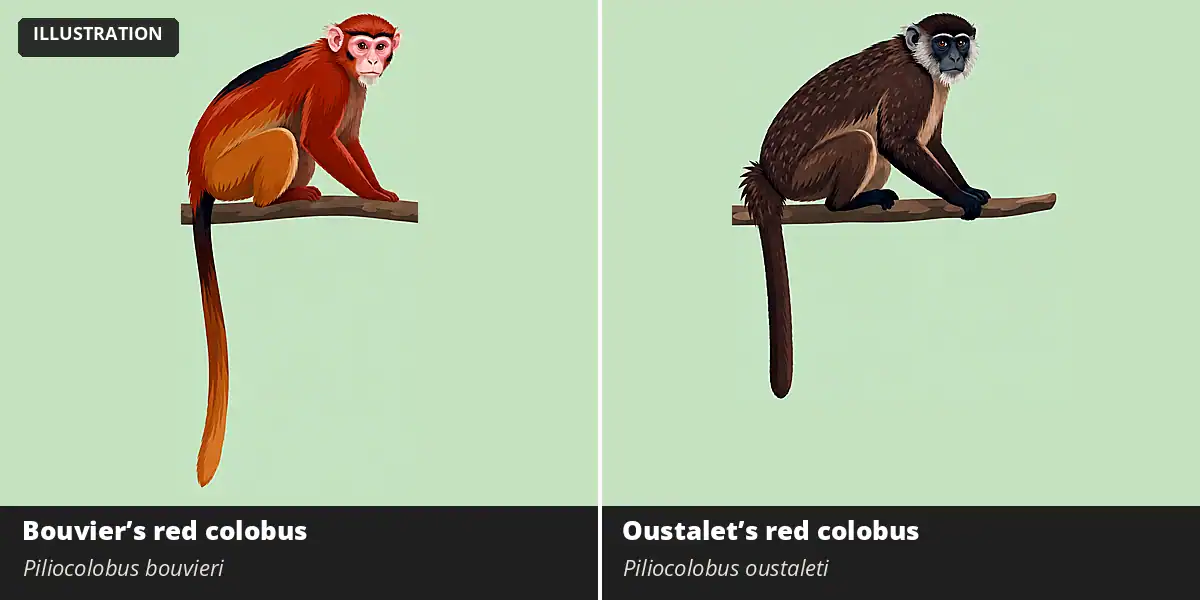
Only one other red colobus lives in the Republic of the Congo.[6] It is Oustalet's red colobus. Its range stops at the Sangha River in the west.[7] Bouvier's red colobus lives just west of that river. Near the Sangha, the two ranges come very close. Yet no intermediates between them are known.[8] Oustalet's is dark, speckled smoky brown above. Its crown barely contrasts with its back, and its hands are dark. Bouvier's is glossy red, with a pale pink face.
Pennant's red colobus lives on Bioko Island, in Equatorial Guinea. It has near-black shoulders, bright red flanks and a black face. Its tail is black above and deep red below. The IUCN lists it as Critically Endangered.[9]
Thollon's red colobus is also called the Tshuapa red colobus. It lives only south of the Congo River.[10] It is foxy red above and creamy white below.[11] It is one of the Democratic Republic of the Congo monkeys.
| Trait | Bouvier's red colobus | Oustalet's red colobus | Pennant's red colobus | Thollon's red colobus |
|---|---|---|---|---|
| Scientific name | Piliocolobus bouvieri | Piliocolobus oustaleti | Piliocolobus pennantii | Piliocolobus tholloni |
| Range | Republic of the Congo only | Northern DR Congo, northeastern Republic of the Congo, southern Central African Republic; possibly extinct in South Sudan | Bioko Island, Equatorial Guinea, now mainly the southwest | DR Congo, south of the Congo River |
| Habitat | Swamp forest and riverside gallery forest | Lowland moist, swamp and gallery forest, and savanna woodland | Lowland and montane forest, sea level to at least 1,500 m | Lowland flooded moist primary rainforest |
| Coat and key marks | Glossy red, narrow blackish mantle, pale pinkish face with pink eye rings | Dark speckled smoky brown above, crown barely contrasting, dark hands and feet; very variable | Near-black shoulders, bright red flanks, black crown and face, white cheek whiskers | Foxy red above, creamy white below, dark hands, feet and tail tip |
| Head and body (females) | About 58 cm, from two specimens | 52 to 64 cm | About 64 cm | 58 to 60 cm, from three specimens |
| Tail (females) | About 76 cm | 68 to 73 cm | About 66 cm | 41 to 69 cm, from three specimens |
| Weight (females) | Not known | 8.2 kg | About 5.8 kg | Not known |
| Diet | Leaves, fruit, flowers, buds, possibly seeds | Leaves, fruit, flowers, buds; enters water for plant bulbs at one site | Leaves, fruit, flowers, buds, possibly seeds | Mostly young leaves, with many seeds |
| Group size | Not known | 3 to 18 at one site | 5 to 30 | 5 to 63 at one site |
| IUCN status | Endangered (assessed 2019, published 2022) | Vulnerable (assessed 2018, published 2020) | Critically Endangered (assessed 2016, published 2019) | Vulnerable (assessed 2019, published 2020) |
Range and Distribution
It is found only in the Republic of the Congo. Its whole range lies on the right bank of the Congo River.
Its older known range was small. It ran along the lower Alima River. It reached the mouth of the Likouala-aux-Herbes. That area lies west of the Sangha River.
Two populations are known today. The northern one lives west of the Sangha River. It also lies east of the Bokiba and Likouala rivers. Surveys in 2007, 2014, 2015 and 2019 confirmed it there. It was recorded on five occasions in all. The records came from the Ngombe logging concession and Ntokou-Pikounda National Park.
The southern population was long thought lost. Surveys there in the mid-1990s found no red colobus. Then, in 2016, a group turned up in Lesio-Louna Reserve. It lived in gallery forest along the Loubilika River. This is the least accessible part of the reserve.
It is recorded from 200 to 800 m (660 to 2,620 ft).
Habitat Needs
It is a largely arboreal monkey. In the north, it lives in swamp forest. These forests flood for part of the year, or all of it. In the south, it uses riverside gallery forest.
The action plan says it seems to prefer riparian and swamp forest. Its wet lowland forests place it among the types of rainforest monkeys.
Diet and Behavior
The handbook lists young and mature leaves in its diet. Fruit, flowers and buds are listed too, and possibly seeds. That plant diet places it among the herbivorous monkeys.
It is active by day and lives in the trees. Its group size, home range and breeding are all unknown.
Like all red colobus, it moves slowly and is easy to hunt. In northern Congo, a female and her infant stayed visible 15 minutes. They watched the observers.
Lost and Found Again
WCS said it was known from just a few museum specimens.[12] They came from three localities, more than 100 years earlier. The last unverified sightings were in the 1970s. A major 2013 handbook said it might be extinct.
WCS surveys recorded red colobus in the area in 2007 and 2014. But encounters were rare, and no one took a photo.
In February 2015, two researchers set out to find it. They were Lieven Devreese and Gaël Elie Gnondo Gobolo. Their local guides knew the monkeys' calls and habits. They led the team to a group in swamp forest. It was along the Bokiba River, inside Ntokou-Pikounda National Park. There the team photographed a mother and her infant.
WCS announced the find on April 16, 2015. Devreese said the photos were the world's first. He said they confirmed the species was not extinct.
The park covers 4,572 square km (1,765 sq mi). It was created in 2013, on WCS advice.
Population and Status
No population estimate exists. Recent surveys have been intensive. Yet records of this monkey are few and far between. The action plan suggests it is now rare wherever it occurs.
The Red List says it is certainly declining because of illegal hunting. Numbers have fallen in and around Lesio-Louna Reserve, where it is hunted.
The IUCN lists it as Endangered under criterion A2d. That means a suspected decline of at least 50% over three generations. The period runs from 1990 to 2019. Poaching is the main cause, with some habitat loss. One generation lasts about 9 to 10 years.
It was listed as Critically Endangered in 2000, 2008 and 2016. The 2019 assessment moved it down to Endangered. The reason was newly found populations in northern Congo. That 2019 assessment was published in amended form in 2022.
Major Threats
Hunting is the main threat. It is hunted illegally for food and sold in bushmeat markets.
A 2015 survey report by Lieven Devreese gathered evidence of hunting. One hunter claimed he killed over 60 red colobus on one trip. He also found heavy commercial trade on the Likouala and Sangha rivers. That trade may have shrunk, as people feared catching Ebola.
Logging brings its own risks. Logging roads open the forest to hunters. Workers who move into concessions add to the pressure. The logging itself may matter less. It seems to prefer swamp forest.
In the south, charcoal is the looming threat. Brazzaville, the capital, lies four hours away by paved road. Its demand for charcoal is very high. Kinshasa, across the river, may add to that demand.
Conservation Efforts
It occurs in two protected areas. They are Ntokou-Pikounda National Park and Lesio-Louna Reserve. Its range also overlaps the Lefini Reserve.
Most of its population likely lives in the Ngombe logging concession. Ngombe is certified by the Forest Stewardship Council. The 2021 action plan called its anti-poaching efforts highly effective. It also reported selective logging and roads blocked after harvest.
Anti-poaching teams have been deployed in the national park. A 2020 wildlife survey there still encountered red colobus.
The action plan names three priority sites. They are Ntokou-Pikounda, Lesio-Louna and the Ngombe concession. It sets a budget of US$70,000 for this species.
Congo's 2011 list of fully protected animals covers all colobus.[13] Such animals may be killed or captured only for science. The species is also listed on CITES Appendix II. The African Convention lists it in Class B.
Explore more monkeys starting with B. Or browse all types of monkeys.
Common Questions
It lives only in the Republic of the Congo. It uses swamp forest and riverside forest.
Its fur is glossy red, with a narrow blackish mantle. Its pale, pinkish face has large pink eye rings.
No. Researchers photographed a mother and infant in 2015. A group was also found in the south in 2016.
Yes. The IUCN lists it as Endangered. Hunting for bushmeat is the main threat.
Two measured females had a head and body about 58 cm long. Their tails were about 76 cm.
No one knows. No population estimate exists, and sightings are rare.
Cite this page
BioExplorer. (2026, November 2). Bouvier’s Red Colobus. https://www.bioexplorer.net/animals/mammals/monkeys/bouviers-red-colobus/
About the author

Wildlife Writer and Photographer, BioExplorer.net
Arjun is a science writer and wildlife photographer at BioExplorer.net. He turns new research on animals into clear, accurate reads for curious readers. His work covers animal behavior, ecology, and newly described species. He holds a Cornell Lab of Ornithology certificate in bird biology. He is pursuing an HBSc at the University of Toronto Mississauga.