What Animals Live In Rainforests?
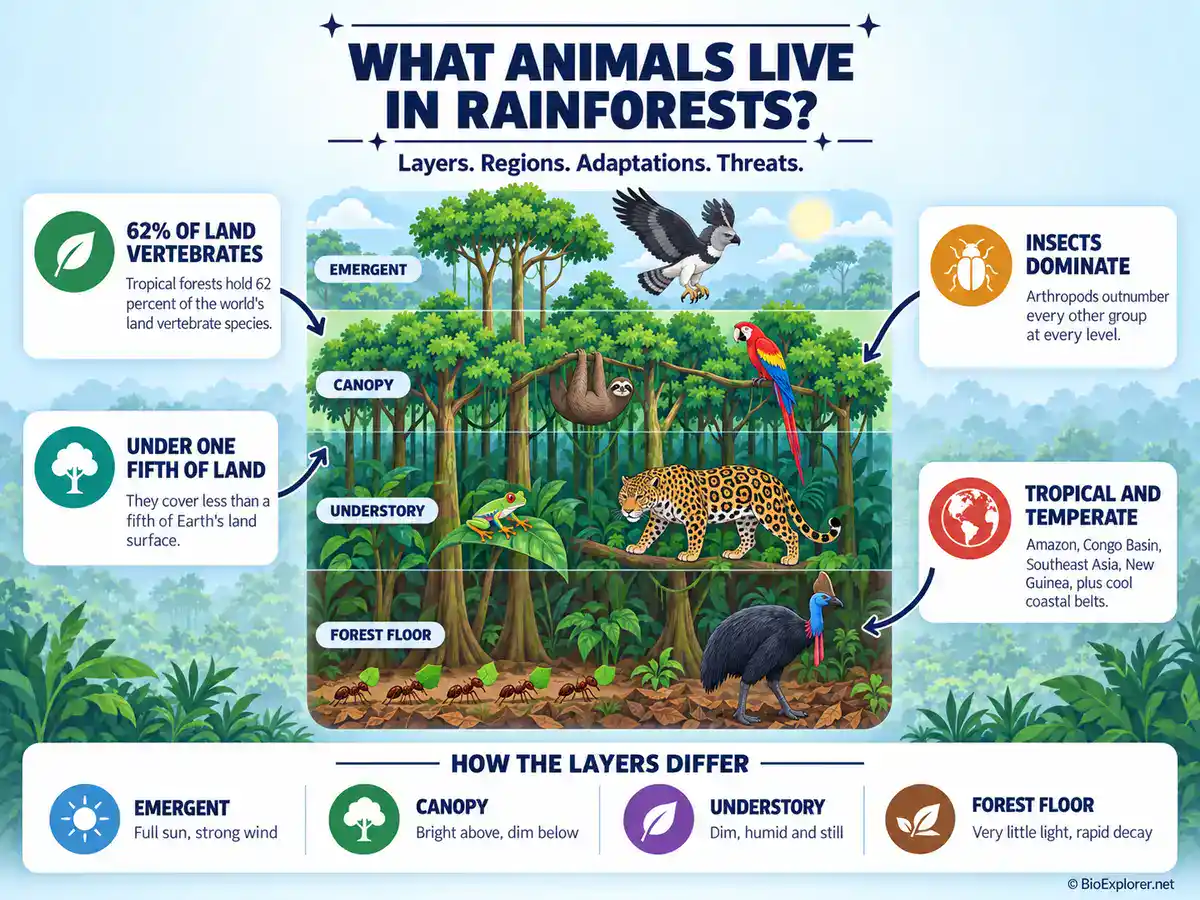
Rainforests are home to mammals, birds, reptiles, amphibians, fish, and invertebrates. Tropical forests hold 62 percent of the world’s land vertebrate species on less than one fifth of the world’s land area.
Familiar examples include jaguars, sloths, scarlet macaws, harpy eagles, poison dart frogs, green anacondas, leafcutter ants, and blue morpho butterflies.
No single animal defines a rainforest. Heavy year round rainfall does, and the thresholds are set out below. What that rainfall supports across many tropical rainforests is the feature most people picture.
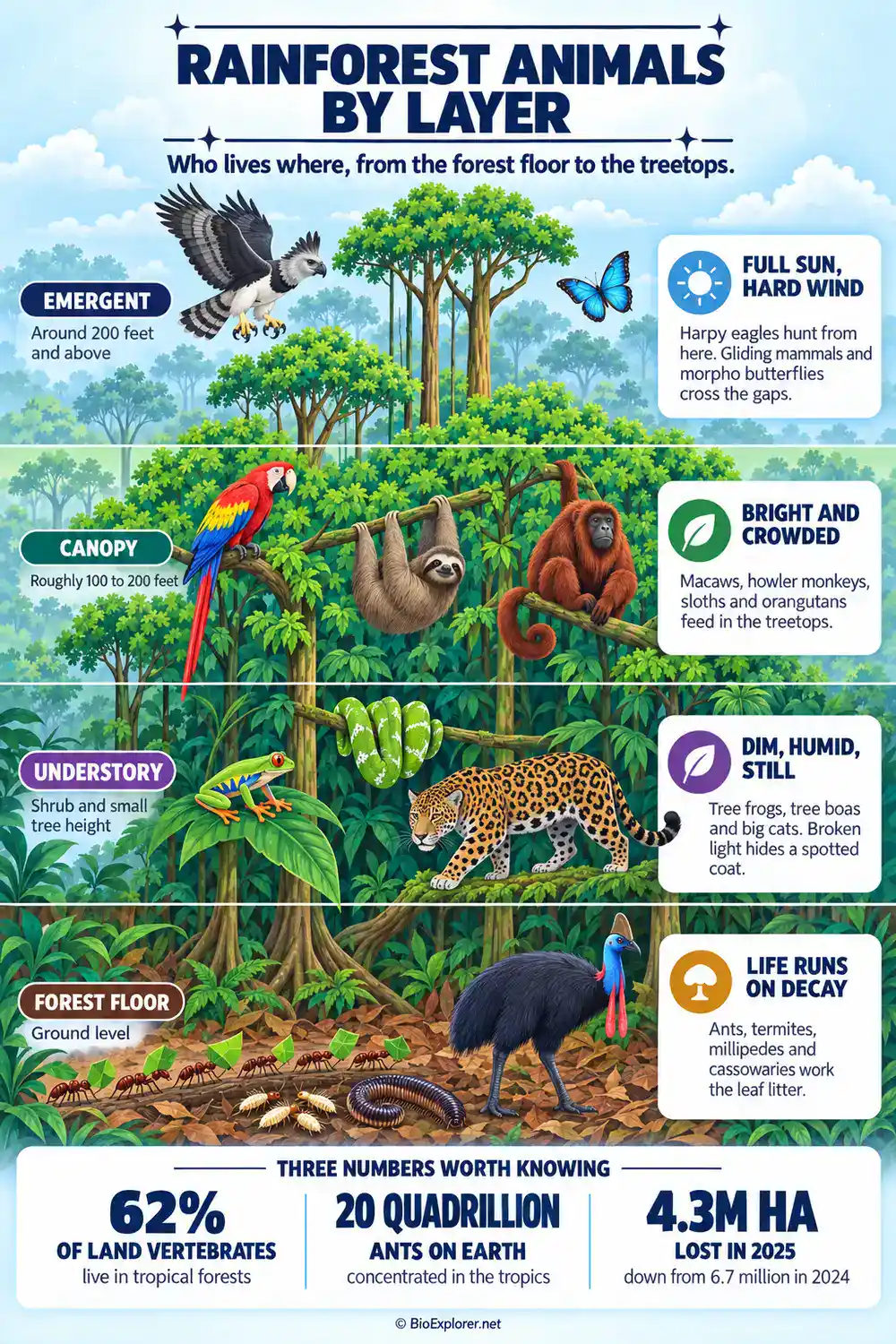
Large numbers of species live packed into a small space, stacked in layers from the soil to the treetops. A jaguar on the forest floor, a howler monkey in the canopy, and a harpy eagle above both are living in the same forest at different heights.
This guide covers what a rainforest is and how many animals live there. It then works through the layers, the adaptations that make rainforest life possible, and the species found in each major rainforest region.
Rainforest Animals Guide:
- Summary of key facts
- What counts as a rainforest?
- Overview of rainforest animal diversity
- Which layer each animal lives in
- Unique adaptations of rainforest animals
- Mammals in rainforests
- Birds in rainforests
- Reptiles and amphibians in rainforests
- Insects and other invertebrates
- Rainforest animals by region
- Small rainforest animals
- How rainforest animals fit the food web
- Threats to rainforest animals
- Rainforest animals at a glance
- Common misconceptions
- Frequently asked questions
- References
Summary of key facts
| Question | Answer |
|---|---|
| What animals live in rainforests? | Mammals, birds, reptiles, amphibians, fish, and invertebrates. Common examples are jaguars, sloths, macaws, harpy eagles, poison dart frogs, anacondas, and leafcutter ants. |
| How many species live in tropical forests? | Tropical forests hold 62 percent of the world’s terrestrial vertebrate species. |
| How much land do they cover? | Less than one fifth of Earth’s land surface. |
| Which animal group is most numerous? | Insects and other arthropods. One Panamanian forest survey collected 5,858 arthropod species from a single reserve. |
| Where do most rainforest animals live? | It depends on the group. Arthropod richness peaks in the canopy, while amphibians and small mammals get less common toward it. |
| Which region has the most species? | The Neotropics, meaning Central and South America, hold nearly half of all tropical forest vertebrates. |
| Are all rainforests tropical? | No. Temperate rainforests grow in cool, wet coastal regions such as the Pacific Northwest. |
| How much rain does a rainforest get? | Tropical rainforests receive roughly 2,000 to 10,000 millimeters per year. |
| What is the largest rainforest predator? | The jaguar on land in the Neotropics. The black caiman is one of the largest top predators in Neotropical waters. |
| What is the main threat to rainforest animals? | Loss of forest. Tropical primary forest loss hit a record 6.7 million hectares in 2024, then fell to 4.3 million in 2025. |
What counts as a rainforest?
Rain and warmth define the biome
A rainforest is a forest that receives heavy rainfall through most of the year. Tropical rainforests sit between the Tropic of Cancer and the Tropic of Capricorn. They receive about 2,000 to 10,000 millimeters of rain per year, which is 79 to 394 inches.
Average daily temperatures stay between 20 and 25 degrees Celsius, or 68 to 77 degrees Fahrenheit. Canopy trees can reach 75 meters, roughly 250 feet.[1]
Those conditions matter for animals, though they are easy to overstate. No winter means no freeze to survive and no need to leave the region. It does not mean the year is uniform.
Most tropical rainforests swing between wetter and drier seasons, and those swings drive real changes in behavior. Flood pulses open the forest to river dolphins. Dry seasons shrink pools and concentrate fish for caimans.
Fruit shortages push mandrills into different habitat. What the tropics offer is a food supply that never fully shuts down, which lets an unusually large number of narrow specialists live side by side.
Tropical and temperate rainforests
Not every rainforest is tropical. Temperate rainforests grow in cool coastal regions where ocean storms deliver heavy year round rain. The rain forest valleys of Olympic National Park in Washington State receive 140 to 167 inches of precipitation a year, or 12 to 14 feet. Temperatures rarely freeze and rarely pass 80 degrees Fahrenheit.
Sitka spruce and western hemlock dominate, some trees reach 250 feet, and mosses, ferns, and lichens coat the trunks. Fallen trees act as nurse logs, giving seedlings a raised place to germinate above the dense ground cover.[2]
The animals differ, though the line is not as clean as it looks. A temperate rainforest holds elk, black bears, salamanders, and slugs. Whole animal groups are rarely confined to the tropics.
The Japanese macaque is the most northerly living non-human primate. In the Chubu Sangaku National Park of the Japanese Alps it lives in one of the coldest areas in the world. When snow cover hides its usual food it feeds on brown trout and riverine insects.[3]
What separates tropical from temperate rainforest is not which groups are present but how many species each holds. Only the tropical version carries the extraordinary counts the word usually brings to mind.
Is a jungle the same as a rainforest?
“Jungle” is a popular term, not a scientific one. It usually describes dense, tangled growth at ground level. That kind of growth appears where sunlight reaches the floor, such as along rivers, at forest edges, and in gaps left by fallen trees.
Inside mature tropical rainforest the canopy blocks nearly all the light, so the floor is comparatively open and easy to walk through.
Tropical forests are also more vertically complex than temperate forests. A temperate forest typically has two or three main layers. A tropical forest can have as many as five.
Many tropical rainforests grow on surprisingly poor soils, though fertility varies a great deal between regions. Where soils are poor, the nutrients sit in living plant tissue and in the thin layer of decomposing litter rather than in deep soil. Isotope studies found that more than 99 percent of nutrients added to the system stayed in surface root mats.[4]
Overview of rainforest animal diversity
How many species live in rainforests?
The claim that rainforests hold more than half of all species on Earth has been repeated for decades without solid evidence behind it. A 2022 analysis put a real number on the vertebrate share. Researchers mapped ranges and habitat data for 33,782 land vertebrate species.
Tropical forests hold 62 percent of them, more than twice the count of any other land biome. Up to 29 percent of all vertebrate species are found nowhere but tropical forests, and more than 20 percent of those endemic species are at risk of extinction. Humid tropical forests, the forests usually called rainforests, hold more than 90 percent of tropical forest vertebrates, and the Neotropics alone hold nearly half.[5]
The figure traces back to a 1982 study that extrapolated beetle counts from 19 individuals of a single Panamanian tree species, and to a 1988 book that cited it. A 2022 analysis in Frontiers in Ecology and the Environment calls that foundation tenuous. The measured number is 62 percent of land vertebrates, which is a real and impressive figure, but it covers vertebrates only.
Invertebrates outnumber everything else
Vertebrates are the visible minority. A four year survey of the San Lorenzo forest in Panama sampled arthropods across the full height of the forest and through the seasons. It collected 113,952 individuals representing 5,858 species.
Species richness was highest in the canopy, and most adult arthropods came from either the soil and litter or the upper canopy. Vertical position explained more of the variation in which species turned up than horizontal position or time of year, accounting for 58.5 percent of the change in species composition.[6]
So the honest answer to which animals live in rainforests is insects, spiders, mites, and their relatives, by a very wide margin. Everything else is a rounding error by species count.
Which layer each animal lives in
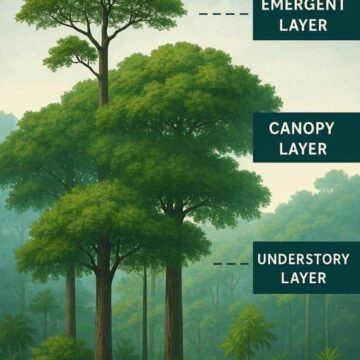
Rainforest animals are not spread evenly through the forest. They sort by height. Each layer has its own light, wind, humidity, and food supply, and most species stay in one or two of them.
The guide to the Layers of the Rainforest covers that structure in more detail.
Vertebrates sort by height
A synthesis of 62 studies across the tropics found that vertical sorting is real but not uniform across animal groups. Bat abundance was weighted toward the canopy. Bird richness and abundance varied from study to study with no single overriding pattern.
Amphibians and small mammals showed the opposite trend, declining in both abundance and richness toward the canopy. Local habitat structure and the distribution of food were the drivers cited most often, and latitude and elevation predicted bird patterns in particular. The authors describe the canopy as a critical niche space for tropical vertebrates, which is also why canopy disturbance hits these communities so hard.[7]
Vertical sorting is real, but it runs in different directions for different groups. Arthropod richness peaks in the canopy, while amphibians and small mammals get scarcer the higher you sample. Treat any claim that most rainforest animals live in the canopy as a simplification.
Insects sort by height too
A study north of Manaus in the central Amazon set Malaise traps at five heights on a metal tower, from ground level to 32 meters, and caught 37,778 insects from 18 orders. Flies, wasps and bees, and beetles were most abundant at ground level. Butterflies, moths, and true bugs were more abundant higher up.
The clearest result came from the flies. Of 856 species identified, 527 of them, or 61.6 percent, were never caught at ground level at all.[8]
The forest floor
Light barely reaches the ground in mature rainforest, so life there runs on decay rather than photosynthesis. Ants are the clearest measure of how much life that supports. A global analysis based on 489 studies estimated about 20 quadrillion ants on Earth, roughly 12 megatons of dry carbon.
That exceeds the combined biomass of all wild birds and mammals and equals about 20 percent of human biomass. Ground dwelling ants are strongly concentrated in tropical and subtropical regions, and the density of leaf litter ants is highest in forests.[9]
Layers at a glance
| Layer | Approximate height | Conditions | Typical animals |
|---|---|---|---|
| Emergent | Around 200 feet and above | Full sun, strong wind | Harpy eagle, gliding mammals, morpho butterflies |
| Canopy | Roughly 100 to 200 feet | Bright at the top, dim below | Macaws, howler monkeys, sloths, orangutans, bats, butterflies and moths |
| Understory | Shrub and small tree height | Dim, humid, still | Tree frogs, tree boas, jaguars, spiders |
| Forest floor | Ground level | Very little light, rapid decay | Ants, termites, millipedes, peccaries, cassowaries |
Unique adaptations of rainforest animals
Life in a wet, crowded, three dimensional forest selects for a distinctive set of traits. The three below are the best studied. A wider list is set out in Tropical Rainforest Animal Adaptations.
Prehensile tails
A prehensile tail is one that can grip a branch and support the animal’s weight. It is a classic answer to the problem of moving through a three dimensional maze of branches that vary in size, springiness, and spacing. Tails capable of substantial grasping have evolved independently in at least 15 families and 40 genera of mammals, including marsupials, pangolins, xenarthrans such as anteaters, carnivorans, primates, and rodents.
Sloths are not among them, despite being xenarthrans themselves. Camera trap work in the canopy of French Guiana showed the tail is not used the same way by every species. Kinkajous used the tail for both balance and weight bearing while moving and while resting.
Red howlers used it mainly for weight bearing and brown capuchins mainly for stability, and both only while resting rather than while traveling.[10]
Camouflage and disruptive pattern
Two different strategies hide an animal against a background. Background matching copies the color and texture of the surroundings. Disruptive coloration uses high contrast markings that break up the body outline so a predator cannot resolve the shape. Experimental work found disruptive patterns harder to detect than background matching, and high contrast disruptive patterns were the hardest of all to find at first. The trade-off is that predators learned to spot those same high contrast patterns faster than low contrast ones.
Camouflage is therefore judged on two counts, how well it defeats detection and how well it resists being learned.[11]
Gliding between trees
Descending to the ground is dangerous and slow, so several rainforest lineages evolved ways to cross gaps through the air. Asian flying treefrogs are the best studied amphibian example. Genome work on two species found that genes controlling limb development and the keratin cytoskeleton underpin their climbing equipment.
Gene expression analysis then traced how the greatly enlarged webbed feet used for gliding actually develop. The webbing is not a minor modification. It is a controlled aerodynamic surface built by a distinct developmental program.[12]
Other common adaptations
- Nocturnal activity. Splitting the day between night active and day active species lets more animals share the same food supply.
- Loud calls. Dense vegetation blocks sight, so many rainforest animals communicate by sound over long distances.
- Specialized diets. Year round food allows extreme specialists, such as leaf eaters, fig eaters, and ant eaters.
- Bright warning color. Red, orange, and yellow advertise toxicity to predators that have learned the association.
- Toxins taken from food. Several rainforest animals do not make their own poisons but concentrate them from prey.
Mammals in rainforests
Jaguar
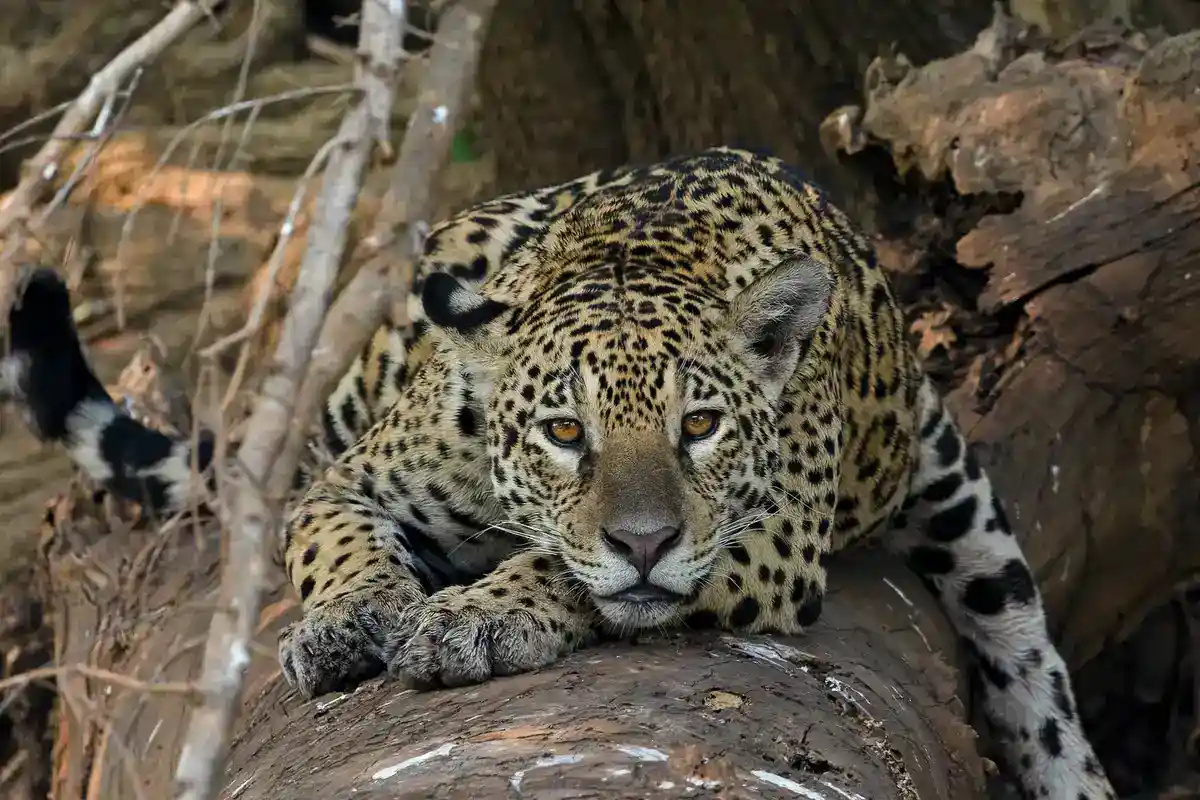
The jaguar, Panthera onca, is the largest cat in the Americas and the top land predator of Neotropical rainforest. A range wide model combined density estimates with habitat mapping. It put the world population at about 173,000 animals, with a confidence interval of 138,000 to 208,000, most of them in the Amazon Basin.
Occupied range covers almost 9 million square kilometers against a historical range of roughly 17.6 million. Over the last hundred years the South American range has shrunk to about half of its historical extent. Densities are highest in the most productive tropical habitats, reaching two to three jaguars per 100 square kilometers in the Amazon and higher in a few areas.[13]
Its prey list is broken down in What Do Jaguars Eat?.
Three-toed sloth
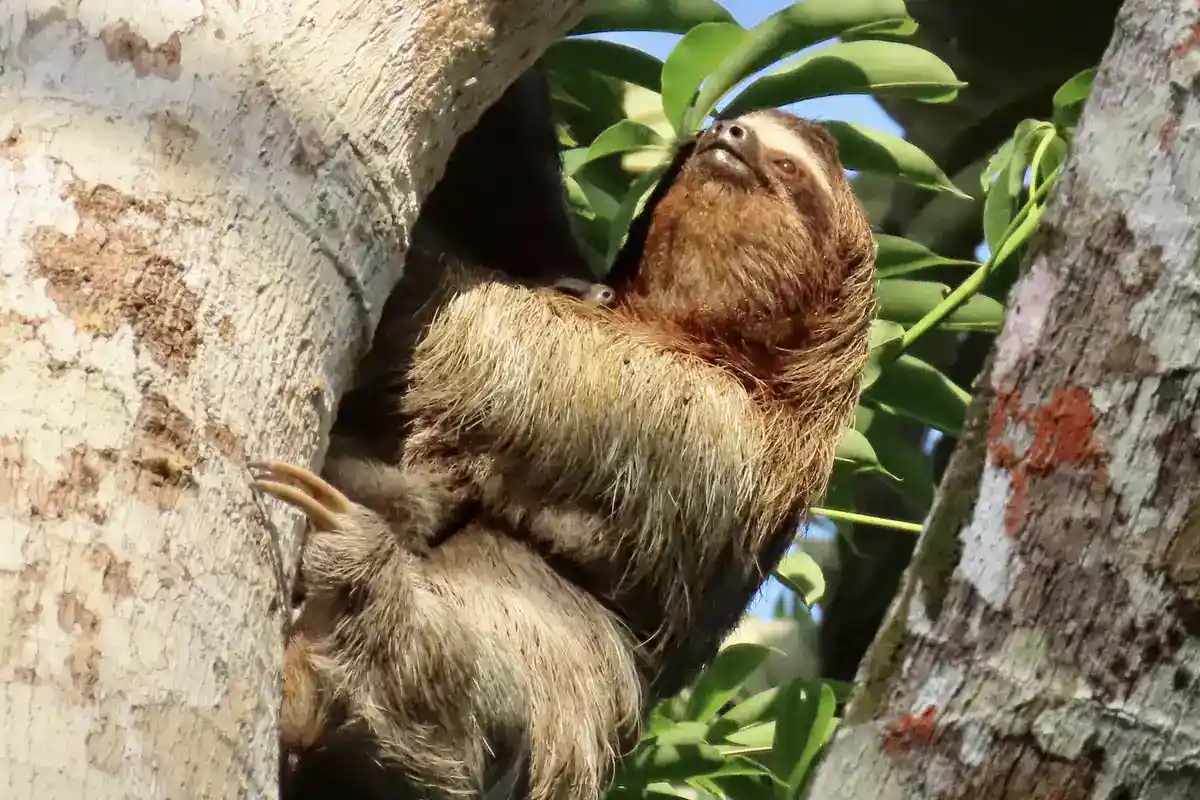
A three-toed sloth descends its tree about once a week to defecate on the ground. The behavior is risky and burns energy the animal can barely spare, and it has long resisted explanation. A 2014 study proposed that the trip sustains an ecosystem living in the sloth’s own fur, and found evidence consistent with that idea.
Three-toed sloths carry more phoretic moths, higher inorganic nitrogen, and more algae in their fur than two-toed sloths do, and moth density tracks both the nitrogen and the algae. Descending to defecate would deliver moths to their egg laying site in the dung. The moths would carry nutrients into the fur, the nitrogen would fuel algal growth, and the sloths do eat that algae, which is highly digestible and lipid rich.
The authors describe these linked mutualisms as appearing to help the sloth manage a very constrained lifestyle. It is a well supported hypothesis rather than the established sole reason for the descent.[14] The leaf diet behind the whole strategy is covered in What Do Sloths Eat?.
Capybara
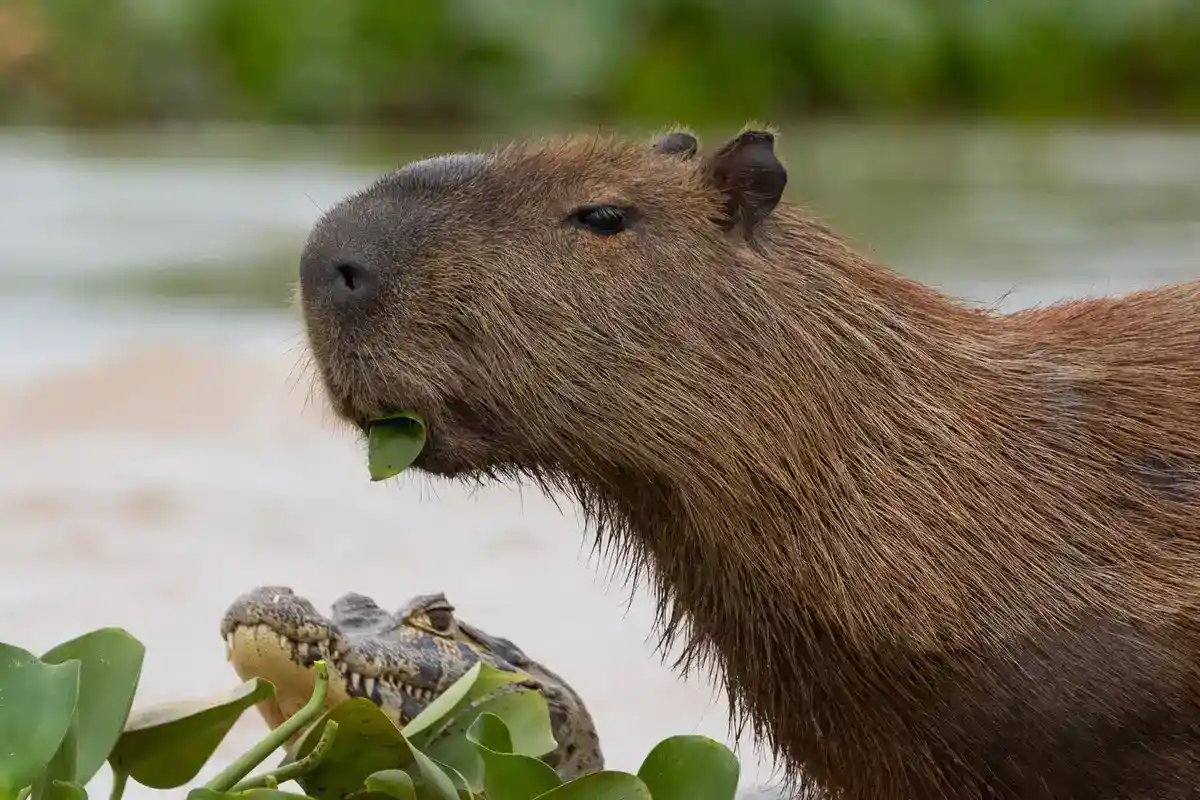
The capybara, Hydrochoerus hydrochaeris, is the world’s largest living rodent, and its genome shows what being that large costs. Large bodied animals have smaller populations, which makes natural selection less efficient at removing harmful mutations, and the capybara genome carries exactly that signature. Growing a much bigger body also means far more cells dividing far more often, which raises cancer risk.
A genome scan found selection on genes controlling postnatal bone growth and musculoskeletal development, alongside an expanded gene family that appears to suppress tumors through T cells. Gigantism in this animal involved selection on pathways directly linked to cancer.[15]
Amazon river dolphin
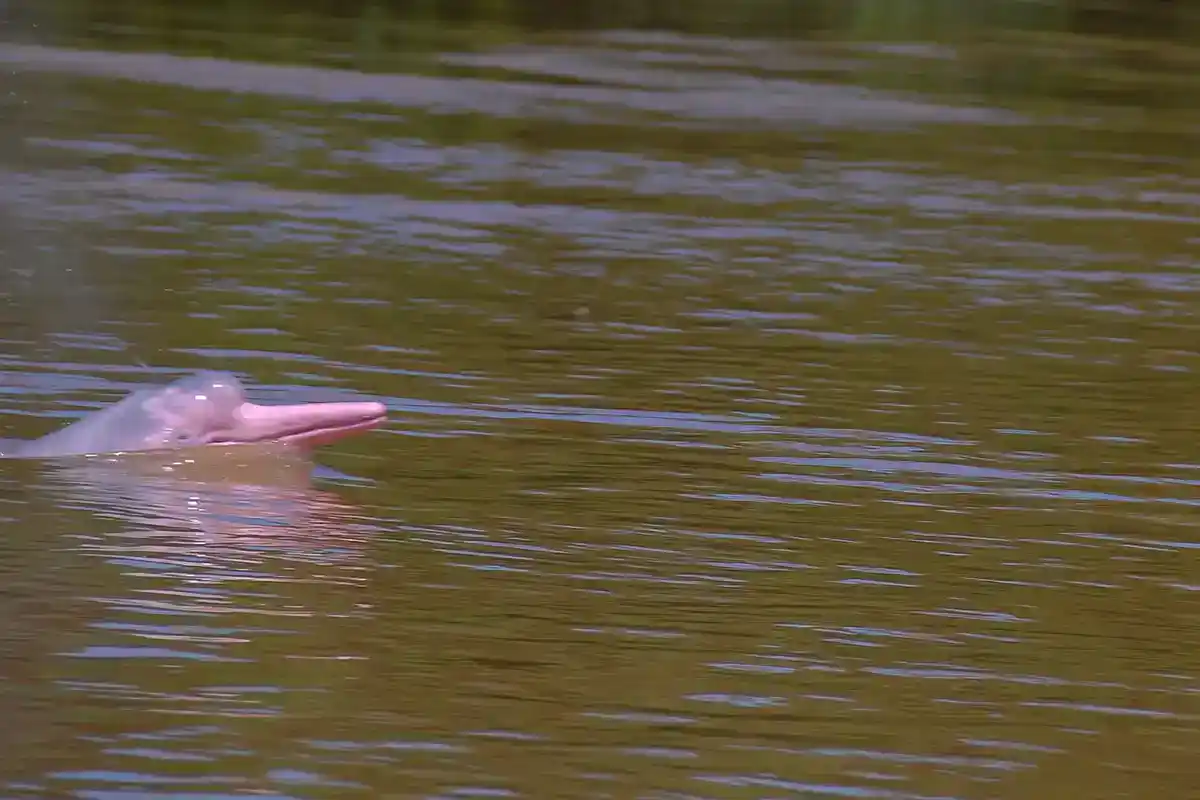
The Amazon river dolphin, Inia geoffrensis, also called the boto, lives in the Amazon and Orinoco basins and moves into flooded forest when the water rises. A 22 year survey at one site in the Brazilian Amazon found numbers falling fast. From 2000 to 2017 the count there dropped by about 6.7 percent a year, a rate that would halve a population every ten years.
Before 2000 the decline was not statistically significant. Whether the whole species is tracking that survey site is not established by this study alone. The turning point matches the point when botos began to be hunted for use as fish bait, a practice recorded in Brazil, Colombia, Peru, and Venezuela.
Survival rates in the years before the hunt were about 7 percent higher than during it, 97 percent against 90.[16] For how river dolphins feed, see What Do Dolphins Eat?.
Red howler monkey
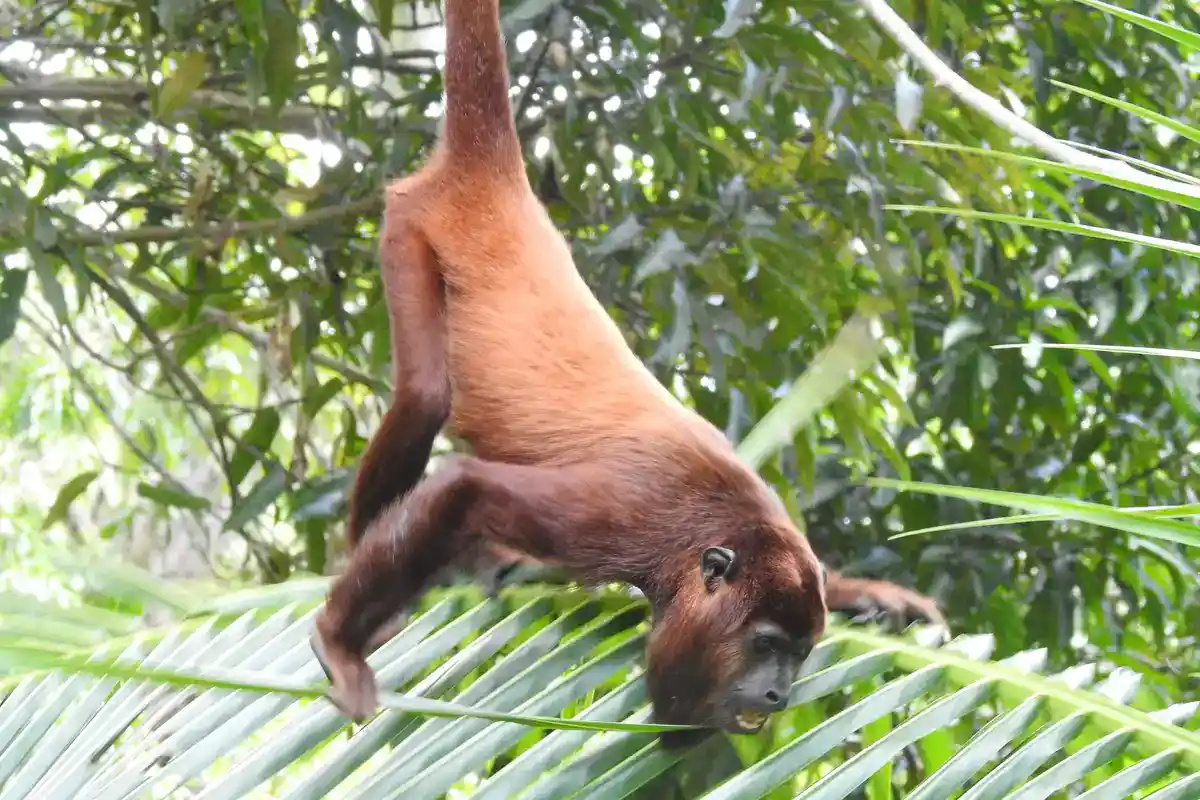
Howler monkeys produce their roars with a greatly enlarged hyoid bone and larynx, and the size of that apparatus turns out to be tied to their mating system. A comparative study found that species living in single male groups have large hyoids and small testes, while species with several males per group have smaller hyoids and larger testes. Larger hyoids lower the formant frequencies of the call, which makes the caller sound bigger than he is.
The finding is the first evidence of an evolutionary trade-off between investment in a vocal signal and investment in sperm production. A howler is either shouting his rivals down or outcompeting them after mating, not both.[17] A full profile of the species is at Red Howler Monkey, and the wider group is covered under Rainforest Monkeys.
Giant otter
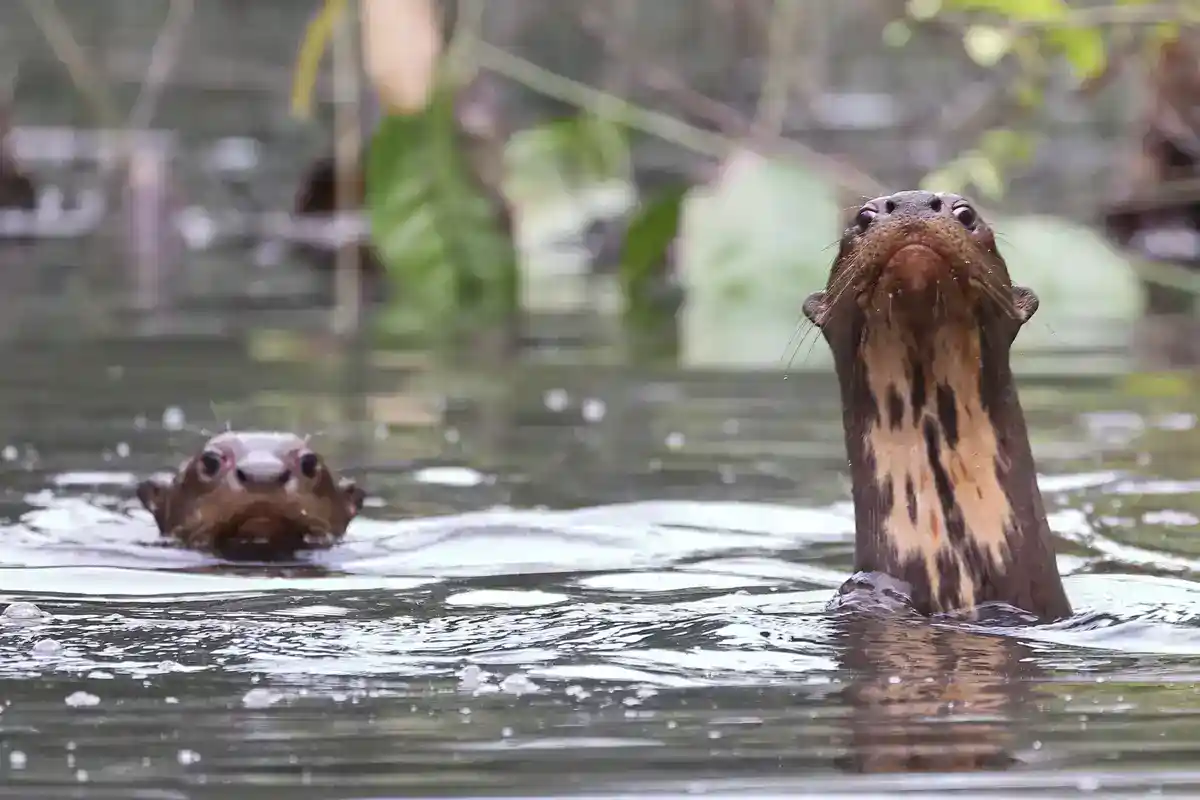
The giant otter, Pteronura brasiliensis, is the most socially and vocally complex species in the otter subfamily. It lives in family groups of three to nine animals, built around a breeding pair and their offspring from several years. A study of the species’ calls identified 22 distinct vocalization types in adults and a further 11 in the babbling of newborns.
Eleven of the adult types keep the group together and coordinate movement. Four are alarm calls warning of caimans, humans, and other dangers. Five are begging calls, which reliably get a response from whichever otter is holding a fish.[18]
The fish in question are listed in What Do Otters Eat?.
Tamarins
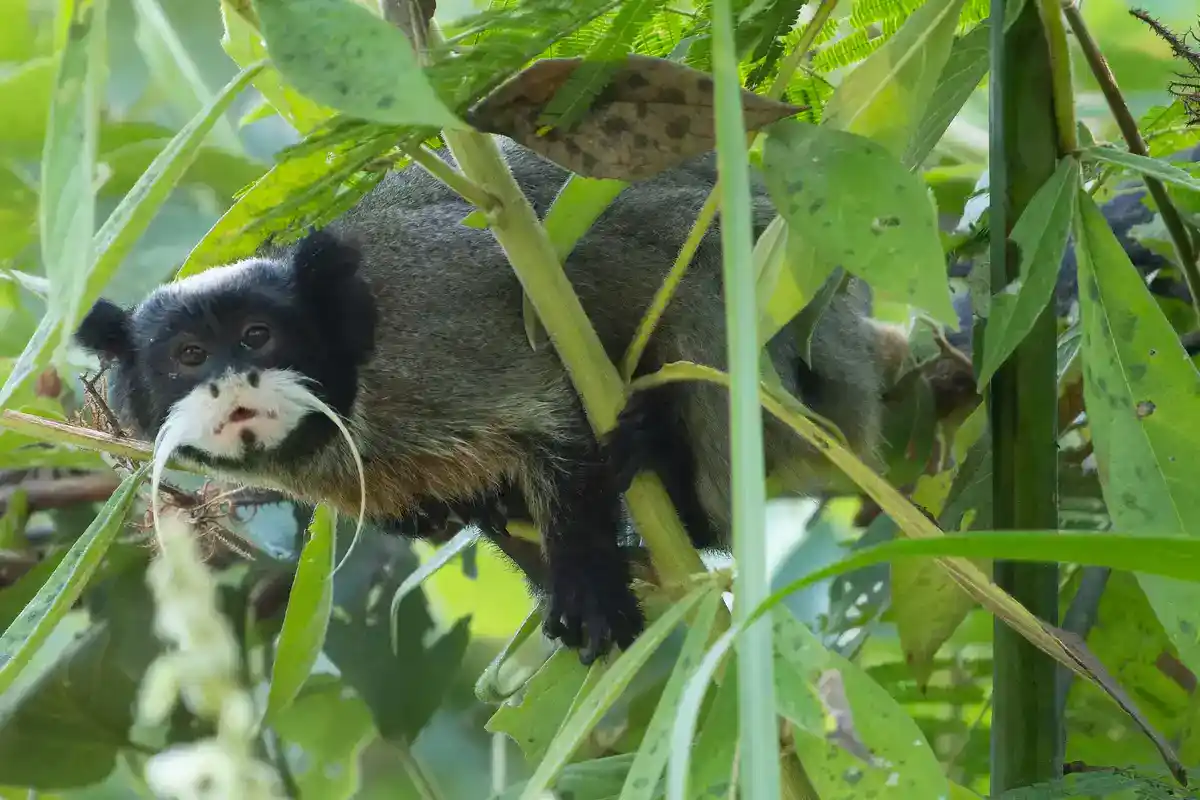
Tamarins are small Amazonian monkeys, including the emperor tamarin with its long white moustache. They practice cooperative breeding, meaning adults other than the mother carry and feed the infants. An eight month study of four wild saddleback tamarin groups in Bolivia measured what that costs.
Adults carrying infants fed less, rested more, and spent more time scanning their surroundings. Groups spent more time watching for danger after births than before them, which suggests carriers and infants are both more exposed. Contributions were not equal.
Males who joined a group after the infants were conceived helped noticeably less than resident males.[19] The best known member of the group has its own profile at Emperor Tamarin.
Bornean orangutan
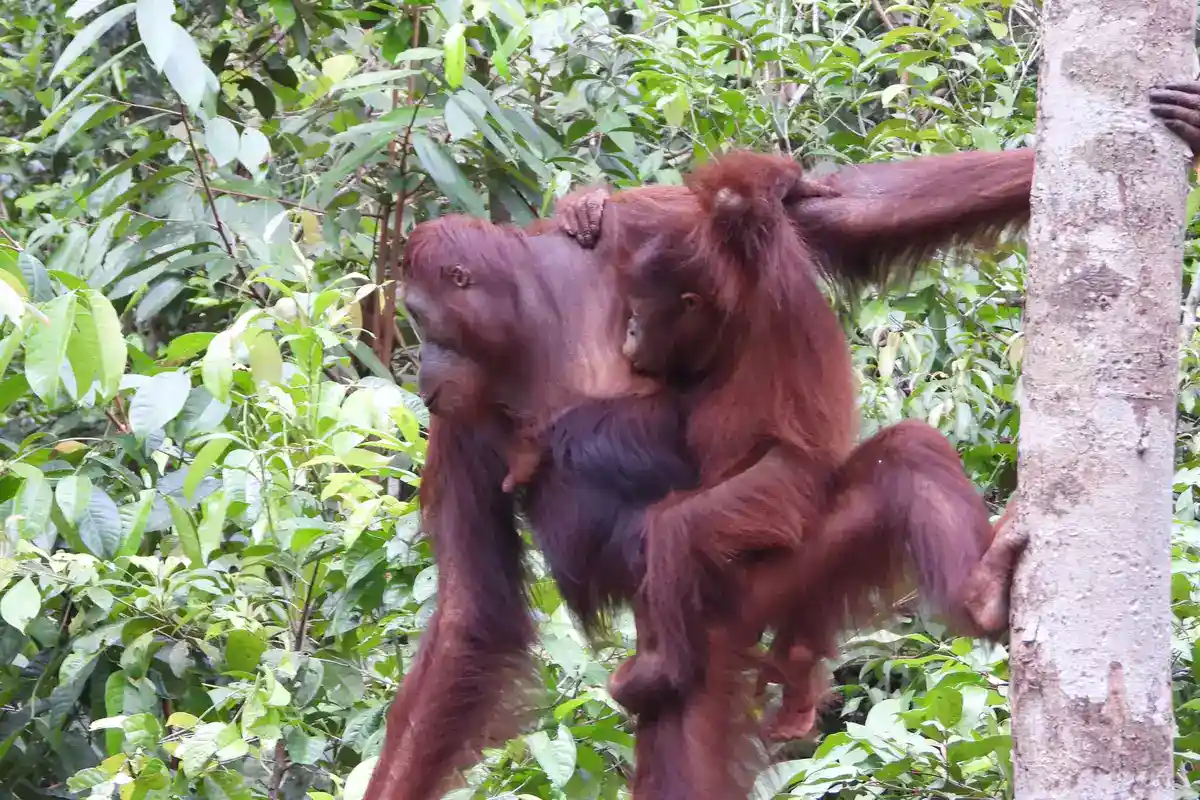
The Bornean orangutan, Pongo pygmaeus, lives only on Borneo and only in forest, and it is critically endangered. Aerial nest surveys flown over Sabah between 2014 and 2017, compared against a baseline from 2002 and 2003, found a split outcome. Large populations in the interior forests of Sabah held stable across 15 years, including populations living in sustainably managed logged forest as well as unlogged forest.
Fragmented populations in eastern Sabah, surrounded by oil palm plantations, declined at varying rates. Increased survey effort also located scattered subpopulations that earlier surveys had missed. Well managed logged forest can hold orangutans.
Isolated forest patches inside a plantation landscape do not.[20] Full profiles are at Bornean Orangutan and Sumatran Orangutan.
Western lowland gorilla
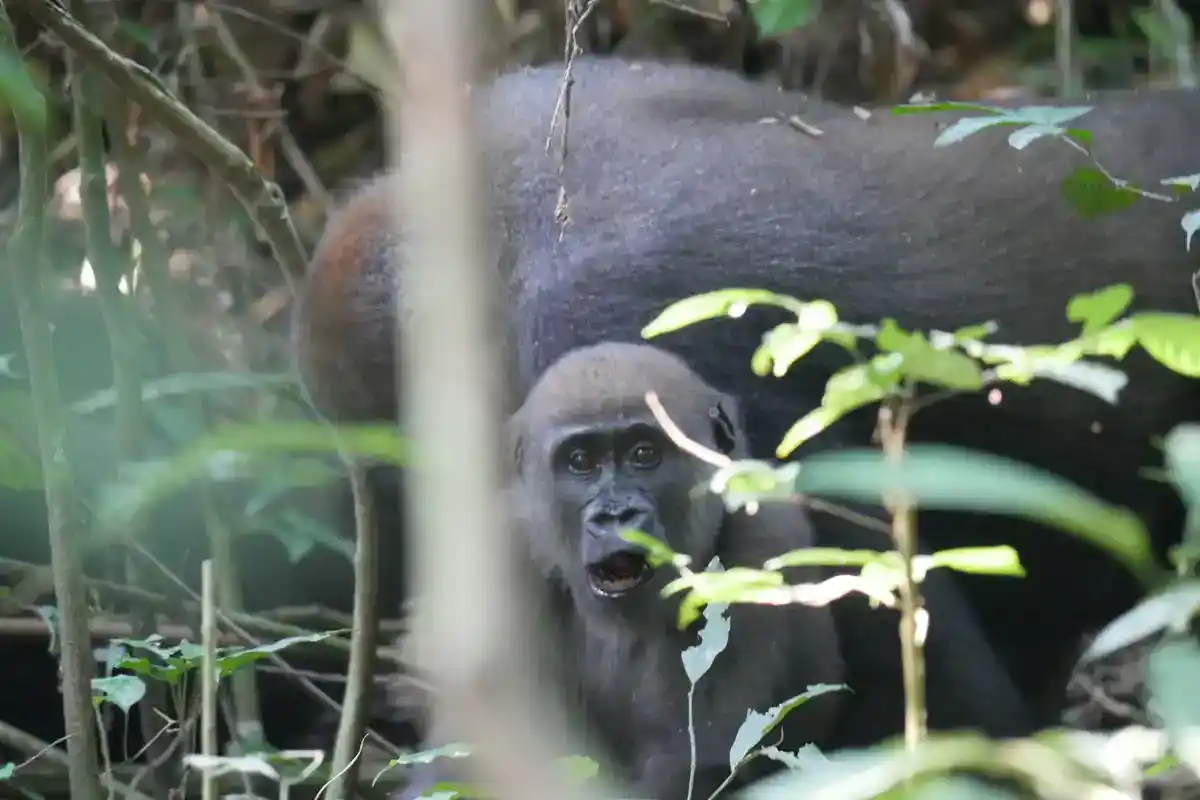
The largest survey ever assembled for African great apes covered 59 sites across five countries between 2003 and 2013, totaling 61,000 person days of fieldwork. It estimated 361,900 western lowland gorillas and 128,700 central chimpanzees in Western Equatorial Africa, substantially more than previous figures suggested. That is not good news on its own.
Gorilla numbers were still falling at about 2.7 percent a year, which keeps the subspecies Critically Endangered. Poaching, disease, and habitat degradation were the three largest threats, and around 80 percent of both subspecies live outside protected areas.[21] The species profile is at Western Gorilla, and its diet is covered in What Do Gorillas Eat?.
Okapi
The okapi, Okapia johnstoni, is the closest living relative of the giraffe and is endemic to the Democratic Republic of Congo. Genetic work across its range found an unusual combination for an endangered animal. The okapi is both highly distinct from other ungulates and highly diverse within itself.
The pattern fits repeated climate cycles that pushed forest into isolated refuges during the Plio-Pleistocene, with populations later reconnecting, and the data imply historic gene flow across the Congo River itself. The species carries a deep evolutionary history that a single population crash could erase.[22]
Mandrill
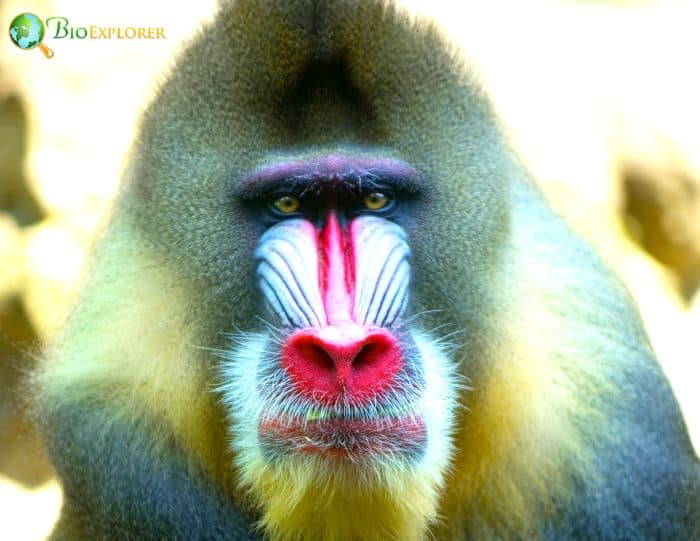
Mandrills gather in some of the largest groups seen in any primate. A horde of more than 600 animals was followed for ten days in the 1995 dry season at the Lopé Reserve in Gabon. Three separate counts showed how the fully colored adult males were distributed.
These are the males carrying the bright red and blue face and the purple rump. They were spread throughout the horde at a ratio of about one to every 21 other individuals, and paler males were spread throughout as well. Over the ten days the horde ate mainly insects, seeds from forest trees, and the leaves and stems of understory herbs.
Feeding was extremely selective, with most items taken far out of proportion to how common they were.[23] A full species profile is at Mandrill.
Matschie’s tree kangaroo
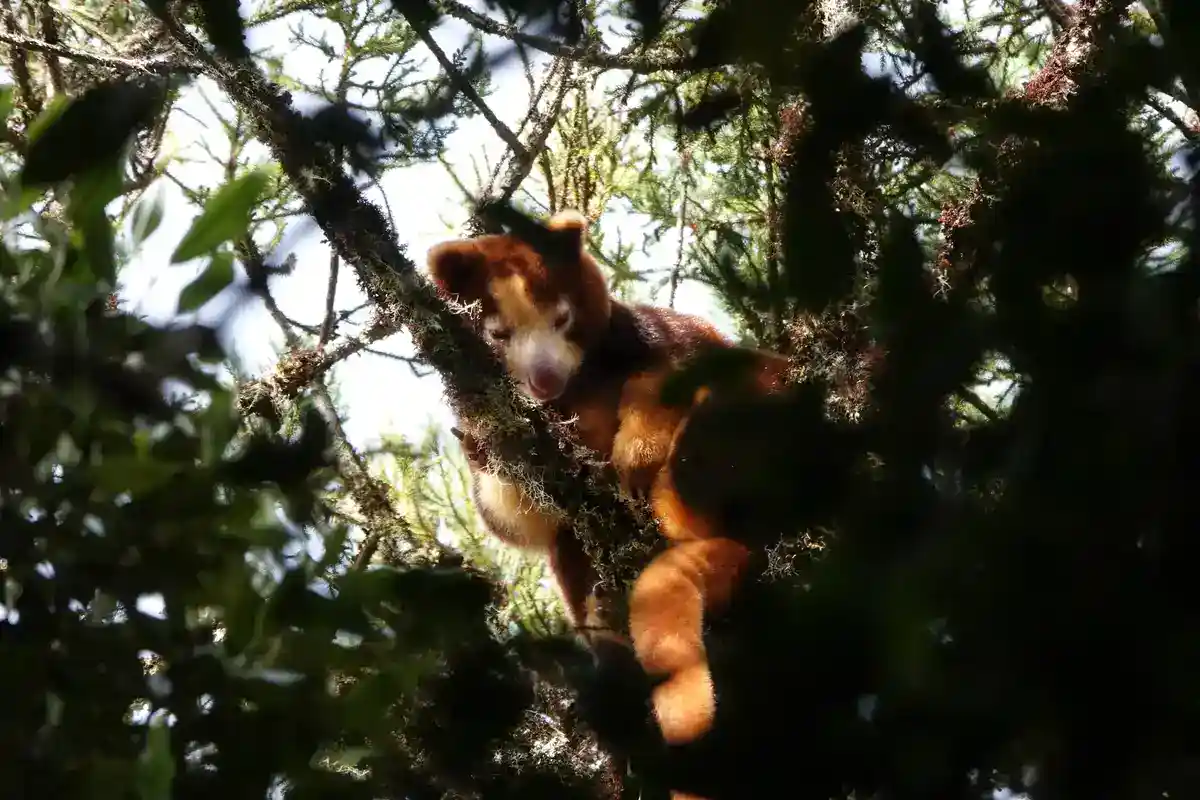
Matschie’s tree kangaroo, Dendrolagus matschiei, lives in upper montane forest on the Huon Peninsula of Papua New Guinea. Radio tracking of 15 animals produced the first published home range estimates for any New Guinea tree kangaroo, averaging 139.6 hectares. That is 40 to 100 times larger than the ranges of Australian tree kangaroos and other rainforest macropods.
Female density worked out to one animal per 19.4 hectares. The authors point to hunting pressure reducing density and to the low productivity of high altitude habitat as the likely explanations. Every New Guinea tree kangaroo species is considered threatened.[24]
For how the family feeds in general, see What Do Kangaroos Eat?.
Roosevelt elk
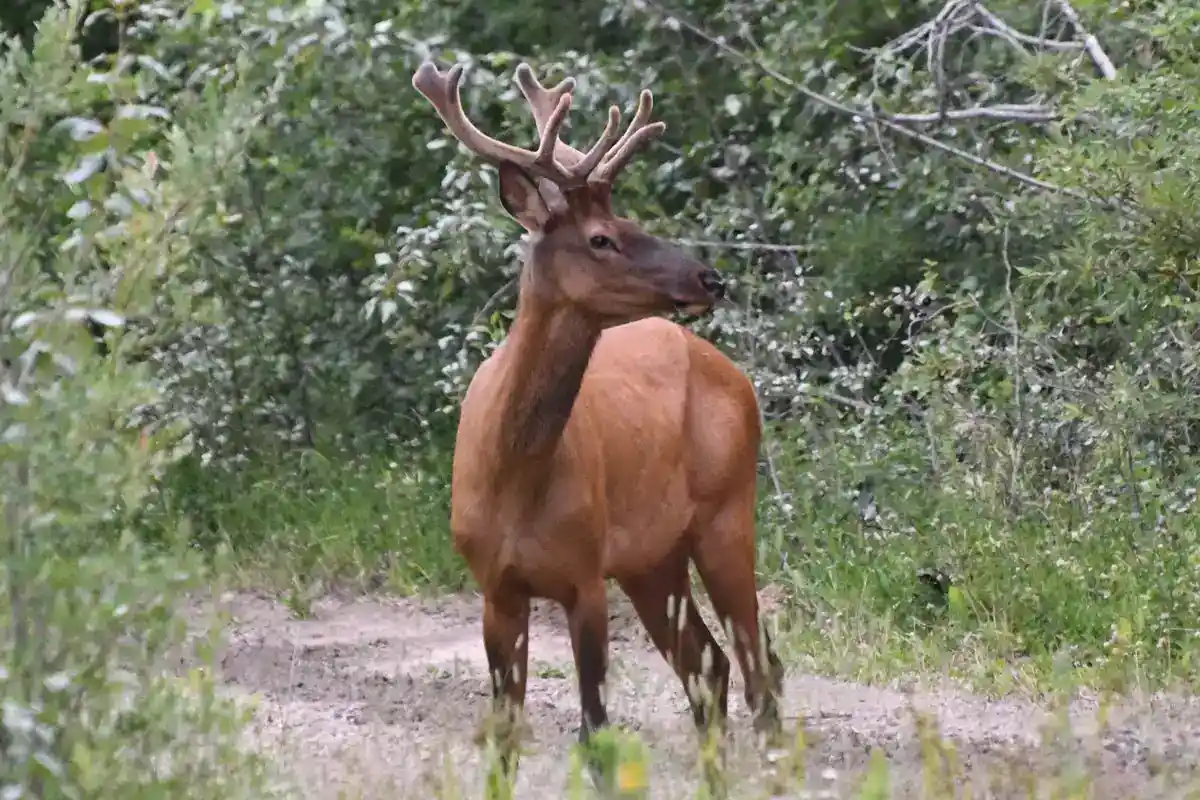
Roosevelt elk, the temperate rainforest counterpart to the tropical browsers above, are the largest elk in North America. Cows weigh 600 to 700 pounds and bulls reach 1,100. Olympic National Park holds the largest fully wild herd in the Pacific Northwest, and the animals are the largest herbivore on the peninsula.
Their browsing shapes the structure of the forest understory, and heavy grazing can strip a vegetated area. Herds in the Hoh Valley are non-migratory and stay year round, typically in groups of about 20 cows and calves. Elk carcasses feed hundreds of other organisms.[25]
Birds in rainforests
Macaws
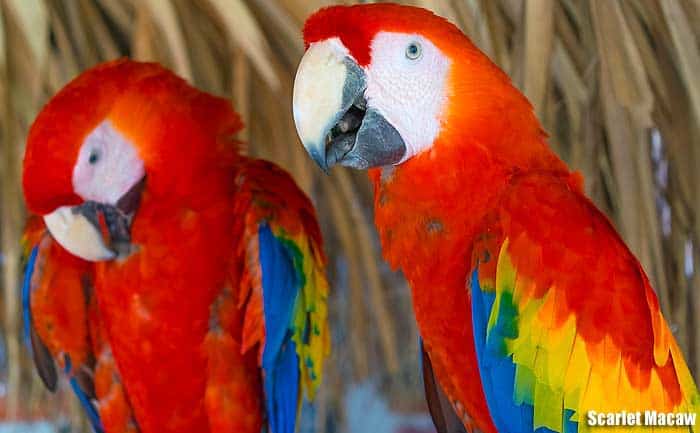
Macaws and other parrots solve a problem that defeats most plant eaters. They destroy seeds rather than swallowing them whole, which means eating the chemical defenses the plant built to prevent exactly that. Field observations of 17 parrot species feeding on 102 tree species in undisturbed Peruvian rainforest found that up to 70 percent of the diet was seeds at various stages of ripeness.
Seeds were higher in protein and lipid and lower in fiber than other plant parts. Large macaws selected foods higher in protein and lipid and lower in phenolic compounds than the plant parts they passed over, yet the foods they did eat still carried measurable toxicity. The ability to tolerate those compounds is what opens the food supply.[26]
Harpy eagle
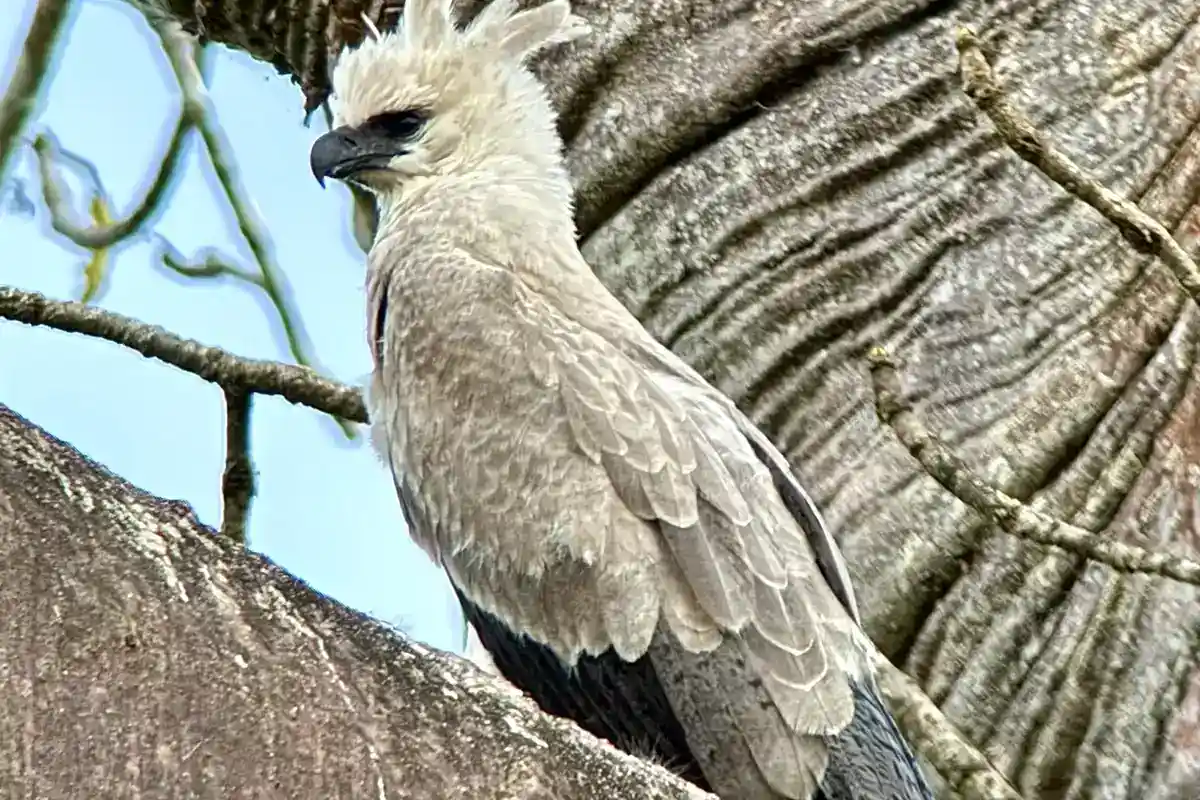
The harpy eagle, Harpia harpyja, is one of the world’s largest eagles and the apex aerial predator of Amazonian forest. Researchers monitored 16 active nests across landscapes that had lost between 0 and 85 percent of their forest, and identified 306 prey items brought in. The eagles could not switch prey.
Even in heavily cleared landscapes they kept hunting canopy vertebrates rather than switching to open country prey, and feeding rates fell as forest disappeared. Three fledged eaglets starved in landscapes that had lost 50 to 70 percent of forest cover. No nests at all were found where more than 70 percent had gone.
The study set a 50 percent forest cover threshold for a harpy eagle pair to breed successfully. Scaled up, that means 35 percent of the 428,800 square kilometer Amazonian Arc of Deforestation can no longer support breeding harpy eagles.[27] It is one of the Monkey-eating Eagles, and the wider family is covered under Types of Eagles.
Toco toucan
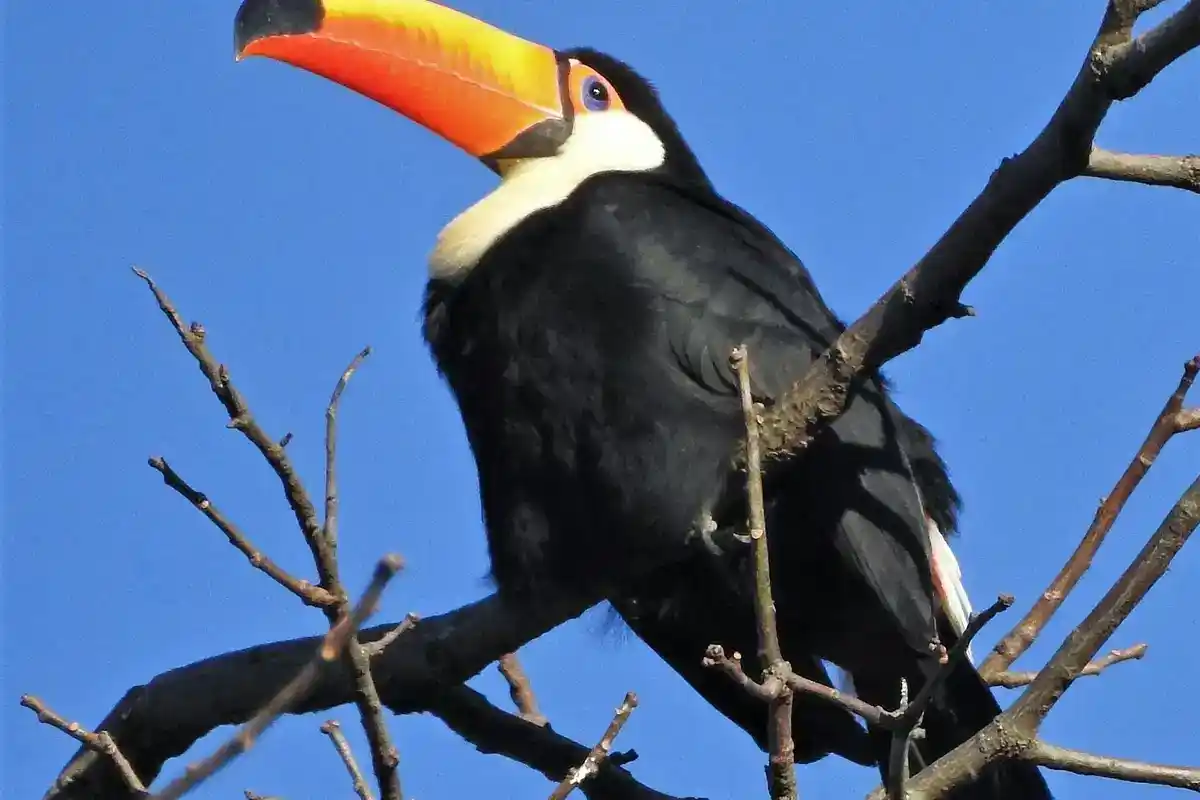
The toco toucan, Ramphastos toco, is a poor emblem for rainforest but a useful lesson in bird engineering. Much of its range is dry, semi-open woodland and savanna rather than closed forest. It has the largest beak relative to body size of any bird, and the explanations long focused on feeding and display.
Infrared imaging showed a third function. The bill is laced with blood vessels the bird can open or close, letting it dump or conserve body heat on demand. Measured against its size, the toucan bill is one of the largest thermal windows in the animal kingdom, rivaling an elephant’s ears in its capacity to radiate heat.[28]
Hornbills
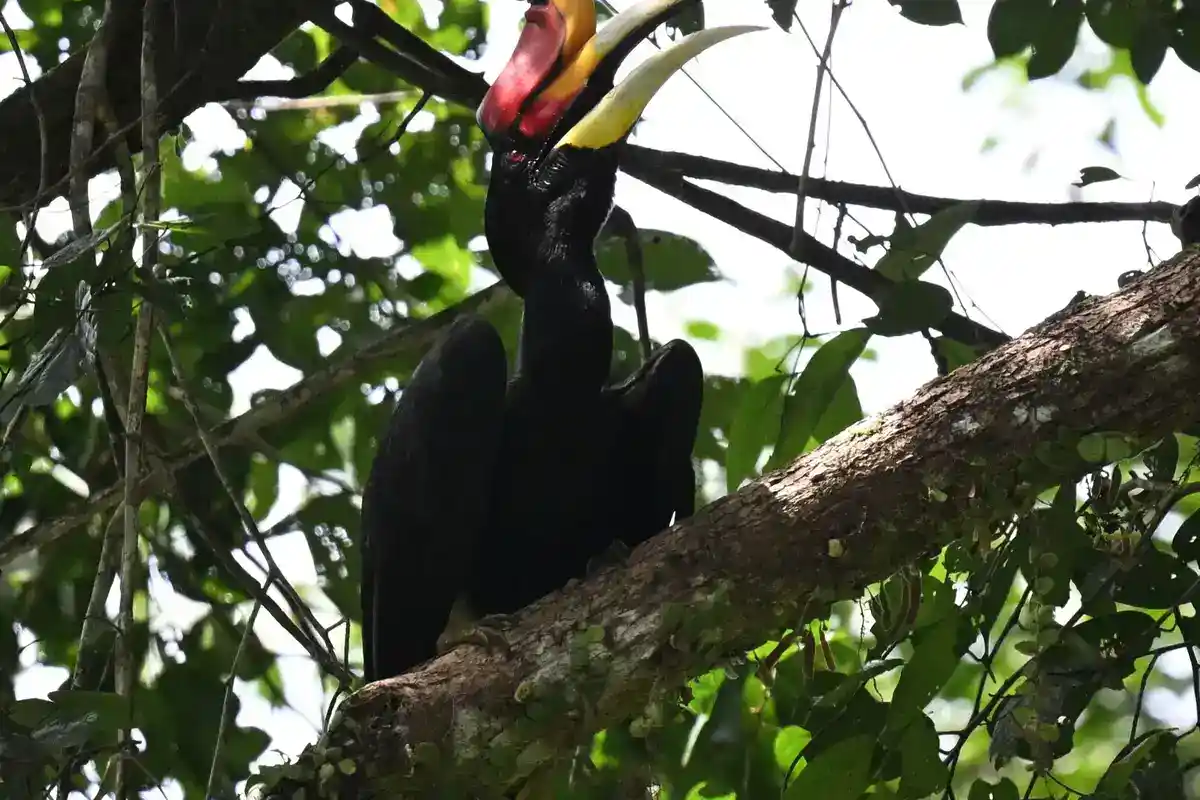
Hornbills are the large seed dispersers of Asian rainforest, and what happens when they disappear has been measured directly. A study in northeast India compared a forest under heavy logging and hunting against a lightly disturbed forest. Hornbill food trees preferentially targeted by loggers were twice as abundant in the less disturbed site.
Hornbills themselves were 22 times more abundant there. Arrival of scatter dispersed seeds was seven times higher, and seedling recruitment of several tree species differed accordingly. Logging removes the trees, hunting removes the birds, and the forest stops replanting itself.[29]
Hornbills sit among the wider Types of Birds covered on this site.
Birds-of-paradise
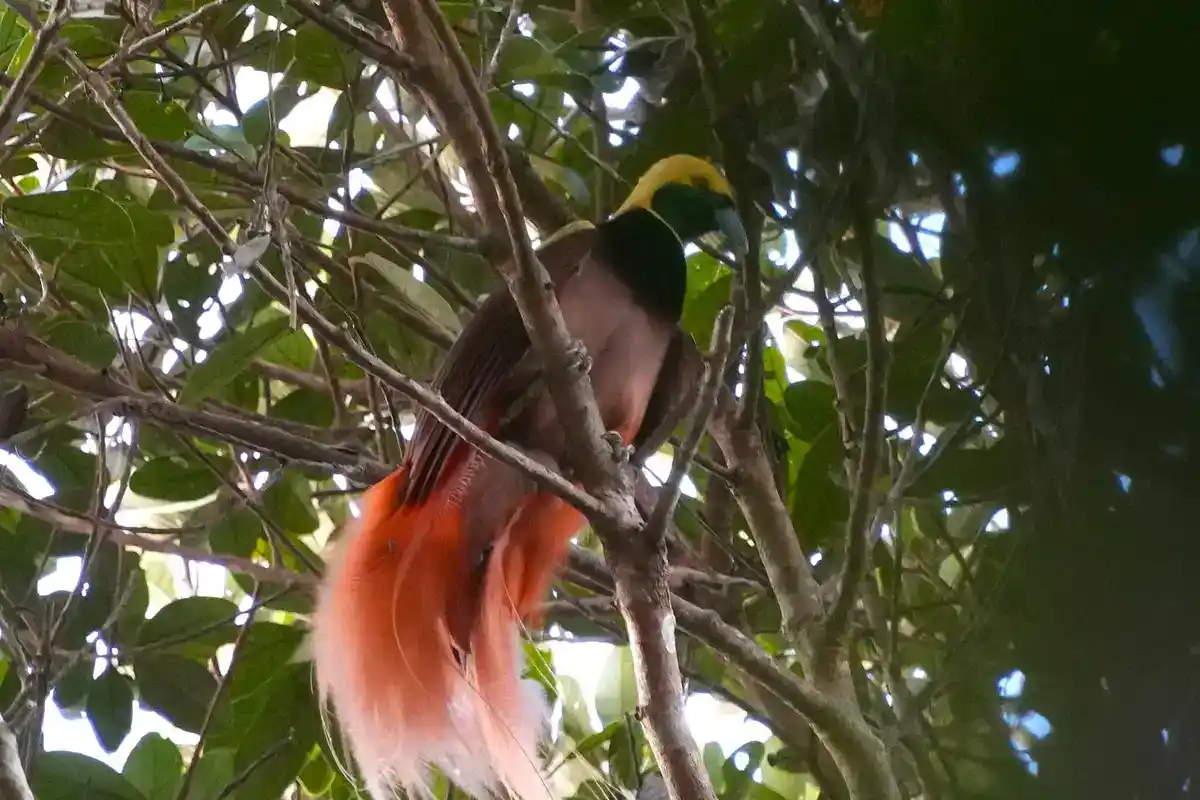
The birds-of-paradise of New Guinea are the standard example of sexual selection producing extreme ornament. Darwin and Wallace expected a trade-off, with elaborate plumage coming at the cost of elaborate song or dance. Analysis of a large natural history dataset found the opposite.
Visual and acoustic signals are positively correlated across species, integrating into what the authors call a courtship phenotype. Because overlapping, interdependent systems tend to be robust, that integration may be exactly what allowed these birds to radiate so far through the space of possible ornaments.[30]
Southern cassowary
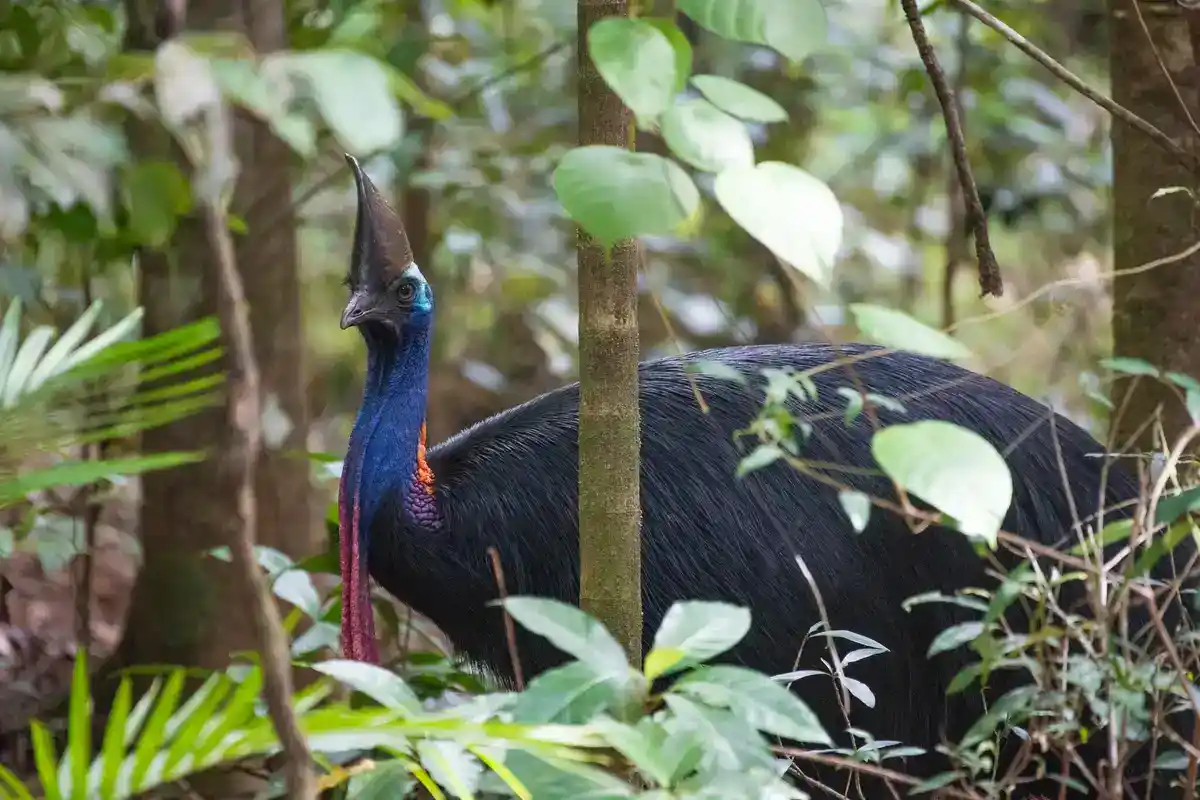
The southern cassowary is the rainforest gardener of northeast Australia and New Guinea. It has been recorded eating over 238 plant species. In Australia’s Wet Tropics it is the only long distance disperser for large seeded fruit.
More than 70 tree species there produce fruit too big for any other animal in that forest to swallow. Fruit goes down whole and the seeds pass unharmed in dung, often far from the parent tree. Its casque may help it detect infrasound over long distances.
About 4,000 adults remain in Australia. The Australian population is listed as endangered by both the Queensland and Australian governments, a national listing that does not describe the species across its whole range. Vehicle strikes are the leading cause of adult deaths.[31]
Reptiles and amphibians in rainforests
Green anaconda
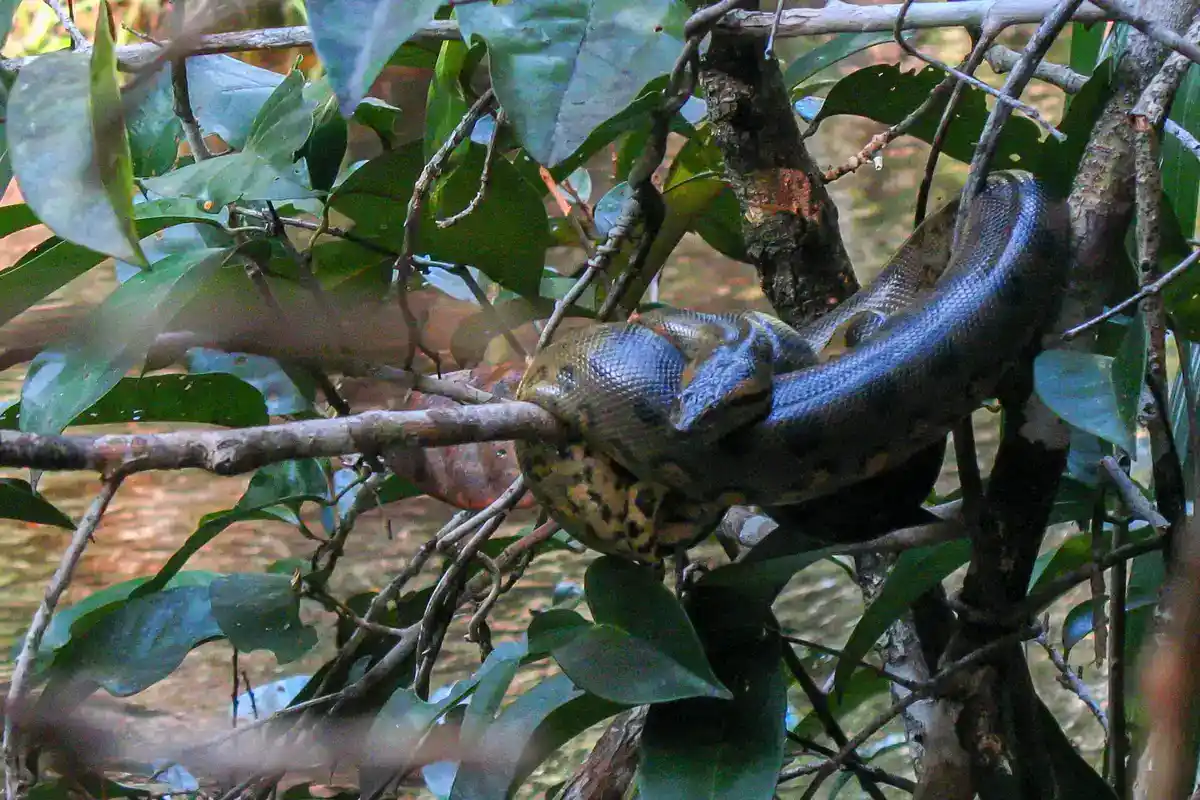
The green anaconda, Eunectes murinus, is the heaviest snake in the world. Females are far larger than males, reported at over 32 feet and over 550 pounds against roughly 20 feet and 235 pounds for males. It favors still, dark, murky water at low altitude across the Amazon basin, from Venezuela and Colombia through Brazil, Peru, and Bolivia to Trinidad.
Prey includes fish, amphibians, capybara, deer, caiman, peccaries, birds, and other snakes. The snake kills by constriction, sometimes holding prey under water. Females give birth to live young, typically 20 to 40 in a litter, each already more than two feet long.[32]
The wider feeding pattern is covered in What Do Snakes Eat?.
Whether that is one species is unsettled. In 2024 a team working in Waorani territory in the Ecuadorian Amazon proposed splitting it, naming a northern green anaconda, Eunectes akayima, in Ecuador, Venezuela, Trinidad, Guyana, Suriname, and French Guiana. The proposal rests on a mean pairwise distance of 5.50 percent across three mitochondrial genes: ND4, ND2, and cytochrome b.
That is 2,939 base pairs from 71 animals, with the split dated to roughly 8.7 million years ago. The six nuclear markers the team also sequenced did not yield enough variable sites to separate the lineages. A mitochondrial signal alone is weaker evidence than a nuclear or whole genome one, and the proposed split has not been settled.[33]
Black caiman
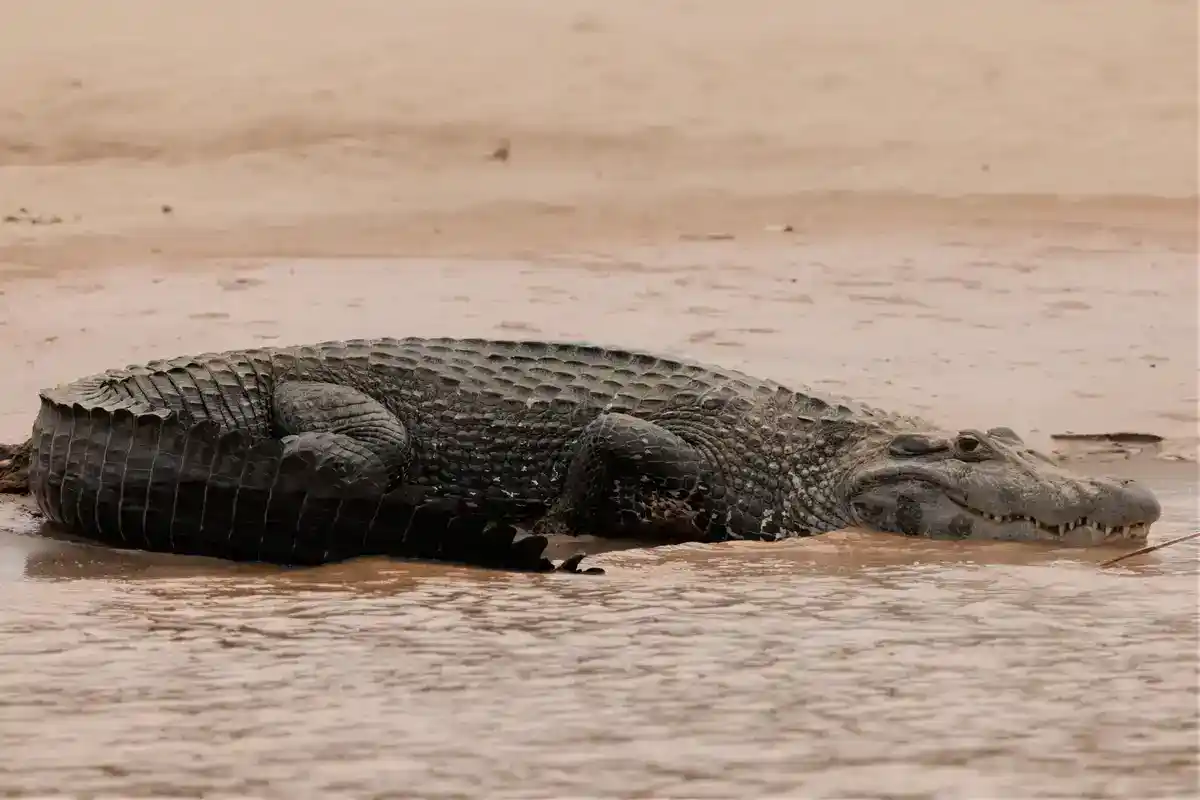
The black caiman, Melanosuchus niger, is one of the largest top predators in the Neotropics. A multi year study at Agami Pond in French Guiana combined satellite tracking with stable isotope analysis and found the population using the pond very differently by season and by age. In the dry season the pond is one of the only places in the marsh still holding water, so it concentrates fish, and the caimans there average about 1.5 meters.
In the wet season, when migratory birds breed, adults up to about 2 meters move into the flooded forest and take fallen chicks and adult birds near the nests. Isotope values differed between adults and young, showing a genuine dietary split that reduces competition within the species.[34] Caimans sit close to the Types of Crocodiles, and the Difference Between Crocodiles and Alligators explains where each one fits.
Poison dart frogs
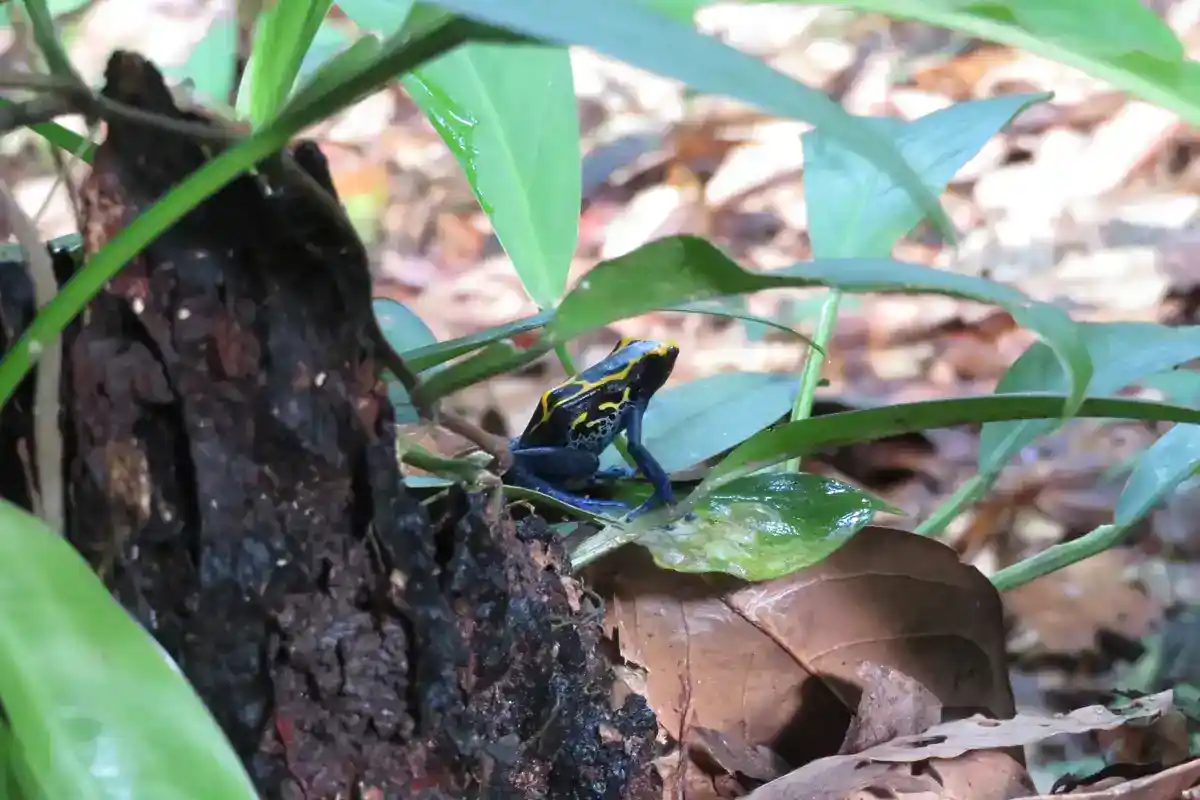
Poison frogs do not manufacture their own toxins. They take them from the arthropods they eat, which is why frogs raised on crickets are harmless. More than 800 fat soluble alkaloids have been identified in poison frog skin over the past 30 years, and that number tracks the chemical variety of their prey.
Oribatid mites collected in Costa Rica and Panama contained about 80 alkaloids. Those spanned 11 of the roughly 24 structural classes known from poison frogs, and 41 of them also appear in the strawberry poison frog living alongside the mites. Other classes come from other sources, with batrachotoxins traced to melyrid beetles and spiropyrrolizidines to millipedes.[35]
The same borrowing happens in birds, as Poisonous Birds describes.
The alkaloids come from mites, ants, beetles and millipedes in the diet. Frogs raised in captivity on crickets are harmless. The toxin is borrowed chemistry, not manufactured chemistry.
Explore what do frogs eat and what do beetles eat here.
The bright coloring turns out to do two jobs at once. Researchers modeled predator vision, ran screen based detection trials, and set up a field experiment with Dendrobates tinctorius. Close up, its yellow and blue-black pattern is highly conspicuous, exactly as a warning signal should be.
Seen from a distance the colors blend together and the frog becomes hard to detect. Survival in the field depended on background, which is a signature of camouflage rather than warning. The same pattern shouts at a predator standing over it and hides the frog from one further away.[36]
Red-eyed tree frog
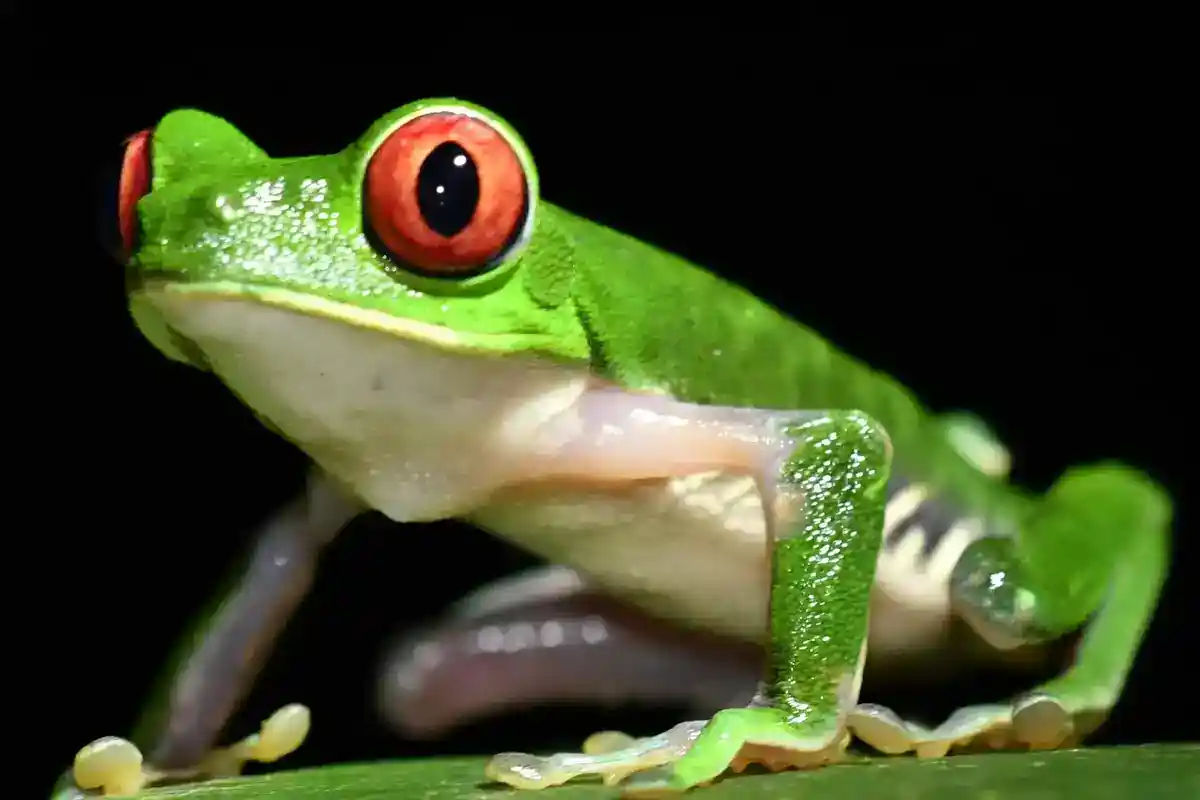
The red-eyed tree frog, Agalychnis callidryas, lays its eggs on leaves overhanging water. That placement sets up a trade-off. Staying in the egg longer means a stronger tadpole facing aquatic predators, but it also means more time exposed to snakes that eat eggs on the leaf.
The embryos solve it by deciding for themselves. When a snake attacks a clutch, the tadpoles hatch within seconds and drop into the water below. Clutches that are not attacked hatch later, when the tadpoles are better able to survive what is waiting in the pond.
The embryo is using immediate local information about risk to time its own move between habitats.[37] See the Difference Between Amphibians and Reptiles for how the two groups separate.
Insects and other invertebrates
Leafcutter ants
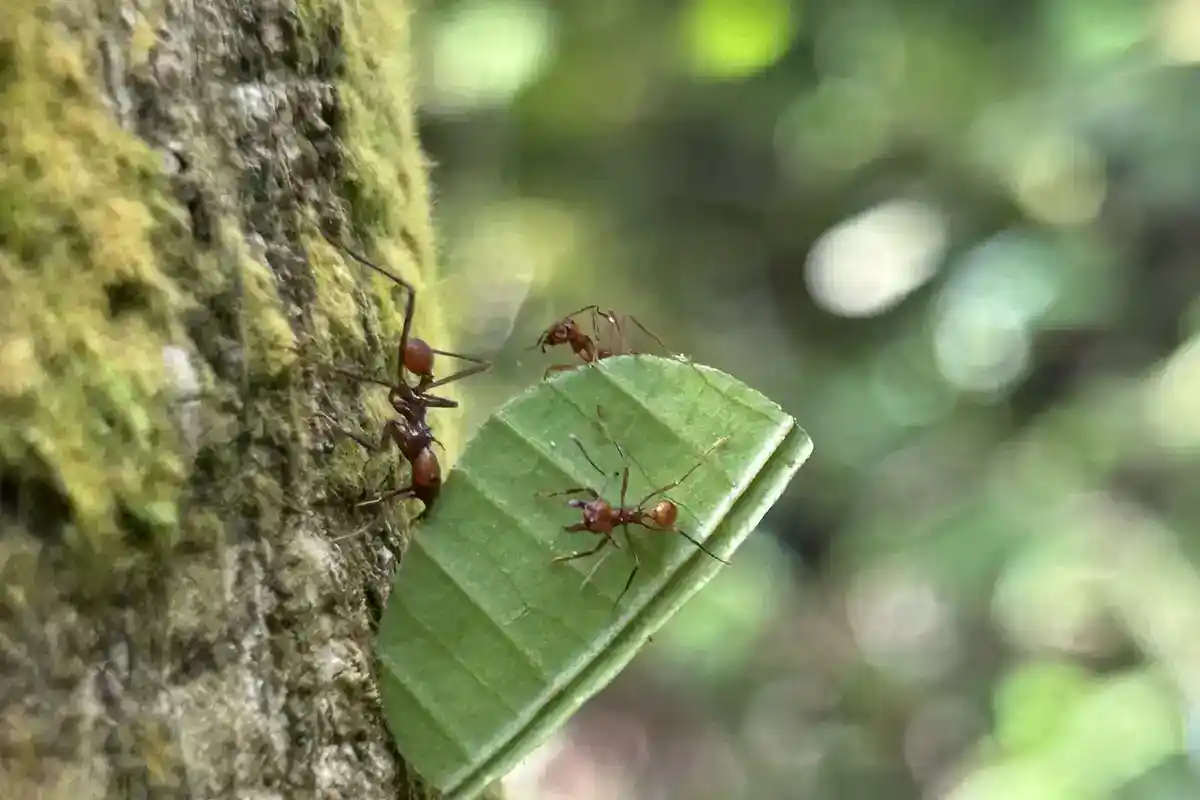
Leafcutter ants do not eat the leaves they carry. They farm. Atta cephalotes colonies can fill 600 cubic meters, hold millions of workers, and harvest more than 400 kilograms of leaf material a year in dry weight. The leaves feed a cultivated fungus, and the fungus feeds the ants through specialized swellings called gongylidia that supply carbohydrates, amino acids, proteins, lipids, and vitamins.
Larvae eat nothing else. The caste system is among the most complex in ants, with worker head widths spanning 0.6 to 4.5 millimeters. The smallest tend the garden and brood, medium workers forage, and the largest act as soldiers.
It is one of the few genuine cases of agriculture outside humans, and neither partner can now survive without the other.[38] Ants sit within the wider Insect Orders.
Blue morpho butterfly
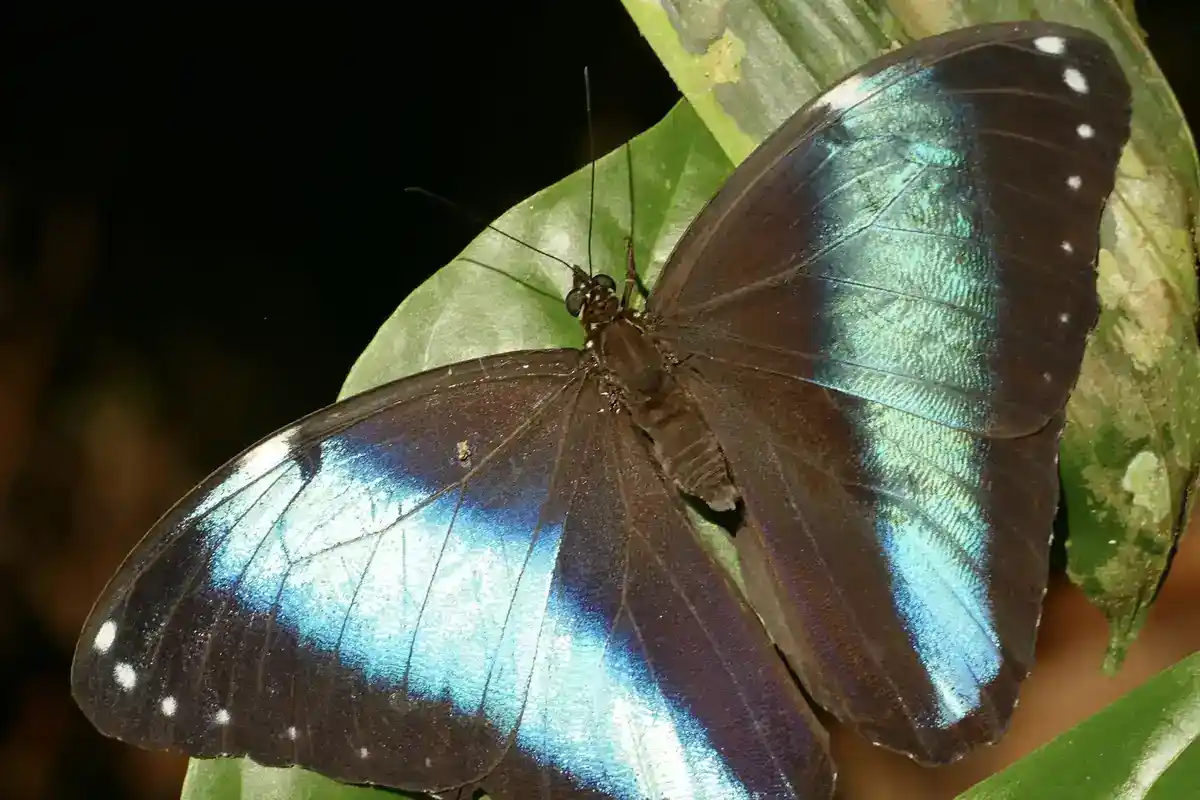
Blue morpho wings contain no blue pigment. The color is structural, produced by the physical architecture of the wing scales rather than by any chemical. The explanation usually given credits the ridges on the upper surface of the scale.
Measurements across three Morpho species, using spectrophotometry, scatterometry, and electron microscopy, showed that is only half the story. The thin lower lamina of the scale also acts as an optical reflector in its own right, contributing substantially to the blue. Both the multilayered upper surface and the thin film beneath it are doing the work, and melanin pigment in some scales sharpens the contrast.[39]
More is collected in Facts About Blue Morpho Butterfly and in Colorful Butterflies.
Brazilian wandering spider
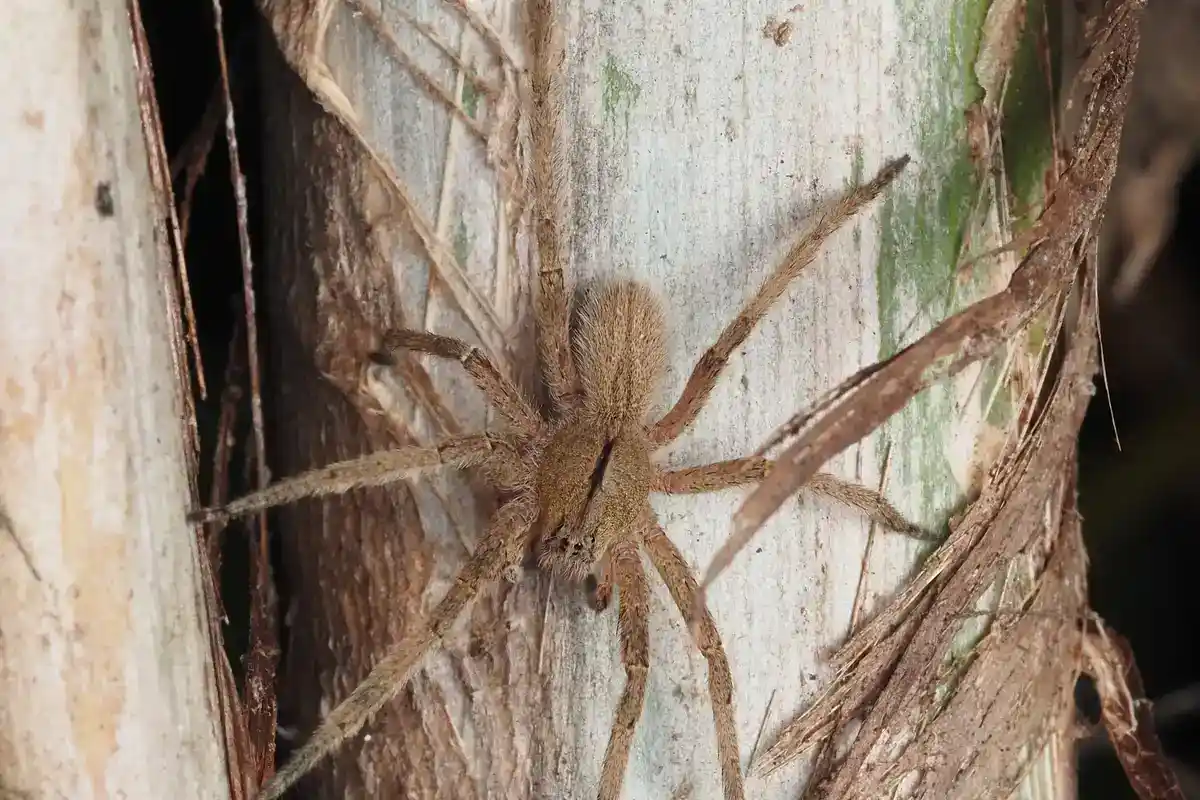
The Brazilian wandering spider is not a tarantula. The genus Phoneutria belongs to the family Ctenidae, a separate lineage from the theraphosid tarantulas, and the two are often confused in popular accounts. These spiders build no snare web.
They hunt on foot, grabbing prey and injecting venom at the same moment. A study of Phoneutria boliviensis found the venom far more effective against vertebrate prey such as geckos than against invertebrate prey such as other spiders. Male venom proved more toxic than female venom.
That pattern suggests the danger these spiders pose to humans is a side effect of venom tuned for catching small vertebrates rather than a defense aimed at large animals.[40] What Do Spiders Eat? covers how spiders hunt more generally.
Other rainforest invertebrates
- Army ants. Nomadic colonies sweep the forest floor in raiding columns, and specialized birds follow them to catch fleeing insects.
- Termites. Primary decomposers on the forest floor, recycling wood and leaf litter back into the nutrient pool.
- Goliath birdeater. A theraphosid tarantula of northern South America and one of the largest spiders by mass.
- Orchid bees. Long distance pollinators that carry pollen between widely scattered trees of the same species.
- Millipedes and centipedes. Abundant under logs and leaf litter, some feeding on decay and others hunting.
Rainforest animals by region
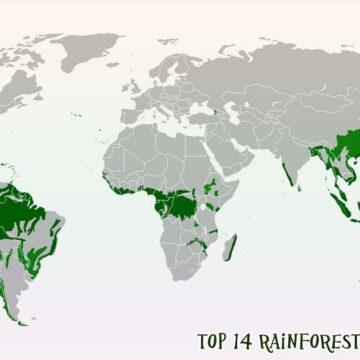
Rainforests on different continents evolved separately, so they hold different animals playing similar roles. The survey of Rainforests in the World maps where each of them sits. A canopy fruit eater in the Amazon is a macaw.
In Borneo it is a hornbill. In New Guinea it is a bird-of-paradise.
The Amazon
The Amazon basin spans 2.7 million square miles across eight countries plus French Guiana and holds about one in ten known species on Earth. That includes nearly 50,000 plant species, 2,400 freshwater fish species, and 370 reptile species. Jaguars, harpy eagles, pink river dolphins, sloths, macaws, and black spider monkeys all live here.
The basin also stores 150 billion to 200 billion tons of carbon. About 17 percent of the Amazon biome has already been cleared, and cattle pasture occupies roughly 80 percent of the deforested area.[41] The plant side of the same forest is covered in Amazon Rainforest Plants.
The Congo Basin
The Congo Basin holds the second largest tropical forest on Earth after the Amazon, spanning about 500 million acres across six countries, an area larger than Alaska. It supports some 10,000 tropical plant species, 30 percent of which grow nowhere else, along with at least 400 mammal species, 1,000 bird species, and 700 fish species. Gorillas, bonobos, chimpanzees, forest elephants, okapis, and forest buffalo are among its best known animals.
Bushmeat hunting, poaching for ivory and pangolin scales, illegal logging, road building, farming, and mining are the main pressures.[42] The pressure on its best known giants is set out in Are Elephants Endangered?, and the Eastern Gorilla faces a comparable squeeze further east.
Borneo and Sumatra
Borneo is the world’s third largest island and Sumatra the sixth. Together they hold more than 15,000 known plants, and since 1995 more than 400 plant and animal species have been identified there, over 50 of them new to science. All three orangutan species live on these islands, and the Sumatran orangutan is Critically Endangered.
Bornean and Sumatran elephants, Sumatran rhinos, Sunda tigers, proboscis monkeys, sun bears, and clouded leopards also live here. More than 80 million people share the two islands. Palm oil expansion is the dominant driver of habitat loss.[43]
The same clearing drives the story told in Why Are Tigers Endangered?.
New Guinea and Australia
New Guinea holds a vast tract of rainforest and is the center of diversity for birds-of-paradise and tree kangaroos. Marsupials occupy many of the niches that placental mammals fill elsewhere. Northeastern Australia’s Wet Tropics, including the Daintree, share the cassowary and tree kangaroos with New Guinea, a legacy of the land bridge that once joined them.
Temperate rainforests
Temperate rainforests line the Pacific coast of North America from northern California to Alaska, and appear again in Chile, New Zealand, Tasmania, and parts of Europe and Asia. Their animals include Roosevelt elk, black bears, cougars, marbled murrelets, banana slugs, and an unusually rich salamander fauna. Species counts are far lower than in the tropics, but these forests carry very high biomass per hectare.
Small rainforest animals
Most rainforest animals are small. The large, photogenic species are a tiny fraction of the total, and small size is an advantage in a forest where food comes in small, scattered packets.
- Poison dart frogs, most of them shorter than a human thumb joint.
- Emperor tamarins at under a pound.
- Pygmy marmosets, among the smallest monkeys, feeding on tree gum.
- Hummingbirds, among the smallest birds, hovering at understory flowers.
- Oribatid mites, invisible to a casual eye, yet the source of most poison frog toxins.
- Leafcutter ant minims, with head widths under a millimeter, riding on cut leaves to fend off parasitic flies.
How rainforest animals fit the food web
Rainforest animals are not just residents. They run the machinery of the forest, and the job with the widest reach is moving seeds.
Large fruit eating animals swallow seeds and drop them far from the parent tree, and the trees they disperse are not a random sample. Work in a Southeast Asian forest found that tree species depending on large frugivores accounted for close to a third of all above-ground carbon in a 30 hectare plot, about 4,559 tons. Species dispersed by primates alone made up about 13 percent of total carbon, and those dispersed by large terrestrial mammals and large birds about 21 percent.
Tree species carried by large frugivores had significantly denser wood than those dispersed other ways. Under full defaunation, meaning the loss of those large animals, the modeled carbon loss reached 2.4 to 3.0 percent, and losses passed 1 percent once defaunation reached 40 percent.[44]
Other roles matter too. Predators such as jaguars and harpy eagles hold herbivore numbers in check. Leafcutter ants and termites recycle plant matter into soil nutrients.
Bees, bats, hummingbirds, and hawkmoths pollinate trees that may stand hundreds of meters apart. The pollinators among them are covered in What Do Bats Eat?. A rainforest without its animals stops working as a rainforest.
Threats to rainforest animals
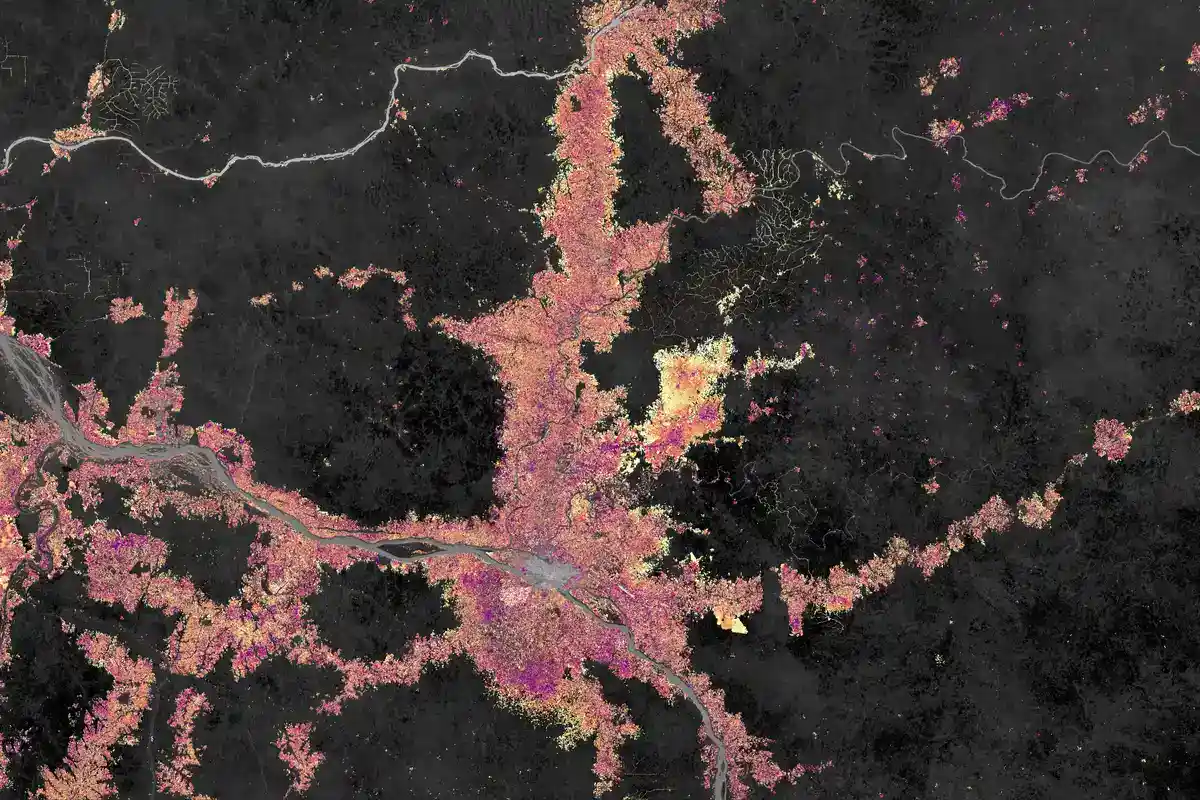
Habitat loss is the dominant threat. 2024 was the worst year on record. The tropics lost 6.7 million hectares of primary forest, nearly double the 2023 figure, at a rate equivalent to 18 soccer fields every minute.
For the first time, fire overtook agriculture as the leading cause and accounted for roughly half the loss. Brazil alone made up 42 percent of the total, with fire behind 66 percent of Brazilian loss. Bolivia lost 1.5 million hectares, a 200 percent rise on the previous year, and both Congos recorded their highest primary forest loss on record.
Fires released 4.1 gigatons of greenhouse gases, more than four times the emissions from all air travel in 2023.[45]
2025 was better. Tropical primary forest loss fell to 4.3 million hectares, a 36 percent drop from the 2024 record. Brazil cut its non-fire primary forest loss by 41 percent to the lowest level on record, Colombia reversed the spike it saw in 2024, and Indonesia and Malaysia held their rates low.
Bolivia was the exception, recording its second highest loss on record. Fire remains the concern, accounting for 42 percent of the 25.5 million hectares of tree cover lost worldwide. One good year is a reprieve, not a recovery, and 4.3 million hectares is still high by any pre-2024 standard.[46]
Clearing is not the only pressure. Rainforest animals are also hunted for meat and body parts, and captured for the pet trade. Fragmentation isolates small populations.
Mining, road building, and disease add further strain. On top of all of it, the climate is shifting faster than many specialists can track.
Rainforest animals at a glance
The table below lists the species profiled above, with the single finding that best distinguishes each one.
| Animal | Scientific name | Region | Main layer | Diet | Standout finding |
|---|---|---|---|---|---|
| Jaguar | Panthera onca | Neotropics | Floor and understory | Carnivore | Modeled at about 173,000 in a 2018 range-wide study, on roughly half the historical South American range |
| Three-toed sloth | Bradypus species | Neotropics | Canopy | Folivore | Weekly descent to defecate may sustain a moth and algae system in its fur |
| Capybara | Hydrochoerus hydrochaeris | Neotropics | Floor and water | Herbivore | World’s largest rodent, with a genome showing anticancer adaptations |
| Amazon river dolphin | Inia geoffrensis | Neotropics | Rivers and flooded forest | Piscivore | Counts at a Brazilian survey site fell about 6.7 percent a year from 2000 to 2017 |
| Red howler monkey | Alouatta seniculus | Neotropics | Canopy | Folivore | Hyoid size trades off against testes size across howler species |
| Giant otter | Pteronura brasiliensis | Neotropics | Rivers | Piscivore | 22 distinct adult calls, plus 11 more in newborn babbling |
| Tamarins | Saguinus species | Neotropics | Canopy and understory | Omnivore | Cooperative breeders; carrying an infant cuts feeding time |
| Bornean orangutan | Pongo pygmaeus | Borneo | Canopy | Frugivore | Stable in managed interior forest, declining in plantation-locked fragments |
| Western lowland gorilla | Gorilla gorilla gorilla | Congo Basin | Floor | Herbivore | Estimated at 361,900 from 2003 to 2013 surveys, falling 2.7 percent a year, 80 percent outside protected areas |
| Okapi | Okapia johnstoni | Congo Basin | Understory | Browser | Both highly genetically distinct and highly genetically diverse |
| Mandrill | Mandrillus sphinx | Central Africa | Floor, sleeps in trees | Omnivore | Hordes of 600 or more, with one fully colored male per 21 animals |
| Matschie’s tree kangaroo | Dendrolagus matschiei | New Guinea | Canopy | Folivore | Home ranges 40 to 100 times larger than Australian tree kangaroos |
| Roosevelt elk | Cervus canadensis roosevelti | Pacific Northwest | Floor | Herbivore | Largest elk in North America and the main shaper of the Hoh understory |
| Macaws | Ara species | Neotropics | Canopy | Granivore | Up to 70 percent of the diet is seeds, toxins included |
| Harpy eagle | Harpia harpyja | Neotropics | Emergent | Carnivore | Needs 50 percent forest cover to raise a chick, and cannot switch prey |
| Toco toucan | Ramphastos toco | Neotropics | Canopy, often semi-open woodland | Frugivore | Bill is one of the largest thermal windows in the animal kingdom |
| Hornbills | Buceros species | Southeast Asia | Canopy | Frugivore | 22 times more abundant in undisturbed forest, with seven times the seed arrival |
| Birds-of-paradise | Family Paradisaeidae | New Guinea and Australia | Canopy and understory | Frugivore | Color, sound, and movement evolve together as one courtship phenotype |
| Southern cassowary | Casuarius casuarius | New Guinea and Australia | Floor | Frugivore | In Australia’s Wet Tropics, sole long distance disperser for 70-plus large seeded trees |
| Green anaconda | Eunectes murinus | Neotropics | Water and floor | Carnivore | Heaviest snake in the world, with females far larger than males |
| Northern green anaconda | Eunectes akayima, proposed | Northern South America | Water and floor | Carnivore | Proposed in 2024 on mitochondrial evidence; the split is not settled |
| Black caiman | Melanosuchus niger | Amazon | Water | Carnivore | Adults and juveniles eat differently, which reduces competition within the species |
| Poison dart frogs | Family Dendrobatidae | Neotropics | Floor and understory | Insectivore | In Dendrobates tinctorius, the coloring warns up close and camouflages at a distance |
| Red-eyed tree frog | Agalychnis callidryas | Neotropics | Understory | Insectivore | Embryos hatch early and drop into water when a snake attacks the clutch |
| Asian flying treefrogs | Rhacophorus species | Southeast Asia | Canopy and understory | Insectivore | Webbed gliding feet built by a distinct developmental program |
| Leafcutter ant | Atta cephalotes | Neotropics | Floor to canopy | Fungus farmer | Farms a fungus neither partner can now live without |
| Blue morpho | Morpho species | Neotropics | Understory to emergent | Fruit juices and sap | Blue comes from scale architecture, not pigment |
| Brazilian wandering spider | Phoneutria species | Neotropics | Floor and understory | Carnivore | A ctenid, not a tarantula, with venom tuned for small vertebrates |
Common misconceptions
- That rainforests hold more than half of all species on Earth. The figure is widely repeated but was never well supported. It traces back to a 1982 beetle extrapolation and a 1988 book that cited it. The measured figure for land vertebrates is 62 percent, which is a real and impressive number, but it covers vertebrates only, not all life.
- That a jungle and a rainforest are the same thing. Jungle is an informal word for dense ground level growth. It describes forest edges, riverbanks, and light gaps, not the interior of mature rainforest, where the floor is relatively open.
- That one layer holds most of the rainforest’s animals. Vertical sorting is real, but it runs in different directions for different groups. Arthropod richness peaks in the canopy, and 61.6 percent of the fly species in one Amazonian study were never caught at ground level. Amphibians and small mammals do the opposite, getting scarcer the higher the sampling goes.
- That poison dart frogs make their own poison. They sequester alkaloids from mites, ants, beetles, and millipedes in their diet. Captive frogs fed crickets are harmless.
- That bright warning color always makes an animal easier to see. In at least one poison frog, the same pattern that shouts at a nearby predator blurs into camouflage at a distance.
- That the Brazilian wandering spider is a tarantula. It belongs to the family Ctenidae. Tarantulas are theraphosids, a different family entirely.
- That the green anaconda has been confirmed as two species. A northern green anaconda was proposed in 2024, but the evidence is a 5.5 percent distance across three mitochondrial genes, and the nuclear markers tested could not separate the lineages. Treat it as a proposed split rather than a settled one.
- That rainforest soil must be rich because the plants grow so well. Many tropical rainforests sit on nutrient poor soil, with most of the nutrients locked in living tissue and surface litter rather than in the ground. That is why cleared land in those places often loses fertility fast. Rainforest soils are not uniform though, and fertility varies widely between regions.
- That all rainforests are tropical. Temperate rainforests exist on cool wet coasts, with completely different animals.
- That sloths are slow because they are lazy. Slow movement is an energy strategy forced by a leaf diet. The weekly trip down the tree to defecate is the part that still puzzles researchers, and the leading explanation is that it services a moth and algae system in the animal’s fur.
- That logging a forest but leaving it standing keeps the animals. It depends on the animal and the management. Orangutan populations held steady in sustainably managed logged forest in Sabah, while hornbill numbers fell 22 fold in a forest that was logged and hunted.
- That rainforest animals are mostly large and dramatic. By species count they are overwhelmingly arthropods. There are roughly 20 quadrillion ants on Earth, outweighing all wild birds and mammals combined.
Frequently asked questions
Rainforest mammals include jaguars, sloths, gorillas, and orangutans. Birds include macaws, toucans, hornbills, and harpy eagles. Reptiles include anacondas and caimans, and amphibians include poison dart frogs and tree frogs. By species count, invertebrates such as leafcutter ants, termites, butterflies, and spiders outnumber all of them combined. Tropical forests hold 62 percent of the world’s land vertebrate species.
No exact count exists. Tropical forests hold 62 percent of the roughly 33,782 known land vertebrate species. Invertebrates are far more numerous and far less well counted. A single forest reserve in Panama yielded 5,858 arthropod species from about 114,000 specimens.
Insects and other arthropods, by a very wide margin. Ants alone number around 20 quadrillion worldwide, with the highest leaf litter densities in forests and the bulk of them concentrated in the tropics and subtropics.
Name species rather than groups, and check each one. Bornean orangutans, okapis, rhinoceros hornbills, Matschie’s tree kangaroos, and harpy eagles all depend on tropical forest. Broad groups are a trap, since monkeys and parrots both have temperate species, including the Japanese macaque of the snowy Japanese Alps. Families are a trap for the same reason, and poison dart frogs are the example: some live in savanna rather than forest. Individual species can mislead too. The toco toucan looks like a rainforest emblem but spends much of its life in dry, semi-open woodland and savanna. Temperate rainforests hold elk, bears, cougars, salamanders, slugs, and seabirds such as the marbled murrelet.
It depends on the region and the layer. In Neotropical rainforest the jaguar leads on land, the harpy eagle leads in the canopy and above, and the black caiman leads in the water. In the Congo Basin and Southeast Asia the leopard, tiger, and clouded leopard fill the large predator role.
Sloths, howler monkeys, spider monkeys, orangutans, toucans, macaws, hornbills, tree kangaroos, and bats, whose abundance is weighted toward the canopy. Researchers describe the canopy as a critical niche space for tropical vertebrates, which is not the same as saying most animals live there. Amphibians and small mammals become less abundant toward the canopy.
Bornean orangutans and western lowland gorillas are Critically Endangered, and okapis are Endangered. The Australian population of the southern cassowary is listed as endangered by the Queensland and Australian governments, which is a national listing rather than the species’ global status. Every New Guinea tree kangaroo species is considered threatened. More than 20 percent of vertebrate species found only in tropical forests are at risk of extinction.
Jaguars, pumas, giant otters, capybaras, sloths, howler monkeys, pink river dolphins, harpy eagles, scarlet macaws, toucans, green anacondas, black caimans, poison dart frogs, leafcutter ants, and blue morpho butterflies. The Amazon holds about one in ten known species on Earth.
Western and eastern gorillas, chimpanzees, bonobos, okapis, mandrills, forest elephants, forest buffalo, and a large number of birds, frogs, and insects. The Congo Basin supports at least 400 mammal species, 1,000 bird species, and 700 fish species.
Through specialization. Prehensile tails and gripping hands solve the problem of moving through branches. Camouflage and warning color solve the problem of predators. Loud calls solve the problem of communicating where sight is blocked. Year round food supports an unusually large number of narrow specialists, such as leaf eaters and fig eaters.
Yes. Tropical rainforests have no winter and no true dry season in the wettest areas, so most animals are year round residents rather than migrants. Some rainforests do serve as wintering grounds for birds that breed in temperate latitudes.
Constant warmth and rain allow food production year round, which supports narrow specialists. Vertical layering creates many separate habitats within the same patch of ground, a tropical forest can have as many as five distinct layers against two or three in a temperate forest. Long term climatic stability has also given these forests far more time to accumulate species than recently glaciated regions.
References
Cite this page
BioExplorer. (2026, September 12). What Animals Live In Rainforests?. https://www.bioexplorer.net/what-animals-live-in-rainforests.html/
About the author