
Ulindi River Red Colobus
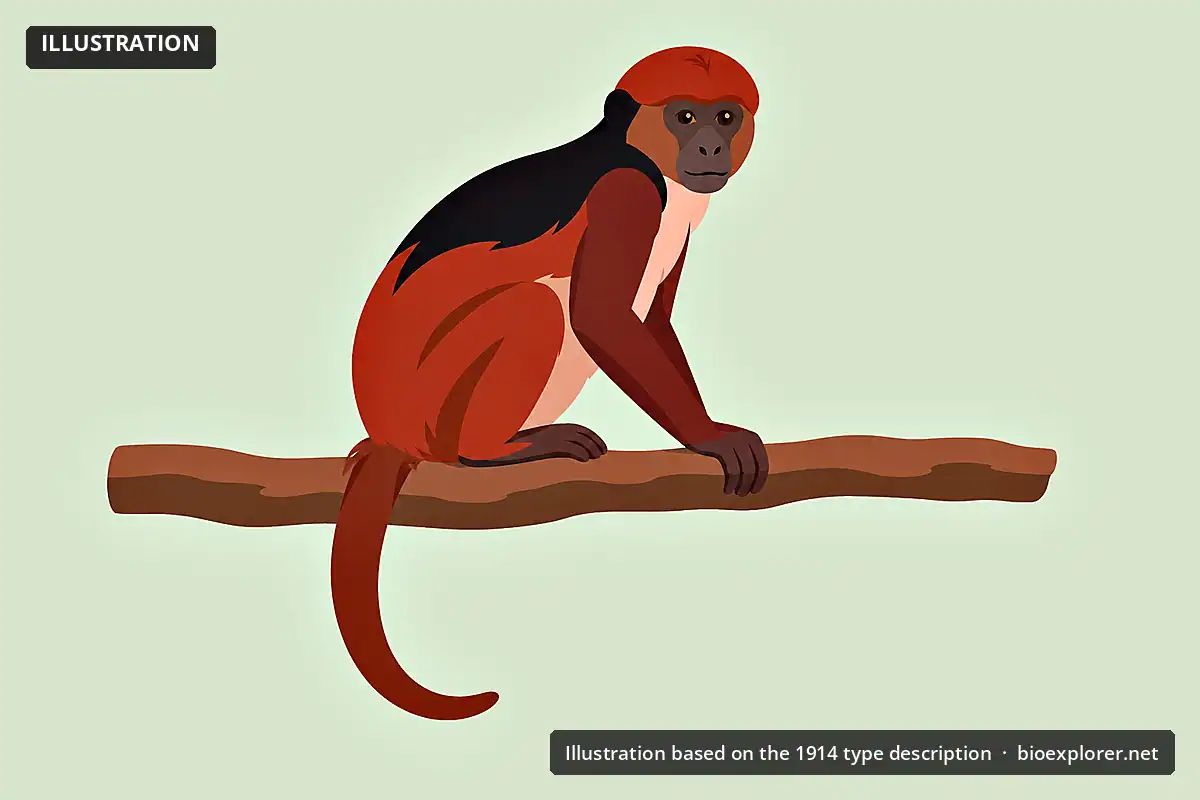
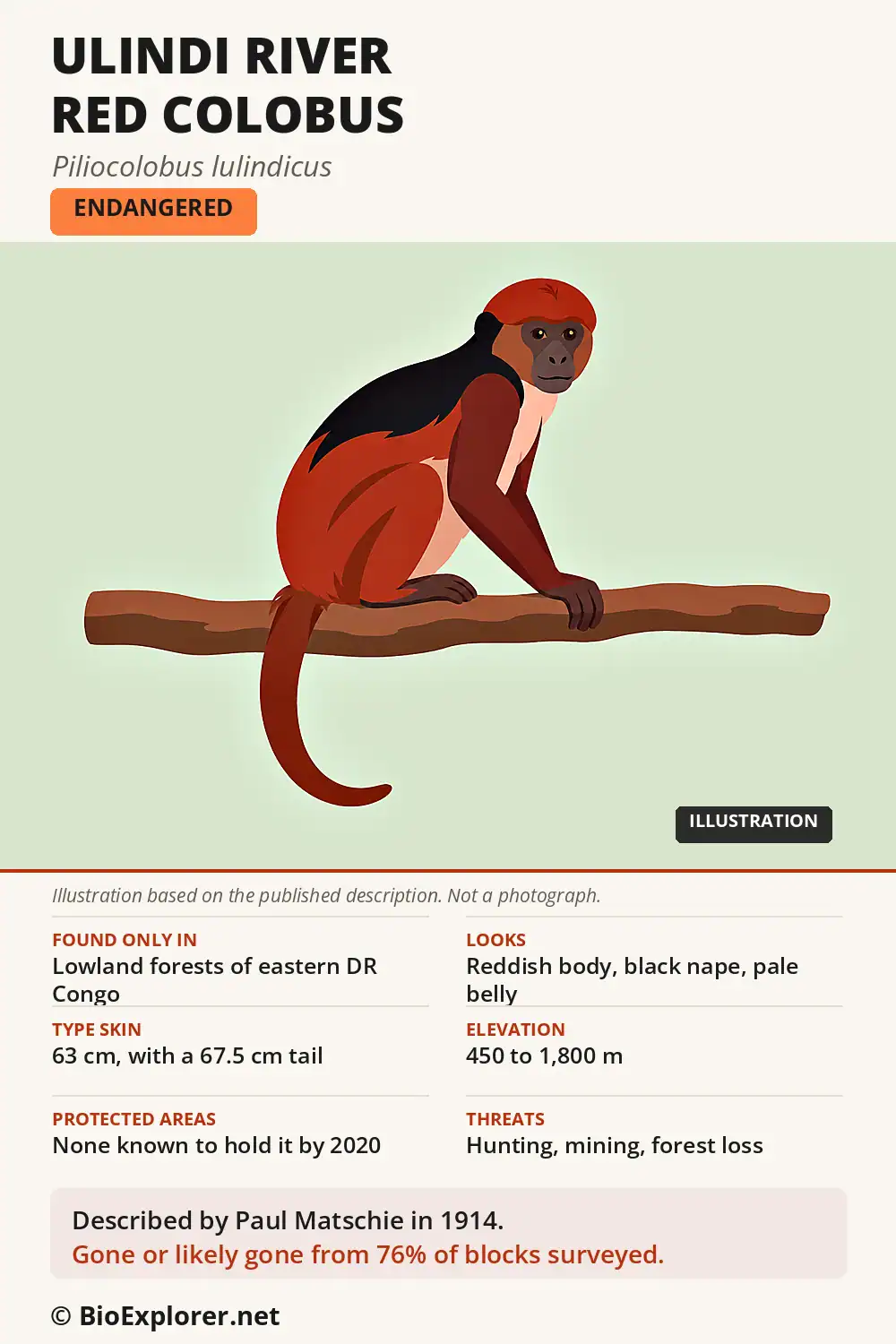
The Ulindi River red colobus is a large, little-known central African monkey. Its scientific name is Piliocolobus lulindicus.[1] It lives only in the lowland forests of the eastern DR Congo. Its body is mostly reddish. Its nape and upper back are black. It is one of the Old World monkeys. The IUCN lists it as Endangered. By 2020, no protected area was known to hold it.
This Endangered red colobus lives in eastern DR Congo's lowland forests.
- Common NamesUlindi River red colobus, Ulindi red colobus, Kahuzi red colobus
- Taxonomy Classification Year1914
- Monkey SizeFemale type skin 63 cm to the tail root, tail 67.5 cm
- Skin Color(s)Reddish body, black nape and front back, brick brown arms, pale belly
- HabitatLowland moist forest, on dry ground and along rivers
- DietAssumed mainly leaves, like other red colobus
- Native CountriesDemocratic Republic of the Congo
- By 2020, no protected area was known to hold it.
- A 2018 survey found it gone from most western blocks checked.
- Paul Matschie described it in 1914, from one skin and skull.
- Its type came from the Lulindi River, near Kasongo.
- The 2020 assessment gave no population estimate.
Ulindi River Red Colobus Distribution
 )
Ulindi River Red Colobus Guide:
Name and Classification
The German zoologist Paul Matschie described this monkey in 1914.[2] He named it Piliocolobus lulindicus. Rudolf Grauer had collected the skin and skull in October 1908. It came from the Lulindi River, near its mouth on the Lualaba. That spot lies not far from Kasongo. The type is an adult female, kept in the Berlin museum.
On the same page, Matschie named a second red colobus. He called it kabambarei, after Kabambare, farther east. He described the Ulindi form by how it differed from that one. Colyn later saw kabambarei as a likely hybrid form.
It belongs to the genus Piliocolobus, the red colobus. They form part of the wider group of colobus monkeys.
Its rank is still argued over. Colyn kept it apart in 1987 and 1991. In 2001 and 2007, Groves merged it into Foa's red colobus. The Mammal Diversity Database follows Groves.[3] It lists lulindicus as a synonym of Piliocolobus foai.
The IUCN takes the other view. A 2016 workshop in Rome chose to keep it as a species. The reason was caution, since all red colobus are threatened. The 2021 red colobus action plan agrees.[4] It calls the split of eastern Congo's red colobus tentative. Possible hybrids blur the lines between them. This page follows the IUCN.
Its genetic relationships remain unresolved. The action plan calls for fecal samples to sort them out.
Physical Description
Matschie said its skin resembles kabambarei, a red brown form. Its underside is a pale flesh color. The sides of its head are brick brown. Its arms are a deeper brick brown than its legs.
Matschie keyed its other colors to a color chart. Its crown, lower back, flanks and legs share one shade. Other traits follow from kabambarei. That form has a hair whorl on the crown. Its hind head, nape and front back are black. Both share the same chestnut brown tail.
Coat color varies across its range. Red forms dominate south of the Elila River. Forms with both red and black prevail to the north.
The Handbook of the Mammals of the World covers the wider group.[5] It treats this monkey within Foa's red colobus. It notes long fur and a fairly short tail. The limbs are red, and the hands and feet are dark. A tuft grows on each side of the tail base.
Its reddish coat places it among the red monkeys. Its black nape and northern forms also fit the black monkeys.
Size and Weight
Colyn collected many specimens in the 1980s. Open sources give figures only for the type skin. It measured 63 cm (24.8 in) to the tail root. Its tail measured 67.5 cm (26.6 in). These are dried skin figures from one female.
The Handbook gives ranges for the wider group. That group includes Foa's red colobus of the mountains. Male head and body: 50 to 69 cm (19.7 to 27.2 in). Male tails run 62 to 67 cm (24.4 to 26.4 in). Males weigh 9 to 13 kg (19.8 to 28.7 lb). Females weigh 7 to 9 kg (15.4 to 19.8 lb).
Similar Species Compared
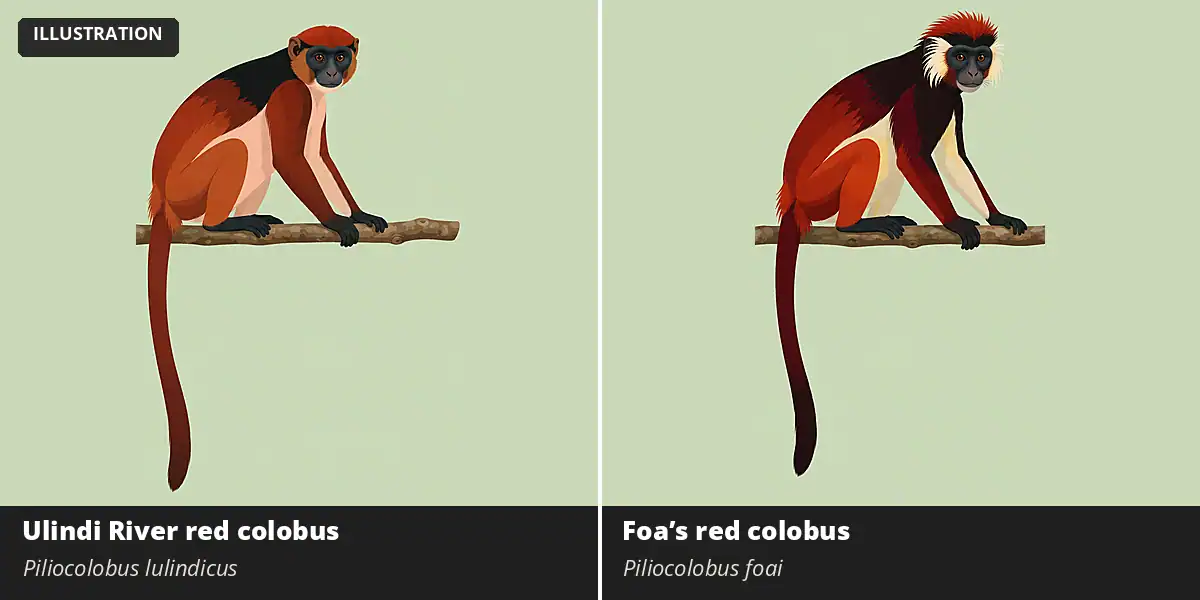
Foa's red colobus is its eastern neighbor.[6] Groves treated the two as one species. Foa's lives in the mountains to the east. The two meet where lowland forest climbs into the hills. That happens at about 1,200 to 1,500 m (3,900 to 4,900 ft). There the two intergrade. Foa's red colobus looks almost black in front.[7] It has a black brow band and a fiery red crest. Matschie's Ulindi description mentions neither trait.
The Lualaba River marks its western edge. Across its northern stretch lives the Lomami red colobus.[8] That species is red, with black on the mid-back and shoulders.[9] Its underside is grayish white, not flesh colored.
Lang's red colobus lives to the northwest, past a hybrid zone.[10] Its reddish front half contrasts with a sepia black rear.[11] Two weighed males were 7.65 kg (16.9 lb) each.[12] The Ulindi form may meet the Semliki red colobus in the north.
| Trait | Ulindi River red colobus | Foa's red colobus | Lomami red colobus | Lang's red colobus |
|---|---|---|---|---|
| Scientific name | Piliocolobus lulindicus (IUCN); within P. foai in the MDD | Piliocolobus foai | Piliocolobus parmentieri | Piliocolobus langi |
| Range | Eastern DR Congo lowlands, from the Lualaba River east to about 28.5°E | Albertine Rift mountains of eastern DR Congo: Kabobo; Itombwe doubtful | Central DR Congo, between the Lomami and Lualaba rivers | Northeastern DR Congo, around Kisangani |
| Habitat | Lowland moist and riverside forest, 450 to 1,800 m | Montane and submontane forest, 800 to 2,270 m | Primary lowland rainforest on dry ground | Primary lowland rainforest |
| Coat and key marks | Reddish, black nape, brick brown arms, pale flesh belly; varies by region | Near-black front, red rear and limbs, black brow band, red crest | Red, black mid-back, shoulders and upper arms, grayish-white underside | Reddish front half, sepia black rear and belly |
| Head and body (males) | Not known; female type skin 63 cm | 50 to 69 cm, wider group with Ulindi form | Not known | About 50 cm |
| Tail (males) | Not known; female type skin 67.5 cm | 62 to 67 cm, wider group | Not known; longer than in Thollon's | About 66.5 cm |
| Weight (males) | Not known separately | 9 to 13 kg, wider group | Not reliably known | Two males 7.65 kg each |
| Diet | Assumed mainly leaves | Leaves, fruit, flowers, buds, possibly seeds; wider group | Leaves, fruit, flowers, buds, possibly seeds | Leaves, fruit, flowers, buds, possibly seeds |
| Group size | At least 46 on average, Kahuzi-Biega lowlands, 1994 to 1995 | Not known | About 20, in John Hart's 2016 observations | Not known |
| IUCN status | Endangered (assessed 2020) | Endangered (assessed 2020) | Endangered (assessed 2017, published 2020) | Endangered (assessed 2018, published 2020) |
Range and Distribution
It is found only in the Democratic Republic of the Congo. That makes it one of the Democratic Republic of the Congo monkeys.
The Lualaba, the upper Congo River, bounds it in the west. It ranges east to about 28.5°E. There lowland forest gives way to the mountains of the Albertine Rift. Its northern limit is the Lowa River, based on one specimen. The IUCN maps its southern limit at the Lukuga River, near 4.7°S. It apparently lives there in large forest islands.
The action plan maps it across four river basins. They are the Lowa, Lubutu, Ulindi and Elila. With hybrid zones, that area is about 95,000 square km. That equals about 36,700 sq mi. The IUCN gives an extent of occurrence of 104,800 square km. That equals about 40,500 sq mi.
The 2020 assessment described isolated subpopulations. Degraded land or emptied forest lies between them.
Habitat Needs
It has only ever been seen in forest. It uses lowland moist forest on dry ground. It also lives in forest along rivers. Its range spans 450 to 1,800 m (1,480 to 5,900 ft).
That lowland forest makes it one of the types of rainforest monkeys.
Diet and Behavior
Little is known of its diet. Like other red colobus, it is assumed to eat mainly leaves. That places it among the herbivorous monkeys.
It lives in groups, and those groups can be big. In 1994 and 1995, a survey counted groups in Kahuzi-Biega's lowlands.[13] Eight groups averaged 46 animals. The authors called this a minimum. Observers counted smaller, tighter groups more easily. They suggested that groups of over about 65 are more typical.
Faced with a hunter, red colobus tend to watch, not flee. That makes several of them easy targets at once.
Population and Status
The 2020 assessment gave no population estimate. It listed the trend as decreasing.
Kahuzi-Biega National Park was once a stronghold. In 1994, it turned up in three of four lowland survey zones. It was common to abundant in two of them. Then came eight years of war. Hunters and miners moved into the park. Surveys resumed in 2004 and ran to 2017. None of them recorded a red colobus.
A 2021 study of Kahuzi-Biega reported the same pattern.[14] It found declines in primates across the region. It linked the declines to likely bushmeat hunting. It singled out the Ulindi River red colobus.
The western range fared badly too. In 2018, John Hart ran a rapid survey there. It covered 102 forest blocks. Red colobus were gone, or likely gone, from 76% of them. Reports placed most losses between 1998 and 2006, a time of unrest. Hunting was cited in most explained cases. These are unpublished data, summarized in the 2020 assessment.
The action plan reports preliminary 2018 surveys with good news. They found several important populations in the Ulindi and Elila basins.
The IUCN listed it as Endangered in 2020. It suspects a drop of over 50% across three generations. One generation is about 10 years. Earlier assessments, in 1996 and 2000, called it Data Deficient.
Major Threats
Hunting for bushmeat is the main threat. Red colobus are large monkeys. Each cartridge brings more profit, so hunters target them first.
Mining drives much of that hunting. The action plan names commercial hunting tied to artisanal mines. Bushmeat is traded to miners and sold in towns. Habitat loss was very high around mining towns like Kalima and Punia.
In the 1980s, Colyn collected specimens in those towns' bushmeat markets. Hart's unpublished 2018 search of those markets found none for sale.
Forest loss is the other big threat. From 2001 to 2018, about 8,920 square km of forest vanished. That equals about 3,440 sq mi. That is about 9.3% of its range. Across the DRC, most forest loss comes from shifting farming. New roads now reach once-remote forest. The 2020 assessment cited 2.7% yearly human population growth there.
War has made all of this worse. Conflict was closely linked to its decline at Kahuzi-Biega.
Conservation Efforts
A 2006 DRC order listed it as fully protected. It used the name Procolobus badius. The order prohibited hunting.
By 2020, it was not known from any protected area. Kahuzi-Biega was the only one where it was ever recorded. Two reserves lie inside its range, South Masisi and Luwama-Kivu. It has not been reported from either.
The action plan ranks it among DR Congo's least known red colobus. It also calls it one of the least protected. Its priority site is the western Ulindi and Elila basins. That area spans the territories of Punia, Kalima, Kailo and Kasongo.
The plan sets out clear steps. Teams would survey forests and take geotagged photos. They would gather fecal samples for genetic study. The plan proposes new protected areas and community reserves. It also calls for better law enforcement and anti-poaching education. Its estimated budget is US$124,000.
Explore more monkeys starting with U. Or browse all types of monkeys.
Common Questions
It lives only in the lowland forests of the eastern DR Congo. Its range runs east from the Lualaba River.
Its body is mostly reddish, with a black nape. Its arms are brick brown, and its belly is pale.
Yes. The IUCN listed it as Endangered in 2020. Hunting and forest loss drive its decline.
Few body measurements are published. The female type skin measured 63 cm, with a 67.5 cm tail.
The IUCN treats it as a species. The Mammal Diversity Database counts it as part of Foa's red colobus.
No one knows. The 2020 assessment gave no population estimate. A 2018 survey covered 102 western forest blocks. It was gone, or likely gone, from 76%.
Cite this page
BioExplorer. (2026, November 2). Ulindi River Red Colobus. https://www.bioexplorer.net/animals/mammals/monkeys/ulindi-river-red-colobus/
About the author

Wildlife Writer and Photographer, BioExplorer.net
Arjun is a science writer and wildlife photographer at BioExplorer.net. He turns new research on animals into clear, accurate reads for curious readers. His work covers animal behavior, ecology, and newly described species. He holds a Cornell Lab of Ornithology certificate in bird biology. He is pursuing an HBSc at the University of Toronto Mississauga.