
Sela Macaque
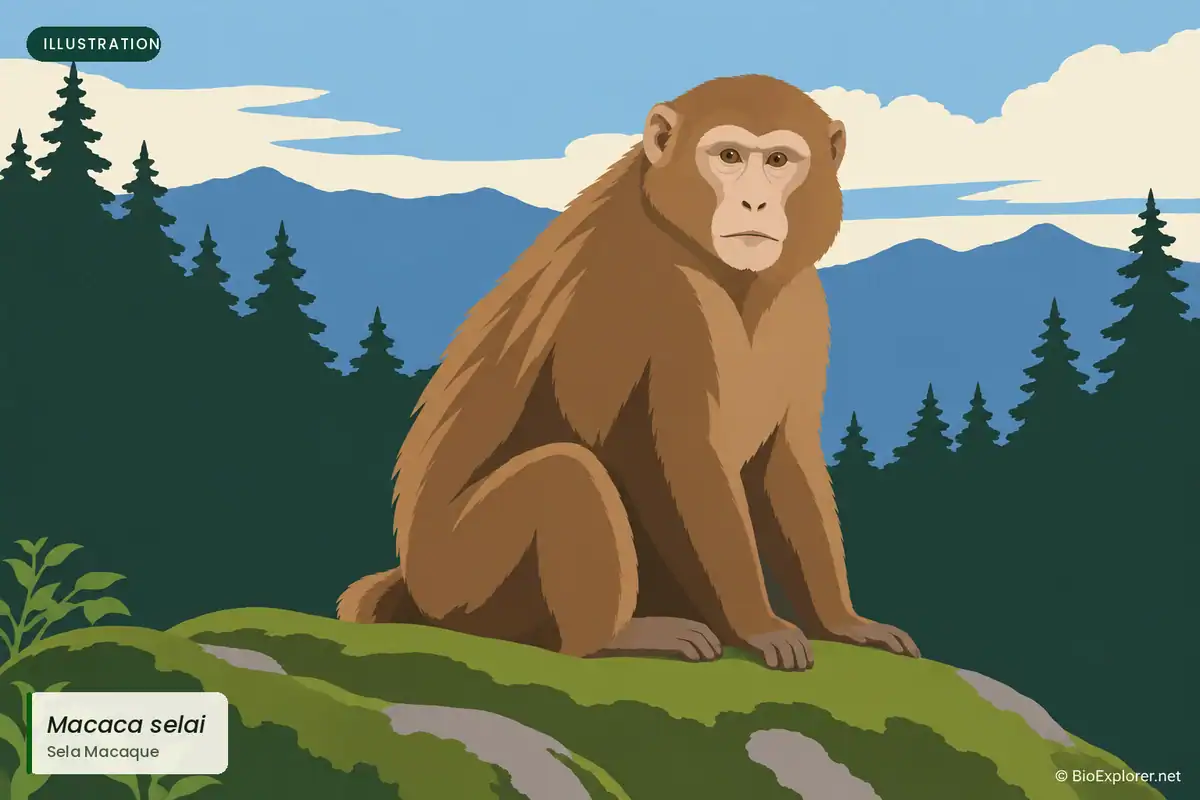
The Sela macaque (Macaca selai) lives in Arunachal Pradesh, India.[1] Sela's macaque is the other name in circulation. It was named in 2022, from genetics rather than bones.[2]
Seven scientists of the Zoological Survey of India described it.[1] They split it from the Arunachal macaque. A mountain pass had kept the two apart.[2]
That pass is Sela, and the species carries its name.[4] The pass itself is named for a local woman.
It belongs to the sinica group of macaque species.[6] The group sits inside the Old World monkeys.
Sela Macaque Guide:
Western and central Arunachal Pradesh, in the Eastern Himalayas. Its holotype is a photograph, not a preserved specimen.
- Common NameSela Macaque
- Taxonomy Classification Year2022
- Monkey SizeNo published measurements. The Arunachal macaque, its closest relative, runs head-body 57.5 cm with a 26.4 cm tail
- Skin Color(s)Pale face and brown coat; heavy build with long hair along the back
- HabitatEastern Himalayan montane forest. The Arunachal macaque holds 2,000 to 3,000 m
- DietNot studied. The Arunachal macaque takes pith, bark and young leaves
- Native CountriesIndia. Bhutan and China are unconfirmed
- Holds West Kameng and Upper Subansiri districts.[2] The Arunachal macaque keeps Tawang.
- The type locality is Nyukmadung, at 2,016 m.[1]
- The face is pale and the coat brown.[4] The Arunachal macaque is darker in both.
- It parted from the Arunachal macaque about 1.96 million years ago.[2]
- The holotype is a photographed specimen.[1]
Sela Macaque Distribution
 )
)Macaque Identification
Two characters separate it from its closest relative.[4]
- The face is pale. The Arunachal macaque has a dark face.[4]
- The coat is brown. The Arunachal macaque is dark brown.[4]
The two share more than they differ.[4] Both carry a heavy build. Both grow long hair along the back.
No measurements have been published for this species.[2] The size row above borrows the Arunachal macaque figures.[6] Head-body is 57.5 cm and the tail 26.4 cm. Treat them as a guide to the pair.
That short tail is a mark of the sinica group.[6] The rhesus macaque of the same genus carries a far longer one.
Range And Habitat
The species holds western and central Arunachal Pradesh.[4] Two districts carry the named populations.[2] They are West Kameng and Upper Subansiri.
Tawang district lies on the far side of the pass.[2] The Arunachal macaque holds that ground.
The type locality is Nyukmadung, in West Kameng.[1] It sits at 2,016 m above sea level. The coordinates are 27.4057 north and 92.1332 east.
Two more countries are possible but unconfirmed.[1] They are Bhutan and China.
No habitat study has been published for this species. The Arunachal macaque holds 2,000 to 3,000 m.[6] Its forests are dominated by Bhutan fir. No other macaque in the subcontinent lives that high.
Other monkeys of India sit far lower down.
A Photographed Type
Most new mammals are named from a preserved specimen. This one was not.
The holotype is a photographed specimen.[1] No skin or skull was collected. The Mammal Diversity Database records the type kind as holotype.
The description itself rests on mitochondrial DNA.[2] The authors used d-loop sequences and a phylogenetic species concept. The rhesus macaque served as the outgroup.
That is a modern and contested way to name a mammal. It is also the only way here. Collecting a Himalayan primate is neither simple nor welcome.
The databases have not fully caught up.
- The Mammal Diversity Database accepts the species.[1] It flags the record as recently described.
- The GBIF backbone does not carry the name at all.[8] A search resolves only to the genus.
- The IUCN has not assessed it.[1]
The parent species is itself debated.[6] The Handbook notes the Arunachal macaque may be a variation. The candidate is the Assamese macaque, Macaca assamensis pelops.
How It Arose
Sela Pass runs above 4,000 m through the Eastern Himalayas. For macaques it is a wall, not a road.
The authors date the split at about 1.96 million years ago.[2] The pass restricted movement between the two groups. That is allopatric speciation, driven by terrain.
The Sela macaque carries high variation within itself.[2] The authors recognize at least two conservation units. West Kameng and Upper Subansiri are the two.
Their demographic histories do not match.[2]
- The West Kameng population has declined for about 2,000 years.[2]
- The Upper Subansiri population expanded over about 8,000 years.[2] It then fell very recently.
- The Arunachal macaque has declined over the same 2,000 years.[2]
Those are effective population sizes from genetic modeling.[2] They are not counts of animals.
Conservation Status
The IUCN has not assessed Macaca selai.[1] The badge above therefore reads Not Evaluated.
The species is only three years old in the literature. No assessment would be expected yet.
The Arunachal macaque, its closest relative, is Endangered.[2] That gives some sense of the pressures nearby.
Crop loss is the conflict villagers report.[4] They name the Sela macaque as a major cause. The reports come from West Kameng district.
Troop behavior differs across the range.[4] Some troops are habituated to people. Others avoid human company altogether.
The authors ask for cross-border surveys.[2] Populations may sit in Bhutan and in China. Neither has been documented.
The underlying sequence data is public.[7] That makes the claim testable by anyone.
Common Questions
In western and central Arunachal Pradesh, in northeast India. The two named populations are in West Kameng and Upper Subansiri districts, with the type locality at Nyukmadung, 2,016 m above sea level. The Mammal Diversity Database also lists Bhutan and China, both unconfirmed.
Two visible characters. The Sela macaque has a pale face and a brown coat, while the Arunachal macaque has a dark face and a dark brown coat. They otherwise share a heavy build and long hair along the back. The firmer difference is genetic, and the two are separated by Sela Pass.
Because mitochondrial d-loop sequences place it apart from the Arunachal macaque, with the split dated at about 1.96 million years ago. Sela Pass acted as a barrier and stopped the two populations mixing. The authors applied a phylogenetic species concept rather than a morphological one.
A local woman. Sela Pass is named after her, and the macaque is named after the pass. The published etymology records that she supported an Indian soldier during the fighting at Tawang. The authors chose the name in her honor.
The IUCN has not assessed it, so the badge reads Not Evaluated. The species was only described in 2022, so no assessment would be expected yet. Its closest relative, the Arunachal macaque, is Endangered. Villagers in West Kameng report the Sela macaque as a major cause of crop loss.
No. The Mammal Diversity Database accepts it and flags the record as recently described. The GBIF backbone does not carry the name at all, and a search resolves only to the genus Macaca. The Handbook of the Mammals of the World also notes that the parent species, the Arunachal macaque, may itself be a variation of the Assamese macaque.
The Assamese macaque is the species this whole question keeps returning to.
Cite this page
BioExplorer. (2026, October 9). Sela Macaque. https://www.bioexplorer.net/animals/mammals/monkeys/sela-macaque/
About the author