
Santa Marta White-fronted Capuchin
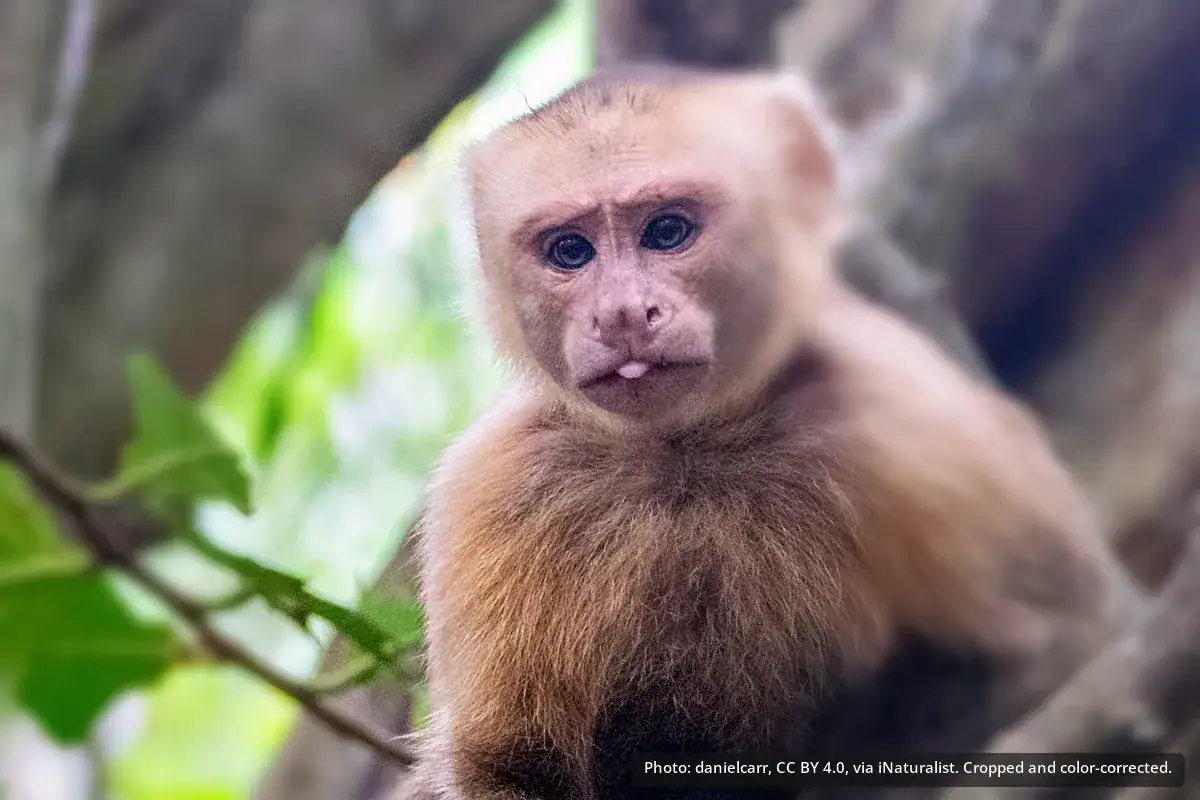
The Santa Marta white-fronted capuchin is a slender monkey from northern Colombia. Its scientific name is Cebus malitiosus. It lives only around the Sierra Nevada de Santa Marta. It is one of the New World monkeys. The IUCN lists it as Endangered.[1] Yet almost nothing is known about how it lives.
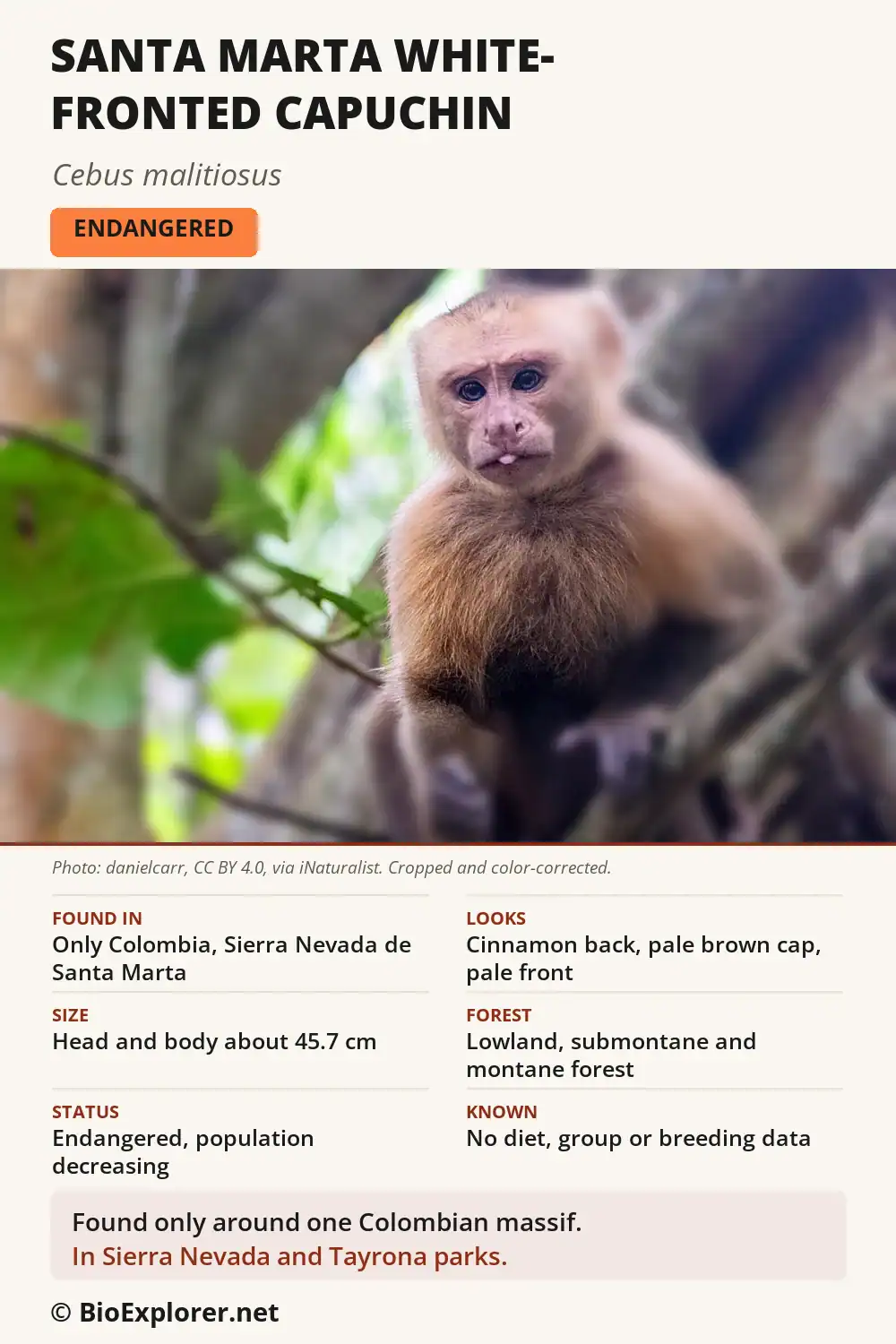
This Endangered capuchin lives only around Colombia's Sierra Nevada de Santa Marta.
- Common NamesSanta Marta white-fronted capuchin, Santa Marta capuchin
- Taxonomy Classification Year1909
- Monkey Size45.7 cm (18 in), measured female skin
- Skin Color(s)Cinnamon-brown body with a pale brown cap and a pale front
- HabitatLowland, submontane and montane forest
- DietPresumed omnivorous; no species-level diet data
- Native CountriesColombia
- Its cap is pale brown and its back is cinnamon brown.
- A pale front spreads across its shoulders and inner upper arms.
- Its forearms barely contrast with the rest of its body.
- The handbook reports no diet, reproduction or behavior data.
- It occurs in Sierra Nevada de Santa Marta and Tayrona parks.
Santa Marta White-fronted Capuchin Distribution
 )
Santa Marta White-fronted Capuchin Guide:
Name and Classification
Daniel Giraud Elliot named this capuchin in 1909.[2] He based it on animals from the Santa Marta foothills. For a long time it was treated as a subspecies. Authors placed it inside the wide-ranging Cebus albifrons. In that broad sense, C. albifrons is Humboldt's white capuchin.
A 2012 DNA study reassessed the untufted capuchins.[3] It proposed several new species. These included the varied and Río Cesar capuchins. The 2013 handbook then recognized this species.[4] The IUCN and GBIF accept it too.
Not every authority agrees. The Mammal Diversity Database still lists it under C. albifrons.[5] It cites limited data and a genus that needs revision. The Red List still treats it as a full species.
Its type specimen hides a twist. A 2026 review examined the original holotype.[6] It turned out to be two animals. The skin is a female; the skull is a male. Three other specimens showed similar label mix-ups.
Physical Description
The handbook describes a mid-toned, cinnamon-brown monkey. Its cap is pale brown. Its back is cinnamon brown. Its belly and chest carry ocherous-tawny to cinnamon hairs with silver tones.
A pale front is its clearest mark. The pale area spreads across the shoulders. It reaches the inner sides of the upper arms. That pale front places it among the white monkeys of Colombia. The cinnamon body places it among the brown monkeys as well.
Its forearms and forelegs barely contrast with the body. That lack of contrast helps separate it from its neighbors. Its relatives show brighter, more sharply marked limbs.
Size and Weight
The handbook gives a head and body length of 45.7 cm. That measurement came from the female skin. It is about 18 in. The tail measures 43.3 cm, or about 17 in. The handbook reports no weight data.
Similar Species Compared
Three closely related named forms occur in northern Colombia. The MDD still folds all four into one species. Each differs mainly in its coat and its range.
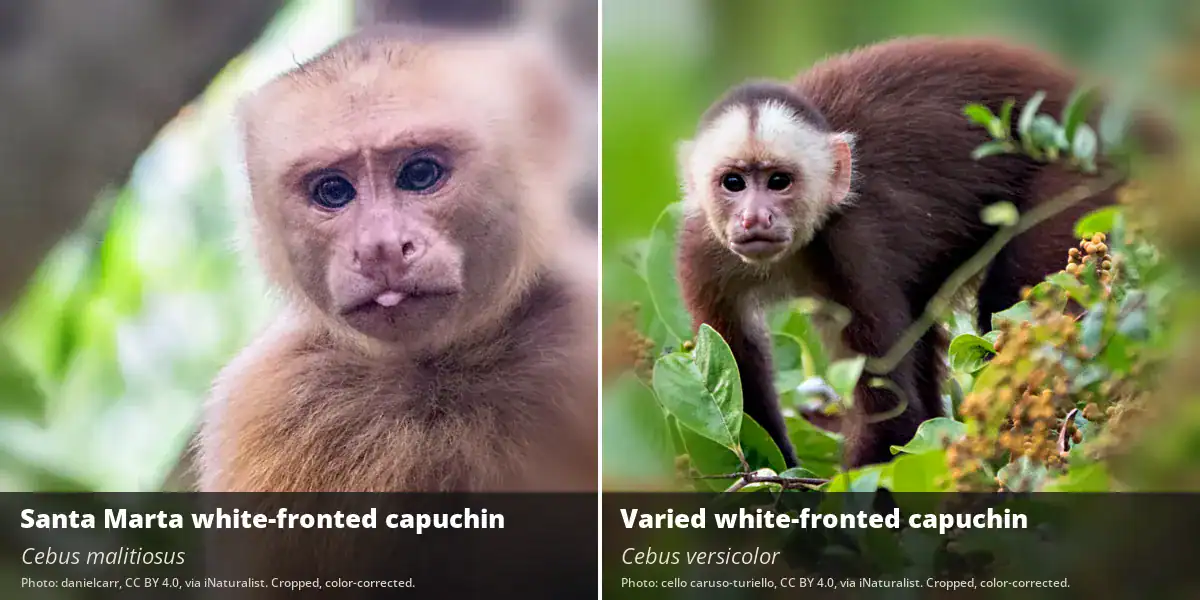
The varied white-fronted capuchin lives south, in the Magdalena valley.[7] It is paler, with red on its back and limbs. The IUCN lists it as Endangered.[8] The Río Cesar white-fronted capuchin lives east, along the Río Cesar.[9] It is the palest, with orange forearms. The IUCN lists it as Endangered.[10] The Sierra de Perijá white-fronted capuchin lives farther east, into Venezuela.[11] It is the darkest, with burnt-sienna limbs. The IUCN lists it as Vulnerable.[12] In the Santa Marta capuchin, the forearms barely contrast.
| Trait | Santa Marta white-fronted capuchin | Río Cesar white-fronted capuchin | Sierra de Perijá white-fronted capuchin | Varied white-fronted capuchin |
|---|---|---|---|---|
| Scientific name | Cebus malitiosus | Cebus cesarae | Cebus leucocephalus | Cebus versicolor |
| Range | Northeastern slopes and northwest base, Sierra Nevada, Colombia | Río Cesar valley and eastern Santa Marta slopes, Colombia | Santander to the Catatumbo basin, Colombia, into Zulia, Venezuela | Middle Magdalena valley, Colombia |
| Habitat | Lowland, submontane and montane forest | Dry, gallery and mangrove forest, up to 500 m | Lowland moist, dry and mangrove forest | Lowland moist forest and palm swamps |
| Coat and key marks | Cinnamon-brown back, pale brown cap, limbs barely contrasting | Palest form, cinnamon cap, orange forearms | Darkest form, burnt-sienna limbs and flanks | Pale form, red mid-back and limb fronts |
| Head and body | 45.7 cm, female skin | Males 34.8 to 40.7 cm | Males 37 to 40.7 cm | 45 to 50.5 cm, sex not given |
| Tail | 43.3 cm, female skin | Males 41.9 to 49.5 cm | Males 39.2 to 49.9 cm | 42 to 45.5 cm, sex not given |
| IUCN status | Endangered (assessed 2020) | Endangered (assessed 2020, amended 2021) | Vulnerable (assessed 2021) | Endangered (assessed 2021) |
Range and Distribution
This capuchin is endemic to northern Colombia. It lives around the Sierra Nevada de Santa Marta. Records span its northwest base and northeastern slopes. The type locality is Bonda, in Magdalena department.
The Sierra Nevada is an isolated coastal massif. A single-massif range leaves the species very exposed. Its distribution map shows Colombia alone.
Habitat Needs
The handbook records it in forest across several bands. It uses lowland, submontane and montane forest. That humid lowland forest ranks it among the rainforest monkeys. Like other capuchins, it is an arboreal, tree-dwelling monkey.
Diet and Feeding
The handbook reports no diet data. Its exact foods remain unknown. Like other capuchins, it is considered an omnivore. That general habit places capuchins among the omnivorous monkeys.
Behavior and Groups
Its daily life is almost unstudied. The handbook reports no reproductive or behavioral data. Species-specific activity and group structure remain unknown.
Other capuchins are diurnal and live in mixed groups. Those habits likely apply here too. Still, the handbook confirms none of it. Its social life remains an open question.
Conservation Status
The IUCN assessed it as Endangered in 2020. The assessment reports a decreasing population. It carries the taxon number 4084 on the Red List.
The handbook notes it on CITES Appendix II. It occurs in two protected areas. These are the Sierra Nevada de Santa Marta and Tayrona national parks. Still, its tiny range sits in a heavily settled region. Explore more monkeys starting with S, or browse all types of monkeys.
Common Questions
The Santa Marta white-fronted capuchin lives only in northern Colombia. It is found around the Sierra Nevada de Santa Marta.
Yes. The IUCN lists the Santa Marta white-fronted capuchin as Endangered. Its assessment reports a decreasing population.
A measured female skin was 45.7 cm, head and body. Its tail measured about 43 cm.
The Santa Marta white-fronted capuchin has a cinnamon-brown back. A pale front spreads over its shoulders and inner arms.
The IUCN treats it as a full species. The Mammal Diversity Database still places it under Cebus albifrons.
The Santa Marta capuchin has limbs that barely contrast. The varied white-fronted capuchin is paler, with red on its back.
Cite this page
BioExplorer. (2026, November 3). Santa Marta White-fronted Capuchin. https://www.bioexplorer.net/animals/mammals/monkeys/santa-marta-white-fronted-capuchin/
About the author

Wildlife Writer and Photographer, BioExplorer.net
Arjun is a science writer and wildlife photographer at BioExplorer.net. He turns new research on animals into clear, accurate reads for curious readers. His work covers animal behavior, ecology, and newly described species. He holds a Cornell Lab of Ornithology certificate in bird biology. He is pursuing an HBSc at the University of Toronto Mississauga.