
Oustalet’s Red Colobus
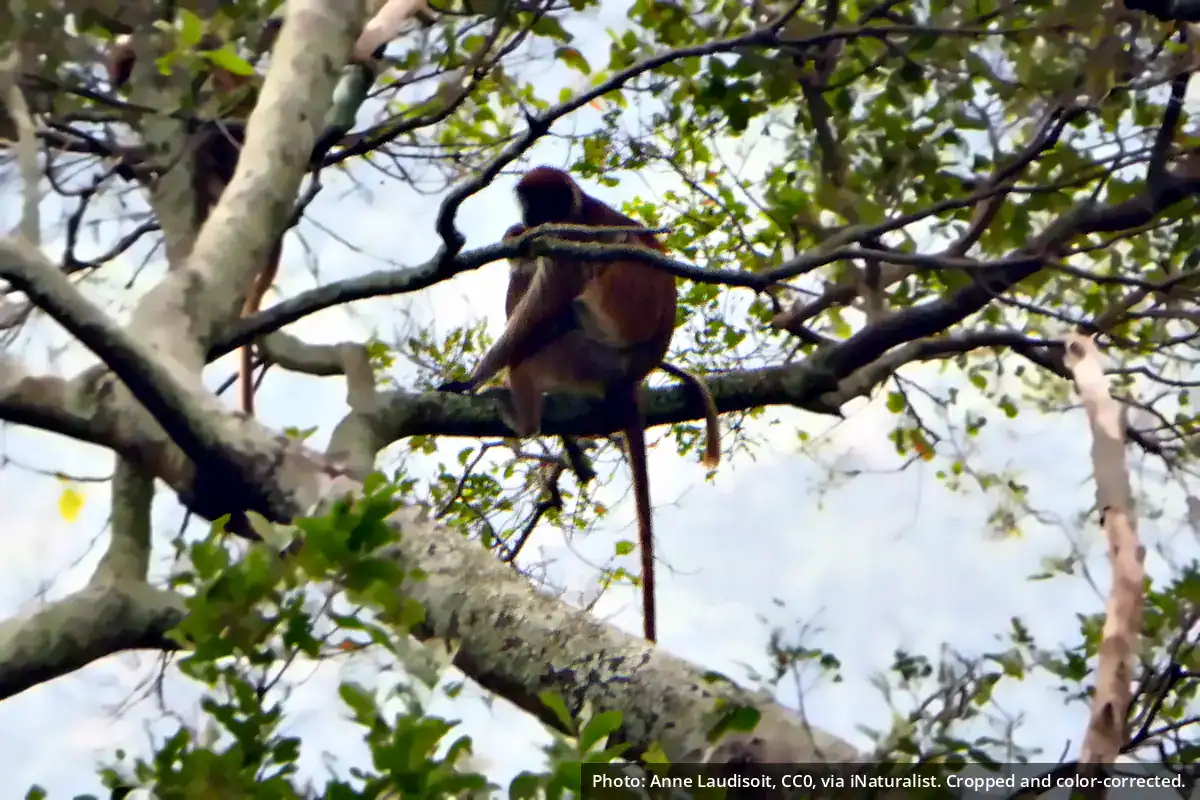
The Oustalet's red colobus is a leaf-eating monkey of central Africa. Its scientific name is Piliocolobus oustaleti.[1] It is also called the Ubangi red colobus. It lives north of the Congo River, mostly in DR Congo.[2] Its coat is usually a dark, speckled smoky brown.[3] It is one of the Old World monkeys. Hunters kill it for bushmeat across much of its range. The IUCN lists it as Vulnerable.
This Vulnerable red colobus lives north of the Congo River.
- Common NamesOustalet's red colobus, Ubangi red colobus, Oubangui red colobus, Colobe d'Oustalet (French)
- Taxonomy Classification Year1906
- Monkey SizeHead and body 45.9 to 68 cm (18.1 to 26.8 in) in males, 52 to 64 cm (20.5 to 25.2 in) in females
- Skin Color(s)Dark speckled smoky brown above, paler below, grayish whiskers, dark to black hands and feet
- HabitatLowland moist forest, swamp forest and gallery forest, 350 to 1,850 m
- DietYoung and mature leaves, fruit, flowers and buds
- Native CountriesDemocratic Republic of the Congo, Republic of the Congo, Central African Republic, South Sudan
- Its range runs from the Sangha River east to Lake Albert.
- Its coat is usually dark smoky brown, but color varies.
- It uses lowland forest, swamp forest and gallery forest along rivers.
- At one site, groups waded into water to collect plant bulbs.
- The 2021 action plan reported no density estimate.
Oustalet's Red Colobus Distribution
 )
 )
 )
 )
Oustalet's Red Colobus Guide:
Name and Classification
Édouard-Louis Trouessart described this monkey in 1906. He named it Colobus oustaleti. The holotype is kept in Paris. It came from Youmba, on the lower Ubangi River's right bank.
The species has carried many names. Matschie, Lönnberg and others named red colobus from its range. The Mammal Diversity Database now lists 21 names under it.
It belongs to the genus Piliocolobus, the red colobus. They form part of the wider group of colobus monkeys.
Its rank has shifted over time. Some authors placed it under Pennant's red colobus. Others placed it under Foa's red colobus. The 2008 Red List ranked it under the Tana River red colobus. Colin Groves treated it as a full species in 2007. The IUCN follows that view.
Its taxonomy is still fluid. Mitochondrial DNA varies a lot between populations. One 2008 study suggested it may hold several taxa. Past gene flow between neighbors could also explain the pattern.
The skull links it to eastern relatives. It shares a long palate and angular eye sockets with three others. They are Foa's, the Semliki red colobus and the ashy red colobus. Like Foa's, it has small teeth.
Physical Description
It is a large, robust monkey. Males and females differ in size.
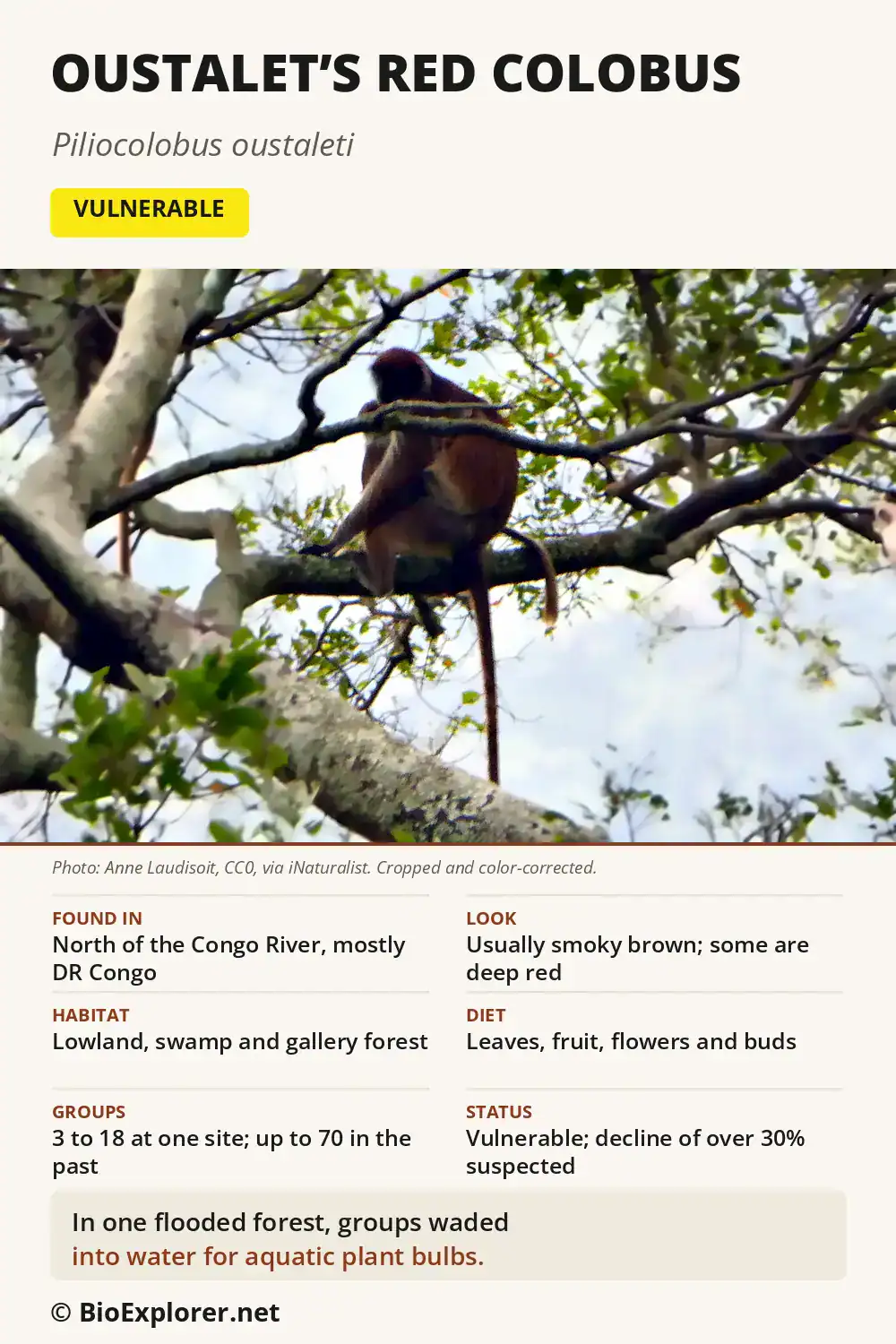
Its fur is usually dark, speckled smoky brown above. Some animals are a paler brownish fawn. The underparts are slightly paler, from buff to whitish or pale red. That brown coat places it among the brown monkeys.
The crown hardly contrasts with the back. The whiskers are grayish. The hands and feet are dark to black.
A prominent tuft of hair, called a panache, grows on the tail. It is shorter than the tuft on Thollon's red colobus.
Color varies a great deal across the range. Some animals near the Ubangi and Lobaye rivers are raw sienna brown. Their underparts may be golden. The tail root may show a coppery patch. Animals in the Uele River galleries tend to be lighter fawn. Their forelimbs and lower legs are pale, against dark hands and feet.
A deep red form also occurs. It appears in the southwest and in the far east. The eastern one probably reflects gene flow from neighboring red colobus. Those red animals fit among the red monkeys.
Size and Weight
Head and body length differs by sex. Males run 45.9 to 68 cm (18.1 to 26.8 in). Their tails run 55.5 to 73 cm (21.9 to 28.7 in).
Females run 52 to 64 cm (20.5 to 25.2 in). Their tails run 68 to 73 cm (26.8 to 28.7 in).
The handbook calls the tail short. Yet its own figures give a tail near body length or longer.
Body weights come from bushmeat markets.[4] One male from the Kisangani region weighed 12.5 kg (27.6 lb). Two females from Ngotto, in the Central African Republic, averaged 8.25 kg. They weighed 7.6 and 8.9 kg (16.8 and 19.6 lb). So these figures rest on only three animals.
Similar Species Compared
The Sangha River marks its western edge. Just west of it lives Bouvier's red colobus.[5] Their ranges come very close near Pombo. Yet no intermediates between them are known. Bouvier's is glossy red, with a narrow blackish mantle.[6] Its pale face has large pink eye rings.
South of the Congo River lives Thollon's red colobus.[7] It is foxy red above and creamy white below.[8] Its tail tuft is longer.
The Aruwimi, or Ituri, River marks the southern edge in the east. South of it lives the Semliki red colobus.[9] It has a gray front body and brick-red arms.[10] Farther west, near Kisangani, lives Lang's red colobus. A broad hybrid zone involves four eastern species, and possibly Oustalet's.[11]
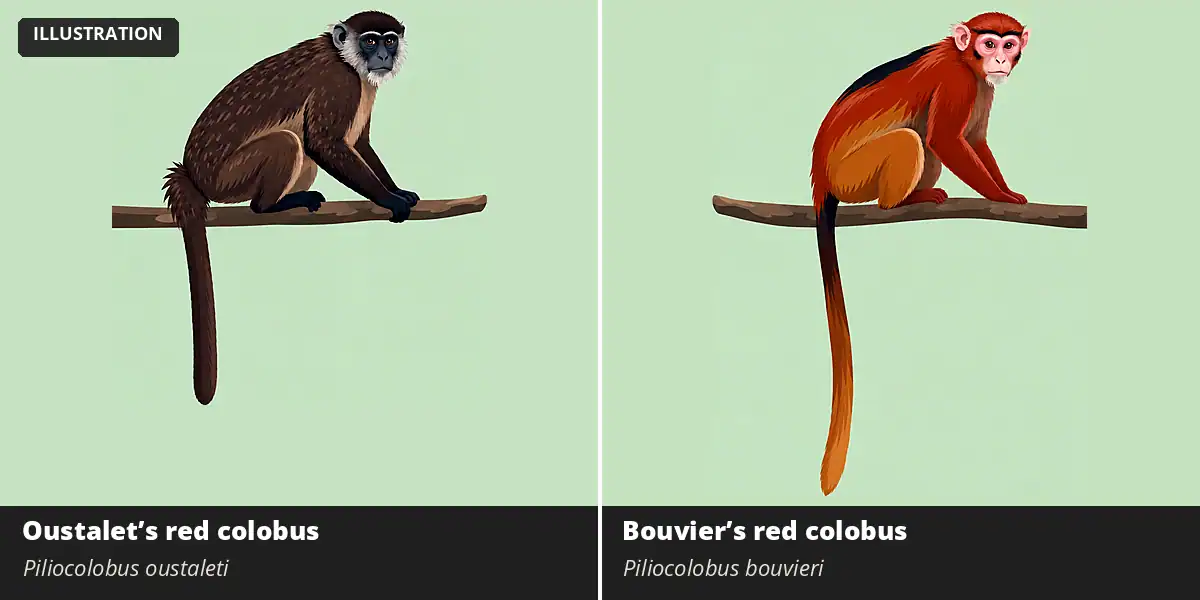
| Trait | Oustalet's red colobus | Bouvier's red colobus | Thollon's red colobus | Semliki red colobus |
|---|---|---|---|---|
| Scientific name | Piliocolobus oustaleti | Piliocolobus bouvieri | Piliocolobus tholloni | Piliocolobus semlikiensis |
| Range | Northern DR Congo, northeastern Republic of the Congo, southwestern Central African Republic, southern South Sudan | Republic of the Congo only | DR Congo, south of the Congo River and west of the Lomami River | Northeastern DR Congo; possibly western Uganda |
| Habitat | Lowland moist, swamp and gallery forest, 350 to 1,850 m | Swamp forest and riverside forest | Closed-canopy lowland rainforest, swamp to dry ground | Lowland, swamp and riverside forest, 550 to 2,400 m |
| Coat and key marks | Dark speckled smoky brown above; very variable, with fawn, sienna and deep red forms | Glossy red, narrow blackish mantle, pale face with pink eye rings | Foxy red above, creamy white below, long black tuft at the tail base | Gray front body, blackish mantle, brick-red arms, black hands and tail |
| Head and body (females) | 52 to 64 cm | About 58 cm, from two specimens | 58 to 60 cm, from three specimens | Not known |
| Tail (females) | 68 to 73 cm | About 76 cm, from two specimens | 41 to 69 cm, from three specimens | Not known |
| Weight (females) | About 8.2 kg, from two specimens | Not known | Not known | Not known |
| Diet | Leaves, fruit, flowers, buds, possibly seeds | Leaves, fruit, flowers, buds, possibly seeds | Mostly young leaves; about 31 percent seeds at one site | Thought to be mainly leaves |
| Group size | 3 to 18 at one site; counts up to 70 in Okapi Wildlife Reserve in the past | Not known | 5 to 63 at one site, in John Hart's 2008 data | Not known |
| IUCN status | Vulnerable (assessed 2018, published 2020) | Endangered (assessed 2019, published 2022) | Vulnerable (assessed 2019, published 2020) | Vulnerable (assessed 2020) |
Range and Distribution
It lives in four countries in central Africa. Most of its range lies in the Democratic Republic of the Congo. It is one of the Democratic Republic of the Congo monkeys. It also lives in the northeastern Republic of the Congo. Its range reaches the far southwest of the Central African Republic.
Its range covers about 766,035 square km (295,768 square miles). It runs from 350 m (1,150 ft) to 1,850 m (6,070 ft).
Rivers mark most of its borders. The Congo River and the Aruwimi, or Ituri, River form the south. The Sangha River forms the west. The Uele River forms the north between about 21° and 27° E.
In the east, it reaches about 31° E. There it lives on the escarpments above Lake Albert.
Its northernmost record lies in Garamba National Park, at about 4.5° N. Yet the species now seems absent from Garamba. It also appears absent from other northern and eastern sites.
Surveys in the Bili-Gangu forests found many primates, but not this one. Open savanna and the Uele River seem to block its spread.
South Sudan is uncertain. The 2020 assessment lists it as possibly extinct there. Yet the 2021 action plan reports camera-trap and patrol records. They came from Bangangai and Bire Kpatuos game reserves. Local residents say it is not common there.
Habitat Needs
It lives in three kinds of forest. Each covers large parts of its range.
The first is mature lowland moist forest. Big blocks lie in Ituri, Rubi-Télé and Aketi, in DR Congo. It also lives in northern Republic of the Congo. There it uses mostly primary evergreen forest. It also uses older secondary forest, but not young regrowth. It seems to favor riversides and swamp forest.
Its forest home places it among the types of rainforest monkeys.
The second is seasonally or permanently flooded swamp forest. Large swamps lie where the Congo, Sangha and Ubangi rivers meet. That area includes Lac Télé in the Republic of the Congo. In the Ngotto Forest, it lives only in flooded riverbank forest.
The third is gallery forest and forest islands in savanna. The easternmost groups live in small patches above Lake Albert. Semi-deciduous trees dominate these high forests. Home ranges there are tightly limited. The assessors suggest these groups may face periodic food stress.
Diet and Behavior
It eats young and mature leaves. It also eats fruit, flowers and buds, and possibly seeds. That plant diet places it among the herbivorous monkeys.
In Okapi Wildlife Reserve, it uses stands of one tree, Gilbertiodendron dewevrei. There it eats flower buds and unripe seeds during mass fruiting. John Hart recorded this in 2007, in unpublished observations.
At Ngotto, a 1979 study watched its groups closely. They spent 30 percent of their time below 10 m (33 ft). They regularly entered water to collect the bulbs of aquatic plants.
It is active by day and lives in the trees. The 2013 handbook reported no breeding data.
Group sizes vary. At one site, groups held 3 to 18 animals. In Okapi Wildlife Reserve, some groups once numbered up to 70. Counts reached up to 50 in 2011. Unpublished 2018 Wildlife Conservation Society data suggested smaller groups.
Population and Status
The 2021 action plan reported no density estimate. Its large range suggests it is among the more numerous red colobus.
Several large surveys have recorded it as common. It was the third most observed primate in Ngotto's flooded forests. It was common at eight of 12 sites around Buta and Aketi.
It was among the most commonly recorded primates in Okapi Wildlife Reserve. That held from 1993 to 2011. Unpublished 2018 Wildlife Conservation Society data showed lower relative abundance.
The Mai Tatu forest, in eastern Ituri, also holds it. Yet in 2018 it was one of the least recorded primates there. The same was true in forest fragments on the Lake Albert escarpment.
The IUCN lists it as Vulnerable under criterion A4cd. The assessors suspect a decline of over 30 percent over 30 years. That projection runs to 2035. One generation lasts about 10 years. The assessment dates from 2018 and was amended in 2020.
It was ranked Least Concern in 2008 and 2016.
Major Threats
Hunting and habitat loss are the main threats. Like all red colobus, it moves slowly and is easy to hunt.
Hunters usually use shotguns. Hunting threatens it around Buta and in the Rubi-Télé Hunting Domain. It also threatens it across the northern Republic of the Congo. The same holds in the southwestern Central African Republic. The threat lies outside areas protected by wildlife guards.
Hunting was once rare in the Ituri forest. Now it is a growing threat there. That includes Okapi Wildlife Reserve and the unprotected Mai Tatu forest.
In 1989, John Hart found widespread hunting in the Abubumbazi forest. A brief survey there found no red colobus at all.
Markets show the trade. Hicks's unpublished 2007 and 2008 surveys covered Buta and Aketi markets. They recorded two red colobus among 169 monkey carcasses.
Forest loss is severe on its northern and eastern edges. Small farms, nomadic herding, small-scale logging and charcoal all clear forest there. Even light wood cutting could harm groups with tiny home ranges.
Deforestation is spreading around Bunia, Isiro, Buta, Lisala and Gemena. A band of cleared forest now isolates the Abubumbazi groups. It is up to 100 km (62 miles) wide. Oil palm plantations near Lisala have destroyed habitat for good.
The 2020 assessment reported high forest-loss rates. About one-quarter of its range was affected. About 15,000 square km of forest vanished there from 2001 to 2016. That is about 5,790 square miles.
Conservation Efforts
National law fully protects all red colobus in DR Congo. The Republic of the Congo protects them too. So does the Central African Republic.
International trade in it falls under CITES Appendix II. The 2020 assessment gives Appendix I instead. The African Convention lists it in Class B.
Its largest remaining populations live in protected areas. DR Congo has Okapi Wildlife Reserve and Rubi-Télé Hunting Domain. It also has Ngiri Nature Reserve. The Republic of the Congo has Nouabalé-Ndoki National Park. It also has Lac Télé Community Reserve. The Central African Republic has the Dzanga-Sangha complex. It also has Mbaéré-Bodingué National Park.
Protected areas that control hunting matter most. Well-managed certified logging concessions can help too.
The 2021 action plan sets a budget of US$210,000 for this species. It calls for surveys across the range, including Lake Albert's forest patches. It also calls for anti-poaching work and education programs.
Explore more monkeys starting with O. Or browse all types of monkeys.
Common Questions
It lives north of the Congo River, mostly in DR Congo. It also lives in the Republic of the Congo. It reaches the Central African Republic too.
It is usually dark, speckled smoky brown above. Its color varies a lot, and some animals are deep red.
It eats leaves, fruit, flowers and buds. At one site, groups waded into water for plant bulbs.
The IUCN lists it as Vulnerable. Hunting and forest loss are the main threats.
The 2021 action plan reported no density estimate. Some large surveys recorded it as common.
Males measure 45.9 to 68 cm in head and body. One sampled male weighed 12.5 kg.
Cite this page
BioExplorer. (2026, November 11). Oustalet’s Red Colobus. https://www.bioexplorer.net/animals/mammals/monkeys/oustalets-red-colobus/
About the author

Wildlife Writer and Photographer, BioExplorer.net
Arjun is a science writer and wildlife photographer at BioExplorer.net. He turns new research on animals into clear, accurate reads for curious readers. His work covers animal behavior, ecology, and newly described species. He holds a Cornell Lab of Ornithology certificate in bird biology. He is pursuing an HBSc at the University of Toronto Mississauga.