
Ornate Titi
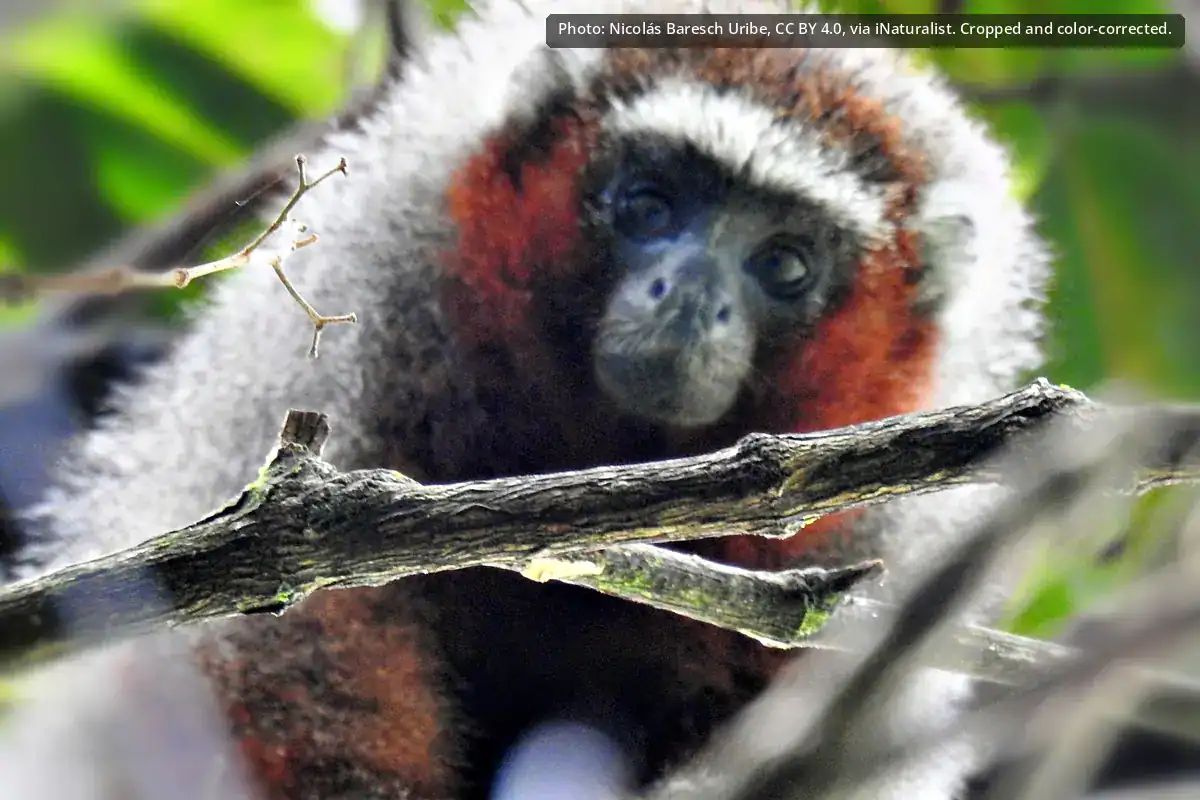
The ornate titi is a small monkey found only in Colombia. Its scientific name is Plecturocebus ornatus. A white blaze crosses its forehead, above red cheeks. It lives in the forests of the eastern plains, the Llanos. It is one of the New World monkeys. The IUCN lists it as Vulnerable.[1]
This Vulnerable titi lives only in Colombia's Meta lowlands.
- Common NamesOrnate titi, ornate titi monkey, zocay, tití zocay
- Taxonomy Classification Year1866
- Monkey Size30 to 36 cm (12 to 14 in) head and body, plus a 38 to 45 cm (15 to 18 in) tail
- Skin Color(s)Grayish-brown back, white forehead blaze, red cheeks and belly, whitish hands and feet
- HabitatLowland and foothill forest, gallery forest and moriche palm swamps
- DietMostly fruit, with insects, leaves and flowers
- Native CountriesColombia
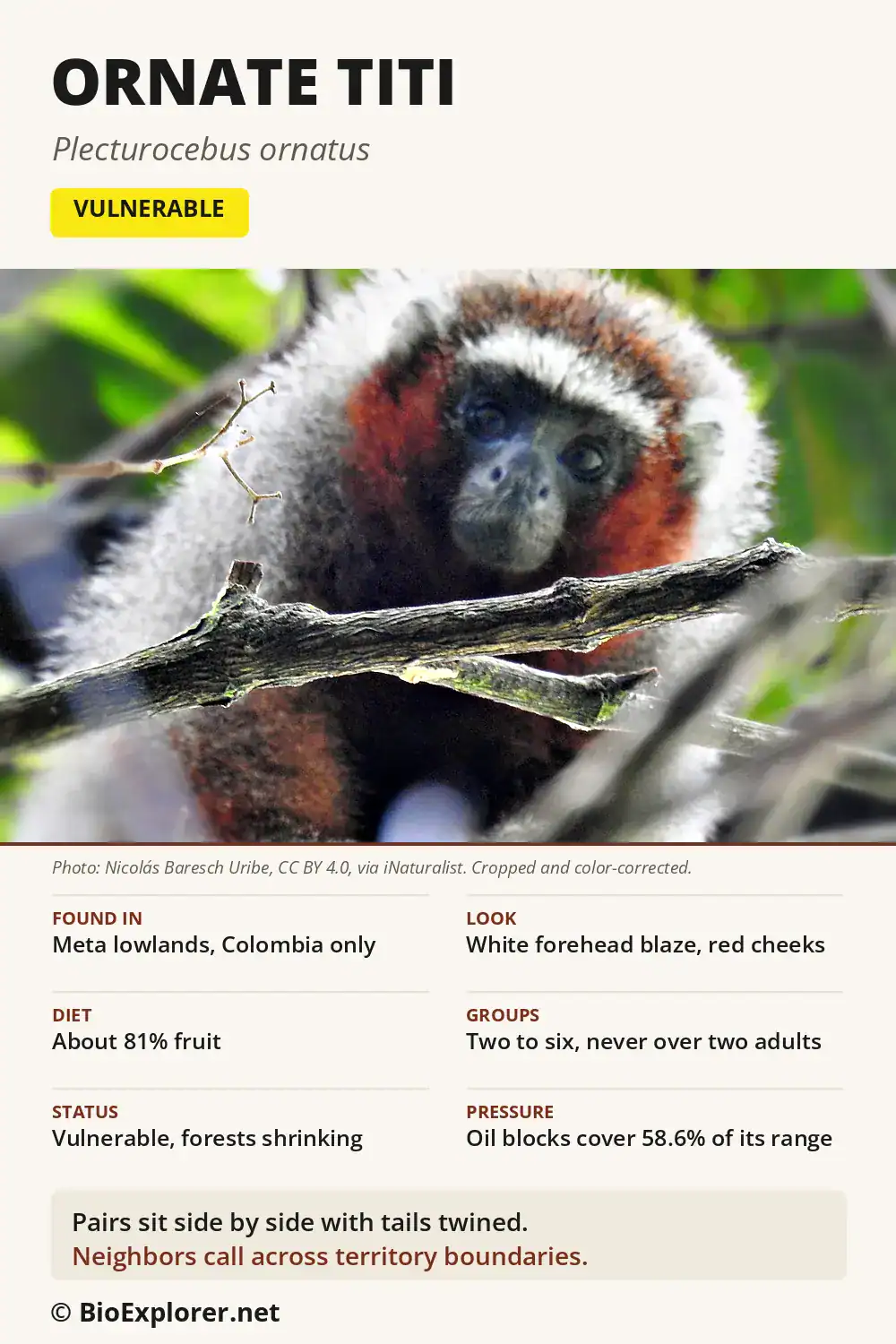
- It wears a white forehead blaze and red cheeks.
- Pairs twine their tails while they sit side by side.
- Groups hold two to six animals, never more than two adults.
- Fruit makes up about four fifths of its diet.
- Licensed oil blocks cover more than half of its range.
Ornate Titi Distribution
 )
Ornate Titi Guide:
Name and Classification
John Edward Gray described it in 1866.[2] He named it Callithrix ornata. His specimen came from "New Granada," the old name for Colombia. In 1963, Philip Hershkovitz narrowed the type locality to the Villavicencio region.[3]
For decades it was treated as a subspecies. Some authors placed it under the coppery titi. Others placed it under the red-bellied titi. Cabrera in 1957 and Groves in 2001 ranked it a full species.[4] A 2016 genetic study moved it to the genus Plecturocebus.[5] No subspecies are recognized.
Its closest relatives are other reddish titis. A 2025 review names three of them. They are the Caquetá titi, the white-tailed titi and the coppery titi. A 2016 DNA study dated their group's split.[6] It diversified between about 1.5 and 1.2 million years ago.
Local people call it the zocay, or tití zocay. It belongs to the family Pitheciidae.
Physical Description
Its most striking mark is a white forehead blaze. A thin line of black hairs runs just below it. Behind the blaze sits a reddish band on the crown. The ears carry tufts of white hair.
The cheeks, throat and belly are reddish. That red varies from orange-red to dark red. Its red fur places it among the red monkeys. The forearms and lower legs are reddish as well.
The back and upper limbs are grayish-brown agouti. Each hair carries bands of color. That coat fits both the gray monkeys and the brown monkeys.
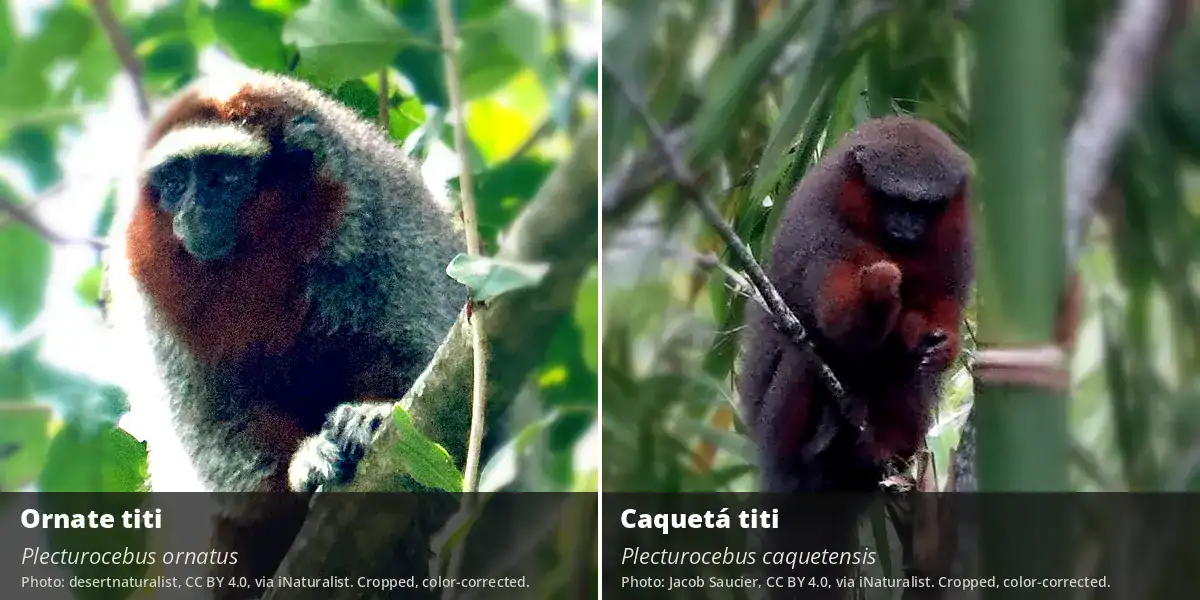
The hands and feet are whitish. That trait sets it apart from its nearest relatives. The tail is brownish at the base. Its outer two thirds are grayish white. The white blaze, ears, hands and tail fit the white monkeys.
Males and females look alike. Infants lack the white forehead line. One possibly juvenile female at one site also lacked it.[7]
Size and Weight
The Handbook of the Mammals of the World gives its measurements. It does not state sample sizes.
Males measure 31.2 to 36 cm in head and body. That is about 12 to 14 in. Females measure 30.4 to 34.7 cm. Males have tails of 40.5 to 45 cm. Female tails run 38.3 to 44.4 cm. The tail is longer than the body.
Males weigh about 1,180 g. Females weigh about 1,160 g. Both are close to 2.6 pounds.
Similar Species Compared
Three related titis share its red underparts and agouti back. None lives in its range.
The Caquetá titi lives about 230 km to the south.[8] The IUCN lists it as Critically Endangered. It has no white forehead blaze.[9] Its red cheeks and throat form a bushy beard. Its hands and feet are orange-red, not whitish. Only one specimen, a young female, has been measured.[10]
The white-tailed titi has a white or buffy forehead.[11] Its hands and feet are reddish, though. Its name has changed. The Mammal Diversity Database now calls it Plecturocebus leucometopus.[12] The IUCN still lists it as P. discolor, of Least Concern.[13]
The coppery titi lives south of the Amazon in Peru and Brazil.[14] It lacks the white blaze. Its hands and feet are reddish. The IUCN lists it as Least Concern.[15]
| Trait | Ornate titi | Caquetá titi | Coppery titi | White-tailed titi |
|---|---|---|---|---|
| Scientific name | Plecturocebus ornatus | Plecturocebus caquetensis | Plecturocebus cupreus | Plecturocebus leucometopus (formerly P. discolor) |
| Range | Meta and edge of Cundinamarca, Colombia | Southern Caquetá, Colombia | East Peru and west Brazil, south of the Amazon | South Colombia, east Ecuador and north Peru |
| Habitat | Lowland and foothill forest, gallery forest, palm swamps | Disturbed lowland forest and swampy ground | Lowland terra firme forest, middle and lower levels | Lowland forest, middle and lower levels |
| Coat and key marks | White forehead blaze, red cheeks, whitish hands and feet | No white blaze, red beard, orange-red hands and feet | No white blaze, reddish hands and feet, pale tail | White or buffy forehead, reddish crown, hands and feet |
| Head and body | 31.2 to 36 cm (males), 30.4 to 34.7 cm (females) | 35 cm (one juvenile female) | 29 to 34 cm (males), 27 to 41 cm (females) | 30 to 35.1 cm (males), 28.5 to 33.9 cm (females) |
| Tail | 40.5 to 45 cm (males), 38.3 to 44.4 cm (females) | Not known | 39.5 to 48 cm (males), 40 to 54.7 cm (females) | 39.2 to 47 cm (males), 38.2 to 51 cm (females) |
| Weight | 1,180 g (males), 1,160 g (females) | Not known | 1,000 to 1,200 g (males) | 850 to 1,010 g (males), 1,080 g (females) |
| Diet | Fruit 81%, arthropods 9%, leaves 8%, flowers 2% | Young leaves, fruit and seeds, few arthropods | Mostly fruit, plus leaves and arthropods | Fruit 63%, leaves and shoots 31%, flowers 6% |
| Group size | 2 to 6, never more than two adults | 3 to 6, average 4.1 | 2 to 7 | One studied group of 4 |
| IUCN status | Vulnerable (assessed 2015) | Critically Endangered (assessed 2015) | Least Concern (assessed 2015) | Least Concern (assessed 2015, as P. discolor) |
Range and Distribution
The ornate titi is endemic to Colombia. It lives on the eastern side of the Andes. Most of its range lies in the department of Meta. A small part may reach Cundinamarca.[16]
The Cordillera Oriental marks its western edge. The Río Metica marks the east. The Guayabero and Guaviare rivers bound it to the south. A 2025 study puts the northern limit at the Río Guacavía. It does not reach Casanare or Guaviare.
That study redrew the range at about 20,571 km². The IUCN map covers about 26,681 km². No other titi lives near it. The Caquetá titi, its closest neighbor, lives far to the south.
South of the Guayabero, the black titi takes its place. An older account said the two overlap. The 2025 field data say they do not.
Habitat Needs
It lives in lowland and foothill forest from 100 to 1,000 m. That places it among the types of rainforest monkeys. A 2023 sighting recorded two adults at 781 m.[17] It came from the buffer zone of Sumapaz National Natural Park.
Groups live in gallery forest along rivers. They also use lowland forest and moriche palm swamps. These palms are Mauritia flexuosa. The species copes with disturbed and secondary forest.
Forest edges suit it well. In one large fragment, edges held 15 to 17 titis per km².[18] The whole fragment averaged 1.07 per km².
Diet and Feeding
Fruit dominates its diet. One study found 81% fruit and 9% arthropods. Leaves made up 8% and flowers 2%. That diet fits the frugivorous monkeys.
Two groups near San Martín, Meta, ate 52 plant species.[19] All of these plants supplied fruit. Main families were Annonaceae, Burseraceae, Melastomataceae and Moraceae. The titis also ate fungi and leaf stalks. The group in the more broken landscape ate more arthropods and leaves.
They eat many fast-growing edge plants. These include Miconia species and Bellucia grossularioides. In secondary forest at Acacías, Miconia and Inga fruits topped the list.[20]
Behavior and Social Life
The ornate titi is active by day and lives in trees. One study found it rested for about half the day. Foraging and travel each took about a fifth.
Each group holds a breeding pair and its young. Forty-one groups in Meta held two to six animals. None held more than two adults. In one very fragmented landscape, a group held three adults.
William Mason studied it in 1964 and 1965.[21] He worked in Socay Forest near San Martín, Meta. Each group kept a fixed area. Neighbors met at boundaries in loud vocal exchanges. On a quiet day, Mason heard these calls a mile away. Pairs often sat side by side with tails twined. Duets mark meetings between groups. They were more frequent in smaller fragments.
Home ranges vary widely. One study recorded 14 ha. A group in Tinigua used just 1.9 ha. Daily travel ran from 315 m to 1,152 m at two sites. Some titis cross pastures between forest patches.
Breeding and Young
Pairs are monogamous. Females give birth to a single infant. The male carries it, except during nursing.
Mason saw the first birth in December 1964. Five more followed over three months. Field teams saw young infants from December to May. That spans the dry season and early rains. One infant at Tinigua appeared in October, though.
Threats and Conservation
The IUCN lists the ornate titi as Vulnerable. The assessment dates from 26 January 2015. It rests on more than 30% habitat loss over 24 years. Oil palm, oil drilling, illegal crops and settlements drive that loss.
A 2025 study mapped the pressures in detail. Licensed oil exploration and production cover 58.6% of the range. Pasture and natural savanna cover 33.4%. Crops cover 12%. Forest cover fell 18.6% between 2005 and 2023.
The forest is badly broken up. Fewer than 1.6% of fragments exceed 100 ha. Most patches are smaller than 10 ha. The study proposed moving it from Vulnerable to Endangered. It suggested the population could fall 50% in 24 years.
Densities can be very high in small fragments. One 17.6 ha fragment held 19 groups. That equals about 369 titis per km². High density does not mean safety, though. Small patches can lose their animals quickly.
Near Villavicencio, roads, dogs and people threaten it.[22] Some titis are captured for the illegal pet trade. Its forest patches there also hold the Humboldt's squirrel monkey. Others hold the Brumback's night monkey. A few hold the Guianan brown capuchin.
It occurs in Sierra de La Macarena and Tinigua national parks. T. Defler told IUCN assessors that guerrilla activity hampers monitoring there. Colombia also lists it as Vulnerable. It is on CITES Appendix II.
Explore more monkeys starting with O. Or browse all types of monkeys.
Common Questions
The ornate titi lives only in Colombia. Most of its range lies in Meta department.
The IUCN lists the ornate titi as Vulnerable. A 2025 study proposed moving it to Endangered.
The ornate titi has a white forehead blaze and red cheeks. Its back is grayish-brown, and its hands are whitish.
An ornate titi measures 30 to 36 cm in head and body. It weighs about 1.2 kg.
The ornate titi eats mostly fruit. One study found 81% fruit, plus insects, leaves and flowers.
The ornate titi has a white forehead blaze and whitish hands. The Caquetá titi has neither and wears a red beard.
Cite this page
BioExplorer. (2026, November 8). Ornate Titi. https://www.bioexplorer.net/animals/mammals/monkeys/ornate-titi/
About the author

Wildlife Writer and Photographer, BioExplorer.net
Arjun is a science writer and wildlife photographer at BioExplorer.net. He turns new research on animals into clear, accurate reads for curious readers. His work covers animal behavior, ecology, and newly described species. He holds a Cornell Lab of Ornithology certificate in bird biology. He is pursuing an HBSc at the University of Toronto Mississauga.