
Muna-Buton Macaque
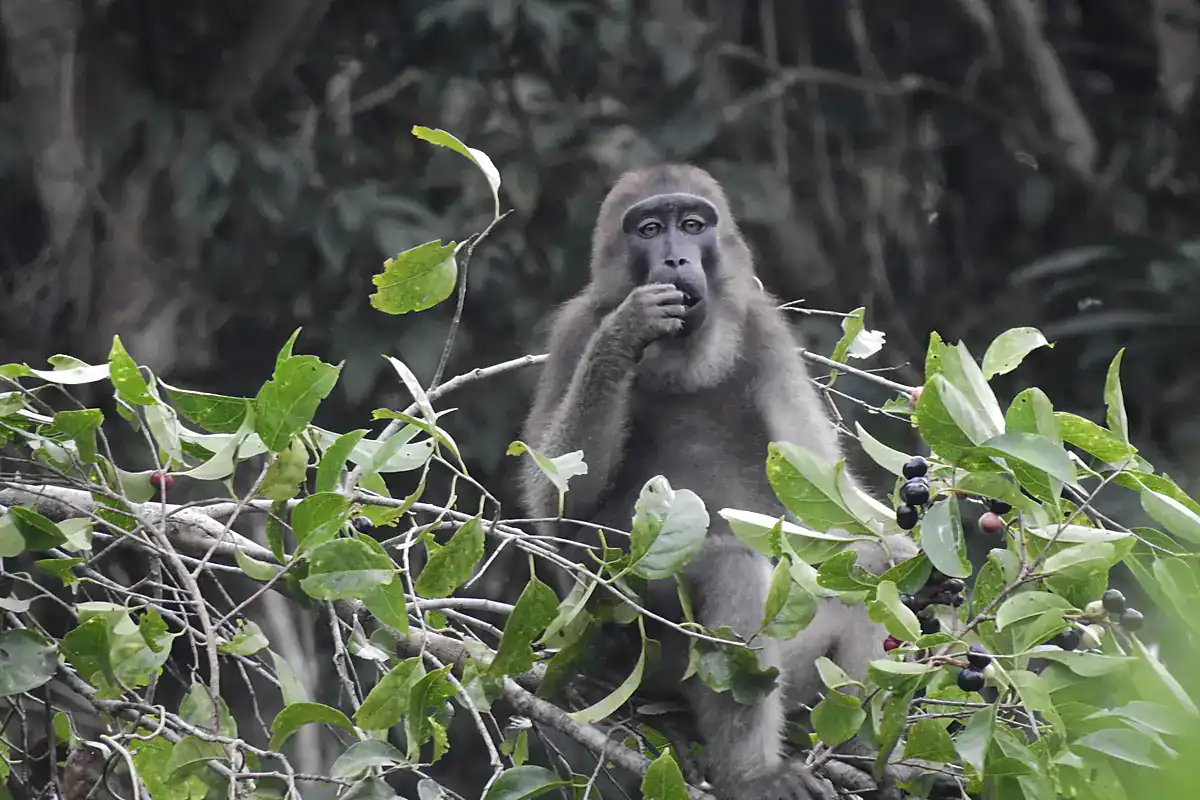
The Muna-Buton macaque (Macaca brunnescens) lives on two Indonesian islands. Nowhere else. Buton and Muna sit just off the southeastern arm of Sulawesi. Paul Matschie described the monkey in 1901 under the name Inuus brunnescens.[1] Many people still call it the Buton macaque.
It belongs to a cluster of seven Sulawesi macaques. None of them lives anywhere else.[12] Each one holds its own patch of Sulawesi. This species drew the shortest straw. Its entire range is smaller than the state of Connecticut.
It is a stocky, brown-black monkey. The tail is barely visible. It feeds mostly on fruit and raids sweet potato gardens. Groups are built around related females. The IUCN Red List rates it Vulnerable, and the population is falling.[2]
For the wider picture, see the Old World monkey species guide. It sits in the genus Macaca, alongside every other macaque monkey.
This is the only primate native to Buton or Muna. It is one of seven macaques found only on Sulawesi and its islands.
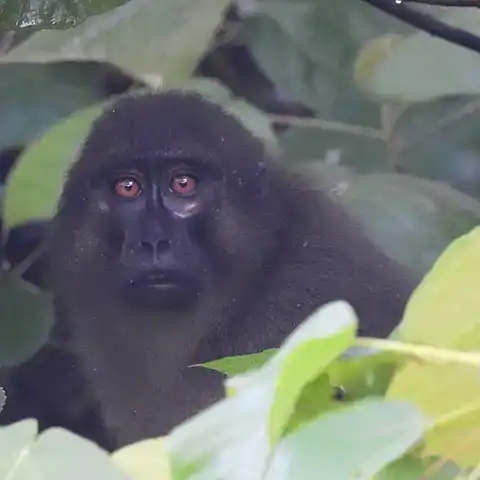
- Common NameMuna-Buton Macaque
- Year Classified1901
- Body SizeMales 48 to 59 cm (18.9 to 23.2 in); females 40 to 48 cm (15.7 to 18.9 in)
- Skin ColorBrown to brown-black, with paler forearms, shanks and rump
- HabitatLowland moist forest, mangrove
- DietOmnivorous, mainly frugivorous
- Native CountriesIndonesia
- The coat is brown above, with paler forearms, shanks and rump. Darker hairs on the crown stand erect, forming a round cap.[3]
- The tail is button-like and only a few centimeters long. No other feature identifies a Sulawesi macaque faster.[3]
- Fruit makes up about 66 percent of what it eats. Wild figs and kapok fruit are the staples. Sweet potato is the crop it takes most often.[2]
- Mean home range is 62 hectares. Canopy time and ground time are close to equal.[2]
- Paul Matschie described the species in 1901. Groves later sank it into the booted macaque. The argument is still open.[1][4]
Muna-Buton Macaque Distribution
 )
)Muna-Buton Macaque Guide:
Identification
No one confuses this monkey with anything outside Sulawesi. The brown-black body and pale lower limbs are distinctive. So is the stub of a tail. Telling it from its mainland neighbor takes a closer look.
Published measurements cover the booted macaque group as a whole. Males run 48 to 59 cm from head to rump, and females 40 to 48 cm. Males weigh 6 to 9 kg, and females 3 to 5 kg. Tails measure 4 to 6 cm in males and 3 to 5 cm in females.[3]
No body mass has been published for this species alone. The figures above describe Macaca ochreata, the wider group it sits in. Several popular sources quote weights near 15 kg for males. That would make it heavier than a mandrill, and nothing supports it.
Against the mainland booted macaque, this one is browner and less glossy. Its fur is shorter and flatter, and its face is shorter.[2] Fooden also found Muna animals slightly paler and larger than Buton animals.[2]
The rump pads, called ischial callosities, are oval and bend outward. Researchers use that shape to sort Sulawesi macaques into groups.[3]
Range And Habitat
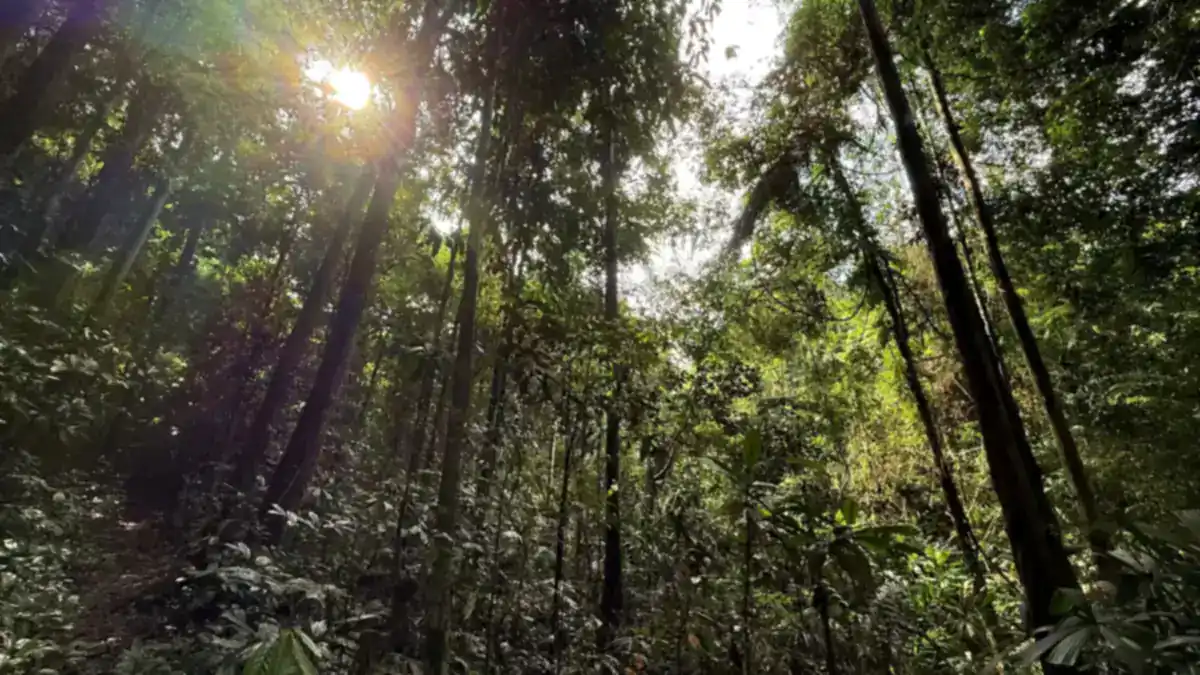
Buton and Muna lie off the southeastern peninsula of Sulawesi. Buton alone covers about 5,180 square kilometers.[5] The macaque occurs on both islands and on no other land.
Most of the range sits between sea level and 400 meters. A few peaks reach 1,000 meters, and the monkeys go that high.[2] Lowland moist forest matters most to them. Mangrove above the high tide line matters almost as much.[2]
Rain falls from November to April. The dry months run June to September. Annual rainfall sits between 1,500 and 2,000 mm.[2] One Buton study site recorded 2,021 mm.[5] Botanists class the island forest as lowland monsoon forest.[5]
The two islands have taken very different paths. Muna has lost most of its forest. The largest surviving population now lives on Buton.[2] Isolated pockets are what remain elsewhere.
Central Buton holds the stronghold. Kakenauwe Nature Reserve and Lambusango Wildlife Reserve protect the core.[6] A further 363.65 square kilometers of production forest adjoins them.[2] Buton Utara Wildlife Sanctuary holds the species too.
Diet And Behavior
Fruit carries this animal. By food item, the diet runs 66 percent fruit. Stems and flowers add 20 percent, leaves 12 percent. Invertebrates make up the last 2 percent.[2] Wild figs and kapok fruit are the staples.
Cultivated crops account for roughly 24 percent of food items taken.[2] Sweet potato is raided more than anything else. See the wider view in what do monkeys eat.
Groups spend most of the day moving. Travel takes about 43 percent of daylight hours. Foraging and feeding take 21 percent, resting 17 percent and grooming 10.5 percent.[2]
Canopy time and ground time are close to equal. Disturbed forest pushes them downward.[2] Mean home range is 62 hectares.[2]
Group size is genuinely unsettled. One long study reported 20 to 40 animals, averaging 32. Other surveys found groups of 4 to 12, averaging 7.5.[2] Large groups split into subgroups, which may explain the gap. Adult females outnumber adult males two to one.[2]
Gestation, lifespan and birth intervals have not been published for this species. The IUCN assessment lists life history as a research priority.[2] Figures circulating online are borrowed from relatives such as the Tonkean macaque.
Species Or Subspecies
Taxonomists have argued over this monkey for a century. Is it a full species, or a form of the booted macaque? The answer changes the species count for the whole family.
Taxonomic registers list the name as Matschie, 1901.[14] Fooden treated the Sulawesi forms as separate species in 1969. Thierry and colleagues followed in 2000, as did later molecular studies.[2] Colin Groves took the other view in 1980 and held it through 2005.[4] He argued the differences amount to color, fur texture and skull shape.
Geology sits behind his argument. Buton and Muna separated from the mainland only in the Holocene. Ten thousand years is very little time for a species to form.[2]
Genetics has not closed the case either. A 2017 study found Macaca ochreata was not monophyletic. Its southernmost sample grouped weakly with brunnescens.[7]
The Mammal Diversity Database lists it as a valid species. BioExplorer follows that treatment across the monkey pages.[8] See the full types of monkeys breakdown.
No hybrid zone exists with the booted macaque. None can form. Open sea separates the islands from the mainland peninsula.[2] Hybrid zones on Sulawesi involve mainland neighbors instead.
Conservation Status
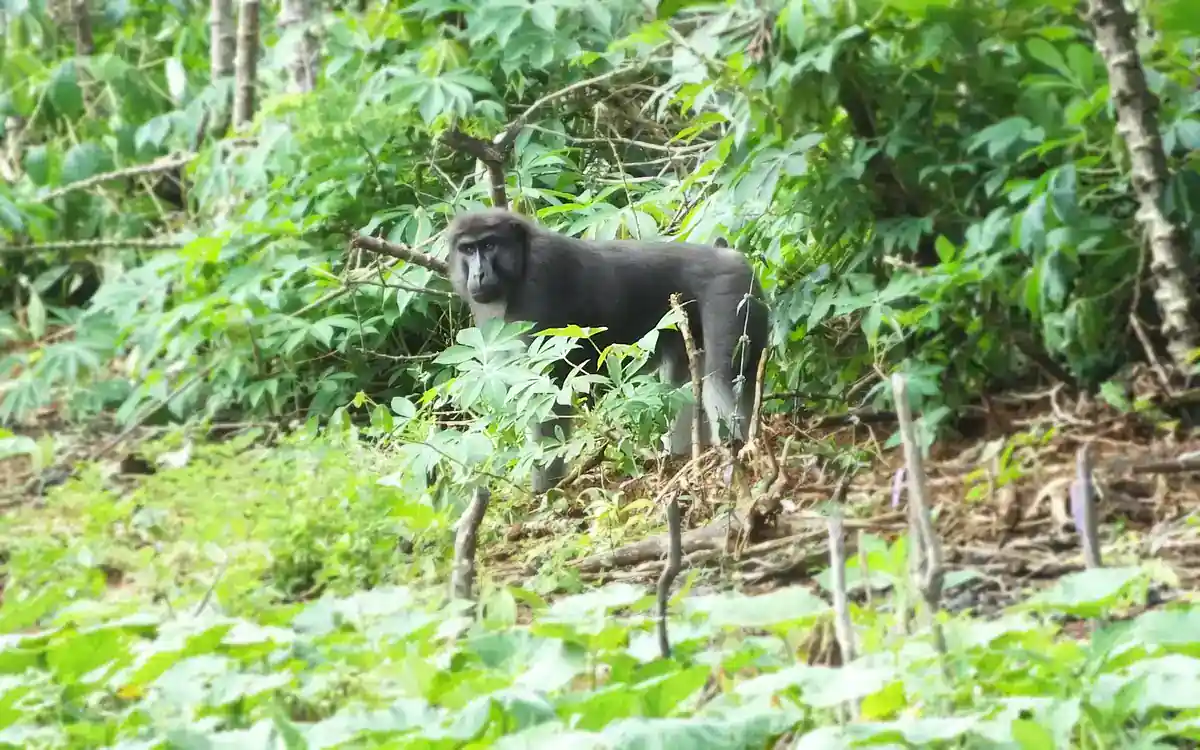
The IUCN Red List rates the Muna-Buton macaque Vulnerable. The criteria are A2c+3c and B1ab(i,ii,iii). The assessment was published in 2021. The population trend is decreasing.[2]
Assessors suspect a decline of more than 30 percent across 33 years. That window covers three generations, counted at 11 years each.[2] Extent of occurrence is 11,349 square kilometers, and the range is severely fragmented.[2]
Logging, mining, plantations and settlement drive the loss. Agro-industry plantations and quarrying carry the heaviest coded impact.[2] Deforestation estimates for Sulawesi run near 1.1 percent a year. Local rates on Buton have been reported far higher.[2] Every Sulawesi endemic primate faces the same squeeze.[13]
Population figures vary widely and deserve caution. A 2004 line-transect study estimated 14.91 animals per square kilometer. That gives about 3,752 macaques inside the two Buton reserves.[5] A 2006 survey gave a much wider range. Its own authors called that estimate unreliable.[2]
Protection on paper is thin. One early assessment put only 8 percent of the population inside reserves.[2] Donor-funded work at Lambusango and Kakenauwe has tried to change that.[9]
Crop raiding shapes daily life at the forest edge. Raiding groups spend 32 to 38 percent of the day at it.[2] Most raids happen within 10 meters of a farm boundary.[10]
Yet conflict stays surprisingly low. Farmers on Buton show considerable tolerance toward these monkeys. Local folklore gives them standing, and that standing gives them cover.[11] Few primates in Southeast Asia enjoy the same goodwill.
The species is not hunted for meat or trade.[2] Habitat loss is the whole story here. Other Sulawesi endemics face heavier pressure, including the crested black macaque.
Common Questions
Most current authorities say yes. The Mammal Diversity Database lists Macaca brunnescens as a valid species. Colin Groves treated it as a booted macaque subspecies. Some references still follow him. Genetic work has not fully settled the question.
Only on Buton and Muna islands, Southeast Sulawesi, Indonesia. It lives from sea level to about 1,000 meters. Lowland moist forest and mangrove are its key habitats. Muna has lost most of its forest. Buton now holds the larger population.
Fruit makes up roughly 66 percent of its food items. Wild figs and kapok fruit are staples. Stems, flowers, leaves and insects fill out the rest. Cultivated crops account for about 24 percent. Sweet potato is raided most often.
No body mass has been published for this species alone. In the booted macaque group, males measure 48 to 59 cm. They weigh 6 to 9 kg. Females measure 40 to 48 cm and weigh 3 to 5 kg. The tail is button-like, only a few centimeters long.
Its range is tiny and broken up. Extent of occurrence is 11,349 square kilometers. Logging, mining, plantations and farming keep eating into the forest. Assessors suspect the population has fallen more than 30 percent over three generations.
Yes, and it is among the main crop raiders on Buton. Sweet potato is the crop taken most often. Most raids happen within 10 meters of a farm edge. Even so, Buton farmers show unusual tolerance. The monkeys figure in local folklore, and that gives them cover.
Cite this page
BioExplorer. (2026, October 7). Muna-Buton Macaque. https://www.bioexplorer.net/animals/mammals/monkeys/muna-buton-macaque/
About the author