
Mentawai Langur
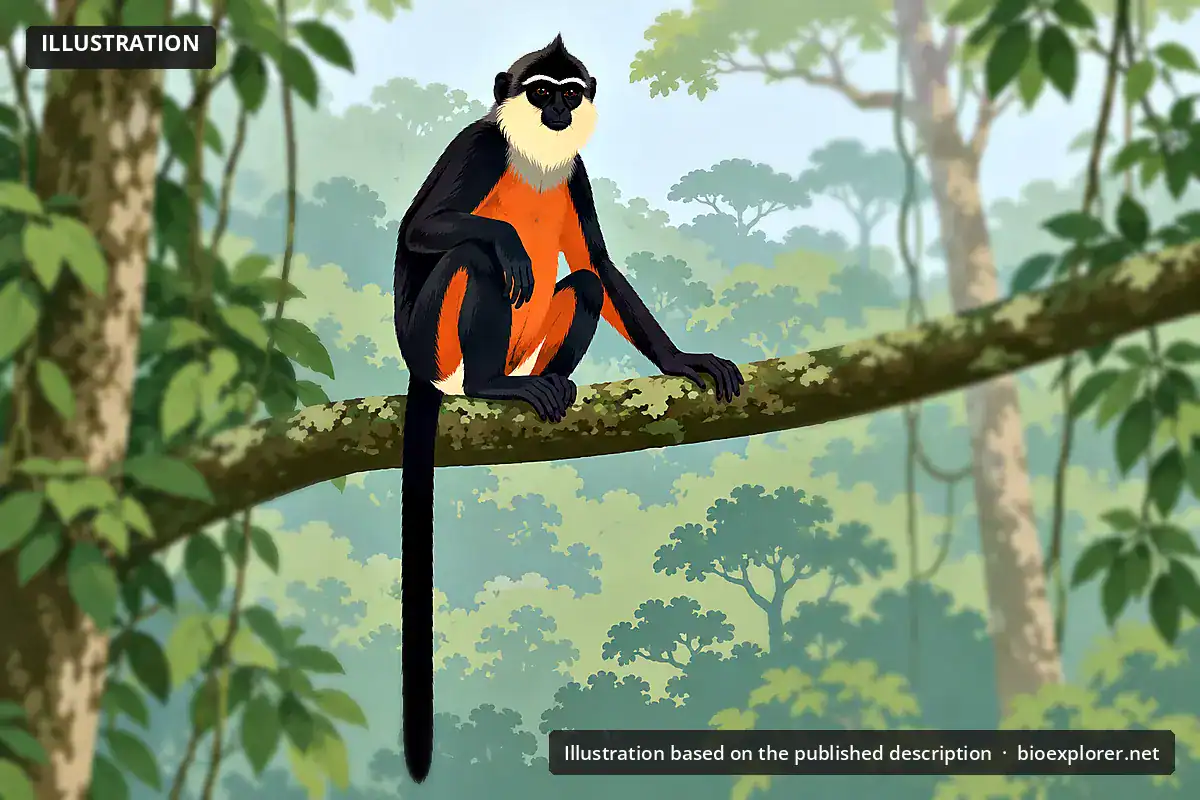
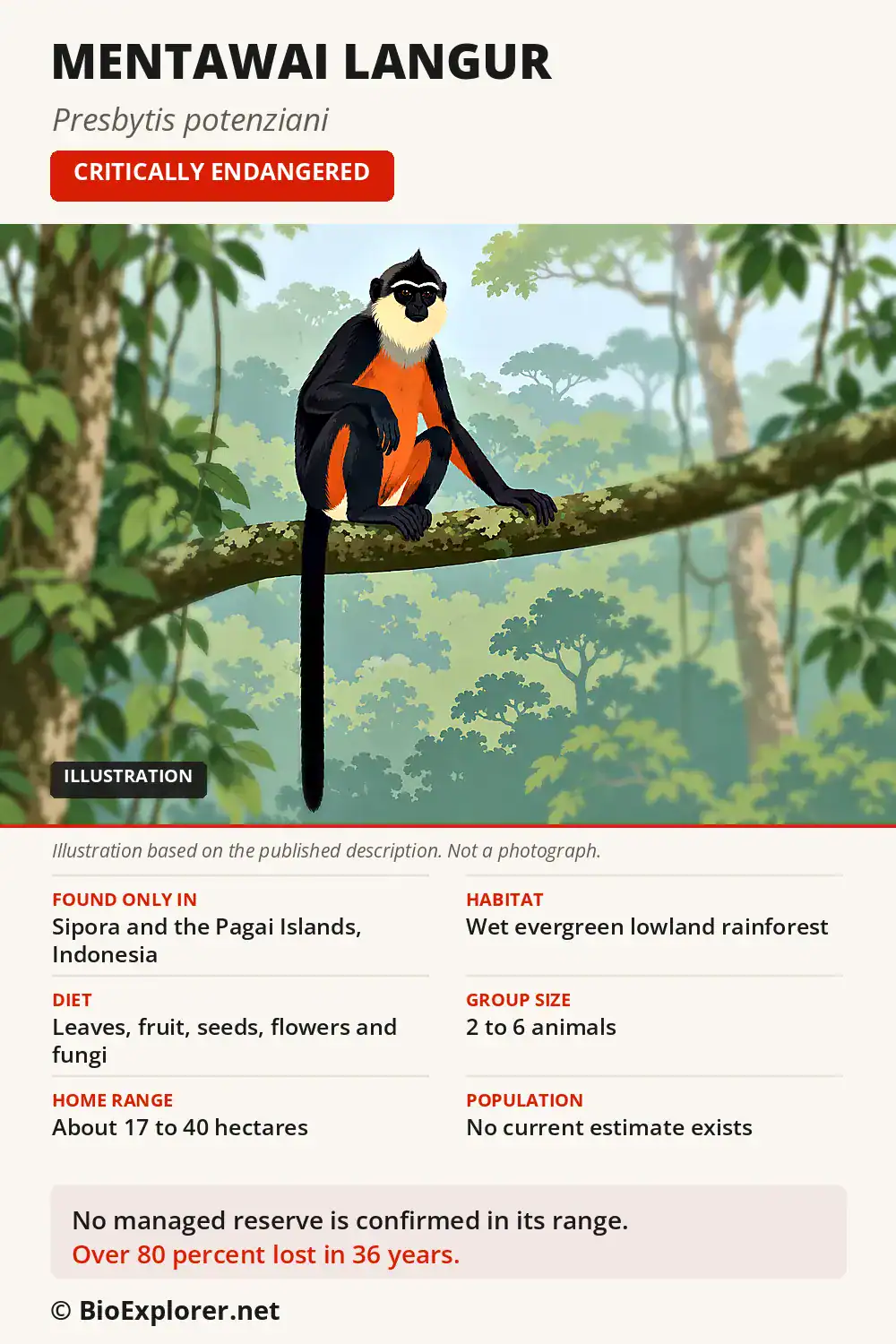
The Mentawai langur is a leaf monkey of western Indonesia. It lives only on Sipora, North Pagai and South Pagai. Its black coat sets off a pale throat and a reddish belly. The IUCN Red List classes it as Critically Endangered.[1] No current population estimate exists. No managed reserve is confirmed anywhere in its range.
This Critically Endangered langur lives only on Sipora and the Pagai Islands.
- Common NamesMentawai Langur, Golden-bellied Mentawai Langur, Mentawai Leaf Monkey, Long-tailed Langur, Southern Mentawai Langur
- Taxonomy Classification Year1856
- Monkey SizeHead and body about 50 cm (20 in); tail about 58 cm (23 in); about 6.4 to 6.5 kg
- Skin Color(s)Blackish back, crown and tail; yellowish white cheeks, chin and throat; reddish to red-brown belly; black facial skin
- HabitatWet evergreen lowland rainforest, mainly primary forest; also secondary forest, swamps and forest gardens
- DietHerbivorous (leaves, fruit and seeds, flowers, fungi)
- Native CountriesIndonesia
- A 2011 mitochondrial study supported separating Siberut's langurs as a species.
- No current estimate of its numbers exists.
- The Red List estimates a decline of over 80% in 36 years.
- Hunters rank it second only to the pig-tailed langur as game.
- No managed reserve is confirmed anywhere in its range.
Mentawai Langur Distribution
 )
Mentawai Langur Guide:
Names and Taxonomy
Charles Lucien Bonaparte described this monkey in 1856. He named it Semnopithecus potenziani.[2] His brief note singled out its bright golden belly.[3] He wrongly gave Tenasserim as its home. Later authors corrected the type locality to the Mentawai Islands. Presbytes chrysogaster, published by Peters in 1867, is a synonym.
Other English names include golden-bellied Mentawai langur and Mentawai leaf monkey. "Long-tailed langur" and southern Mentawai langur are also in use. On its home islands people call it atapaipai.[4]
The species is one of the Old World monkeys, family Cercopithecidae. It belongs to the leaf-eating subfamily Colobinae and the genus Presbytis. This site covers the wider group under types of langurs. Brandon-Jones called it the golden-bellied Mentawai Islands sureli.
Siberut's langurs were long treated as a subspecies of this one. In 2011, mitochondrial DNA supported treating them as separate species.[5] The authors asked for nuclear data on the genus's wider history. That animal is now the Siberut langur, Presbytis siberu. The Mentawai langur is now monotypic. Older sources that cover "the Mentawai langur" often mix both species.
Brandon-Jones placed its closest kin among Sumatran and Bornean surilis. Its skull and coat pointed that way. So did the adult male's loud call. That call resembles the call of the North Sumatran leaf monkey.
Range and Islands
The Mentawai langur is endemic to the southern Mentawai Islands. It lives on Sipora, North Pagai and South Pagai. It also occurs on Sinakak, an islet off South Pagai's east coast. All lie in West Sumatra province, Indonesia. The Red List puts its extent of occurrence at 4,150 km². It does not occur on Siberut. It counts among the Indonesian monkeys.
Museum specimens come from Sipora, North Pagai and South Pagai. Brandon-Jones provisionally fixed the type locality as North Pagai.
Habitat Preferences
Its home is wet evergreen rainforest. Yearly rainfall there reaches about 4,000 mm. It favors primary forest. It also uses secondary forest, swamps and forest gardens, though less often. Some groups sleep in coconut groves. At dawn they move into primary forest to feed.
Logging changes where it lives. Densities peaked in forest logged about 20 years earlier.[6] They were lowest in forest logged about ten years earlier. It ranks among the rainforest monkeys of Indonesia.
North Pagai groups fed, moved and rested mostly in the upper canopy.[7] The Red List adds that it uses every forest level. It comes to the ground only now and then.
Physical Appearance
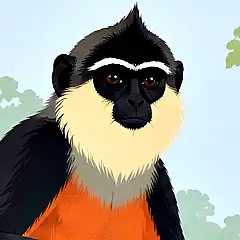
The Mentawai langur is jet black above and on the tail.[8] Museum skins show the same blackish back and crown. The cheeks, chin and throat are yellowish white. A pale arc runs across the brow. The belly is reddish, and the color reaches the inner thighs. Its dark coat places it among the black monkeys.
The facial skin is black. It fades to a dusky flesh color around the mouth. Some animals have a white tail tip. Both sexes carry a pale patch of hair around the genitals. In males the bare sitting pads meet. In females they sit apart.
Coat color varies between islands. Sipora skins have the brightest red bellies. Most North Pagai skins look red-brown below instead. North Pagai animals also show a broader white brow band.
The head and body measure about 50 cm. The tail adds about 58 cm. Males weigh about 6.5 kg and females about 6.4 kg.
Diet and Feeding
The Mentawai langur's diet depends on its habitat. It is unusually fruit-loving for a colobine. In North Pagai primary forest it ate mostly leaves, plus fruit. Climbers and dipterocarp trees were its main food sources. Few primates eat dipterocarp leaves, but this langur does. The Red List says climbers can make up 35% of its diet. It is one of the herbivorous monkeys.
Fruit made up only about 32% of the diet there. Across studies, leaves form 22 to 55% of the diet. A later study at Muntei worked in secondary forest on North Pagai.[9] There, fruit and seeds took 70% of feeding time. Leaves took 22%, flowers 7% and fungi 1%. Feeding peaks twice a day, in early morning and mid-afternoon.
Behavior and Groups
The Mentawai langur is active by day and lives in the trees. It moves mostly on all fours, with frequent leaps. At Muntei it spent 56% of the day resting. Feeding took 33%, travel 10% and social behavior 1%.
Groups hold 2 to 6 animals. Early studies described the species as monogamous. The Muntei study, from 2000 to 2001, found more variety. It recorded groups of one male and one female. It also found one male living with several females. Some groups held several adults of each sex. The author suggested habitat loss may explain this flexibility.
North Pagai studies report home ranges of about 17 to 40 ha. Day ranges spanned 100 m to over 1,000 m. Groups stayed together as they traveled. Neither sex usually led the way. Encounters between groups were mostly hostile. Neighbors defended the areas where their ranges overlapped.
The call repertoire includes duets. These were heard in some populations but not others. Females also give loud calls. The study described these as previously undocumented in other colobines.
Population and Status
The Red List assessment dates from 2015 and was published in 2020. It lists the species as Critically Endangered under criteria A2cd+4cd. The species was rated Vulnerable in 2000. It was already Critically Endangered by 2008. Both earlier listings treated it as a subspecies.
The assessors estimate a population fall of over 80% in 36 years. That span equals three generations of 12 to 13 years. They suspect the decline will continue at the same rate.
No current abundance estimate exists. The few studies of this species are at least 15 years old. Historical estimates conflict. A 2005 estimate suggested 300 to 1,200 animals on the three islands. It used densities of 1 to 4 per km² on the Pagais. Hunted langurs may hide well, so those counts could run low. A 2009 estimate put about 1,545 on the Pagais alone.[10] One North Pagai study met 10 groups in 1.36 km². Another found four groups in a 50 ha site. Local densities clearly vary widely. After two decades of hunting and logging, numbers may also have fallen.
Main Threats
Hunting and commercial logging are the main threats. Several logging operations remain active in its range. Oil palm plantations and forest clearing add to the losses. Logging roads carry hunters deep into once remote forest. Air rifles have replaced bows and arrows. Rituals and taboos once limited the hunt. Missionary and state influence have worn them away.
Hunters rank it second only to the pig-tailed langur as game. People hunt it for food. Young people increasingly hunt wildlife for sport. The pet trade is a minor threat. Occasional pets reportedly survive poorly.
Island Neighbors
Three other primates share its islands. One is Kloss's gibbon. The others are the pig-tailed langur and the Pagai Island macaque. Siberut has its own langur and the Siberut macaque.
Conservation Measures
No managed reserve is confirmed in the Mentawai langur's range. Sipora and North Pagai have no protected areas. South Pagai may hold a designated area near Sinaka village. Its boundaries are unclear, and it has no management. A North Pagai research forest won protection in the late 1990s. After Paciulli left in 2002, local people sold it to loggers. The Red List records no managed captive population.
CITES lists the species in Appendix I. That listing still covers the Siberut langur too. Indonesia's 2018 protected species list includes Presbytis potenziani. A United States federal rule names it the long-tailed langur.[11] That rule covers it among threatened primates.
The 2023 to 2025 report on the most endangered primates mentions it. It appears there as a special mention, not one of the 25. The Siberut langur received the same flag for imminent extinction risk.
The 2024 to 2034 langur action plan sets current priorities. First come new field surveys to find priority sites. It calls for one protected site on each island. It urges work with landowners, government and local communities. It calls for campaigns in schools and religious communities. It proposes youth activities to discourage recreational hunting.
Earlier proposals date from 2006. Whittaker suggested working with a long-standing Pagai logging concession. That permit was due to expire in 2012.
Our types of monkeys guide covers its many relatives. It also appears among the monkeys starting with M.
Common Questions
The Mentawai langur lives only on Sipora, North Pagai and South Pagai. These islands lie off western Sumatra, Indonesia. It also occurs on the islet of Sinakak.
No. The Siberut langur was once a subspecies of the Mentawai langur. A 2011 mitochondrial study supported treating it as a separate species.
The Mentawai langur eats leaves, fruit, seeds, flowers and fungi. One primary-forest study found mainly leaves. At Muntei, fruit and seeds dominated.
No current abundance estimate exists for the Mentawai langur. Historical estimates conflict. A 2005 estimate suggested 300 to 1,200 animals. A 2009 estimate put about 1,545 on the Pagais alone.
Hunting and commercial logging drive the Mentawai langur's decline. Oil palm and forest clearing add to it. No managed reserve is confirmed in its range.
Not strictly. Some Mentawai langur groups are a single pair. Others hold one male with several females. Some have several adults of each sex.
Cite this page
BioExplorer. (2026, October 19). Mentawai Langur. https://www.bioexplorer.net/animals/mammals/monkeys/mentawai-langur/
About the author