
Mitered Langur
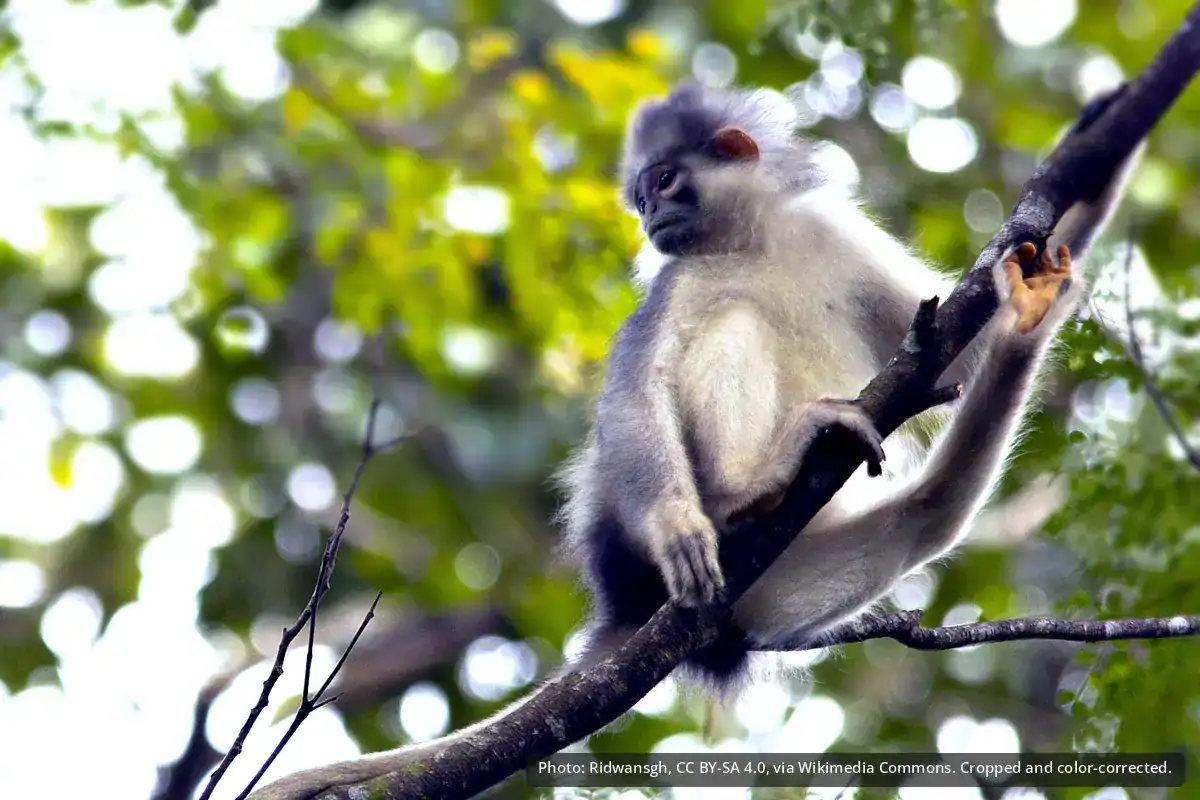
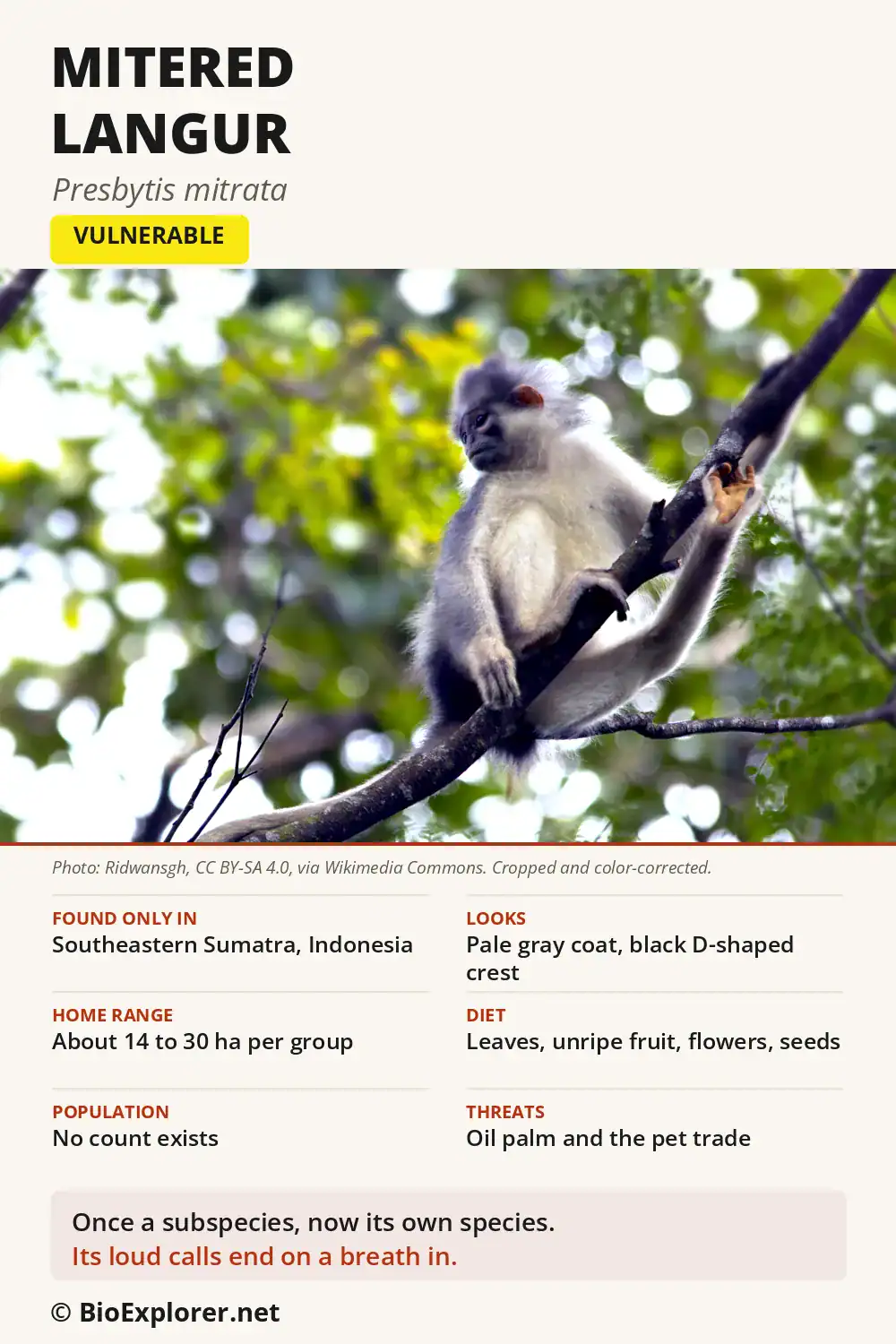
The mitered langur is a pale leaf monkey of southern Sumatra. Its scientific name is Presbytis mitrata.[1] It lives only in Indonesia. It is one of the Old World monkeys. The IUCN lists it as Vulnerable.[2]
This Vulnerable langur lives in the forests of southeastern Sumatra, Indonesia.
- Common NamesMitered langur, southern mitered langur, mitred leaf monkey
- Taxonomy Classification Year1821
- Monkey Size42 to 57 cm (17 to 22 in), head and body; handbook figure
- Skin Color(s)Gray face, often a pink muzzle; mouse-brown to ash-gray coat, cream to white below
- HabitatLowland rainforest, rubber plantations and scrub, 10 to 600 m
- DietYoung leaves, unripe fruit, flowers, mature leaves and seeds
- Native CountriesIndonesia (Sumatra)
- A black D-shaped crest frames white fur on its forecrown.
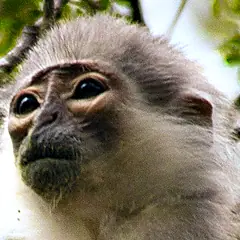
- Its gray face often has a pink muzzle.
- It eats young leaves, unripe fruit, flowers and seeds.
- A group ranges over about 14 to 30 ha of forest.
- Trappers catch it for the illegal pet trade.
Mitered Langur Distribution
 )
Mitered Langur Guide:
Name and Classification
Johann Friedrich von Eschscholtz named it in 1821. He gave it the name Presbytis mitrata. The same work founded the genus Presbytis. The type animal came from the mainland opposite the Zutphen Islands.[3] That spot lies in southern Lampung.
The IUCN calls it the southern mitered langur. Other names include mitred leaf monkey.
For many years it was a subspecies of a wider species. Its old name was Presbytis melalophos mitrata. A 2011 genetic study split that group apart.[4] Its southern Sumatran animals formed a separate line. Their closest relatives lived on Java, across the sea.
A 2012 study then compared the males' loud calls.[5] The calls agreed with the genes. The authors proposed full species rank for P. mitrata. Major checklists now follow that split.
These leaf monkeys belong among the types of langurs.
Physical Description
Its coat color varies a great deal. The upper body ranges from dark mouse-brown to ash-gray. Some animals are pale red-yellow or yellow-gray. A blackish overlay tips the fur.
The underside is creamy yellow or white. That pale color reaches well up the flanks. The limbs mix whitish with gray or red-brown. The hands and feet are gray.
Gray and brown animals both occur. It is listed among the gray monkeys. It is also among the brown monkeys.
The crest is its best field mark. A black D-shaped line rings the crest. It encloses white hair on the forecrown. There are usually no hair whorls.
The face is gray. The muzzle is often pink. A white or pink crescent sits at the outer eye corners. A white ruff frames each cheek.
The tail is redder than the body above. It is pale buff below. Its tip is white. A mostly white form has also been linked to this species.
The 2012 study team described southern animals as grayish white. Their neighbors to the west are reddish.
Size and Weight
The handbook gives a head and body of 42 to 57 cm. That is about 17 to 22 in. Females measure 42 to 56 cm.
The tail is longer than the body. It runs 64 to 82 cm in males. That is about 25 to 32 in. Females have tails of 62 to 82 cm.
Males weigh about 5 to 9 kg. That is about 11 to 20 lb. Females weigh about 5 to 8 kg. The handbook gives no sample sizes.
Similar Species Compared
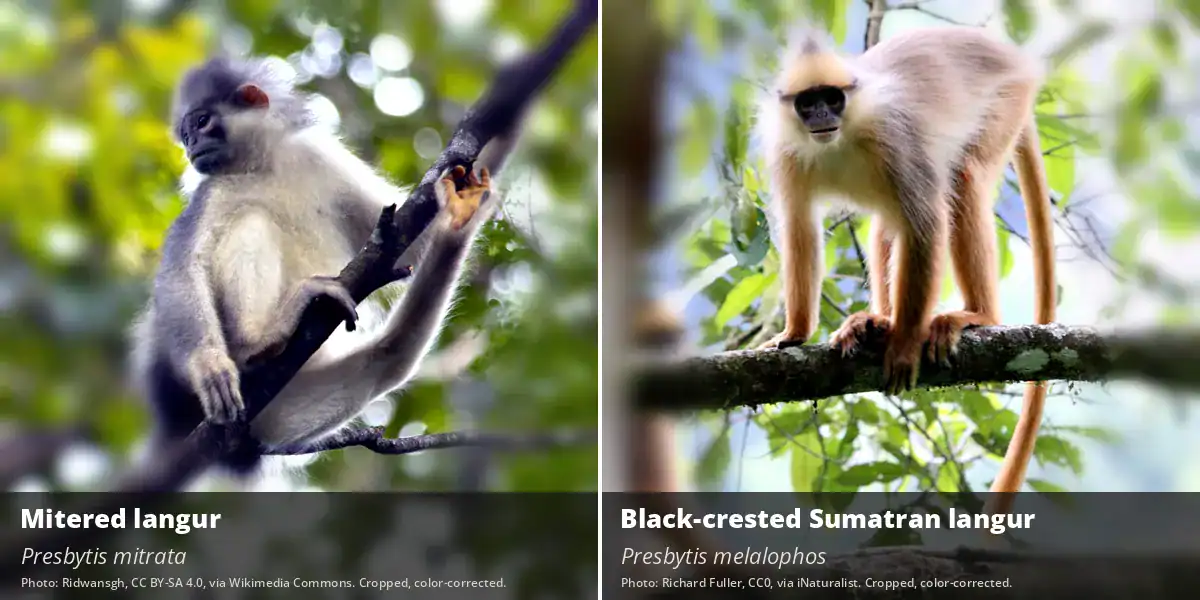
The black-crested Sumatran langur is its former parent species.[6] It lives to the west, along the Barisan Range. Its coat is usually reddish orange, with a black face. Its crown crest is black. It is listed as Endangered.[7] A 2024 action plan says both may live in Bukit Barisan Selatan.[8]
The black and white langur lives to the north.[9] It ranges north of the Batang Hari River, mainly in hills. Its dark chocolate body and black limbs stand out. Its underside is white. The IUCN lists it as Data Deficient.[10]
The black Sumatran langur was also once part of P. melalophos.[11] It lives in western and north-central Sumatra. Its upperparts are dark gray-brown to nearly black. Its white underside is sharply set off. It is listed as Endangered.[12]
The Javan surili lives across the Sunda Strait, in western Java. Genes link southern mitered langurs most closely with Java's langurs. Its coat is gray above and white below. It is listed as Vulnerable.[13]
| Trait | Mitered langur | Black-crested Sumatran langur | Black and white langur | Black Sumatran langur |
|---|---|---|---|---|
| Scientific name | Presbytis mitrata | Presbytis melalophos | Presbytis bicolor | Presbytis sumatrana |
| Range | Southeastern Sumatra, Batang Hari River south to Lampung | Western Sumatra along the Barisan Range | East-central Sumatra, Inderagiri to Batang Hari rivers | Western and north-central Sumatra, Batu Islands |
| Habitat | Lowland rainforest, rubber plantations and scrub, 10 to 600 m | Lowland and hill rainforest, rubber plantations and scrub, up to 1,000 m | Mainly hill rainforest, up to 600 m | Lowland and hill rainforest, old-growth and secondary forest, 100 to 1,000 m |
| Coat and key marks | Gray to mouse-brown, white below, black D-shaped crest, often pink muzzle | Usually reddish orange, black face, black crest | Dark chocolate and black, white below, black brow fringe | Dark gray-brown to near black above, white below, black hands and feet |
| Head and body, males | 42 to 57 cm (handbook figure) | 34 to 40 cm (handbook figure) | 33 to 35 cm (handbook figure) | 33 to 35 cm (handbook figure) |
| Tail, males | 64 to 82 cm | 68 to 80 cm | 64 to 73 cm | 64 to 72 cm |
| Weight, males | About 5 to 9 kg | 5.9 to 9 kg | 4.9 to 7.2 kg (same figure for both) | 4.9 to 7.2 kg (same figure for both) |
| Diet | Young leaves, unripe fruit, flowers, seeds | Young leaves, unripe fruit, flowers, seeds | Probably young leaves, fruit, flowers, seeds | Probably young leaves, fruit, flowers, seeds |
| Group size | Not known | 2 to 8, one adult male | Not known | Not known |
| IUCN status | Vulnerable (assessed 2015) | Endangered (assessed 2015) | Data Deficient (assessed 2021) | Endangered (assessed 2015) |
The head and body figures above come from four handbook accounts. They differ more than the animals seem to. Methods may not match, so compare them with care. The handbook also prints one weight range for two species.
Range and Distribution
It lives only in southeastern Sumatra. That makes it one of the Indonesian monkeys.
Its range lies east of the Barisan Range. It runs southwest from the Batang Hari to the upper Musi River. From there it reaches south into Lampung Province.
The action plan lists sites in four provinces. These are Jambi, South Sumatra, Bengkulu and Lampung. They include Way Kambas and Bukit Barisan Selatan national parks. Berbak-Sembilang and Hutan Harapan in Jambi are also named.
The western and northern limits are still debated. The 2012 study saw central Sumatran animals as pale black-crested langurs. Both species may share Bukit Barisan Selatan. The plan calls for genetic sampling there.
Habitat Needs
It lives in primary and secondary lowland rainforest. It also uses rubber plantations and bushy areas. The Red List gives an elevation range of 10 to 600 m. That is about 30 to 2,000 ft.
It is one of the types of rainforest monkeys of Sumatra. It uses every level of the canopy. Yet it tends to favor the understory.
It copes with some forest change. It survives in disturbed and secondary forest. Yet it does not tolerate the complete replacement of forest.
Diet and Feeding
It eats young leaves and mature leaves. It also eats unripe fruit, flowers and seeds. Its leafy diet places it among the herbivorous monkeys.
The handbook gives no dietary proportions for this species.
Behavior and Groups
The mitered langur is active by day and lives in trees. Its home range covers 14 to 29.5 ha. A group travels about 300 to 1,360 m a day.
The handbook gives no group size for this species.
Males give loud calls. Southern calls end with alternating out-breaths and in-breaths. Most other P. melalophos group calls use out-breaths only.
These calls helped show that southern animals are distinct.
Breeding and Young
The handbook has no breeding data for this species. Births, gestation and infant color are all unrecorded. This is a real gap in our knowledge.
Population and Status
No total population count exists. The handbook calls it fairly common where forest remains. Yet its occurrence is patchy and fragmented.
The IUCN listed it as Endangered in 2008. That listing used the name P. melalophos mitrata. The 2015 assessment moved it to Vulnerable. The IUCN marks that assessment as needing an update.
The IUCN suspects a decline of at least 30%. That spans about 30 years. Forest loss in well-known areas almost certainly exceeded 70%. The decline is expected to continue.
Major Threats
Habitat loss is a major threat. Forest is being cleared for farms and oil palm plantations. The Red List also names wood and pulp plantations.
Trapping is the other big threat. The species is caught for the illegal pet trade. The IUCN describes hunting and trapping as heavy. Some animals are also hunted for food.
The action plan adds local threats. People often kill langurs for raiding crops. In Bukit Barisan Selatan, illegal logging continues. People also clear the park for coffee.
Near Berbak-Sembilang, land disputes slow forest restoration. Illegal gold and mercury mining goes on there.
Conservation Efforts
It is listed on CITES Appendix II. The handbook says Indonesian law protects it.
It lives in at least two national parks. These are Bukit Barisan Selatan and Way Kambas.
The action plan sets several priorities. It calls for surveys of population size and range. It wants genetic work to settle its taxonomy. It suggests langur tourism at Way Kambas. It asks for better training of park staff.
It is among few Presbytis langurs kept successfully in zoos. Jakarta's Ragunan Zoo is one example. The plan wants care guidelines built from that experience.
Explore more monkeys starting with M. Or browse all types of monkeys.
Common Questions
The mitered langur lives only in southeastern Sumatra, Indonesia. It is found from the Batang Hari River south to Lampung.
The mitered langur eats young and mature leaves. It also eats unripe fruit, flowers and seeds.
The mitered langur has a pale gray to brown coat. A black D-shaped crest frames white forecrown fur.
Yes. The mitered langur was once a subspecies of the black-crested Sumatran langur. Genetic and call studies supported the split.
The mitered langur loses forest to oil palm and farms. It is also trapped for the pet trade.
No. The IUCN lists the mitered langur as Vulnerable. It was listed as Endangered in 2008.
Cite this page
BioExplorer. (2026, November 8). Mitered Langur. https://www.bioexplorer.net/animals/mammals/monkeys/mitered-langur/
About the author

Wildlife Writer and Photographer, BioExplorer.net
Arjun is a science writer and wildlife photographer at BioExplorer.net. He turns new research on animals into clear, accurate reads for curious readers. His work covers animal behavior, ecology, and newly described species. He holds a Cornell Lab of Ornithology certificate in bird biology. He is pursuing an HBSc at the University of Toronto Mississauga.