
Likweli
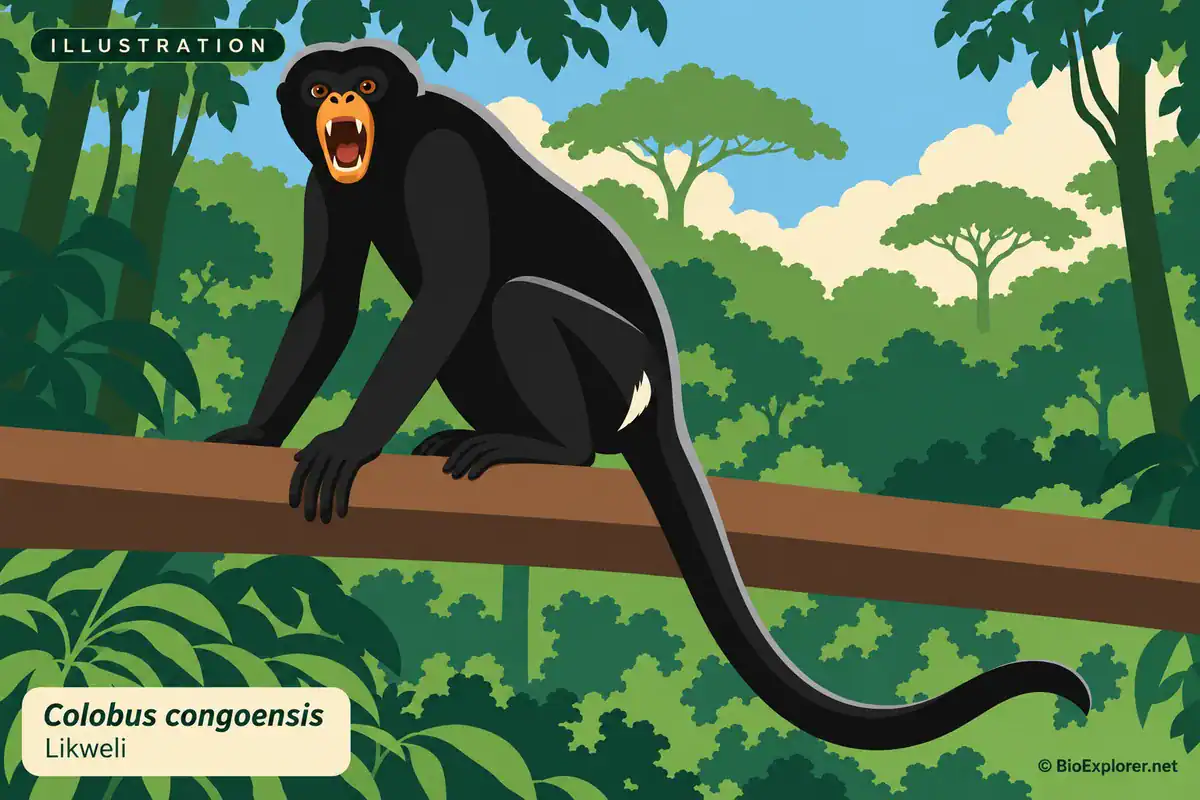
The Likweli (Colobus congoensis) is a black colobus monkey. Scientists described it on July 15, 2026.[1] It lives in one small corner of the Democratic Republic of Congo. Nowhere else on earth holds it.
Communities west of the Lomami River gave it the name Likweli. The describing authors adopted that name, and so does this page.[1] Mituku people to the east call it kasaba nkoni, the branch shaker.[1]
Its whole known range covers about 1,700 square kilometers. Most other members of its genus occupy more than 60,000.[1] That is one of the smallest ranges of any African monkey.
It is the fifth new African monkey species named in 75 years.[1] See where it sits among the colobus monkey group. The genus belongs to the Old World monkey family.
The only colobus with a pale orange mouth patch on a black face. Its closest relative lives 1,200 km to the west.

- Common NameLikweli
- Taxonomy Classification Year2026
- Monkey SizeTotal length 127 to 135 cm (50 to 53 in), of which the tail is 70 to 82 cm (28 to 32 in)
- Skin Color(s)Black coat; orange-cream bare skin around the mouth; white perianal patch
- HabitatUpland rainforest on deep clay soils
- DietNot yet studied; dental form suggests a low-seed diet
- Native CountriesDemocratic Republic of the Congo
- Described on July 15, 2026, from three specimens taken from hunters in 2021. The holotype is held at the Yale Peabody Museum.[1]
- Its sister species is the black colobus, Colobus satanas, 1,200 km west. The two split roughly 4 to 5 million years ago.[1]
- The known range is about 1,700 square kilometers. The Lomami River bounds it in the west.[1]
- Groups held 1 to 20 animals, averaging 6.2. Most sightings were in mixed groups with other monkeys.[1]
- The IUCN has not assessed it. The describing authors propose Endangered as a provisional category.[1][2]
Likweli Distribution
 )
)Likweli Guide:
A New Species
Hart and eleven colleagues named this monkey in 2026.[1] Nothing was split, merged or renamed. The animal was simply unknown to science until then.
Three specimens anchor the description. Park rangers confiscated them from hunters in April 2021. The holotype is an adult male at the Yale Peabody Museum.[1][3]
Four kinds of evidence were used together. Mitochondrial DNA, skull and tooth measurements, coat pattern, and recorded calls.[1] The skull work compared 182 specimens from 13 colobine species.[1] The genetic sample was far smaller, just two unique sequences.[1]
The result surprised the authors. Its closest relative is the black colobus, Colobus satanas. That species lives about 1,200 km away in western central Africa.[1]
The two lineages parted roughly 4 to 5 million years ago. That is the deepest split between sister species in the genus.[1][4] Only mitochondrial DNA was used, so the authors want nuclear genomes next.[1]
One count is being reported wrongly. Many reports say the genus jumped from six species to seven. The Mammal Diversity Database still lists six.[5] Its July 2026 release added this species and dropped Colobus caudatus. That form went back to being a race of the mantled guereza.[5][6]
Likweli Identification
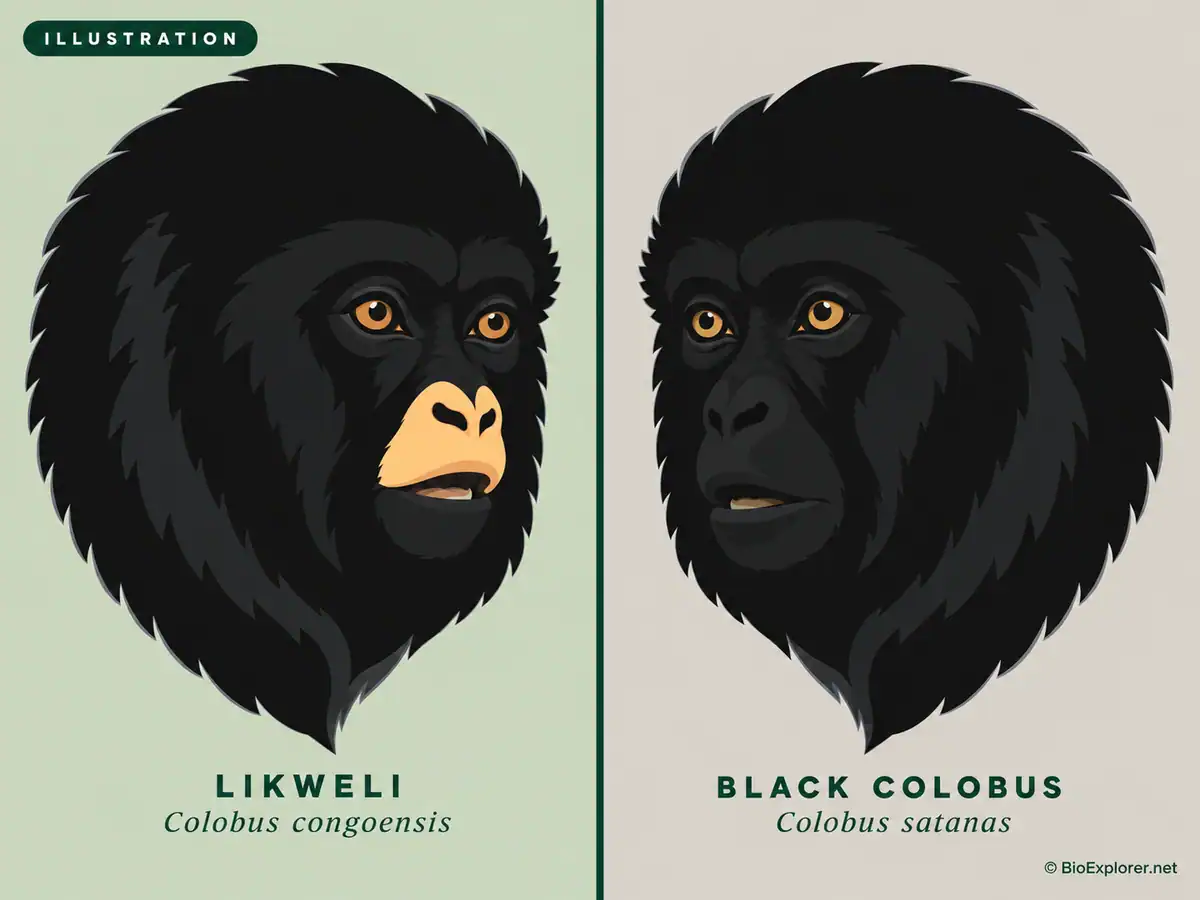
The body and limbs are black. A patch of bare skin runs from the lip to the nostrils. It is pink to orange-cream, and it shows at a distance.[1]
Bare gray skin over the cheekbones gives the face a mask.[1] Long black hairs frame the head, about 4 to 6 cm.[1] The ears are large, black and crinkled at the edge.
A white patch sits beneath the tail in both sexes. It measured 9 by 5 cm in the male. In one female it was 12 by 6 cm.[1] No other colobus carries one that large.
Three animals have been measured, which is the whole published sample. Total length ran 127 to 135 cm. The tail alone accounted for 70 to 82 cm of that.[1]
Body mass cannot yet be given by sex. The male weighed 6.9 kg and both females 7.4 kg. Both females were pregnant when weighed. The male was a young adult.[1] The authors say so themselves. Do not read these figures as dimorphism.
Against the black colobus the differences are clear. That species has an entirely black face.[1] It also carries a long tuft at the tail base. This one lacks that tuft. Its skull is larger, and its front teeth are broader.[1]
Range And Habitat
The range lies in Tshopo and Maniema provinces. It runs from the Lomami River east to the Lilo River.[1] North to south it spans roughly 1 degree 20 minutes to 2 degrees South.
Land here sits between 390 and 500 meters. Animals were seen between 406 and 490 meters.[1] Rain falls in two seasons, totaling about 1,700 to 1,900 mm a year.[1]
It keeps to upland forest on deep clay soils. Those forests carry more tree species than the surrounding ground.[1] Of 114 records, 104 fell within 10 km of the Lomami River.[1]
The two edges of the range work differently. The Lomami River is over 200 meters wide and stops them crossing. The Lilo River is under 50 meters and sometimes bridged by canopy.[1]
What blocks them in the east is the soil. Rivers there have been captured and left behind white sand. Those sands are nutrient poor and the forest on them is thin.[1] No African primate range was known to end this way before.[1]
Most of the range sits inside Lomami National Park. The park was created in July 2016 as the country's eighth.[7] It covers close to 8,900 square kilometers, with a wide buffer zone.[7][8]
That park holds 15 primate species in all.[1] Eight of them live only in this country or barely beyond it. The bonobo is among them.[8]
Behavior And Voice
Groups ran from 1 to 20 animals. The average was 6.2 and the middle value 5.5.[1] That sample covers 62 sightings where the group could be counted.
They rarely travel alone. In 45 of those 62 sightings they moved with other monkeys.[1] Mixed parties held two to six species at once.
They keep to the canopy and middle levels of mature forest.[1] Twice they were seen lower down. Once a group fled to the understory, attacked by a crowned eagle.[1]
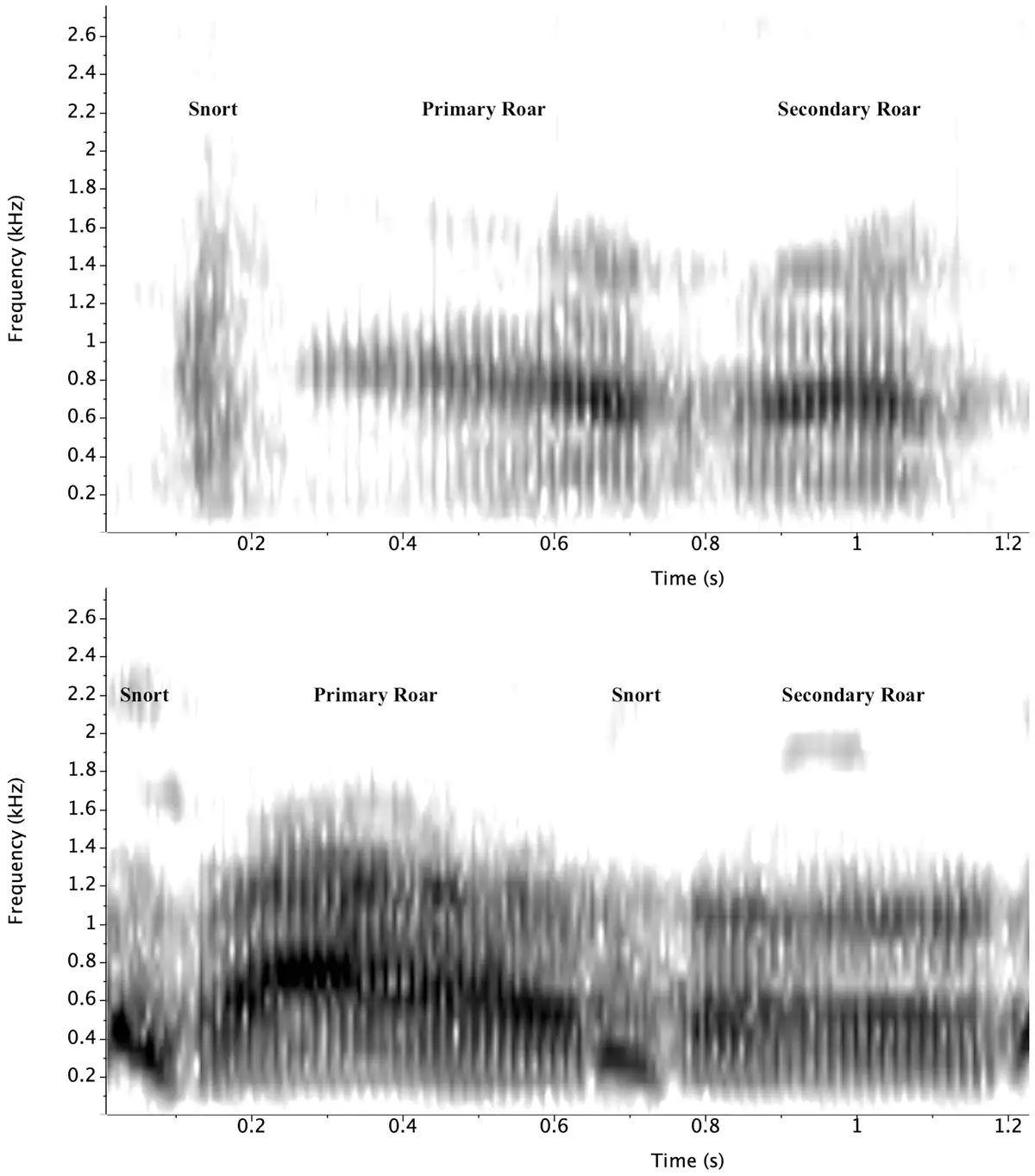
The roar carries the clearest signature. Peak frequency averaged 733 Hz, with a pulse rate near 56 per second.[1] A snort comes first, then the roar itself.
The black colobus snorts again between its two roars. This one does not, and that gap separates the recordings.[1] The pale mouth flashes open as the animal roars.[1]
Nobody has studied what it eats. There is no feeding record for this species at all.[1] Teeth are the only clue, and they point away from seeds. The black colobus takes seeds for half its diet or more. This one lacks the teeth for that work.[1]
Colobines in general ferment leaves in a chambered stomach.[9] That trait belongs to the subfamily, not to this species alone. Compare the wider picture of what monkeys eat.
Young were seen in February, April, July, August and September. All of them already wore adult colors.[1] Nothing else about breeding has been recorded.
The Discovery
A photograph taken in 2008 started it. Ashley Vosper and Bernard Ikembelo photographed an unfamiliar monkey.[1] The frame showed only part of the animal.
Then ten years passed with nothing. In November 2018 a patrol leader named Jean Pierre Kapale photographed it again.[1] He was running an anti-poaching patrol, not a survey.
Over the next ten months his team found it seven more times.[1] Older patrol photographs were then reviewed. One from August 2018 showed the same animal, misidentified at the time.[1]
The same landscape produced the lesula in 2012.[10] Several of the same researchers were involved both times. That earlier paper argued for a national park of about 9,000 square kilometers.[10]
The park was created four years later. The monkey was then found inside it. A third primate, the Dryas monkey, turned up there too.[1]
Local knowledge of the animal is thin. Only 8 of 52 surveyed villages could describe it accurately.[1] That is unusual, since other primates there are widely known.
Conservation Status
The IUCN Red List has not assessed this species. Its status is Not Evaluated.[5] The describing authors propose Endangered as a provisional category.[1] That proposal is theirs, not a Red List decision.
No population estimate exists. There is no density figure and no count of mature animals.[1] What exists instead is survey effort, and it is sobering.
Patrols covered 3,063 km between 2020 and 2022. They produced 29 detections, about one per hundred kilometers.[1] Line transects covered 1,285 km for 38 sightings.
Those sightings made up 5.4 percent of all primate records.[1] Six survey blocks were walked and only two held the species. Both were upland clay forest.[1]
Hunting is not the historical problem here. Local informants say it was never specifically targeted.[1] The type specimens came from hunters, but opportunistically.
The pressure is land. Tshopo Province loses roughly 4 percent of its primary forest a year.[1] The national population grows at about 3.2 percent annually.[1] At least 15 new villages appeared in the buffer zone between 2015 and 2023.[1]
The authors are blunt about what matters. Protecting Lomami National Park is the single most important action.[1] The park is managed by the national conservation institute.[11]
One neighbor is already listed as threatened. The Angola colobus shares this forest and is rated Vulnerable.[12] Another island-bound monkey faces the same squeeze. See the Muna-Buton macaque. Counts for every group appear in the monkey species list.
Common Questions
Likweli is the common name of Colobus congoensis. It is a black colobus monkey described in July 2026. It lives only in the Democratic Republic of Congo. Its home is Lomami National Park. Communities west of the Lomami River gave it the name.
It was first photographed in 2008, then not seen again for ten years. A park patrol led by Jean Pierre Kapale rephotographed it in November 2018. The formal description was published on July 15, 2026.
The pale area is bare skin, not hair. It runs from the upper lip to the nostrils. It separates this monkey from the black colobus. That species has an all-black face. The patch flashes open when the animal roars.
Six, under the Mammal Diversity Database treatment this site follows. Many reports say seven. The July 2026 release added Colobus congoensis. It also returned Colobus caudatus to the mantled guereza.
The IUCN has not assessed it. Its official status is Not Evaluated. The scientists who described it propose Endangered as a provisional category. They cite a range of about 1,700 square kilometers. They also cite rapid forest loss nearby.
Nobody has studied it. No feeding record has been published for this species. Its teeth are small and narrow. The black colobus has broad teeth and eats mostly seeds. That suggests a different diet, but it has not been observed.
Cite this page
BioExplorer. (2026, October 9). Likweli. https://www.bioexplorer.net/animals/mammals/monkeys/likweli/
About the author