
Lesula
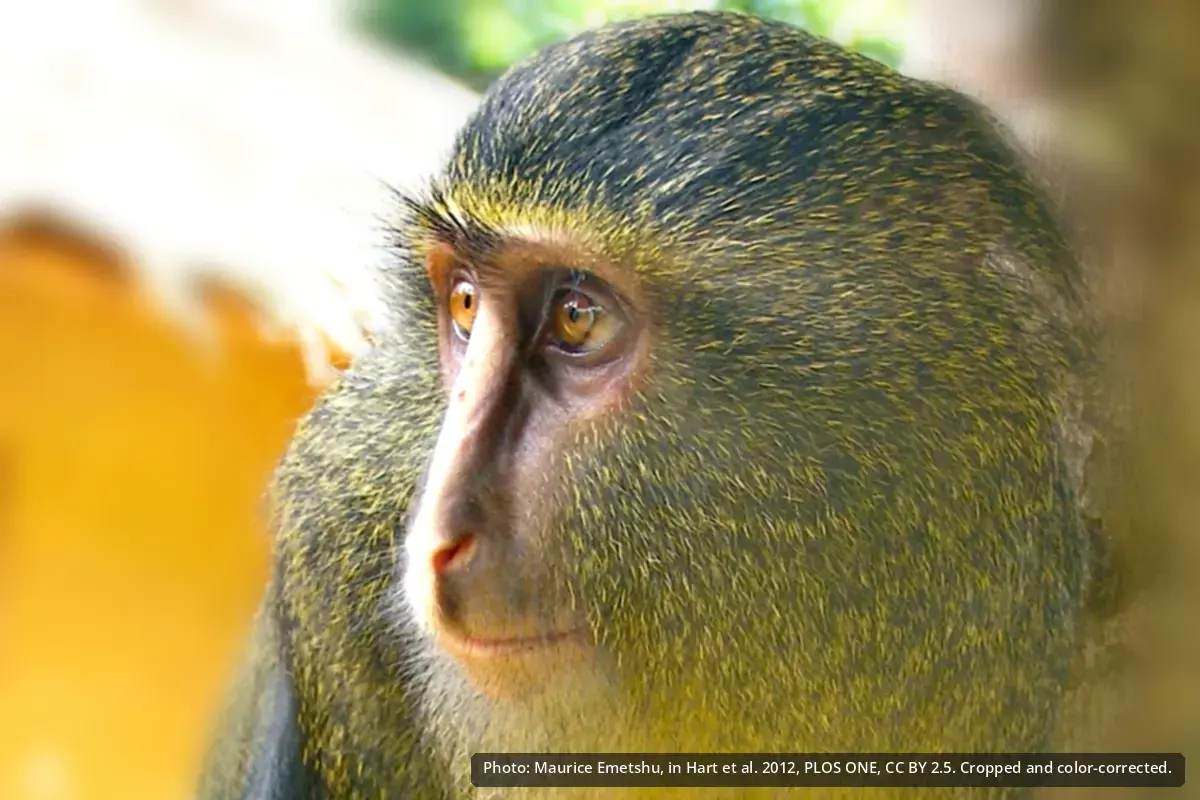
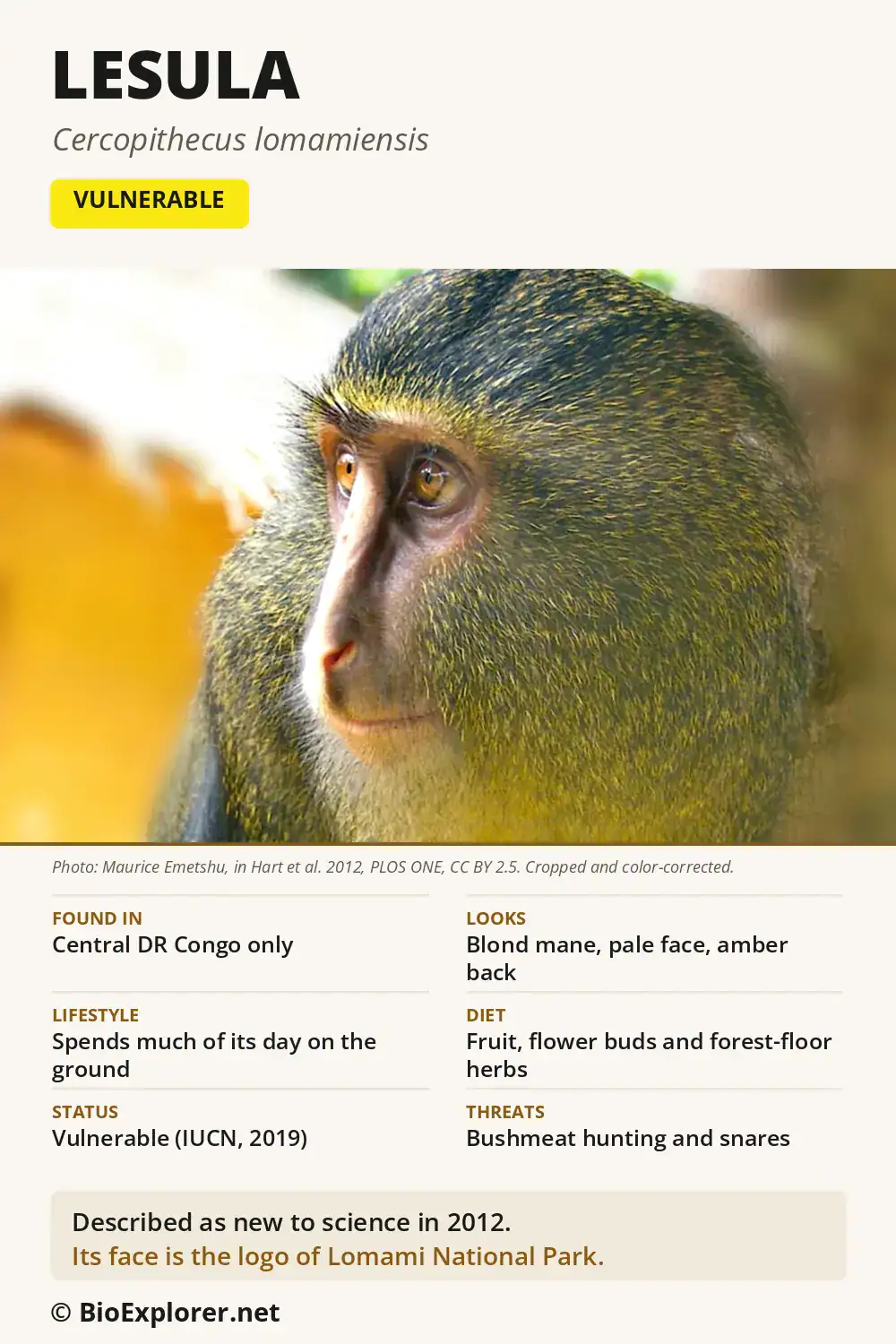
The lesula is a shy forest monkey found only in DR Congo. Its scientific name is Cercopithecus lomamiensis.[1] It is one of the Old World monkeys. Scientists described it as new to science in 2012. The IUCN lists it as Vulnerable.[2]
This Vulnerable guenon lives only in central DR Congo's forests.
- Common NamesLesula, lesula monkey, lesula guenon
- Taxonomy Classification Year2012
- Monkey Size47 to 65 cm (19 to 26 in), head and body, adult males
- Skin Color(s)Blond mane, pale pinkish gray to tan face, amber back, black limbs
- HabitatMature terra firma evergreen forest, 400 to 715 m
- DietFruit, flower buds, leaf stalks and shoots of forest-floor herbs
- Native CountriesDemocratic Republic of the Congo
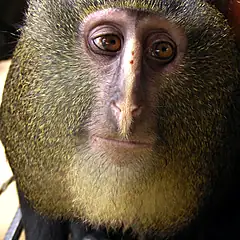
- Its pale, bare face is framed by a blond mane.
- Adult males have a bright blue scrotum and rump patch.
- It spends much of its day on the forest floor.
- Males give deep booming calls, mostly around dawn.
- Its face is the logo of Lomami National Park.
Lesula Distribution
 )
Lesula Guide:
Name and Classification
A team led by John Hart named the lesula in 2012.[3] The holotype is an adult male from near Lohumonoko. It sits in the Yale Peabody Museum. The species name honors the Lomami River. That river marks the eastern edge of its range.
The authors chose "lesula" as its common name. It is the local name across most of its range. Other local names include kifula and tou. They called it only the second new African monkey in 28 years.
Its closest relative is Hamlyn's monkey, the owl-faced monkey. The two form a group of their own. Two loci dated their split at 1.7 and 2.8 million years.
In 2025, scientists sequenced the genome of the holotype.[4] They dated the split to about 3.8 million years ago. They found no sign of later gene flow involving either species. The lesula genome showed little inbreeding.
How It Was Found
In June 2007, Hart's field team visited the town of Opala. At the primary school director's home, they saw a captive young female. No one could match her to any known monkey.
The director called her a lesula. He said local hunters knew the animal well. He said a relative killed her mother near Yawende. The team watched and photographed her for 18 months.
Searches in Opala and Yawende found more captive young lesulas. In December 2007, the team saw it in the wild near Obenge. Hunters there knew it well too.
Physical Description
The lesula is a medium-sized, long-limbed monkey with a slender body. A mane of long, grizzled blond hair frames its face.[5] The bare face juts forward and is pale. Its skin ranges from pinkish gray to tan brown. A faint cream stripe often runs down the nose.
Its chin, throat and upper chest are yellowish buff. That blond front makes it one of the yellow monkeys. An amber patch runs down the middle of the back. It glows brightest at the base of the tail.
The lower belly, shoulders and forelimbs are black. The upper thigh is silvery gray. The rest of the leg is black. Those dark limbs place it among the black monkeys. The tail is amber at the base and black beyond. It has no tuft at the tip.
Adult males have a bright blue scrotum and rump patch. The color fades fast after death. Females have a pale gray rump patch, sometimes bluish.
Young lesulas are pale blond all over. The amber back patch appears within three months. One captive female reached adult size at about 15 months.
Size and Weight
Hart's team reported these sizes in 2012. Two adult males measured 47 to 65 cm (19 to 26 in). That is head and body length. They weighed 4.0 to 7.1 kg (8.8 to 15.7 lb).
Their tails ran 65 and 78 cm (26 and 31 in).[6] Two subadult females weighed 3.5 to 4.0 kg (7.7 to 8.8 lb). Their sample held no adult females. Males are larger and have bigger canines.
Similar Species Compared
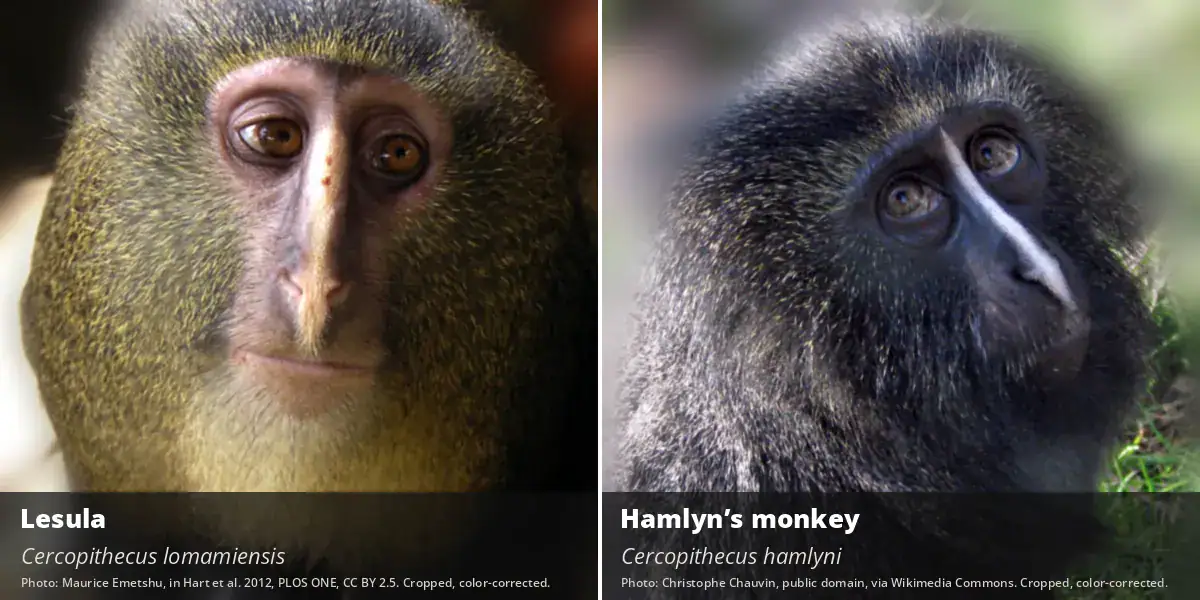
Hamlyn's monkey lives east of the Lomami and Lualaba rivers. It looks darker and less vividly marked. It has an olive mane and dark facial skin.[7] A clear white nose stripe crosses its face. Its tail is mostly gray, with a tufted black tip. The lesula has larger eye sockets and a pale face. The IUCN lists Hamlyn's monkey as Vulnerable.[8]
The L'Hoest monkey is another ground-loving guenon of eastern DR Congo.[9] It is mostly black, with an orange saddle. Bushy white whiskers and a white throat ruff frame its gray face. The 2025 study found lesula mitochondrial DNA came from that lineage's ancestor. The IUCN lists it as Vulnerable too.[10]
| Trait | Lesula | Hamlyn's monkey | L'Hoest monkey |
|---|---|---|---|
| Scientific name | Cercopithecus lomamiensis | Cercopithecus hamlyni | Allochrocebus lhoesti |
| Range | Central DR Congo, between the upper Tshuapa and Lomami rivers | Eastern DR Congo east of the Lualaba, and Nyungwe, Rwanda | Eastern DR Congo, southwestern Uganda, Rwanda, northern Burundi |
| Habitat | Mature lowland terra firma forest, 400 to 715 m | Lowland to montane forest and bamboo | Lowland to montane forest, mostly 1,000 to 2,500 m |
| Coat and key marks | Blond mane, pale face, amber back and tail base, black limbs | Dark olive gray hood, dark face, white nose stripe | Black coat, orange saddle, white whiskers and throat ruff |
| Head and body | Males 47 to 65 cm | Males about 55 cm | Males 54 to 70 cm |
| Tail | Males 65 to 78 cm | Males about 57 cm | Males 50 to 76 cm |
| Weight | Males 4.0 to 7.1 kg | Males about 5.5 kg | Males 6 to 10 kg |
| Diet | Fruit, flower buds, leaf stalks, herb shoots | Fruit, seeds, leaves, flowers, insects, bamboo | Herbs, fruit, seeds, leaves, insects |
| Group size | Usually 5 to 15, once about 30 | 2 to 22 | Usually 10 to 17, once 29 |
| IUCN status | Vulnerable (assessed 2019) | Vulnerable (assessed 2018) | Vulnerable (assessed 2016) |
Range and Distribution
The lesula is endemic to the Democratic Republic of the Congo. It is one of the Democratic Republic of the Congo monkeys. Its range lies in the country's eastern central basin.
The Lomami River bounds it to the east. The upper Tshuapa River bounds it to the west. It reaches south to the forest edge, near 3°30′ S. It has not been reported north of 1° S.
Hart's team put its range at about 17,000 km² (6,600 sq mi). The Red List estimates about 19,600 km² (7,600 sq mi). Hamlyn's monkey lives beyond the Lomami and Lualaba rivers. Neither species is known between those two rivers.
The Lomami red colobus lives across the Lomami, on the east bank.
Habitat Needs
The lesula lives in mature, closed-canopy evergreen forest on dry ground. Some of that forest is dominated by Gilbertiodendron trees. These forests make it one of the rainforest monkeys of central Africa.
It is rare or absent in regrowing forest near villages. It was never found in seasonally flooded forest. Nor was it found in gallery forest in the southern savannas. Its known range lies at 400 to 715 m.
Diet and Feeding
Field teams watched lesulas feed in eight first encounters. They ate leaf stalks, ripe and unripe fruit and flower buds. They also ate the growing tips of two forest-floor herbs. These herbs belong to the arrowroot family, Marantaceae. The Red List names Megaphrynium as one of them.
Of 26 feeding animals, 11 fed on the ground. Twice they ate food dropped by monkeys feeding above. This plant diet places it among the herbivorous monkeys.
Behavior and Groups
The lesula is active by day. It was the least often seen primate on early surveys. Of 223 primate groups seen, only 19 were lesulas. Many fled when spotted, often along the ground.
It spends much of its time on the ground. It also climbs into the lower and middle forest layers. A skeleton study predicts it spends nearly half its time grounded.[11]
Camera traps in Lomami National Park recorded 598 lesula events.[12] Of these, 591 met the study's test for ground travel. Among 238 qualifying events, the average count was 7.17 animals. The authors think that figure is probably low. The largest single count was 32. Groups can hold one or two adult males, females and young. Of identified males, 45% were alone or in male-only groups.
Estimated births peaked from August through October. That is the start of the second wet season.
In 11 of 19 encounters, lesulas were with other primates. Partners included Wolf's mona monkey and red-tailed monkeys. The blue monkey shares its forests. So does De Brazza's monkey.
Voice and Calls
Adult males give a deep, falling "boom". It sounds like Hamlyn's monkey's call, but differs slightly. Booms come in bouts of two or three calls. They are heard mostly around dawn. A few come at night, soon after dark.
Imitating an eagle call can set off its booms. That trick rarely works on Hamlyn's monkeys. Researchers reported an apparent crowned eagle attack on one lesula. The wounded young female died after 37 minutes.
Population and Status
No full count exists. The Red List thinks there are more than 10,000 animals. It is locally common in some areas. The trend is decreasing.
The IUCN assessed it as Vulnerable in January 2019. Its small range and hunting pressure drove that listing. Hart's team had proposed Vulnerable when they named it.
Major Threats
Commercial bushmeat hunting is the main threat. Hunters supply towns such as Kisangani and Kindu. Lesulas spend much time on the ground. That makes them easy to catch in snares set for duikers. Hunters with dogs also take them.
Most early specimens came from hunters. Densities are lower in heavily hunted forest than in patrolled forest. On camera, hunted sites showed groups of at most 11.
Farming is clearing forest near Opala, at its northern edge. Shifting farms and upland rice may spread further.
Conservation Efforts
DR Congo created Lomami National Park in July 2016.[13] It covers 8,874 km² (3,426 sq mi). The lesula's face is the park's official logo. Armed guards patrol the park. Yet it protects only about 20% of the lesula's range.
Tshopo Province protects it at the provincial level. The Red List urges full protection at the national level. The species sits on CITES Appendix II with all guenons. In 2024, the park entered UNESCO's Tentative List.
Explore more monkeys starting with L. Or browse all types of monkeys.
Common Questions
The lesula lives only in central DR Congo. It ranges between the upper Tshuapa and Lomami rivers.
Scientists first saw a captive lesula in Opala in 2007. They described the lesula as a new species in 2012.
The IUCN lists the lesula as Vulnerable, not Endangered. Bushmeat hunting is its main threat.
The lesula eats fruit, flower buds and leaf stalks. It also eats shoots of forest-floor herbs.
Two adult male lesulas measured 47 to 65 cm, head and body. They weighed 4.0 to 7.1 kg.
The lesula has a blond mane and a pale face. Hamlyn's monkey is darker, with a clear white nose stripe.
Cite this page
BioExplorer. (2026, November 8). Lesula. https://www.bioexplorer.net/animals/mammals/monkeys/lesula/
About the author

Wildlife Writer and Photographer, BioExplorer.net
Arjun is a science writer and wildlife photographer at BioExplorer.net. He turns new research on animals into clear, accurate reads for curious readers. His work covers animal behavior, ecology, and newly described species. He holds a Cornell Lab of Ornithology certificate in bird biology. He is pursuing an HBSc at the University of Toronto Mississauga.