
Kulinas’ Mustached Tamarin
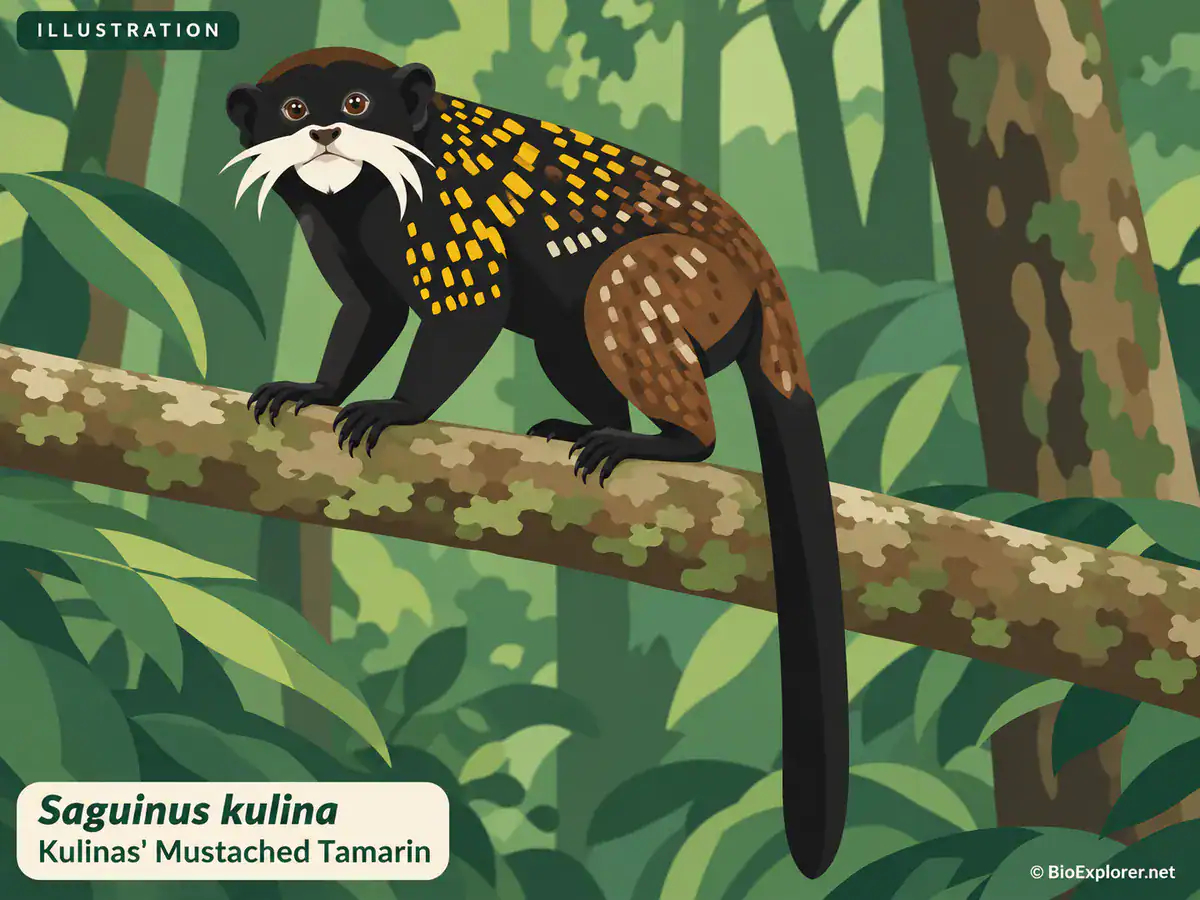
Kulinas' mustached tamarin (Saguinus kulina) is a small Brazilian monkey. Scientists named it in January 2023.[1] It is the newest of the types of monkeys on this site.
It belongs to the New World monkey group. It lives in one block of Amazon forest.[1] That block sits between two rivers.[1]
The scientific description examined nine museum specimens.[1] That description gives no data on diet, social organization or population size.[1]
Its name honors the Kulina people.[1] They hold the largest indigenous territory in that stretch of forest.[1]
A small Amazonian tamarin with a yellow band on each mantle hair. Described in 2023 from the forest between the Juruá and Tefé rivers.

- Common NameKulinas' Mustached Tamarin
- Taxonomy Classification Year2023
- Monkey SizeNot published
- Skin Color(s)White hairs ringing mouth and nostrils; mantle hairs light black with a yellow band; saddle and rump banded brown; tail black
- HabitatKnown from terra firme forest in the Juruá to Tefé interfluve, Amazonas, Brazil
- DietNot studied
- Native CountriesBrazil
- Described on 11 January 2023 from the Juruá to Tefé interfluve.[1] Before that no mustached tamarin had been collected there.[1]
- The holotype is an adult male, IDSM 03594.[1] It was collected on 18 July 2018.[1]
- Each mantle hair carries a yellow band below a black tip.[1] In Saguinus mystax that band is orange.[1]
- The scientific description examined nine museum specimens.[1] All came from Amazonas state, Brazil.[1]
- The IUCN has not evaluated it.[3] ITIS places it in Tamarinus instead.[4]
Kulinas' Mustached Tamarin Distribution
 )
)Kulinas' Mustached Tamarin Guide:
A New Tamarin
The animal belongs to Callitrichidae.[1] That is the marmosets and tamarins family.
Hershkovitz reviewed this group in 1977.[1] He examined no specimens from this forest block.[1] He assigned the area to a known subspecies instead.[1]
Specimens in the type series were collected there in 2018 and 2019.[1] Their coats did not match any named form.[1]
Genetic work placed them on their own branch.[1] The team described them as a new species.[1] The same paper reviewed the whole moustached tamarin complex.[1]
Recent work groups these animals with the emperor tamarin.[5] The red-chested mustached tamarin sits in the same group.[5]
Stephen Nash drew the coat plates for the paper.[1] He is also one of its twelve authors.[1]
Coat And Markings
Long white hairs ring the mouth and nostrils.[1] The whiskers are well developed.[1] The rest of the face wears black hair.[1]
The forehead is light black. The crown is blackish brown.[1]
The mantle carries the key feature. Its hairs are light black.[1] Each carries a yellow band below a black tip.[1] The base of each hair is white.[1] That white shows through unevenly.[1]
The forelimbs match the mantle as far as the elbow.[1]
The saddle, rump and outer thighs differ. Their hairs carry a brown band, not yellow.[1] The hindlimbs match the saddle.[1]
Hands and feet are black above.[1] The tail is black except at its base.[1] The underside runs black to light brown.[1]
Colors were scored in daylight against Munsell codes.[1]
Telling It Apart
The description diagnoses this animal by a combination of characters.[1] Yellow bands sit on the mantle and forelimbs.[1] Brown bands sit on the saddle, rump and hindlimbs.[1]
Compared with Saguinus mystax, the clearest single difference is that band color.[1] In S. mystax the mantle band is orange, not yellow.[1] Its forelimbs are plain black rather than matching the mantle.[1]
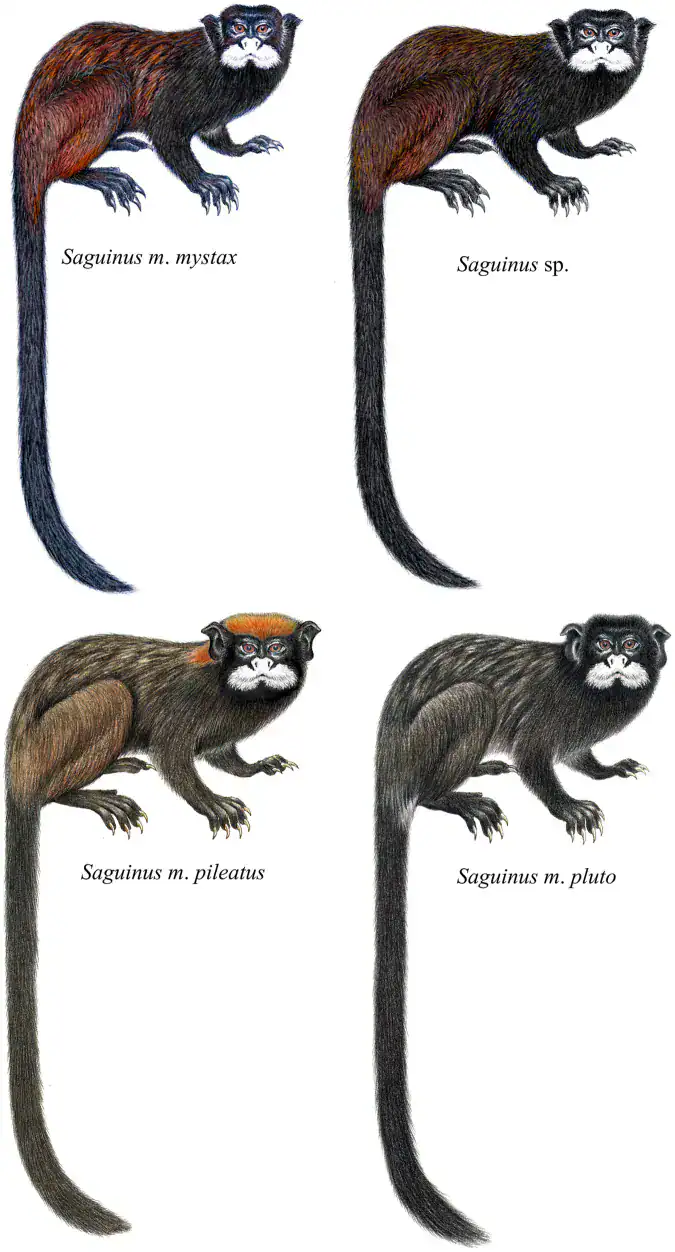
The nominate form, Saguinus pileatus pileatus, wears a broad reddish orange cap.[1] That cap divides toward the back of the head.[1] Kulinas' mustached tamarin has no such cap.[1]
The other subspecies, Saguinus pileatus pluto, has no cap either.[1] Telling these apart uses the complete coat pattern.[1]
Range And Habitat
The range is one interfluve in Amazonas state, Brazil.[1] It sits between the Juruá and the Tefé.[1]
The western limit is the right bank of the Juruá.[1] The eastern limit is the left bank of the Tefé.[1] The description reports no records outside that interfluve.[1]
The type specimens came from terra firme forest.[1] That is forest which does not flood.[1]
The holotype came from a sustainable-use reserve.[1] Other type specimens came from two river communities.[1]
Brazil has greater primate diversity than any other country.[6] See the other Brazil monkeys for the wider picture.
Life In The Group
Nothing in this section has been recorded for this species. The lines below describe Saguinus mystax.[2] That is a closely related, formerly conspecific species.[1] They are context only.
Mustached tamarins eat mainly fruit pulp and arthropods.[2] They also take nectar, tree gums and small vertebrates.[2] Frogs and lizards are on record.[2]
They use every forest layer.[2] They travel mostly through the middle one.[2] They forage on the ground only occasionally.[2]
Groups hold three to ten animals.[2] Six is typical.[2] Adult males outnumber adult females.[2]
Polyandry is the usual mating system.[2] Monogamy, polygyny and polygynandry also occur.[2] Infants are carried mainly by adult males.[2] Other adults and subadults also carry them.[2]
One caveat on the measurements. Heymann's account predates this revision.[2] Its figures pool forms now placed in Saguinus pileatus.[1] On that basis, adults weigh 450 to 650 grams.[2]
Whether any of this holds for kulina is unknown.
Named For Kulina
The name is a noun in apposition.[1] It honors the Kulina indigenous peoples.[1]
Their Kumaru Indigenous Territory is the largest in the interfluve.[1]
The paper records three names for the animal.[1] English speakers use Kulinas' tamarin.[1] In Portuguese it is sauim-dos-kulinas.[1] The Kulina call it pishi.[1]
Conservation Status
The IUCN has not evaluated the species.[3] It therefore has no formal global threat category.
The describing paper makes no assessment.[1] It lists no threats.[1] It gives no population figure.[1]
The published range is restricted to the Juruá to Tefé interfluve.[1] No range area has been calculated.[1]
The holotype came from the Baixo Juruá Extractive Reserve.[1] The Kumaru Indigenous Territory lies within the same interfluve.[1]
Common Questions
A small tamarin from Amazonas state, Brazil, described in January 2023. It lives in the forest between the Juruá and Tefé rivers. It is the newest monkey species on this site.
Only in Amazonas state, Brazil. It occupies the forest between the Juruá and Tefé rivers. The description reports no records elsewhere.
Sources disagree, and both are current. The Mammal Diversity Database uses Saguinus kulina. ITIS and the 2024 Rylands and Mittermeier review use Tamarinus kulina. This page follows the Mammal Diversity Database.
Its mantle hairs carry a yellow band. In the moustached tamarin that band is orange. Its forelimbs also match its mantle, which theirs do not.
The description publishes no body mass or external body-length measurements. A close relative weighs 450 to 650 grams. Whether kulina matches that is unknown.
The description gives no population estimate. The IUCN has not evaluated the species.
Cite this page
BioExplorer. (2026, October 13). Kulinas’ Mustached Tamarin. https://www.bioexplorer.net/animals/mammals/monkeys/kulinas-mustached-tamarin/
About the author