
Kanamari White Uakari
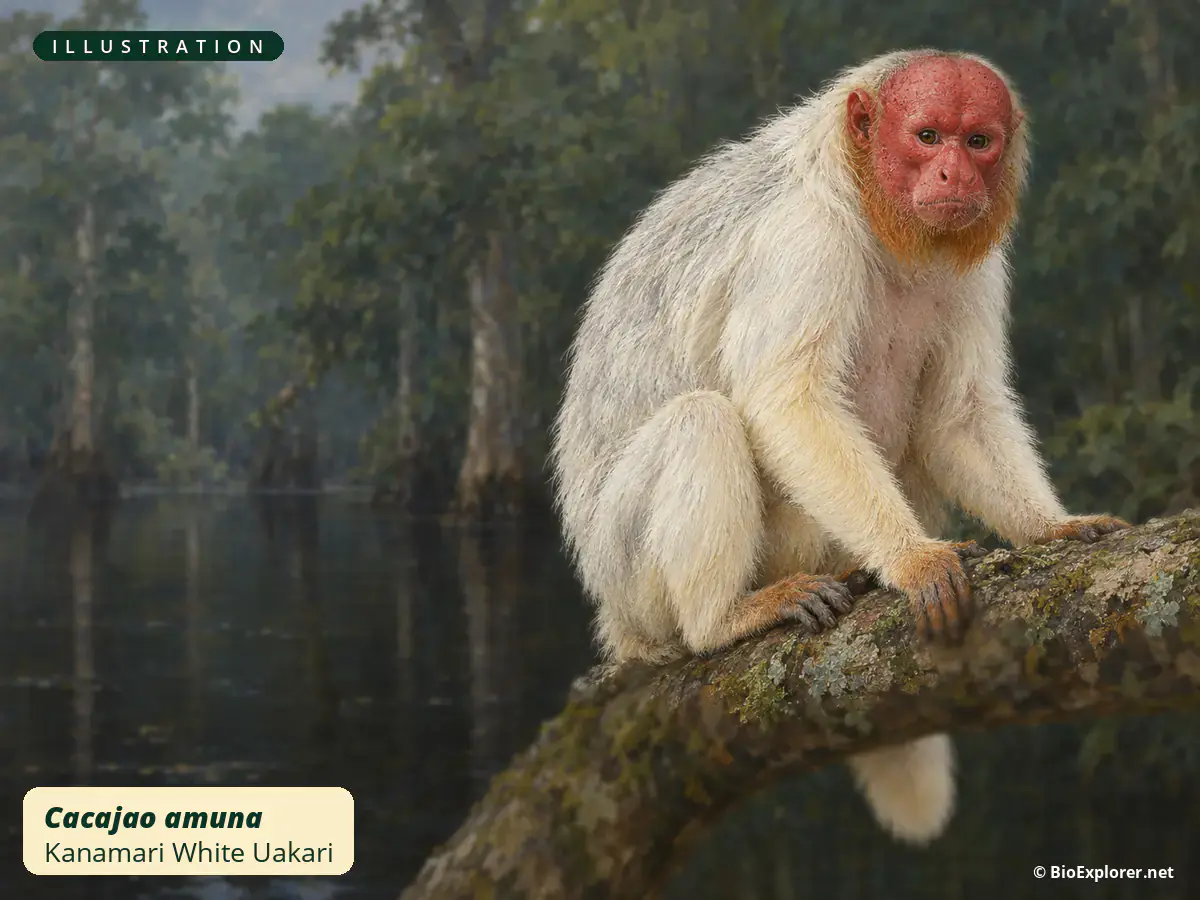
The Kanamari white uakari (Cacajao amuna) is a whitish Amazonian monkey. It lives in western Brazil. It has a bare red face and a short tail. A reddish orange beard frames the face.
Scientists formally described it in 2022.[1] It was the only new species in that revision.[1] The others were taxa Hershkovitz treated as subspecies.[1]
It belongs to the New World monkeys. It is endemic to Brazil.[2] It holds the right bank of the Rio Tarauacá.[2]
The IUCN lists it as Least Concern.[2] The population trend is recorded as stable.[2]
A whitish short-tailed Amazonian monkey with a bare red face. The only new species in the 2022 uakari revision.
- Common NameKanamari White Uakari
- Taxonomy Classification Year2022
- Monkey SizeNot published in the 2022 description
- Skin Color(s)Bare red face with a reddish orange beard; coat whitish to light greyish white, cream on the underside of the tail
- HabitatKnown from white-water flooded forest on the right bank of the Rio Tarauacá, Amazonas and Acre, Brazil
- DietNot studied in this species; related uakaris specialize on immature seeds
- Native CountriesBrazil
- Formally described in 2022, the only new species in that revision.[1] The others were taxa Hershkovitz treated as subspecies.[1]
- The name honours the Amuna-dyapas, a Kanamari subgroup.[1] “Amuna” is a Katukina word for uakari monkey.[1]
- It holds the right bank of the Rio Tarauacá.[2] The describing paper estimates the range at 30,028 square kilometers.[1]
- The IUCN lists it as Least Concern.[2] The population trend is recorded as stable.[2]
- No detailed study of its ecology has been published.[2] Density and abundance are equally unstudied.[2]
Kanamari White Uakari Distribution
 )
)Kanamari White Uakari Guide:
A White Coat
The back is whitish.[1] Most hairs are white or whitish throughout.[1] A few carry a greyish tip.[1]
The overall effect is a light greyish white.[1] The nape is whiter still.[1] So is the rear of the tail.[1]
The flanks are white or whitish.[1] The chest and belly carry sparse whitish hairs.[1] There is no orange chest.[1]
The arms are yellowish white.[1] The forearms are paler.[1] The legs are whitish outside and cream inside.[1]
The tail is whitish above and cream below.[1] Hands and feet mix short orange hairs with greyish white.[1]
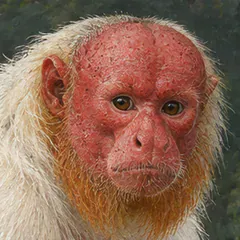
The face is essentially bare.[1] The beard is reddish orange.[1] Some animals carry a reddish chestnut beard instead.[1]
The paper says the dorsum is whitest in males.[1] Variation among the paratypes is described as minor.[1]
Neither the 2022 description nor the Red List assessment provides body measurements.[1][2]
Described In 2022
White uakaris were reported here long before the species had a name. A 1999 note recorded them on the Rio Jurupari.[5] Their taxonomic status stayed unclear.[2]
The 2022 study used ddRAD genomic data.[1] Seven samples of this animal entered that dataset.[1] Ten entered the mitochondrial dataset.[1]
The ddRAD tree places it beside the bald uakari.[1] The two are sister species.[1] The analysis reported 100 percent support for that sister relationship.[1]
A species-delimitation test compared a merged model against a split model.[1] The split model won decisively.[1] The Mammal Diversity Database[6] and ITIS[7] both accept the species.
Two studies date that split differently. The ddRAD analysis put it at about 310,000 years.[1] Its interval ran from 200,000 to 430,000 years.[1] A 2024 whole-genome study put it at about 160,000 years.[8] That interval ran from 150,000 to 180,000 years.[8] Whole genomes narrowed the estimate.[8]
The type series holds six animals.[1] Four came from the Rio Tarauacá.[1] Two came from the Rio Moaco.[1]
Range And Habitat
The range lies in Amazonas and Acre states, Brazil.[2] It covers the right bank of the Rio Tarauacá.[2] It reaches the rios Envira and Jurupari.[2]
The animal also lives on the rios Pauini and Moaco.[2] Those drain into the upper Rio Purus.[1]
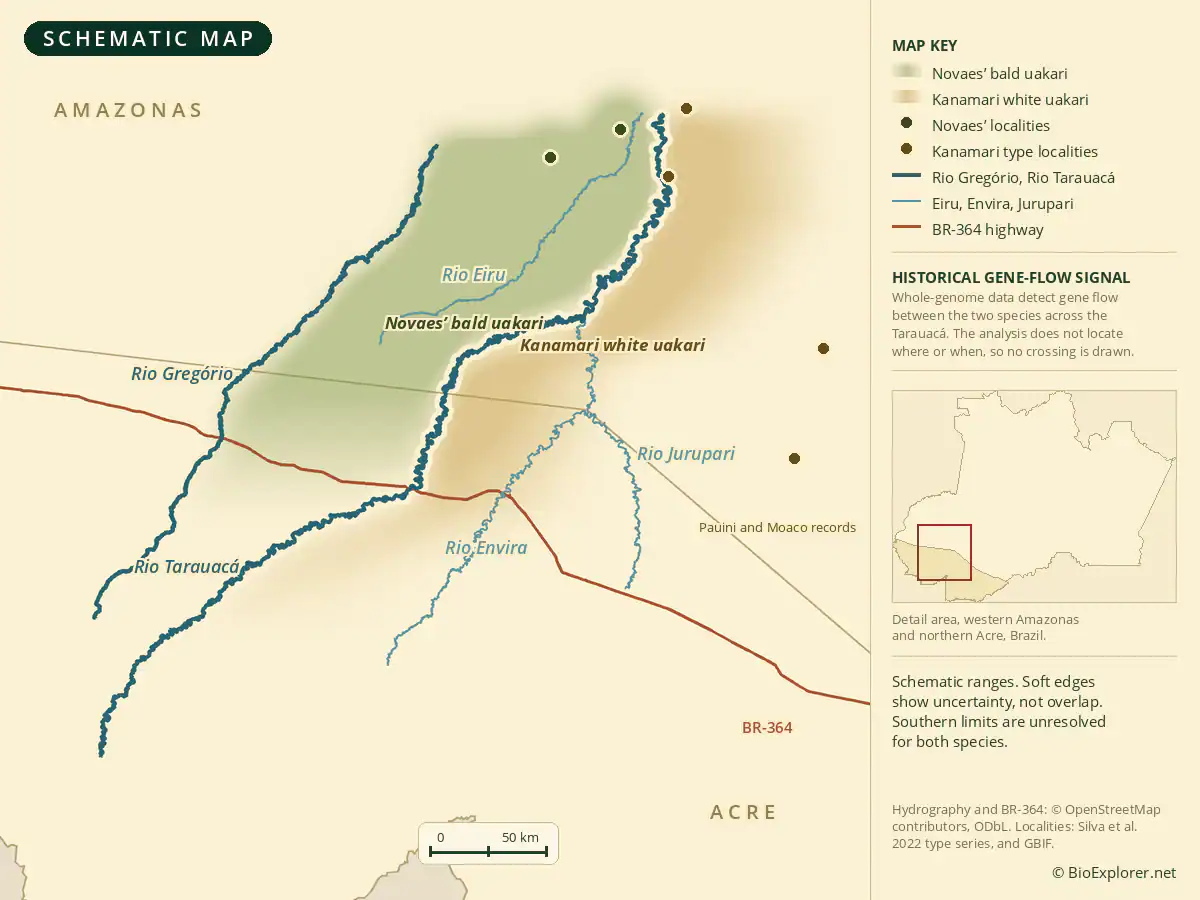
The describing paper estimates the range at 30,028 square kilometers.[1] The Red List publishes no extent of occurrence figure.[2]
Its southern limit is unknown.[1] The authors had no information from the upper Tarauacá.[1]
The animal is known from white-water flooded forest.[2] That habitat is called várzea.[2]
Across the Tarauacá lives the Novaes' bald uakari.[10] The two carry different Red List categories.[2][10] Neither assessment provides a field-based population estimate.[2][10] Published genetic estimates differ by dataset and model.[3][8]
The species is endemic to Brazil.[2] See the other Brazil monkeys for context.
Roads And Towns
The Red List names three ongoing threats.[2] They are roads, hunting and trapping, and climate change.[2]
BR-364 is the road in question. It links the main cities of Acre state.[2] Deforestation may follow it.[2]
The 2022 paper is blunter. It names this species and Cacajao novaesi together.[1] Both sit near expanding towns.[1] It names Eirunepé, Envira, Tarauacá and Feijó.[1]
That paper says BR-364 cuts the rivers both animals live on.[1] It lists the Gregório, Envira, Eiru and Tarauacá.[1]
Hunting is coded but barely documented. The assessment records the species as a pet on the Rio Tarauacá.[2] That record is a personal observation.[2]
Conservation Status
The IUCN lists the species as Least Concern.[2] It was assessed in March 2024 and published in 2025.[2]
The stated reason is twofold. There is no evidence of population decline.[2] Human population density in the area is relatively low.[2]
The assessment also records what was missing then. No study yet showed how human activity affects the habitat.[2]
The population trend is recorded as stable.[2] The population is not severely fragmented.[2]
The protected-area field records none.[2] The species does occur in the Kanamari do Rio Juruá Indigenous Land.[2] The assessment counts those two things separately.[2]
The genus Cacajao is listed in CITES Appendix I.[9] The Red List records the species as subject to trade controls.[2]
What Is Unknown
No detailed study of its ecology has been published.[2] Density and abundance are equally unstudied.[2]
What stands in for a count is genetic. A 2024 ddRAD study estimated an effective population size of 89,229.[3] A whole-genome study the same year reported a different estimate.[8] The two used different data and different models.[3][8] Effective population size is not a head count.[3]
That whole-genome study found something else. It detected gene flow with its neighbour across the Tarauacá.[8] The Tarauacá has not completely prevented historical gene flow.[8]
Diet has never been studied here.[2] Related uakaris open hard fruit and eat immature seeds.[2] Seeds and fruit are therefore the likely staples.[2]
The bare red face is shared across the bald uakaris.[1] A study examined four Ucayali animals.[4] No melanin granules were seen in their facial skin.[4] Dense capillaries sat just beneath it.[4] This species has not been examined.[4]
Compare the black uakari for the black-headed side of the genus. The types of monkeys hub lists every group.
Common Questions
The Kanamari white uakari is a short-tailed Amazonian monkey. Its coat is whitish. Its face is bare and red. A reddish orange beard frames it. Scientists described the species in 2022.
Kanamari white uakaris live in Amazonas and Acre states, Brazil. They hold the right bank of the Rio Tarauacá. The range reaches the rios Envira and Jurupari. They also live on the rios Pauini and Moaco.
The name honours the Amuna-dyapas, a Kanamari subgroup. They live on the right bank of the Rio Tarauacá. "Amuna" is a Katukina word for uakari monkey. The describing authors proposed the English name themselves.
The IUCN lists the Kanamari white uakari as Least Concern. There is no evidence of population decline. The trend is recorded as stable. The genus is listed in CITES Appendix I.
The Kanamari white uakari is whitish rather than red. It lacks the orange chest of the bald uakari. Its beard is paler than that of its sister species. No single field mark separates every uakari.
Nobody has counted Kanamari white uakaris in the field. Two 2024 genomic studies estimated effective population sizes. Their figures differ by dataset and model. Effective population size is not a head count.
Cite this page
BioExplorer. (2026, October 12). Kanamari White Uakari. https://www.bioexplorer.net/animals/mammals/monkeys/kanamari-white-uakari/
About the author