
Novaes’ Bald Uakari
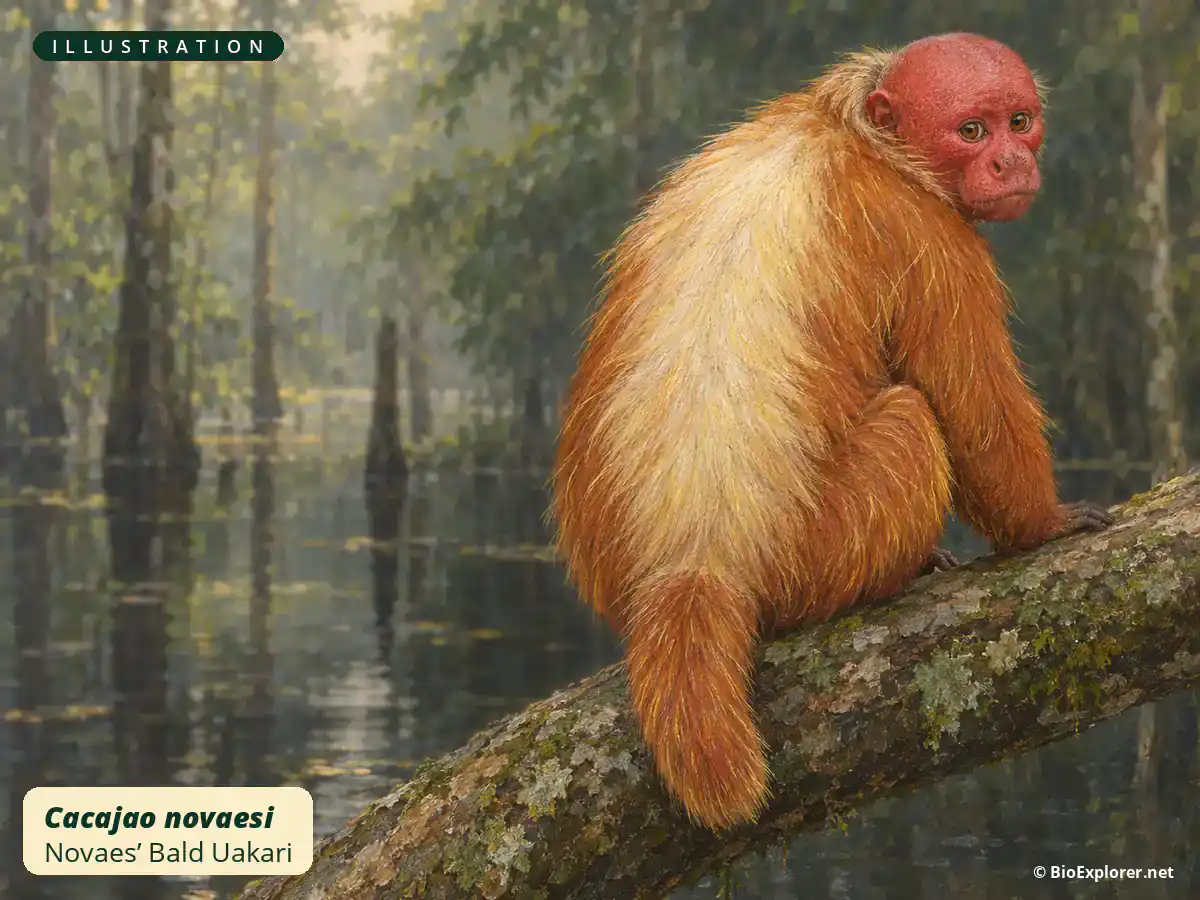
The Novaes' bald uakari (Cacajao novaesi) is a monkey from western Brazil. It has a bare red face and a short tail. A pale field runs along the back.
Hershkovitz described it in 1987.[5] He treated it as a subspecies of Cacajao calvus.[5] A 2022 genomic revision raised it to species rank.[1]
It belongs to the New World monkey group. It is endemic to Brazil.[7] It lives between two rivers in Amazonas state.[2]
The IUCN lists it as Near Threatened.[2] Its known range covers about 3,757 square kilometers.[2]
A short-tailed Amazonian monkey with a bare red face and pale back. Named in 1987 and raised to species rank in 2022.
- Common NameNovaes' Bald Uakari
- Taxonomy Classification Year1987
- Monkey SizeNot published for this species
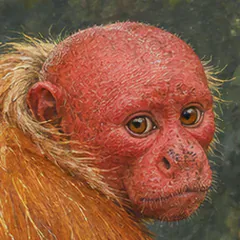
- Skin Color(s)Bare red face with a bald crown; body reddish orange to reddish chestnut, with a whitish or yellowish field along the back
- HabitatFlooded and unflooded forest in the Gregório to Tarauacá interfluve, Amazonas, Brazil
- DietNot studied in this species; related uakaris specialize on immature seeds
- Native CountriesBrazil
- Hershkovitz named it in 1987 as a subspecies of Cacajao calvus.[5] A 2022 genomic revision raised it to species rank.[1]
- It lives between the Rio Gregório and the Rio Tarauacá.[2] The extent of occurrence is about 3,757 square kilometers.[2]
- The southern limit of the range is unknown.[7] Surveys never found it on the left bank of the Gregório.[2]
- The IUCN lists it as Near Threatened on two criteria.[2] It also names low genetic diversity as a threat.[2]
- No field estimate of population size exists.[2] A 2024 ddRAD analysis put genetic effective population size at 2,121.[3]
Novaes' Bald Uakari Distribution
 )
)Novaes' Bald Uakari Guide:
A Pale Back
The body is reddish orange.[1] Some animals are reddish chestnut instead.[1]
The back carries the key feature. A whitish and yellowish field runs along the dorsum.[1] It reaches from the nape to the rump.[1] In some animals it reaches the tail.[1]
That pale field does not stop sharply. It grades into light orange on the saddle.[1] The same orange covers the flanks.[1]
The arms and legs are reddish orange.[1] Some hairs on them are wholly yellow.[1] Others are reddish orange at the base and yellow at the tip.[1]
Measurements are a problem. ICMBio lists figures compiled for Cacajao calvus.[7] They are not confirmed measurements of this species.[7] The lengths come from a 1976 catalogue.[7] That predates the 1987 description.[7] Species-specific measurements remain unavailable.
Uakaris are still the short-tailed monkeys of the New World.[1]
Raised To Species
Hershkovitz treated the bald uakaris as one species in 1987.[2] He gave it four subspecies.[2] This animal was one of them.[2]
The 2022 study sequenced museum and field samples.[1] Each dataset included five samples of this animal.[1]
The genome-wide tree places it outside the other two red uakaris.[1] Those two are the red bald uakari and the Ucayali bald uakari.[1] It is sister to that pair.[1] The branch carried 100 percent bootstrap support.[1]
The splits were not simultaneous. This species parted from the other two about 310,000 years ago.[1] Those two then parted about 260,000 years ago.[1]
A species-delimitation test compared a merged model against a split model.[1] The split model won decisively.[1] The Mammal Diversity Database[5] and ITIS[6] both accept the species.
The bald uakari page covers the white species these were separated from.
Range And Habitat
The known range lies in western Amazonas, Brazil.[2] It sits in the Gregório to Tarauacá interfluve.[2] The Tarauacá separates it from Cacajao amuna.[2]
The range is small. The extent of occurrence is about 3,757 square kilometers.[2] ICMBio separately maps a distribution area of 9,990 square kilometers.[7] The IUCN records a continuing decline in extent of occurrence.[2] Area of occupancy is also declining.[2]
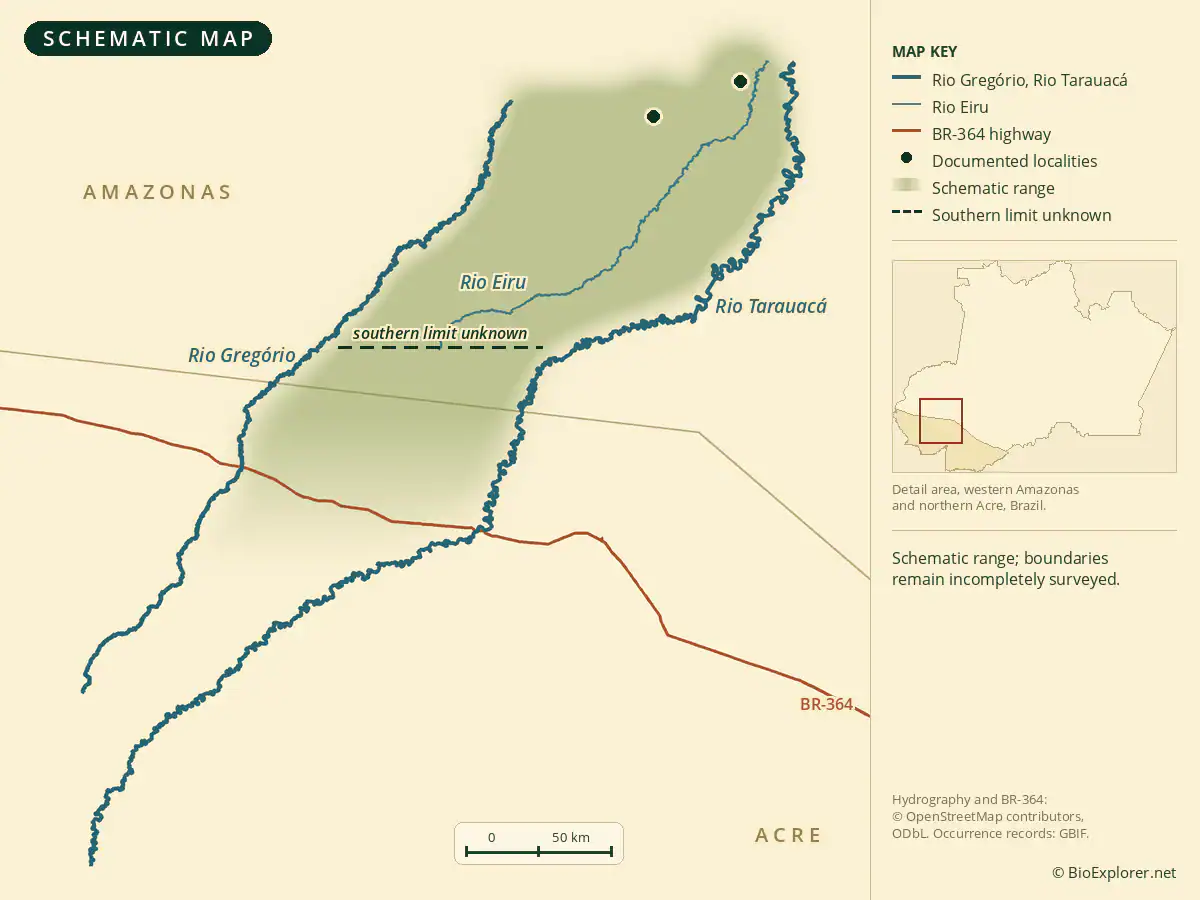
Its southern limit is unknown.[7] Surveys never found it on the left bank of the Gregório.[2]
The animal uses flooded and unflooded forest.[2]
The type specimen is an adult male in Stockholm.[5] It came from the Rio Eiru.[5]
The species is endemic to Brazil.[7] See the other Brazil monkeys for context.
Hunting And Roads
Two pressures dominate, and both are documented locally.
Hunting is direct. The species is hunted for food.[2] Rio Eiru residents reported about fifteen animals killed in one hunt.[7] A 2010 reserve plan listed it third among hunted primates.[7]
The second is the BR-364 highway. It cuts through forest in Acre state.[2] The road runs between Cruzeiro do Sul and Rio Branco.[2] It connects onward to Rondônia, where deforestation rates are among the highest.[7]
The 2022 paper flagged this animal and Cacajao amuna together.[1] Both sit nearer expanding towns than the other uakaris do.[1] It names Eirunepé, Envira, Tarauacá and Feijó.[1]
Forest loss so far has been modest. One estimate puts it at 0.56 percent across three generations.[7] A model projects at least 14.3 percent habitat loss by 2045.[7] Its window runs from 2015.[7] That covers the area around the extent of occurrence.[7] The model is still in preparation.[7]
Conservation Status
The IUCN lists the species as Near Threatened.[2] It was assessed in April 2024 and published in 2025.[2]
Near Threatened here means close to Vulnerable on two counts. The assessment cites criteria B1ab(ii,iii,v) and C1.[2] The small range drives the first.[2] The small suspected population drives the second.[2]
Several things stopped it reaching Vulnerable. The population is not severely fragmented.[2] It is not clear the species has fewer than ten locations.[2] The record is also in tension with itself. The population section suspects at least a thirty percent decline.[2] The justification says the decline rate remains uncertain.[2]
The assessment also names low genetic diversity as a threat.[2] That is unusual wording for a Red List entry.
Fewer than 2,500 animals are thought to remain.[2]
Brazil assessed it nationally as Near Threatened in 2019.[7] Earlier global assessments had placed it in Vulnerable.[2]
It is listed in CITES Appendix I.[2] Two protected areas cover part of the range.[2] Residents may still hunt inside both.[2]
What Is Unknown
No field estimate of population size exists.[2] No species-specific ecological study has been published.[2]
What stands in for a population figure is genetic. A 2024 ddRAD analysis estimated a genetic effective population size of 2,121.[3] The range given was 1,283 to 3,061.[3] A whole-genome study published later that year produced a much larger estimate.[8] These model-based values depend strongly on the dataset and assumptions.[8] Neither is a field count.[3]
Diet has never been studied in this species.[7] Related uakaris open hard fruit and eat immature seeds.[2] Seeds and fruit are therefore the likely staples.[2]
The bare red face is shared across the bald uakaris.[1] A study examined four Ucayali animals.[4] No melanin granules were seen in their facial skin.[4] Dense capillaries sat just beneath it.[4] This species has not been examined.[4]
Part of the range sits in the Kulina do Médio Juruá land.[2]
Compare the black uakari for the black-headed side of the genus. The types of monkeys hub lists every group.
Common Questions
The Novaes' bald uakari is a short-tailed Amazonian monkey. It has a bare red face. A pale field runs along the back. It lives in western Amazonas state, Brazil. Hershkovitz described it in 1987.
Confirmed records of the Novaes' bald uakari are in western Amazonas, Brazil. They occupy the forest between the Rio Gregório and the Rio Tarauacá. The extent of occurrence is only about 3,757 square kilometers. The southern limit is still unknown.
The IUCN lists the Novaes' bald uakari as Near Threatened. That means it is close to Vulnerable but does not yet qualify. Fewer than 2,500 animals are thought to remain. The population is declining.
The Novaes' bald uakari has a very small range. Its genetic diversity is low. It is hunted for food. The BR-364 highway brings deforestation to the southern part of its range. Climate change is also listed as a threat.
Nobody has counted Novaes' bald uakaris in the field. A 2024 ddRAD analysis estimated a genetic effective population size of 2,121. A whole-genome study later that year produced a much larger estimate. Neither is a field count. The IUCN suspects fewer than 2,500 remain.
Both are red uakaris with a pale area on the back. Some red bald uakaris look very similar. There is no reliable single field mark. The 2022 revision separated them using coat series, geography and genetics.
Cite this page
BioExplorer. (2026, October 12). Novaes’ Bald Uakari. https://www.bioexplorer.net/animals/mammals/monkeys/novaes-bald-uakari/
About the author