
Red Bald Uakari
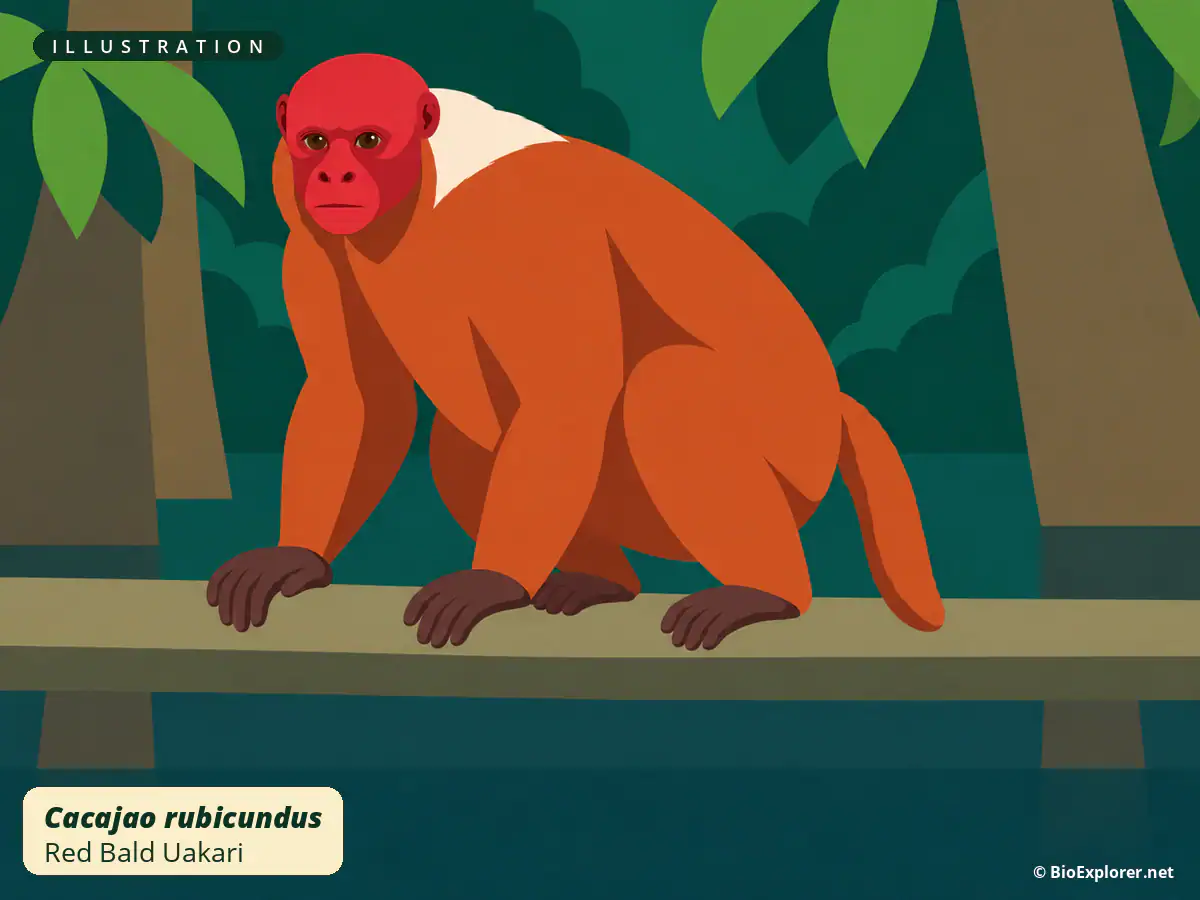
The red bald uakari (Cacajao rubicundus) is a monkey from Brazil. It has a bare red face and an unusually short tail. The crown is bald or sparsely haired.
Scientists described it as a species in 1848.[1] Hershkovitz treated it as a subspecies of Cacajao calvus in 1987.[1] A 2022 genomic revision restored species rank.[1]
It belongs to the New World monkey group. It lives in three separate patches of flooded forest.[1] All three sit along the middle Solimões.[1]
The three patches do not look alike. Each holds animals with a different coat.[1]
A short-tailed Amazonian monkey with a bare red face. Described in 1848 and restored to species rank in 2022.

- Common NameRed Bald Uakari
- Taxonomy Classification Year1848
- Monkey SizeNot published in the 2022 revision
- Skin Color(s)Bare red face with a bald or sparsely haired crown; coat reddish orange to reddish chestnut, with a whitish nape or a pale dorsal field
- HabitatFlooded forest at three sites on the middle Rio Solimões, Amazonas, Brazil
- DietNot studied for this species
- Native CountriesBrazil
- Described as a species in 1848.[1] Hershkovitz reduced it to a subspecies in 1987.[1]
- A 2022 genomic revision restored species rank.[1] The Mammal Diversity Database[4] and ITIS[5] both accept it.
- Three separate populations exist, each with its own coat.[1] All sit along the middle Solimões.[1]
- The bare red face comes from blood, not pigment.[3] The facial skin carries no melanin.[3]
- The IUCN lists it as Least Concern.[2] The same assessment reports a decreasing trend.[2]
Red Bald Uakari Distribution
 )
)Red Bald Uakari Guide:
Three Red Populations
Silva and colleagues examined museum skins from all three areas.[1] They found three coat patterns.[1] Each pattern matched one population.[1] Very few specimens were available per population.[1]
Animals from the Jacurapá channel are reddish orange.[1] A whitish nape contrasts with the body.[1] This is the population the species was named from.[1]
Animals from the Rio Jutaí are reddish chestnut.[1] The whitish nape runs further back onto the mantle.[1] It then grades into a chestnut saddle.[1]
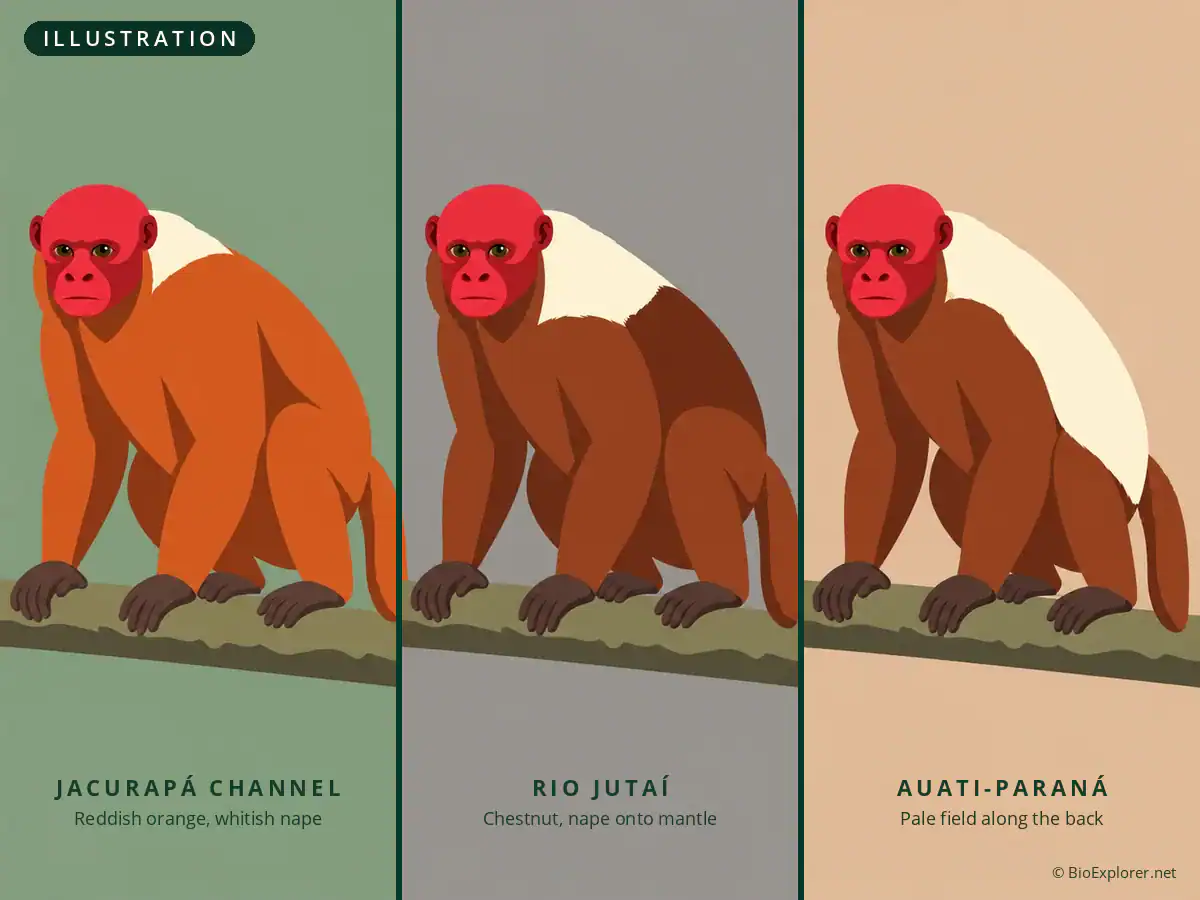
Auati-Paraná animals differ again.[1] Their flanks and limbs are reddish chestnut.[1] A whitish or pale buff dorsal field contrasts with them.[1] In the examined male, that field ran from nape to tail.[1] In the single female, it reached only the saddle.[1]
Hershkovitz had called that third group a blend.[1] He thought it sat between two subspecies.[1] The 2022 study places it inside this species.[1]
From Subspecies
Hershkovitz grouped all bald uakaris as one species in 1987.[1] He gave it four subspecies.[1] This animal was one of them.[1]
The 2022 study sequenced museum and field samples.[1] The mitochondrial analysis recovered only two broad clades.[1] The genome-wide ddRAD data recovered five distinct lineages.[1]
A species-delimitation analysis supported recognizing all five as species.[1] One of the five was new to science.[1] The bald uakaris now number five species.[1]
The genome-wide tree places it closest to the Ucayali bald uakari.[1] That placement drew 62 percent bootstrap support on the species tree.[1] Only two genomic samples, both from one locality, represented that species.[1]
The bald uakari page covers the white species these were split from.
The Bare Face
Bald uakaris have bare red faces.[1] The color is not pigment.[3]
A histological study examined four Peruvian red uakaris.[3] Those animals are now classed as Cacajao ucayalii.[1][3] Their facial skin held no melanin granules.[3]
Facial epidermis averaged 9 to 15 micrometers by region.[3] Non-red monkeys averaged roughly 29 to 40.[3] Capillaries beneath it were denser and wider.[3]
Blood close to the surface therefore produces the color.[3] The 2022 revision treats this as a shared bald-uakari feature.[1] Black-headed uakaris do not have it.[1]
The authors propose that the face could signal health.[3] Earlier observers reported pale faces in sick uakaris.[3] That signaling hypothesis has not been tested directly.[3]
Range And Habitat
The species lives in the middle Rio Solimões, in Amazonas, Brazil.[1] It occupies three disjunct populations.[1][2]
The first is the flooded forest of the Jacurapá channel.[1] That is the type locality, opposite São Paulo de Olivença.[1]
The second is the left bank of the Rio Jutaí.[1] The Jutaí joins the Solimões from the south.[1]
The third follows the Auati-Paraná.[1] That channel links the Solimões to the Japurá.[1]
The IUCN counts three locations for the species.[2] Brazil holds more primate species than any other country.[6] See the other Brazil monkeys for context.
What Is Known
Little has been published on this species alive. The 2022 revision gives no body measurements and no population figure.[1]
What the assessment records is general. Its habitat is forest.[2] Its generation length is about ten years.[2]
The genus also holds black-headed species.[1] Compare the Aracá uakari and the black uakari. The types of monkeys hub lists every group.
Conservation Status
The IUCN lists the species as Least Concern.[2] It was assessed in April 2024 and published in 2025.[2]
Least Concern does not mean stable. The assessment reports a decreasing population trend.[2] It recognizes only three threat-defined locations.[2]
The assessment names two threats.[2] One is hunting and trapping.[2] The other is climate change and severe weather.[2] It records local use as human food.[2]
It calls climate change the principal imminent threat.[2] Its effects on this species have not been studied directly.[2]
The two sources weigh hunting differently. The assessment codes it as ongoing, but says occasional hunting may occur.[2] Juveniles have been recorded as pets near São Paulo de Olivença.[2] It calls for field studies to establish the impact.[2]
The 2022 revision drew on earlier fieldwork.[1] It reported the species as not hunted.[1] These rest on different evidence rather than a flat contradiction.
The species occurs in at least one protected area.[2] International trade controls apply to it.[2]
Common Questions
The red bald uakari is a short-tailed Amazonian monkey. It has a bare red face and a bald crown. It lives in flooded forest in Amazonas, Brazil. Scientists described it in 1848.
The red face of the red bald uakari comes from blood. It is not pigment. Dense capillaries run beneath thin, hairless facial skin. Researchers found this in four Ucayali bald uakaris. This species has not been examined directly.
The red bald uakari is a full species. Hershkovitz classed it as a subspecies of Cacajao calvus in 1987. A 2022 genomic revision restored species rank. The Mammal Diversity Database and ITIS both list it as valid.
No. Red bald uakaris differ by population. Each of the three populations has its own coat. One is reddish orange with a whitish nape. One is reddish chestnut. The third has a pale field along the back. Only a few specimens have been examined.
Red bald uakaris live only in Amazonas state, Brazil. They occupy flooded forest along the middle Solimões. Three separate populations exist. They sit at the Jacurapá channel, the Rio Jutaí, and the Auati-Paraná.
The IUCN lists the red bald uakari as Least Concern. That assessment was published in 2025. It records a decreasing population and only three locations.
Cite this page
BioExplorer. (2026, October 12). Red Bald Uakari. https://www.bioexplorer.net/animals/mammals/monkeys/red-bald-uakari/
About the author