
Javan Fuscous Langur
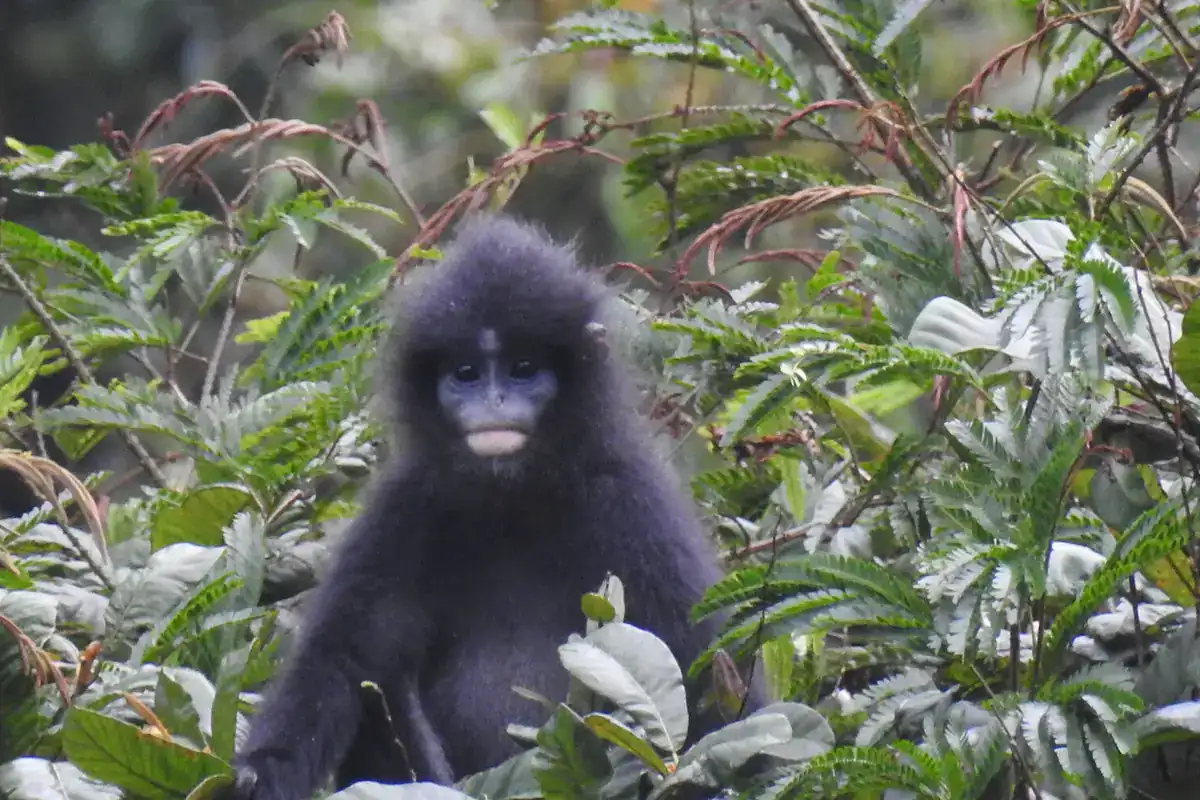
The Javan fuscous langur (Presbytis fredericae) lives in Central Java. It is the dark end of a color gradient crossing the island.[1][2] Indonesians call it the rekrekan.[3]
Java holds more people than any island on earth. Its forest survives mainly on slopes too steep to farm. This langur survives there with it, in four to eight separated pockets.[2]
Hendrik Sody named it in 1930, as a subspecies.[1] It waited 92 years for its own conservation assessment. The IUCN rates it Vulnerable.[4]
It belongs to the surilis, genus Presbytis. See where that sits among the langur species. The genus is part of the Old World monkey family.
Endemic to three mountain areas of Central Java. Only one of its populations sits inside a national park.
- Common NameJavan Fuscous Langur
- Year Classified1930
- Body SizeHead-body 48 to 60 cm (19 to 24 in) in males, 43 to 57 cm (17 to 22 in) in females, for the Javan surili as a whole
- Skin ColorBlack above and below; white lower belly and inner limbs; pale gray throat
- HabitatMontane and upper montane rainforest
- DietMainly young leaves, with fruit, flowers, seeds and fungi
- Native CountriesIndonesia
- Black above and below, with a white lower belly. Other Javan surilis are gray and white.[5]
- Known from three areas: the Dieng Mountains, Gunung Slamet and Gunung Merbabu.[2]
- Recorded from 750 to 2,500 meters on Gunung Slamet. One lowland population survives near 500 meters.[2][6]
- Groups of 2 to 14 animals were counted on Gunung Slamet, across 54 groups.[6]
- Total population is put at 5,000 to 17,000, of which 2,300 to 7,800 are mature.[2]
Javan Fuscous Langur Distribution
[display-map id=’1234′]
Javan Fuscous Langur Guide:
Identification
This is the dark one. The coat is black above and below.[5] The lower belly and the inner surfaces of the limbs are white.
The throat and upper chest are light gray or whitish. A thin pale streak joins the two.[5] There is a little white on the fingers and toes.
A tall black crest sits on the crown, shaped like a miter. A single whorl of hair marks the front of the head.[5] Infants are born dark gray or black. That is unusual in this genus.[5]
The Javan grizzled langur is the one to compare it with. That species is slaty gray above and whitish below.[5] The two sit at opposite ends of one gradient.
West Javan animals are gray with white undersides. From roughly 108 degrees east the back turns brownish black. The pale underside is steadily replaced as you go east.[2]
No body measurements have been published for this species alone. Figures exist only for the Javan surili as a whole. Head-body runs 48 to 60 cm in males and 43 to 57 cm in females. Tails run 59 to 72 cm.[5]
Species Or Subspecies
Sody described this animal in 1930 as Pithecus aygula fredericae.[1] He collected it at 1,000 meters on Gunung Slamet. Both name-bearing specimens sit in Leiden.[1]
The genus name did not last. By 1985 it had moved into Presbytis comata as a subspecies.[1] Douglas Brandon-Jones spent two decades arguing it deserved species rank.
The species combination was first used in a 2004 classification of Asian primates.[1] A mitochondrial study in 2011 supported the split.[7] The IUCN adopted it in 2022.[4]
Not everyone followed. The United States taxonomic register still lists it as a subspecies.[8] Several major primate references do the same.[2]
The boundary itself is unclear. Grouping rests mainly on coat color, and color runs as a gradient.[2] One mountain, Gunung Ciremai, holds animals that look intermediate.[2]
The IUCN action plan is blunt about it. Its first recommended action for both animals is to resolve the taxonomy.[2] BioExplorer follows the Mammal Diversity Database, which treats it as a species.[1] See the full monkey species list.
Range And Habitat
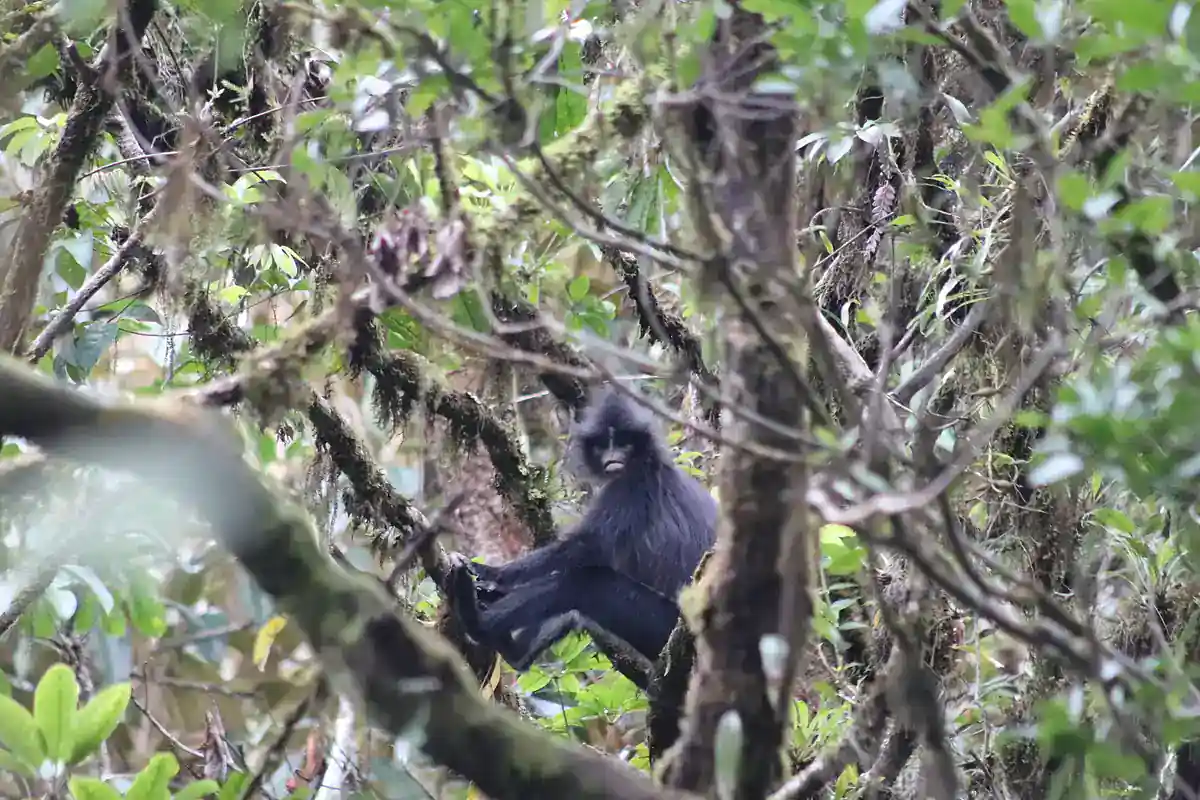
Three mountain areas hold this langur. They are the Dieng Mountains, Gunung Slamet and Gunung Merbabu.[2] All three lie in Central Java province.
A fourth range may be a meeting point. The Pembarisan mountains may be where it meets the Javan grizzled langur.[2] Gunung Ciremai remains uncertain.
One mountain has already lost it. The langur is confirmed gone from Gunung Lawu.[2] It was still recorded there in the mid 1990s.
On Gunung Slamet it ranges from 750 to 2,500 meters.[6] The Javan surili once reached 2,565 meters, and sea level too.[5] Almost all of that lower ground is gone now.
Most of what survives is montane and upper montane forest.[5] One lowland population holds on at about 500 meters. That is Sokokembang forest, inside the Dieng range.[2][10]
Gunung Slamet is wet, with about 5,000 to 6,200 mm of rain yearly.[6] Oaks and their relatives dominate above 1,000 meters. Below that the forest is younger and more disturbed.[6]
Protection is close to nonexistent. Only Gunung Merbabu National Park covers any population.[2] Everything else sits in unprotected forest. Parts of Slamet are watershed forest, strict reserve and production forest.[2]
Diet And Behavior
Surilis are colobines. They ferment leaves in a chambered stomach, as the whole subfamily does. That is a trait of the whole group, not of this species.[2]
The diet is mainly young leaves. Fruit, flowers, seeds and fungi fill out the rest.[5] Animals have been seen eating large tree snails and reddish soil.[5]
There is a reason they avoid sweet fruit. Sugary pulp acidifies the forestomach. That can kill the gut microbes the animal needs to digest leaves.[5] Compare the wider picture of what monkeys eat.
No diet study has been published for this species alone. The quantified figures in circulation come from West Java. Those animals are the Javan grizzled langur, not this one.[5]
Group size is the one solid behavioral number. A survey of Gunung Slamet counted 54 groups and 233 animals. Groups ran from 2 to 14 individuals.[6]
Groups usually hold one adult male, sometimes two.[5] Encounters between groups are hostile. Males leave before they reach maturity, and females stay.
They sometimes travel with the East Javan langur.[5] Home range, activity budget and calls are all unstudied here. A 2012 survey of surili calls sampled West Java only.[10]
Conservation Status
The IUCN rates the Javan fuscous langur Vulnerable. Nijman, Setiawan and Ang assessed it in 2022.[4] It was the first assessment made under its own name.
The total population is put at 5,000 to 17,000 animals. Of those, 2,300 to 7,800 are mature.[2] They sit in four to eight isolated groups of forest.
One of those is nearly gone. Fewer than 50 animals are thought to remain on Gunung Merbabu.[2] Gunung Slamet holds the largest group, at 1,172 to 1,621.[6]
Density on Slamet runs 5.6 to 8.16 animals per square kilometer.[6] That count covered about 199 square kilometers. It took 150 days and 125 km of trails.[6]
The listing may already be too mild. The IUCN langur action plan says it may qualify as Endangered. What is missing is a documented rate of decline.[2]
Habitat loss drives everything here. Java is among the most densely settled places on earth. Forest survives mostly where the ground is too steep to farm.
Hunting is opportunistic rather than targeted. One animal was shot and eaten during fieldwork on Slamet.[6] A small pet trade exists, with young animals sold to nearby towns.[6]
Other pressures stack up. Illegal logging, firewood cutting and orchid collection all take trees.[6] Parts of Slamet are set aside for geothermal power.[2] Farmers shoot animals that raid cassava.[6]
One problem got solved, and it is worth knowing. Four langurs were electrocuted on power lines between 2019 and 2022. This happened in Petungkriyono, in Pekalongan Regency.[2]
Local agencies insulated the lines. The animals can now cross between forest patches safely. The same work cut the number killed by vehicles.[2]
Another small-range monkey faces the same squeeze. See the Muna-Buton macaque of Sulawesi.
An Indonesian group called SwaraOwa works in this forest.[11] It ties village coffee growing to keeping the trees standing. Three threatened Javan primates share these same shrinking patches.
Common Questions
It is a dark leaf-eating monkey found only in Central Java, Indonesia. Its scientific name is Presbytis fredericae and Indonesians call it the rekrekan. It is a surili, and the darkest of the Javan ones.
The Mammal Diversity Database and the IUCN treat it as a species. The United States taxonomic register still lists it as a subspecies. The split rests mainly on coat color. The IUCN says the taxonomy still needs resolving.
In three areas of Central Java: Dieng, Gunung Slamet and Gunung Merbabu. Most animals live in montane forest between about 750 and 2,500 meters. One lowland population survives at around 500 meters at Sokokembang.
The 2022 assessment puts the total at 5,000 to 17,000 animals. Of those, 2,300 to 7,800 are mature, spread over four to eight isolated populations. Fewer than 50 are thought to survive on Gunung Merbabu.
Java is among the most densely populated places on earth. Its forest is mostly gone. Only one population sits inside a national park. Hunting, logging, firewood cutting and geothermal development add to the pressure.
Mainly young leaves, with fruit, flowers, seeds and fungi. Like other langurs it avoids sweet fruit. Sugar upsets the gut microbes it needs. No feeding study has been published for this species on its own.
Cite this page
BioExplorer. (2026, October 7). Javan Fuscous Langur. https://www.bioexplorer.net/animals/mammals/monkeys/javan-fuscous-langur/
About the author