
East Sumatran Banded Langur
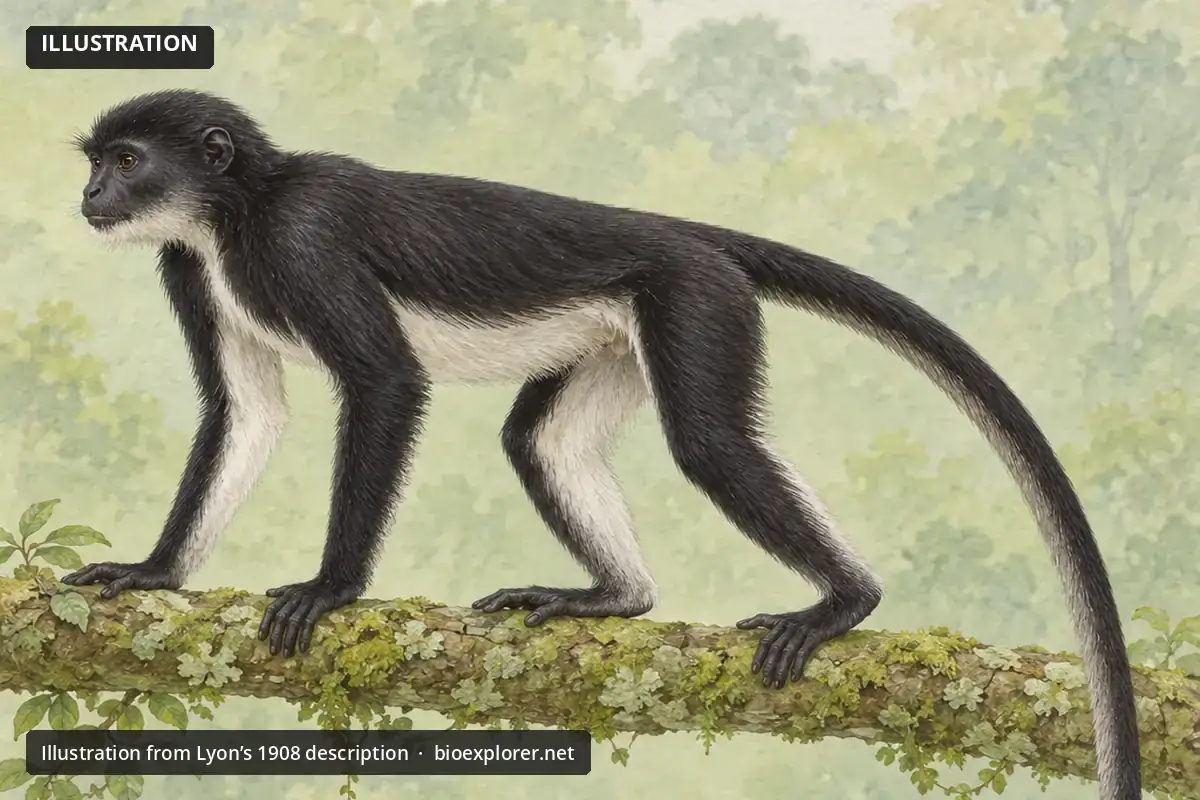
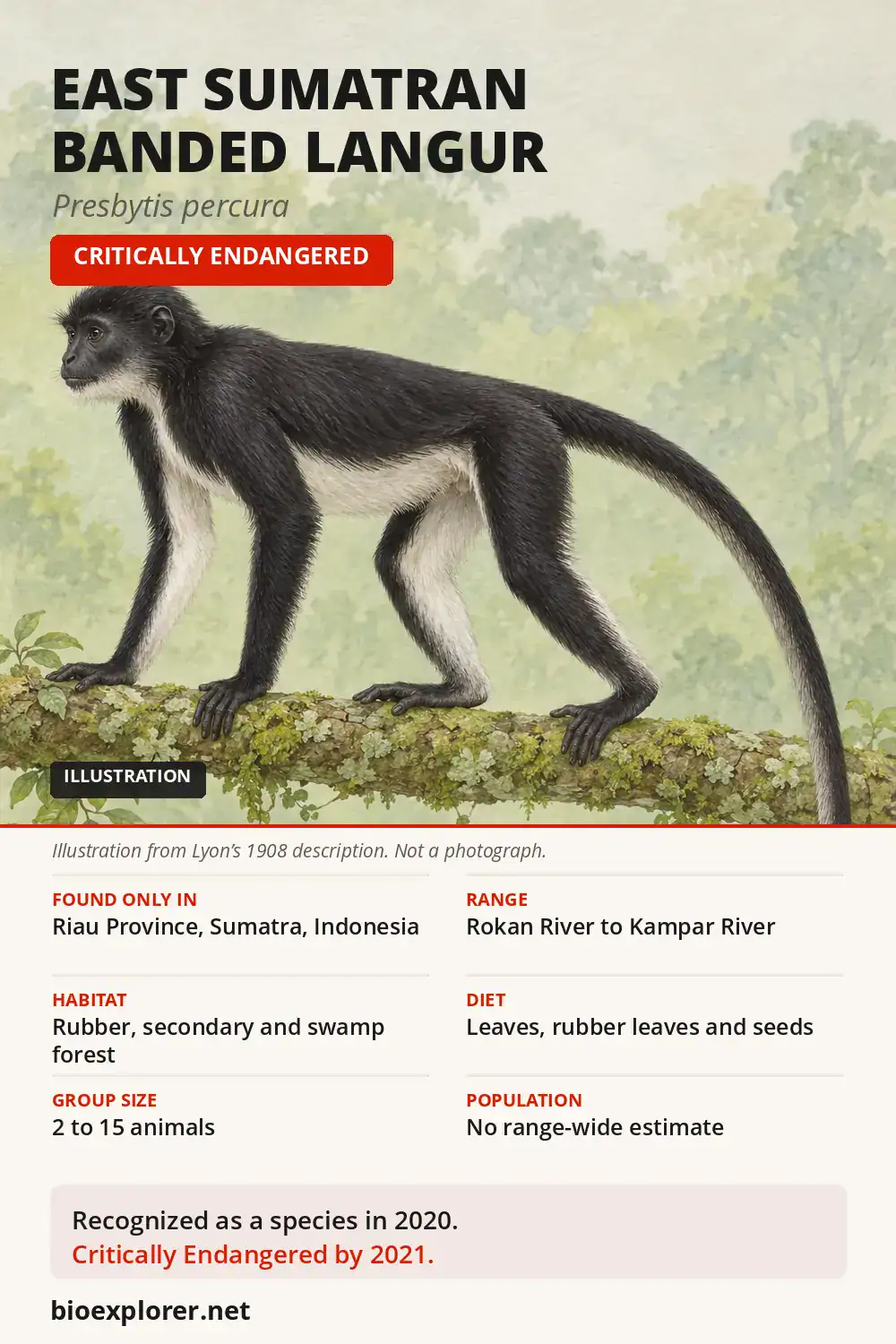
The East Sumatran banded langur is barely known to science. It lives only in Riau Province, in east-central Sumatra. Researchers recognized it as a full species in 2020.
Before that it spent decades as a subspecies. The split forced an urgent conservation reassessment. A form once listed as Data Deficient is now Critically Endangered.
Its scientific name is Presbytis percura. It belongs to the leaf-eating colobines, within the Old World monkey family.
A leaf-eating monkey of one Indonesian province. Riau has lost most of its forest, and nobody has counted what is left of this species.
- Common NamesEast Sumatran Banded Langur, Banded Surili
- Taxonomy Classification Year1908
- Monkey SizeNo modern measurement series published for this species; Lyon described a uniform series of 11 specimens in 1908
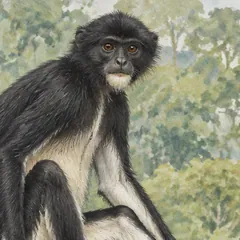
- Skin Color(s)Black to blackish over the head, back, outer limbs, hands, feet and tail, with whitish chin, belly, chest line, inner arms and inner legs
- HabitatRubber, secondary and swamp forest, often near plantations, settlements and roads
- DietHerbivorous
- Native CountriesIndonesia
- Researchers resurrected it to full species rank in 2020.[2] It had been a subspecies for most of a century.[2]
- It is known only from Riau Province, east-central Sumatra.[2][4]
- The one recent survey found 75 animals in nine groups.[4] They turned up at seven of 25 sites.[4]
- Riau lost 63 percent of its natural forest between 1985 and 2008.[2][4]
- Indonesian law protects it only under the older name Presbytis melalophos.[3]
East Sumatran Banded Langur Distribution
 )
)East Sumatran Banded Langur Guide:
A Recent Split
Marcus Ward Lyon Jr. described Presbytis percura in 1908.[1][6] The holotype is USNM 144088, from Kompei in eastern Sumatra.[1]
Later authors folded it into Presbytis femoralis as a subspecies.[2] It stayed there for most of a century. It was the least studied member of that group.[2]
That changed in 2020. A team led by Andie Ang sequenced faecal DNA from wild animals.[2] They recovered 11 complete mitochondrial genomes.[2] Three delimitation methods agreed.[2]
The study resurrected three species from one. These are P. femoralis, P. percura and P. robinsoni.[2] The genus now holds 20 species and 28 taxa.[3] Seventeen of the 20 are threatened.[3]
Cytochrome b divergence from Raffles's banded langur is at least 7.1 percent.[2] The two lineages parted around 2.6 million years ago.[2] That estimate sits near the Pliocene and Pleistocene boundary.[2]
Robinson's banded langur falls outside that sister pair.[2] Its lineage separated from the broader group about 4.5 million years ago.[2]
Black And White
Lyon worked from a uniform series of 11 specimens.[6] Adults are black to blackish over most of the body.[6] That covers the head, back and outer limbs.[6] Hands, feet and tail are dark too.[6]
Whitish fur marks the belly and chin.[6] A narrow pale line runs down the chest.[6] The inner arms are white from armpit to wrist.[6]
White also runs along the inner thighs and legs.[6] It reaches down toward the heels.[6] The tail is lightly grizzled below, not boldly pale.[6]
Lyon found no distinguishing characters in the skull or teeth.[6]
Riau Endemic
This langur is known from one Indonesian province.[2][4] Its reported range runs from the Rokan River south.[4] It reaches at least the Kampar River.[4]
The southern boundary remains unresolved.[4] During the 2018 reconnaissance, every sighting occurred between those two rivers.[4] They could not confirm the Kampar as a true limit.[4]
Camera traps recorded it in Giam Siak Kecil-Bukit Batu Biosphere Reserve.[4] Confirmed occurrence records remain sparse.[3][4]
For other species on the same islands, see monkeys of Indonesia.
Rubber And Swamp
The 2018 reconnaissance recorded animals in three settings.[4] These were rubber forest, secondary forest and swamp forest.[4]
All sat near plantations, settlements and roads.[4] Observers did not record the species inside oil palm stands.[4]
Surviving groups occupy isolated forest patches.[4] Oil palm, rubber, acacia and eucalyptus surround them.[4]
Some populations persist in human-modified landscapes.[3] These include areas near croplands and protected land at Perawang City.[3]
Rubber leaves and seeds were directly observed as food.[4] Leaves dominate the diet of langurs generally.[5] Fruit, seeds and flowers are also taken.[5]
Another Sumatran colobine is the North Sumatran leaf monkey.
Small Groups
The principal recent survey ran eight days in April and May 2018.[4] Results were published the following year.[4]
Observers found the species at seven of 25 sites.[4] They recorded nine groups and 75 animals.[4] Group size ranged from two to 15.[4]
Two dependent infants were seen.[4] A few juveniles were also noted.[4]
Field staff report small family groups.[5] A typical group holds one adult male with several females and young.[5]
An earlier study at Perawang ran 16 months in the 1980s.[3] It recorded 136 food-plant species.[3] Beyond these two efforts, its ecology and behavior stay poorly known.[3][4]
Vanishing Forest
Riau lost 63 percent of its natural forest between 1985 and 2008.[2][4] That was the highest rate in Sumatra.[2] Oil palm and pulpwood drove the clearing.[4]
ENSO-linked fires and agricultural burning compound the damage.[2][4] Riau is especially vulnerable because of its extensive peatlands.[2][4]
Villagers have killed langurs that raided fruit trees.[3] Rambutan, durian and mangosteen appear in reports.[3]
No range-wide population estimate exists.[4][5] Researchers infer a decline of at least 80 percent.[2] That covers three generations, roughly 30 years.[2]
An Outdated Name
The 2020 study proposed Critically Endangered status.[2] It cited criteria A2cd, A3cd and A4cd.[2] IUCN assessed the species in 2020.[3] The formal Red List account was published in 2021.[7]
Indonesian law still uses outdated taxonomy. The 2018 protected species list names Presbytis melalophos.[3] That was once a broad grouping covering several species.[3]
Presbytis melalophos has since been split into at least eight species.[3] Presbytis percura is one of them.[3] It is therefore protected only under the older name.[3]
The 2024 action plan recommends naming the species explicitly.[3] It asks for a revised national protected-species list.[3]
One restoration program works inside the range.[5] Restorasi Ekosistem Riau runs patrols and replanting on the Kampar Peninsula.[5] RER reports that its cumulative inventory now lists 901 species.[5]
Compare it with other langur species across Asia.
Common Questions
It is a leaf-eating monkey found only in Riau Province, Sumatra. Researchers recognized it as a full species in 2020. Before that it was a subspecies of Raffles's banded langur.
Adults are black to blackish over the back, limbs and tail. White marks the belly, chin, inner arms and inner legs. A narrow pale line runs down the chest.
It is known only from Riau Province, in east-central Sumatra, Indonesia. Its reported range runs between the Rokan and Kampar rivers. The southern boundary is still unresolved.
Riau lost 63 percent of its natural forest between 1985 and 2008. Oil palm, pulpwood, fire and retaliatory killing all contribute. Researchers infer a decline of at least 80 percent over three generations.
No range-wide population estimate exists. An eight-day survey in 2018 found 75 animals in nine groups. They turned up at seven of 25 sites checked.
Yes, but under outdated taxonomy. Indonesia's list covers it under an older broad name. That name is Presbytis melalophos. The 2024 action plan recommends listing P. percura explicitly.
Cite this page
BioExplorer. (2026, October 14). East Sumatran Banded Langur. https://www.bioexplorer.net/animals/mammals/monkeys/east-sumatran-banded-langur/
About the author