
Adjuvant Mixing Calculator
An adjuvant mixing calculator computes per-animal and per-cohort batch preparation volumes for immunization protocols. It supports 11 adjuvants across four active formulation classes. The Class 1 emulsions are CFA, IFA, TiterMax, Montanide ISA 51 VG, and AddaVax. The Class 3 mineral suspensions are Alhydrogel, Adju-Phos, and Imject Alum.
The Class 4 soluble immunostimulants are CpG ODN 1826 VacciGrade, poly(I:C) HMW VacciGrade, and Quil-A. The Class 5 option is no adjuvant. Researchers, students, and core facility staff can use this calculator without writing code. Every output is volume arithmetic, not a protocol recommendation. The user is responsible for IACUC approval and adherence to all institutional, national, and international regulations.
The calculator checks each per-site volume against limits set by species, route, and adjuvant class. These numerical limits come primarily from the NIH OACU adjuvant guidelines [2], with Leenaars & Hendriksen [3] used as a secondary source for routes the NIH guidelines don’t cover.
Stills [1] is cited separately for background: it explains the pros and cons of each route and footpad welfare concerns, but it is not the source of the numerical limits. These route limits apply specifically to CFA-antigen emulsions. Other adjuvant classes use the limits listed in their own product records, or a value you enter from your IACUC-approved protocol.
Adjuvant Mixing Calculator
Compute per-animal and per-cohort batch preparation volumes for immunization protocols. Pick from 11 adjuvants across a five-class framework (four active in v1), with NIH OACU and Leenaars & Hendriksen per-site safety checks.
Antigen
Protocol
Adjuvant
The public Seppic product page does not establish the fraction or per-site limit; enter both from your approved protocol.
Per-product allowed range. Alhydrogel/Adju-Phos 1:1-1:9; Imject Alum 1:1-1:3.
Specify a target final volume per animal; the tool will compute the diluent (PBS/saline) volume as the difference. If left blank, diluent is 0 mL and the final volume equals the antigen volume. Must be ≥ antigen volume when > 0.
Batch
! Hard stops (no recipe computed)
! Warnings (recipe still computed)
1 Per-animal recipe (nominal, no overage)
2 Per-cohort batch (with overage)
How to use this calculator
Pick your antigen type, stock concentration, and dose per animal. The stock unit and dose unit must be dimensionally consistent (e.g. ug with mg/mL, or CFU with CFU/mL). Enter the number of animals, species, route, and number of sites. Select the adjuvant product. The form shows the conditional fields you need to fill (ISA 51 VG fraction and per-site limit, alum ratio, Class 4 dose and stock, or target final volume for None). Click Compute recipe.
The output shows hard stops (red, no recipe computed) and yellow warnings (recipe still computed). For a clean run, the per-animal recipe (antigen + adjuvant + diluent volumes and per-site volume) and the per-cohort batch (with overage) appear in two cards. The disclaimer at the bottom of the output reminds you to use the tool only under an institutionally approved IACUC/ACUC protocol.
Four active formulation classes
| Class | Description | Equation | Examples |
|---|---|---|---|
| Class 1 | Emulsions (1:1 v/v; user-entered adjuvant product fraction for ISA 51) | total = aqueous / (1 – adjuvant_product_fraction); adjuvant = adjuvant_product_fraction × total | CFA, IFA, TiterMax, Montanide ISA 51 VG, AddaVax |
| Class 2 | Non-1:1 emulsions (target-volume driven) – deferred to v2 | aqueous = target × (1 – oil_fraction); adjuvant = target × oil_fraction; total = target | Montanide ISA 720 (planned) |
| Class 3 | Mineral suspensions (volume-ratio driven) | alum_volume = volume_antigen / antigen_to_alum_ratio; total = volume_antigen + alum_volume | Alhydrogel, Adju-Phos, Imject Alum |
| Class 4 | Soluble immunostimulants (dose + stock) | adjuvant_volume = adjuvant_dose / adjuvant_stock_concentration; total = volume_antigen + adjuvant_volume | CpG ODN 1826 (VacciGrade), poly(I:C) HMW (VacciGrade), Quil-A |
| Class 5 | No adjuvant | if user enters target_final_volume: volume_diluent = target_final_volume – volume_antigen; total = target_final_volume. Otherwise: total = volume_antigen, diluent = 0. adjuvant = 0 | None |
Worked examples
The calculator’s behavior is verified against 20 worked fixtures covering standard use cases and hard-stops. Each fixture specifies the exact formulation class, inputs, and expected output.
| # | Antigen | Species | Route | Adjuvant | Class | N | Sites | Per-animal recipe (nominal) | Per-cohort batch (with 20% overage) |
|---|---|---|---|---|---|---|---|---|---|
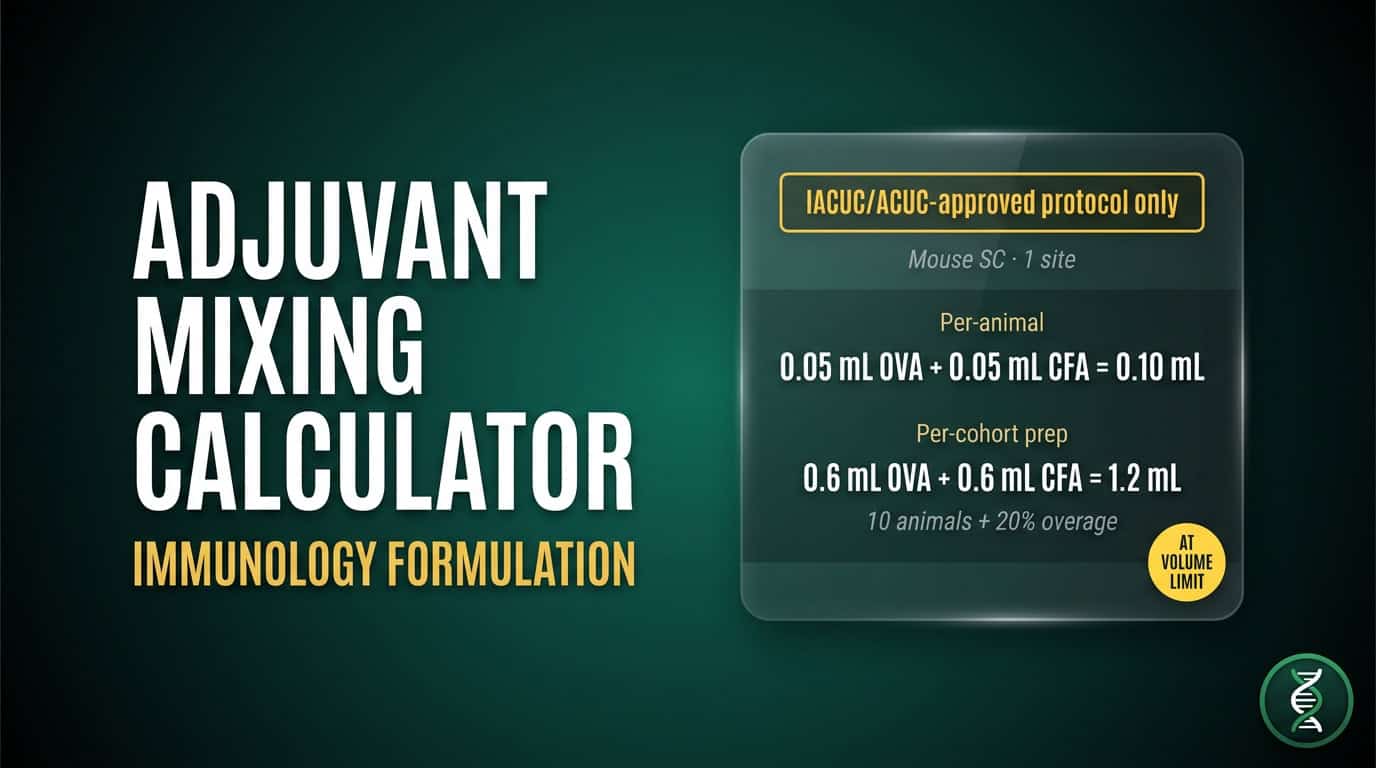
| 1 | OVA, 1.0 mg/mL, 50 ug | mouse (BALB/c) | SC | CFA | 1 (1:1) | 10 | 1 | 50 uL antigen + 50 uL CFA = 100 uL total | 600 uL OVA + 600 uL CFA = 1.2 mL |
| 2 | OVA, 1.0 mg/mL, 50 ug | mouse (BALB/c) | SC | IFA | 1 (1:1) | 10 | 1 | 50 uL antigen + 50 uL IFA = 100 uL total | 600 uL OVA + 600 uL IFA = 1.2 mL |
| 3 | Peptide, 2.0 mg/mL, 100 ug | rabbit (NZW) | SC | Montanide ISA 51 VG (user-entered) | 1 (f=0.5, per-site 0.1 mL, fixture input) | 4 | 2 | 50 uL antigen + 50 uL ISA 51 = 100 uL | 240 uL peptide + 240 uL ISA 51 = 0.48 mL |
| 4 | OVA, 1.0 mg/mL, 50 ug | mouse (BALB/c) | SC | Alhydrogel 1:1 | 3 | 10 | 1 | 50 uL antigen + 50 uL Alhydrogel = 100 uL | 600 uL OVA + 600 uL Alhydrogel = 1.2 mL |
| 5 | OVA, 1.0 mg/mL, 50 ug | mouse (BALB/c) | SC | AddaVax 1:1 | 1 (O/W) | 10 | 1 | 50 uL antigen + 50 uL AddaVax = 100 uL | 600 uL OVA + 600 uL AddaVax = 1.2 mL |
| 6 | OVA, 1.0 mg/mL, 50 ug; poly(I:C) 1 mg/mL, 20 ug | mouse (BALB/c) | SC | poly(I:C) HMW VacciGrade | 4 | 10 | 1 | 50 uL antigen + 20 uL poly(I:C) = 70 uL | 600 uL OVA + 240 uL poly(I:C) = 0.84 mL |
| 7 | OVA, 1.0 mg/mL, 50 ug; CpG 1 mg/mL, 20 ug | mouse (BALB/c) | SC | CpG ODN 1826 VacciGrade | 4 | 10 | 1 | 50 uL antigen + 20 uL CpG = 70 uL | 600 uL OVA + 240 uL CpG = 0.84 mL |
| 8 | Peptide, 5.0 mg/mL, 200 ug | mouse (BALB/c) | SC | AddaVax 1:1 | 1 (O/W) | 6 | 1 | 40 uL antigen + 40 uL AddaVax = 80 uL | 288 uL peptide + 288 uL AddaVax = 0.576 mL |
| 9 | DNA, 2.0 mg/mL, 50 ug; target 50 uL | mouse (BALB/c) | IM | None (Class 5, with target 50 uL) | 5 | 8 | 1 | 25 uL DNA + 25 uL PBS = 50 uL | 240 uL DNA + 240 uL PBS = 0.48 mL |
| 10 | Killed Salmonella, 1e9 CFU/mL, 1e7 CFU | mouse (BALB/c) | IP | CFA | 1 (1:1) | 8 | 1 | 10 uL antigen + 10 uL CFA = 20 uL | 96 uL Salmonella + 96 uL CFA = 0.192 mL |
| 11 | OVA, 1.0 mg/mL, 50 ug | rabbit | IP | CFA | RED HARD STOP – NIH marks this route as not recommended [2] | N/A | N/A | N/A | N/A |
| 12 | OVA, 1.0 mg/mL, 50 ug | mouse | IV | None | 5 | 5 | 1 | 50 uL antigen + 50 uL PBS = 100 uL | 300 uL OVA + 300 uL PBS = 0.6 mL |
| 13 | OVA, 1.0 mg/mL, 50 ug; Quil-A 1 mg/mL, 10 ug | mouse | SC | Quil-A (within mouse max 15 ug) | 4 | 10 | 1 | 50 uL antigen + 10 uL Quil-A = 60 uL | 600 uL OVA + 120 uL Quil-A = 0.72 mL |
| 14 | OVA, 0.05 mg/mL, 2.5 ug | mouse | SC | TiterMax (1:1) | 1 | 8 | 1 | 50 uL antigen + 50 uL TiterMax = 100 uL | 480 uL OVA + 480 uL TiterMax = 0.96 mL |
| 15 | OVA, 1.0 mg/mL, 50 ug | mouse | IV | AddaVax | RED HARD STOP – oil-emulsion adjuvants should not be given IV [2][1] | N/A | N/A | N/A | N/A |
| 16 | OVA, 1.0 mg/mL, 50 ug | mouse | footpad | CFA | RED HARD STOP – per-site volume of 0.10 mL exceeds the 0.05 mL limit [2] | N/A | N/A | N/A | N/A |
| 17 | OVA, 0.5 mg/mL, 25 ug | mouse | SC | Alhydrogel (1:1, default) | 3 | 10 | 1 | 50 uL antigen + 50 uL Alhydrogel = 100 uL | 600 uL OVA + 600 uL Alhydrogel = 1.2 mL |
| 18 | OVA, 1.0 mg/mL, 50 ug; prime CFA, boost IFA | mouse | SC | prime = CFA, boost = IFA | 1 | 10 | 1 | prime: 50 uL OVA + 50 uL CFA; boost: 50 uL OVA + 50 uL IFA | prime 1.2 mL; boost 1.2 mL; combined 2.4 mL |
| 19 | OVA, 1.0 mg/mL, 50 ug, overage 0.10 | mouse | SC | CFA | 1 | 10 | 1 | 50 uL antigen + 50 uL CFA = 100 uL per animal | 550 uL OVA + 550 uL CFA = 1.10 mL |
| 20 | 3 groups x 10 mice, OVA + CFA / IFA / AddaVax, prime + 1 boost | mouse | SC | varies | 1 | 30 total | 1 | 50 uL antigen + 50 uL adjuvant per animal | per-product: OVA 3.6 mL; CFA/IFA/AddaVax 1.2 mL each. Grand total 7.2 mL (informational, not an actionable prep quantity) |
Source bibliography
Every per-product record, per-route limit, and source-anchored rule is grounded in the citations below. The key sources are:
- Stills HF Jr. 2005. Adjuvants and Antibody Production: Dispelling the Myths Associated with Freund’s Complete and Other Adjuvants. ILAR Journal 46(3):280-293. PMID 15953835. DOI 10.1093/ilar.46.3.280
- NIH Office of Animal Care and Use (OACU). 2025. Guidelines for the Use of Adjuvants in Research (direct 2025 PDF).
- Leenaars M, Hendriksen CFM. 2005. Critical Steps in the Production of Polyclonal and Monoclonal Antibodies: Evaluation and Recommendations. ILAR Journal 46(3):269-279. PMID 15953834. DOI 10.1093/ilar.46.3.269
- Sigma-Aldrich. Freund’s Adjuvant, Complete (F5881) and Incomplete (F5506) product sheets.
- Invivogen. Alhydrogel 2%, Adju-Phos, AddaVax, CpG ODN 1826 (VacciGrade), poly(I:C) HMW (VacciGrade), Quil-A product sheets.
- Seppic. Montanide ISA 51 VG Range product page.
- Thermo Fisher Scientific. Imject Alum manufacturer instructions.
- TiterMax USA Technical Information.
- Billiau A, Matthys P. 2001. Modes of action of Freund’s adjuvants in experimental models of autoimmune diseases. J Leukoc Biol 70(6):849-860. PMID 11739546. DOI 10.1189/jlb.70.6.849 (Scope caveat: this review concerns Freund’s adjuvants, not universal rules for poly(I:C) or other TLR agonists. The tool does not derive any “≤ 2 boost” rule from this source.)
Related Resources
- Biology tools directory for more interactive BioExplorer calculators across molecular biology, ecology, immunology, neuroscience, and statistics.
- Immunology for the branch of biology that covers the immune system, vaccine adjuvants, antibody production, and host-pathogen interactions.
- Cell Culture Media Preparation Calculator for media and buffer recipes from stock components, used to resuspend antigens and adjuvants in working solutions.
- Cell Viability Dose-Response Calculator for 4PL/3PL dose-response fitting and IC50/EC50 estimation, used to measure adjuvant-stimulated cell responses.
- Model Organism Development Stage Converter for morphology-first developmental-stage crosswalks across mouse, rat, rabbit, chick, zebrafish, and Xenopus, useful for stage-matched immunization schedules.
- History of Immunology for a year-by-year timeline of key discoveries in immunology, useful for understanding how today’s adjuvant and immunization protocols developed.
Frequently asked questions
The Adjuvant Mixing Calculator computes per-animal and per-cohort batch preparation volumes for immunization protocols. It supports 11 adjuvants (CFA, IFA, TiterMax, Montanide ISA 51 VG, AddaVax, Alhydrogel, Imject Alum, Adju-Phos, CpG ODN 1826 VacciGrade, poly(I:C) HMW VacciGrade, Quil-A) within a five-class framework, with four classes currently implemented (Class 1 emulsions, Class 3 mineral suspensions, Class 4 soluble immunostimulants, Class 5 no adjuvant). Class 2 (non-1:1 emulsions) is deferred to v2. 7 routes (SC, IP, IM, ID, IV, IN, footpad) and 5 species (mouse, rat, rabbit, guinea pig, NHP) are supported.
No. The tool is for formulation arithmetic only. All inputs and outputs are user-supplied or user-validated; the user is responsible for IACUC approval, veterinary oversight, and adherence to all institutional, national, and international regulations (USDA, OLAW, AAALAC, EU Directive 2010/63/EU, etc.). The tool prominently displays this disclaimer at the top of every output and the top of the page.
Red hard-stops prevent recipe computation entirely. Examples include CFA in rabbit IP, oil-emulsion adjuvants by IV, NHP with CFA, and per-site volumes that exceed the species-route limit. Yellow warnings still compute the recipe but flag a concern (e.g., 80-100% of per-site limit, multi-footpad with institution override, footpad in rodents, repeat CFA at boost). The tool returns “Cannot compute – see safety warning” for any red condition.
Montanide ISA 720 (7:3 v/v oil:aqueous) is the only candidate for Class 2 (non-1:1 emulsions, target-volume driven). It is deferred to v2 because the public Seppic product page does not visibly establish the 70:30 ratio with a resolvable URL, and we could not find a verified manufacturer technical sheet. When a verified product sheet is available, the class will be added.
The adjuvant product fraction for Montanide ISA 51 VG is a user-entered REQUIRED field with no database default. The public Seppic product page does not establish the value, so the user must enter it from their approved protocol. This is also true for the per-site volume limit for ISA 51.
The Invivogen Quil-A product sheet recommends per-animal maxima that vary by species (mouse ≤ 15 ug, guinea pig ≤ 25 ug, rabbit ≤ 50 ug). The calculator rejects doses that exceed the species-specific maximum with a red hard-stop. The tool does not recommend alternative adjuvants; the user is responsible for protocol choice.
For O/W adjuvants like AddaVax, 0.5 means “50% of the final volume is the AddaVax product” – not “50% squalene oil”. The term “adjuvant product fraction” makes this clear: the fraction is of the formulated adjuvant product, not the underlying oil phase.
The calculator supports the following (numerator, denominator) pairs: (ug, ug/uL), (ug, mg/mL), (mg, mg/mL), (CFU, CFU/mL), (IU, IU/mL), and (particles, particles/mL). Mismatched units (e.g. ug with CFU/mL) are rejected with an error.
Cite this page
BioExplorer. (2026, August 26). Adjuvant Mixing Calculator. https://www.bioexplorer.net/adjuvant-mixing-calculator/