
Cell Culture Media Preparation Calculator
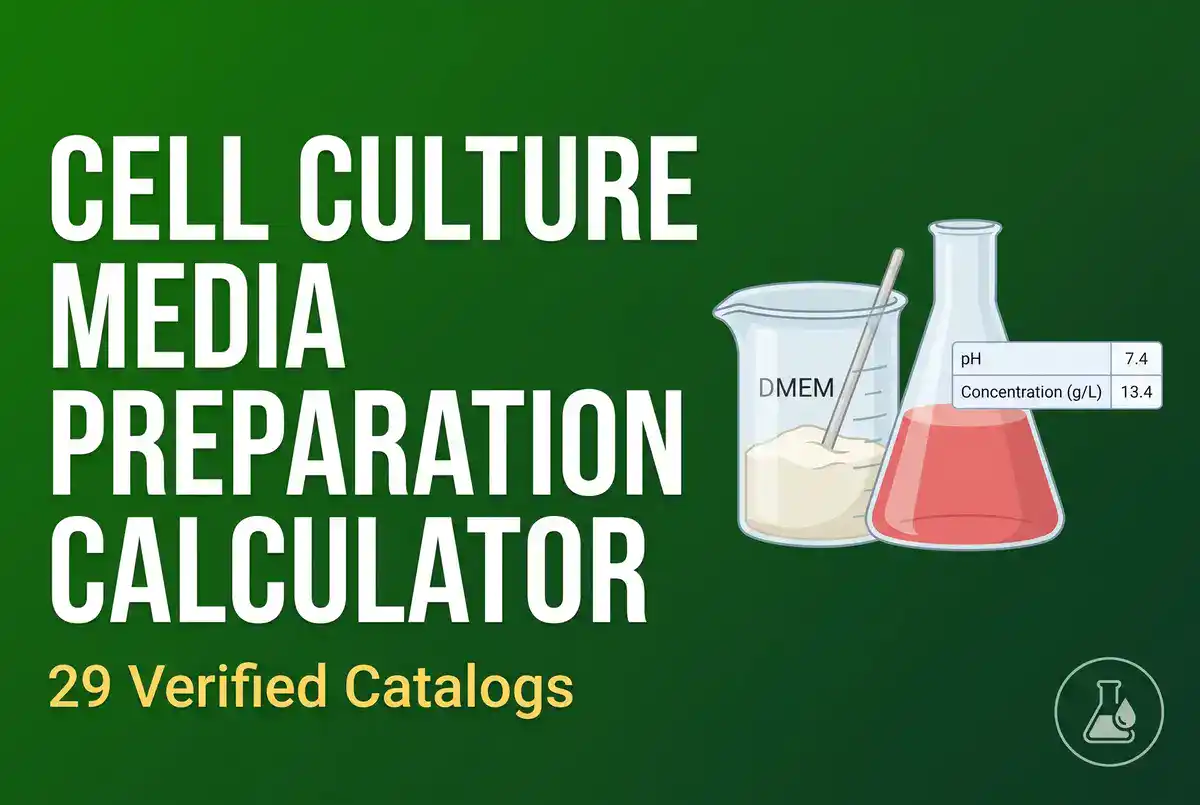
A cell culture media preparation calculator computes the powder mass, dissolution water, separate additions, predicted pH, final concentrations, and post-filtration supplement volumes for any commercial cell culture medium.
This cell culture media calculator ships with 29 source-verified catalog entries spanning DMEM (Dulbecco’s Modified Eagle Medium), RPMI 1640, MEM (Minimum Essential Medium), IMDM (Iscove’s Modified Dulbecco’s Medium), L-15 (Leibovitz), McCoy’s 5A, Waymouth’s MB 752/1, and DMEM/F-12.
Two modes are supported: Mode 1 for premix plus supplements, and Mode 2 for scratch preparation from individual reagents.
Cell Culture Media Preparation Calculator
Compute prep masses, pH, and final concentrations for 29 commercial media catalogs (DMEM, RPMI, MEM, IMDM, L-15, McCoy’s, Waymouth’s, DMEM/F-12). Two modes: Mode 1 premix plus supplements, Mode 2 scratch prep from individual reagents.
Inputs
Per-component table (mg/L, override base defaults)
| Component | mg / L |
|---|---|
| Select a base medium to load components. | |
1 Preparation
2 pH (Henderson-Hasselbalch)
3 Concentration Tables
4 Supplements to Add After Filtration
How to use the Cell Culture Media Preparation Calculator
The tool follows a five-step flow that mirrors the actual bench media preparation protocol. Mode 1 covers the standard premix-plus-supplements case, where you start from a commercial powder or sterile liquid and add the supplements. Mode 2 covers the scratch case, where you weigh every component from dry reagents.
- Select your catalog and mode. Pick the commercial product (Sigma D5648, Gibco 11965, ATCC 30-2002, and 26 others) from the catalog dropdown, or switch to Mode 2 to specify a scratch formula from a base medium.
- Set the final volume and atmosphere. Enter the final volume you want to make (50 to 10000 mL) and the CO2 percentage your incubator supplies (5% is standard for bicarbonate buffered media; 0% is required for L-15).
- Configure supplements. Set the fetal bovine serum (FBS) percentage, the penicillin-streptomycin percentage, the glutamine source (powder L-glutamine or GlutaMAX stable dipeptide), and any additional supplements like HEPES, glucose, or sodium pyruvate.
- Click Calculate. The tool returns four result cards: preparation instructions, predicted pH, side-by-side concentration tables for basal and final complete medium, and post-filtration supplement volumes.
- Follow the workflow notes. Each result includes a workflow note that specifies whether you need to dissolve powder, adjust pH, sterile filter, or aseptically add supplements. Powder catalogs and sterile liquid catalogs follow different protocols.
Background: what the calculator is doing
Cell culture media are aqueous solutions of salts, amino acids, vitamins, glucose, and buffering agents. Commercial vendors sell two forms: powder (cheaper, requires dissolution and sterile filtration) and sterile liquid (ready to use, no filtration). The bench preparation is the same idea either way: dissolve or dispense, adjust pH, filter if needed, then aseptically add the supplements that cannot be sterilized in place (FBS, pen-strep, sometimes L-glutamine).
For bicarbonate buffered media (DMEM, RPMI, MEM, IMDM, McCoy’s, Waymouth’s, DMEM/F-12), the pH is set by the Henderson-Hasselbalch equilibrium between dissolved bicarbonate (HCO3–) and carbon dioxide. The standard relation, with [CO2] expressed as partial pressure in mmHg (760 mmHg x CO2 percent / 100), is:
pH = 6.1 + log10( [HCO3–] / (0.03 x PCO2) )
The factor 0.03 is the Henry-Law constant for CO2 in aqueous media at 37 degrees C, in units of mM / mmHg. At 5% CO2 the partial pressure is 38 mmHg, and the dissolved CO2 term is 0.03 x 38 = 1.14 mM. With 44 mM NaHCO3 (the high-bicarbonate level used in some Gibco DMEM formulations, which target a 10% CO2 incubator), the predicted basal pH at 10% CO2 is 6.1 + log10(44 / 2.28) = 7.39. At 5% CO2 the same 44 mM gives 6.1 + log10(44 / 1.14) = 7.69, which is too alkaline for routine culture.
The calculator instead solves for the bicarbonate concentration that lands at the user-specified target pH (default 7.4), which is why a typical 5% CO2 / target pH 7.4 setup needs roughly 22.7 mM NaHCO3. Vendors tune the bicarbonate concentration to match a target pH at a target CO2 level, which is why the calculator asks for both.
L-15 (Leibovitz L-15 medium) is the exception: it is not bicarbonate buffered and is used in ambient air, so its pH is set by phosphate and free-base amino acids, not by CO2.
- 29 verified catalog entries across 8 medium families, with form, bicarbonate, L-glutamine, sodium pyruvate, HEPES, and phenol red values traceable to vendor product pages.
- HEPES buffer preparation uses HEPES free acid (not the sodium salt), titrated to pH 7.4 with NaOH; the osmotic contribution includes both the HEPES itself and the NaOH titrant.
- GlutaMAX supplement (L-alanyl-L-glutamine dipeptide) replaces L-glutamine, does not accompany it. The dipeptide is heat-stable and does not degrade to ammonia the way free L-glutamine does.
- FBS supplementation at the standard 10% brings proteins, lipids, growth factors, and approximately 25 mM endogenous bicarbonate. The complete-medium pH calculation includes that endogenous HCO3– on top of the diluted basal bicarbonate.
- Mode 1 vs Mode 2. Mode 1 is the default. Mode 2 is for advanced users who need a custom formulation that does not match a commercial product (for example, glucose-free DMEM for glycolysis assays, or phenol-red-free DMEM for fluorescence imaging).
- Volume accounting. The basal volume Vbasal equals the final volume Vfinal minus the post-filtration supplements (FBS, pen-strep, GlutaMAX). All powder masses and dissolution-water volumes are computed against Vbasal.
How the calculator works (technical)
Mode 1 reads a static catalog of 29 entries, each storing the form (powder or sterile liquid), the powder grams per liter (for powders), the vendor specifications for sodium bicarbonate, L-glutamine, sodium pyruvate, HEPES, and phenol red, the reference osmolality, and the vendor pH range.
The calculator then layers on the user’s supplements (additional HEPES, glucose, Na-pyruvate, optional L-glutamine or GlutaMAX) and computes the basal volume Vbasal = Vfinal – VFBS – Vpen-strep – VGlutaMAX.
For DMEM preparation from a powder like Sigma D5648 (no intrinsic sodium bicarbonate), the user specifies a target basal pH (default 7.4), and the calculator solves for the required bicarbonate concentration using the inverse Henderson-Hasselbalch equation, then computes the mass of sodium bicarbonate to weigh out: m = [HCO3–] x MW(NaHCO3) x Vbasal, where MW(NaHCO3) = 84.01 g/mol.
The same mass-times-MW-times-volume pattern applies to every other solid supplement (L-glutamine, MW 146.14; HEPES free acid, MW 238.30; D-glucose, MW 180.16; sodium pyruvate, MW 110.04).
For premixed catalogs (Gibco 11965, Sigma D5796, ATCC 30-2002) that already contain sodium bicarbonate, the calculator adds the user’s additional bicarbonate on top. The complete-medium pH is computed by diluting the basal bicarbonate by Vbasal/Vfinal, then adding the FBS endogenous bicarbonate contribution.
Mode 2 follows the same idea but starts from a base-medium template (DMEM-high-glucose, DMEM-low-glucose, RPMI-1640, MEM, IMDM, L-15, DMEM-F12) and lets the user override any individual component’s mg/L value.
Worked Examples
Five worked examples cover the most common preparation cases. Each example shows the input parameters, the calculator’s expected output, and the bench-protocol reasoning behind the numbers.
All five are also verifiable in the calculator above; the dropdown defaults to Example 1, and you can switch catalogs to reproduce any of the others.
Example 1: HeLa cells in DMEM 10% FBS (Sigma D5648)
This is the standard adherent mammalian cell culture case. DMEM preparation from powder D5648 (catalog: Sigma-Aldrich D5648, 13.4 g/L, no intrinsic sodium bicarbonate) for 500 mL of complete medium.
Setup:
- Catalog: Sigma D5648 (powder, 13.4 g/L, 0 NaHCO3, 584 mg/L L-glutamine, 0 Na-pyruvate, 0 HEPES, 15 mg/L phenol red)
- Vfinal: 500 mL
- CO2: 5%
- FBS: 10% (50 mL), pen-strep: 1% (5 mL)
- Dissolution: 80% of Vbasal (356 mL initial water, top up to 445 mL Vbasal)
- Target basal pH: 7.4
- No GlutaMAX, no additional supplements
Grid (calculator expected output):
- Premix powder: 13.4 x 0.445 = 5.963 g (round to 5.96 g)
- Sodium bicarbonate: at target basal pH 7.4 with 5% CO2, required is 22.75 mM. Mass = 22.75 x 84.01 x 0.445 / 1000 = 0.850 g.
- L-glutamine: 0 additional needed (catalog intrinsic 584 mg/L is 4 mM, sufficient).
- Vbasal = 500 – 50 – 5 = 445 mL; dissolution water = 80% of 445 = 356 mL; top-up water = 20% of 445 = 89 mL.
- Predicted basal pH: 7.40. Approximate complete-medium pH (after FBS dilution + 2.5 mM endogenous HCO3–): 7.40 (the basal pH is already at the target, so the FBS dilution is essentially offset by the endogenous HCO3–).
Results:
The preparation card lists 5.96 g D5648 powder, 0.850 g NaHCO3, and 356 mL initial dissolution water. The pH card shows predicted basal 7.40 and complete-medium 7.40. The concentration tables show D-Glucose at 4500 mg/L in basal and 4005 mg/L in final complete medium (445/500 dilution), L-Glutamine 584 mg/L in basal and 519.5 mg/L in final.
The supplement card lists 50 mL FBS, 5 mL pen-strep, 0 mL GlutaMAX to add after filtration.
Example 2: Suspension cells in RPMI 1640 10% FBS (Sigma R8758)
Suspension cells (Jurkat, K562, many lymphoblastoid lines) prefer RPMI 1640 preparation with the standard 2.0 g/L bicarbonate and 300 mg/L L-glutamine that the vendor ships. No target-pH solve is needed because the catalog has intrinsic bicarbonate.
Setup:
- Catalog: Sigma R8758 (sterile liquid, 2000 mg/L NaHCO3, 300 mg/L L-glutamine, 2000 mg/L D-glucose)
- Vfinal: 500 mL, CO2 5%, FBS 10%, pen-strep 1%
Grid:
- Vbasal = 445 mL of sterile liquid (no powder to weigh).
- Predicted basal pH at 23.81 mM intrinsic HCO3– and 5% CO2: 7.42. Complete-medium pH after 10% FBS dilution plus 2.5 mM endogenous HCO3–: 7.42.
- Recommended CO2 for target basal 7.4: 5.23%.
Results:
The workflow notes specify the sterile-liquid protocol: do not refilter, aseptically dispense 445 mL of the sterile liquid into a sterile bottle, then aseptically add 50 mL FBS and 5 mL pen-strep. The sterile-liquid case is the easiest preparation; the heavy lifting was done by the vendor.
Note that R8758’s intrinsic 23.8 mM HCO3– at 5% CO2 overshoots a 7.4 target slightly (predicted basal 7.42), and the recommended CO2 for a 7.4 target is 5.23%.
Example 3: HEK293 in DMEM/F-12 10% FBS (ATCC 30-2006)
DMEM/F-12 is a 1:1 mix that combines DMEM’s high amino acid and glucose levels with F-12’s broader vitamin set. DMEM powder reconstitution is not needed here because ATCC 30-2006 ships as a sterile liquid.
The catalog already contains 15 mM HEPES and 0.5 mM sodium pyruvate, so no additional HEPES or Na-pyruvate is required for routine HEK293 culture.
Setup:
- Catalog: ATCC 30-2006 (sterile liquid, 1200 mg/L NaHCO3, 365.35 mg/L L-glutamine, 55.02 mg/L Na-pyruvate, 3574.5 mg/L HEPES, 8.1 mg/L phenol red)
- Vfinal: 500 mL, CO2 5%, FBS 10%, pen-strep 1%
Grid:
- Vbasal = 445 mL.
- Predicted basal pH at 14.28 mM HCO3– and 5% CO2: 7.20. Complete-medium pH after 10% FBS dilution plus 2.5 mM endogenous HCO3–: 7.23.
- Recommended CO2 for target basal 7.4: 3.14%.
- HEPES provides additional buffering that the Henderson-Hasselbalch model does not capture; in practice the pH holds steadier than the pure bicarbonate prediction suggests.
Results:
The calculator reports a moderately low predicted basal pH (7.20) because the vendor ships ATCC 30-2006 with only 1200 mg/L bicarbonate, designed for a lower-CO2 incubator.
The recommended CO2 for a 7.4 basal target is 3.14%, slightly below the standard 5% lab value; many HEK293 workflows use this catalog at 5% CO2 anyway and accept the resulting pH around 7.2. The workflow is sterile-liquid (no powder), with the HEPES already present.
Example 4: Ambient-air L-15 10% FBS (Sigma L1518)
Leibovitz L-15 is a special case. It is not bicarbonate buffered and is used in ambient air (no CO2 incubator). The pH is set by phosphate and free-base amino acids, not by CO2 partial pressure. This is the case the calculator handles differently from bicarbonate buffered media.
Setup:
- Catalog: Sigma L1518 (powder, 14.8 g/L, 0 NaHCO3, 0 L-glutamine, 550 mg/L Na-pyruvate, 0 HEPES, 10 mg/L phenol red; required L-glutamine supplement 2.05 mM)
- Vfinal: 250 mL, CO2 0 (forced by the calculator for L-15), FBS 10%, pen-strep 1%
- No GlutaMAX, default target pH (irrelevant for L-15)
Grid:
- Premix powder: 14.8 x 0.2225 = 3.293 g.
- L-glutamine supplement: 2.05 mM x 146.14 x 0.2225 / 1000 = 0.0667 g.
- Vbasal = 250 – 25 – 2.5 = 222.5 mL; dissolution water = 80% of 222.5 = 178 mL; top-up water = 20% of 222.5 = 44.5 mL.
- pH card: predicted basal pH and complete-medium pH are reported as n/a (L-15 is not CO2-buffered). Recommended CO2: 0%.
Results:
The calculator still honors user supplements (HEPES, glucose, Na-pyruvate) when they are added, and the concentration tables work the same way. The difference is that the pH card shows n/a for the Henderson-Hasselbalch outputs and instructs the user to adjust pH to 7.2 to 7.4 with 1 M HCl after dissolution.
The workflow note says: dissolve powder, top up, adjust pH to 7.2 to 7.4 with 1 M HCl, sterile filter 0.22 micrometer, aseptically add FBS, use in ambient air.
Example 5: GlutaMAX replaces L-glutamine (Sigma D5671)
Sigma D5671 ships without L-glutamine (catalog intrinsic 0 mg/L). DMEM requires 4 mM L-glutamine for most cell lines, which the vendor expects the user to add separately.
The standard practice today is to use GlutaMAX supplement (L-alanyl-L-glutamine, a heat-stable dipeptide) instead of free L-glutamine, because GlutaMAX does not degrade to ammonia during long incubations. The calculator handles the GlutaMAX toggle by replacing the required L-glutamine, not adding to it.
Setup:
- Catalog: Sigma D5671 (sterile liquid, 3700 mg/L NaHCO3, 0 L-glutamine, 0 Na-pyruvate, 0 HEPES, 15 mg/L phenol red; required L-glutamine 4 mM)
- Vfinal: 500 mL, CO2 5%, FBS 10%, pen-strep 1%
- GlutaMAX toggle: ON, 2 mM target
Grid:
- L-glutamine powder addition: 0 g (GlutaMAX replaces the 4 mM requirement).
- GlutaMAX stock volume: 500 x 2 / 200 = 5 mL of 200 mM GlutaMAX-I.
- Vbasal = 500 – 50 – 5 – 5 = 440 mL (now accounts for the 5 mL GlutaMAX).
Results:
The supplement card shows 5 mL GlutaMAX to add (alongside 50 mL FBS and 5 mL pen-strep). The preparation card correctly shows 0 g L-glutamine powder. The sterile-liquid workflow applies: aseptically dispense 440 mL of sterile liquid, aseptically add the supplements. This example demonstrates the L-glutamine cell culture best practice: prefer GlutaMAX over free L-glutamine for routine culture.
Mode 1 vs Mode 2: when to use which
Mode 1 (premix plus supplements) is the default and covers roughly 95% of bench preparations. You pick a commercial catalog, set the volume and atmosphere, configure the supplements, and the calculator handles the math. The 29 catalog entries span the most common cell lines: HEK293 and HeLa in DMEM, Jurkat and K562 in RPMI 1640, primary fibroblasts in DMEM/F-12, hybridomas in RPMI or DMEM/F-12, etc.
Mode 2 (scratch prep) is for advanced use cases where a commercial product does not match the experiment. Examples include glucose-free DMEM for glycolysis assays, phenol-red-free DMEM for fluorescence imaging, custom amino acid compositions for selection pressure, or any custom formula published in a methods paper.
Mode 2 starts from a base medium template (DMEM-high-glucose, DMEM-low-glucose, RPMI-1640, MEM, IMDM, L-15, DMEM-F12) and lets the user override any individual component’s mg/L value. The calculator then returns per-component masses, total powder mass, predicted pH, and an osmolality estimate from first principles.
Limits of the calculator
- 29 catalog entries, not all catalogs. The tool covers the 8 most common medium families from the major vendors (Sigma-Aldrich, Gibco/Thermo Fisher, ATCC, Sartorius). Specialty media (M199, F-12K, StemPro, ExCell) and serum-free formulations are out of scope for v1. A full per-component vendor audit across all ~30-50 components in each catalog also remains optional future work.
- pH is computed from bicarbonate only. For bicarbonate buffered media, the predicted pH uses the Henderson-Hasselbalch relation with the CO2 percentage you specify. For media with additional buffers (HEPES, MOPS, phosphate), the pH prediction is approximate and ignores the buffer capacity of those species. Real-world pH should be measured with a calibrated pH meter.
- Osmolality is reported as a vendor reference plus a user supplement delta. The two are measured in different units (mOsm/kg vs mOsm/L) and cannot be safely combined into a single predicted osmolality value. For research that needs a specific osmolality, verify with an osmometer.
- No culture conditions. The calculator does not handle seeding density, incubation time, passage number, mycoplasma testing, or any other cell culture variable. It only handles the medium preparation step.
- Educational use. This tool is for routine bench preparation. For research-grade work with cGMP, FDA, or ISO compliance requirements, follow your institution’s standard operating procedures and the vendor’s official product documentation.
Related Resources
The Cell Culture Media Preparation Calculator sits alongside the other cell biology tools.
- For a single cytotoxicity readout at one dose, the Annexin V/PI Apoptosis Calculator covers the early/late apoptosis and necrosis breakdown from a flow cytometry experiment.
- For full dose-response analysis, the Cell Viability Dose-Response Calculator fits a 4-parameter logistic (4PL) curve and returns IC50 with a 95% confidence interval.
- For population growth curves, the Cell Doubling Time and PDL Calculator handles the time-course side.
The full cell-biology tool set is at the cell biology calculators hub.
External resources and further reading
For additional guidance on cell culture media composition, bicarbonate buffering, pH control, osmolality, and product-specific preparation, consult the following scientific and manufacturer resources:
- Evidence-based guidelines for controlling pH in mammalian cell culture media: a peer-reviewed explanation of bicarbonate–CO2 buffering and culture-medium pH.
- CO2 concentration and pH control in the cell culture laboratory: practical guidance from Culture Collections.
- pH and pressure in closed tissue culture vessels: a Thermo Fisher application note on gas exchange and medium pH.
- DMEM formulation guide: component and formulation information for Dulbecco’s Modified Eagle Medium.
- RPMI 1640 formulation guide: reference composition for RPMI 1640 media.
- Gibco DMEM/F-12 formulation: the official component table for Gibco 11320 DMEM/F-12.
- Temperature dependence of pH for common buffers: a technical reference covering HEPES and other biological buffers.
- Cell culture media osmolality measurement: an overview of osmometer-based verification from Roche.
Always confirm the formulation and preparation instructions on the official product page for the exact catalog number and lot being used.
Frequently asked questions
Powder media are cheaper per liter but require dissolution in water, pH adjustment, and 0.22 micrometer sterile filtration before use. Sterile liquid media are ready to use and do not need filtration, but the user must aseptically add the supplements (fetal bovine serum, penicillin-streptomycin, GlutaMAX) and avoid introducing nonsterile materials. The calculator’s workflow notes specify which protocol applies to your catalog.
For bicarbonate buffered media (DMEM, RPMI, MEM, IMDM, McCoy’s, Waymouth’s, DMEM/F-12), the calculator uses the Henderson-Hasselbalch relation with the user-specified CO2 percentage. The standard form is pH = 6.1 + log10([HCO3-] / (0.03 x [CO2])). For L-15 (Leibovitz L-15), pH is not predicted because L-15 is not bicarbonate buffered; the user adjusts pH to 7.2 to 7.4 with 1 M HCl after dissolution.
GlutaMAX (L-alanyl-L-glutamine) is a dipeptide that is heat-stable and does not degrade to ammonia during long incubations. Free L-glutamine is heat-labile and breaks down to glutamic acid and ammonia over 2 to 4 weeks at 37 degrees C. For routine cell culture the calculator recommends GlutaMAX over free L-glutamine. The GlutaMAX toggle replaces the required L-glutamine, it does not accompany it.
V_basal is the volume of basal medium you need to prepare, before adding the post-filtration supplements. It equals V_final minus V_FBS minus V_pen-strep minus V_GlutaMAX. For 500 mL final volume with 10% fetal bovine serum and 1% penicillin-streptomycin, V_basal is 445 mL. All powder masses and dissolution-water volumes are computed against V_basal.
L-15 (Leibovitz L-15 medium) is not bicarbonate buffered and is used in ambient air, so CO2 is set to 0. The calculator forces CO2 to 0 when the catalog is L-15. The pH of L-15 is set by phosphate and free-base amino acids, not by CO2 partial pressure. After dissolution the user adjusts pH to 7.2 to 7.4 with 1 M HCl, sterile filters 0.22 micrometer, and uses the medium in ambient air rather than a 5% CO2 incubator.
The calculator covers the 8 most common medium families (DMEM, RPMI, MEM, IMDM, L-15, McCoy’s, Waymouth’s, DMEM/F-12) with the 29 verified catalog entries. Specialty serum-free formulations like StemPro, ExCell, or M199 are out of scope for v1. For those, switch to Mode 2 (scratch prep) and override the base medium components to match your published formula, then weigh each reagent from dry stock.
HEPES (4-(2-hydroxyethyl)piperazine-1-ethanesulfonic acid) is a zwitterionic buffer that holds pH stable in the 6.8 to 7.8 range, useful when incubator CO2 is variable or when culture times are long. HEPES is typically added at 10 to 25 mM. The calculator uses HEPES free acid (not the sodium salt), titrated to pH 7.4 with NaOH. The osmotic contribution includes both the HEPES itself and the NaOH titrant; the standard factor is 1.55 mOsm per mM HEPES at pH 7.4.
This educational tool was developed by BioExplorer for routine cell culture media preparation, vendor catalog selection, and bench-protocol training. It computes the powder mass, dissolution water, separate additions, predicted pH, final concentrations, and post-filtration supplement volumes for 29 source-verified commercial media catalogs across 8 medium families.
The math uses the Henderson-Hasselbalch relation for pH, the standard mM×MW×volume pattern for mass, and a per-component summation for total powder mass. The calculator is open and free to use, with all source code and tests published in the package. For research-grade work with cGMP, FDA, or ISO compliance requirements, follow your institution’s standard operating procedures and the vendor’s official product documentation.
Cite this page
BioExplorer. (2026, September 30). Cell Culture Media Preparation Calculator. https://www.bioexplorer.net/cell-culture-media-preparation-calculator/