
Branches of Anatomy
Anatomy is the branch of biology that studies the structure of living organisms, especially the organization of bodies, tissues, organs, and organ systems. It examines how bodies are built, how different parts connect, and how structure supports biological function.
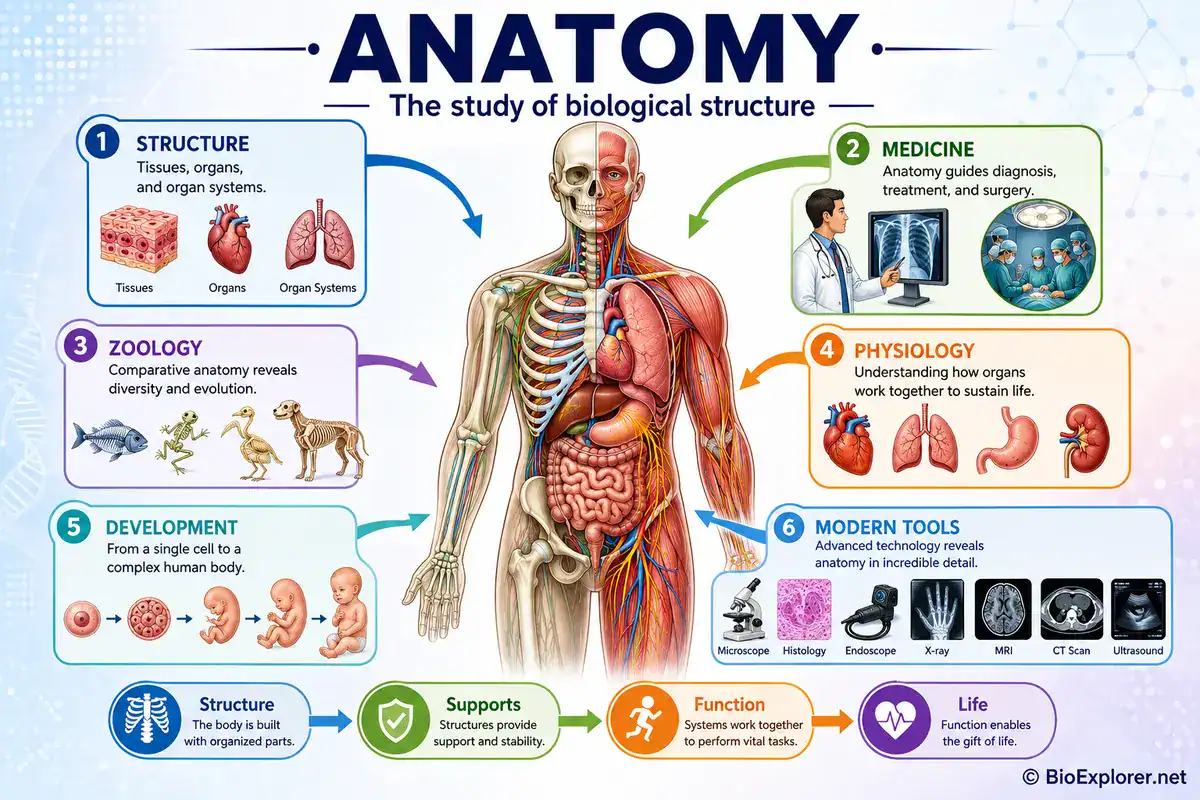
Anatomy uses many structural terms to describe body parts, tissues, regions, and systems. These terms help scientists, doctors, students, and educators communicate clearly.
The heart pumps oxygenated blood through the aorta into arteries, which branch into smaller capillaries that deliver nutrients to tissues like skeletal muscle before returning deoxygenated blood through the veins.
For short definitions, examples, and related terms, visit the Anatomy Glossary.
Anatomy: Division of Biology
Anatomy is important in medicine, veterinary science, zoology, physiology, neuroscience, developmental biology, and many other life science fields.
- A doctor studies anatomy to understand organs and body systems.
- A zoologist uses anatomy to compare animal body forms.
- A developmental biologist studies how anatomical structures form during growth.
- A physiologist uses anatomy as the structural foundation for understanding how the body works.
Although anatomy is often associated with dissection, the field is much broader today. Modern anatomy uses microscopes, histology, medical imaging, digital models, endoscopy, X ray imaging, MRI, CT scans, ultrasound, and comparative studies to explore biological structure.
What Anatomy Studies
Anatomy studies biological structure at several levels. At the smallest scale, it examines cells and tissues. At larger scales, it studies organs, organ systems, body regions, and complete body plans.
In human anatomy, this includes structures such as bones, muscles, nerves, blood vessels, organs, glands, skin, and body cavities. In animal anatomy, it includes the body forms of different species. In microscopic anatomy, it includes tissues and cells that cannot be seen clearly without magnification.
This structural focus makes anatomy the foundation for subjects such as physiology, medicine, surgery, pathology, embryology, and comparative biology.
Anatomy Origin
The word anatomy comes from Greek roots meaning "to cut up", reflecting the early role of dissection in studying body structure. Historically, anatomy was closely tied to dissection because scientists and physicians learned about body structure by carefully cutting and observing tissues and organs.
The anatomy of animals other than humans is sometimes called zootomy. Older sources may use the term phytotomy for plant anatomy, although modern readers usually encounter plant structure within botany and plant biology.
Dissection remains important in anatomical education and research, but modern anatomy also uses imaging, microscopy, digital visualization, and comparative analysis to study living and preserved structures.
Why Anatomy Matters
Anatomy matters because structure shapes function. The chambers and valves of the heart explain how blood moves through the body. The branching structure of the lungs helps oxygen enter the bloodstream. The arrangement of bones and muscles explains movement. The layered structure of skin helps protect the body from injury, water loss, and microbes.
Anatomy also helps scientists compare life forms. Similar bone patterns in vertebrate limbs, for example, can reveal evolutionary relationships. Differences in teeth, skull shape, digestive organs, or limb structure can show how species adapt to different diets, habitats, and behaviors.
In medicine, anatomy supports diagnosis, surgery, imaging, rehabilitation, and clinical care. In biology, it supports the study of development, evolution, animal diversity, and body system organization.
Types of Anatomy
Since anatomy is elucidated as the identification of physical structures in living things, it is broadly classified into two categories.
Gross Anatomy
Gross anatomy, also called macroscopic anatomy, studies biological structures that can be seen without a microscope. These include organs, bones, muscles, blood vessels, lungs, eyes, and other visible body parts.
Dissection has long been used in gross anatomy because it allows direct observation of internal structures. However, gross anatomy can also be studied through noninvasive methods. Endoscopy uses a small camera to view structures inside the body. X ray imaging, angiography, MRI, CT scanning, and ultrasound can reveal internal anatomy without traditional dissection.
Gross anatomy can be studied in different ways. Regional anatomy focuses on one body region, such as the head, neck, chest, abdomen, or pelvis. Systemic anatomy studies structures by organ system, such as the nervous system, skeletal system, muscular system, digestive system, or circulatory system.
Microscopic Anatomy
Microscopic anatomy studies structures that cannot be seen clearly with the naked eye. It includes the study of tissues and cells, often using microscopes, thin tissue sections, and stains that make structures easier to distinguish.
Histology is the study of tissues. It examines how cells are arranged into tissue types such as epithelial tissue, connective tissue, muscle tissue, and nervous tissue.
Cytology focuses on cells themselves, including their structure, organization, and visible components.
Microscopic anatomy is essential for understanding how organs work at a smaller scale. For example, the structure of lung tissue explains gas exchange. The structure of blood vessels explains circulation. The structure of skin tissue explains protection, sensation, and repair.
Difference Between Anatomy and Physiology
Anatomy Articles on BioExplorer
14 Best Anatomy and Physiology Books
17 Major organs on left side of body
Best Anatomy and Physiology Coloring Workbook Review
Explore Different Types of Nerve Cells
Explore The Cells of The Epidermis
History of Anatomy
Top 10 Anatomy/Physiology News in 2020

Top 15 Anatomy & Physiology News In 2019
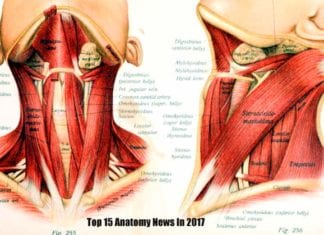
Top 15 Anatomy & Physiology News In Innovations & Breakthroughs For 2017
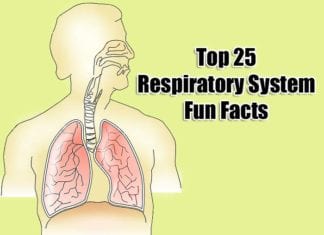
Top 25 BEST Respiratory System Fun Facts
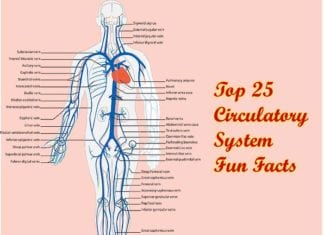
Top 25 Circulatory System Fun Facts
Top 25 Endocrine System Fun Facts
Top 25 Fun Facts About The Digestive System
Top 25 Fun Facts About The Muscular System
Top 25 Fun Facts About The Skeletal System
Top 25 Immune System Fun Facts
Top 25 Integumentary System Facts (Skin Fun Facts)

Top 25 Reproductive System Fun Facts
Top 25 Urinary System Fun Facts
Top 26 Anatomy & Physiology News in 2018
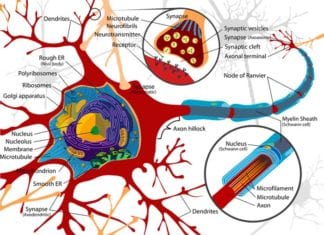
Top 38 Fun Facts About The Nervous System
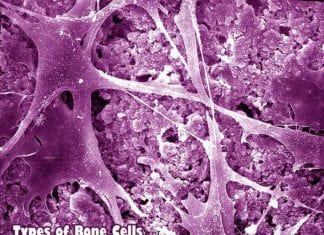
Types of Bone Cells
Careers Associated with the Study of Anatomy
- Doctors and Medicinal Professionals
- Histotechnicians
- Biomedical Scientists
- Teachers
- Forensic Investigators
- Archeology
Recommended Anatomy Resources
These trusted external resources can help readers explore human anatomy, body systems, anatomical terminology, histology, cross-sectional anatomy, medical imaging, and classic anatomy references in more detail.
Anatomy Learning Resources
- OpenStax Anatomy and Physiology 2e
A free textbook for learning human anatomy, physiology, body organization, tissues, organs, body systems, homeostasis, and anatomical terminology. - MedlinePlus: Anatomy
A reliable National Library of Medicine resource with descriptions and images of body parts and organ systems from head to toe. - NCI SEER Training: Anatomy and Physiology
A clear training module from the National Cancer Institute covering cells, tissues, membranes, body systems, anatomical locations, and major body functions. - LibreTexts: Anatomy and Physiology
An open educational resource collection covering anatomy, physiology, body organization, tissues, organs, and organ systems.
Anatomy Atlases and Visual Anatomy
- Anatomy Atlases: Atlas of Human Anatomy in Cross Section
A cross-sectional anatomy atlas covering head and neck, thorax, abdomen, pelvis, upper limb, and lower limb regions. - National Library of Medicine: Visible Human Project
A major anatomy imaging resource with cross-sectional cryosection, CT, and MRI image data from anatomically detailed male and female human body datasets. - NLM Visible Human Project Gallery
A sample gallery of images from the Visible Human Project datasets. - Open Anatomy Project
An open anatomy atlas project focused on free, collaborative, and web-based anatomical knowledge. - Radiopaedia: Labeled Imaging Anatomy Cases
A useful advanced resource for learning anatomy through labeled radiology cases by body region and imaging modality.
Histology and Microscopic Anatomy
- University of Michigan Histology
A free histology manual for learning cells, tissues, organs, microscopic anatomy, and virtual microscopy. - Histology Guide
A visual histology resource that helps students recognize the microscopic structure of cells, tissues, and organs. - NCI SEER Training: Cells, Tissues, and Membranes
A focused resource on cell structure, tissue types, membranes, and the microscopic organization of the human body.
Historical Anatomy References
- Gray’s Anatomy of the Human Body
A public-domain historical anatomy text from the 1918 edition, useful for classic anatomical illustrations and terminology. - Internet Archive: Gray’s Anatomy, 1918 Edition
A scanned public-domain copy of Henry Gray’s classic anatomy reference.
Cite this page
BioExplorer. (2026, August 26). Branches of Anatomy. https://www.bioexplorer.net/divisions_of_biology/anatomy/