
40 Most Colorful Birds in the World (Stunning Photos)
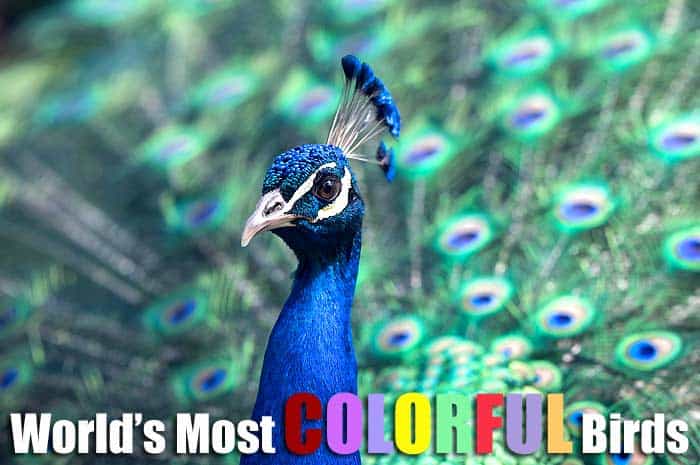
Colorful birds are among the most visually striking animals on Earth, displaying an extraordinary range of colors, patterns, and feather designs.
From rainforest parrots to mountain pheasants, the birds below showcase some of the most breathtaking colors found in nature, representing a wide range of types of birds shaped by evolution for communication, camouflage, and courtship.

Explore some of the most colorful birds
- Colorful Birds of the World
- Scarlet Macaw
- Mandarin Duck
- Indian Peafowl
- The Resplendent Quetzal
- Painted Bunting
- Rainbow Lorikeet
- Lilac-breasted Roller
- European Bee-eater
- Indian Roller
- Golden Pheasant
- Himalayan Monal
- Wilson's Bird-of-Paradise
- Northern Cardinal
- Red-necked Tanager
- Blue Crowned Pigeon
- Nicobar Pigeon
- Blue/Azure Kingfisher
- Spangled Cotinga
- Splendid Fairy Wren
- Plum-throated Cotinga
- Paradise Tanager
- Andean Cock-of-the-Rock
- Purple Gallinule
- Yellow-collared Lovebird
- Curl-crested Aracari
- Toco Toucan
- Keel-billed Toucan
- Gouldian Finch
- Red-bearded Bee Eater
- Crowned Woodnymph
- Scarlet-chested Parakeet
- Cassin's Finch
- Crimson Rosella
- Elegant Parrot
- Golden-collared Toucanet
- Hoatzin
- Orange-breasted Green Pigeon
- Lady Amherst's Pheasant
- Bornean Crested Fireback
- Senegal Parrot
- FAQ: Why Are Birds So Colorful?
- Conclusion
- Jump to comments
Colorful Birds of the World
Scarlet Macaw
| Kingdom | Order | Family | Genus | Species |
|---|---|---|---|---|
| Animalia | Psittaciformes | Psittacidae | Ara | Ara macao |
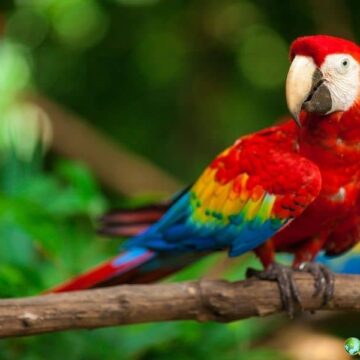
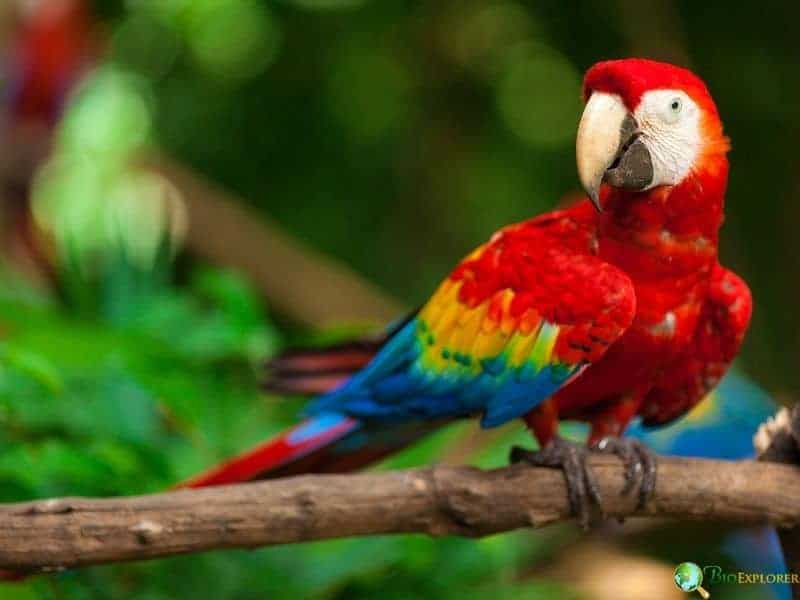
The Scarlet macaw is one of the largest and most colorful parrot species in the world. It lives in tropical rainforests, frequenting the upper layers of the rainforest across Mexico, Central America, and South America, where it travels above forest canopies and river corridors in bonded pairs.
Its plumage is dominated by scarlet red, accented with bright yellow and deep blue feathers on the wings. Highly intelligent, scarlet macaws exhibit complex social behavior, tool use, and playful problem-solving abilities.
Suggested Reading: Explore the world of White Cockatoos!
Mandarin Duck

| Kingdom | Order | Family | Genus | Species |
|---|---|---|---|---|
| Animalia | Anseriformes | Anatidae | Aix | Aix galericulata |
The Mandarin duck is widely regarded as one of the most beautiful duck species in the world. Native to East Asia, it inhabits wooded wetlands, rivers, and lakes across China and Japan, where it prefers calm, forest-lined waters.
Its plumage is remarkably ornate, featuring a blend of blue, green, copper, and silver, with males displaying striking golden and orange accents. Both sexes possess a crest, but it is far more pronounced in males, where it plays a key role in courtship displays and mate attraction.
Suggested Reading: The painted stork carries the most colorful plumage of any type of stork.
Indian Peafowl
| Kingdom | Order | Family | Genus | Species |
|---|---|---|---|---|
| Animalia | Galliformes | Phasianidae | Pavo | Pavo cristatus |
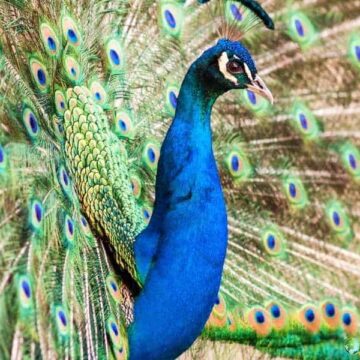
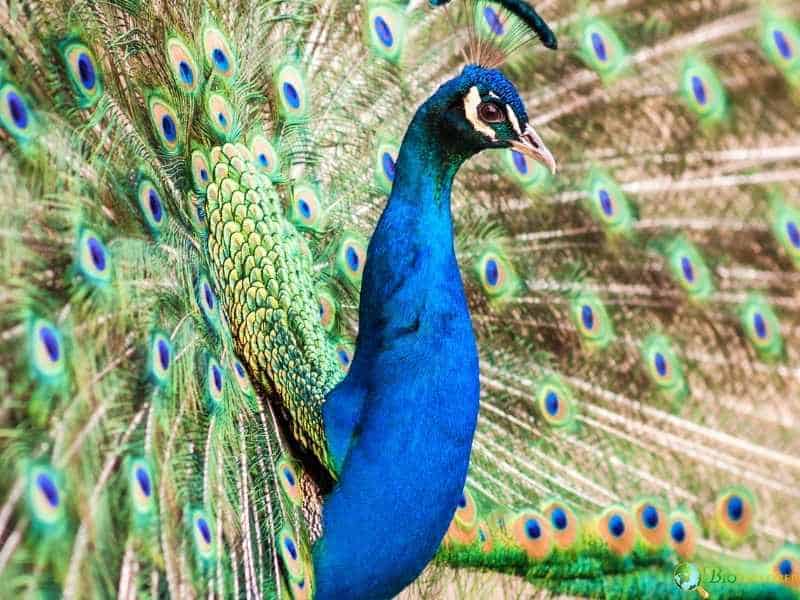
The Indian peafowl is native to India, Sri Lanka, and other parts of South Asia, where it inhabits forests, grasslands, and rural landscapes near water.
This species shows strong sexual dimorphism. Male peacocks display a dramatic fan of iridescent feathers—often reaching 5 feet—shimmering in blue and green hues, while peahens remain muted brown for camouflage. The peacock's ornate plumage has long been regarded as a symbol of beauty and prosperity.
What Do Peacocks Eat?
The Resplendent Quetzal
| Kingdom | Order | Family | Genus | Species |
|---|---|---|---|---|
| Animalia | Trogoniformes | Trogonidae | Pharomachrus | Pharomachrus mocinno |
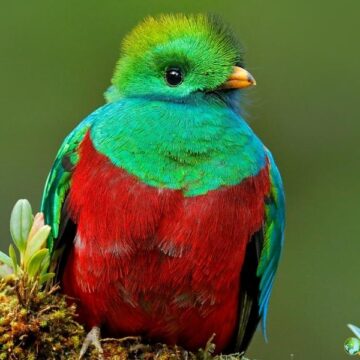
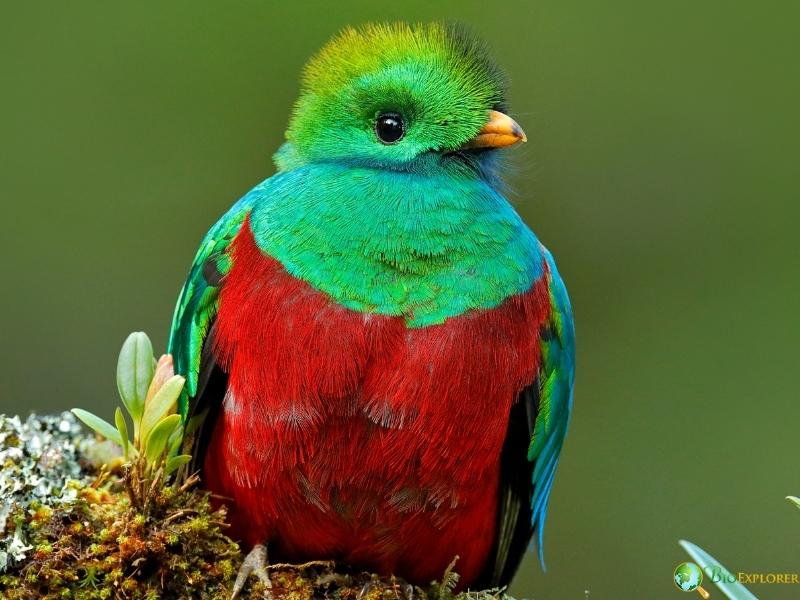
The Resplendent Quetzal belongs to the trogon family and inhabits the cool cloud forests and mountainous rainforests of Central America, particularly in southern Mexico, Guatemala, and Costa Rica.
It is renowned for its iridescent plumage, which appears emerald green or blue-green depending on light angle and time of day. Males develop elongated tail feathers during the breeding season, while the species primarily feeds on fruits—especially wild avocados—along with insects and small vertebrates.
Painted Bunting
| Kingdom | Order | Family | Genus | Species |
|---|---|---|---|---|
| Animalia | Passeriformes | Cardinalidae | Passerina | Passerina ciris |
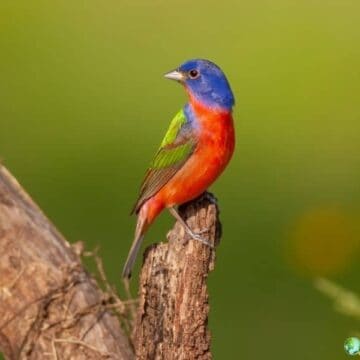
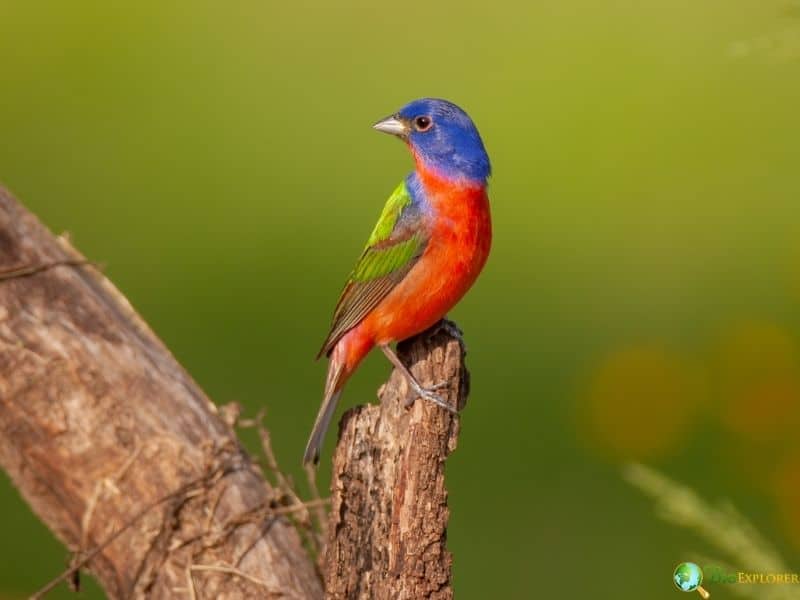
The Painted Bunting is a small songbird in the cardinal family (Cardinalidae), native to North America, where it inhabits brushy woodlands, forest edges, and shrubby coastal regions.
Females are primarily bright green, a coloration that provides effective camouflage among foliage. Males—historically called nonpareil, meaning "without equal"—display one of the most striking color combinations of any North American bird, with deep blue on the head, bright red underparts, and yellow-green tones on the back.
Rainbow Lorikeet
| Kingdom | Order | Family | Genus | Species |
|---|---|---|---|---|
| Animalia | Psittaciformes | Psittaculidae | Trichoglossus | Trichoglossus moluccanus |
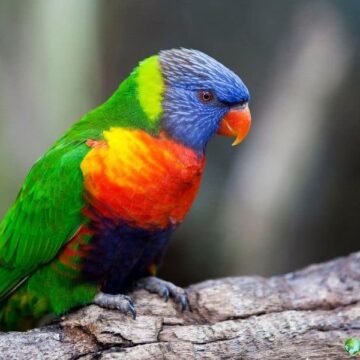
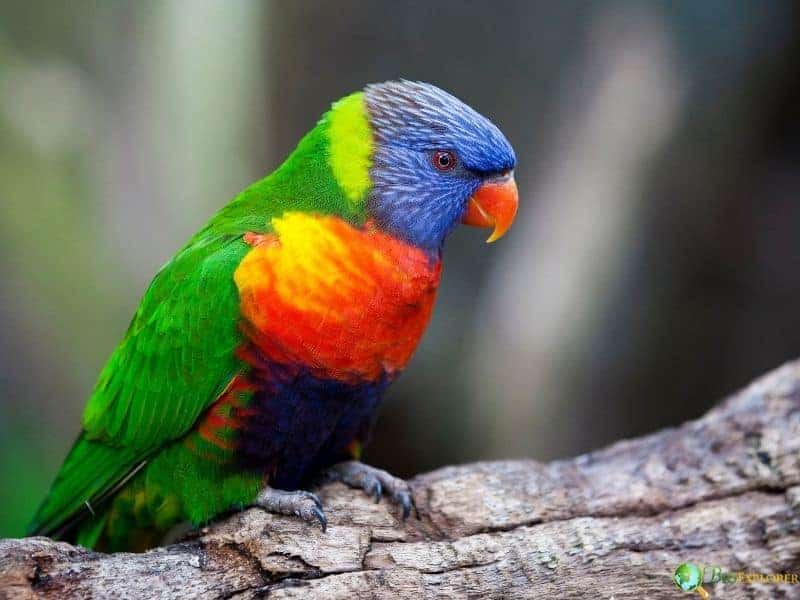
The Rainbow Lorikeet is a highly social parrot native to the coastal regions of northern and eastern Australia, where it frequents woodlands, forests, and urban parks, often gathering in noisy flocks.
Its plumage is instantly recognizable, combining bright green, deep blue, orange, and yellow, contrasted by a vivid red beak. Both sexes appear identical. A specialized brush-tipped tongue allows rainbow lorikeets to feed on nectar, fruits, and types of insects, while their communal behavior is evident as flocks roost together at dusk.
Lilac-breasted Roller
| Kingdom | Order | Family | Genus | Species |
|---|---|---|---|---|
| Animalia | Coraciiformes | Coraciidae | Coracias | Coracias caudatus |
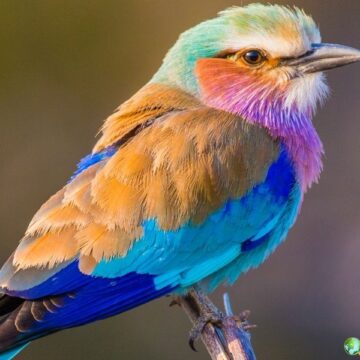
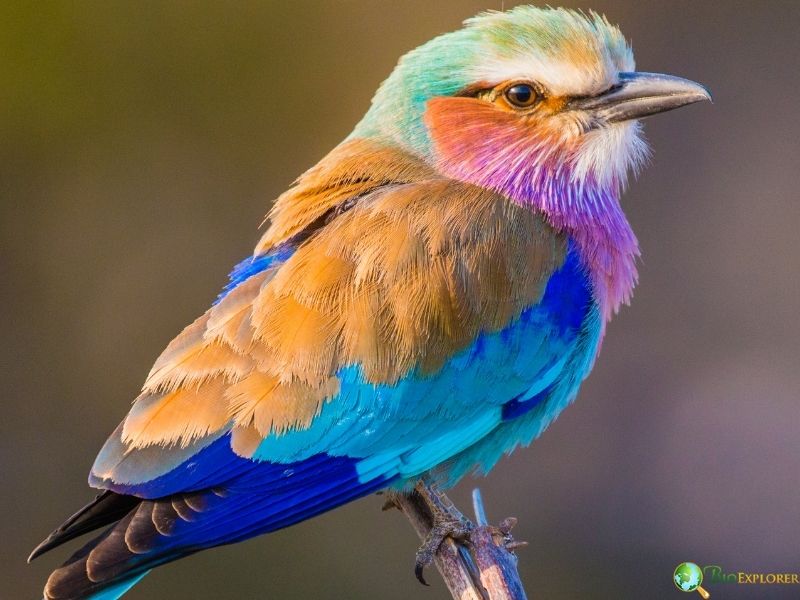
The Lilac-breasted Roller is a member of the roller family (Coraciidae) and is widely distributed across eastern and southern Africa, where it inhabits open woodlands, savannas, and grasslands with scattered trees.
This species is best known for its spectacular courtship flight, during which it performs rolling and diving displays in the air. Its plumage is exceptionally vivid, featuring a lilac breast, pale green head, violet and turquoise wings, blue underparts, a brown back, and a contrasting black tail, making it one of Africa's most colorful birds.
European Bee-eater
| Kingdom | Order | Family | Genus | Species |
|---|---|---|---|---|
| Animalia | Coraciiformes | Meropidae | Merops | Merops apiaster |
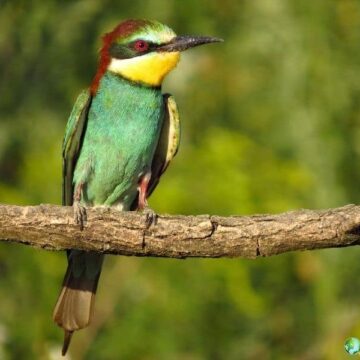
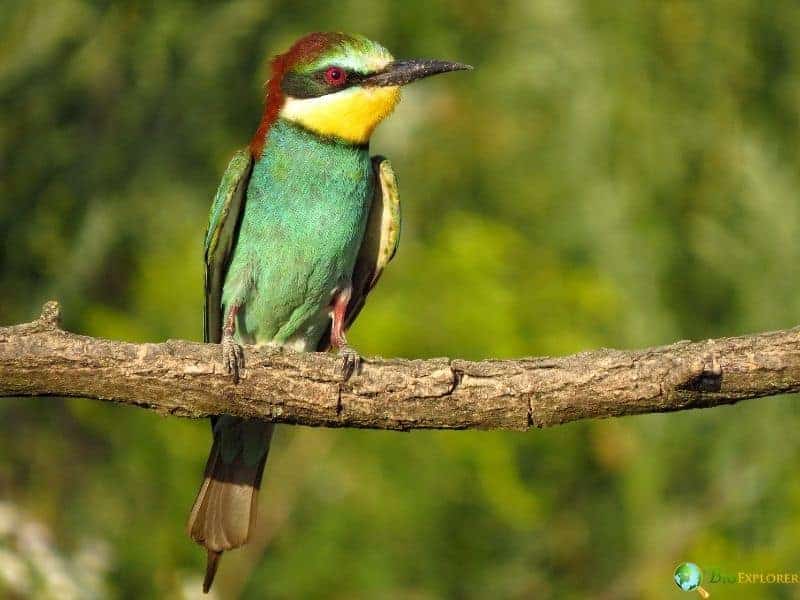
The European Bee-eater inhabits open woodlands, grasslands, and river valleys across southern Europe, parts of Africa, and western Asia, favoring warm regions with sandy banks for nesting.
Its plumage is striking, with a turquoise-blue body, a golden-yellow throat, and rich chestnut wings. An agile aerial hunter, this species specializes in catching bees and other flying insects mid-air, skillfully removing their stingers by rubbing prey against branches before feeding.
Indian Roller
| Kingdom | Order | Family | Genus | Species |
|---|---|---|---|---|
| Animalia | Coraciiformes | Coraciidae | Coracias | Coracias benghalensis |
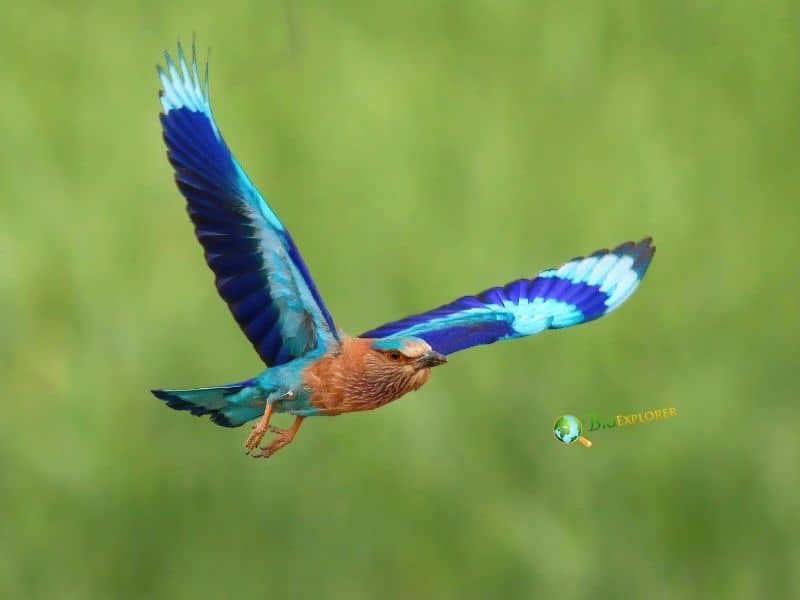
The Indian Roller is widely distributed across the Indian subcontinent, where it inhabits open grasslands, farmland, and lightly wooded areas, often perching conspicuously on trees or utility wires.
Its plumage contrasts a warm brown body with vivid electric blue wings accented by turquoise highlights. During courtship and territorial displays, the bird performs dramatic rolling and diving flights, a distinctive behavior that gives the species its common name.
Golden Pheasant

| Kingdom | Order | Family | Genus | Species |
|---|---|---|---|---|
| Animalia | Psittacifornmes | Psittaculidae | Trichoglossus | Trichoglossus moluccanus |
The Golden Pheasant, also known as the Chinese pheasant, is native to the forests of central and western China, where it inhabits dense woodland undergrowth and mountainous forest edges. Although extremely shy and elusive, it is diurnal, spending most of the day concealed among vegetation.
This species shows strong sexual dimorphism. Males are unmistakable, displaying a golden crest, a vivid red abdomen, dark wings, and a long, patterned brown tail. Females are far more subdued, with an overall brown plumage and pale yellow legs that provide effective camouflage on the forest floor.
Himalayan Monal
| Kingdom | Order | Family | Genus | Species |
|---|---|---|---|---|
| Animalia | Galliformes | Phasianidae | Lophophorus | Lophophorus impejanus |
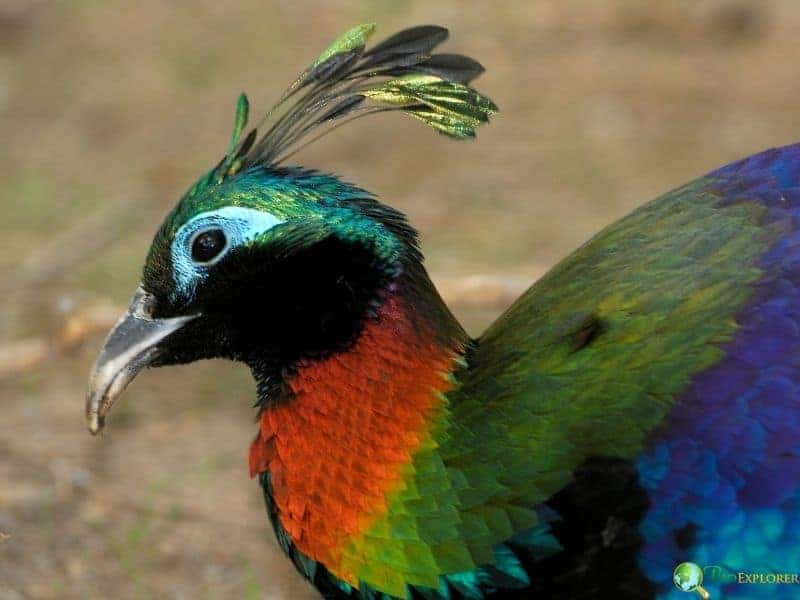
The Himalayan Monal inhabits alpine forests and high mountain slopes across the Himalayan region, including India, Nepal, and Bhutan, where it ranges at high elevations among rocky terrain and coniferous woodland.
Its plumage is intensely iridescent, featuring a green head, copper-gold back, and deep blue wing feathers. In males, this metallic coloration shifts dramatically with changing light angles, creating a shimmering effect that makes the species one of the most striking pheasants in the world.
Wilson's Bird-of-Paradise
| Kingdom | Order | Family | Genus | Species |
|---|---|---|---|---|
| Animalia | Passeriformes | Paradisaeidae | Cicinnurus | Cicinnurus respublica |
The Wilson's Bird-of-Paradise is native to eastern Indonesia, where it inhabits lowland and hill forests, particularly on small islands within the region known for birds-of-paradise diversity.
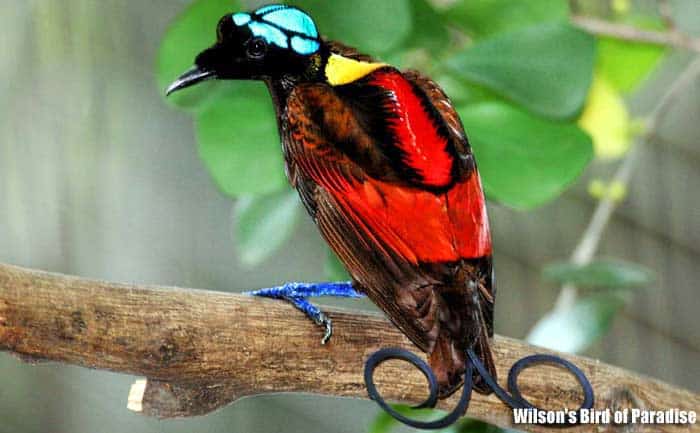
This species shows extreme sexual dimorphism. Females are comparatively muted, with a lilac-blue head, reddish upper body, and brown wings, and they lack elongated tail feathers.
Males are exceptionally vivid, displaying a turquoise crown, yellow mantle, red back, and green breast and tail. Notably, the male's crown consists of bare skin, patterned with fine black feather lines.
Northern Cardinal
| Kingdom | Order | Family | Genus | Species |
|---|---|---|---|---|
| Animalia | Passeriformes | Cardinalidae | Cardinalis | Cardinalis cardinalis |
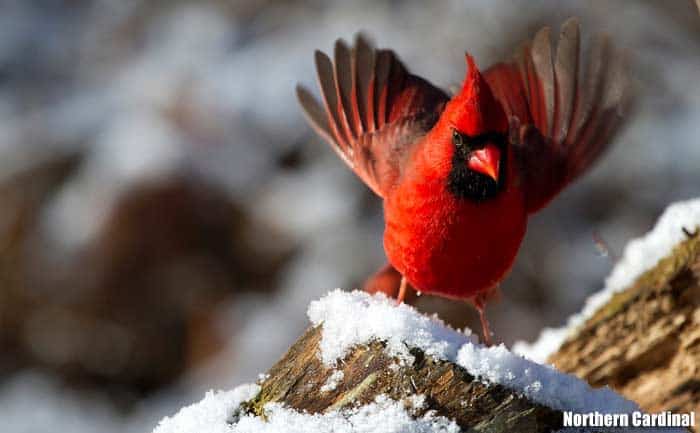
The Northern Cardinal is a widespread songbird native to North America, commonly found in woodlands, gardens, and suburban areas, and it is especially familiar among Florida birds.
Males are instantly recognizable by their vivid red plumage and distinctive black face mask, while females display softer brown and gray tones with subtle red accents on the wings. Juveniles of both sexes initially resemble adult females, developing their mature coloration after molting. The bird's name originates from the red robes worn by Roman Catholic cardinals, a resemblance reflected in the male's striking appearance.
Red-necked Tanager

| Kingdom | Order | Family | Genus | Species |
|---|---|---|---|---|
| Animalia | Passeriformes | Thraupidae | Tangara | Tangara cyanocephala |
The Red-necked Tanager is endemic to eastern South America, where it inhabits forest canopies and wooded habitats, often remaining high among the treetops.
Its plumage is vividly multicolored, combining yellow-orange wings, a bright red chin, a deep blue crown and lower neck, and a rich green underside. These canopy-dwelling birds are recognized by their sharp "sip" calls, and like many passerines, they undergo a complete molt once each year.
Blue Crowned Pigeon
| Kingdom | Order | Family | Genus | Species |
|---|---|---|---|---|
| Animalia | Columbiformes | Columbidae | Goura | Goura cristata |
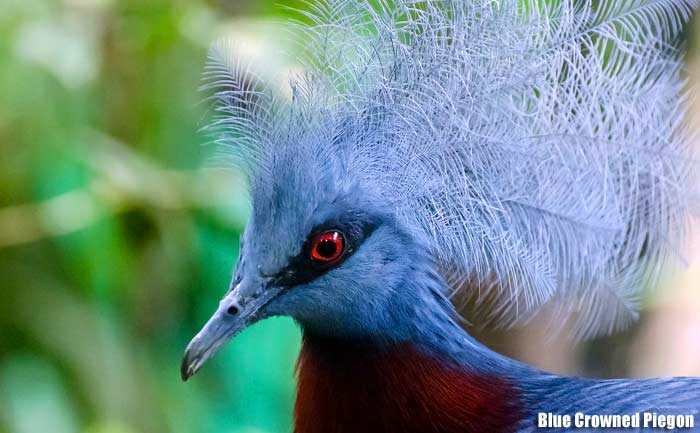
The Blue-crowned Pigeon, also known as the Western crowned pigeon, is native to the rainforests of Papua New Guinea, where it inhabits lowland and swamp forests across several islands.
It is one of the largest pigeon species in the world and among the most striking members of the pigeon family. Its appearance is defined by a delicate lacy blue crest, deep blue facial feathers around the eyes, and a slate-blue body. Males are generally larger than females, and due to habitat loss and hunting pressure, this species is considered among the rare birds of its region.
Nicobar Pigeon
| Kingdom | Order | Family | Genus | Species |
|---|---|---|---|---|
| Animalia | Columbiformes | Columbidae | Caloenas | Caloenas nicobarica |
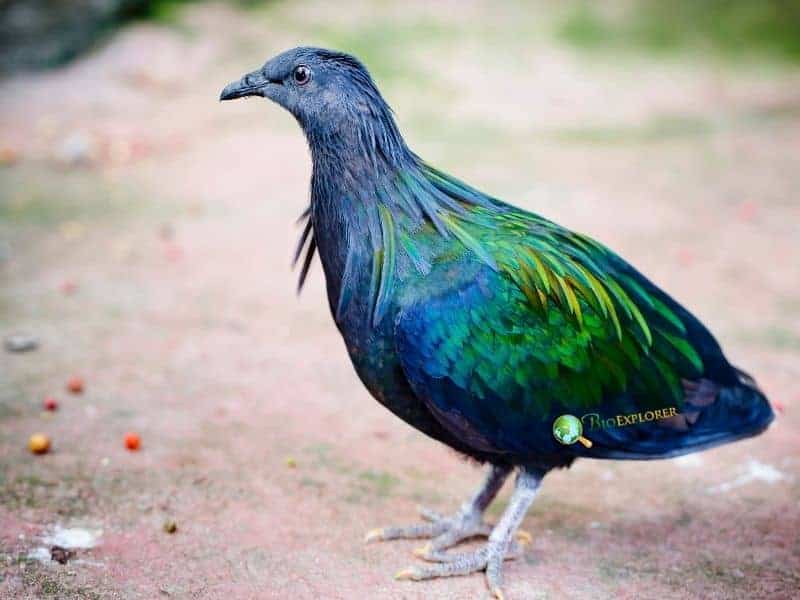
The Nicobar Pigeon inhabits coastal forests and remote islands across Southeast Asia and parts of the Pacific, often nesting on small, uninhabited islands.
Its plumage features shimmering metallic green and bronze feathers contrasted by a bright white tail. This distinctive pigeon is considered one of the closest living relatives of extinct birds such as the dodo, offering valuable insight into the evolutionary history of island-dwelling pigeons.
Blue/Azure Kingfisher
| Kingdom | Order | Family | Genus | Species |
|---|---|---|---|---|
| Animalia | Coraciiformes | Alcedinidae | Ceyx | Ceyx azureus |
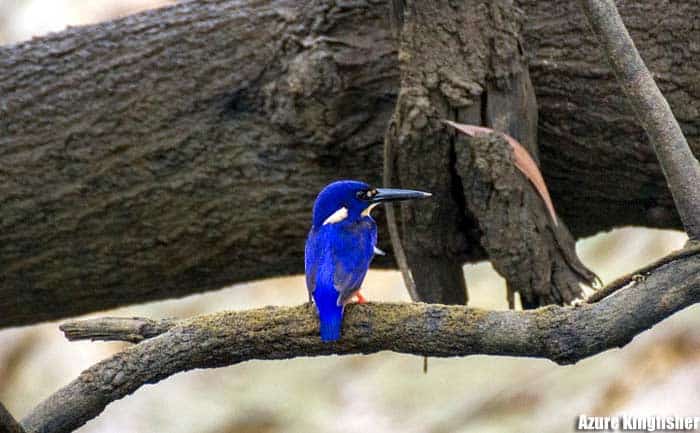
The Blue/Azure Kingfisher is a skilled riverside hunter, commonly found along streams, rivers, lakes, and wetlands across both tropical and temperate regions worldwide, reflecting the largely cosmopolitan distribution of kingfishers.
Its appearance is dominated by brilliant blue to azure plumage, a coloration produced not by pigment but by feather structure. Microscopic feather layers scatter blue light, creating the intense coloration seen as the bird dives from perches or hovers briefly above the water surface while hunting fish.
Spangled Cotinga
| Kingdom | Order | Family | Genus | Species |
|---|---|---|---|---|
| Animalia | Passeriformes | Cotingidae | Cotinga | Cotinga cayana |
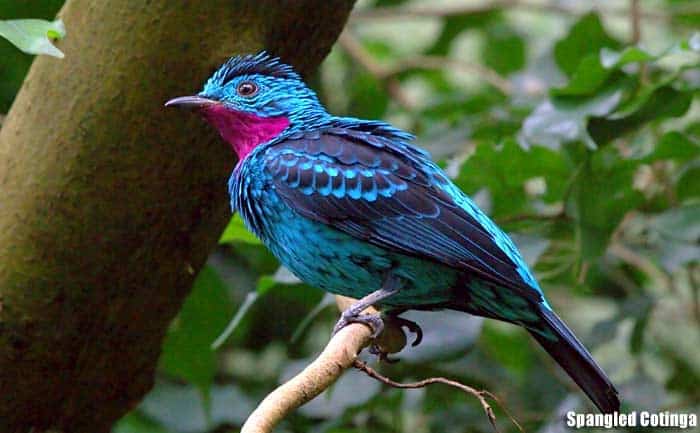
The Spangled Cotinga inhabits the canopy of Amazonian rainforests, where it remains high above the forest floor, often perched quietly among tall trees.
Males are strikingly colorful, displaying a turquoise body accented with black on the back and wings, along with a vivid purple neck. Females are more subdued, showing brown to grayish plumage with a noticeable purple throat. Unusually, this species lacks true vocal calls and instead produces a soft whistling sound created by its wings during flight.
Splendid Fairy Wren
| Kingdom | Order | Family | Genus | Species |
|---|---|---|---|---|
| Animalia | Passeriformes | Maluridae | Malurus | Malurus splendens |
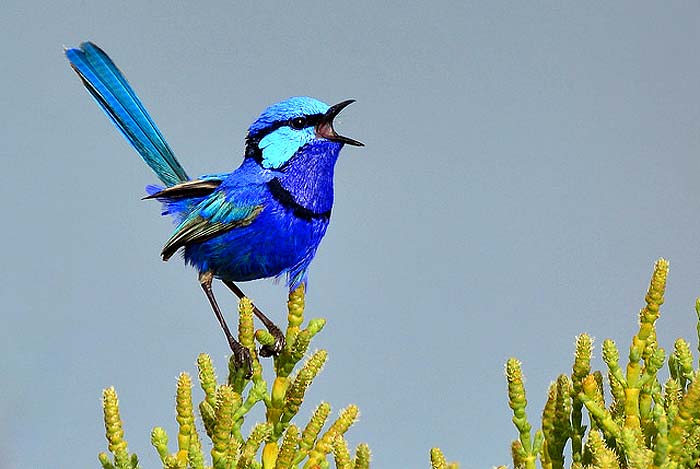
The Splendid Fairy Wren inhabits semi-arid to arid woodlands and shrublands of Australia, where it is often included among desert birds that thrive in open landscapes with dense low vegetation for cover.
Males are vividly colored, displaying cobalt-blue to violet-blue plumage contrasted by a black beak and darker facial markings. Females are much paler, with an overall brown body, white underparts, and a distinctive reddish-tan line extending from the beak through the eye, a feature that helps distinguish them from related species.
Plum-throated Cotinga
| Kingdom | Order | Family | Genus | Species |
|---|---|---|---|---|
| Animalia | Passeriformes | Cotingidae | Cotinga | Cotinga maynana |
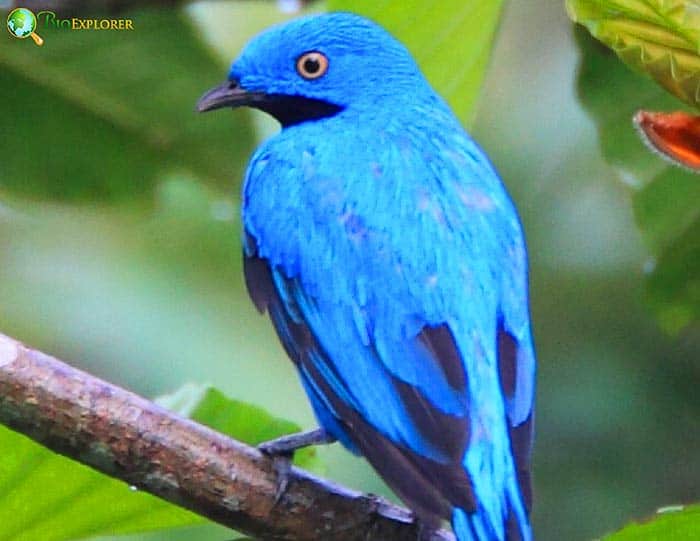
The Plum-throated Cotinga inhabits tropical and subtropical lowland forests and swampy woodlands across Bolivia, Brazil, Colombia, Ecuador, and Peru, where it is most often seen high in the forest canopy.
Males are exceptionally vivid, displaying an electric blue body contrasted by a deep plum-colored throat and matching blue wings and back. Females are more subdued, with greenish tones that provide camouflage among foliage. Primarily fruit-eaters, these birds play an important ecological role by dispersing seeds throughout their rainforest habitat.
Paradise Tanager
| Kingdom | Order | Family | Genus | Species |
|---|---|---|---|---|
| Animalia | Passeriformes | Thraupidae | Tangara | Tangara chilensis |
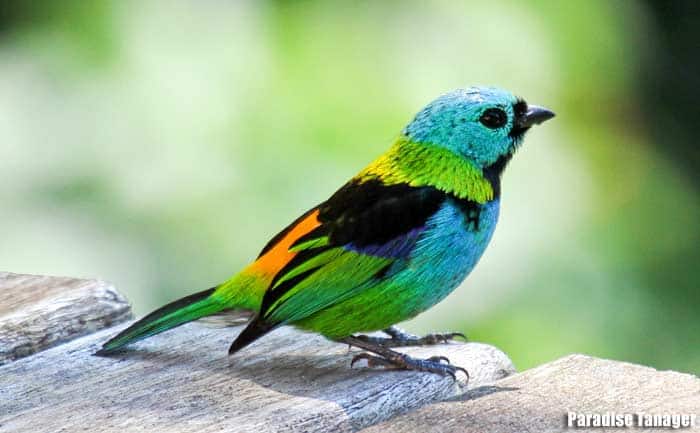
The Paradise Tanager is a small but vividly colored songbird widely distributed across the Amazonian tropical forests of South America, where it inhabits forest edges and mid to upper canopy layers.
Its plumage is striking, featuring a bright apple-green head, a blue abdomen, and a yellow or red rump depending on the species. Despite its scientific name, it is not found in Chile. Known for its pleasant vocalizations, the paradise tanager produces a variety of soft, musical calls as it moves through the forest.
Andean Cock-of-the-Rock
| Kingdom | Order | Family | Genus | Species |
|---|---|---|---|---|
| Animalia | Passeriformes | Cotingidae | Rupicola | Rupicola peruvianus |
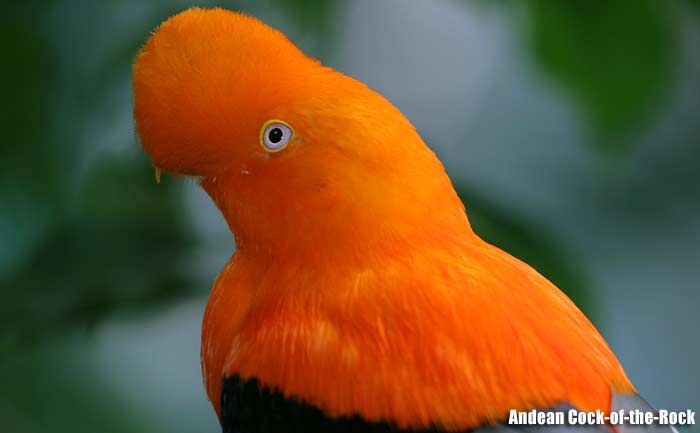
The Andean Cock-of-the-Rock, the national bird of Peru, inhabits warm montane forests, favoring shaded riverbanks, forest streams, and rocky ravines along the Andes.
Males are unmistakable, displaying a vivid red head, breast, throat, and shoulders, contrasted by gray wings, black underparts, and a prominent disk-shaped crest over the bill. Females are more subdued, showing orange-brown plumage with a smaller crest, allowing them to blend into their forest surroundings.
Purple Gallinule
| Kingdom | Order | Family | Genus | Species |
|---|---|---|---|---|
| Animalia | Gruiformes | Rallidae | Porphyrio | Porphyrio martinicus |
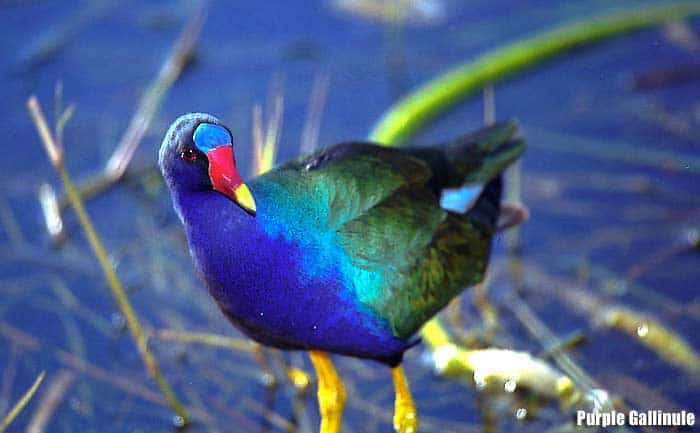
The Purple Gallinule is widely distributed across humid and tropical regions of the southern United States, where it inhabits marshes, wetlands, and freshwater swamps with dense vegetation.
Its plumage is exceptionally colorful, featuring a purple head, throat, and underparts, a green back, a blue forehead shield, and a red bill tipped with yellow. Bright yellow legs add to its striking appearance. Despite its vivid colors, this bird moves with surprising agility, swimming like a duck while also walking across floating vegetation much like a chicken.
Suggested Reading: Explore Duck’s Diet here. | Most Colorful Butterflies
Yellow-collared Lovebird
| Kingdom | Order | Family | Genus | Species |
|---|---|---|---|---|
| Animalia | Psittaciformes | Psittaculidae | Agapornis | Agapornis personatus |
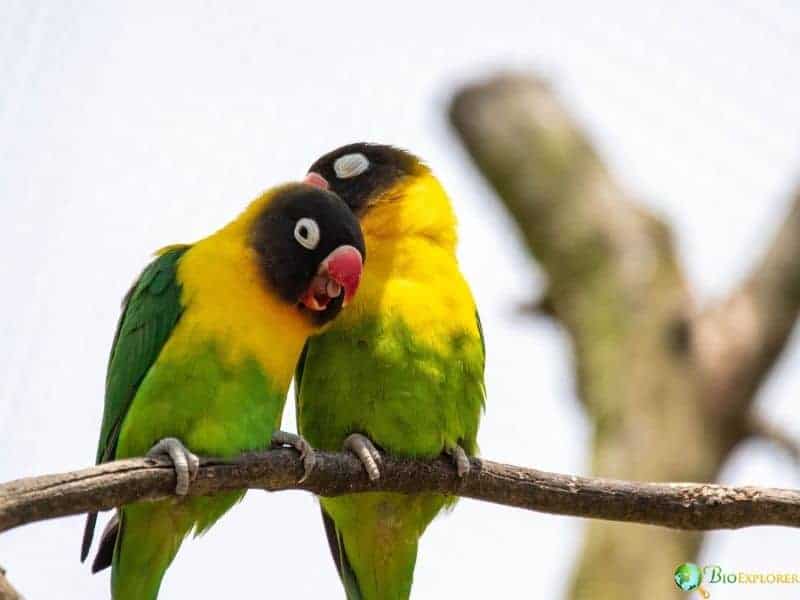
The Yellow-collared Lovebird, also known as the masked lovebird, is native to Tanzania, with introduced populations now established in parts of Kenya and Burundi, where it inhabits woodlands, savannas, and cultivated areas.
Its plumage is predominantly green, with darker upperparts, a contrasting black head, white eye rings, and a vivid red beak. A distinctive yellow collar extends around the nape of the neck. Males and females are visually identical, a trait common among lovebirds that form strong pair bonds.
What Do Cardinals Eat?
Curl-crested Aracari
| Kingdom | Order | Family | Genus | Species |
|---|---|---|---|---|
| Animalia | Piciformes | Ramphastidae | Pteroglossus | Pteroglossus beauharnaesii |
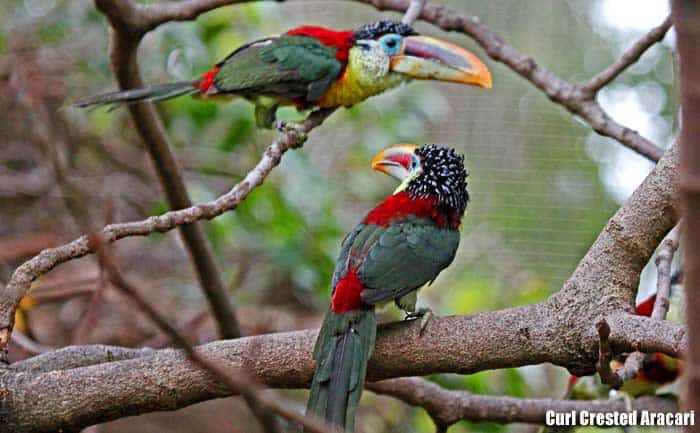
The Curl-crested Aracari, a member of the toucan family (Ramphastidae), is endemic to the lowland rainforests of western Brazil, northern Bolivia, and the southern Amazon Basin, where it inhabits dense tropical forest interiors.
Its appearance is unmistakable, featuring yellow underparts, a red back, dark green wings, and a vividly patterned multicolored beak. Most distinctive are its unusual curled head feathers, which resemble glossy black plastic strands and give the species one of the strangest yet most striking looks among tropical birds.
Toco Toucan
| Kingdom | Order | Family | Genus | Species |
|---|---|---|---|---|
| Animalia | Piciformes | Ramphastidae | Ramphastos | Ramphastos toco |
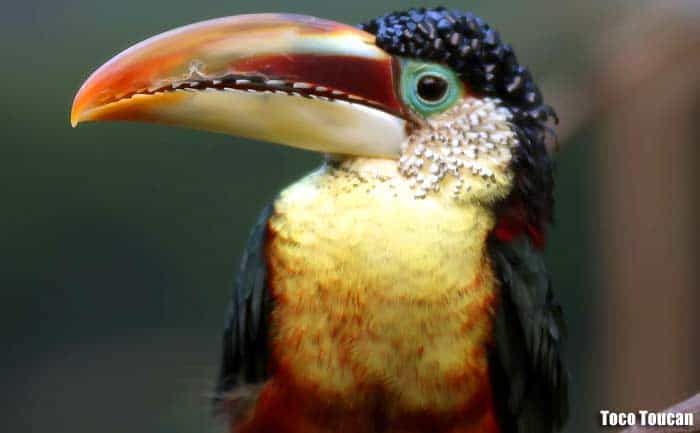
The Toco Toucan is native to South America, where it inhabits savannas, tropical forests, woodland edges, and shrublands, often moving between open areas and forest canopies.
It is the largest of all toucans and instantly recognizable by its oversized multicolored beak, jet-black body, white throat, and blue eye rings. Beyond its striking appearance, the beak serves a vital function: by regulating blood flow through it, the Toco Toucan can efficiently control its body temperature in hot environments.
Keel-billed Toucan
| Kingdom | Order | Family | Genus | Species |
|---|---|---|---|---|
| Animalia | Piciformes | Ramphastidae | Ramphastos | Ramphastos sulfuratus |
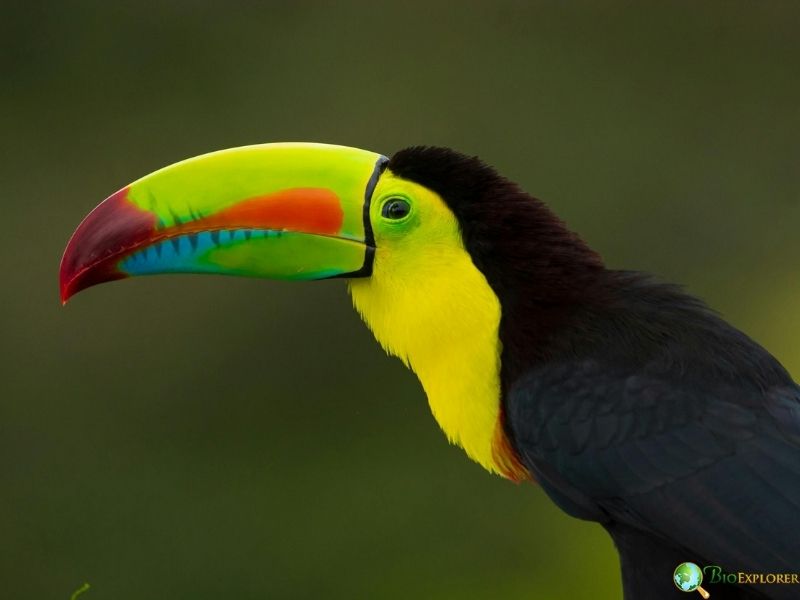
The Keel-billed Toucan inhabits tropical rainforests from southern Mexico through Central America to Panama, making it a well-known species among Mexican birds, especially in lowland forest canopies and edges.
It is instantly recognizable by its oversized neon-green bill accented with yellow, red, and blue. Despite its dramatic size, the bill is lightweight and functional, helping the bird regulate body temperature in hot, humid climates while also assisting in feeding and display.
Gouldian Finch
| Kingdom | Order | Family | Genus | Species |
|---|---|---|---|---|
| Animalia | Passeriformes | Estrilididae | Erythrura | Erythrura gouldidae |
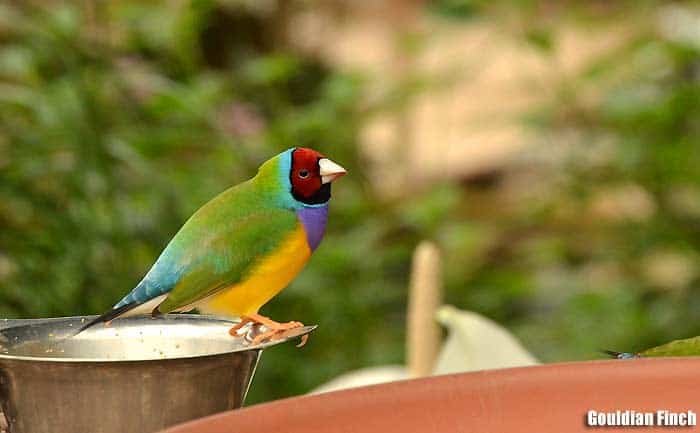
The Gouldian Finch, also known as the rainbow finch, inhabits the savanna woodlands of northern and western Australia, favoring open grasslands dotted with trees near water sources.
Both sexes display a vivid mix of green, black, yellow, and red, but males are more intensely colored, with a rich purple chest compared to the female's softer lilac tones. This strong sexual dimorphism makes males especially recognizable, with brighter hues and more intricate patterning across the body.
Red-bearded Bee Eater
| Kingdom | Order | Family | Genus | Species |
|---|---|---|---|---|
| Animalia | Coraciiformes | Meropidae | Nyctyornis | Nyctyornis amictus |
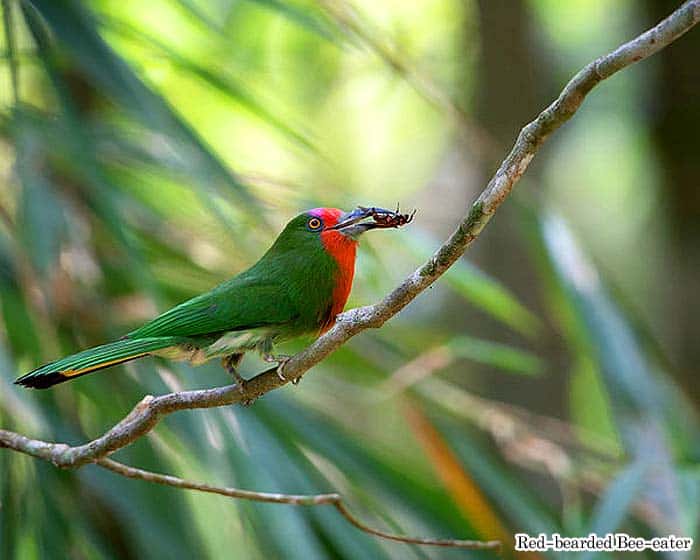
The Red-bearded Bee-eater inhabits the dense tropical forests of the Indo-Malayan region in Southeast Asia, where it favors shaded woodland interiors and forest edges.
Its appearance is defined by an overall green body contrasted with a vivid red face and throat, which gives the species its name. Long tail feathers, a gently curved beak, and sharply pointed wings support its agile flight as it hunts flying insects within the forest canopy.
Crowned Woodnymph
| Kingdom | Order | Family | Genus | Species |
|---|---|---|---|---|
| Animalia | Apodiformes | Trochilidae | Thalurania | Thalurania colombica |
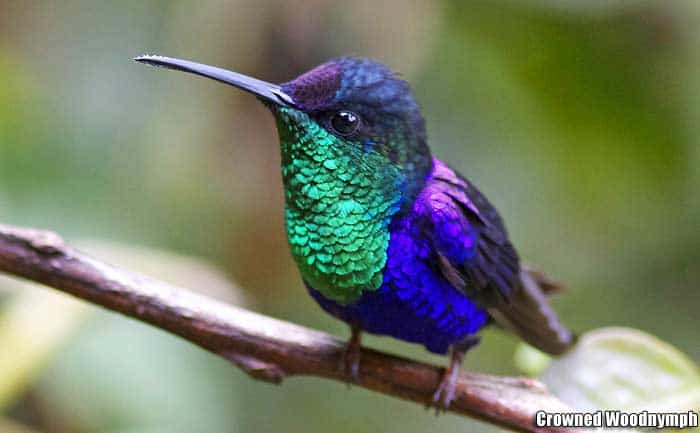
The Crowned Woodnymph is a hummingbird in the genus Thalurania, inhabiting humid forests from eastern Panama to southern Ecuador, where it frequents forest edges and shaded understory.
Males are vividly colored, featuring a shimmering green crown, green neck, and rich blue breast and abdomen. Females are noticeably paler, with a grayish neck and a green to gray abdomen that provides effective camouflage. Like many hummingbirds, this species relies on iridescence, causing its colors to shift with changing light.
Scarlet-chested Parakeet
| Kingdom | Order | Family | Genus | Species |
|---|---|---|---|---|
| Animalia | Psittaciformes | Psittaculidae | Neophema | Neophema splendida |
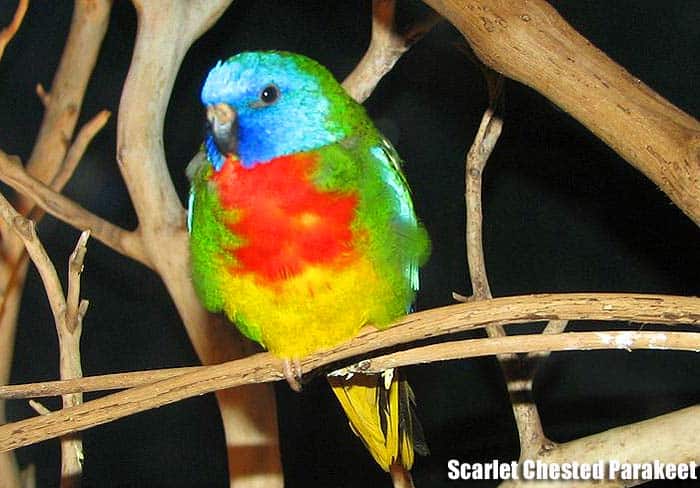
The Scarlet-chested Parakeet, also known as the scarlet-breasted parrot, is endemic to southern and southwestern Australia, where it inhabits arid grasslands, shrublands, and open woodland edges.
This species is strongly sexually dimorphic. Males display a bright blue face, a vivid scarlet chest, and yellowish underparts set against green plumage, while females lack the red chest and appear more muted overall. Feeding mainly on grass seeds, these parakeets can survive long periods without water by consuming succulent plants that help maintain hydration.
The binomial name for the scarlet-chested parrot is Neophema splendida, which was named by the famous ornithologist John Gould in 1841.
Cassin’s Finch
| Kingdom | Order | Family | Genus | Species |
|---|---|---|---|---|
| Animalia | Passeriformes | Fringillidae | Haemorhous | Haemorhous cassinii |
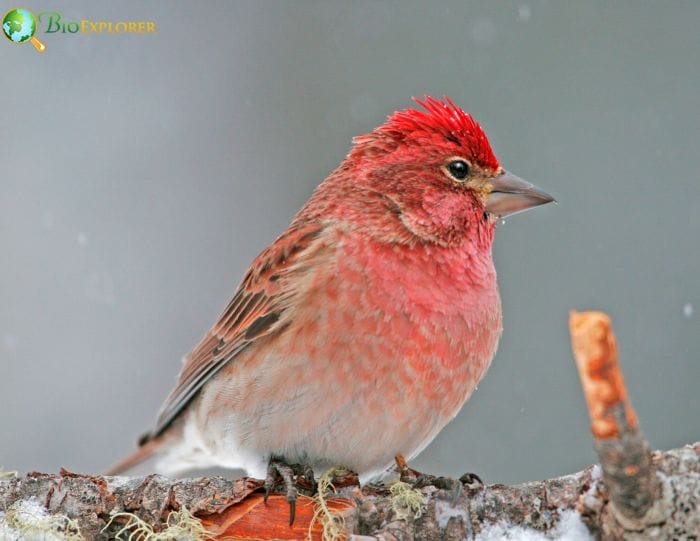
The Cassin's Finch inhabits coniferous forests and mountainous woodlands of western North America, where it is commonly found among pine and fir trees at higher elevations.
Adult males display vivid rosy-pink plumage that contrasts with brown-streaked flanks and breast, along with a reddish crown and rump that set them apart from other finches. Females are more subdued, showing gray-brown streaked plumage that provides camouflage while nesting. Despite its small size, this finch stands out for the intensity and richness of its coloration.
Crimson Rosella
| Kingdom | Order | Family | Genus | Species |
|---|---|---|---|---|
| Animalia | Psittaciformes | Psittacidae | Platycercus | Platycercus elegans |
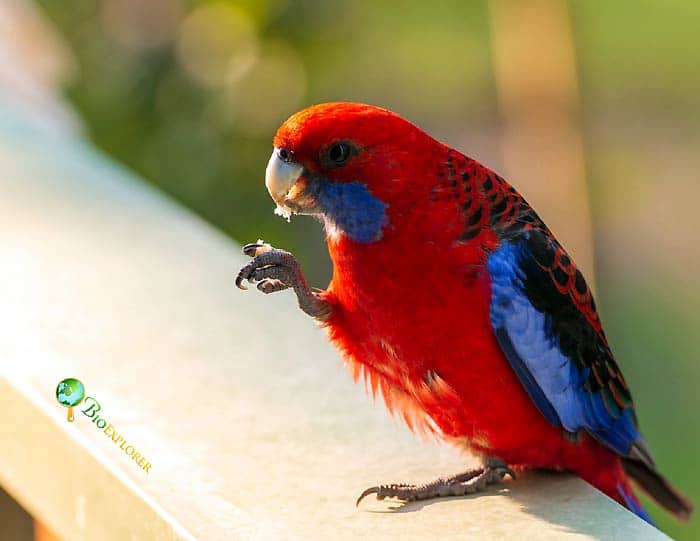
The Crimson Rosella is native to eastern and southeastern Australia, where it inhabits coastal and mountain forests, as well as gardens and parks near human settlements.
Adults are striking in appearance, with a vivid crimson body, blue cheeks, and black-scalloped blue wings, complemented by mostly blue tail feathers. Juveniles begin with greenish-olive plumage before gradually molting into adult coloration. Feeding on fruits, seeds, nectar, and berries, this parrot plays an important role in seed dispersal within its habitat.
Elegant Parrot
| Kingdom | Order | Family | Genus | Species |
|---|---|---|---|---|
| Animalia | Psittaciformes | Psittacidae | Neophema | Neophema elegans |
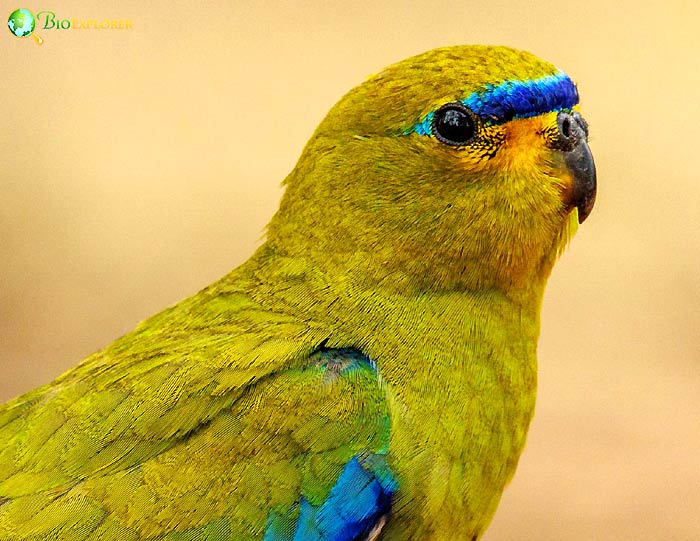
The Elegant Parrot is native to southwestern and southeastern Australia, where it inhabits coastal heaths, open woodlands, and grasslands, including areas shaped by human activity.
Its plumage is softly vibrant, featuring golden-olive body feathers contrasted by dark blue wings and forehead, bright yellow underparts, and a tail blending olive and blue tones. Social and active by nature, this parrot feeds mainly on seeds, flowers, fruits, and leaves, and typically nests in tree hollows during the breeding season.
Golden-collared Toucanet
| Kingdom | Order | Family | Genus | Species |
|---|---|---|---|---|
| Animalia | Piciformes | Ramphastidae | Selenidera | Selenidera reinwardtii |
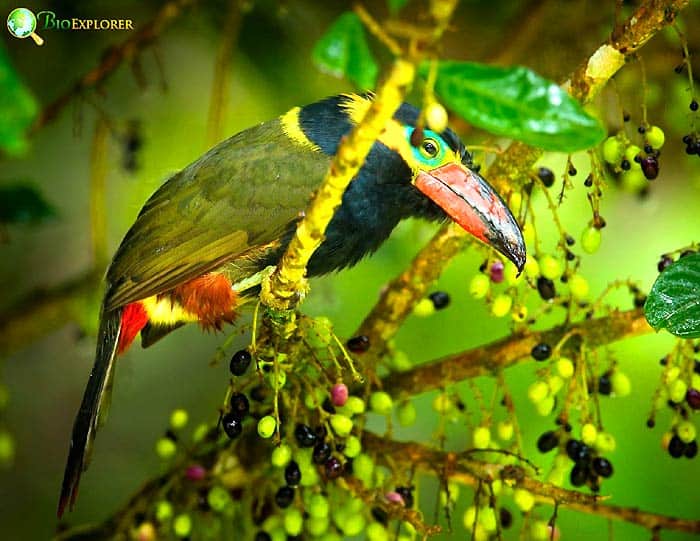
The Golden-collared Toucanet inhabits tropical rainforests of the western Amazon Basin, particularly in parts of Brazil, Peru, and Ecuador, where it remains active within dense forest canopies.
Males are visually striking, with a predominantly black body highlighted by a bright yellow collar encircling the neck, a vivid red rump, and a black tail. The bill is especially colorful, blending yellow, green, and blue tones. Females share a similar pattern but appear more subdued, with softer coloration and reduced contrast.
Hoatzin
| Kingdom | Order | Family | Genus | Species |
|---|---|---|---|---|
| Animalia | Opisthocomiformes | Opisthocomidae | Opisthocomus | Opisthocomus hoazin |
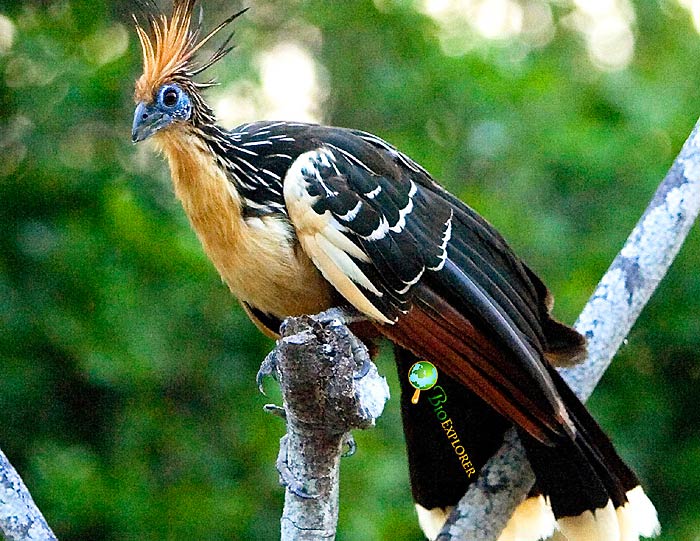
The Hoatzin inhabits swamps, riverine forests, and mangroves of the Amazon and Orinoco basins in South America, where it remains close to dense vegetation near water.
It is famous for one of the most unusual digestive system fun facts in the bird world: the hoatzin uses foregut fermentation to digest leaves, a process similar to that of ruminant types of mammals such as cows. While not classified among flightless birds, this specialized digestive system limits its flight ability, resulting in short, labored flights.
Orange-breasted Green Pigeon
| Kingdom | Order | Family | Genus | Species |
|---|---|---|---|---|
| Animalia | Columbiformes | Columbidae | Treron | Treron bicinctus |
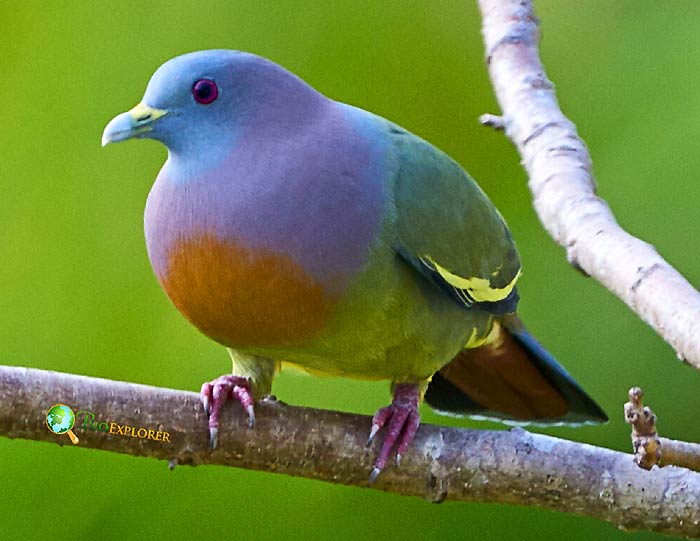
The Orange-breasted Green Pigeon is found across tropical Asia, including India, Sri Lanka, and Southeast Asia, where it inhabits dense forests and woodlands rich in fruit-bearing trees.
Males are distinguished by lilac and orange breast bands set against an overall green body, while females appear subtler, with a bright yellow breast and softer undertail markings. Feeding mainly on fruits and seeds, this pigeon plays an important role in seed dispersal within forest ecosystems.
Lady Amherst’s Pheasant
| Kingdom | Order | Family | Genus | Species |
|---|---|---|---|---|
| Animalia | Galliformes | Phasianidae | Chrysolophus | Chrysolophus amherstiae |
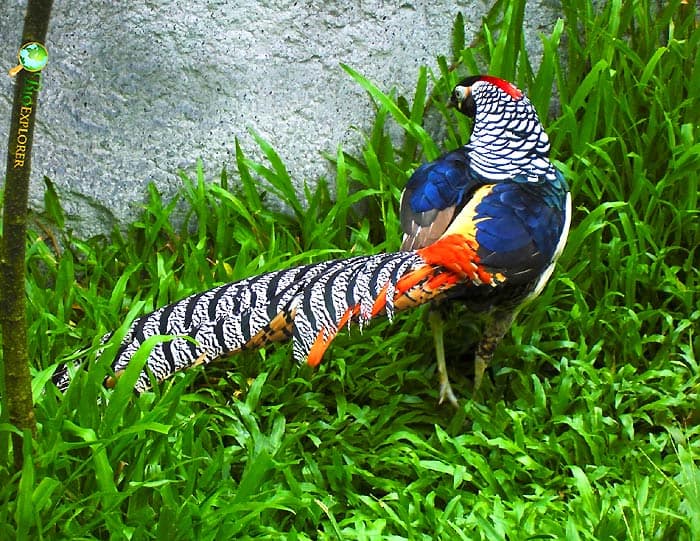
The Lady Amherst's Pheasant is native to southwestern China and northern Myanmar, where it inhabits dense forests and mountainous woodland edges, often remaining concealed in thick undergrowth.
Males are exceptionally ornate, featuring a red crest, a white-and-black nuchal cape, a dark green back, blue-and-brown wings, and a long barred tail accented with red streaks. Females are far more subdued in brown tones, providing camouflage while nesting. The species is named after Lady Sarah Amherst, who introduced it to the Western world in the 19th century.
Bornean Crested Fireback
| Kingdom | Order | Family | Genus | Species |
|---|---|---|---|---|
| Animalia | Galliformes | Phasianidae | Lophura | Lophura ignita |
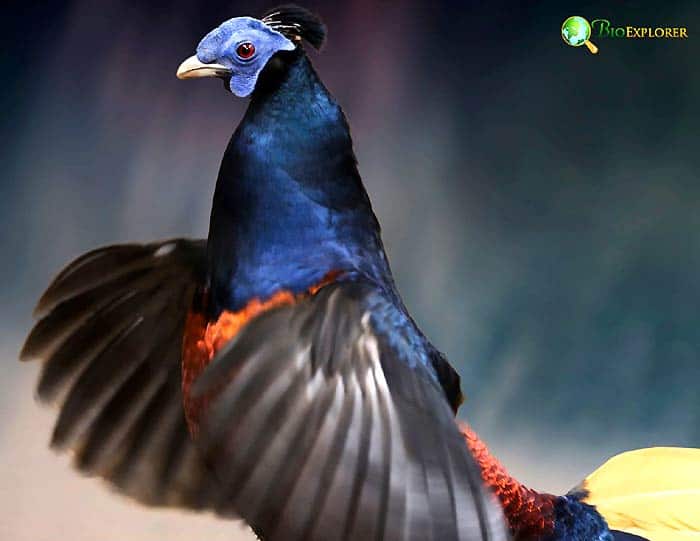
The Bornean Crested Fireback is native to the lowland rainforests of Borneo, where it inhabits dense forest floors and shaded woodland interiors alongside a rich diversity of wildlife, including Borneo monkeys.
Males are especially striking, displaying dark iridescent bluish-black plumage contrasted by a rich reddish-brown rump, black tail feathers, and a glossy crest. Bare blue facial skin and a red iris add to their dramatic appearance. Females are more subdued, with warm brown plumage, a shorter crest, and spotted underparts that provide camouflage within the forest understory.
Senegal Parrot
| Kingdom | Order | Family | Genus | Species |
|---|---|---|---|---|
| Animalia | Psittaciformes | Psittacidae | Poicephalus | Poicephalus senegalus |
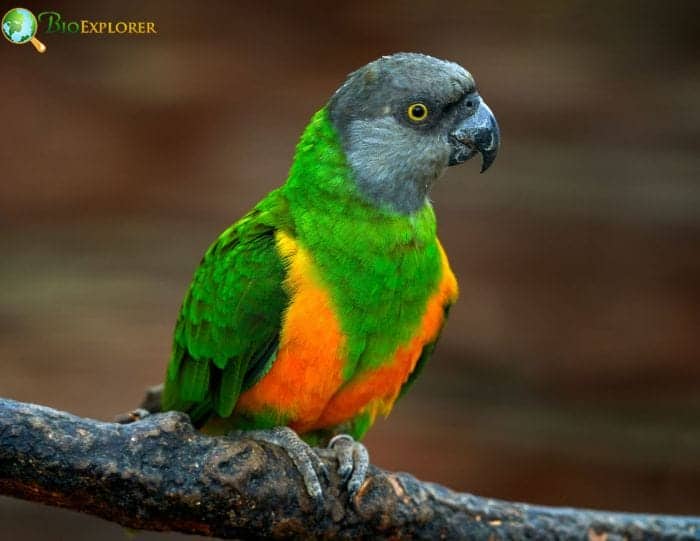
The Senegal Parrot is native to the woodlands and savannas of West Africa, including Senegal, Ghana, and Ivory Coast, where it thrives in open habitats and forest edges typical of many African birds.
It displays a distinctive color pattern, with a charcoal gray head, bright green back and wings, and a yellow or orange belly forming a bold V-shape on the chest. Like many parrots, its beak functions as a third limb for climbing, and individuals often show handedness, favoring one foot when handling objects.
FAQ: Why Are Birds So Colorful?
Some birds are more colorful because of sexual dimorphism, where males evolve bright plumage to attract mates and signal genetic fitness, while females remain less colorful for camouflage and nesting safety. This pattern is common in species such as peafowl, birds-of-paradise, and tanagers.
Birds get their colorful feathers through a combination of pigments and feather structure. Pigments such as melanin, carotenoids, and porphyrins produce blacks, browns, reds, yellows, and greens, while feather microstructures create blues and iridescent effects.
Structural coloration occurs when microscopic feather layers refract and scatter light, producing colors like blue, green, and ultraviolet that can change depending on viewing angle, even without pigments.
Iridescent feathers are feathers whose color shifts with light angle due to layered feather structures, creating shimmering effects seen in hummingbirds, starlings, and many birds-of-paradise.
Yes. Many birds can see ultraviolet (UV) light, which allows them to detect feather patterns, mate signals, and food cues that are invisible to the human eye.
Color alone does not determine risk, but some brightly colored birds face higher threats from habitat loss, hunting, and illegal pet trade, making conservation efforts critical for certain species.
Conclusion
While these colorful birds are visually spectacular, several species are becoming endangered even within their native habitats. Their striking plumage often makes them targets for hunting and illegal wildlife trade.
At the same time, widespread habitat loss caused by deforestation and human expansion continues to threaten many populations, highlighting the importance of conservation and habitat protection.
Cite this page
BioExplorer. (2026, September 24). 40 Most Colorful Birds in the World (Stunning Photos). https://www.bioexplorer.net/colorful-birds.html/


Really awesome article! Amazing birds.
You use Golden Peasant and Pheasant interchangeably. Not sure if that was purposeful 🙂
Hi the bird named Splendid Fairywren is infact a Superb Fairywren
The Splendid fairywren has much more blue than the Splendid Fairywren
The Splendid fairy wren is the Malurus splendens but the Splendid Fairywren (the one shown) is the Malurus cyaneus
Both are truly beautiful birds and deserve to be in the list
Not trying to be picky just correct
Regards
Martin
Thanks Martin. I fixed the picture for Splendid Fairywren!
very beautiful birds
Even looking at these photographs will simply make our mouth agape with awe. To appreciate their beauty we need not be a avid bird watcher. Yes, there are some ideal places in the world to watch those most beautiful bird that are dripping with colors and feathers. For further read: http://viewtraveling.com/where-to-watch-the-5-most-beautiful-bird-in-the-world/
The photo of the Red-Bearded Bee-Eater appears to be incorrect. It obviously doesn’t have a red beard. The photo looks like a European Bee-Eater. Also, in your bibliography, the link you have to your source at Animal Files shows a totally different bird – with a red beard. http://www.theanimalfiles.com/birds/kingfishers_relatives/red_bearded_bee_eater.html
Perhaps a correction of either the photo or the description would be in order. I didn’t check the other birds for accuracy but assuming this is the only error it is a beautiful, informative webpage.
Thanks, Donovan for taking the time to review this page. Just corrected the image.
A bird left out is the gorgeous Scarlet Chested Parakeet from Australia.
I agree Thomas. I will add it to this list.
Woooww i really enjoyed the article, its so amazing . It reminds me the time i went to Kruger National Park . I was surprised to hear that there are about 10 000 different species of birds. Its so cool. You can check Kruger National Park out guys http://www.krugerpark.co.za/. The trip advisers where so helpful as well, they seemed so knowledgeable, you can check out Iconic Africa trip advisers as well http://www.krugerpark.co.za/