
Cell Biology Tools
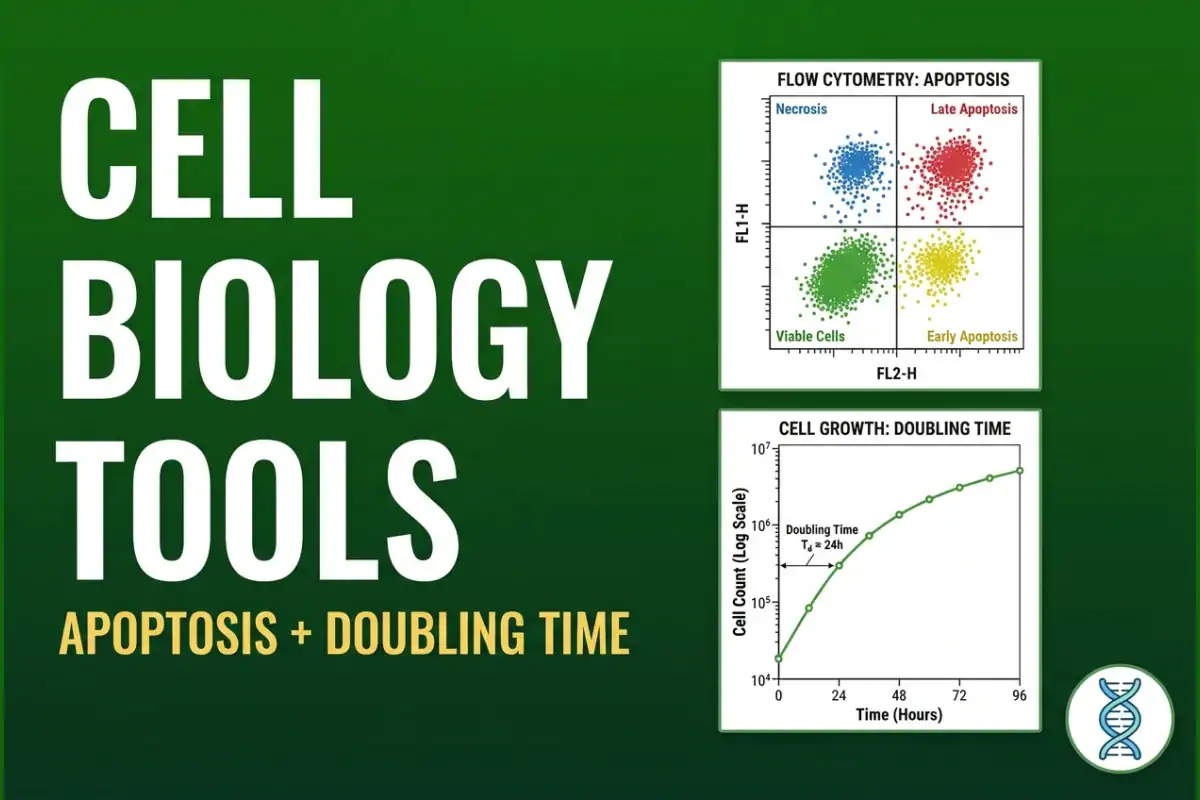
BioExplorer's cell biology tools help turn common lab and classroom calculations into quick, browser-based workflows. Each calculator pairs an interactive tool with a full explanation article, worked examples, and notes on how to interpret the results. The tools run entirely in your browser with no installation, no signup, and no data collection. New cell biology calculators are added as they ship.
All Cell Biology Tools
BioExplorer currently offers cell biology tools for common flow cytometry and cell culture problems students and researchers encounter. Each tool targets a specific use case. The brief descriptions below explain what each calculator does; click into any tool to read its full article and use the calculator.
Annexin V/PI Apoptosis Calculator
The Annexin V/PI Apoptosis Calculator takes the four quadrant percentages or raw event counts from a flow cytometry Annexin V-FITC and propidium iodide double-staining experiment for two samples, such as a control and a treatment.
It returns normalized per-quadrant percentages of total events, total apoptosis percentage (early plus late apoptotic), total cell death percentage (early apoptotic plus late apoptotic plus necrotic), cell viability percentage, the induction delta between treatment and control, and an interpretation zone chart.
Quadrant labels use biological identity (viable, early apoptotic, late apoptotic, necrotic) as primary labels with Q-number as a secondary reference. Interpretation bands are anchored to reference examples from untreated MCF-7 cells, MCF-7 plus camptothecin, HeLa plus staurosporine, Jurkat plus UV, and HL-60 plus etoposide experiments.
The tool follows the common Annexin V/PI quadrant convention for apoptosis analysis. It is useful for apoptosis research, drug screening, and cell death mechanism studies.
Cell Doubling Time and PDL Calculator
The Cell Doubling Time and PDL Calculator computes exponential growth rates, doubling times, and population doubling levels for routine cell culture work. The doubling time side has two modes: 2-point mode (count at seeding and at harvest, returning Td, µ, fold change, and population doublings) and batch log-phase mode (a time series of counts during log phase, fit with ordinary least-squares regression of ln(N) on t, returning fitted µ, Td, R², and an inline log-linear plot).
The PDL side has two modes: single passage (cells seeded, cells harvested, and split ratio, returning PDL increase, cumulative PDL, equivalent Td, and Hayflick or stem-cell monitoring percent where applicable) and cumulative tracker (a passage log with per-passage doublings and cumulative PDL).
Eighteen cell-line presets supply reference doubling times (HeLa 22 h, HEK293 25 h, CHO-K1 19 h, primary fibroblast 60 h, hiPSC 34 h, mESC 14 h, and others) and finite-cell or stem-cell monitoring thresholds where relevant. It is useful for routine culture work, primary cell expansion, stem-cell passaging, and growth characterization.
Cell Viability Dose-Response Calculator
The Cell Viability Dose-Response Calculator fits a 4-parameter logistic (4PL) curve to cell viability data across a dose range, returning IC50 (or EC50 for activation), Hill slope with standard error, top and bottom asymptotes, R², and a plotted dose-response curve with the inflection point marked.
It supports inhibition mode (B > 0, viability decreases with dose, typical drug cytotoxicity) and activation mode (B < 0, viability increases with dose, typical for proliferation or receptor-agonist assays), with optional fixed top or bottom parameters, and ships with six synthetic worked examples based on published assay contexts (HeLa, HEK293, MCF-7, A549, HCT116, HepG2).
Cell Culture Media Preparation Calculator
The Cell Culture Media Preparation Calculator computes the powder mass, dissolution water, separate additions, predicted pH, and final concentrations for 29 source-verified commercial media catalogs across DMEM (Dulbecco’s Modified Eagle Medium), RPMI 1640, MEM, IMDM (Iscove’s Modified Dulbecco’s Medium), L-15 (Leibovitz L-15 medium), McCoy’s 5A, Waymouth’s MB 752/1, and DMEM/F-12. Two modes cover the standard premix plus supplements case and the scratch prep case where every component is weighed from dry reagents.
CTCF Calculator
The Corrected Total Cell Fluorescence (CTCF) Calculator computes background-corrected fluorescence from ImageJ or Fiji ROI measurements using the McCloy et al. (2014) formula: CTCF = Integrated Density − (ROI Area × Mean Background Fluorescence).
Single-cell mode accepts IntDen, Area, Background, image settings, and optional Min/Max values, while batch mode processes pasted Results-table rows using averaged background readings and reports descriptive cell-level statistics. Max enables saturation screening against the effective clipping value; for intensity-calibrated data, clipping and Min/Max inputs are disabled and saturation is not assessed.
DELTA F OVER F0 CALCULATOR
The Calcium Imaging Delta F over F0 Calculator converts a raw fluorescence time series into a normalized ΔF/F₀ trace using ΔF/F₀ = (F(t) − F₀) / F₀. It supports pre-stimulus mean, whole-trace mean, and whole-trace median baselines for GCaMP and other calcium-imaging data.
Users can apply optional background subtraction, supply a custom F₀, and enter timestamps or a frame rate. The calculator reports peak, minimum, mean, median, and area under the curve; generates raw-fluorescence and normalized-trace plots; flags possible bleaching drift; and exports per-frame results as CSV.
Which Tool Should You Use?
Different cell biology problems call for different tools. The decision tree below covers the most common cases. If your problem does not fit any of these branches, start with the Annexin V/PI Apoptosis Calculator for flow cytometry apoptosis work or the Cell Doubling Time and PDL Calculator for culture-growth work.
- Quantifying apoptosis in flow cytometry data with Annexin V and propidium iodide double staining: start with the Annexin V/PI Apoptosis Calculator. Enter the four quadrant percentages or counts from your control and treated samples, and read off viability, total apoptosis, total cell death, and the induction delta. The tool auto-detects whether your inputs are percentages or counts.
- Comparing two samples in an apoptosis experiment (control vs treated): the Annexin V/PI Apoptosis Calculator is the two-sample comparison tool. The induction delta output reports treatment minus control in percentage points, a common way to summarize treatment-induced apoptosis. The tool accepts both raw quadrant counts and percentage inputs.
- Computing the doubling time from two cell counts at different time points: use the Cell Doubling Time and PDL Calculator, 2-point mode. Enter N1 at t1 and N2 at t2, set the dilution factor if you diluted the sample before counting, and read off Td, µ, fold change, and population doublings. The tool also flags lag-phase contamination and counting noise.
- Fitting exponential growth to a multi-point log-phase time series: use the Cell Doubling Time and PDL Calculator, batch log-phase mode. Add rows for each log-phase measurement, and read off the fitted µ, Td, R², and an inline plot. The tool warns if R² falls below 0.95, which suggests that the data may not be cleanly log-linear.
- Tracking cumulative population doublings across passages for primary cells or stem cells: use the Cell Doubling Time and PDL Calculator, cumulative tracker. Add rows for each passage with cells seeded and cells harvested, and read off per-passage doublings, cumulative PDL, days in culture, and the percent of the Hayflick limit or stem-cell monitoring threshold reached.
- Pairing apoptosis data with growth rate data for the same experiment: use both tools. The Annexin V/PI calculator quantifies how much apoptosis a treatment induces. The Cell Doubling Time calculator shows whether the surviving population is still growing normally or has impaired proliferation. Together they describe the full cellular response to a treatment.
- Estimating drug potency (IC50) and Hill slope from a cytotoxicity screen: use the Cell Viability Dose-Response Calculator. Enter concentration and viability pairs (or load one of the six published worked examples), pick inhibition or activation mode, and read off the IC50 (or EC50), Hill slope with standard error, top and bottom asymptotes, R², and a plotted dose-response curve with the inflection point marked.
- Routine cell culture medium preparation: When you need to weigh out a commercial powder, solve for the bicarbonate mass to hit a target basal pH, or aseptically prepare a sterile liquid catalog. The tool covers 29 source-verified catalogs in two modes: premix plus supplements, or scratch prep from individual reagents.
- CTCF plus Annexin V/PI analysis: use the CTCF calculator to quantify background-corrected fluorescence from cellular or nuclear ROIs, then use the Annexin V/PI calculator to measure viable, early-apoptotic, late-apoptotic, and membrane-compromised cell fractions. Together, these tools relate treatment-associated changes in a fluorescent marker to the population-level cell-death response.
- Calcium-imaging fluorescence time series: When you have per-frame F(t) measurements from GCaMP or another calcium indicator and need to normalize the signal relative to F₀. The Delta F over F0 Calculator applies the selected baseline and optional background subtraction, plots ΔF/F₀ over time, flags possible bleaching drift, and exports the normalized trace; use CTCF instead for a single image or projection.
How Cell Death and Cell Growth Connect
Cell death and cell growth are two sides of the same cell-culture question: what happened to the population after a treatment, passage, or experimental condition changed?
The Annexin V/PI Apoptosis Calculator answers the cell-death side. Annexin V marks phosphatidylserine exposure on the outer leaflet of the plasma membrane, while propidium iodide marks loss of membrane integrity. Together, the two stains separate the sample into four practical groups:
- Viable cells: Annexin V-negative, PI-negative.
- Early apoptotic cells: Annexin V-positive, PI-negative.
- Late apoptotic or secondary necrotic cells: Annexin V-positive, PI-positive.
- Primarily necrotic cells: Annexin V-negative, PI-positive.
The Cell Doubling Time and PDL Calculator answers the growth side. Doubling time should be calculated from log-phase data, when the population is growing at a relatively steady exponential rate. Lag, stationary, and decline-phase points can distort the result.
Population doubling level (PDL) adds the long-term view. It tracks cumulative doublings across passages, which is often more informative than passage number alone for primary cells and finite cell lines. Hayflick-limit tracking and stem-cell passage flags are best treated as monitoring aids, not absolute biological cutoffs.
Together, the two tools help separate different outcomes that can look similar in a culture flask: a treatment may kill cells directly, slow proliferation without much death, or leave surviving cells healthy enough to keep expanding.
Worked Example Combinations
Many real cell biology problems need two or more tools working together. A few common patterns:
- Annexin V/PI plus Cell Doubling Time: a cell death experiment often needs both tools. The Annexin V/PI calculator quantifies how much apoptosis a treatment induces. The Cell Doubling Time calculator shows whether the surviving population is still growing normally or has impaired proliferation. Together they describe the full cellular response to a treatment: how many cells died and how fast the survivors are still growing.
- Cell Doubling Time single passage plus cumulative tracker: a single passage PDL is the difference between cells seeded and cells harvested, expressed as log2(Nf/N0). The cumulative tracker sums these differences across passages, the standard workflow for tracking primary cell expansion or stem cell passaging. Switch between the two modes by clicking the mode pills at the top of the Population Doubling tab.
- Batch log-phase plus Hayflick tracking: fit a multi-point time series in batch log-phase mode to confirm that the culture is in exponential growth (R² above 0.95 is a practical rule of thumb), then switch to the cumulative tracker to log the passage and check the percent of the Hayflick limit or stem-cell monitoring threshold reached. This is a useful workflow for primary fibroblast or stem-cell expansion.
- Cell line preset comparison: enter the same growth data and switch the cell line preset between HeLa and HEK293 (both immortalized, both fast-growing) to compare interpretation bands. The chart’s typical and faster regions shift, but the biological conclusion for an immortalized line does not change.
Related Resources
- Biology Tools Hub. Main directory of all BioExplorer interactive tools, organized by branch of biology.
- Biology Glossary. Definitions for hundreds of biology terms, from allele to zygote, organized by domain.
- Branches of Biology. Background on the major divisions of biology, from anatomy to zoology, with the major thinkers in each.

Cell Biology Glossary
Frequently Asked Questions
Start with the Annexin V/PI Apoptosis Calculator if you are running flow cytometry apoptosis assays, or the Cell Doubling Time and PDL Calculator if you are tracking cell culture growth. The Annexin V/PI calculator handles any experiment where cells are stained with Annexin V-FITC and propidium iodide and run on a flow cytometer.
The Cell Doubling Time calculator handles any culture experiment where you are measuring cell counts over time or across passages. Both tools cover common introductory and advanced cell biology problems with no setup required.
The math in each tool follows standard cell biology calculations and was checked against worked examples from the individual calculator articles. The Annexin V/PI Apoptosis Calculator follows common Annexin V/PI quadrant conventions described in vendor protocols and peer-reviewed methods.
The Cell Doubling Time and PDL Calculator follows the cell-line reference values, supplier guidance, ATCC culture guidance, Cellosaurus, and primary literature; finite-cell replicative lifespan should be interpreted from primary sources. The tools are designed for educational use, teaching, and research preparation.
For primary research publication, use vendor flow cytometry software with proper compensation and gating, or specialized cell counting instruments.
The Annexin V/PI calculator accepts both percentage inputs (four quadrant percentages that sum to 100) and raw event counts (typical 10,000 or more events from a flow cytometry run). It auto-detects which you entered.
The Cell Doubling Time and PDL calculator accepts cell counts in any unit (cells per mL, cells per well, total cells) as long as both the start and end counts use the same unit. Time inputs accept hours or days via a toggle. The PDL formula is unitless because it is a ratio, so the input units cancel out.
Yes, the doubling time values in the Cell Doubling Time calculator presets are reference values compiled from cell-line databases, supplier guidance, ATCC, Cellosaurus, and literature reports. The 18 cell-line presets should be treated as reference values because doubling time varies with medium, serum lot, seeding density, passage history, incubator conditions, and counting method.
Hayflick and stem-cell monitoring values are practical reference thresholds, not universal biological limits. The Annexin V/PI interpretation bands are anchored to reference examples from MCF-7, HeLa, Jurkat, and HL-60 experiments rather than to universal diagnostic thresholds.
Passage number is the operational count of how many times a culture has been split. Population doubling level (PDL) is the cumulative number of doublings, calculated as log2(Nf divided by N0) per passage and summed across passages.
A 1:2 split gives 1.0 doubling per passage. A 1:10 split gives 3.3 doublings. A 1:20 split gives 4.3 doublings. For continuous or immortalized cell lines such as HeLa and HEK293, passage number plus split ratio, seeding density, medium, and authentication history are often the most useful reproducibility records.
For primary cells and finite lines such as MRC-5, WI-38, and HUVEC, PDL is more informative than passage number alone because it tracks cumulative doublings.
BioExplorer adds new tools based on user requests and audits of underserved calculation problems in cell biology. Open problems include cell cycle phase analysis from flow cytometry DNA content, transfection efficiency calculation, cell viability dose-response curves, and CRISPR editing efficiency. Send suggestions through the BioExplorer contact form on the main site.
References: ATCC Animal Cell Culture Guide; Hayflick and Moorhead 1961; van Engeland et al. 1998 Annexin V review; Vermes et al. 1995 Annexin V flow cytometry assay.
Cite this page
BioExplorer. (2026, September 30). Cell Biology Tools. https://www.bioexplorer.net/biology-tools/cell-biology/