
Botany Calculators and Tools
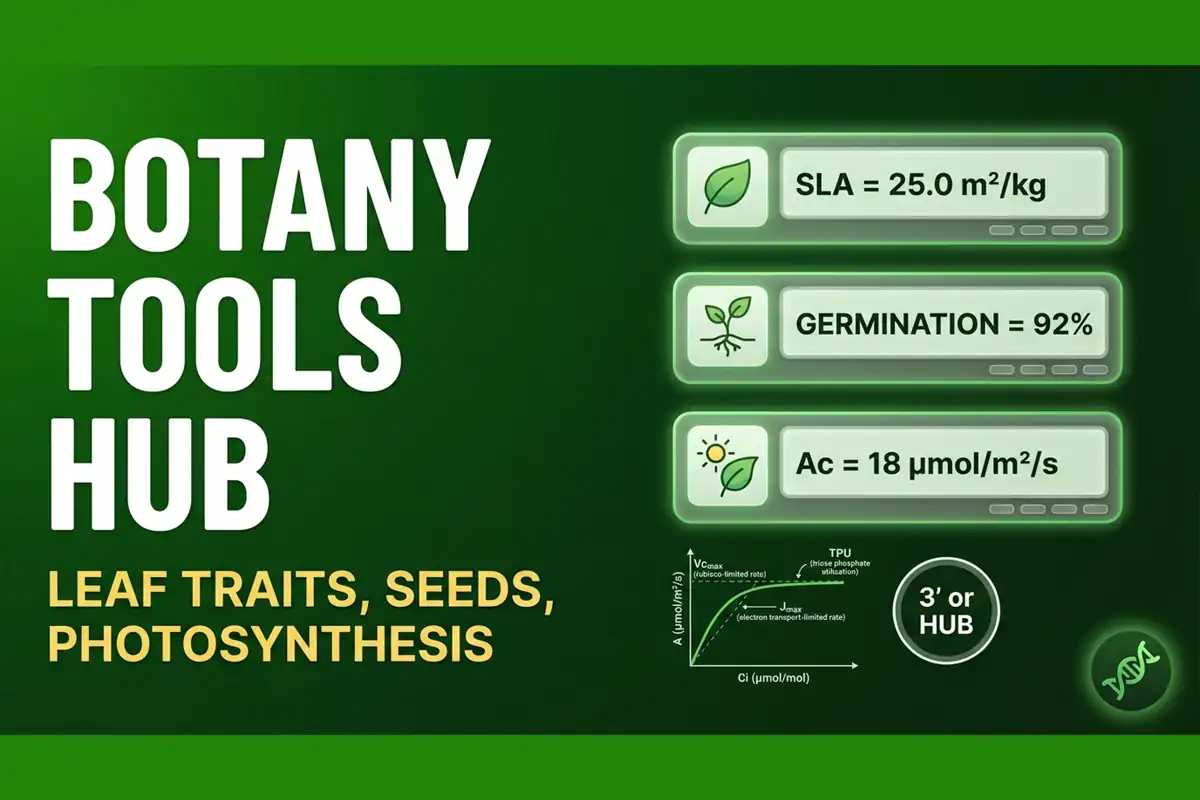
This sub-hub gathers the interactive botany and plant biology calculators available on BioExplorer. Each tool pairs a browser-based calculator with a full explanation article that walks through worked examples from standard plant biology and ecology references. Every calculator runs in your browser with no installation, no signup, and no data collection. The list grows as new tools ship.
Botany Tools Guide:
- All Botany Tools
- Specific Leaf Area Calculator
- Seed Germination Calculator
- Farquhar Photosynthesis Simulator
- Germination Rate Calculator
- Root:Shoot Ratio Calculator
- Plant Trait Trade-Off Calculator
- Which Tool Should You Use?
- How Leaf Function and Plant Performance Connect
- Worked Example Combinations
- Related Resources
- Frequently Asked Questions
All Botany Tools
BioExplorer currently ships botany and plant biology tools covering the main measurement and modeling problems students and researchers encounter. Each tool targets a specific use case, and the brief descriptions below explain when to use each calculator. Click into any tool to read its full article and use the calculator.
Specific Leaf Area Calculator
The Specific Leaf Area Calculator computes standard leaf trait metrics used in plant ecology. The tool takes leaf area and dry mass, then returns Specific Leaf Area (SLA) in m squared per kg and Leaf Mass per Area (LMA). When fresh mass is provided, it also returns Leaf Dry Matter Content (LDMC) and an estimated leaf thickness.
The tool ships with species presets spanning Arabidopsis, soybean, oak, sunflower, pine, wheat, maize, rice, cotton, tomato, alfalfa, maple, beech, aspen, eucalyptus, fescue, ryegrass, plantain, clover, and brome. It is useful for plant ecology fieldwork, leaf economics spectrum studies, and trait comparisons across species.
Seed Germination Calculator
The Seed Germination Calculator adapts the paper towel germination test used in seed testing and home seed starting. The tool takes the number of seeds tested and the number that germinated, then returns the germination percentage, a 95 percent confidence interval, an optional Wilson score interval for small samples, a species-specific viability comparison, and a storage-adjusted viability estimate under common conditions (freezer, refrigerator, cool dry, room temperature, garage).
The tool includes 30 species presets covering vegetables, flowers, herbs, and a model plant. It is useful for seed viability screening, home seed starting, and educational seed-lot evaluation; official commercial testing should follow the current AOSA or ISTA rules.
Farquhar Photosynthesis Simulator
The Farquhar Photosynthesis Simulator runs an educational FvCB (Farquhar, von Caemmerer, and Berry) three-limitation model of C3 leaf photosynthesis in the browser. The tool takes Vcmax, Jmax, TPU (triose phosphate utilization), Rd (day respiration), leaf temperature, PPFD (photosynthetic photon flux density), and intercellular CO2 (Ci), then returns the three net limiting rates Ac, Aj, and Ap, the net assimilation A, the limiting regime, and a full A vs Ci curve from 0 to 1500 µbar. Kc, Ko, and Γ* follow Bernacchi et al. 2001 temperature functions, while Vcmax, Jmax, TPU, and Rd use simplified educational temperature-response functions.
The tool includes Generic C3, Tobacco, and Tomato presets. It is useful for plant physiology coursework, leaf gas exchange modeling, and quick sensitivity checks before using research-grade curve-fitting software.
Germination Rate Calculator
The Germination Rate Calculator takes a germination test time series (time and germinated count at each observation) and returns the standard kinetics metrics used in seed science: germination percentage with Wilson 95 percent confidence interval, mean germination time (MGT), T50 (median germination time), Timson index, coefficient of velocity (CV), and mean daily germination.
The tool accepts both daily and cumulative count inputs and supports days or hours as the time unit. The calculator ships with 12 species presets (lettuce, tomato, Arabidopsis, wheat, rice, maize, soybean, cucumber, pepper, onion, carrot, bean) and fits a Gompertz or logistic sigmoid to the cumulative curve for visualization. Useful for seed vigor testing, treatment comparisons, dormancy research, and germination assay analysis.
Root:Shoot Ratio Calculator
The Root:Shoot Ratio Calculator computes plant biomass allocation between belowground and aboveground tissue from a single paired observation, an allometric log-log regression across 3 or more plants, or a control versus treated comparison. The tool takes root and shoot dry mass or total length, returns the root:shoot ratio, the root mass fraction, and a 5-band interpretation chart anchored to published typical ranges, and ships with 10 species presets covering major crops, the Arabidopsis model plant, and 4 tree species.
The two-sample mode reports the percent change plus a consistent or inconsistent verdict against published meta-analysis effect sizes for 7 stress contexts. Useful for plant biology coursework, agronomy field trials, ecophysiology stress response studies, and forestry seedling quality assessment.
Plant Trait Trade-Off Calculator
The Plant Trait Trade-Off Calculator combines Specific Leaf Area, Leaf Dry Matter Content, and (optionally) leaf nitrogen into a single Leaf Economics Spectrum score from 0 to 100, classifies the plant into one of six trait clusters (sclerophyll, shade leaf, herbaceous forb, deciduous tree, grass or crop, or evergreen broadleaf), and returns derived metrics including Leaf Mass per Area, nitrogen per area, and an empirical leaf lifespan estimate.
The tool ships with 12 species presets covering major crops, model plants, and forest trees. Useful for plant ecology coursework, leaf economics spectrum studies, and trait-based comparisons across species and growth forms.
Which Tool Should You Use?
Different plant biology problems call for different tools. The decision tree below covers the most common cases. If your problem does not fit any of these branches, the Specific Leaf Area Calculator is a safe default for trait measurement work.
- Measuring a leaf trait on a single species (or comparing species): start with the Specific Leaf Area Calculator. Enter the leaf area and dry mass, add fresh mass if you want LDMC and estimated thickness, pick a species preset if you have one, and read off the leaf trait values. SLA is a widely reported trait in plant ecology and is comparable across studies when the same measurement protocol is used.
- Testing whether a batch of seeds is still viable: use the Seed Germination Calculator. The paper towel test usually takes several days to a few weeks, depending on the species. Once you have your germinated and ungerminated counts, the tool returns the germination percentage, confidence interval, and species-specific viability comparison.
- Estimating the effect of storage on seed viability: use the Seed Germination Calculator with the storage feature. Pick a storage condition (freezer, refrigerator, cool dry, room temperature, garage), enter the species baseline viability, and read off the storage-adjusted expected viability for the selected seed age.
- Modeling leaf gas exchange or predicting net photosynthesis at a given CO2 and light level: use the Farquhar Photosynthesis Simulator. The tool implements an educational FvCB three-limitation model and returns the limiting rate plus the full A vs Ci curve.
- Comparing photosynthesis across temperatures for a parameter set: use the Farquhar Photosynthesis Simulator. The simulator updates the temperature-sensitive parameters and shows how the limiting regime and net assimilation change across the selected temperature range.
- Combining leaf trait data with photosynthesis modeling: pair the Specific Leaf Area Calculator with the Farquhar Photosynthesis Simulator. SLA tells you about the leaf’s structural investment in area versus mass, and the Farquhar simulator estimates biochemical photosynthetic capacity per unit leaf area. Together they connect leaf structure with leaf-level function.
- Analyzing germination kinetics from a multi-day time series (not just the final count): use the Germination Rate Calculator. Enter (time, daily count) observations and read off MGT, T50, Timson index, and CV, with a fitted sigmoid curve and species-preset comparison bands. Pair it with the Seed Germination Calculator when you have both the full time series and the final viability count.
How Leaf Function and Plant Performance Connect
Plant biology covers a wide range of scales, from cellular biochemistry to ecosystem-level patterns. A single leaf sits at the intersection: a leaf is both a structural organ (with measurable size, mass, and thickness) and a biochemical machine (running photosynthesis, respiration, and transpiration). BioExplorer tools cover both halves of that story.
Leaf economics is the study of how leaves invest resources. A leaf with high Specific Leaf Area (lots of area per gram of dry mass) is typically thin, fast-growing, and short-lived (an acquisitive strategy). A leaf with low SLA is thick, slow-growing, and long-lived (a conservative strategy). This trade-off is one of the most robust patterns in plant ecology, holding across species, biomes, and growth forms. The Specific Leaf Area Calculator gives you the four standard trait metrics (SLA, LMA, LDMC, leaf thickness) needed to place a leaf on the economics spectrum.
Photosynthesis is the biochemical side. The Farquhar Photosynthesis Simulator implements the FvCB model, the standard biochemical description of C3 photosynthesis since 1980. The model partitions leaf CO2 assimilation into three limiting regimes: Rubisco-limited (Ac, controlled by the maximum carboxylation rate Vcmax), electron transport limited (Aj, controlled by the maximum electron transport rate Jmax), and triose phosphate utilization limited (Ap, controlled by TPU). At any given leaf temperature and light level, one of these three limits dominates, and the A vs Ci curve shows the transition between regimes. This is the same model that plant physiologists fit to gas exchange data in the lab, distilled into a browser calculator.
Reproduction is the third axis. Seed viability and longevity influence whether a plant population can persist through unfavorable seasons. The Seed Germination Calculator covers a paper towel germination test for education and home seed starting, with confidence intervals and species-specific viability comparisons built in. Storage-adjusted viability under common conditions is a separate but related estimate. Together with the leaf-level tools, the botany calculators cover measurement, modeling, and reproduction in plant biology.
Worked Example Combinations
Many real plant biology problems need two or more tools working together. A few common patterns:
- Specific Leaf Area plus Farquhar: SLA describes the leaf’s structural investment, and the Farquhar simulator estimates biochemical capacity per unit leaf area. A high-SLA leaf with high Vcmax is consistent with a fast-growing, acquisitive strategy. A low-SLA leaf can indicate a longer-lived, more conservative strategy, but photosynthetic capacity still needs to be interpreted with species, growth conditions, and nitrogen status in mind.
- Seed Germination plus storage longevity: run a germination test with the Seed Germination Calculator, then use the storage feature to estimate the expected viability of the same seed lot under different storage conditions. This is a practical workflow for home seed savers and classroom seed-testing exercises, while formal seed banks use stricter sampling, moisture, temperature, and viability protocols.
- Farquhar plus temperature sweep: hold the baseline parameters constant in the Farquhar Photosynthesis Simulator and vary leaf temperature from 5 to 45 degrees C. The individual capacity parameters and the realized net assimilation rate can peak at different temperatures, so the limiting regime should be read from the simulator output rather than assumed from a single textbook optimum.
- Specific Leaf Area plus species preset: pick a species preset (Arabidopsis, soybean, oak, and so on) in the Specific Leaf Area Calculator to compare a measured leaf against a typical range for that species or functional group. The reference ranges in the tool flag when a measured leaf is unusual for its selected comparison group.
- Measuring biomass allocation between roots and shoots, or quantifying a stress treatment’s effect on allocation, use the Root:Shoot Ratio Calculator. Enter root and shoot dry mass and read off the R:S, the root mass fraction, and a 5-band interpretation chart anchored to published typical ranges. The two-sample mode adds a consistent or inconsistent verdict against published meta-analysis effect sizes.
- Classifying a plant’s overall leaf economics strategy from multiple leaf traits, use the Plant Trait Trade-Off Calculator. Enter Specific Leaf Area, Leaf Dry Matter Content, and (optionally) leaf nitrogen, pick a species preset if you have one, and read off the 0 to 100 Leaf Economics Spectrum score, the cluster classification into one of six trait profiles (sclerophyll, shade leaf, herbaceous forb, deciduous tree, grass or crop, or evergreen broadleaf), and the derived Leaf Mass per Area, nitrogen per area, and leaf lifespan estimate. The tool is the right choice when you have measured more than one leaf trait and want a single interpretive label rather than a list of independent numbers.
Related Resources
- Biology Tools Hub: Main directory of all BioExplorer interactive tools, organized by branch of biology.
- Botany Glossary: Definitions for hundreds of botany terms, from abscission to xylem.
- Branches of Botany: Background on plant anatomy, plant physiology, plant ecology, taxonomy, and the major thinkers in each.
- Types of Plants: Explore different types of plants and their characteristics.
- History of Botany: Timeline of major discoveries in plant biology, from Theophrastus through modern molecular botany.
Frequently Asked Questions
Start with the Specific Leaf Area Calculator if you are measuring leaf traits, or the Seed Germination Calculator if you are testing seed viability. Both tools cover common introductory plant biology problems with no setup required. Once you are comfortable with the basics, the Farquhar Photosynthesis Simulator handles the more advanced leaf gas exchange modeling.
The tools use standard educational formulas and have been checked against worked examples from plant physiology, plant ecology, and seed-testing references. The Specific Leaf Area Calculator follows the Pérez-Harguindeguy et al. 2013 trait-measurement framework. The Seed Germination Calculator adapts paper towel/blotter-style germination testing with confidence intervals and an optional Wilson score interval. The Farquhar Photosynthesis Simulator implements an educational FvCB model with temperature-sensitive parameters. For primary research publication or official seed certification, use the relevant instrument software, R plant physiology packages, or the current AOSA/ISTA rule books.
The Farquhar Photosynthesis Simulator is currently implemented for C3 plants only. C4 plants use a different biochemical model (the von Caemmerer C4 model with bundle sheath and mesophyll compartments) and are not currently supported. The Specific Leaf Area Calculator and the Seed Germination Calculator work for any plant species, with species presets covering both C3 and C4 examples (maize is a C4 plant, for instance, and is included in the SLA preset list).
The Specific Leaf Area Calculator uses m squared per kg for SLA, g per m squared for LMA, mg per g for LDMC, and mm for estimated leaf thickness. The conversion between m squared per kg and mm squared per mg is 1 to 1, so the two SLA units are equivalent for leaf trait reporting. The Seed Germination Calculator reports germination percentage and confidence intervals as percentages. The Farquhar Photosynthesis Simulator uses µbar for intercellular CO2 (Ci) and µmol m⁻² s⁻¹ for assimilation rate (A).
The species presets in the Specific Leaf Area Calculator use typical ranges compiled from trait-measurement references, the TRY database, and species-level literature. The 20 presets cover a wide taxonomic and functional spread (Arabidopsis, soybean, oak, sunflower, pine, wheat, maize, rice, cotton, tomato, alfalfa, maple, beech, aspen, eucalyptus, fescue, ryegrass, plantain, clover, and brome). The Seed Germination Calculator uses 30 common garden and model-plant species with species-specific germination and storage assumptions. The Farquhar Photosynthesis Simulator includes three teaching presets: Generic C3, Tobacco, and Tomato.
The BioExplorer team reads every email sent through the contact form on this site. Common requests include adding more species to the existing presets, expanding the Farquhar tool to C4 photosynthesis, adding a photosynthesis light response curve (A vs PPFD) tool, and a soil water potential tool. Send your idea and the team can usually assess feasibility within a few days.
References:
- Pérez-Harguindeguy et al. 2013
- Wright et al. 2004
- Farquhar, von Caemmerer, and Berry 1980
- Bernacchi et al. 2001
- Wilson 1927.
Cite this page
BioExplorer. (2026, September 30). Botany Calculators and Tools. https://www.bioexplorer.net/biology-tools/botany/