
Red-cap Mustached Tamarin
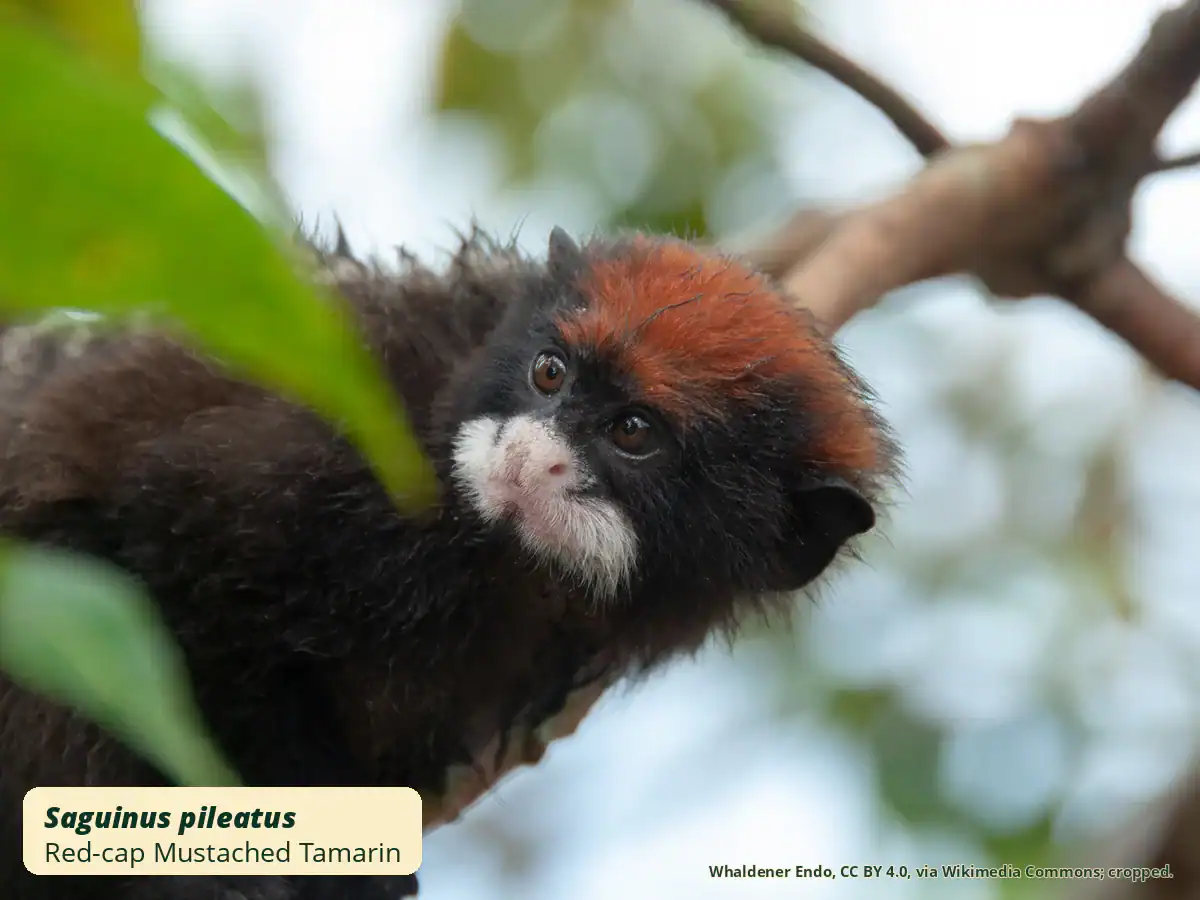
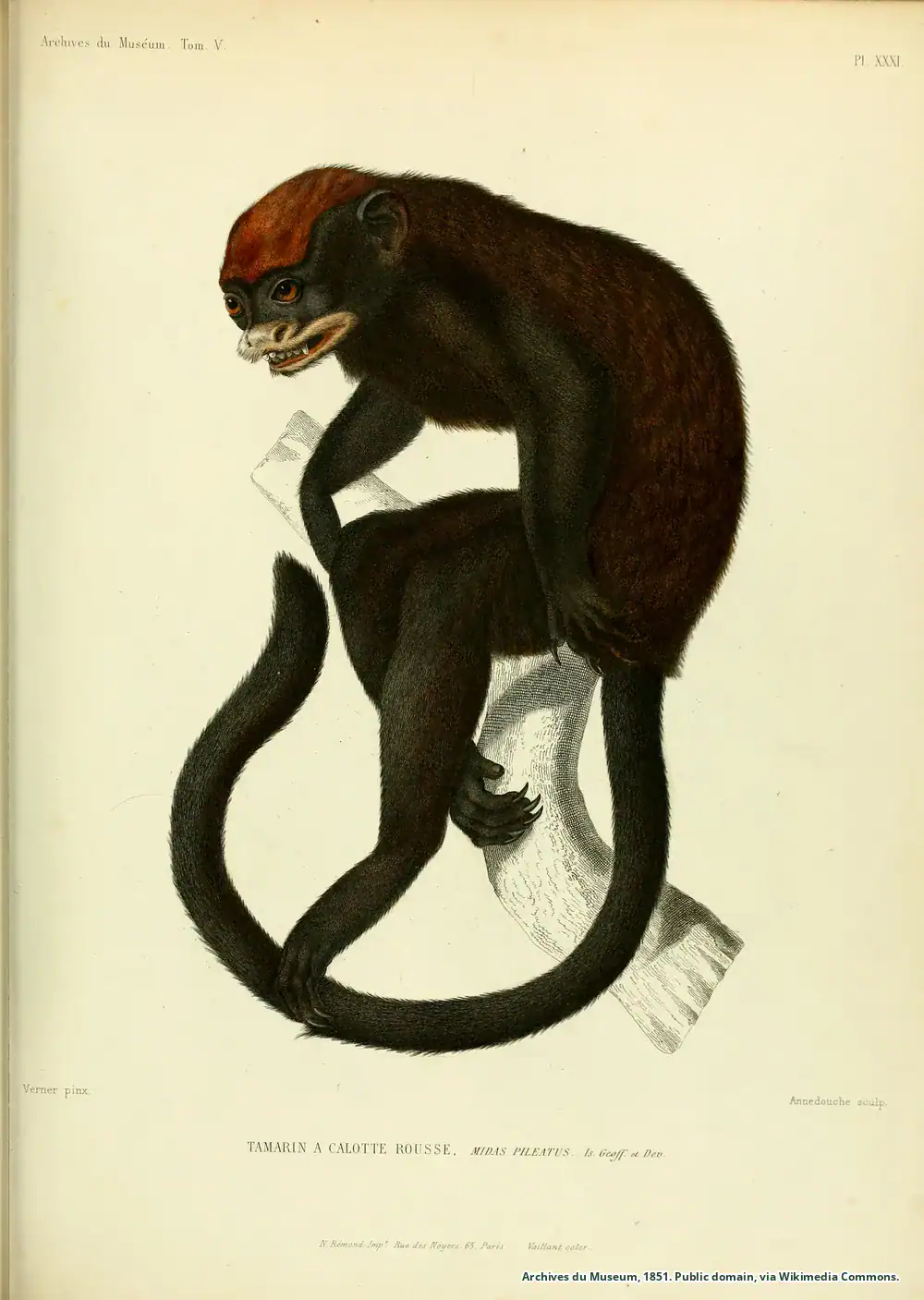
The red-cap mustached tamarin (Saguinus pileatus) is a small Amazonian monkey. A broad white moustache frames its black face.[3]
It belongs to the New World monkeys. It lives only in Amazonas, Brazil.[1][3] Terra firme rainforest is its habitat.[5]
The species holds two subspecies. The nominate form carries the red cap that names it.[3] The other form has a black crown.[3]
A 2023 genomic review recognized it as a full species.[3] Most preceding treatments kept it as a subspecies of the moustached tamarin.[3] One authority places it in genus Tamarinus.[2]
The Mammal Diversity Database records it as Not Evaluated.[1] Its parent species is listed as Least Concern.[4][5]
A small Amazonian monkey of one stretch of Amazonas, Brazil. Its nominate subspecies carries the rusty red cap that gives the species its name.
- Common NameRed-cap Mustached Tamarin
- Taxonomy Classification Year1848
- Monkey SizeNo head and body series published for this species alone; the parent species averages head and body 25.7 cm (10.1 in) and tail 39 cm (15.4 in)
- Skin Color(s)Black facial skin with unpigmented pink skin around the mouth and nostrils; the nominate subspecies has a rusty red cap over the forehead and crown, a blackish brown body ticked with buff, and a black tail, while the second subspecies has a black crown and a white rump
- HabitatTall and secondary terra firme rainforest, favoring dense growth, treefalls and forest edges
- DietOmnivorous
- Native CountriesBrazil
- A 2023 genomic review recognized it as a full species.[3] Most earlier treatments kept it as a subspecies.[3]
- The nominate subspecies carries a rusty red cap.[3] The second subspecies has a black crown and a white rump.[3][5]
- The Rio Coari separates the two subspecies.[3]
- Fruit made up 70.6 percent of the diet at the Rio Urucu.[5]
- No Red List assessment covers this species.[1] Brazil does not list it as threatened.[9]
Red-cap Mustached Tamarin Distribution
 )
Red-cap Mustached Tamarin Guide:
The Red Cap
The cap belongs to the nominate subspecies. S. p. pileatus carries it.[3] It is reddish orange over the forehead and crown.[3] It runs forward as a thin line between the eyes.[3] Toward the back of the head it divides.[3]
The second subspecies is capped in black. S. p. pluto is named for its white rump instead.[1][5] White hair covers its anogenital region and lower tail base.[5]
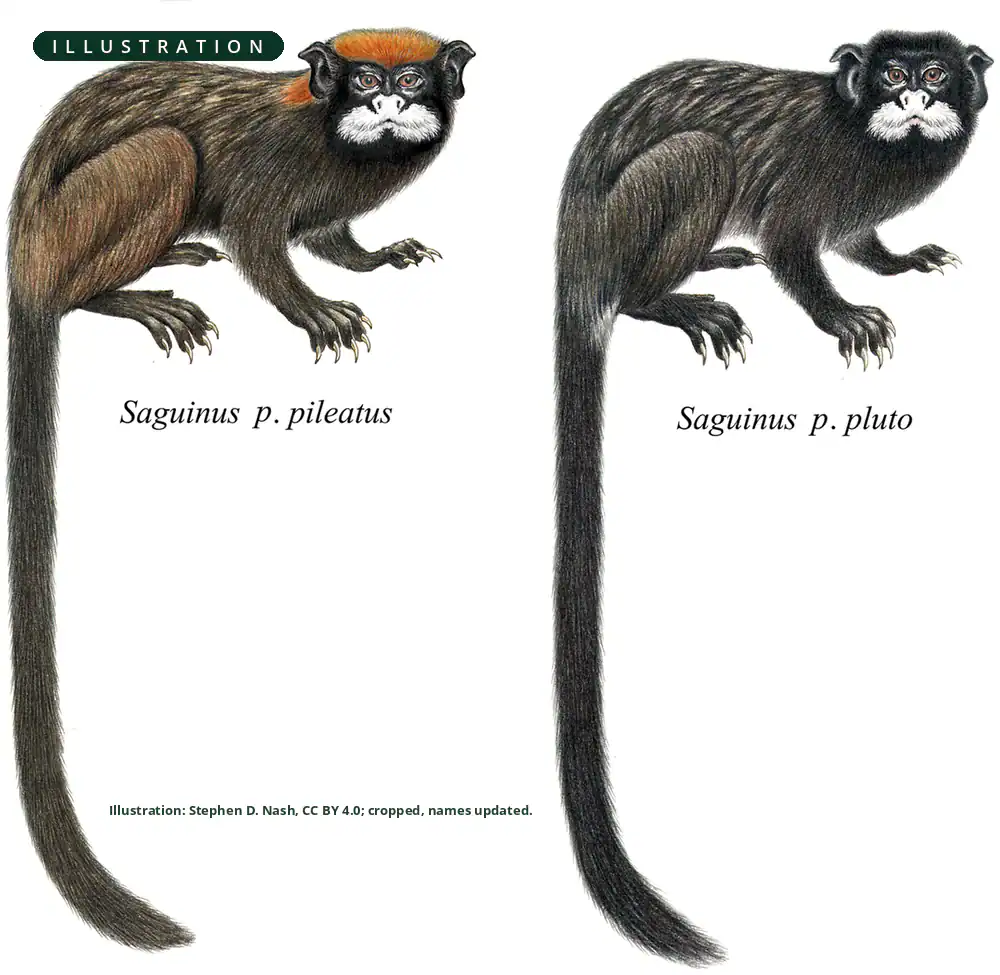
Every other close relative also has a dark crown.[3] The cap names this animal in the field.[4]
The rest of the description below covers the nominate form.
The face is black apart from the moustache.[3] Skin around the mouth and nostrils is unpigmented pink.[3] Long white hairs cover it.[3]
Hairs along the muzzle form a low crest.[3] They are black in front and light red behind.[3]
The mantle is blackish brown, ticked with buff or orange.[5] The saddle and rump mix blackish brown and buffy hairs.[5]
Outer limbs are brown.[5] Hands and feet are blacker.[5] The underparts and inner limbs are blackish brown.[5]
The tail is black.[3] Only its base matches the rump.[5]
Two other English names are in use. They are red-capped mustached tamarin and red-capped tamarin.[2][6]
Measured animals are scarce. No head and body series covers this species alone.[5] A Rio Urucu body mass of 450 grams has been reported.[4] Its sample size was not published.[4]
Combined figures cover all forms of the parent species. Head and body average 25.7 cm.[4] The tail averages 39 cm.[4]
A Twenty-Year Argument
Groves proposed full species rank in 2001.[4]
The objection to him was geographic. Lifting this tamarin out would strand a third form.[4][5] That form sat between it and the nominate one.[5] Specialists called the result implausible.[4]
The standard handbook therefore kept three subspecies in 2013.[5] A dedicated species account repeated the objection in 2022.[4]
Genomic data answered it three months later. Lopes and colleagues sequenced ddRAD markers.[3] They sampled 25 animals of this group.[3] Three outgroup specimens were added.[3] The matrix held 556 loci.[3]
The result differed from both earlier taxonomic arrangements. The stranded form does not belong with the nominate one.[3] It belongs with this animal instead.[3]
So the species was raised, and it took that form with it.[3] The geographic objection then disappeared.[3]
The test was statistical. Bayes factors compared five taxonomic hypotheses.[3] A three-species arrangement won decisively.[3]
A four-species split was rejected at 100.92.[3] The older subspecies arrangement was rejected at 116.64.[3]
Both subspecies survive inside the species. The two forms are distinguishable and live apart.[3] They may be early in speciation.[3]
The authors flag where their own evidence is thin. One tree supported merging the two forms.[3] A second did not contradict it.[3] Coat pattern and distribution did not support that merger.[3]
Coat color was scored across 11 fields.[3] Eleven specimens of the nominate form were examined.[3] The paper published no body measurements.[3]
The same paper described the Kulinas' mustached tamarin.[3]
Bounded By Rivers
The species lives south of the Solimões.[3][4]
It runs from the Tefé and upper Juruá east to the Purus.[3][4]
The Coari separates its two subspecies. The nominate form holds ground west of that river.[3] S. p. pluto holds ground east of it.[3]
The nominate range reaches the Purus above the Coari headwaters.[3] It reaches the Juruá above the Tefé headwaters.[3] It also crosses the Tefé near that river's headwaters.[3]
Southward it passes the right bank of the Pauiní.[3] The bearded emperor tamarin appears to limit it there.[3][4] That southern limit is not firmly resolved.[4]
The range of S. p. pluto ends at the Tapauá.[3] Sampling is thin where the two forms may meet.[3]
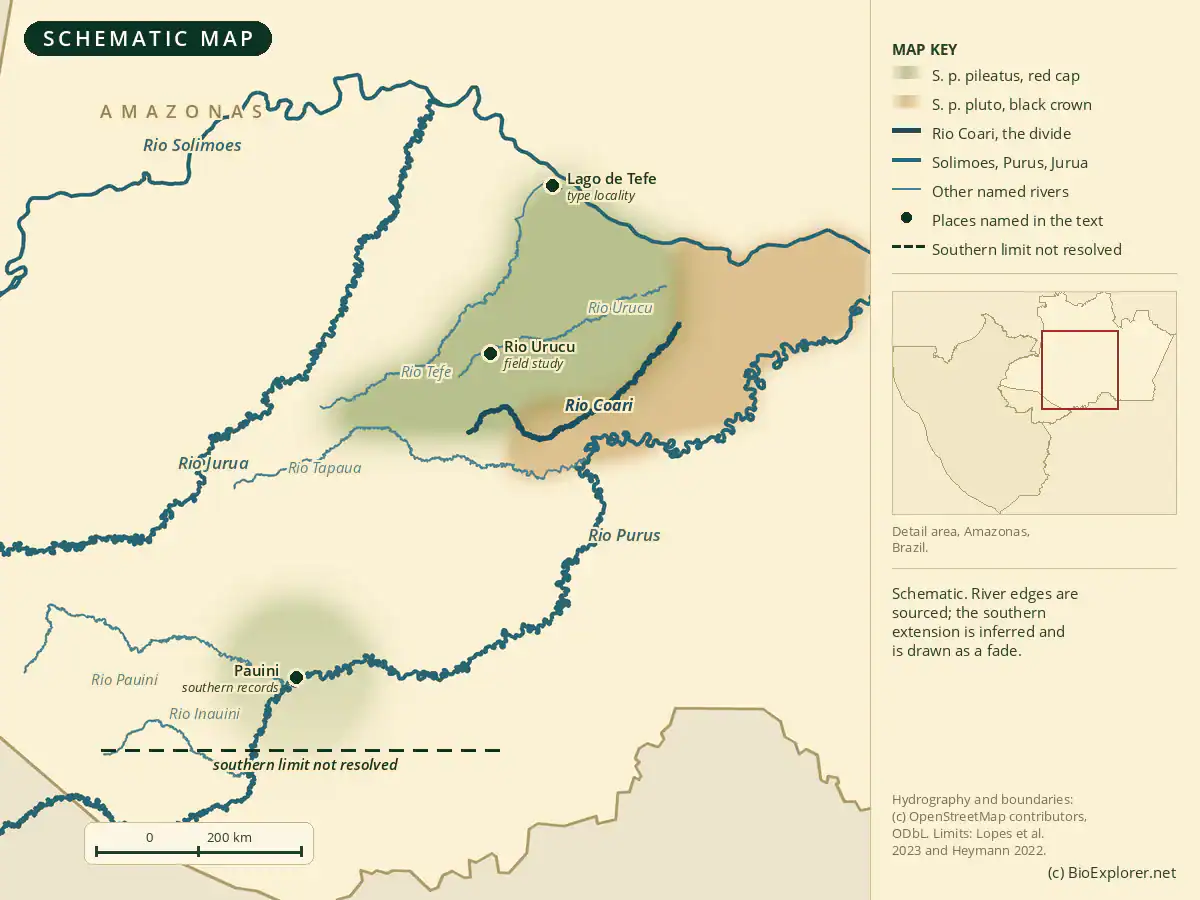
The type locality was published wrong. It read as the Rio Javari on the Peru border.[4] Hershkovitz corrected it to Lago de Tefé.[4]
The original description appeared in 1848.[7] It named the animal Midas pileatus.[7]
Like many Brazilian monkeys, it lives nowhere else.[1]
Habitat is tall and secondary terra firme rainforest.[5] Dense growth, treefalls and edges are favored.[5] Flooded forest is used only marginally.[5]
Fruit And Gums
Fieldwork at the Rio Urucu describes the nominate form directly.[5]
Fruit made up 70.6 percent of the diet.[5] Animal prey took 12.4 percent.[5]
Gums added 10.4 percent and nectar 6.2 percent.[5] The troop ate ripe fruit from 155 plant species.[5]
Two plants carry the lean season. Gums come mostly from two Parkia species.[5] Nectar comes from Symphonia globulifera.[5] Both matter most from July to September.[5]
Figs and Inga dominate the fruit list.[5]
Color vision is known from the parent species. Every male sees two colors only.[4] Two thirds of females see three.[4] Selection holds the variation in place.[4]
Swallowed seeds travel a long way. Seeds up to 2.5 cm across are taken whole.[5] They pass through in one to five hours.[5] Many land over 200 meters from the parent tree.[5]
Large katydids are the preferred prey.[5] Stick insects, mantises and spiders are also taken.[5] Frogs and lizards appear occasionally.[4]
The working day is long. Moving takes 30 percent of it.[5] Feeding takes 26 percent.[5]
Searching for animal prey takes 20.6 percent.[5] Resting takes only 16.6 percent.[5] The active day averages nine hours twelve minutes.[5]
These tamarins favor the upper canopy.[5] They rarely forage along trunks.[5]
Troops And Partners
Troops at the Urucu held eight to eleven animals.[4]
Three to five adult males were usual.[5] One or two adult females were present.[5]
They travel with a second tamarin species. The partner is a form of the brown-mantled tamarin.[5] The two move as one troop.[5]
They stayed within 50 meters over 80 percent of the day.[5] Closer still, 72 percent fell within 20 meters.[5]
The troop separates in the late afternoon.[5] They sleep 15 to 120 meters apart.[5]
Sleeping habits come from the Peruvian nominate population. Palms, foliage tangles and branch crotches are used.[4] Tree hollows are not.[4]
Published range estimates differ. The mixed troop covered about 179 hectares.[5] Published ranges for this animal span 85 to 141 hectares.[4]
Daily travel ran from 1,150 to 2,700 meters.[5]
Density estimates disagree sharply. Three surveys near the Urucu returned 10.7 to 12 per square kilometer.[5] A later review cites 71.5 instead.[4]
The two species defend their shared ground together. Encounters bring loud calling and chasing.[5] They can last up to two hours.[5]
The long call is known from the parent species.[4] It carries up to 32 sound units.[4] Each animal's call is distinct.[4]
Raptors and snakes both take mustached tamarins.[4] The crested eagle is a known predator.[5]
Breeding And Young
Most breeding data come from the parent species. Peruvian populations supplied them.[4] They remain the best guide here.[4]
One female usually breeds in each troop.[4] Males outnumber females among the adults.[4]
Polyandry is the usual arrangement. Several males may mate with one female.[4] Other systems also occur.[4]
Gestation runs 150 to 160 days.[4] Twins are the normal litter.[4]
Females breed again after 11 to 12 months.[4] The full range is 8 to 14 months.[4]
Birth timing at the Urucu is this animal's own record. Ten of 14 births there fell in the dry season.[4] The rest came in December and January.[4]
Peruvian animals peak instead from November to February.[4]
Infants are born with the moustache already showing.[4] Nursing lasts about three months.[4]
Males do most of the carrying. Infants ride on the back.[4] They first leave the carrier at three weeks.[4] Solid food begins at four to five weeks.[4]
Conservation Status
The Mammal Diversity Database records this species as Not Evaluated.[1] No Red List assessment covers it.[1]
Its parent species is listed as Least Concern.[4][5]
Brazil has not listed it as threatened. The 2026 national list names 1,289 taxa.[9] Neither this tamarin nor its parent appears on it.[9]
CITES Appendix II covers it.[2][5] That listing reaches all primates by order.[8] Species on Appendix I are excepted.[8]
The handbook names no protected area specifically for this form.[5] It names two inside the parent species' Brazilian range.[5]
Mustached tamarins can persist in disturbed forest near settlements.[4] Their small size makes them poor meat targets.[4]
Mustached tamarins are trapped or hunted for pets.[4] Wild animals were once exported for hepatitis research.[4]
Common Questions
The red-cap mustached tamarin is a small Amazonian monkey. Its nominate subspecies carries a rusty red cap and a white moustache. Scientists raised it to full species rank in 2023.
The red-cap mustached tamarin lives only in Amazonas, Brazil. Its range lies south of the Solimões River. It extends from the Tefé and upper Juruá east to the Purus.
The species split rests mainly on genomic evidence. Its nominate form has a reddish orange cap. Saguinus mystax has a black crown. The second Saguinus pileatus subspecies also has a black crown.
No. The red-cap mustached tamarin has two subspecies. Only the nominate form carries the red cap. The other form has a black crown and a white rump.
No Red List assessment covers the red-cap mustached tamarin. Its parent species is listed as Least Concern. Brazil's 2026 national list does not name either one as threatened.
The red-cap mustached tamarin eats mostly ripe fruit. Gums, nectar and insects make up the rest. One study recorded fruit from 155 plant species.
Cite this page
BioExplorer. (2026, October 13). Red-cap Mustached Tamarin. https://www.bioexplorer.net/animals/mammals/monkeys/red-cap-mustached-tamarin/
About the author