
Bearded Emperor Tamarin
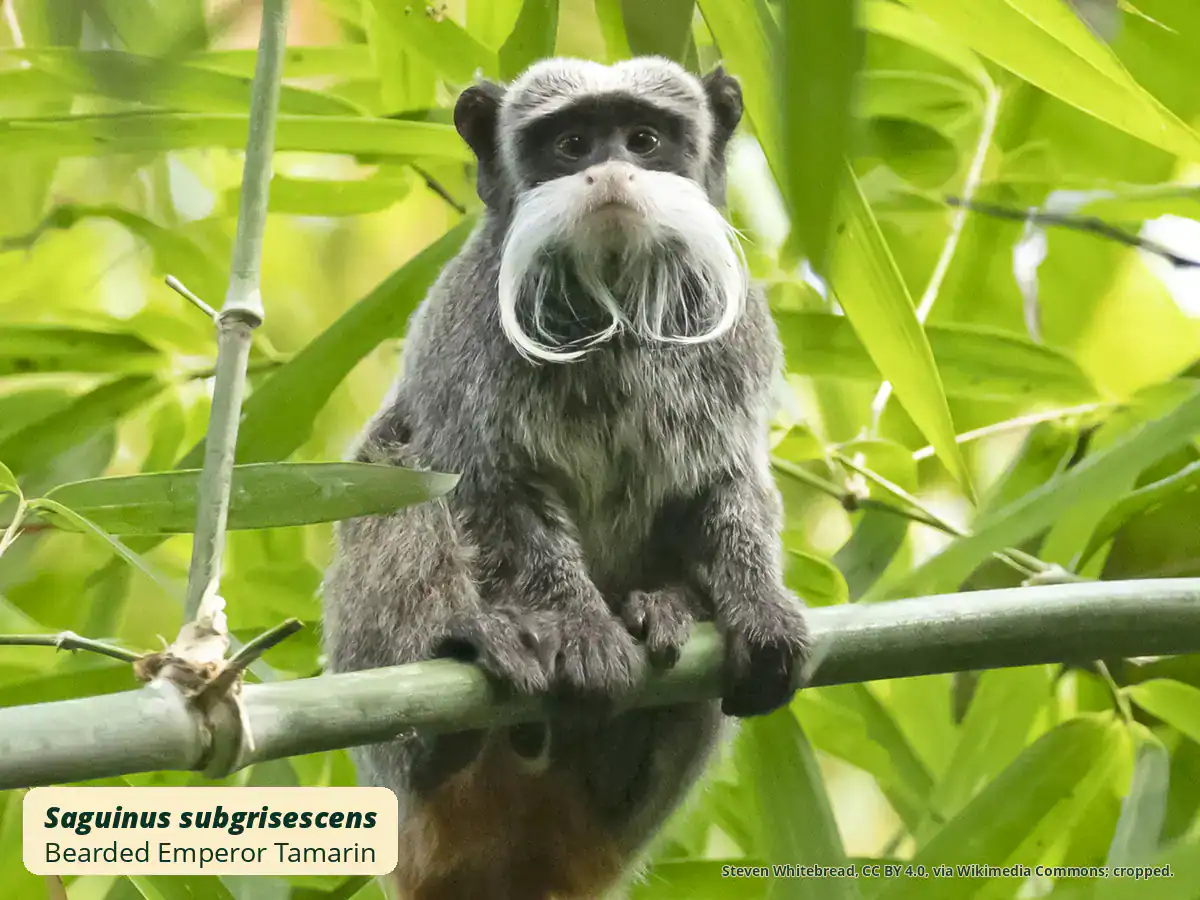
The bearded emperor tamarin (Saguinus subgrisescens) is a small monkey of the southwest Amazon. A long white moustache hangs forward in two strands.[6] A white beard covers the chin below it.[4][6]
It belongs to the New World monkeys. It lives in southeastern Peru, northern Bolivia and western Brazil.[2] Rainforest canopy is its habitat.[2]
Scientists raised it to full species in 2023.[4] Before that it was a subspecies of the emperor tamarin.[4] Two authorities now place it in genus Tamarinus.[2][3]
The IUCN account carries it as Least Concern.[2] That assessment dates from 2015 and is marked as needing updating.[2]
A small Amazonian monkey with a long white moustache and a white chin beard. Raised from subspecies to full species in 2023.

- Common NameBearded Emperor Tamarin
- Taxonomy Classification Year1940
- Monkey SizeHead and body 23 to 26 cm (9.1 to 10.2 in); tail 35 to 42 cm (13.8 to 16.5 in)
- Skin Color(s)Black facial skin and black hands and feet; coat brown agouti above and grizzled brown below, with a long white moustache, a white chin beard, and a rufous tail
- HabitatLowland and lower montane rainforest, seasonally flooded forest, bamboo stands and secondary growth
- DietOmnivorous
- Native CountriesBolivia, Brazil, Peru
- Raised from subspecies to full species in 2023.[4] A genomic study supported the split later the same year.[5]
- A long white moustache plus a white chin beard.[4][6] Its ears are bare, without the black tuft of its sister species.[4]
- It travels in stable mixed troops with saddleback tamarins.[6] The two species share about 43 percent of their fruits.[6]
- Adult females at Los Amigos averaged 533 grams.[7] Adult males averaged 495 grams.[7]
- Manu National Park protects a well-studied population.[2] No Bolivian protected area has a record of it.[11]
Bearded Emperor Tamarin Distribution
 )
 )
 )
Bearded Emperor Tamarin Guide:
A White Beard
Head and body measure 23 to 26 cm.[6] The tail adds 35 to 42 cm.[6] Published weights span 400 to 550 grams.[6]
Captures at Los Amigos produced measured weights. Adult females averaged 533 grams.[7] Adult males averaged 495 grams.[7] Both were heavier than sympatric saddleback tamarins.[7] Thicker limbs explain that, not greater body size.[7]
The facial skin is black.[6] Hands and feet are black.[6] The tail is orange red with a dark tip.[6]
The upperparts are brown agouti.[6] The belly and inner arms are grizzled brown.[6] Both emperor tamarins share the long white moustache.[6]
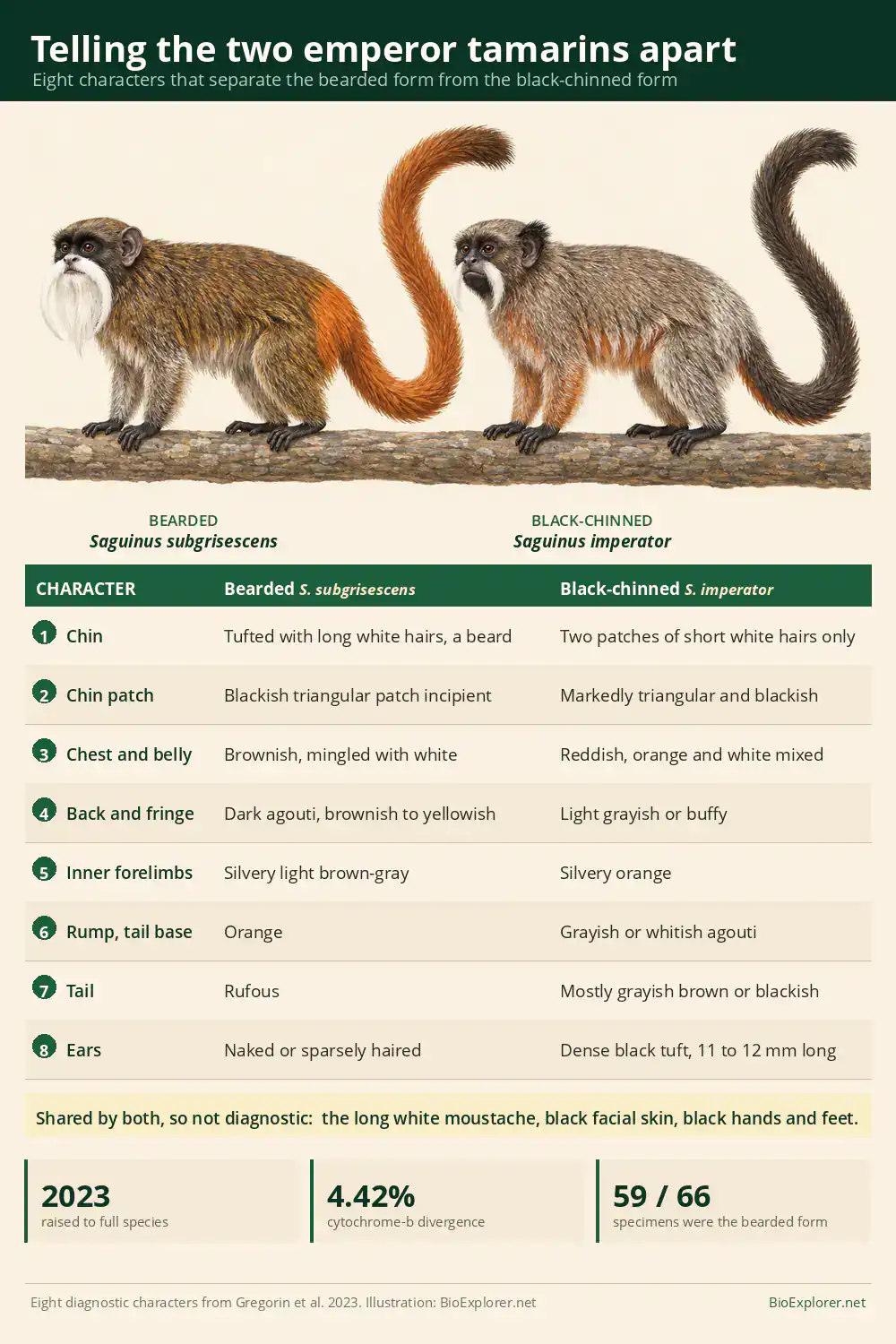
The beard is the field mark. White chin whiskers grow long here.[4] They largely hide the blackish patch beneath.[6] The black-chinned form carries only two short white patches.[4]
Seven more characters separate the two. The rump and tail base are orange here, gray in the other.[4] The tail is rufous rather than gray brown.[4] The back fringe is dark agouti rather than buffy.[4]
The ears differ most oddly. Ears are naked or sparsely haired in this species.[4] The black-chinned form grows a black tuft 11 to 12 mm long.[4]
In the study sample, mean skull measurements were larger throughout.[4] All thirteen variables showed it.[4] Only three nominate skulls were available, against thirty-two here.[4]
Split In 2023
Hershkovitz separated the two forms on coat pattern in 1977 and 1979.[2][4] He ranked them as subspecies.[4] No hybrid zone has been documented.[4]
That missing zone was the problem. Subspecies rank assumed intergradation.[4] The forms are parapatric and easily told apart.[4]
Gregorin and colleagues tested the question four ways.[4] They compared coat characters, skull measurements, mitochondrial DNA and distribution.[4] All four character sets agreed.[4]
The genetic distance is modest but comparable. Cytochrome-b divergence between the forms is 4.42 percent.[4] Other accepted sister pairs of tamarin sit near that value.[4]
They examined 66 museum specimens in all.[4] Fifty-nine were this species.[4] Only seven represented the black-chinned form.[4]
A genomic study agreed later the same year. Lopes and colleagues built a dated phylogeny from ddRAD data.[5] It supported the two as distinct species.[5]
The split also redistributed the older research. Much classic emperor tamarin fieldwork sat in Manu National Park.[6] That ground belongs to this species.[4] The black-chinned form has been studied in Rio Branco.[4]
The genus name is still unsettled. ITIS places seven species in genus Tamarinus.[3] They include the Kulinas' mustached tamarin.[3]
Not every authority has followed the split. Brazil still assesses one species with two subspecies.[10] Its figures therefore cover both forms.[10]
Range And Rivers
In Brazil it holds the right bank of the upper Rio Juruá.[2] It reaches east to the Tarauacá and Jurupari rivers.[2] Pauiní on the Purus is its northernmost reliable record.[4][10]
In Peru it runs west to the Andean foothills.[2] It lies south of the Urubamba and Inuya rivers.[2] The Fitzcarrald Arch lowlands appear to mark its western edge.[4]
In Bolivia confirmed records cluster in Pando.[4] They include the Muyumanu basin and the south Tahuamanu.[4] Sites near Cobija sit on the Acre's south bank.[4] The southern limit there is not firmly established.[2][11]
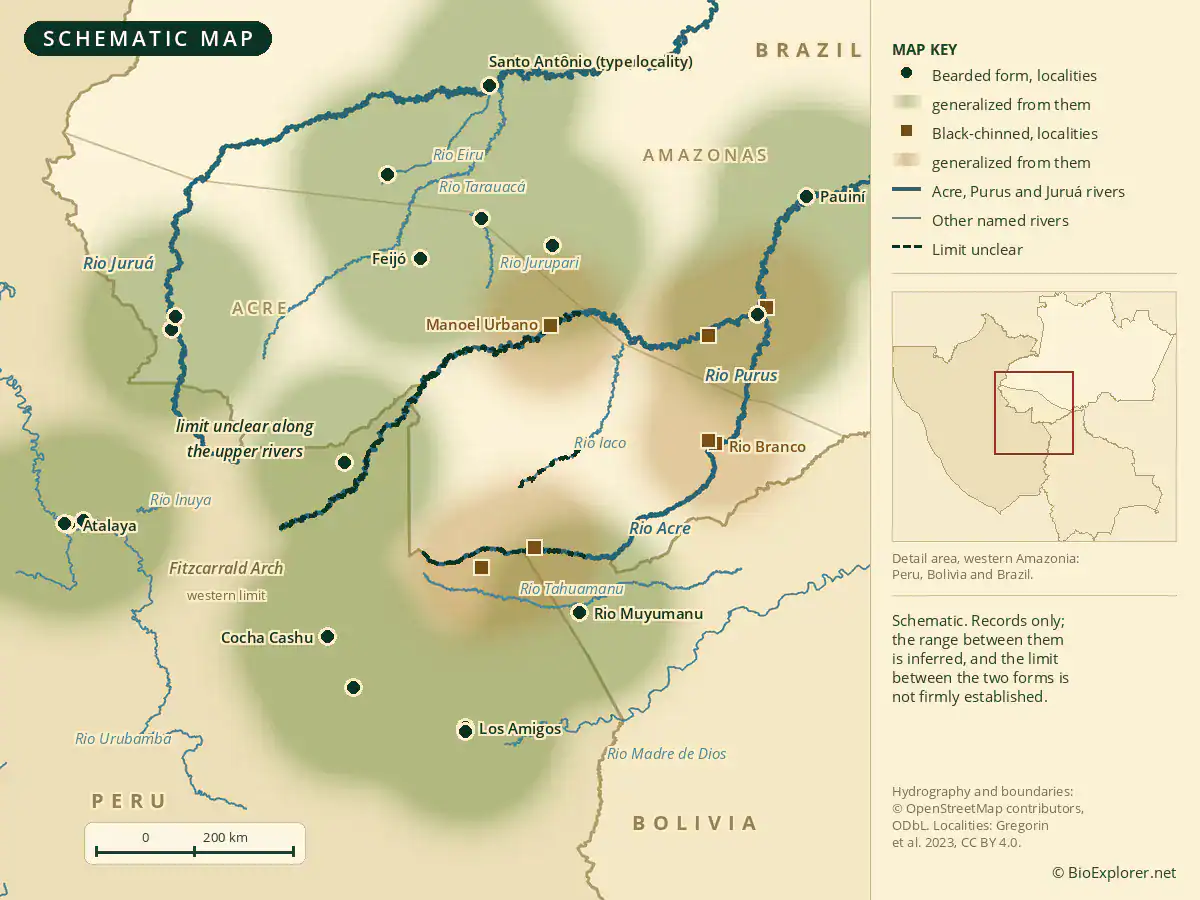
Rivers divide it from the black-chinned form. That form holds the left bank of the Acre.[4] This species holds the right bank, including Cobija.[4]
The boundary is not fully mapped. The limit along the upper Acre, Purus and Iaco is unclear.[4] No clear barrier separates the two there.[4]
Whether they interbreed is unknown.[4] Sampling in the contact zone is too thin.[4]
The species shares its forests with many other monkeys of Peru. Several Brazilian monkeys overlap its eastern range. It is one of a handful of Bolivia monkeys reaching Pando.
Habitat includes lowland and lower montane rainforest.[2] Seasonally flooded forest and secondary growth also qualify.[2] Bamboo stands are used as well.[10]
Brazil's assessment also records tolerance of disturbance.[10]
Diet And Canopy
Fruit dominates the wet season diet.[6] It supplies 97 percent of plant food then.[6] That share falls to about 41 percent in the dry season.[6]
Nectar fills the dry-season gap. It rises to 52 percent of plant food.[6] Two sources matter most at Manu.[6] They are a vine and a cultivated-fruit tree.[6]
Gums contribute only 1 to 2 percent year round.[6] Flowers and fungi appear in small amounts.[6]
The fruits taken are tiny. Some 87 percent measure half a centimeter to one centimeter.[6] A few hard berries reach eight centimeters.[6]
One hackberry species can dominate for months.[6] Animals fed on it up to 90 percent of the time.[6]
Animal prey means mostly grasshoppers and caterpillars.[6] Ants, beetles, snails and frogs are also taken.[6][10] Prey is caught by stealth and pounce.[6]
Foraging style is distinctive. They glean foliage 86 percent of the time.[6] Under one percent of searching happens in crevices.[6] Over half of it happens among vines.[6]
The time budget is known from Manu. Searching for animal prey takes about 34 percent.[6] Resting takes 25 percent and travel 21 percent.[6] Plant feeding takes 17 percent.[6]
Resting peaks in the early afternoon.[6] Fruit feeding peaks early and again late.[6]
Mixed Troops
This tamarin travels with Weddell's saddleback tamarin.[6] The two form stable mixed troops.[6] One such troop was watched for over three years.[6]
Terborgh and Goldizen followed mixed troops for more than thirteen years.[6] Their site was Cocha Cashu in Manu.[6]
The two species divide the forest vertically. This species travels at 11 to 20 meters.[6] Over half its fruit feeding happens at 20 to 30 meters.[6] Saddlebacks stay lower and were not observed that high.[6]
Mean foraging height is 9.4 meters for insects.[6] For fruit it is 16.7 meters.[6] Saddlebacks average 6.1 and 11.2 meters.[6]
Their diets overlap heavily. About 43 percent of fruits are shared.[6] The emperor tamarin is dominant at fruiting trees.[6]
Combined troop sizes were counted at Manu. The smallest held three of this species and two saddlebacks.[6] The largest held eight of each.[6]
Their joint home ranges ran from 30 hectares upward.[6] Some exceeded 100 hectares.[6] The two species defend that range together.[6]
They travel on parallel routes.[6] Long calls keep the troop in contact.[6] They rest and forage separately.[6] Each species uses different forest levels and prey-search methods.[6]
In western Brazil they also travel with Goeldi's monkey.[6][10]
Groups And Breeding
Groups hold two to ten animals.[6] At Manu the count was three to five.[10] The mean there was four.[6]
Home ranges at Manu ran about 30 hectares.[6] Groups are strongly territorial.[6] Range overlap between neighbors is minimal.[6]
One density estimate covers this species. Near Filadelfia, one estimate was 1.4 groups per square kilometer.[11] That site lies south of the Rio Tahuamanu.[11]
Usually one female breeds in a group.[6] She may mate with two breeding males.[8] Such polyandry was recorded at Los Amigos.[7]
Suppression of other females is not absolute. Several groups held two breeding females at once.[7] The authors called the suppression less strict than expected.[7]
Life-history figures come from emperor tamarins generally. Gestation runs 140 to 152 days.[10] Litters are one or two young.[10] Births fall about 183 to 189 days apart.[10]
Females mature near 16 months and males near 20.[10] Captive animals have lived past 17 years.[10]
Adult males may assist at birth by taking and cleaning newborns.[8] Males then perform much of the infant carrying.[8] Reported nursing bouts last about 30 minutes.[8]
Carrying continues until six or seven weeks.[8] Weaning follows at two to three months.[8]
Both field studies reported seasonal birth timing. At Manu they fall in October and November.[6] At Los Amigos the peak spans the wet season.[7]
Cold snaps from the Andes can empty breeding positions.[7] Outsiders then move in to fill them.[7]
Conservation Status
The IUCN account carries it as Least Concern.[2] That assessment was made in 2015 and published in 2021.[2] It is annotated as needing updating.[2]
No global IUCN assessment at species rank has followed the split.[1][2] The IUCN retains the former subspecies' Least Concern account.[2] The Mammal Diversity Database records the species as Not Evaluated.[1]
Bolivia assesses the full species as Vulnerable.[11] Its restricted Pando range and habitat loss underpin that category.[11] Earlier Bolivian editions used the same category.[11]
A Brazilian assessment covers both forms together. It reached Least Concern in 2019.[10] The Bolivian account reports no threatened listing in Peru or Brazil.[11]
That combined assessment describes the trend as possibly declining.[10] It estimated 3.6 percent habitat loss over 18 years.[10] For Brazil, it calculated an extent of occurrence of 162,635 square kilometers.[10]
The same assessment identifies settlement, cattle, logging and roads as threats.[10] Pressure is greatest in the eastern part of the range.[10] Paving of the BR-364 intensified that pressure.[10]
It is probably not hunted for food.[2] Some animals enter the pet trade.[2] Its teeth have been used for ornaments.[6]
Trade is controlled at order level. CITES covers this species through its Appendix II listing for primates.[9] Species listed separately in Appendix I are excepted.[9] Brazil records the listing as dating from 1977.[10]
Manu National Park in Peru protects a well-studied population.[2]
No Bolivian protected area has a record of it.[11] It is thought to occupy a tiny part of one biological station.[11] That area is too small to protect a viable population.[11]
Bolivia calls a new reserve urgent.[11] It recommends protection along the Muyumanu in northwest Pando.[11]
Brazil protects documented populations too. Records assigned to this species come from Serra do Divisor National Park.[6][10] The Arapixi Extractive Reserve is another.[4][10]
Common Questions
The bearded emperor tamarin is a small Amazonian monkey. It carries a long white moustache and a white chin beard. Scientists raised it to full species rank in 2023.
Bearded emperor tamarins live in southeastern Peru, northern Bolivia and western Brazil. They hold the right bank of the upper Rio Juruá. Their western edge is the Fitzcarrald Arch.
The bearded emperor tamarin has long white chin whiskers forming a beard. The black-chinned emperor tamarin shows only two short white patches. Its rump, tail and ear tufts also differ.
The global IUCN account retains Least Concern for the former subspecies. It predates the 2023 split and needs updating. Bolivia's 2026 national assessment classifies the full species as Vulnerable.
Bearded emperor tamarins eat fruit, nectar, gums and small animals. Fruit supplies most plant food in the wet season. Nectar takes over in the dry season.
The emperor tamarin name refers to the long white moustache. It is said to recall the German emperor Wilhelm II. Both emperor tamarin species carry the moustache.
Cite this page
BioExplorer. (2026, October 13). Bearded Emperor Tamarin. https://www.bioexplorer.net/animals/mammals/monkeys/bearded-emperor-tamarin/
About the author