
Ucayali Bald Uakari
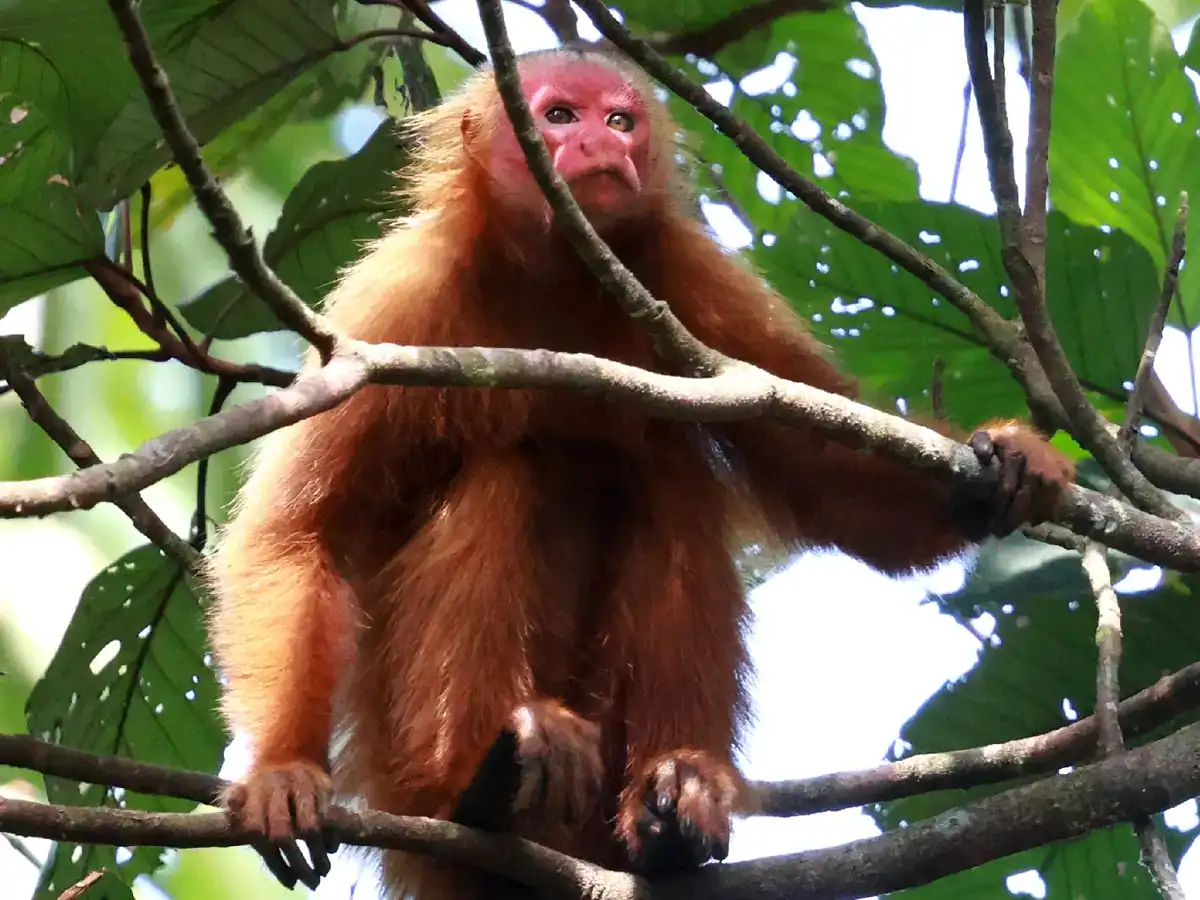
The Ucayali bald uakari (Cacajao ucayalii) is a red-faced Amazonian monkey. Its face and crown are almost bare. The skin there runs pink to scarlet.[6]
Oldfield Thomas named it in 1928 from Cerro Azul, in Peru.[1] For most of the century after, it was ranked as a subspecies.[2] A 2022 genomic revision raised it to full species.[2]
Its tail is the shortest, in proportion, of any New World monkey.[4] No other platyrrhine genus is built that way.[4]
See where it sits among the New World monkey group. It is one of several types of monkeys in the Amazon basin.
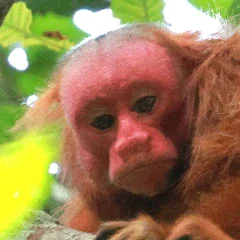
A bare scarlet face sits on a reddish-chestnut body. The color comes from blood vessels, not pigment.
- Common NameUcayali Bald Uakari
- Taxonomy Classification Year1928
- Monkey SizeBody mass 2.3 to 3.5 kg (5 to 8 lb); tail just 34 to 36 percent of head and body length
- Skin Color(s)Bare pink to scarlet face and ears; uniform reddish-chestnut to reddish-orange coat
- HabitatTerra firme, seasonally flooded forest, and moriche palm swamp
- DietFrugivore; mostly immature seeds, with fruit pulp and arils
- Native CountriesBrazil, Peru
- Oldfield Thomas described this monkey in 1928.[1][12] The type came from Cerro Azul, near Contamana, Peru.[1]
- A 2022 genomic revision raised it to full species.[2] Five bald uakari species are now recognized.[2]
- Seeds make up 55.4 percent of the diet along the Yavari.[3]
- One study troop held at least 200 animals.[4] Around 100 foraged together for days at a time.[4]
- It is not a flooded-forest specialist.[5] Most records come from terra firme forest.[5]
Ucayali Bald Uakari Distribution
 )
) )
)Ucayali Bald Uakari Guide:
Ucayali Uakari Identification
Nothing else in the Amazon looks like this.
The face and the crown are nearly bare. Skin there runs pink to scarlet.[6] The coat is long and shaggy. It is a fairly uniform reddish-chestnut to reddish-orange.[2] A heavier cape of hair covers the shoulders.[6] Hands and feet are dark.
Thomas pinned the diagnosis in 1928. He wrote that coloration matched the red bald uakari.[1] The difference was the nape, bright chestnut-red rather than whitish.[1] Close relatives carry that paler back or nape.[2] This one does not.
The tail is the second giveaway. It runs only 34 to 36 percent of head and body length.[4] That proportion is unique among New World monkey genera.[4] It is reddish, with some darker hairs above in places.[2]
Adults weigh roughly 2.3 to 3.5 kg.[7] Older sources split that figure by sex. Those come from the pre-split Cacajao calvus. Best left alone here.
Five bald uakari species are now recognized.[2] Two of them are white.[2] The other three are reddish or orange, including this one.[2] The bald uakari page covers C. calvus, a white species.
Range And Habitat
Most populations sit between the Ucayali and Javari rivers.[5] That interfluve covers Loreto and northern Ucayali in Peru.[5] Scattered records also come from west of the Ucayali.[5] The species occurs in western Brazil too.[2]
The habitat picture has been corrected in the literature. Older textbooks called it a flooded-forest specialist. A 2010 review of every known locality overturned that.[5] Most sites were terra firme forest, or mixed.[5] Encounter rates were highest in the Sierras de Contamana.[5] That is terra firme at 600 to 700 m elevation.[5]
One site makes the point sharply. Near Quebrada Blanco, flooded forest sits 8 to 10 km away.[5] That is inside the animals' daily travel range.[5] In 25 years nobody there recorded them in flooded forest.[5]
They do use seasonally flooded forest elsewhere.[5] Moriche palm swamp matters too, in flooded and non-flooded forest alike.[5] The honest summary is flexibility, not specialization.[5]
In Brazil, the confirmed records are in Acre. A 2022 study sequenced animals from Serra do Divisor National Park.[2] These photographs come from Mâncio Lima, in that corner of Acre. They were taken in August 2026.
Diet And Seeds
This is a seed predator, not a simple fruit eater.
At the Yavari River, seeds made up 55.4 percent of feeding.[3] Pulps and arils added 38.9 percent.[3] Everything else came to 5.6 percent.[3]
Fruit choice was selective.[3] Harder fruits were positively selected.[3] When fruit ran short, they ate more pulp.[3] Moriche palm, Mauritia flexuosa, became especially important then.[3] It made up a fifth of the diet at Lago Preto.[13] No other plant mattered as much.[13]
Jaw strength separates the age classes. Juveniles could not open the hardest species adults opened.[3] Adult males handled harder fruits than females.[3]
The closest living relatives are the bearded sakis.[8] The two genera split around 5 to 6 million years ago.[8] The black bearded saki shares that heavy jaw and seed-cracking habit.[8] True sakis branch off earlier, and titis earlier still.[8]
Voice And Troops
A 2026 study documented at least twelve distinct call types.[4] The work ran at Lago Preto, on the Yavari.[4] Researchers logged around 1,000 hours of observation.[4] They analyzed 1,155 recorded calls.[4]
The method is worth stating plainly. They started with 13 candidate call types.[4] A random forest model sorted 1,151 of those calls.[4] It agreed with the hand labels 84.5 percent of the time.[4] Chance across 13 labels would be 7.69 percent.[4]
One candidate failed the test. The rhork was misread as the rhä more often than not.[4] The authors folded it in.[4] That leaves at least 12 reliable call types.[4] Two had never been described, the high-chick and the shriek.[4]
One call dominates. Hics made up 53.9 percent of the recorded calls.[4] Hics average about 0.04 seconds.[4]
Only adult males produced the recorded barks.[4] Males delivered up to 2.3 barks per second.[4] Each bark came with a single front-to-back tail wag.[4] That wag had not been reported before.[4] Only infants and juveniles produced the recorded shrieks.[4]
Troops are large by monkey standards. Groups of 20 to 50 are most common.[4] The study troop held at least 200 animals.[4] Roughly 100 travelled and fed together for days.[4] Smaller units hold up to ten.[4]
That Red Face
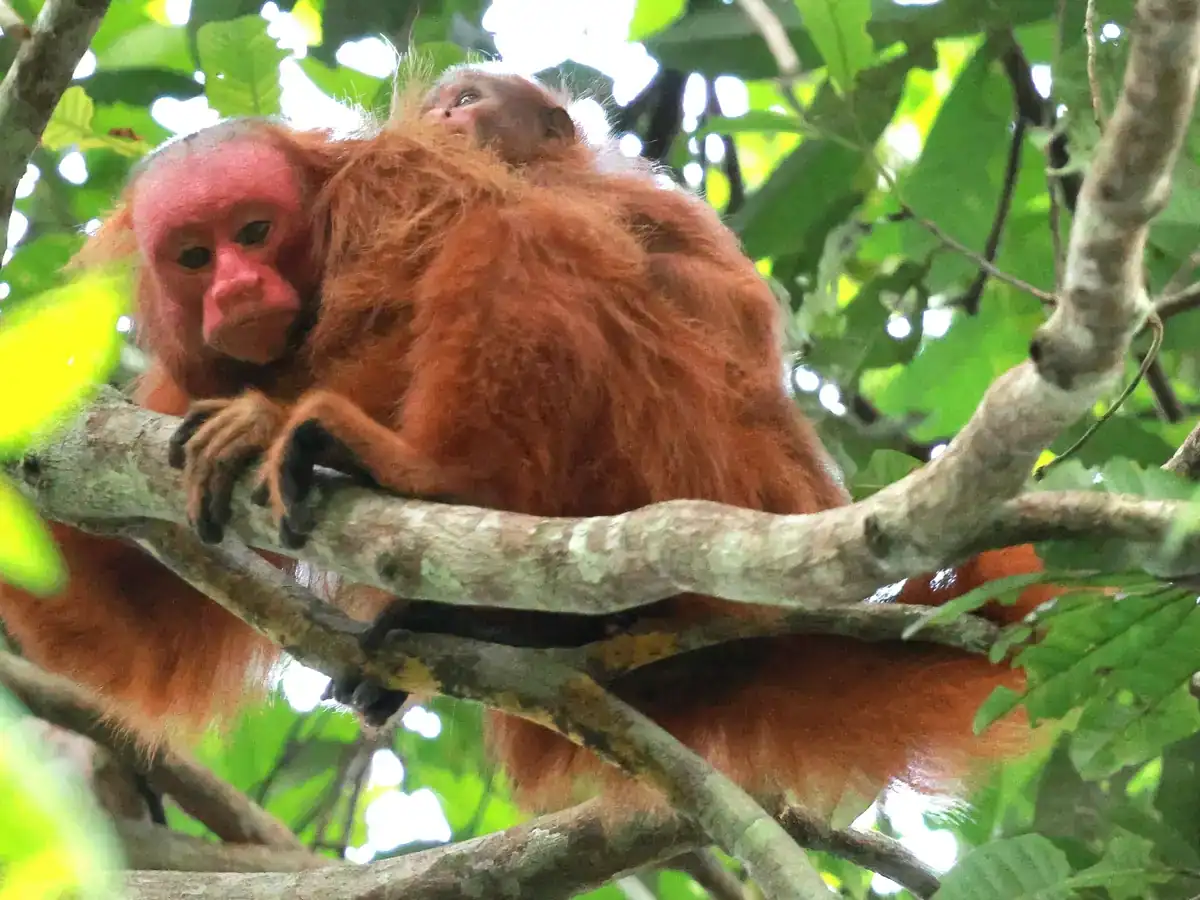
The red is not a pigment. There is no melanin in that skin.[9]
A 2015 study examined the facial tissue directly.[9] The epidermis there is unusually thin.[9] Below it sits a dense bed of capillaries.[9] They are larger and more winding than in other New World monkeys.[9]
Blood shows through. The authors proposed that the color advertises blood condition.[9] They were careful to note that the idea is untested.[9] It may also carry sexual or behavioral information.[9]
Color builds with age. Infants show grey to pink faces.[4] Juveniles are pink to red, but duller than adults.[4] Adult males carry the most intense scarlet.[4]
The black uakari has no bare red face at all. Nor does the Neblina uakari of the upper Rio Negro.
Conservation Status
The IUCN lists the Ucayali bald uakari as Vulnerable.[10] The 2025 assessment treats it as a full species.[10] Earlier assessments covered it as a bald uakari subspecies.[10] It is listed on CITES Appendix I.[6]
Hunting is a major pressure across the range.[13] At Yavari, Bowler identified it as the greatest threat.[13] Logging and plant harvesting may intensify it.[13] Acre state records list bald uakaris among hunted primates.[11] Older surveys report the animal gone from parts of northeastern Peru.[6]
Space is the other problem. At Lago Preto one group ranged over at least 1,200 hectares.[13] That is a floor, not a ceiling.[7] Groups left the study area.[7] An earlier estimate exceeded 30 square kilometers.[7] Daily travel runs 6 to 7.3 km.[7] A small fragment may not hold one troop's range.
Protected areas help on both sides of the border. Peru has Tamshiyacu Tahuayo, Sierra del Divisor, and Lago Preto.[6] Brazil has Serra do Divisor National Park.[2]
Common Questions
Blood vessels show through thin, unpigmented facial skin. A 2015 study found no melanin there. The epidermis is unusually thin. Below it sits a dense bed of capillaries. Researchers proposed that the color advertises blood condition. They noted the function has not been tested.
Only 34 to 36 percent of head and body length. No other New World monkey genus is built that way. The tail is reddish, with some darker hairs above in places.
Mostly between the Ucayali and Javari rivers in Peru. That covers Loreto and northern Ucayali. Scattered populations lie west of the Ucayali. In Brazil it is confirmed in Acre. That includes Serra do Divisor National Park.
Yes, under current treatment. A 2022 genomic revision raised it from subspecies rank. Five bald uakari species are now recognized. Two are white, three reddish or orange.
The long field studies did not record it. They feed in the middle and upper canopy. Ground use is rare across sakis and uakaris generally.
Mostly immature seeds, which they crack open with heavy jaws. At the Yavari River seeds made up 55.4 percent of feeding. Pulps and arils added 38.9 percent. Moriche palm matters most when other fruit is scarce.
Cite this page
BioExplorer. (2026, October 11). Ucayali Bald Uakari. https://www.bioexplorer.net/animals/mammals/monkeys/ucayali-bald-uakari/
About the author