
Niger Delta Red Colobus
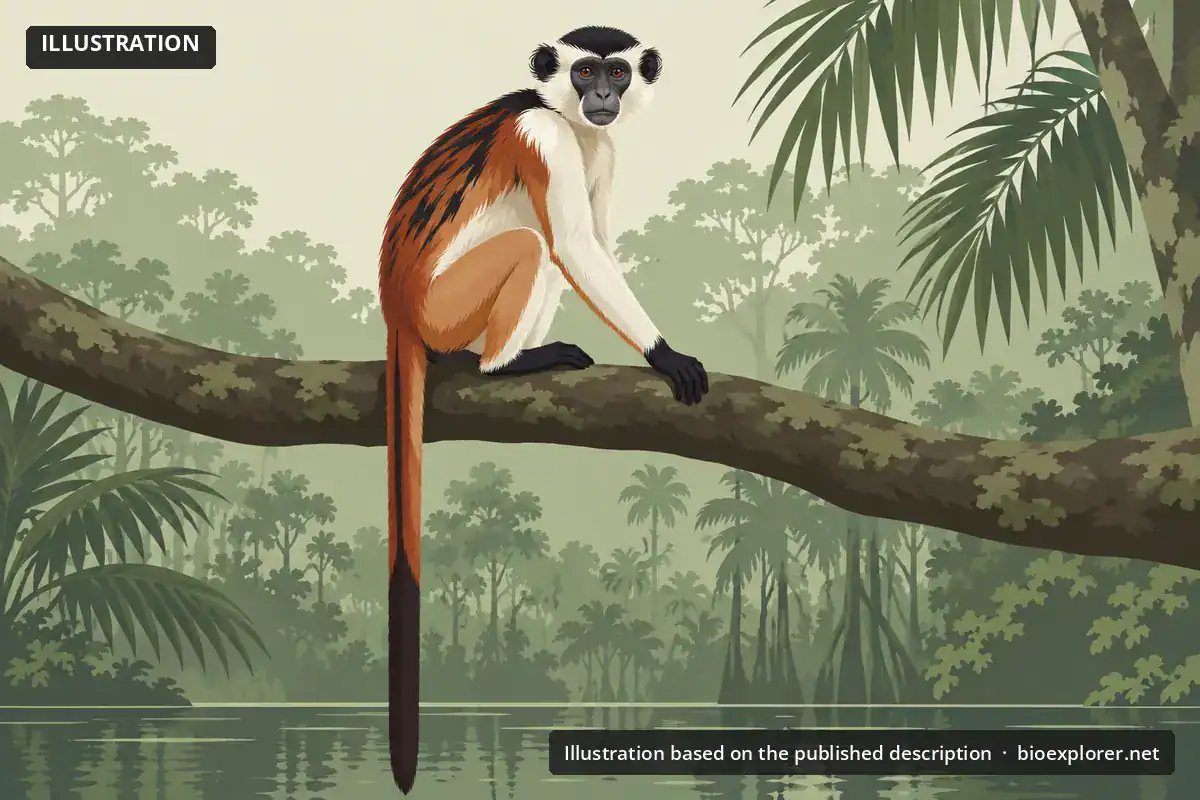
The Niger Delta red colobus is a swamp-forest monkey of southern Nigeria. Scientists first documented it in 1993. It survives in a small network of western Niger Delta forest fragments. The IUCN Red List classes it as Critically Endangered.[1] Fewer than a thousand are thought to survive. Community conservancies are its only working protection.
This Critically Endangered red colobus survives only in Nigeria's Niger Delta marsh forests.
- Common NamesNiger Delta Red Colobus, Delta Red Colobus, Colobe epieni (French), Colobo rojo del Níger (Spanish)
- Taxonomy Classification Year1999
- Monkey SizeNo published species-specific body measurements are available
- Skin Color(s)Black crown; banded black and orange mantle; whitish underparts and outer arms; black hands and feet; dark red-brown tail
- HabitatFreshwater marsh forest of the Niger Delta, sea level to about 10 m
- DietHerbivorous (young leaves, leaf buds, stem tips, seeds, flowers)
- Native CountriesNigeria
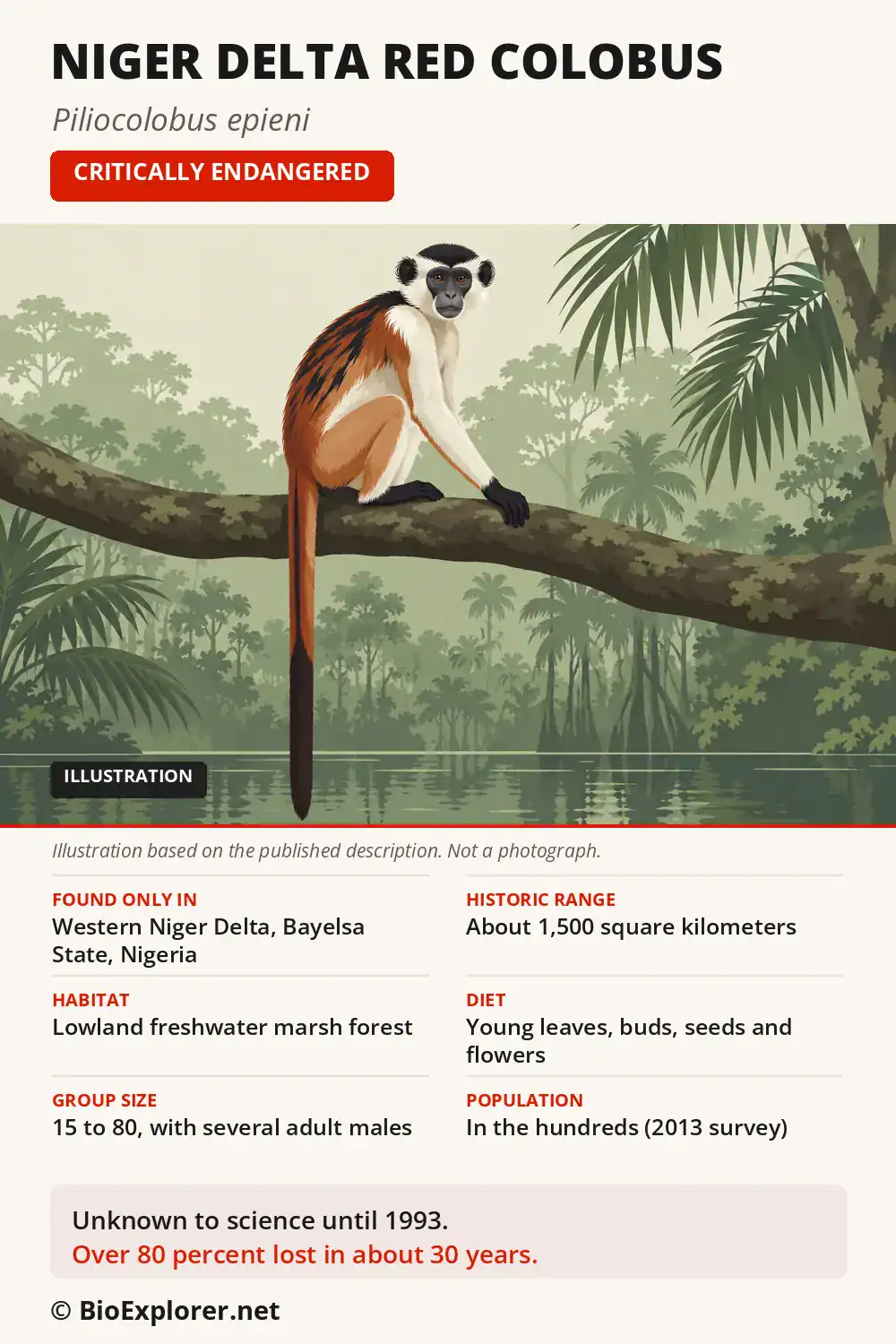
- Scientists first documented this monkey as recently as 1993.
- Its whole historical range covered only about 1,500 square kilometers.
- Surveys suggest a decline of more than 80 percent in 30 years.
- Groups hold 15 to 80 animals, with several adult males.
- Community areas around Apoi Creek protect and restore its habitat.
Niger Delta Red Colobus Distribution
 )
Niger Delta Red Colobus Guide:
Names and Taxonomy
Peter Grubb and C. Bruce Powell described this monkey in 1999. They named it Procolobus badius epieni. That made it a subspecies of the western red colobus. The type locality is Sampou-Apoi in Bayelsa State. The holotype sits in the Natural History Museum, London.[2] The authors called it a distinctive and geographically isolated population. Its discovery closed a 1,200 km gap in red colobus range.[3] The epithet epieni comes from the Ijaw language. The Ijaw people live throughout its small range.[4]
The name changed twice afterward. Grubb and colleagues moved it under Procolobus pennantii in 2003. Colin Groves raised it to a full species in 2007. The Handbook of the Mammals of the World followed in 2013. GBIF and the Mammal Diversity Database accept that name today.[5] The species has no subspecies.[6]
Red colobus belong to the Old World monkeys, family Cercopithecidae. They form the leaf-eating subfamily Colobinae. This site covers the group under colobus monkeys. Its nearest neighbor on Bioko is Pennant's red colobus. To the east lives Preuss's red colobus of Cameroon. Genetics tells a different story. Limited mitochondrial and vocal evidence separates it from both neighbors. A 2021 action plan ranks it among the most distinct red colobus.[7] The evidence is thin. One mitochondrial sample grouped with East and Central African red colobus instead.
To the west lives Miss Waldron's red colobus of Ghana. The original describers noted it resembles Pennant's red colobus most. It differs in its whitish arms and hair whorls above the ears. It is one of the red monkeys of West Africa. Its name also places it among the monkeys starting with N.
Appearance and Coat
No published species-specific body measurements are available. The Handbook of the Mammals of the World states that plainly. Field guides describe the coat instead.
The crown is black. The mantle across the back is banded black and orange. That orange tone earns it a place among the orange monkeys. Whitish fur covers the underparts. It spreads onto the outer sides of the arms. Orange-brown shrinks to a narrow band along each arm's trailing edge. In some animals it is missing from the arms entirely. The hands and feet are black. That black does not extend up the limbs.
The tail is dark red-brown above with a darker central stripe. Below it is chestnut or maroon. The last third to two thirds of the tail turns black-brown. White patches mark the shoulders and cheeks. Black hairs over the ears form conspicuous whorls. Those whorls separate it from Pennant's red colobus.
Adult females develop sexual swellings around ovulation. The swellings reach 12 cm long and 10 cm wide. No source describes infant coloration or size differences between the sexes.
Distribution and Range
The species is endemic to Nigeria. It occupies the western and central Niger Delta in Bayelsa State. The Forcados River and Bomadi Creek bound it to the northwest. The Sagbama, Osiama and Apoi creeks bound it to the east. The mangrove belt bounds it to the south. The historical range covered about 1,500 square kilometers. Reports place it sporadically farther east, almost to 7°E.
That range has shrunk hard. A 2013 survey checked 16 former sites. It found the monkey at only half of them. Only two landscapes still held viable populations. One was the Apoi Creek area, about 22 square kilometers. The other was the Otolo-Kolotoro-Ongoloba area, about 140 square kilometers. Their surviving forest fragments totaled only about 78 square kilometers.[8] The Red List puts the remaining range at roughly 200 square kilometers. Unconfirmed local reports place it farther north in Delta State. Those reports have not been verified.
The eastern forests fared worst. The Kolotoro forest held the largest cluster in 2013. A 2019 revisit found the area severely degraded and no colobus. The species is now thought lost from that eastern block.[9] The western swamps around Apoi hold what remains.
Habitat Preferences
This monkey lives in freshwater marsh forest. The water table stays high all year. The forest never floods deeply and feels no tides. It is exceptionally low-lying habitat. The upper elevation limit is just 10 m above sea level. The Red List codes the habitat as tropical swamp forest. That places it among Nigeria's rainforest monkeys in the broad sense.
The range lies within a known center of primate endemism. Grubb and Powell suggested the Delta served as a Pleistocene refuge. Food trees grow in clumps across the marsh forest. Lodewijk Werre proposed that clumping as the key limit on its range. The species flourishes only where favored food trees form large patches. It is therefore very sensitive to losing those trees.
The Apoi Creek Forests became a Ramsar wetland in 2008. The site covers 29,213 hectares of marshes, mangroves and freshwater swamp. Ramsar lists this monkey as a reason for the designation.[10] The Niger Delta holds Africa's second largest swamp forest. It also holds the world's third largest contiguous mangrove forest.
Diet and Feeding
The diet is herbivorous. Young leaves, leaf buds and stem tips make up most of it. Seeds, flowers, flower buds and leaf petioles are also important. Seeds matter most in season. That diet places it among the herbivorous monkeys.
The abura tree is a key food plant. Primate literature cites it as Hallea ledermannii or Fleroya ledermannii. Botanists now place it in Mitragyna. Loggers prize the same tree. Its removal has stripped much of the monkey's food supply. The Red List notes that the species also disperses seeds.
Behavior and Daily Life
The Niger Delta red colobus is diurnal and arboreal. It stays largely in the trees. Werre watched groups in the mid-1990s. They spent 36 percent of their time feeding. Resting took 33 percent and traveling 25 percent. Social behavior filled the remaining 6 percent.
Groups travel 450 to 1,900 m a day. One study group used a home range of 73 hectares. Birds of prey are possible predators of the young. Dead infants have been found, but no attack has been documented.
Social Groups
Groups are large. They hold 15 to 80 individuals. Each contains multiple adult males and multiple adult females. Females groom most often. Males usually groom females that show perineal swellings.
The marsh forest holds other primates. The red-bellied monkey, or Nigerian white-throated guenon, shares it. So does the collared mangabey, also called the red-capped mangabey. The greater spot-nosed monkey and mona monkey live there too. So does the olive colobus.
Reproduction and Breeding
Mating occurs throughout the year. It peaks in the rainy season from April to July. Small infants appear most often in the dry season. That runs from December to March. The species has never been bred successfully in captivity. The Red List says every breeding attempt outside the forest has failed.
Population and Threats
Surveys in 1994 to 1997 suggested fewer than 10,000 animals. No accurate census was made. The monkey was then locally common near Gbanraun. The 2013 survey found a decline of about 90 percent. The 2013 survey placed the population in the hundreds, not thousands. No completed range-wide census has been published. The Red List justification cites a decline of more than 80 percent. That covers three generations, about 30 years.
Habitat loss and degradation are the main threats. Hunting adds to them, though it is often opportunistic. Oil and logging have dominated the Delta since the late 1950s. Oil infrastructure opened formerly empty forest to settlers. Artisanal loggers felled the key food trees. They floated the logs out on rafts to Lagos. Canals dug for oil and timber altered local hydrology. Forest cover fell 1.2 percent a year between 1991 and 2013. Many forests now lack any large trees. Hunting was rare among the Ijaw, who traditionally fish. Oil money encouraged commercial bushmeat hunting and logging.
The species often appears on the World's 25 Most Endangered Primates list. The 2008, 2010, 2016 and 2018 editions all listed it. Photographs were so scarce that the 2018 edition used an illustration. Re:wild reported its inclusion again in the 2023 to 2025 edition.[11]
Conservation Status
The IUCN assessed the species as Critically Endangered in 2018. The criteria are A2cd+4c. The assessment was published in 2019. The Red List first rated it Endangered in 1996. It was still a subspecies then. It became Critically Endangered in 2008. Generation length is set at 10 years. A separate 2024 Green Status assessment rated it Critically Depleted. Its species recovery score was 8 percent.
The species sits on CITES Appendix II. It is Class B under the African Convention on Nature. No protected area was ever operational in its range. Insecurity in the Delta blocked conservation for years.
Change came in 2020. The Apoi community signed a memorandum of understanding that year. It set aside about 1,000 hectares of the Apoi Creek Forest. The Apoi Community Conservation Area followed in 2021. The SW/Niger Delta Forest Project works there with the community. Three red colobus groups held territories inside. Rangers, education and forest management followed. The 2024 Green Status assessment called the Apoi population stable, possibly rising. Monitoring recognized three groups where two were previously known. More groups may reflect better surveying rather than growth. In 2024 the Gbanraun and Kokoloama communities added two more conservation areas. They cover 6.57 and 3.63 square kilometers.[12] They protect and restore forest and mangrove around Apoi. Apoi remains the core managed refuge.
In late 2020 Nigeria's president approved ten new national parks. Apoi Creek Forest Reserve, 64.8 square kilometers, was among them. A National Park (Declaration) Order naming Apoi National Park followed in 2022. The National Assembly concurred with the declaration in March 2023.[13] An effective park could still take time to establish. The 2021 red colobus action plan names two priority sites. They are Apoi Creek and Otolo-Kolotoro-Ongoloba. It budgets 130,000 US dollars for laws, research stations and awareness work. A 2015 review recorded 45 larger mammal species in the Delta. This monkey was its only Critically Endangered mammal.[14] Read about the wider group under types of monkeys.
Common Questions
The Niger Delta red colobus lives only in Nigeria. Its range is the western Niger Delta marsh forest in Bayelsa State. The remaining animals cluster around the Apoi Creek forests.
The Niger Delta red colobus fell over 80 percent in 30 years. Logging removed its food trees and oil canals changed the swamps. Hunting added to the losses.
Fewer than a thousand Niger Delta red colobus survive. A 2013 survey put the total in the hundreds. No completed range-wide census has been published.
The Niger Delta red colobus mostly eats young leaves and buds. Stem tips, seeds, flowers and leaf stalks add to the diet. The tree Hallea ledermannii is a key food source.
Scientists first documented the Niger Delta red colobus during a 1993 survey. Grubb and Powell described it formally in 1999.
Niger Delta red colobus groups hold 15 to 80 animals. Each group has several adult males and many adult females.
The Niger Delta red colobus sits on CITES Appendix II. Community conservation areas at Apoi Creek, Gbanraun and Kokoloama protect its forest. Apoi has legal national-park status, but operational management remains unclear.
Cite this page
BioExplorer. (2026, October 19). Niger Delta Red Colobus. https://www.bioexplorer.net/animals/mammals/monkeys/niger-delta-red-colobus/
About the author