
Hatinh Langur
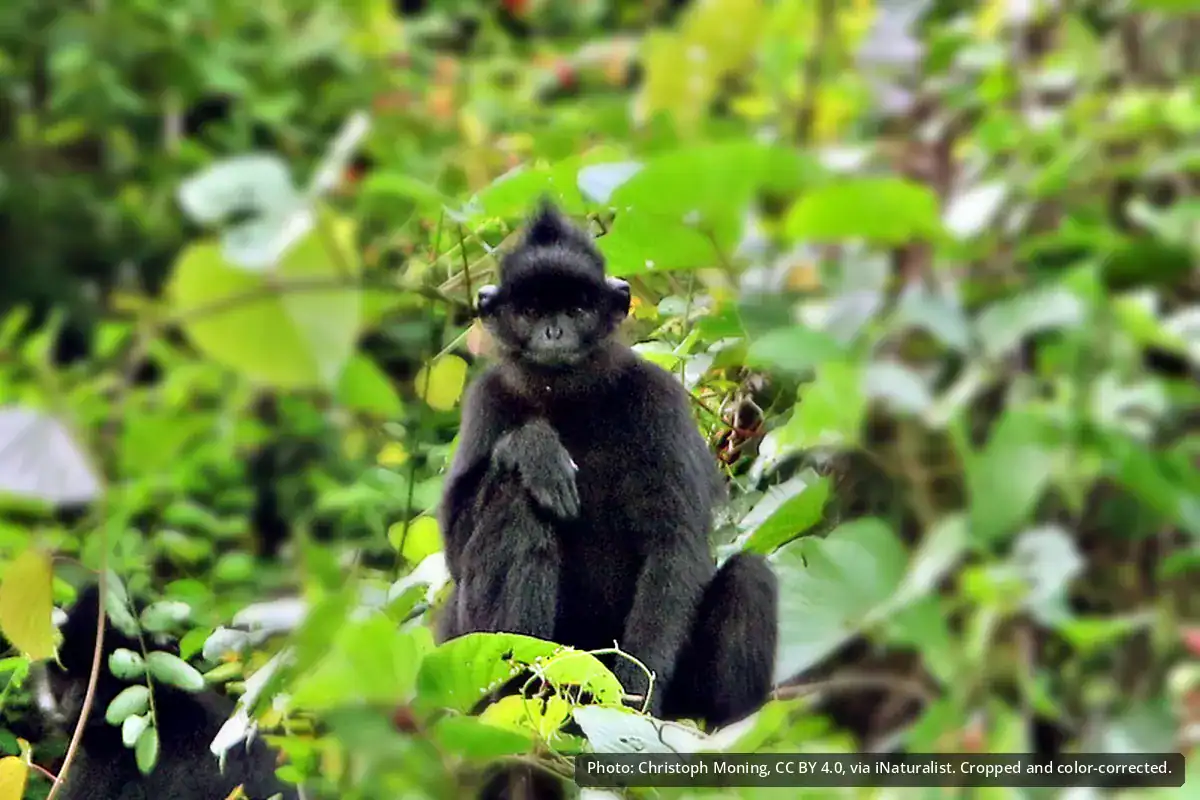
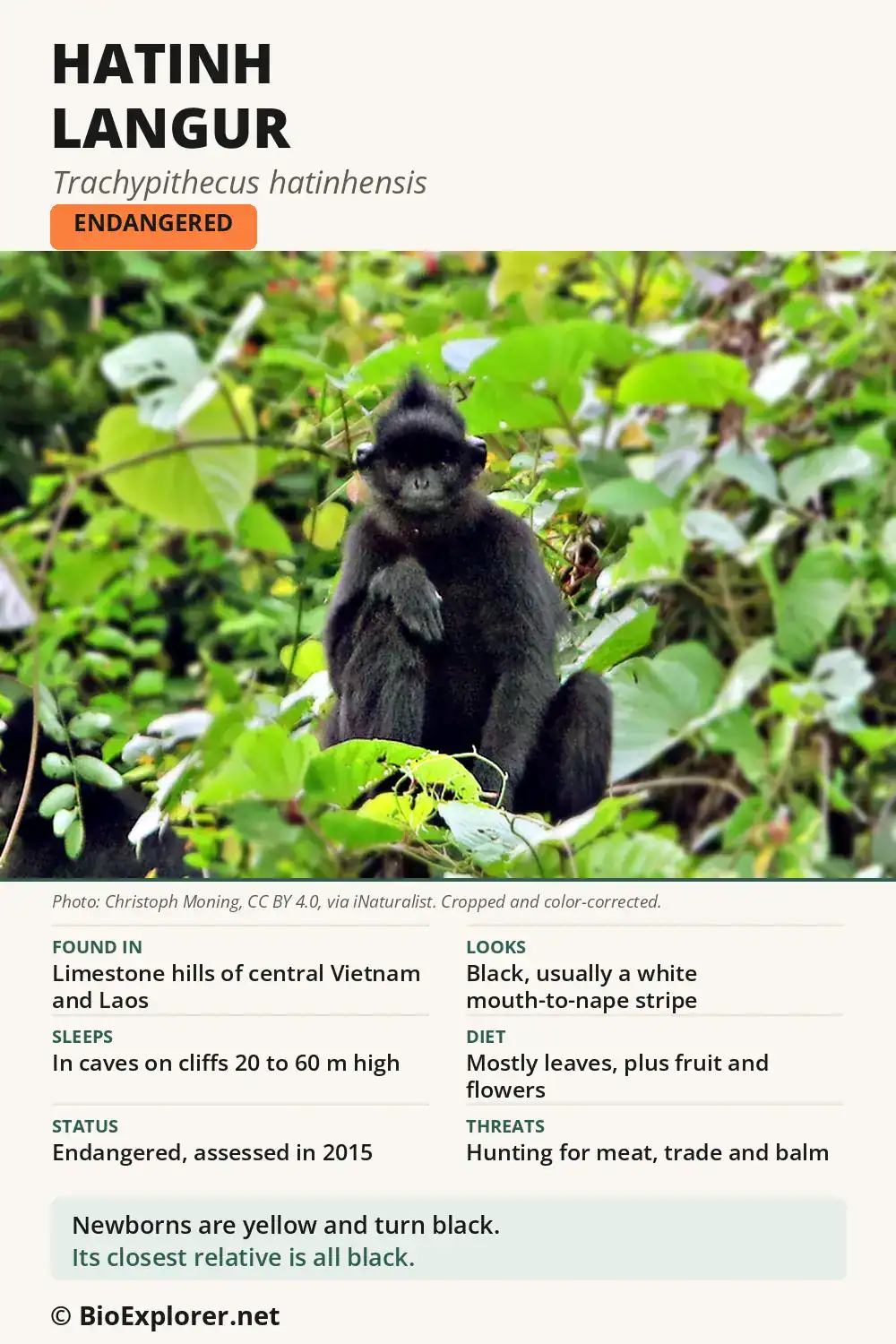
The Hatinh langur is a black leaf monkey. It usually has a bold white cheek stripe. Its scientific name is Trachypithecus hatinhensis.[1] It lives in limestone hills of central Vietnam and Laos. It sleeps in caves and on sheer cliffs. It is one of the Old World monkeys. The IUCN lists it as Endangered.[2]
This Endangered langur sleeps in caves on limestone cliffs.
- Common NamesHatinh langur, Ha Tinh langur, stripe-headed black langur
- Taxonomy Classification Year1970
- Monkey Size50 to 66.5 cm (20 to 26 in) head and body, tail 78 to 90 cm (31 to 35 in)
- Skin Color(s)Black coat, usually with a white mouth-to-nape stripe and white moustache
- HabitatForested limestone karst with cliffs and caves, up to 1,500 m
- DietMostly leaves, plus fruit, vines and flowers
- Native CountriesVietnam, Laos
- Its black coat usually carries a white stripe from mouth to nape.
- Its newborns have yellow fur and turn black within months.
- It eats mostly leaves, plus some fruit and flowers.
- It sleeps in caves and crevices high on cliffs.
- Hunting is the main threat to its survival.
Hatinh Langur Distribution
 )
 )
Hatinh Langur Guide:
Name and Classification
Vietnamese zoologist Đào Văn Tiến named this langur in 1970.[3] He described it as Presbytis francoisi hatinhensis, a form of François' langur. Its holotype is an adult female, collected in December 1942.[4] It came from Xom Cuc, in the former Tuyen Hoa District. A male paratype skin was lost during the Vietnam War.
Both type sites lie in the former Quang Binh Province. Brandon-Jones wrote that the name may be a misnomer. Still, the species does live in western Ha Tinh.
Today it is a full species. It belongs to the francoisi group of seven limestone langurs.[5] Its closest relative is the Indochinese black langur. Mitochondrial DNA puts their split at about 0.33 million years ago. The Laotian langur branched off earlier, about 0.59 million years ago.
The group also includes François' langur and Delacour's langur. The white-headed langur and Cat Ba langur complete it. Browse more types of langurs on our hub.
Physical Description
The Hatinh langur's coat is mostly black from head to tail. That coat puts it among the black monkeys of Asia.
Typically, each side of its face carries a narrow white stripe. The stripe starts at the corner of the mouth. It runs past the ear and onto the side of the nape. Groves reported that the stripes sometimes almost meet behind the head.
It also has a white moustache and white sideburns.[6] François' langur has a similar face stripe but no moustache.
Head patterns vary across its range, especially in Laos. Some Lao animals are all black.
Adult females have a small triangle of yellowish white pubic hair.
Newborn infants have yellow fur. They begin turning black after about two weeks. By three months, they are almost all black.
Size and Weight
Few Hatinh langurs have been measured. Several published measurements come from the Endangered Primate Rescue Center.
Two males there measured 56 to 59 cm (22 to 23 in). That is head and body length. Their tails were 82 to 87 cm (32 to 34 in). They weighed 8.2 to 8.7 kg (18 to 19 lb).
Three females there measured 54 to 57 cm (21 to 22 in). Their tails were 78 to 90 cm (31 to 35 in). Four females weighed 6.4 to 8 kg (14 to 17.6 lb).
The two type specimens add more data. The male paratype's head and body measured 66.5 cm (26 in). Its tail was 81 cm (32 in). It weighed 8 kg (17.6 lb). The female holotype measured 50 cm (20 in). Her tail was 87 cm (34 in).
Every measured animal had a tail longer than its body.
Similar Species Compared
The Indochinese black langur is its closest relative. Its head is all black, with no white stripe. The IUCN treats it as part of the Hatinh langur. Some experts call it a dark variant. Others keep it as a separate species.
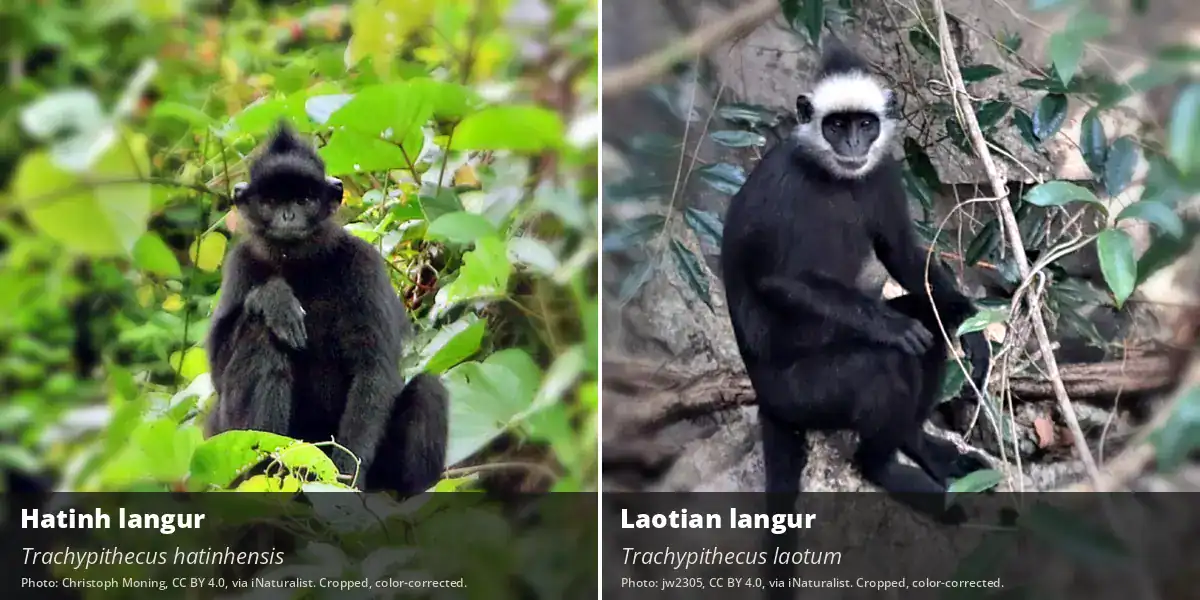
The Laotian langur lives just to the west, in central Laos.[7] Its white mark is a broad band across the forehead. White hair also covers its cheeks. The two species may overlap somewhere in central Laos.
François' langur lives farther north, in China and northern Vietnam.[8] Its white stripe stops behind the ear. It also lacks the white moustache.
| Trait | Hatinh langur | Laotian langur | Indochinese black langur | François' langur |
|---|---|---|---|---|
| Scientific name | Trachypithecus hatinhensis | Trachypithecus laotum | Trachypithecus ebenus | Trachypithecus francoisi |
| Range | Central Vietnam and east-central Laos | Central Laos, in Bolikhamxai and Khammouan | Laos and Vietnam, range poorly known | South-central China and northern Vietnam |
| Habitat | Forested limestone karst, up to 1,500 m | Karst and other cliffs in evergreen forest | Not known | Limestone forest, mostly below 600 m |
| Coat and key marks | Black, usually a white mouth-to-nape stripe and moustache | Black, white forehead band and white cheeks | Black, with an all-black head | Black, white stripe from mouth corner to ear |
| Head and body | Male 66.5 cm, one specimen | Male 48.5 cm, one specimen | Not known | Males 47 to 63.5 cm, nine specimens |
| Tail | Male 81 cm, one specimen | Male 84.5 cm, one specimen | Not known | Males 74 to 90 cm, nine specimens |
| Weight | Male 8 kg, one specimen | Not known | Not known | Males 5.7 to 9.45 kg, four specimens |
| Diet | Mostly leaves, 81% in an enclosure study | Leaves, never studied in the wild | Not known | Mostly leaves, 53% to 90% by site |
| Group size | Average 6 to 8, largest 30 | Likely 15 to 25, from sightings | Not known | 9 to 10 in intact populations |
| IUCN status | Endangered (assessed 2015) | Endangered (assessed 2015) | Not assessed separately | Endangered (assessed 2015) |
Range and Distribution
The Hatinh langur lives in two countries. In Vietnam, it lives in western Ha Tinh and Quang Tri. Quang Binh merged into Quang Tri Province in 2025.[9] In Laos, it lives in eastern Khammouan and Savannakhet.
Its range runs from about 18°N south to about 16°10′N. Westward, it reaches to about 20 km (12 mi) from Thakhek, Laos. Phou Xang He marks its southern limit there.
Phong Nha-Ke Bang National Park holds its largest population in Vietnam. Ke Go, Khe Net and Bac Huong Hoa reserves hold others. In Laos, it lives in Hin Nam No and Nakai-Nam Theun. It also reaches southern Phou Hin Poun.
Phong Nha-Ke Bang became a World Heritage Site in 2003.[10] In 2025, Hin Nam No across the border joined that site.
Lao animals vary a lot in head pattern. Some are all black. Others show only a thin white line along the ear.
Habitat Needs
This langur depends on limestone karst. It lives in dense forest growing over the rock. In Laos, it also uses other steep rock outcrops. It has been reported up to 1,500 m (4,920 ft).
The IUCN codes its habitat as moist lowland and montane forest. It also uses cliffs and caves. That forest makes it one of the rainforest monkeys of Southeast Asia.
Caves and cliffs are its preferred sleeping sites. They likely shelter it from predators, including people. Sleeping cliffs stand 20 to 60 m (65 to 200 ft) high. Dark yellow and brown stains often mark the rock below.
A 2025 genome study looked at limestone langurs.[11] Their ion-channel genes evolved faster than in other langurs. The authors linked this to mineral-rich karst.
Diet and Feeding
The Hatinh langur is highly folivorous. One study watched langurs in a 20 ha (49 acre) enclosure. Leaves made up 81% of their diet. Fruit made up 9% and vines 9%. Flowers made up the last 1%. That leafy diet places it among the herbivorous monkeys.
A 2026 study read its diet from plant DNA in droppings.[12] Researchers tested 116 samples over one year. They found 129 plant genera in 60 families. The top genera were Phanera, Ficus and Sideroxylon. Its main foods shifted from month to month.
Fruit and vines tied for second in the enclosure study. A Phong Nha-Ke Bang study recorded fruit from 131 plant species.[13] Seeds of 85 species passed through its gut. Some were carried up to 397 m (1,300 ft) away.
Behavior and Groups
The Hatinh langur is active by day. It leaves its sleeping cave at dawn. Around 4 p.m., groups gather near the sleeping site. They rest and play there before entering the cave.
It spends much time in the trees. It also climbs steep cliffs and mountainsides.
Groups usually have one adult male and several females. They average 6 to 8 animals. Groups of up to 30 have been seen.
Births happen all year, with a peak from January to June. Females give birth to a single infant. Gestation lasts 180 to 190 days.
At a rescue center, langurs spent over half the day resting.[14] Young animals played more than adults.
In 2022, cameras recorded a mixed-species association.[15] One red-shanked douc langur appeared among several Hatinh langurs. The authors called it the first such record in the wild.
Population and Status
No reliable global count exists. Its steep karst makes standard surveys very hard.
Estimates for Phong Nha-Ke Bang vary widely. A 1997 estimate was 520 to 750 animals. A 2002 estimate put the maximum at 800. A 2007 transect survey modeled 2,143 animals, give or take 467.[16] A later study put the 2009 total at only 150. The IUCN says a new survey is needed.
Smaller populations live elsewhere. Ke Go Nature Reserve holds about 50. One survey suggested 20 to 30 in Khe Net, still unconfirmed.
In Laos, Hin Nam No likely holds the largest population. A 2019 study estimated 1,046 animals there, give or take 410. Sightings per kilometer walked fell by more than half in a decade.
The IUCN assessed it as Endangered in 2015, under criterion A2cd. It likely lost over half its numbers in 36 years.
Major Threats
Hunting is the main threat. People kill it for meat and the wildlife trade. Its body parts go into a traditional "monkey balm."
Each group leaves and returns to its sleeping cave at steady times. Hunters use these well-marked sleeping sites. By the late 1990s, snares led the hunting in Phong Nha-Ke Bang.
New roads have made its forests easier to reach. Around Phong Nha-Ke Bang, they increased hunting and illegal logging.
A 2006 review called habitat loss the second main threat. Its three Vietnamese provinces lost much forest from 2002 to 2019. About 54,000 ha (133,000 acres) of humid primary forest disappeared.
Large karst areas still protect some healthy groups. The IUCN warns that this protection cannot be relied on.
Conservation Efforts
The Hatinh langur is listed on CITES Appendix II. Vietnam's Red Data Book lists it as Endangered. In Laos, it is a Prohibited Species, Category I.
It lives in several protected areas in both countries. The largest are Phong Nha-Ke Bang and Hin Nam No.
The Endangered Primate Rescue Center breeds it in Cuc Phuong National Park. In 2011, the center kept one group in cages. Another lived on a fenced 5 ha (12 acre) hill. That group was being prepared for release. The IUCN reports that the species has since been reintroduced in Vietnam.
The IUCN calls for new surveys and stronger action against poaching. It also wants its overlap with the Laotian langur mapped.
Explore more monkeys starting with H. Or browse all types of monkeys.
Common Questions
The Hatinh langur lives in limestone hills of central Vietnam and Laos.
The Hatinh langur is black. Usually, a white stripe runs from its mouth to its nape.
The Hatinh langur eats mostly leaves. It also eats fruit, vines and flowers.
The Hatinh langur sleeps in caves and crevices on limestone cliffs.
Yes. The IUCN assessed the Hatinh langur as Endangered in 2015. Hunting is the main threat.
The Hatinh langur has a thin white cheek stripe. The Laotian langur has a broad white forehead band.
Cite this page
BioExplorer. (2026, November 2). Hatinh Langur. https://www.bioexplorer.net/animals/mammals/monkeys/hatinh-langur/
About the author

Wildlife Writer and Photographer, BioExplorer.net
Arjun is a science writer and wildlife photographer at BioExplorer.net. He turns new research on animals into clear, accurate reads for curious readers. His work covers animal behavior, ecology, and newly described species. He holds a Cornell Lab of Ornithology certificate in bird biology. He is pursuing an HBSc at the University of Toronto Mississauga.