
Delacour’s Langur
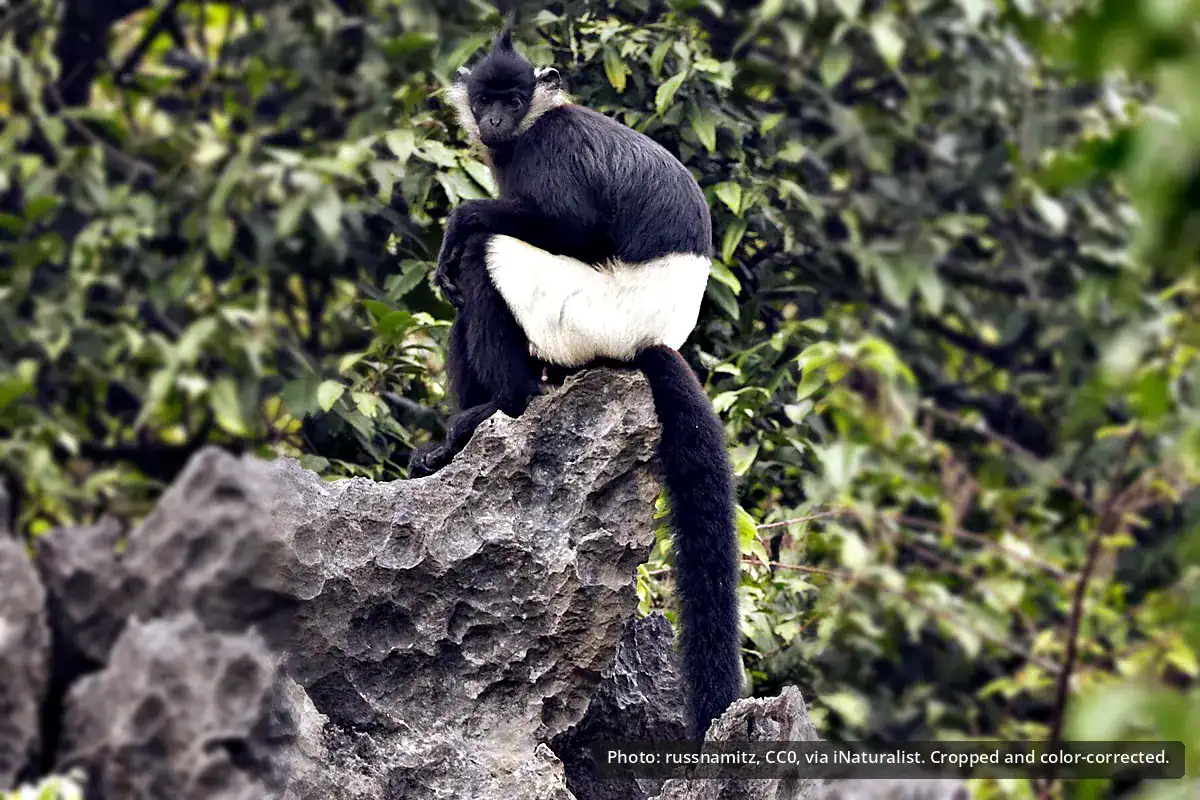
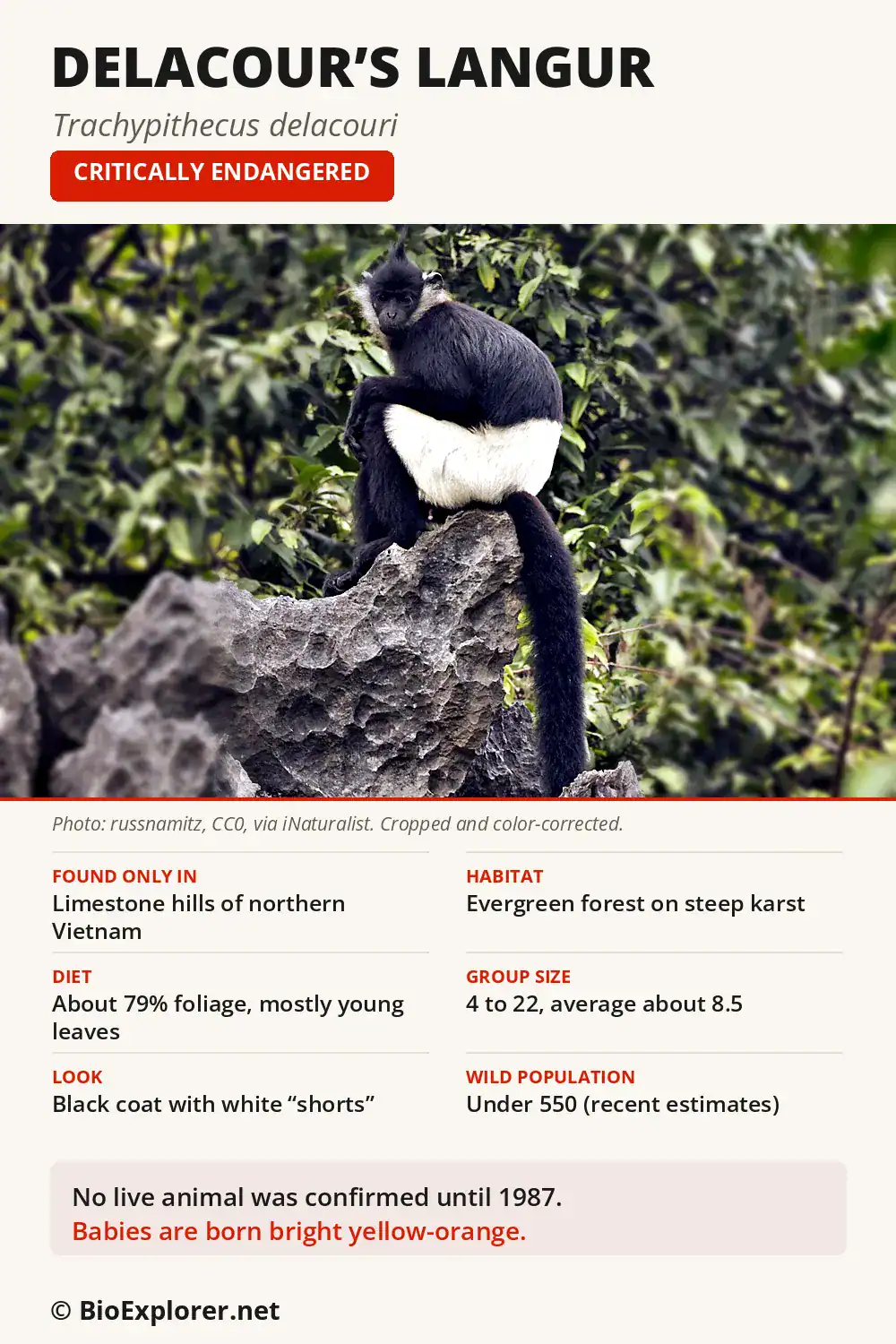
Delacour's langur is a black monkey that seems to wear white shorts. [1] It lives only in the limestone hills of northern Vietnam. [2] The IUCN lists it as Critically Endangered. [3] Recent estimates suggest fewer than 550 survive in the wild. [4]
For decades it was known only from museum skins. Hunting for traditional medicine pushed it to the edge. Today, most known animals survive at a few karst sites.
Delacour's langur is a leaf monkey found only in northern Vietnam. It is Critically Endangered.
- Common NamesDelacour's Langur, White-rumped Black Leaf Monkey, Voọc mông trắng
- Taxonomy Classification Year1932
- Monkey SizeHead and body 52 to 62 cm (20 to 24 in), tail 81 to 90 cm (32 to 35 in), males
- Skin Color(s)Glossy black, with white rump and outer thighs
- HabitatEvergreen forest on limestone karst
- DietHerbivorous: mostly young leaves
- Native CountriesVietnam
- Scientific name: Trachypithecus delacouri
- First described: by Osgood in 1932
- Other names: white-rumped black leaf monkey; Voọc mông trắng in Vietnamese [5]
- IUCN status: Critically Endangered
- Range: northern Vietnam only
- Habitat: evergreen forest on limestone karst
- Diet: mostly young leaves
- Group size: usually about 8 to 10
Delacour's Langur Distribution
 )
Delacour's Langur Guide:
Taxonomy and Names
Delacour's langur belongs to the family Cercopithecidae. It sits in the subfamily Colobinae, the leaf monkeys. Wilfred Osgood described it in 1932 as Pithecus delacouri. The type specimen came from Hoi Xuan, in what was then Annam. It is named for Jean Delacour, whose expeditions collected it.
Some older works treated it as a form of François' langur. Later authors placed it with other species too. Today it is a full species with no subspecies.
It belongs to the francoisi group, the limestone langurs. [6] The group has seven species. One is François' langur of China and Vietnam. Another is the Cat Ba langur of Cat Ba Island. The white-headed langur of southern China is another member. So is the Hatinh langur. The Laotian langur, another karst dweller is too. The Indochinese black langur completes the set.
Its genus covers the lutungs, among the langurs and lutungs of Asia. Like them, it is one of the Old World monkeys. It is also listed among our monkeys starting with D.
Appearance and Size
The coat is mostly glossy black. A sharp white patch covers the rump and outer thighs. Its Vietnamese name means white-rumped langur. It is one of many black-furred monkeys in our guide.
Females have a white patch in the pubic area. The face is black, with pale whiskers on the cheeks. A pointed crest of hair rises on the crown. The long, bushy tail is carrot-shaped, thick at the base.
Infants are born bright yellow-orange. Darkening starts early. The full adult pattern takes 18 to 36 months.
One published account gives these figures. Males measure 52 to 62 cm (20 to 24 in) long. Females measure 57 to 60 cm (22 to 24 in). Both figures run from head to rump. The tail is longer than the body. In males it runs 81 to 90 cm (32 to 35 in). In females it reaches 84 to 89 cm (33 to 35 in). Males weigh 7.5 to 8.5 kg (17 to 19 lb). Females weigh 7.3 to 7.7 kg (16 to 17 lb).
Where It Lives
This langur is endemic to northern Vietnam. MDD places it south of the Red River. A 2014 account tied its range to limestone hills. [7] These spanned Ninh Binh, Thanh Hoa, Hoa Binh and Ha Nam. That account put the wider region at about 5,000 km². It put the area actually occupied at about 400 km².
Its home is evergreen broadleaf forest on steep karst. Most animals live below about 500 m (1,600 ft). Its world is mostly rock.
Caves and ledges serve as sleeping sites. They stay warmer during cold winters. Rain pools in shaded hollows provide water.
In Van Long, groups cluster at low elevations. [8] Most sit between 50 and 150 m (160 and 490 ft). Much of that habitat is grass, scrub and scattered trees.
Life on the Rocks
Delacour's langur is active by day. It is busiest in the early morning and late afternoon. It spends about 60% of its time resting and 30% feeding. Home ranges cover about 20 to 50 ha.
A Van Long study logged 372 hours of observation. [9] Nearly 80% of movement and postures took place on rock. Most travel was on all fours. Leaping made up only 6% of locomotion. The study found no special body adaptations for karst.
The authors argue cliff travel is not true ground travel. They call rock substrates "petrous."
Diet and Feeding
A year-long study in Van Long measured its diet. [10] Foliage made up about 79% of what it ate. Young leaves alone made up almost 60%. It fed on 42 of 145 available plant species. Just five species supplied more than 60% of the diet.
Over half its food came from climbing plants. Its main food plants were not limestone endemics. The study ranks it among the most leaf-eating colobines measured. It belongs firmly among the leaf-eating herbivorous monkeys.
Adults eat about 1.1 kg (2.4 lb) of food a day. No insects have been recorded in the diet. In captivity, keepers have offered it 137 plant species.
Groups and Breeding
Most groups have one adult male and several females. Some have two adult males. [11] Young males leave and form bachelor groups. Females sometimes move between groups too.
A 2020 to 2022 count in Van Long found 25 groups. [12] Group sizes ranged from 4 to 22. The average was about 8.5 animals.
Females mature at about 4 years. Males mature at about 5 years. Pregnancy lasts about 180 to 196 days. A female gives birth to one infant at a time. Births come every 19 to 25 months. Researchers examined two placentas. Both were bidiscoid, with two lobes. [13]
Population and Decline
Live animals went unseen for decades after its discovery. The first confirmed sightings came in 1987, in Cuc Phuong. In the 1990s, surveys found 18 isolated populations. Together they held about 280 to 320 animals. Later surveys could not confirm it in 8 of those areas.
Hunting records list 320 animals killed from 1990 to 1999. By 2010, an estimate put the total at no more than 200.
Protection then began to work in some places. A paper published in 2022 cited earlier estimates. [14] These gave 250 to 300 animals nationally. Van Long held the largest group, with 176 to 184. At least eight populations had vanished since 2000.
A second strong population lives at Kim Bang. It lies about 15 km (9 mi) north of Van Long. At least 73 animals in 13 groups were counted there in 2018.
A 2022 drone survey of Kim Bang counted 104 animals. [15] Its model suggested about 175. In 2025, thermal cameras found about 120 animals there. A 2026 paper summarized recent estimates as fewer than 550 wild animals. That is a summary, not a new nationwide census. Most live at three sites, Van Long, Kim Bang and Yen Mo.
These rising numbers partly reflect better surveys. They do not mean the species is safe. The 2015 IUCN assessment estimated 240 to 250 mature individuals. IUCN now flags that assessment as needing an update. It predates most of these counts.
Main Threats
Poaching is the main threat. Hunters take the langurs mainly for traditional medicine. Bones, organs and tissue are used, not usually the meat. One product is known as "monkey balm."
Limestone quarrying is another major threat. The rock is mined for cement and construction. In 2018, seven companies were quarrying the karst at Kim Bang. Snares and homemade rifles were also found there.
A 2019 to 2020 survey covered 14 areas. [16] Hunting pressure correlated with fewer langur individuals. It also correlated with slower growth in the number of populations. State protection alone did not correlate with population growth.
Conservation Efforts
Van Long became a nature reserve in 2001. The Frankfurt Zoological Society trained and paid local guards. Primate hunting near Van Long reportedly stopped completely. [17] Its population has grown since protection began.
The Endangered Primate Rescue Center opened at Cuc Phuong in 1993. It is the only facility that keeps this species. Breeding began with five confiscated animals. A 2014 account reported 20 births there since 1996.
In 2011, three captive-bred langurs were released into Van Long. Two more followed in 2012. All wore radio collars so researchers could follow them. A trial reintroduction began at Tràng An in 2020. [18] Its first infants were born in 2021 and 2022. A 2026 UNESCO listing says the troop has grown to six. [19]
The species is listed on CITES Appendix II. It is also protected under Vietnamese law. Kim Bang gained formal protection in 2026. [20] A new conservation area there covers over 3,000 ha. Researchers also want a forest corridor linking Kim Bang and Van Long. Over 99% of Van Long residents surveyed backed its conservation.
From 2000 to 2014, it made every "25 Most Endangered Primates" list.
Want to meet more primates like this one? Explore our guide to the many types of monkeys.
Delacour's Langur FAQ
Delacour's langur lives only in northern Vietnam. It survives in limestone karst hills. Most live at Van Long, Kim Bang and Yen Mo.
A 2026 paper summarized recent estimates: under 550 Delacour's langurs remain. Most live at Van Long, Kim Bang and Yen Mo.
Delacour's langur is hunted for traditional medicine. Limestone quarrying also destroys its karst habitat.
Delacour's langur eats mostly leaves. In Van Long, foliage made up about 79% of its diet.
Delacour's langur infants are born bright yellow-orange. The full black and white pattern appears by 18 to 36 months.
Delacour's langur honors Jean Delacour. His expeditions collected the first specimens.
Yes. Captive-bred Delacour's langurs were released into Van Long in 2011 and 2012. Radio collars let researchers follow them. A trial release at Tràng An followed in 2020.
Cite this page
BioExplorer. (2026, November 2). Delacour’s Langur. https://www.bioexplorer.net/animals/mammals/monkeys/delacours-langur/
About the author

Wildlife Writer and Photographer, BioExplorer.net
Arjun is a science writer and wildlife photographer at BioExplorer.net. He turns new research on animals into clear, accurate reads for curious readers. His work covers animal behavior, ecology, and newly described species. He holds a Cornell Lab of Ornithology certificate in bird biology. He is pursuing an HBSc at the University of Toronto Mississauga.