
Colombian Black-handed Titi
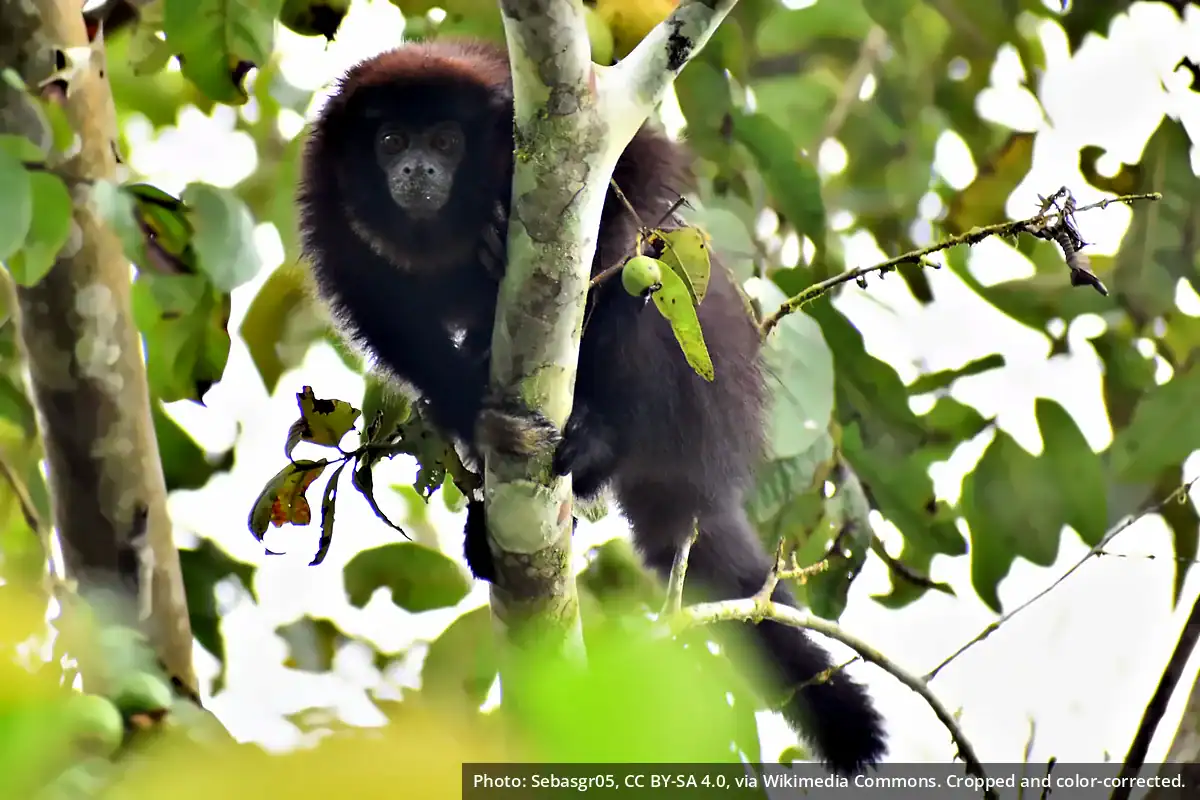
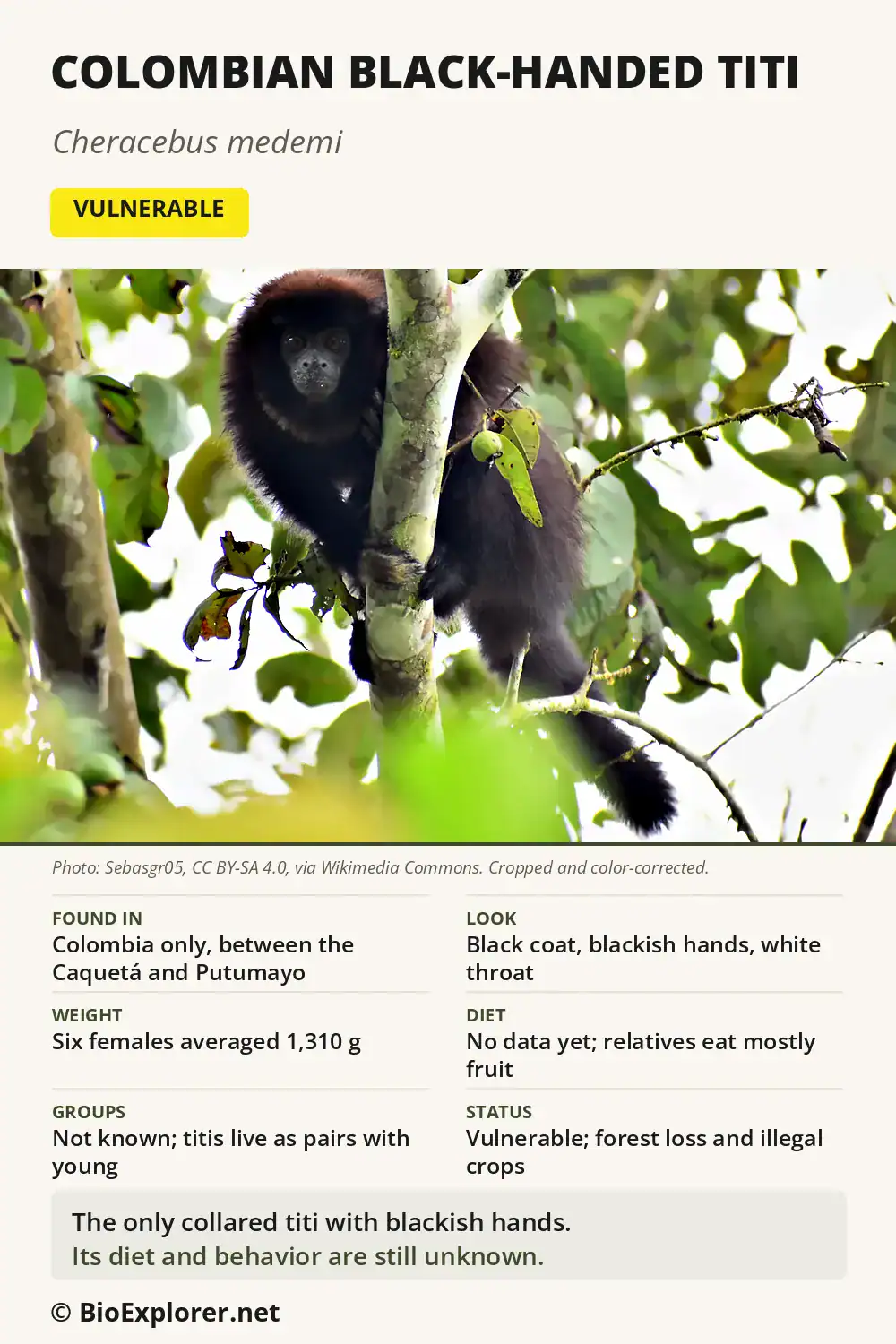
The Colombian black-handed titi is a small, dark titi monkey. Its scientific name is Cheracebus medemi. It lives only in southern Colombia, between the Caquetá and Putumayo rivers. It is one of the New World monkeys. The IUCN lists it as Vulnerable.[1]
This Vulnerable titi lives only in southern Colombia's Amazon lowlands.
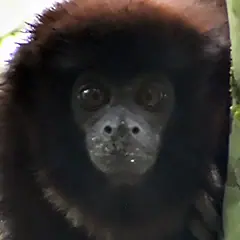
- Common NamesColombian black-handed titi, Medem's titi, Medem's collared titi
- Taxonomy Classification Year1963
- Monkey SizeFemales 23.2 to 36 cm (9.1 to 14.2 in), head and body
- Skin Color(s)Black to blackish, with a white throat
- HabitatLowland Amazon rainforest, 100 to 450 m
- DietNo data; its relatives eat mostly fruit and seeds
- Native CountriesColombia
- Philip Hershkovitz described it in 1963.
- It is the only collared titi with blackish hands.
- It lives only in Colombia, between two rivers.
- Its 2015 assessment found no data on its ecology.
- GenBank held no genetic data for it in 2024.
Colombian Black-handed Titi Distribution
 )
Colombian Black-handed Titi Guide:
Name and Classification
Philip Hershkovitz described it in 1963.[2] He named it Callicebus torquatus medemi. That made it a subspecies of the collared titi.
Hershkovitz collected the holotype himself, on 17 March 1952.[3] It is a female, kept at the Field Museum in Chicago. It came from near the mouth of the Río Mecaya, in Putumayo. That spot is on the right bank of the Río Caquetá. It sits at about 180 m.
Later authors raised it to a full species. The handbook credits Colin Groves, in 2001.[4]
In 2016, Byrne and colleagues split the old titi genus into three.[5] The collared titis became a new genus, Cheracebus. The name means "widow monkey". It refers to Humboldt's "viudita", the little widow of the Orinoco. The team dated the genus split to about 11 million years ago.
The Mammal Diversity Database now lists six Cheracebus species. The newest is Aquino's titi, described from Peru in 2022.[6]
No samples reached the 2016 team. A 2020 genus study also lacked them.[7] Its authors called its phylogenetic position unclear. A 2024 review found no molecular data for it in GenBank.[8] So its closest living relative is still untested.
Physical Description
Males and females look alike in size and color, the handbook says. The head, body, tail and underparts are black or blackish. Only the throat is white. That dark coat places it among the black monkeys.
Hershkovitz used its hands to tell it apart. Their upper surface is uniformly or mostly blackish. Its feet, tail, sideburns and underparts are blackish too.
He found this unique among the collared titis. In its relatives, the hands are yellow, golden or orange. The handbook and Hershkovitz describe its throat as white. A 2022 comparison says its collar reaches the base of the ears.
Size and Weight
Few of these titis have ever been measured. The handbook gives females 23.2 to 36 cm in head and body. That is 9.1 to 14.2 in.
Female tails run 42.5 to 49.3 cm, or 16.7 to 19.4 in. So the tail is longer than the head and body.
Hershkovitz weighed one male at 1,100 g, or 2.4 lb. Six females averaged 1,310 g, or 2.9 lb. They ranged from 1,151 to 1,462 g. That is about 2.5 to 3.2 lb.
Similar Species Compared
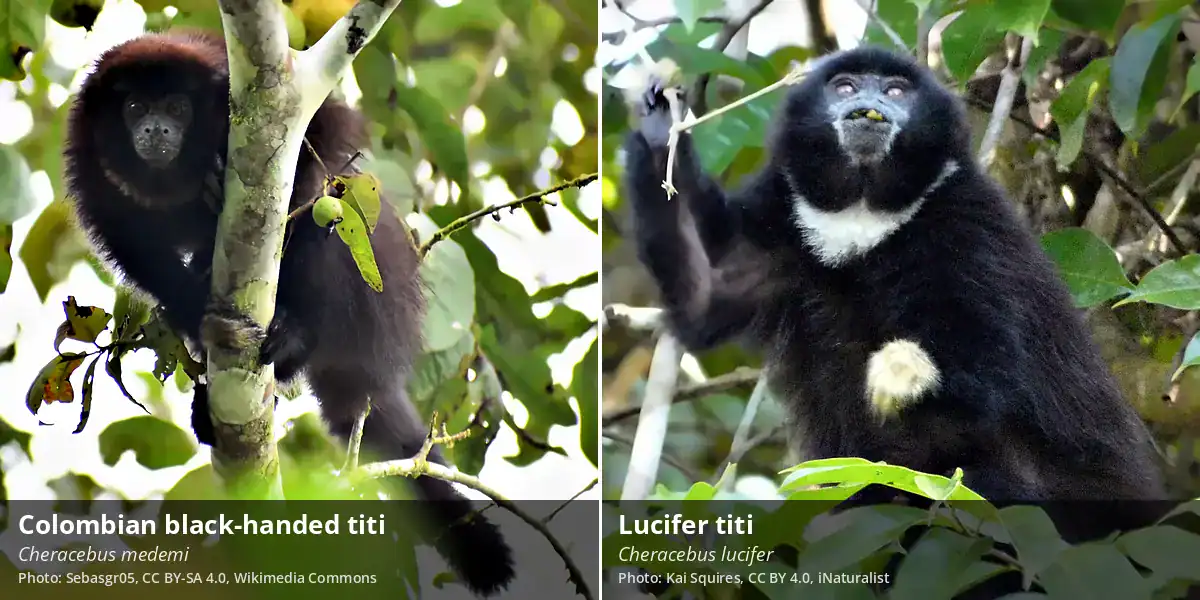
Two close relatives live nearby in Colombia. Both have pale hands, so the hands tell them apart.
The Lucifer titi shares the same river interfluve, to the east.[9] No river separates the two. Their exact border is still unclear. Lucifer titis have yellowish orange hands. Their white throat collar runs up to the ears.
Titis in Ecuador were once thought to be this species. A 2003 study showed they are Lucifer titis instead. The IUCN cites that work by Martinez and Rowe.[10]
The black titi lives north of the Río Caquetá.[11] Its hands are whitish or pale buff. Its throat and upper chest are whitish. The river keeps the two species apart.[12]
| Trait | Colombian black-handed titi | Lucifer titi | Black titi |
|---|---|---|---|
| Scientific name | Cheracebus medemi | Cheracebus lucifer | Cheracebus lugens |
| Range | Colombia only, between the Caquetá and Putumayo | Colombia, Ecuador, Peru and Brazil, south of the Caquetá | Colombia, Venezuela and Brazil, north of the Caquetá |
| Habitat | Lowland rainforest, 100 to 450 m | Lowland rainforest, 100 to 300 m; terra firme and white sand | Lowland rainforest, 100 to 1,000 m; terra firme, white sand, várzea |
| Coat and key marks | Black; blackish hands; white throat | Blackish; yellowish orange hands; white collar to the ears | Blackish with some chestnut; whitish hands; white throat and chest |
| Head and body | Females 23.2 to 36 cm | Males 36 to 39 cm; females 34.9 to 41 cm | Males 31.2 to 35.5 cm; females 30 to 40 cm |
| Tail | Females 42.5 to 49.3 cm | Males 46.5 to 48 cm; females 45 to 45.6 cm | Males 42 to 48.5 cm; females 41 to 49 cm |
| Weight | One male 1,100 g; females 1,151 to 1,462 g | Males 1,500 g | Not known |
| Diet | Not studied | 67 to 74% fruit; 14 to 16% arthropods | 82 to 86% fruit; seeds up to 48% |
| Group size | Not known | 2 to 5, per Heymann and Palacios | Mean 3.5 in Vichada |
| IUCN status | Vulnerable (assessed 2015) | Least Concern (assessed 2015) | Least Concern (assessed 2015) |
Range and Distribution
It is endemic to Colombia, the only country in its range. It lives in Putumayo and southern Caquetá departments.
The Río Caquetá marks its northern limit. The Río Putumayo marks its southern limit. The Andean foothills form its western edge. Its eastern limit is poorly known.
Most records come from Putumayo. Of 50 GBIF records in November 2026, 46 were there.[13] Hershkovitz's specimens came from Río Mecaya, Caño Caucaya and El Pepino. Others came from Quebrada El Hacha, Umbría, Tres Troncos and La Tagua.
Hershkovitz noted it fills a gap of about 350 km. That gap separates two other titis. One of them is the ornate titi, far to the north.
North of the Río Caquetá lives the Caquetá titi.[14] It was described as Critically Endangered in 2010.
Other primates share its forests. Río Mecaya specimens include the Spix's night monkey.[15] The Humboldt's woolly monkey was collected there too. Miller's saki lives across the same interfluve.[16]
Habitat Needs
It lives in lowland Amazon rainforest, from 100 to 450 m. That makes it one of the types of rainforest monkeys. The IUCN also sets its upper limit at 450 m.
No habitat study exists for this species. The handbook suggests it may favor white-sand forest. It adds that this is not certain.
Field work points the other way for its relatives. Thomas Defler found Colombian collared titis did not depend on white sand.[17] They used tall upland and flooded forests on many soils. That study did not single out this species.
Diet and Behavior
Almost nothing is known about its life in the wild. The handbook has no data on its food or daily activity. It has none on home range or social life either. The 2015 IUCN assessment found no ecological data for it.
Titis in general live in small family groups. Each holds one bonded pair and its young. The IUCN describes titis as monogamous and territorial. Their home ranges span 1.5 to 30 ha.
The male carries the single infant, as in all titis. That comes from the handbook's general titi account.
Its relatives eat mostly fruit and seeds, plus leaves and insects. Cheracebus titis eat more insects and seeds than sympatric Plecturocebus titis. If it eats like its relatives, it ranks among the omnivorous monkeys.
Titi pairs sing duets together. A 2018 study compared duets across many titi species.[18] The only collared titi with recordings was the Lucifer titi. That study analyzed no duet from this species.
Population and Status
The IUCN lists it as Vulnerable under criteria A2cd. The assessment dates from 26 January 2015. It was republished in 2022 to update the range map. The IUCN flags it as needing an update.
The 2015 assessment gave no population estimate. The trend is decreasing. The IUCN suspects a decline of at least 30% over 25 years. That span covers three generations of about 8.3 years. Habitat loss and hunting drive the decline.
Colombia's 2017 national list of threatened species left it out. A 2018 review flagged that as an omission.[19]
Major Threats
Deforestation is the main threat, the IUCN says. Growing illicit crops and timber extraction drive it. Slash-and-burn farming and cattle grazing clear more forest.
Aerial spraying of illegal crops adds more harm. E. Palacios reports spraying even inside La Paya National Park. Some titis are also hunted for food or caught as pets.
Oil exploration overlaps its range too. Several GBIF records come from oil company baseline surveys. They were made near Puerto Asís, Putumayo, from 2019 to 2022.
Conservation Efforts
It is listed on CITES Appendix II. The IUCN and the handbook place it in La Paya National Park.
The IUCN calls the park hard to manage. It is remote and has land tenure problems. Local conflicts and illegal armed groups add to the strain.
A 2013 Putumayo mammal checklist omits La Paya from its localities. So its presence there deserves a fresh check.
The IUCN calls for site management and research on threats. The 2015 assessment had no diet or population data. GenBank had no genetic data for it in 2024.
Explore more monkeys starting with C. Or browse all types of monkeys.
Common Questions
The Colombian black-handed titi lives only in southern Colombia. It ranges between the Caquetá and Putumayo rivers.
The IUCN lists the Colombian black-handed titi as Vulnerable, not Endangered. Forest loss, illegal crops and hunting drive its decline.
The Colombian black-handed titi is black or blackish, with a white throat. Its hands are blackish, unlike its relatives' pale hands.
Sources through 2015 report no diet data for the Colombian black-handed titi. Its close relatives eat mostly fruit and seeds.
Female Colombian black-handed titis measure 23.2 to 36 cm, head and body. Six females averaged 1,310 g.
The Colombian black-handed titi is Cheracebus medemi. Hershkovitz first named it Callicebus torquatus medemi in 1963.
The Colombian black-handed titi has blackish hands. The Lucifer titi has yellowish orange hands.
Cite this page
BioExplorer. (2026, November 10). Colombian Black-handed Titi. https://www.bioexplorer.net/animals/mammals/monkeys/colombian-black-handed-titi/
About the author

Wildlife Writer and Photographer, BioExplorer.net
Arjun is a science writer and wildlife photographer at BioExplorer.net. He turns new research on animals into clear, accurate reads for curious readers. His work covers animal behavior, ecology, and newly described species. He holds a Cornell Lab of Ornithology certificate in bird biology. He is pursuing an HBSc at the University of Toronto Mississauga.