
Ugandan Crested Mangabey
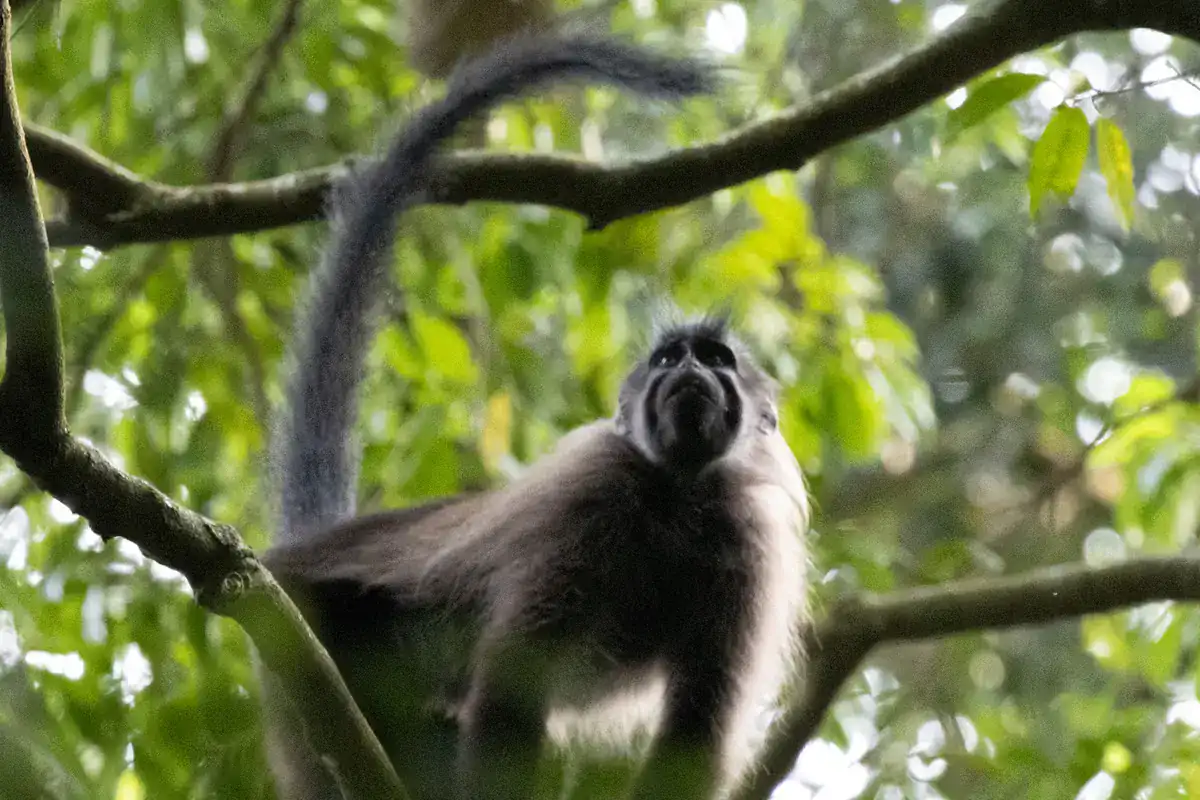
The Ugandan crested mangabey (Lophocebus ugandae) is a forest monkey of Uganda.[1] A small population reaches northwest Tanzania. It is probably the smallest of the crested mangabeys.[2]
Most famous research on gray-cheeked mangabeys describes this animal.[2] Kibale Forest National Park sits inside its range. Decades of work there was published under another name.
Paul Matschie named it in 1913, as a subspecies.[1] Colin Groves raised it to species rank in 2007.[9] Not everyone accepts that, and the IUCN still does not.[3]
It belongs to the crested mangabeys, genus Lophocebus. Its larger relative is the gray-cheeked mangabey. Both sit among the Old World monkey species.
Nearly endemic to Uganda, with one population in northwest Tanzania. Most famous mangabey research describes this species, not its larger relative.
- Common NameUgandan Crested Mangabey
- Taxonomy Classification Year1913
- Monkey SizeHead-body 42 to 70 cm (17 to 28 in); tail 55 to 75 cm (22 to 30 in)
- Skin Color(s)Dark gray-brown to blackish brown, paler shoulder mantle, black face
- HabitatPrimary, secondary, semi-deciduous, flooded and gallery forest
- DietOmnivorous; mostly fruit, with leaves, flowers and animal matter
- Native CountriesTanzania, Uganda
- Found along the north and northwest shores of Lake Victoria.[2] Also on the east side of the Albertine Rift.
- Groves proposed Mabira Forest as the type locality.[2] A 2024 museum review puts that in doubt.[4]
- Kibale Forest National Park is its best studied site.[2] Density there reaches 34 animals per square kilometer.
- Groups run from five to about 30 animals.[2] Most hold fewer than 20.
- The IUCN has never assessed it as a species.[1]
Ugandan Crested Mangabey Distribution
[be-svg-map countries=”Uganda, Tanzania”]
Ugandan Crested Mangabey Guide:
Mangabey Identification
The coat is soft and long, dark gray-brown to blackish.[2] A paler mantle lies over the shoulders. It is more prominent in males.
Thin whiskers run from that mantle across the cheeks.[2] They are grayish or pale whitish. The face is entirely black.
The crown carries a tuft. Eyebrow tufts stand up as two small horns.[2]
- Head-body is 54 to 70 cm in males.[2] Females measure 42 to 61 cm.
- The tail runs 65 to 75 cm in males.[2] Females measure 55 to 65 cm.
- Males weigh 6 to 10 kg. Females weigh 4 to 6 kg.[2]
- This is probably the smallest crested mangabey species.[2]
- Size difference between the sexes is less marked than in relatives.[2]
The tail is long but it cannot grip. It is held vertically with the tip curved forward.[2] Watch for that posture when the animal stands on all fours.
Telling it from Johnston’s mangabey is harder.[2] Its mantle contrasts more strongly with the body color. The Handbook calls for the pelage to be restudied.
Range And Habitat
The species is close to a Ugandan endemic.[1] One forest in northwest Tanzania holds the rest.
In Uganda it follows the shores of Lake Victoria.[2] Mabira, Bujuko and Bukasa Forests all hold it. The Handbook points to Mabira as the type locality.[2] A 2024 review of the Berlin collection disputes that.[4]
A second block sits along the Albertine Rift.[2] Kibale Forest National Park and the Bukoma area are the strongholds.
Sango Bay Forest in Uganda completes the Ugandan range.[2] Minziro Forest in Tanzania is the only site outside it. Both belong to one transboundary site.
Habitat is primary and some secondary forest.[2] Semi-deciduous, flooded and gallery forest all count. It prefers the middle and upper canopy.
Densities vary widely, from under 4 to 10 per square kilometer.[2] Kibale is far richer at 34. Gallery forest can reach 77.
It travels with blue monkeys and red-tailed monkeys.[2] Ashy red colobus and guerezas join those parties.
Recent photographic records come mostly from Buikwe, Kamwenge and Hoima.[10] All three sit inside the range described above.
Diet And Feeding
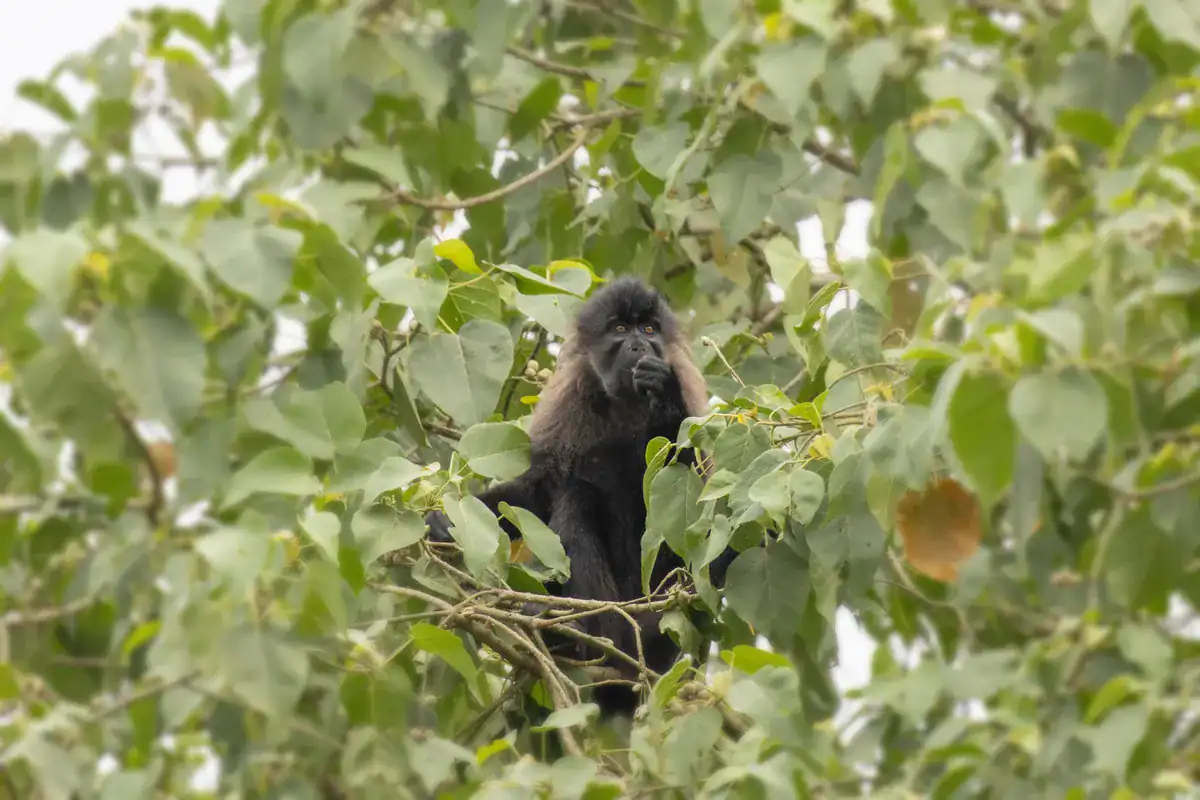
Two feeding studies ran in Kibale Forest National Park.[2] Fruit made up 35 to 78 percent of the diet. Leaves took 2 to 10 percent.
Flowers added 1 to 8 percent. Animal matter reached 9 percent at most.[2] The two studies recorded 51 and 65 plant species.
Hard foods matter more than those numbers suggest.[2] They form a large part of every mangabey diet. Thick tooth enamel is regarded as the adaptation.
That is a real anatomical answer, not a folk one. Compare it with what monkeys eat across the wider group.
The Whoop-Gobble
Males give a loud two-part call, the whoop-gobble.[2] It is the signature sound of crested mangabeys.
Peter Waser tested what the call does, at Kibale.[5] He played recorded calls back to wild groups. The experiments showed the call mediating avoidance between groups.
A longer study followed.[6] Whoop-gobbles proved stereotyped and individually distinctive. Responses to them were variable and sometimes not obvious.
Playbacks produced three kinds of response.[6] Groups answered with calls of their own. They changed how they moved, and how they spread out.
Those experiments are about 50 years old and still cited.[5][6] They were run on this species, under an older name.
Groups And Breeding
Groups hold five to 30 animals, usually under 20.[2] Larger groups carry more than one adult male. One male is present for every two to four females.
Average home range at Kibale is 155 hectares.[2] Daily movement runs 0.8 to 1.5 km. They are diurnal and rarely come down to the ground.
Males leave the group they were born into.[2] They do so after reaching maturity.
Dominance hierarchies probably form in both sexes.[2] That has only been confirmed in captive animals.
Females develop a sexual swelling like a baboon’s.[2] Pairs form consortships around ovulation.
Males cannot monopolize females the way some baboons do.[2] Females solicit copulation from several males. They also call during and shortly after it.
Gestation runs about 186 days in the wild.[2] Captive animals average 175 days. The interval between births is around 33 months.
The ovarian cycle averages 47 days in the wild.[2] Recorded cycles ran from 8 to 184 days. In captivity the average drops to 30.
Eagles And Defense
Crowned eagles are a documented predator at Kibale.[7] Over 37 months one study recovered 390 prey remains. Primates were 74 of 90 identified individuals.
Mangabeys were a small share at Ngogo.[7] Only two turned up among 53 primates identified to species.
Defense falls to a few individuals.[8] In four of five study groups at Kanyawara, one male chased eagles. Each was the top-ranking male in his group.
It costs them. Cortisol ran 2.25 times higher the day after.[8] Males that only alarm called showed no such rise.
A Contested Species
Matschie described this animal in 1913, as a subspecies.[1] Groves raised it to a full species in 2007.[9] He worked from shoulder mantle color and skull shape.[2]
The genus now holds six species.[1] The black crested mangabey lives across the Congo River. So does its southern relative, Opdenbosch’s mangabey.
The Mammal Diversity Database follows Groves.[1] It calls the arrangement tentative, pending further research.
The IUCN does not follow him.[3] It still treats the animal as a subspecies of L. albigena. William Olupot assessed it at that rank in 2018.
Whether it intergrades with Johnston’s mangabey is not known.[2]
The type specimen adds a second problem. Berlin’s catalog marks specimen ZMB 32805 as the type.[4] A 2024 review of that collection shows it cannot be.
That animal was collected by Neumann at Chagwe.[4] Matschie worked from a different male, collected by Grauer. Old labels place it in Bugoma forest, east of Lake Albert.
The skull of that animal has not been located.[4] Groves restricted the type locality to Chagwe in 2007.[2] Chagwe is where the ruled-out specimen came from. Those two accounts have not been reconciled.
This page follows the Mammal Diversity Database.[1] Under that treatment the Ugandan crested mangabey is a species.
Conservation Status
The IUCN has not assessed Lophocebus ugandae as a species.[1] The badge above therefore reads Not Evaluated.
That does not mean the animal is unassessed.[3] The IUCN assesses the same population as a subspecies. William Olupot made that assessment in 2018.
It was published in 2020, as Lophocebus albigena ugandae.[3]
Trade is regulated under CITES Appendix II.[2] The 1968 African Convention listed it in Class B.
They are hunted for food in some areas.[2] They are occasionally shot as a crop pest.
The Handbook lists four protected areas.[2] Three sit in Uganda: Kibale, Mabira and Bugoma. The fourth is Minziro Forest Reserve in Tanzania.
At Ngogo in Kibale the trend is upward.[11] A 47-year census found mangabey encounters increased significantly. Red colobus encounters fell sharply over the same period.
That is one site, not the whole range.[11]
Common Questions
It lives in Uganda, along the north and northwest shores of Lake Victoria and along the east side of the Albertine Rift. Named sites include Mabira, Bujuko, Bukasa and Sango Bay Forests, plus Kibale Forest National Park and the Bukoma area. The only population outside Uganda is in Minziro Forest, northwest Tanzania.
It depends which authority you follow. Colin Groves raised it from subspecies to species in 2007, and the Mammal Diversity Database follows him while calling the arrangement tentative. The IUCN still treats it as a subspecies of Lophocebus albigena. This page follows the Mammal Diversity Database.
It is the loud two-part call that male crested mangabeys give. Peter Waser’s playback experiments at Kibale in the 1970s showed that the call mediates avoidance between groups. The calls are stereotyped and individually distinctive. Groups answered them, changed how they moved, and changed how they spread out.
Mostly fruit. Two studies at Kibale put fruit at 35 to 78 percent of the diet, leaves at 2 to 10 percent, flowers at 1 to 8 percent and animal matter at up to 9 percent. The two studies recorded 51 and 65 plant species. Hard foods are a large part of the diet, and the thick tooth enamel of mangabeys is regarded as the adaptation to them.
The IUCN has never assessed it as a species, so the badge reads Not Evaluated. That does not mean the population is unassessed: the IUCN assesses the same animals as the subspecies Lophocebus albigena ugandae, in an assessment made by William Olupot in 2018 and published in 2020. At Ngogo in Kibale a 47-year census found mangabey encounters increasing significantly, though that is one site rather than the whole range.
It is smaller, probably the smallest of the crested mangabeys, and the difference in size between males and females is less marked. Its ranges do not overlap: the gray-cheeked mangabey lives in Central Africa, west of the Ubangi River, while this species is confined to Uganda and one forest in Tanzania.
Kibale Forest National Park in western Uganda is one of the most studied tropical forests anywhere, and it sits inside this species’ range. Waser’s whoop-gobble playbacks, the crowned eagle predation data and the male defense and cortisol work were all done there. None of it was published under the name used here. Waser’s 1970s papers used Cercocebus albigena; the later ones used Lophocebus albigena.
Mangabey Species, the six crested and six white-eyelid mangabeys side by side.
Cite this page
BioExplorer. (2026, October 7). Ugandan Crested Mangabey. https://www.bioexplorer.net/animals/mammals/monkeys/ugandan-crested-mangabey/
About the author