
Southern Black Crested Mangabey
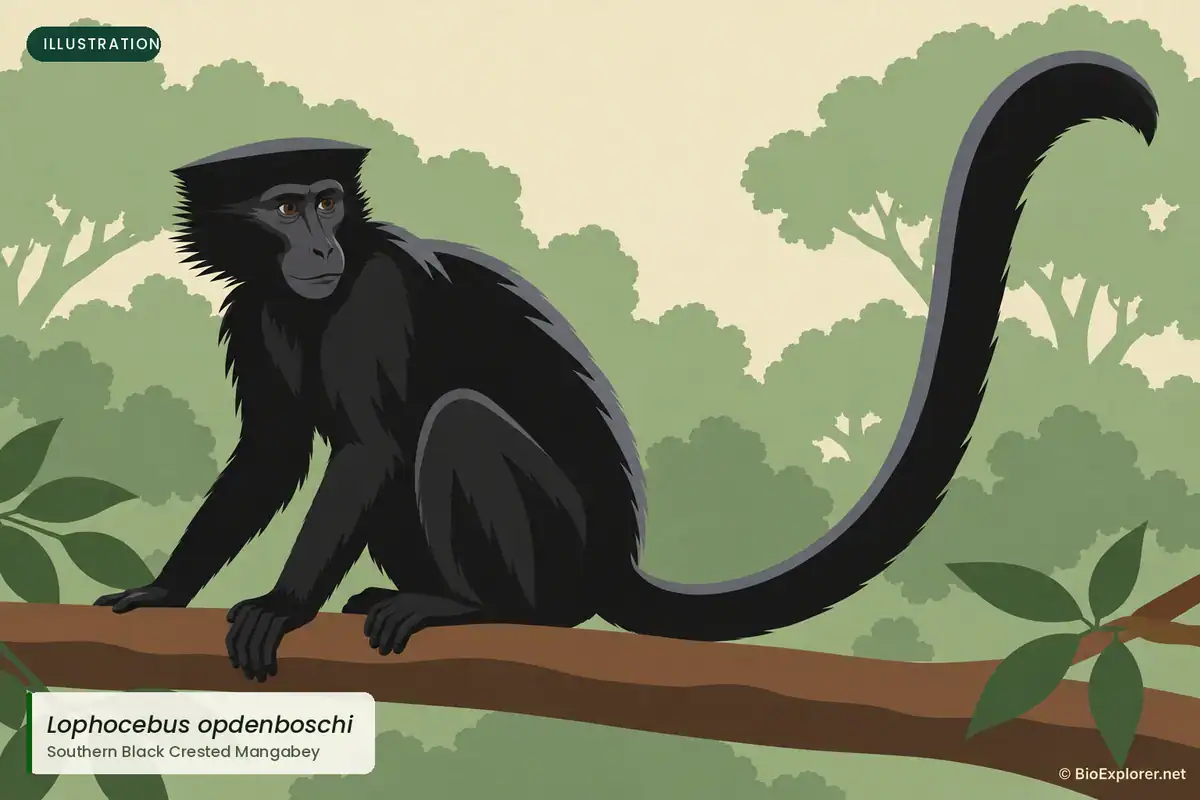
The southern black crested mangabey (Lophocebus opdenboschi) is an all black monkey.[2] It lives in southwestern DR Congo and northern Angola. Opdenbosch's mangabey is the name most other sites use.[1]
Henri Schouteden described it in 1944.[1] He named it Cercocebus opdenboschi, from a single holotype. That animal came from Mwilambongo, in what is now DR Congo.
It is the least documented crested mangabey of all. No field study of its feeding has ever been published.[2] Nothing at all is known of its social life.
The genus is Lophocebus, the crested mangabeys. It sits inside the Old World monkeys. Its closest relative is the black crested mangabey.
Forests along the Kwilu, Wamba and Kwango rivers, and northern Angola. It is not known to occur in any protected area.
- Common NameSouthern Black Crested Mangabey
- Taxonomy Classification Year1944
- Monkey SizeHead-body 40 to 62 cm (16 to 24 in); tail 55 to 85 cm (22 to 33 in)
- Skin Color(s)Entirely black, with longer and laxer fur than the black crested mangabey
- HabitatPrimary and some secondary rainforest, plus swamp and gallery forest
- DietNot studied in the wild; probably seeds, fruit, young leaves, bark, flowers and animal prey
- Native CountriesAngola, Democratic Republic of the Congo
- Holds forests along the Kwilu, Wamba and Kwango rivers.[2] Those lie in southwestern DR Congo.
- Northern Angola carries the rest of the range.[2]
- The coat is entirely black, with long lax fur.[2]
- The crest is broad and flat, sloping back and slightly up.[2]
- It is not known from any protected area.[2]
Southern Black Crested Mangabey Distribution
 )
) )
)Southern Black Crested Mangabey Guide:
Mangabey Identification
This monkey is entirely black.[2] There is no mantle and no pale cheek patch. The fur is longer and laxer than in its northern relative.
Three characters separate it from the black crested mangabey.[2]
- Cheek whiskers are black, not sepia gray.[2] They carry no noticeable curve.
- The crown crest is flat rather than pyramidal.[2]
- That crest is broader, and it slopes back and slightly up.[2]
Head-body length runs 40 to 62 cm.[2] The tail adds another 55 to 85 cm. Males weigh about 8 kg and females 4.5 to 6.7 kg.
Albinism has been reported in this species.[2] The Johnston's mangabey records the same thing. Both are crested mangabeys of the southern Congo Basin.
Range And Habitat
Three rivers define the range.[2] They are the Kwilu, the Wamba and the Kwango. All three run through southwestern DR Congo.
Northern Angola holds the southern part of the range.[2] The Mammal Diversity Database lists both countries.[1]
Habitat is primary rainforest and some secondary growth.[2] Swamp forest and gallery forest also carry it.
The type specimen came from Mwilambongo.[1] Schouteden gave its position as 4 degrees 53 minutes south. The longitude was 19 degrees 42 minutes east.
That holotype sits in Tervuren, under the number RMCA 15647.[1]
A Split Species
This animal was long treated as a subspecies.[1] The parent species was Lophocebus aterrimus.
Colin Groves raised it in his 2007 review.[3] The same paper reshaped the whole genus.
Authorities have not settled behind him.
- The Mammal Diversity Database accepts it as a species.[1] It calls the arrangement tentative, pending more research.
- The IUCN assesses it as L. aterrimus opdenboschi, a subspecies.[4]
- The GBIF backbone lists the name as a synonym of L. aterrimus.[6]
- The Integrated Taxonomic Information System carries it as a species.[7]
This page follows the Mammal Diversity Database.[1] That is the authority the rest of this site uses.
The same argument runs through the whole genus. It also covers the rusty-mantled mangabey and two others.
What Is Unknown
The gaps here are larger than the knowledge.
- Its diet has never been studied in the wild.[2]
- There is no information at all on its breeding.[2]
- Home range and social organization are both unrecorded.[2]
- No population estimate exists for any part of the range.[2]
- The limits of its distribution are still not fixed.[2]
The Handbook entry for activity patterns is five words.[2] They are diurnal and arboreal.
What the diet row gives is read across from the genus.[2] Seeds are probably the major component. Fruit, young leaves, bark, flowers and animal prey fill it out.
One breeding detail is recorded.[2] Females show a pink genital swelling when receptive.
Conservation Status
The IUCN has not assessed Lophocebus opdenboschi as a species.[1] The badge above therefore reads Not Evaluated.
It is assessed as a subspecies instead.[2][4] Under that name it is listed as Data Deficient.
It is not known to occur in any protected area.[2] That is unusual even among poorly known monkeys. Every other crested mangabey has at least one park.
Hunting for food is the likely main pressure.[2] Habitat loss from logging may add to it. Neither has been measured for this species.
Trade is regulated under CITES Appendix II.[2] The African Convention on Nature lists it in Class B.
The Handbook is blunt about the record.[2] There is no recent information on its population status. The limits of its distribution are equally open.
Common Questions
In southwestern Democratic Republic of the Congo, in forests along the Kwilu, Wamba and Kwango rivers, and in northern Angola. The Handbook of the Mammals of the World records no protected area anywhere in that range, which is unusual even for a poorly known monkey.
Three characters, all on the head and coat. This species is entirely black with longer, laxer fur. Its cheek whiskers are black rather than sepia gray, and they carry no noticeable curve. Its crown crest is flat rather than pyramidal, broader, and it slopes back and slightly up.
Authorities disagree. The Mammal Diversity Database accepts it, while calling the arrangement tentative pending further research. The IUCN assesses it as Lophocebus aterrimus opdenboschi, a subspecies. The GBIF backbone lists the name as a synonym. The Integrated Taxonomic Information System carries it as a species. This page follows the Mammal Diversity Database.
Nobody has studied its feeding in the wild. The Handbook of the Mammals of the World reads its diet across from the rest of the genus: seeds are probably the major component, filled out with fruit, young leaves, bark, flowers and animal prey such as invertebrates and small vertebrates.
The IUCN has never assessed it as a species, so the badge reads Not Evaluated. Assessed as a subspecies of L. aterrimus, it is listed as Data Deficient. Trade is regulated under CITES Appendix II and the African Convention on Nature lists it in Class B. It is most likely hunted for food and may be threatened by logging, but neither has been measured.
The species honors him, but neither the Mammal Diversity Database nor the Handbook of the Mammals of the World states who he was. Henri Schouteden named the animal in 1944 in the Revue de zoologie et de botanique africaines, from a holotype collected at Mwilambongo. This page leaves the etymology unstated rather than guessing at it.
The gray-cheeked mangabey is where this whole genus began.
Cite this page
BioExplorer. (2026, October 9). Southern Black Crested Mangabey. https://www.bioexplorer.net/animals/mammals/monkeys/southern-black-crested-mangabey/
About the author